
Slippery Elm Dosage for Horses: Weight Chart, Free Calculator & the Safety Rules Most Owners Miss
Written & Reviewed By: Medshorse Team
Last Updated: October 2026
Slippery elm dosage for horses is one of those topics where every label tells a different story. One supplier says 10 to 20 grams a day. Another says 2 to 4 tablespoons. A third says one-third of a cup. Same herb, same horse, very different numbers.
The reason is simple: no regulator has set an official dose of slippery elm for horses. Each supplier publishes its own feeding guideline, and they measure in grams, scoops, tablespoons and cups that do not weigh the same.
Quick answer: most suppliers suggest about 10 to 40 grams of slippery elm powder a day for a 500 kg (1,100 lb) horse, and most guidelines cluster between 15 and 30 grams. Stir the powder into water until it gels, split it between two feeds, and weigh it on a kitchen scale instead of scooping.
This guide lines up those suppliers, shows where they agree, and turns them into a weight-based chart and a calculator. It also covers what the research says about ulcers, how long to feed it, what can go wrong, and when a supplement is the wrong tool.
Disclaimer: This article is for general education and is not veterinary advice. Product names mentioned, including Slippery Elm, belong to their respective owners, and MedsHorse is not affiliated with them. Always follow your veterinarian’s instructions and the current product label.
- Typical daily amount
- 15 to 30 g for a 500 kg (1,100 lb) horse. Published range: 10 to 40 g.
- How to feed it
- Stir into water until it gels, mix into damp feed, split across two meals.
- Course length suppliers cite
- 10 to 12 weeks for ulcer or colitis support.
- Spacing
- At least 1 hour from supplements. 1 to several hours from oral medicines.
- Ask your vet first
- Pregnant mares, foals, colic, bloody diarrhea, fever, or a horse that stops eating.
- Strength of evidence
- Moderate. One uncontrolled study. No placebo-controlled trial of plain powder found.
What Is Slippery Elm, and How Does It Work in Horses?
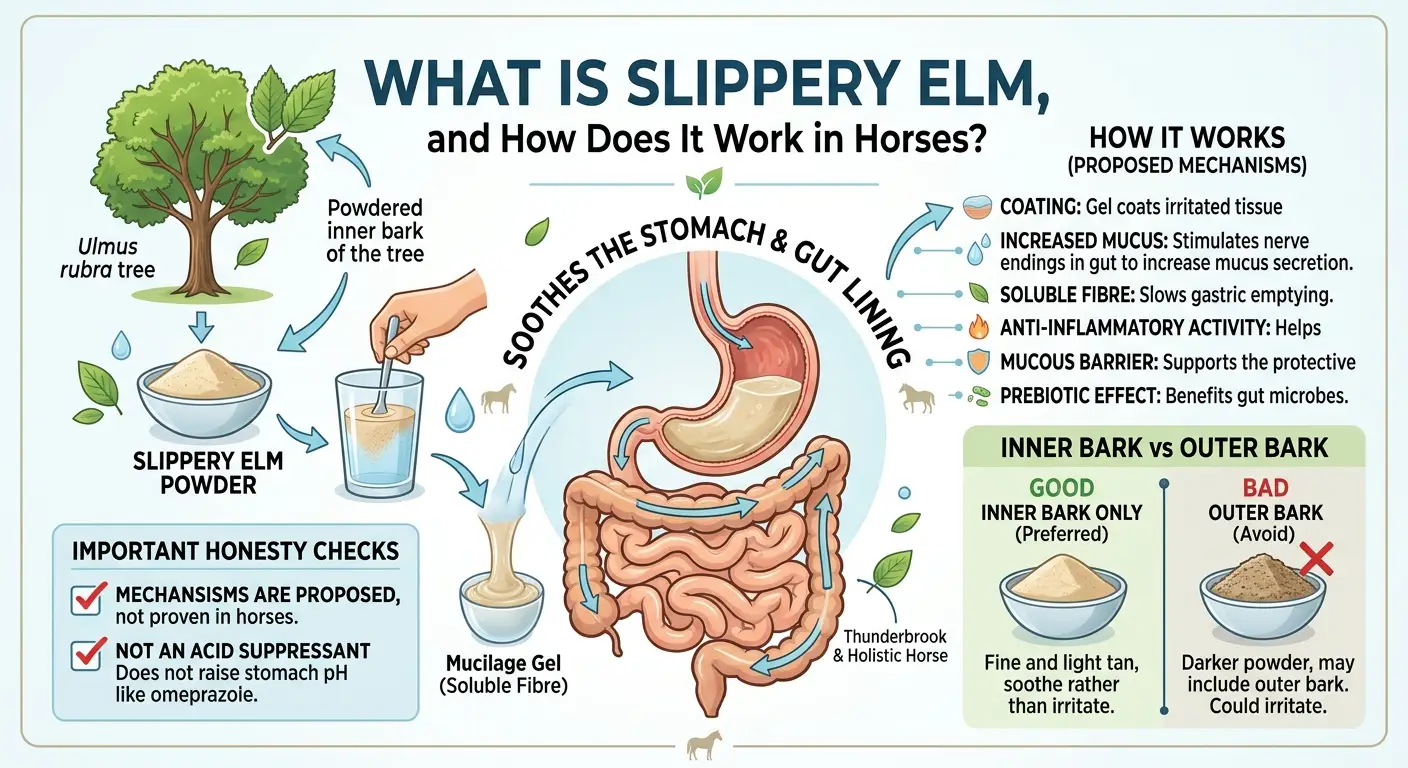
Slippery elm is the powdered inner bark of the Ulmus rubra tree (formerly Ulmus fulva), a North American elm. It is rich in mucilage, a soluble fibre that turns into a slick gel when it meets water. Horse owners feed it to soothe the stomach and gut lining.
The mucilage effect
Stir the powder into water and it swells into a thick, slippery gel. In the digestive tract, that gel is thought to coat irritated tissue. The Mount Sinai herb library adds that slippery elm stimulates nerve endings in the gut, which increases mucus secretion.
The Mad Barn evidence review lists several proposed mechanisms: soluble fibre that slows gastric emptying, anti-inflammatory activity, support for the mucous barrier, and a prebiotic effect on gut microbes.
Two honesty checks. These mechanisms are proposed, not proven in horses. And slippery elm is not an acid suppressant: nothing in the sources reviewed shows it raising stomach pH the way omeprazole does.
Inner bark vs outer bark
Only inner bark belongs in the feed scoop. Thunderbrook says two grades exist and uses only the finer inner bark, rejecting the coarser outer bark. The Holistic Horse offers a visual check: good powder is fine and light tan, while darker powder may include outer bark that could irritate rather than soothe.
Slippery Elm Dosage for Horses: What Suppliers Say
Across six suppliers, daily guidelines for an average horse run from about 10 to 40 grams. Hilton Herbs says 10 to 20 g. Feedmark works out to roughly 13 to 20 g depending on weight. Thunderbrook says 20 to 30 g, and Mane Event says 2 to 4 tablespoons (about 20 to 40 g) per 500 kg.
* These two quote one-third of a cup per day. Brown bars show our estimate of 15 to 30 g, based on The Holistic Horse’s own stated and implied weights for that volume. Feedmark advises half a 26 g scoop up to 400 kg and three-quarters of a scoop above that.
The Holistic Horse and McDowell’s Herbal Treatments both recommend one-third of a cup a day, mixed with water and fed with the meal. Convert that to weight and you land somewhere between 15 and 30 grams, depending on the powder.
Why the numbers do not match
Three reasons. First, there is no regulated equine dose. Second, some suppliers give one number for “the horse” while others scale by weight. Third, volume measures are unreliable. The same one-third of a cup can weigh 15 g or more than 50 g depending on whose density you trust.
Slippery Elm Dosage Chart by Horse Weight
For a 500 kg (1,100 lb) horse, a standard daily amount is about 25 grams, with a low start of 15 g and an upper range of 40 g. Smaller and larger horses scale by body weight. The chart below converts the supplier ranges into grams per kilogram.
| Weight | Pounds | Low | Standard | Upper | Standard, per feed (2 feeds) |
|---|---|---|---|---|---|
| 200 kg | 440 lb | 6 g | 10 g | 16 g | 5 g |
| 250 kg | 550 lb | 7.5 g | 12.5 g | 20 g | 6 g |
| 300 kg | 660 lb | 9 g | 15 g | 24 g | 7.5 g |
| 350 kg | 770 lb | 10.5 g | 17.5 g | 28 g | 9 g |
| 400 kg | 880 lb | 12 g | 20 g | 32 g | 10 g |
| 450 kg | 990 lb | 13.5 g | 22.5 g | 36 g | 11 g |
| 500 kg | 1,100 lb | 15 g | 25 g | 40 g | 12.5 g |
| 550 kg | 1,210 lb | 16.5 g | 27.5 g | 44 g | 14 g |
| 600 kg | 1,320 lb | 18 g | 30 g | 48 g | 15 g |
| 650 kg | 1,430 lb | 19.5 g | 32.5 g | 52 g | 16 g |
| 700 kg | 1,540 lb | 21 g | 35 g | 56 g | 17.5 g |
Planning estimate synthesised from published supplier guidelines. It is not a veterinary prescription. Foals, miniature horses and pregnant mares are not covered.
How the chart was built: the Low column (0.03 g/kg) matches Feedmark’s lighter amounts, Standard (0.05 g/kg) sits in the middle of the Thunderbrook and Holistic Horse range, and Upper (0.08 g/kg) matches the top of the Mane Event range. It is a planning estimate, not a prescription.
Hilton Herbs suggests starting with a lower amount of this gentle herb, and Feedmark says to introduce it gradually. Begin at the Low column for the first week, then move to Standard if your horse eats it well.
Slippery Elm Dosage Calculator for Horses
Type in your horse’s weight, pick a feeding level, and the calculator returns grams per day, the amount per feed, and how long a bag will last.
Slippery Elm Dosage Calculator for Horses
Enter your horse’s weight, choose a dose level, then press Calculate Dose.
Dose for kg ( lb) horse at to g per kg
Stir the powder into water until it gels, then split it between two feeds.
Weigh the powder on a kitchen scale instead of scooping.
Check with your vet before use, especially for horses with health conditions or on medication.
© medshorse.com
Scoops, Spoons and Grams: Why You Should Weigh It
Weigh slippery elm powder on a kitchen scale instead of measuring by volume. Suppliers quote anywhere from about 3 to 10 grams per level tablespoon, so the same two tablespoons could be 6 g or 20 g depending on whose number you trust.
| Supplier | What they state | Grams per level tablespoon | Implied weight of 1/3 cup |
|---|---|---|---|
| The Holistic Horse | 5 level tbsp = 15 g | 3 g | about 15 g |
| Hilton Herbs | 15 ml scoop = 5.2 g | 5.2 g | about 27 g |
| Feedmark | 50 ml scoop = 26 g | 7.8 g | about 41 g |
| Mane Event | 1 tbsp = 10 g | 10 g | about 53 g |
Conversions use 15 ml per tablespoon and 79 ml per one-third cup. Differences come from grind size, density and how firmly the powder is packed.
Even a single product page can pull in different directions. The Holistic Horse says one-third of a cup is about 15 g, yet its own “44 servings in a 2 lb bag” works out to roughly 21 g, and “30 days from a 2 lb bag” implies about 30 g. Weigh a level scoop of your own powder once and write the number on the lid.
How Long Should You Feed Slippery Elm to a Horse?
Suppliers suggest about 10 to 12 weeks for ulcer or colitis support, and Hilton Herbs says to allow up to a month before judging results. The Holistic Horse and McDowell’s both describe the 10 to 12 week course, though neither page cites a trial for that number.
- Days 1 to 4Early response windowAn open study of ulcer-related colic reported improvement within four days. Start at the Low amount and build up.
- Week 1Build to your targetFeedmark advises introducing it gradually. Hilton Herbs suggests starting lower with this gentle herb.
- Weeks 2 to 4Judge the responseHilton Herbs says to allow up to one month before expecting benefits. Track appetite, manure and attitude.
- Weeks 10 to 12Full course for ulcers or colitisThe Holistic Horse and McDowell’s describe a 10 to 12 week course. Ask your vet about re-scoping.
- After the courseReassessStress and constant NSAID use raise relapse risk. No long-term horse safety trials were found, so review with your vet.
McDowell’s adds that you can stop after the course unless the horse is stressed or on constant bute, both flagged as relapse risks. If your horse takes regular NSAIDs, see our guide to bute dosage for horses and ask your vet about gut protection.
Slippery Elm Dosage for Specific Situations
Slippery elm for horses with ulcers
For suspected or diagnosed ulcers, suppliers use the standard amount and the 10 to 12 week course. The diagnosis matters first.
The Holistic Horse lists poor appetite, colitis, lower performance, attitude change, poor condition, weight loss and dullness as possible signs, and these overlap with other problems. Only gastroscopy confirms ulcers.
Colitis, IBD and loose manure
The Holistic Horse recommends a daily dose for 10 to 12 weeks for colitis, and some owners report firmer manure within weeks. Those are testimonials, not trials. Persistent or severe diarrhea needs a vet because dehydration can escalate quickly.
Stress periods: travel, shows and training
Mad Barn lists transport, intense exercise, stall confinement, limited forage and high-grain diets as ulcer risk factors. Some owners add slippery elm around those periods. There is no study showing it prevents ulcers during stress, so pair it with management changes such as more forage.
Ponies, miniatures, foals, seniors and pregnant mares
Ponies and seniors scale by weight using the chart. For foals, The Holistic Horse notes traditional use for scouring but gives no dose, so ask your vet.
For pregnant mares, the Drugs.com natural products monograph advises avoiding slippery elm. Hilton Herbs asks owners of pregnant animals to contact its helpline first.
How to Feed Slippery Elm to a Horse
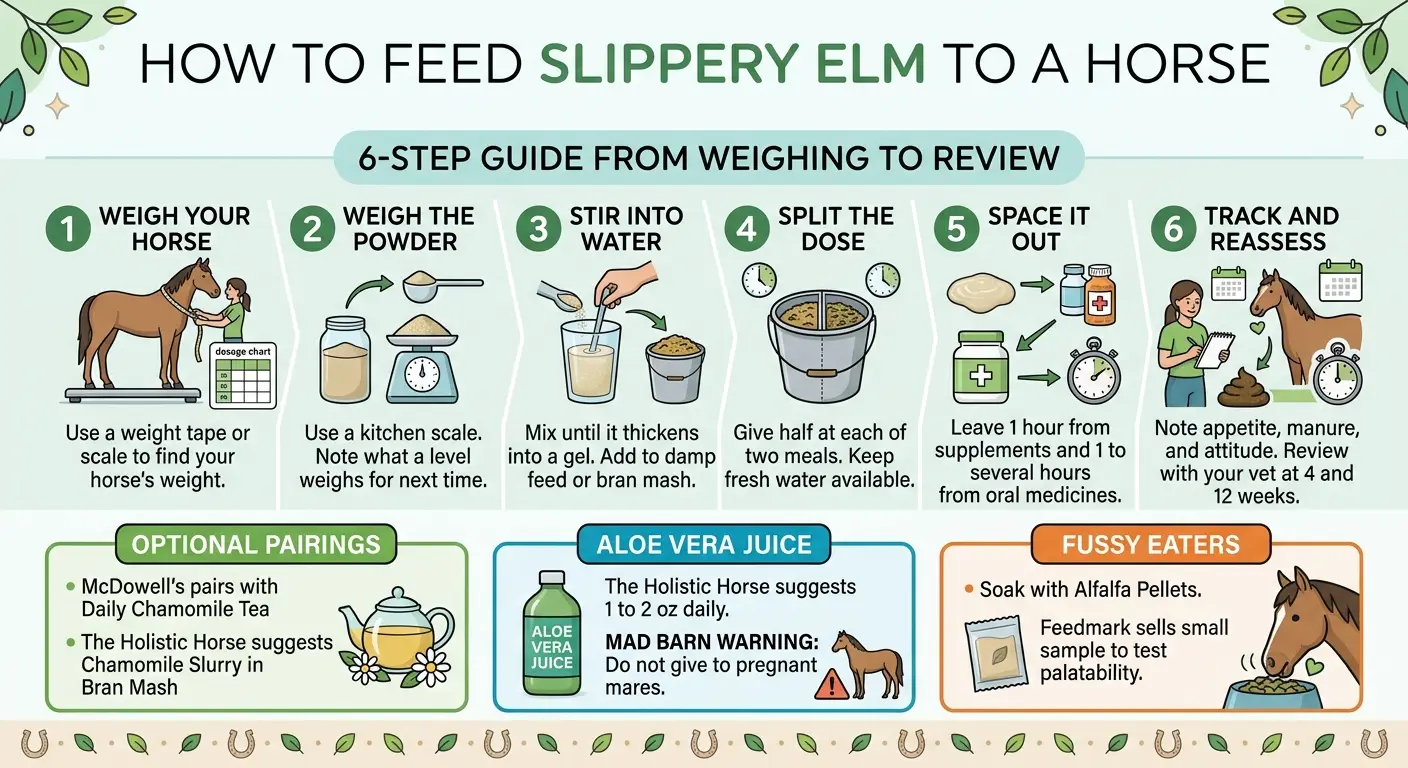
Mix slippery elm powder with water until it thickens into a gel, stir it into damp feed or a bran mash, and split the daily amount between two meals. Give it at least one hour from supplements and one to several hours from oral medicines.
- Weigh your horseUse a weight tape or scale, then find the row in the chart.
- Weigh the powderUse a kitchen scale. Note what a level scoop weighs for next time.
- Stir into waterMix until it thickens into a gel. Add it to damp feed or a bran mash.
- Split the doseGive half at each of two feeds. Keep fresh water available.
- Space it outLeave 1 hour from supplements and 1 to several hours from oral medicines.
- Track and reassessNote appetite, manure and attitude. Review with your vet at 4 and 12 weeks.
- Chamomile tea: McDowell’s pairs slippery elm with daily chamomile tea, and The Holistic Horse suggests chamomile slurry in a bran mash.
- Aloe vera juice: The Holistic Horse suggests 1 to 2 oz alongside the daily dose. Mad Barn warns aloe should not be given to pregnant mares.
- Fussy eaters: one owner on The Holistic Horse page soaks it with alfalfa pellets. Feedmark sells a small sample so you can test palatability.
Does Slippery Elm Work for Horse Ulcers? What the Research Says
The evidence is moderate, not conclusive. A veterinary-reviewed summary from Mad Barn rates slippery elm as having moderate evidence for equine gastric ulcers, based mainly on one open observational study. Omeprazole remains the standard treatment for squamous ulcers.
Ulcers are common, which is why owners look for options. The Kentucky Equine Research summary of the 2015 ECEIM consensus statement shows how sharply prevalence climbs with training.
Estimates vary by breed, workload and study. KER also cites 50 to 90% in racehorses overall.
The study behind the claims
The key paper is a 2013 open-label observational study by McCullough covering 209 horses with ulcer, colic or diarrhea.
Per the Mad Barn summary, four days of an elm preparation improved 85% of 198 horses with ulcer-related colic, and 23 horses with gastric ulcers healed completely without other treatment.
Limits matter here. There was no control group. The study title describes a “potency-enhanced sucralfate-like elm phyto-saccharide,” so results may not transfer to plain bark powder. No placebo-controlled equine trial of plain slippery elm powder turned up in this research.
Supplier claims versus evidence
The Holistic Horse says research shows slippery elm kills the bacteria behind some ulcer problems while sparing helpful ones. The page does not cite a study for that claim, so treat it as unverified.
| Ingredient | Evidence verdict | What the review found |
|---|---|---|
| Glutamine | Strong evidence | Supports gut lining repair, especially under stress or NSAID use. |
| Pectin-lecithin complex | Suitable evidence for healing | Did not prevent ulcers in several studies. |
| Slippery elm | Moderate evidence | One open observational study of ulcer-related colic. No control group. |
| Aloe vera | Some evidence | 40-horse trial: 56% improved, 17% healed. Omeprazole did better. |
| Marshmallow root | Some evidence in other species | Little horse research. |
| Licorice | Some evidence | Mostly rodent and human data. No horse trials of licorice alone. |
| Antacids | Poor long-term efficacy | Short-lived effect and risk of acid rebound. |
Slippery Elm vs Omeprazole and Other Ulcer Treatments
Slippery elm is a support, not a replacement for veterinary treatment. According to Mad Barn, omeprazole is the primary treatment for squamous ulcers, while glandular ulcers are treated with omeprazole plus sucralfate or with misoprostol.
See our guides to omeprazole dosage for horses, sucralfate dosage for horses and misoprostol dosage for horses. Older acid reducers are covered in our ranitidine dosage for horses guide.
| Option | Role according to sources | Evidence level | Key limit |
|---|---|---|---|
| Omeprazole | Primary treatment for squamous ulcers | Established veterinary treatment | Costly, tedious to give, ulcers can return |
| Sucralfate or misoprostol | Used for glandular ulcers, often with omeprazole | Standard veterinary practice | Needs a veterinary diagnosis and plan |
| Slippery elm | Supportive coating and mucus support | Moderate | One uncontrolled study, may slow drug absorption |
| Aloe vera | Supplement option for ulcer support | Some | In a 40-horse trial omeprazole outperformed it |
| Antacids | Short-term acid buffering | Poor long-term | Short-lived effect and acid rebound risk |
Is Slippery Elm Safe for Horses? Side Effects and Precautions
Slippery elm is generally described as well tolerated, and Mount Sinai says it is not known to have serious side effects. But the safety research is mostly in people, toxicity data is limited, and three precautions matter: drug absorption, pregnancy and product quality.
Medications and absorption
Because mucilage coats the gut, it may slow the absorption of other oral drugs. The Drugs.com monograph suggests separating doses by 1 to several hours, and WebMD advises at least one hour after oral medicines.
The Holistic Horse says to feed it several hours after other medications. Ask your vet to set the schedule if your horse takes omeprazole or sucralfate.
Pregnant and breeding mares
Folk history links slippery elm bark with miscarriage, mostly through insertion into the cervix. Mount Sinai says it is unclear whether oral use carries the same risk, and Drugs.com advises avoiding it in pregnancy. Until a vet signs off, skip it for pregnant mares.
Skin reactions and allergies
Oleoresins from elm species have caused contact dermatitis, and slippery elm pollen is a known allergen, according to Drugs.com. If you use a poultice, patch test a small area first.
Water, calcium and sugar
Mucilage absorbs water, so feed it pre-mixed and keep fresh water available. Feedmark’s analysis lists about 6.9% calcium, so 25 g a day adds roughly 1.7 g of calcium, which matters for tightly balanced diets.
No supplier page reviewed publishes sugar or starch values, so ask for an NSC analysis if your horse is insulin resistant.
Competition and drug testing
One UK supplier states that its slippery elm contains nothing that contravenes competition rules. Rules vary by sport and country, so confirm with your governing body before competing.
- Weigh the powder and the horse
- Mix with water into a gel first
- Space it from oral medicines and supplements
- Choose fine, light tan inner bark powder
- Keep fresh water available
- Track appetite and manure daily
- Rely on it for colic or severe diarrhea
- Feed it to pregnant mares without vet approval
- Dose by scoop or by guess
- Buy dark, coarse powder that may include outer bark
- Stop prescribed ulcer treatment to switch to it
- Give it at the same moment as oral drugs
When to Call Your Vet Instead
Call your vet right away for colic signs, bloody or severe diarrhea, fever, or a horse that stops eating. A supplement is never first aid. Use the check below before you start.
Common Slippery Elm Mistakes to Avoid
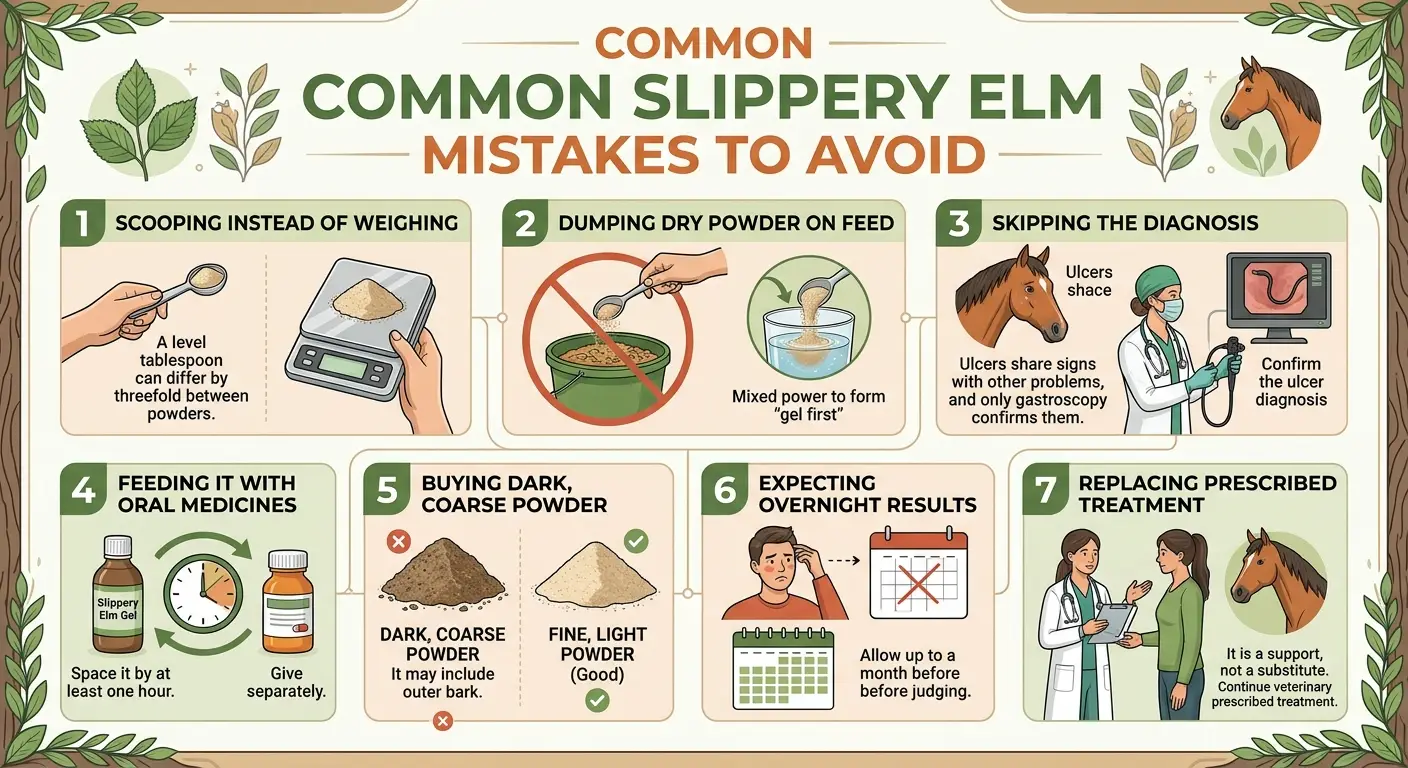
- Scooping instead of weighing. A level tablespoon can differ by threefold between powders.
- Dumping dry powder on feed. It should be mixed with water into a gel first.
- Skipping the diagnosis. Ulcers share signs with other problems, and only gastroscopy confirms them.
- Feeding it with oral medicines. Space it by at least one hour.
- Buying dark, coarse powder. It may include outer bark.
- Expecting overnight results. Allow up to a month before judging.
- Replacing prescribed treatment. It is a support, not a substitute.
What Else Supports a Horse’s Gut?
Management does more than any single supplement. Mad Barn lists more forage and less grain as common dietary steps, and names stress as a risk factor.
Supportive options in its review include glutamine dosage for horses, which earned a strong evidence rating, and yeast probiotics. Suppliers also pair slippery elm with chamomile.
Other herbs get mixed attention. Our licorice root dosage for horses guide covers one, and psyllium husk dosage for horses covers another mucilage-rich fibre. Do not stack several gut products at once without asking your vet.
FAQs
How much slippery elm should I give my horse per day?
Most suppliers suggest about 10 to 40 grams of powder a day for a 500 kg (1,100 lb) horse, with most guidelines clustering between 15 and 30 grams. Smaller horses get less. Start at the low end, weigh the powder on a kitchen scale, and split the amount between two feeds.
How many tablespoons of slippery elm for a horse?
It depends on the powder, because suppliers quote about 3 to 10 grams per level tablespoon. For 25 grams that could mean anywhere from 2.5 to 8 tablespoons. Weigh a level tablespoon of your own powder once, then do the math, or simply feed by weight.
How long should a horse stay on slippery elm?
Two suppliers describe a 10 to 12 week course for ulcer or colitis support, and Hilton Herbs says to allow up to one month before judging results. No long-term safety trials in horses were found, so review ongoing use with your vet every few months.
Can slippery elm cure ulcers in horses?
Not reliably. A veterinary-reviewed summary rates the evidence as moderate, based mainly on one uncontrolled observational study. Omeprazole remains the standard treatment for squamous ulcers, and glandular ulcers often need combination therapy. Use slippery elm as support after your vet confirms the diagnosis, not as a replacement.
Can I give slippery elm with omeprazole?
Many owners do, but timing matters because mucilage may slow the absorption of oral medicines. Sources advise spacing slippery elm one to several hours from oral drugs. Ask your vet to set the schedule for your horse, especially with omeprazole paste or sucralfate.
Is slippery elm safe for pregnant mares?
Evidence is lacking, and one clinical monograph advises avoiding it in pregnancy because abortifacient effects have been described. Mount Sinai says the concern may relate to the outer bark or to folk use, and that safety is unconfirmed. Ask your vet before feeding it to a pregnant or breeding mare.
Does slippery elm help with diarrhea or colitis in horses?
Suppliers and traditional use support it for loose manure and colitis, and some owners report firmer manure, but controlled equine trials are lacking. Persistent, bloody or severe diarrhea can dehydrate a horse quickly, so call your vet first and treat slippery elm as a supportive extra.
What is the best way to feed slippery elm to a horse?
Stir the powder into water until it thickens into a gel, then mix it into damp feed or a bran mash. Splitting the daily amount between two meals helps. Some owners add chamomile tea. Keep fresh water available and give it apart from medicines.
Does slippery elm have side effects in horses?
Slippery elm is generally described as well tolerated, but research is limited and mostly in people. Known concerns are slower absorption of oral medicines, possible skin reactions when used topically, and unresolved pregnancy safety. Stop feeding it and call your vet if manure, appetite or behavior worsens.
When should I feed slippery elm, morning or evening?
No study has compared feeding times. Practical advice is to split the daily dose between two feeds and keep it away from other supplements and oral medicines. Pick times that fit your medication schedule, and keep them consistent from day to day.
Is inner bark or outer bark better for horses?
Choose inner bark. It is the part rich in soothing mucilage. Suppliers warn that darker, coarser powder may include outer bark, which could irritate rather than soothe, and Mount Sinai notes the outer bark may carry pregnancy concerns. Look for fine, light tan powder with a single ingredient.
Can I give slippery elm to a foal?
No foal dose appears in the supplier guidance reviewed here, although traditional use mentions scouring in foals. Diarrhea in foals can turn serious quickly, so call your vet rather than guessing an amount. Do not scale an adult dose down by weight yourself.
Can slippery elm be used as a poultice on horses?
Yes, suppliers describe mixing the powder with water into a poultice for minor skin problems, and one mentions hoof abscesses. Test a small patch first, since contact dermatitis has been reported with topical use. Have your vet confirm and manage any abscess, wound or swelling.
Will slippery elm affect competition or drug testing rules?
No drug-testing data for slippery elm in horses turned up in this research. One UK supplier states its product contains nothing that contravenes competition rules, but rules differ by sport and country. Check with your governing body or event vet before competing.
Is slippery elm safe for insulin-resistant horses?
The supplier pages reviewed do not publish sugar or starch values, so there is no verified answer. Ask the supplier for an NSC analysis and discuss it with your vet, especially if your horse has insulin resistance, PPID or a history of laminitis.
How much does it cost to feed slippery elm to a horse?
At 25 grams a day, prices checked in October 2026 worked out to roughly GBP 1.83 a day from Feedmark, GBP 3.05 from Thunderbrook, USD 3.03 from The Holistic Horse and AUD 2.65 from Mane Event, before shipping. Prices change, so recheck before buying.
Can dogs and horses use the same slippery elm powder?
Some suppliers sell one powder for both, but the doses are very different and a dog dose cannot be scaled up to a horse by guesswork. Follow species-specific guidance and ask your vet. Check that the product is a plain inner bark powder.
Key Takeaways and Next Steps
- There is no official equine dose. Suppliers suggest roughly 10 to 40 g a day for a 500 kg horse, mostly 15 to 30 g.
- Weigh the powder. A level tablespoon ranges from about 3 to 10 g.
- Mix with water, split into two feeds, and space it from medicines.
- Evidence for ulcers is moderate and observational. Omeprazole is still the standard for squamous ulcers.
- Skip it for pregnant mares and foals unless your vet agrees.
- Call your vet for colic, bloody diarrhea, fever or poor appetite.
Next step: weigh your horse, use the calculator, and talk to your vet about the plan, including timing around any medication.
Sources and Further Reading
- Mad Barn: 16 Best Ulcer Supplements for Horses (research review)
- McCullough RW. Expedited management of ulcer, colic and diarrhea in 209 horses. J Vet Med Anim Health, 2013
- Bush J et al. Comparison of aloe vera and omeprazole in equine gastric ulcer syndrome. Equine Vet J, 2017
- Vokes J et al. Equine Gastric Ulcer Syndrome: An Update on Current Knowledge. Animals, 2023
- Kentucky Equine Research: Gastric ulcers in horses, consensus statement statistics
- Mount Sinai Health Library: Slippery elm
- Drugs.com Natural Products Database: Slippery elm
- WebMD: Slippery elm
- Feedmark: Slippery Elm feeding guide and analysis
- Thunderbrook: Slippery Elm powdered inner bark
- Hilton Herbs: Slippery Elm Powder
- The Holistic Horse: Organic Slippery Elm Powder
- The Holistic Horse: Slippery Elm for Dogs, Cats and Horses
- McDowell’s Herbal Treatments: How can I heal gut ulcers in a horse?
- Mane Event Equestrian Supplies: Slippery Elm Bark Powder
Important Notice: This article is for education and is not veterinary advice. No regulator has set a dose of slippery elm for horses, and the amounts here are estimates from supplier guidelines. Always consult your veterinarian before starting a supplement, especially for a sick horse, a pregnant mare, a foal, or a horse on medication.