Comfrey Dosage for Horses: Dosage Chart, Calculator & Safety Guide Before You Feed a Single Scoop
Written & Reviewed By: Medshorse Team
Last Updated: October 2026
Comfrey has been fed to horses for generations, usually with the hope of supporting bones, tendons and sore tissue. The real question is how much is too much. Comfrey dosage for horses is not a simple “more is better” matter, because the plant carries natural liver toxins that build up over time. This guide gives you the label based amounts, a calculator and the safety limits that matter.
Quick answer: Hilton Herbs, a UK herbal brand, lists 20 to 30 grams of dried comfrey leaf per day for horses, ideally split across two feeds. Its 1:3 tincture is listed at 10 to 20 ml per day. Use comfrey for short courses only, and speak to your vet first.
Disclaimer: This article is for general education and is not veterinary advice. Product and brand names mentioned, including Hilton Herbs, Equine Herbals, Feedmark and Mad Barn, belong to their respective owners, and MedsHorse is not affiliated with them. Always follow your veterinarian’s instructions and the current product label.
What Is Comfrey and Why Do Horse Owners Feed It?
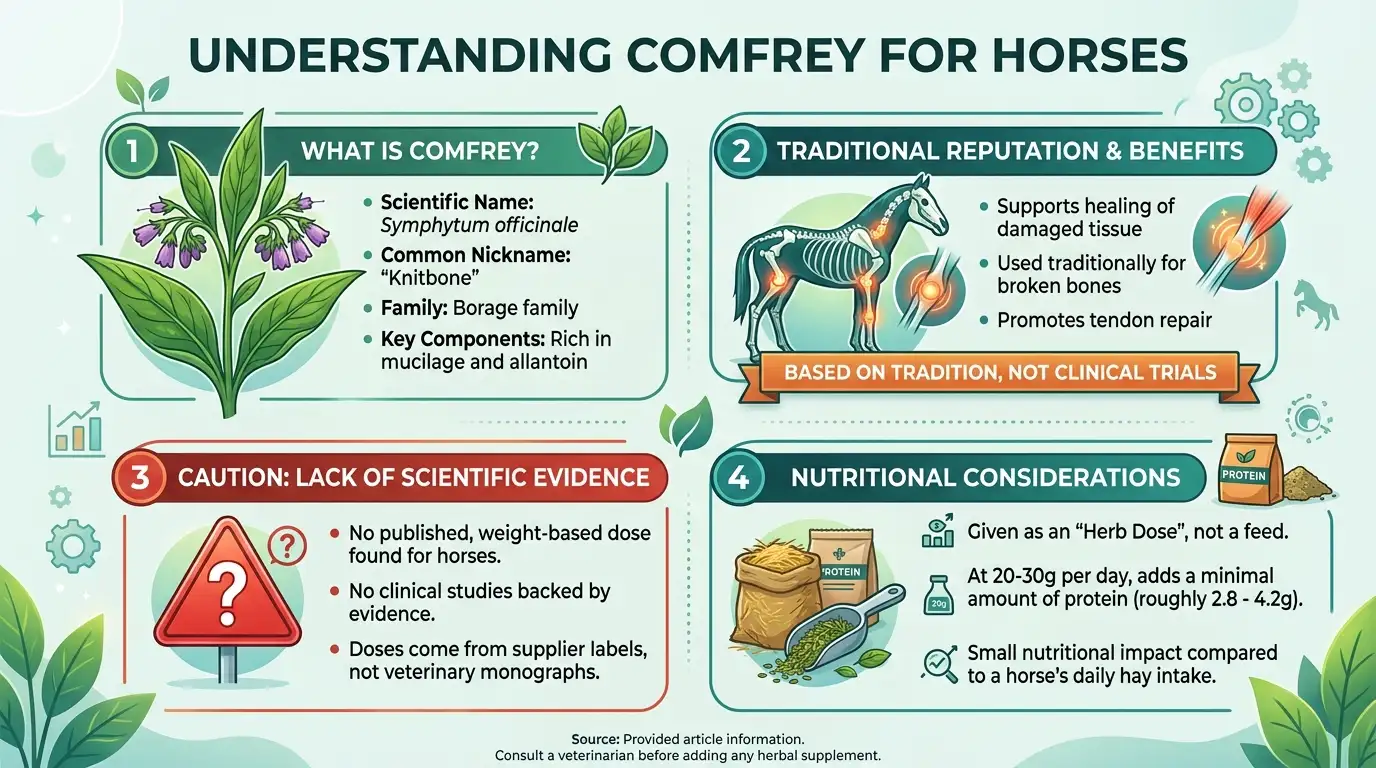
Comfrey (Symphytum officinale) is a leafy herb in the borage family. It is also called knitbone, a nickname that explains its reputation. Suppliers such as Equine Herbals describe it as rich in mucilage and allantoin, and it is popular for supporting the healing of damaged tissue such as broken bones and tendons.
That reputation comes from tradition, not from controlled horse trials. We found no published, weight based comfrey dose for horses backed by clinical studies. Every dose in this article comes from supplier labels, not from a veterinary drug monograph.
Nutritionally, comfrey at label amounts is a herb dose, not a feed. The Mad Barn Feed Bank lists one commercial comfrey leaf product at about 15.6 percent crude protein on a dry matter basis, with 90 percent dry matter.
At 20 to 30 g a day, that works out to roughly 2.8 to 4.2 g of protein. That is a small amount next to a horse’s hay.
Comfrey Dosage Chart for Horses
Here are the typical amounts printed by equine herb suppliers. Always follow the label on your own product, because strength varies between brands.
| Product form | Typical label amount for a horse | How it is given | Source |
|---|---|---|---|
| Dried cut leaf | 20 to 30 g per day | Add to feed, ideally split across two feeds | Hilton Herbs Comfrey Leaf |
| Tincture, 1:3 at 25% | 10 to 20 ml per day | Add to feed, split if possible | Hilton Herbs Comfrey Tincture |
| Liquid herbal product | 10 to 20 ml, twice daily | Two doses per day | Equine Herbals Comfrey Leaf |
| Scoop based leaf product | 4 scoops per day (about 24 g) | Introduce gradually, split across feeds | Feedmark MeadowBlend Comfrey |
Notice that the liquid products do not match. Equine Herbals lists 10 to 20 ml of its liquid product twice daily for all horses, while Hilton Herbs lists 10 to 20 ml in total per day for its tincture. The strengths and extraction methods differ, so never swap one brand’s volume for another’s.
| Scoop holds | Scoops for 20 g | Scoops for 30 g |
|---|---|---|
| 3 g | 6.7 | 10 |
| 6 g | 3.3 | 5 |
Does Body Weight Change the Comfrey Dose?
Not in the way you might expect. The labels above give a flat amount for “horses,” not a milligram per kilogram figure. We found no verified formula for scaling comfrey up or down by weight.
For context, 20 to 30 g for a 500 kg horse equals about 0.004 to 0.006 percent of body weight. One veterinary reference notes that horses generally need to eat roughly 2 to 5 percent of their body weight in pyrrolizidine alkaloid plants before liver disease develops, though toxicity builds up over a lifetime.
That figure is a general estimate for PA plants, not a proven safe ceiling for comfrey, so label discipline still matters.
Ponies, miniatures and foals are the gap. Label doses are written for average sized horses, and no one has published a reliable scaled down amount. If your animal is small, ask your vet and do not guess.
Comfrey Dosage Calculator
Enter your horse’s weight and your product type to see the label range turned into feeds, scoops and a 30 day total. The calculator deliberately refuses to produce numbers for small animals.
Comfrey Dosage Calculator For Horses
Calculate safe, proportioned daily dried comfrey leaf feeding amounts
Enter your horse’s weight and click Calculate Dose to view guidelines.
- Add to feed on a daily basis, splitting the required amount between two feeds if possible.
- Timeline Notice: Allow up to one month for benefits to be seen.
- Safety Warning: Do not exceed recommended limits. Consult a veterinarian prior to long-term usage.
Dried Leaf vs Tincture vs Fresh Comfrey
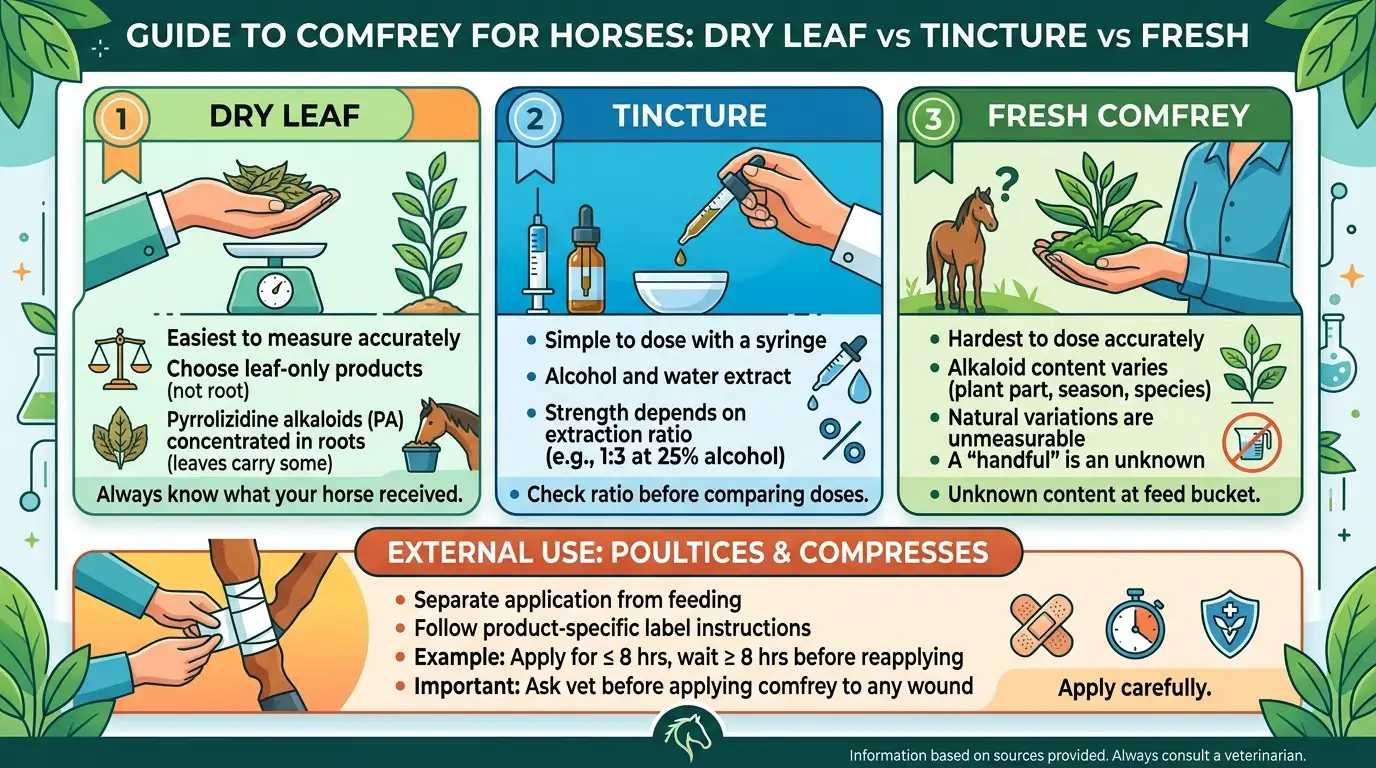
Dried leaf is the easiest form to measure accurately. You can weigh it, so you always know what your horse received. Choose a leaf only product, not one containing root. Veterinary references note that comfrey’s pyrrolizidine alkaloids are concentrated mainly in the roots, though the leaves carry them too.
Tincture is simple to dose with a syringe. It is an alcohol and water extract, so strength depends on the extraction ratio. Hilton Herbs’ version is 1:3 at 25 percent alcohol. Check the ratio on any other brand before comparing doses.
Fresh garden comfrey is the hardest to dose. Alkaloid content varies with the plant part, season, species and natural variation. You cannot see or measure that variation at the feed bucket, so a “handful” is a real unknown.
Poultices and compresses are a separate use. Product instructions differ, so follow your own label. Feedmark, for example, says to leave its poultice in place for no more than 8 hours and wait at least 8 hours before reapplying. Ask your vet before applying comfrey to any wound.
| Form | Easiest to measure | Strength consistency | Best for |
|---|---|---|---|
| Dried leaf | Yes, by weight | Good, if from a reputable supplier | Daily feeding for a short course |
| Tincture | Yes, by syringe | Depends on extraction ratio | Owners who want small volumes |
| Fresh leaf | No | Poor | Not recommended for internal use |
| Poultice or compress | Not applicable | Varies by product | Topical use under vet guidance |
Why Comfrey Dosage for Horses Needs Limits: The Liver Risk
This is the part many product pages skip. Comfrey contains pyrrolizidine alkaloids, or PAs, which the horse’s liver converts into harmful compounds. These alkaloids have been identified in the leaves and roots of both common and Russian comfrey, and they damage the liver.
Horses and cattle are generally the most severely affected, while sheep and goats are quite resistant.
The danger is that damage builds quietly. Horses can lose more than 80 percent of liver function by the time clinical signs appear. Once liver failure signs show, the damage is severe and irreversible, and the outlook is generally very poor.
Drying does not make comfrey safe. Research presented at the UC Davis alfalfa symposium notes that PAs resist heat and stay toxic in dried plant material.
| Safety fact | What the sources say |
|---|---|
| PAs identified in comfrey | At least eight |
| Highest concentration | Root, roughly 0.3 to 0.4 percent |
| Liver function lost before signs appear | More than 80 percent |
| Effect of drying or heat | PAs persist |
| Most sensitive livestock | Horses and cattle |
The evidence is not entirely one sided. Feedipedia notes that Russian comfrey is considered a toxic plant, yet feeding trials with it did not report toxicity problems.
Richters Herbs points out that herbalists cite centuries of animals eating the leaf, but that studies show PAs, especially from the root, can accumulate and harm the liver. Its advice is to use comfrey for specific conditions rather than daily.
For people, the UK Committee on Toxicity advised against eating comfrey root and leaves in its 1992 review. That advice was written for humans, but it shows how seriously regulators take the plant.
You can read the full Committee on Toxicity PA statement, and the IVIS poisonous plants guide covers horse specific effects.
How Long Can You Feed Comfrey to a Horse?
Keep it to a short course. Hilton Herbs says to allow up to one month to see benefits. Feedmark states that comfrey should not be fed for more than one month, and that it is not suitable for pregnant mares.
We could not verify a standard rest period between courses. Ask your vet how long to wait before any repeat course, and whether liver blood tests make sense before and after.
Who Should Not Get Comfrey
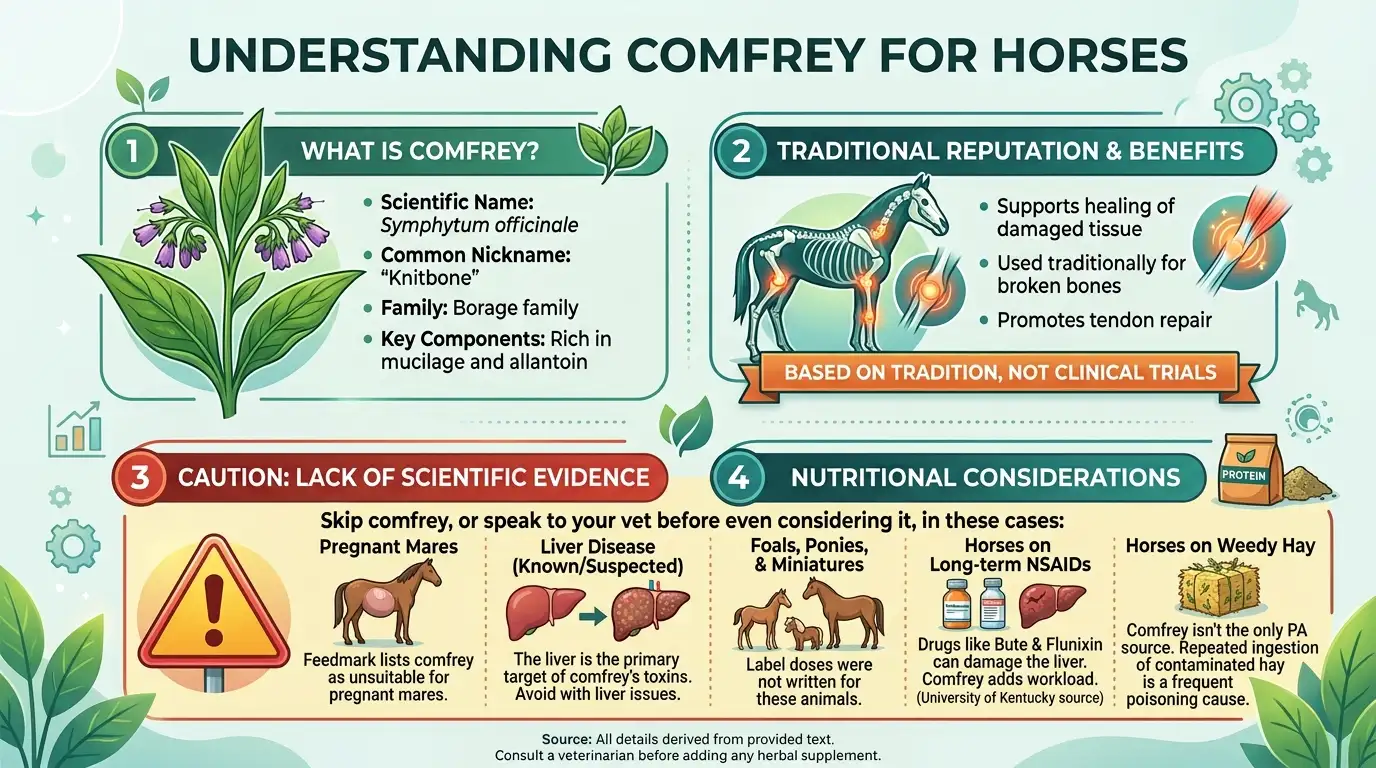
Skip comfrey, or speak to your vet before even considering it, in these cases:
- Pregnant mares. Feedmark lists comfrey as unsuitable for pregnant mares.
- Horses with known or suspected liver disease. The liver is the organ comfrey’s toxins target.
- Foals, ponies and miniatures. Label doses were not written for them.
- Horses on long term anti-inflammatory medication. The University of Kentucky notes that drugs such as phenylbutazone and flunixin can themselves damage the liver, especially at high doses, over long periods, or with existing conditions. Adding comfrey adds to the liver’s workload. If your horse is on bute, see our guide to bute dosage for horses.
- Horses fed hay from weedy fields. Comfrey is not the only PA source. Horses often fail to notice PA plants mixed into hay, and repeated ingestion of contaminated hay is one of the most frequent ways horses are poisoned.
Signs of Liver Trouble to Watch For
Early signs are easy to miss. Appetite loss is the most commonly listed one, and your vet may confirm trouble through liver enzyme tests. Other signs can include weight loss, dullness, yellow tinged gums and behavior changes.
Comfrey and Competition Rules
If you compete, check the rules before feeding anything herbal. The FEI forbids herbal or natural products used to calm or energize a horse. Cross contamination between herbal products is possible, and an accidental positive can still bring a ban and a fine.
Review the Equine Prohibited Substances List on the FEI website and your own discipline’s rules. Some brands advertise testing or compliance accreditation, so ask the supplier for proof rather than relying on a label claim.
What Comfrey Cannot Replace
Comfrey is not a painkiller and does not replace a diagnosis. Lameness, colic and suspected ulcers all need your vet. Owners sometimes reach for herbs when the real answer is a prescribed medicine, such as omeprazole dosage for horses in confirmed ulcer cases.
Other Supplements Owners Compare With Comfrey
If you want gentler gut or calming support, a few other options have their own dosing guides. Our guide to hops dosage for horses covers calming and gut support. Psyllium husk dosage for horses explains fiber based gut care.
For recovery and gut lining, see glutamine dosage for horses. For trace mineral support, read our kelp dosage for horses guide.
Common Comfrey Mistakes
- Feeding fresh garden leaves by the handful
- Buying a root containing blend without checking the label
- Guessing the scoop size instead of weighing it
- Running comfrey for months with no break or vet review
- Using it alongside long term NSAIDs without telling the vet
- Dosing a pony or mini by “scaling down” the horse amount
Key Takeaways
- Label amounts are about 20 to 30 g of dried leaf or 10 to 20 ml of 1:3 tincture per day, split across two feeds.
- No verified weight based dose exists, so do not scale for ponies or minis.
- Comfrey contains liver toxic PAs that build up over time, and drying does not remove them.
- Keep courses short, around one month, and ask your vet about breaks and liver tests.
- Avoid it in pregnant mares, liver compromised horses and horses on long term NSAIDs.
- Competition riders should check prohibited substance rules and supplier testing.
Frequently Asked Questions
How much comfrey can I give my horse per day?
Supplier labels suggest about 20 to 30 grams of dried leaf per day, or 10 to 20 ml of a 1:3 tincture per day, split across two feeds. Strength differs between brands, so follow your product label and confirm the amount with your vet first.
Is comfrey safe for horses?
Comfrey contains pyrrolizidine alkaloids that can damage the liver, and the harm is cumulative. Short courses at label amounts are the most cautious approach, ideally with vet approval. Long term daily feeding is not recommended.
How long can a horse stay on comfrey?
One supplier says to allow up to a month to see benefits, and another says not to feed comfrey for more than one month. We could not verify a standard rest period between courses, so ask your vet before repeating it.
Can I feed fresh comfrey from my garden?
It is not recommended. Alkaloid levels vary by species, plant part and season, and you cannot measure them at home. A weighed dried leaf product from a reputable supplier gives you a known amount.
What is the comfrey dosage for a pony or miniature horse?
No verified scaled down dose exists. Label amounts are written for average sized horses, so do not guess. Ask your vet before giving comfrey to a pony, miniature horse or foal.
Can pregnant mares have comfrey?
It is best avoided. At least one equine supplier lists comfrey as unsuitable for pregnant mares. Speak to your vet before using it in any breeding animal.
Does comfrey heal bones and tendons in horses?
Comfrey is traditionally called knitbone and is sold to support healing, but we found no controlled horse studies proving it works. It should never replace veterinary diagnosis and treatment of an injury.
What are the signs of comfrey liver toxicity in horses?
Signs can include loss of appetite, weight loss, dullness, yellow tinged gums and behavior changes. They often appear late, after most liver function is already lost. Stop feeding comfrey and call your vet if you see any of them.
Can I give comfrey with bute or other NSAIDs?
Be cautious. Phenylbutazone and flunixin can themselves stress the liver at high doses or over long periods. Adding comfrey adds to that load, so tell your vet about every product your horse receives.
Is comfrey allowed in horse competition?
Rules vary by discipline. The FEI forbids herbal products used to calm or stimulate a horse and publishes a prohibited substances list. Contamination between herbal products is possible, so check the rules and ask your supplier for testing proof.
How do I use comfrey as a poultice?
Follow the instructions on your specific product. One brand says to leave its poultice on for no more than 8 hours and wait at least 8 hours before reapplying. Ask your vet before putting comfrey on a wound.
Is dried leaf or tincture better for horses?
Dried leaf is easy to weigh, so you know exactly what your horse gets. Tincture is easy to measure by syringe but varies in strength between brands. Choose one form, follow its label and do not combine them.
How many scoops of comfrey equal 20 to 30 grams?
It depends on your scoop. A 3 gram scoop gives roughly 7 to 10 scoops, and a 6 gram scoop gives roughly 3 to 5 scoops. Weigh your own scoop once on a kitchen scale to be sure.
Can I feed comfrey daily all year?
No. Herbalists and suppliers advise short term, occasional use because the liver toxins accumulate. Year round daily feeding raises the risk of long term liver damage.
Conclusion and Next Steps
Comfrey dosage for horses comes down to three habits: measure it, keep it short and involve your vet. Weigh your dried leaf or syringe your tincture, use the label range, and stop after about a month. Before you begin, ask your vet whether a baseline liver check makes sense.
If your horse is dealing with pain or a slow healing injury, get a proper diagnosis first, then add comfrey only if your vet agrees.