Jiaogulan Dosage for Horses: Chart, Calculator and Safe Feeding Guide for Laminitis, IR and Respiratory Support
Written & Reviewed By: Medshorse Team
Last Updated: October 2026
Your vet mentions jiaogulan for a horse with sore feet. Or you read about it in a laminitis group, then opened three product pages that disagree. One says 3 g a day. Another says 30. So what is the right jiaogulan dosage for horses?
Jiaogulan is typically fed at 2 to 7 g twice daily for a 500 kg (1,100 lb) horse. Most owners should start near 1 g twice a day, raise it slowly, and let the gums guide them. This guide shows the math behind that range, a weight chart, a calculator, what product labels say, and who should skip it.
Disclaimer: This article is for general education and is not veterinary advice. Product names mentioned, including Jiaogulan, belong to their respective owners, and MedsHorse is not affiliated with them. Always follow your veterinarian’s instructions and the current product label.
What Is Jiaogulan, and Why Do Horse Owners Feed It?
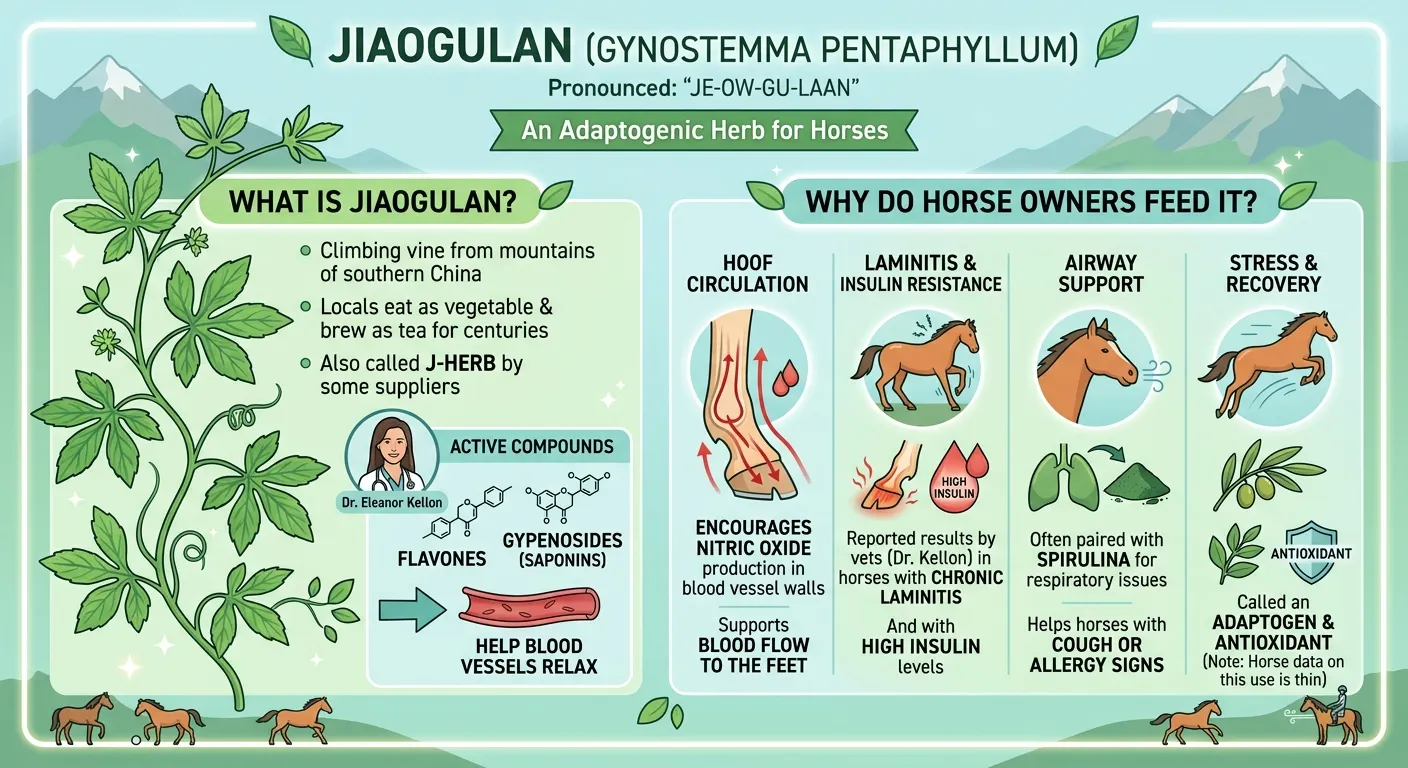
Jiaogulan (Gynostemma pentaphyllum, said “je-ow-gu-laan”) is a climbing vine from the mountains of southern China. Locals have eaten it as a vegetable and brewed it as tea for centuries. Some suppliers call it J-herb.
According to veterinarian Dr. Eleanor Kellon, the active compounds are flavones and gypenosides. Gypenosides are saponins that help blood vessels relax. That is the main reason horse people care about it.
Here is what owners and vets use it for:
- Hoof circulation: It encourages nitric oxide production in blood vessel walls, which supports blood flow to the feet.
- Laminitis and insulin resistance: Dr. Kellon reported results in horses with chronic laminitis and high insulin.
- Airway support: It is often paired with spirulina for horses with cough or allergy signs.
- Stress and recovery: It is called an adaptogen and an antioxidant, though horse data here is thin.
Jiaogulan Dosage for Horses: The Quick Answer
For a 500 kg horse, published directions run from about 3 g a day for general support to roughly 14 g a day at the top of the range used for hoof problems. Dr. Kellon’s reference dose is 2 g twice daily, and she starts new horses at half of that. Split the dose into two feedings and adjust by response.
There is no regulator-approved equine dose, because jiaogulan is a supplement and not an approved horse drug. Every number below comes from a vet’s published report or a supplier’s label, so treat the chart as a starting framework and not a prescription.
Jiaogulan Dosage Chart by Horse Weight
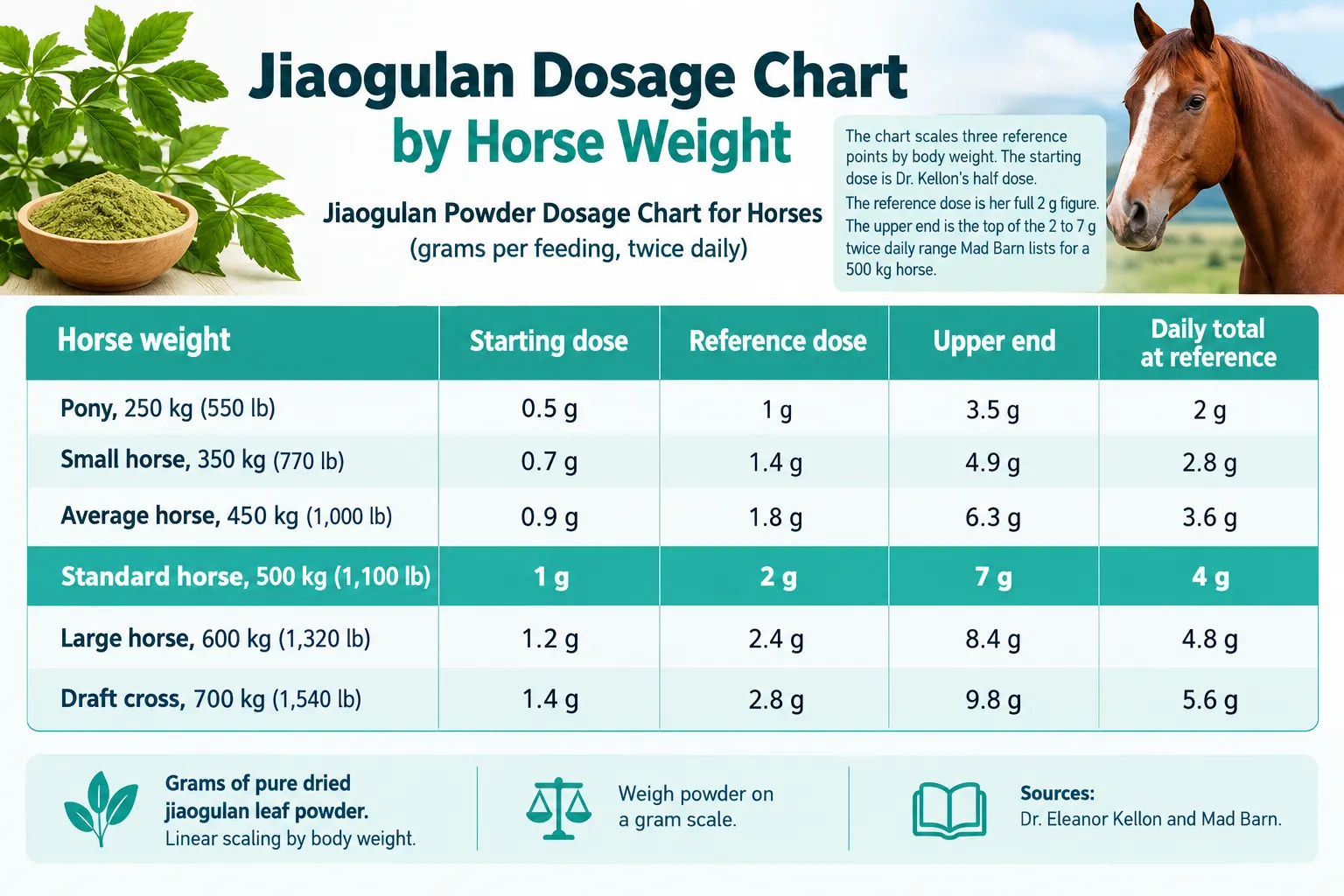
The chart scales three reference points by body weight. The starting dose is Dr. Kellon’s half dose. The reference dose is her full 2 g figure. The upper end is the top of the 2 to 7 g twice daily range Mad Barn lists for a 500 kg horse.
| Horse weight | Starting dose | Reference dose | Upper end | Daily total at reference |
|---|---|---|---|---|
| Pony, 250 kg (550 lb) | 0.5 g | 1 g | 3.5 g | 2 g |
| Small horse, 350 kg (770 lb) | 0.7 g | 1.4 g | 4.9 g | 2.8 g |
| Average horse, 450 kg (1,000 lb) | 0.9 g | 1.8 g | 6.3 g | 3.6 g |
| Standard horse, 500 kg (1,100 lb) | 1 g | 2 g | 7 g | 4 g |
| Large horse, 600 kg (1,320 lb) | 1.2 g | 2.4 g | 8.4 g | 4.8 g |
| Draft cross, 700 kg (1,540 lb) | 1.4 g | 2.8 g | 9.8 g | 5.6 g |
Jiaogulan Dose Calculator for Horses
Enter your horse’s weight, pick a dose level, and the calculator does the scaling. Begin with the starting dose unless your vet says otherwise.
Jiaogulan Dosage Calculator For Horses
Feed twice daily. A 500 kg (1,100 lb) horse typically gets 2 to 7 g per feeding. Start low, raise slowly and let the gums guide you. Ask your veterinarian first if the horse is pregnant, nursing, young or on medication.
© medshorse.com
How the Dose Is Worked Out: Dr. Kellon’s Method
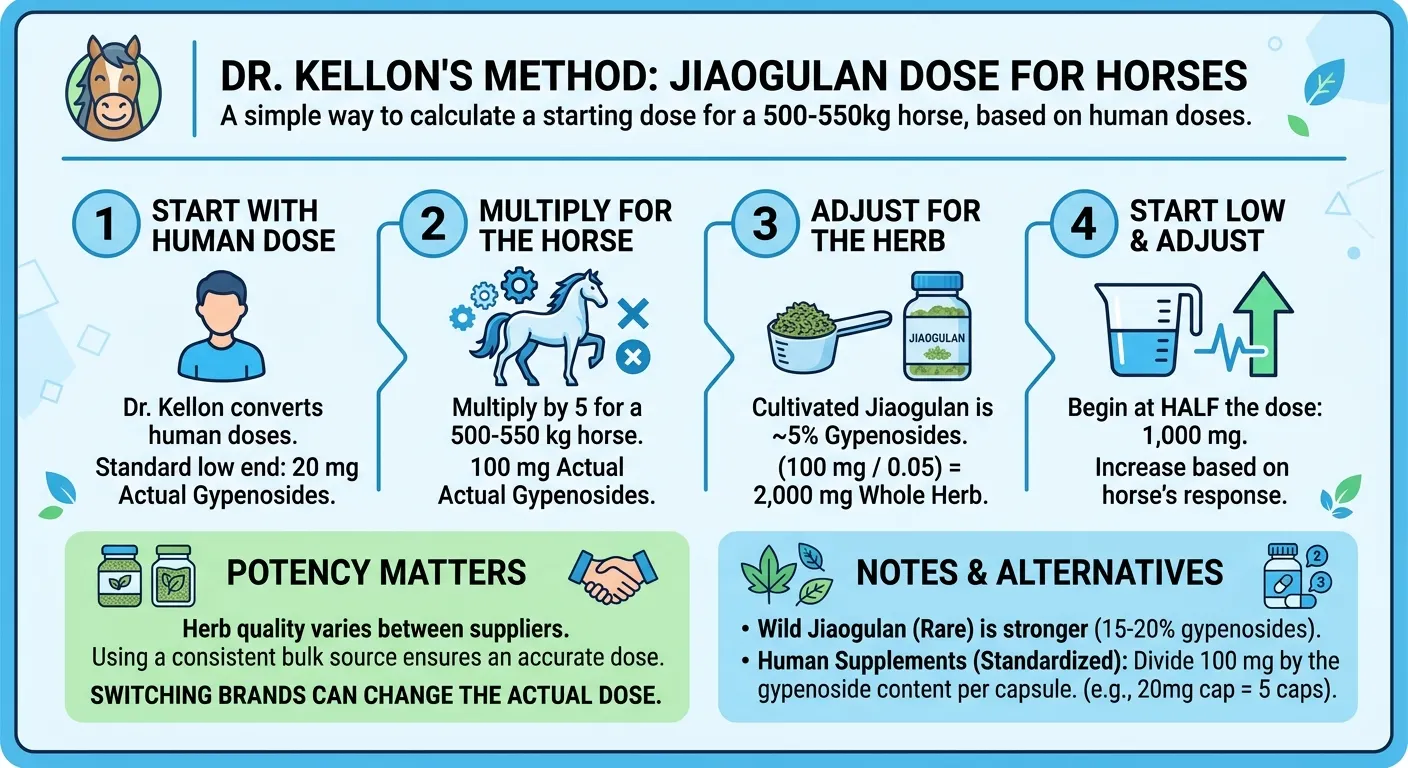
Dr. Kellon did not pick her numbers at random. She converted human doses to horse doses using metabolic body weight, which is a standard way to scale between species.
- Start with the human dose. The low end is about 20 mg of actual gypenosides.
- Multiply for the horse. For a 500 to 550 kg horse she multiplies by 5, which gives 100 mg of gypenosides.
- Adjust for the herb. Cultivated jiaogulan, the kind sold commercially, is about 5% gypenosides. So 100 mg divided by 0.05 gives 2,000 mg of whole herb.
- Start low. For a first-time herb she begins at half, or 1,000 mg, and increases based on response.
Wild jiaogulan can reach 15 to 20% gypenosides but is rarely sold outside China. If you use a standardized human product instead, divide 100 mg by the gypenoside content per capsule. A capsule with 20 mg means 5 capsules.
Potency matters here. Dr. Kellon notes that herb quality can vary between suppliers, and she stuck with one bulk supplier for consistency. Switching brands mid-protocol can quietly change your real dose.
Jiaogulan Dosage by Goal
Jiaogulan for Laminitis and Insulin Resistance
This is where most of the horse evidence sits. In Dr. Kellon’s report, horses with chronic laminitis and high insulin received 1,000 to 2,000 mg of powder per 500 lb of body weight, twice a day.
Her paper states the trial dose per 500 lb but does the dose math for a 500 to 550 kg horse. That gap is one reason to adjust by response and not by chart alone. Insulin-resistant horses in her experience were often sensitive and did well at lower doses.
Australian supplier Missy’s Bucket suggests 1.5 g twice daily for a laminitic 500 kg horse. It then raises the dose to 2 to 6 g twice daily, with a hard cap of 15 g per dose.
Jiaogulan was not used as a stand-alone fix. Dr. Kellon’s inclusion rules were strict:
- Pergolide in place if the horse also tested positive for PPID
- A low-NSC, mineral-balanced diet
- Regular, appropriate hoof care
- At least 6 weeks of ongoing lameness after an acute episode despite all of the above
- NSAIDs and other vasoactive drugs discontinued
That last point deserves care. Never stop pain medication on your own. If your horse is on phenylbutazone, check the bute dosage for horses guide and talk with your vet about whether and how to change anything.
Diet is the foundation. If your insulin-resistant horse also needs mineral balance, our magnesium dosage for horses guide covers that side. For prescription support, see the metformin dosage for horses article.
Jiaogulan and Spirulina for Respiratory Support
Dr. Kellon also used jiaogulan for inflammatory airway disease, often alongside spirulina. In her cases, a 500 kg horse received 2,000 mg of jiaogulan plus 20 g of spirulina, twice daily.
Her three cases show the pattern:
- 8-year-old Warmblood event mare: Poor recovery after exercise and a chronic cough. Recovery rates normalized within 48 hours, coughing stopped within a week, and she stayed symptom-free at 6 months.
- 2-year-old Standardbred filly: Given 2,000 mg of jiaogulan alone, 30 minutes to 1.5 hours before exercise. Her recovery normalized after the first dose, and her mile training time improved from 2:27 to 2:21 over a week.
- 4-year-old Standardbred gelding: Half doses (1,000 mg plus 10 g spirulina) gave a partial response. Full doses stopped the headshaking and sneezing.
These are case reports, not controlled trials. They show promise, not proof.
Jiaogulan for General Support and Stress
Missy’s Bucket lists 3 g a day for a 500 kg horse and 1.5 g a day for a 250 kg pony for general adaptogenic support. Mad Barn describes jiaogulan as an adaptogen and notes a human trial of a gypenoside-containing extract on fatigue and physical performance. The human trial was double-blind and placebo-controlled.
For horses, the adaptogen evidence is still thin. Dr. Kellon says it needs further investigation.
What Product Labels Say About Jiaogulan Dosage
Labels disagree, sometimes by a factor of ten. That is not a sign anyone is wrong. These are supplements with no standard dose, built for different goals.
| Source | Directions | Notes |
|---|---|---|
| Dr. Kellon (report) | 1 to 2 g per 500 lb, twice daily | Laminitis study dose |
| Missy’s Bucket | 3 g a day general. 1.5 g twice daily for hooves, rising to 2 to 6 g twice daily | Max 15 g per dose |
| Mad Barn | 10 g a day, split in two feedings | Article range: 2 to 7 g twice daily |
| SmartPak Smart and Simple | 7 g once daily | One scoop is 7 g |
| Basic Equine Nutrition | 15 g once daily for maintenance | Twice daily for therapeutic use |
| All Natural Horse Care | 1/2 to 2 teaspoons a day (1,000 lb horse) | Divide into two feedings |
The sources are Missy’s Bucket, Mad Barn, SmartPak, Basic Equine Nutrition, and All Natural Horse Care.
How to Know You Have Found the Right Dose
Instead of chasing a number, supplier guidance and Dr. Kellon both point to the same practical check: gum and tongue color. Horses on an effective dose often show pinker gums and tongue, more alertness, and freer movement. Dr. Kellon saw this consistently and used it to judge when a therapeutic dose had been reached.
Look at the gums before you begin so you have a baseline. If the gums do not become noticeably pinker, Missy’s Bucket suggests raising the dose by 1/4 teaspoon (about 0.75 g) every 3 days. It also says to never exceed 15 g per dose.
Gum color is a handy guide, but it is not a medical test. Dehydration, pain, and illness all change gum color. If gums look pale, blue, muddy, or bright red, or your horse seems unwell, call your vet.
How to Feed Jiaogulan Powder
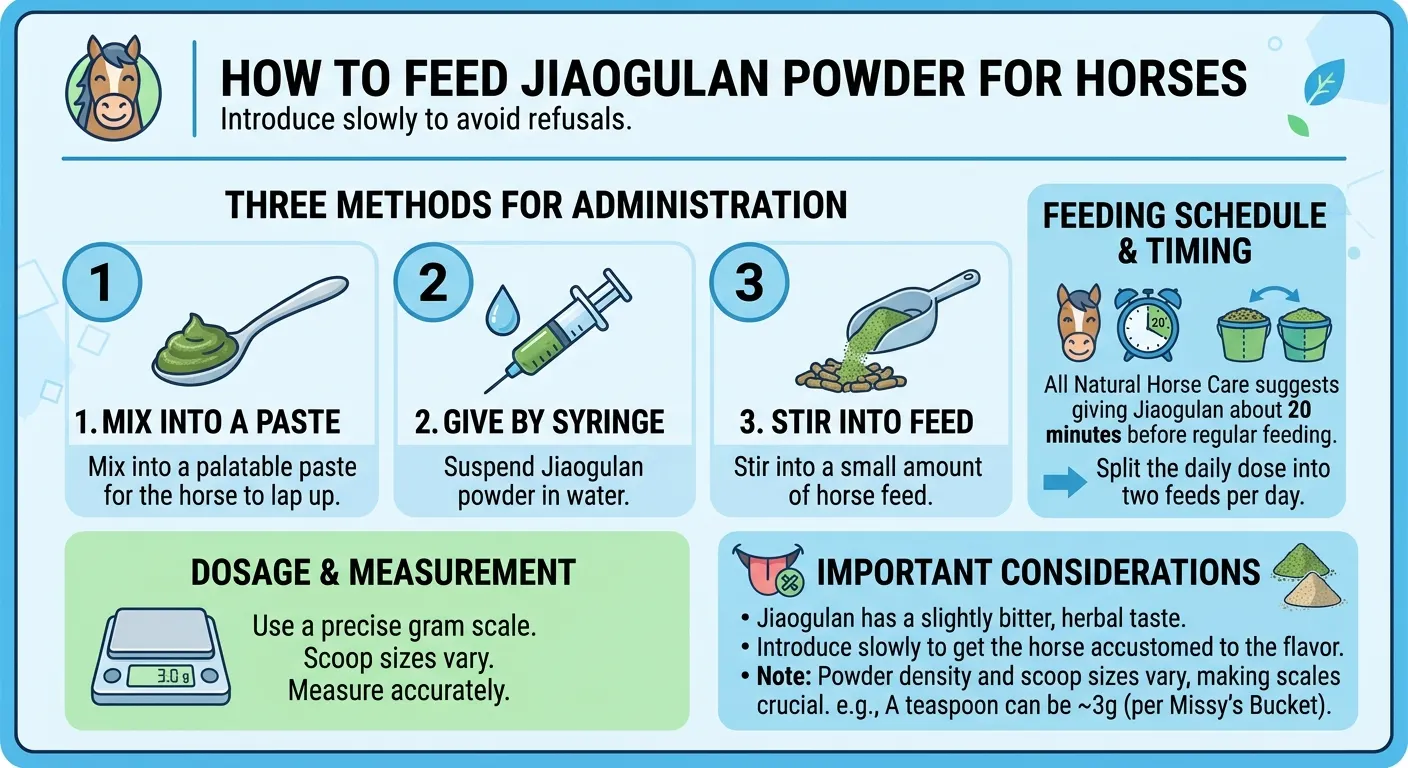
Jiaogulan has a slightly bitter, herbal taste, and Mad Barn recommends introducing it slowly to avoid refusals. Missy’s Bucket offers three ways to give it:
- Mix it into a paste for the horse to lap up.
- Suspend it in water and give it by syringe.
- Stir it into a small amount of feed.
All Natural Horse Care suggests giving it about 20 minutes before feeding, split into two doses. Use a gram scale instead of scoops. One level teaspoon is roughly 3 g by Missy’s Bucket’s conversion, but powder density varies, and scoop sizes range from 5 g to 15 g across brands.
What the Research Actually Shows
The best horse data comes from Dr. Kellon’s follow-up of 176 horses and ponies, watched for 3 months to 2.5 years. All were hyperinsulinemic with normal blood sugar, aged 3.5 to 29, and about 57% were mares. Three quarters had needed NSAIDs for pain beforehand.
Several details add context:
- Abscess collections commonly surfaced during the first 2 to 3 weeks of treatment, which Dr. Kellon describes as very common.
- Coffin bone rotation and starting lameness grade did not predict who responded.
- Chronic laminitis tissue in earlier horse research showed endothelin-1 levels about 7 times higher than controls (Katwa et al., 1999). That vessel-narrowing molecule is part of why circulation support interests researchers.
There are limits. This was not a placebo-controlled trial, and the data are from the 2000s. Other lab and human findings, such as a tea study in people with type 2 diabetes, do not prove the same effect in horses.
Is Jiaogulan Safe for Horses?
Safety data is reassuring but incomplete. Formal toxicity testing has not been done in horses. In rats, six months of feeding at up to six times the high human dose showed no toxicity. Dr. Kellon reports using up to 5,000 mg a day for 2 years with no clinical or lab signs of toxicity.
The main risks are interactions and the wrong horse. Talk to your vet first in these situations:
For drug dosing context, see our acepromazine dosage for horses and Banamine dosage for horses guides.
Where Jiaogulan Fits With Other Supports
Jiaogulan is one tool, not a program. Mad Barn notes it is often combined with spirulina, AAKG, or chasteberry. If you are exploring PPID support, our chasteberry dosage for horses guide explains the research and limits.
Hoof quality also depends on diet and trimming. Some owners add biotin; our biotin dosage for horses guide covers that.
Jiaogulan for Competition Horses
Do not assume a plant supplement is legal in the show ring. Missy’s Bucket warns that herbs of this kind may contain prohibited substances. We found no official ruling on jiaogulan either way.
USEF tells members they are responsible for auditing supplement ingredients. Check FEI Clean Sport and your own governing body before feeding it to a competition horse.
Common Jiaogulan Dosing Mistakes
- Starting at the top dose: Begin low and step up, as Dr. Kellon does with any new herb.
- Skipping the foundation: Diet, hoof care, and metabolic control come first.
- Judging by the calendar: Use gum color, alertness, and movement, not just days.
- Switching brands midstream: Gypenoside content varies, so your real dose can shift.
- Mixing up scoops: A 7 g scoop and a 15 g scoop are very different doses.
- Combining without a plan: NSAIDs and vasodilators need a vet’s input.
- Expecting a cure: It supports circulation. It does not fix the root cause.
Key Takeaways
- Typical dosing for a 500 kg horse is 2 to 7 g twice daily, and starting near 1 g twice daily is the cautious route.
- Scale by body weight and weigh the powder on a gram scale.
- Pinker gums, more alertness, and freer movement signal the dose is working.
- Fix diet, hoof care, and PPID or IR control first.
- Ask your vet before combining with NSAIDs, vasodilators, or anticoagulants.
- The evidence is mostly observational, so keep expectations realistic.
FAQs
How much jiaogulan should I give my horse?
Published directions for a 500 kg (1,100 lb) horse range from about 3 g a day for general support to roughly 14 g a day at the top of the 2 to 7 g twice daily range used in hoof and metabolic cases. Most owners start near 1 g twice daily and raise the dose slowly based on gum color and response.
What is a safe starting dose of jiaogulan for horses?
Dr. Kellon starts a first-time herb at half of her 2,000 mg reference dose, which is about 1 g per feeding for a 500 kg horse. Missy’s Bucket suggests 1.5 g twice daily for a laminitic 500 kg horse before increasing.
How often should jiaogulan be fed?
Twice daily is the most common schedule, with the daily total split into two equal feedings. Some brands list a single daily serving for maintenance, but hoof and respiratory protocols use two feedings.
How long does jiaogulan take to work in horses?
In Dr. Kellon’s report, responding laminitic horses returned to pasture soundness at a walk within 2 days to 2 weeks. In her respiratory cases, recovery rates improved within days and coughing stopped within a week. These were case reports, so individual results can differ.
How do I know if my horse is getting the right dose of jiaogulan?
Look for pinker gums and tongue, more alertness and freer movement. Check gum color before you start so you have a baseline. If the gums do not become pinker, one supplier suggests raising the dose by 1/4 teaspoon every 3 days, never above 15 g per dose.
Can I give jiaogulan to a horse with laminitis?
Many owners do, but it works best once diet, hoof care and metabolic control are in place. Dr. Kellon’s protocol required those steps and asked for NSAIDs to be stopped, so work with your vet instead of deciding alone.
Is jiaogulan safe for horses long term?
No formal toxicity study has been done in horses. A six month rat study at up to six times the high human dose found no toxicity, and Dr. Kellon reports using up to 5,000 mg a day for 2 years without clinical or lab signs of toxicity.
Can jiaogulan be given with bute or Banamine?
Ask your vet first. Dr. Kellon’s laminitis protocol discontinued NSAIDs, and one horse care site advises against combining jiaogulan with bute or flunixin. Never stop pain medication without veterinary advice.
Can I give jiaogulan with acepromazine or isoxsuprine?
Use caution. Jiaogulan may widen blood vessels, so Dr. Kellon advises care with drugs that also dilate vessels or lower blood pressure, such as acepromazine. Mad Barn gives the same warning about isoxsuprine.
Can jiaogulan help horses with allergies or cough?
Dr. Kellon reported improvement in horses with inflammatory airway disease when jiaogulan was given with spirulina, usually 2,000 mg of jiaogulan plus 20 g of spirulina twice daily. These were three case reports, not controlled trials.
How many teaspoons of jiaogulan is a dose?
One supplier equates 1 teaspoon to about 3 g. That makes 2 g roughly two thirds of a level teaspoon and 6 g about 2 teaspoons. Powder density varies, so a gram scale is more accurate.
Should jiaogulan be given with spirulina?
Spirulina is mainly added for airway or allergy goals. In Dr. Kellon’s cases it was dosed at 20 g twice daily for a 500 kg horse next to jiaogulan. For hoof goals, jiaogulan is also paired with AAKG or chasteberry in some programs.
Can jiaogulan cause hoof abscesses?
Abscesses that were already building can surface. Dr. Kellon reports that abscess collections commonly appeared during the first 2 to 3 weeks in laminitic horses. Call your vet or farrier if your horse becomes more lame or shows heat, swelling or discharge.
Is jiaogulan allowed in competition?
Rules differ by organization, and one supplier warns that herbs of this kind may contain prohibited substances. Check with FEI Clean Sport, USEF or your own governing body before feeding it to a competition horse.
Can ponies and miniature horses take jiaogulan?
Dose by body weight. One Australian supplier lists 1.5 g a day for general support in a 250 kg pony, and 1 g twice daily for hoof cases rising to 2 to 4 g twice daily with a 10 g per dose cap. Ask your vet for guidance on miniature horses.
Your Next Step
Talk to your vet before you start, especially if your horse has laminitis, PPID, or takes any medication. Pick one reputable supplier, weigh the powder, start low, and check gum color before and after each step up. Keep notes for 2 to 3 weeks so you and your vet can judge whether it is helping.
This article is educational and is not a substitute for veterinary advice.
Sources and Further Reading
- Use of Gynostemma pentaphyllum and Spirulina platensis in Horses, Dr. Eleanor Kellon
- 10 Science-Backed Benefits of Jiaogulan for Horses, Mad Barn
- Jiaogulan directions, Missy’s Bucket
- Jiaogulan directions, Basic Equine Nutrition
- Jiaogulan for Horses, All Natural Horse Care
- Expression of endothelin in equine laminitis, PubMed
- Gypenoside L extract and fatigue, human RCT, PubMed