Ventipulmin Dosage For Horses: Calculator, Chart & Complete Guide
Ventipulmin® Dosage Calculator for Horses
Calculate clenbuterol syrup dose based on body weight
Enter the horse’s current body weight to calculate the twice-daily dose.
Recommended Dose (Per Administration)
Clenbuterol Dose
— mcg
Syrup Volume
— mL
Pump Strokes (metered dosing pump)
— strokes
Administer this dose twice daily (approx. every 12 hours) mixed into the grain portion of the feed, via oral route. Dosing basis: 0.8 mcg clenbuterol per kg body weight — equivalent to one pump stroke (4 mL) per 125 kg (275 lbs.) body weight, twice daily. Duration of action is approximately 8 hours after a single dose and 12 hours on repeated twice-daily dosing.
This calculator is for informational purposes only. Always confirm dosing with your veterinarian before administration.
Feeding a horse the wrong dose of Ventipulmin does not work, it can also cause a racing heart, muscle spasms or a lost 30 days of treatment time as your horse continues to struggle to breathe. You are here, and likely you want a single thing, namely the number of milliliters of water you require to weigh your horse, and which you will find on the label, without first ploughing through a paragraph of pharmacology.
Here’s the short answer: the standard starting dose is 0.5 mL of Ventipulmin Syrup per 100 lbs of body weight (0.8 mcg/kg), given twice a day. For a 1,000 lb horse, that’s 5 mL, twice daily. But that’s only the starting dose – Ventipulmin Dosage For Horses follows a step-up method that can be raised as time goes by, and that is precisely why a chart (not a single number) is important. We will go through it all below, based on the FDA-approved label and compared with the dosage of the large equine pharmacies.
Quick Facts
- Active ingredient: Clenbuterol hydrochloride
- Drug class: Beta-2 adrenergic agonist (bronchodilator)
- U.S. concentration: 72.5 mcg clenbuterol HCl per mL
- Starting dose: 0.5 mL per 100 lbs (0.8 mcg/kg), twice daily
- Route: Oral, mixed into the grain portion of feed
- Max treatment length at effective dose: 30 days
- Prescription status: Rx only, veterinarian-prescribed
- FDA approval: NADA 140-973, approved May 11, 1998
What Is Ventipulmin (Clenbuterol) and What’s It Used For?
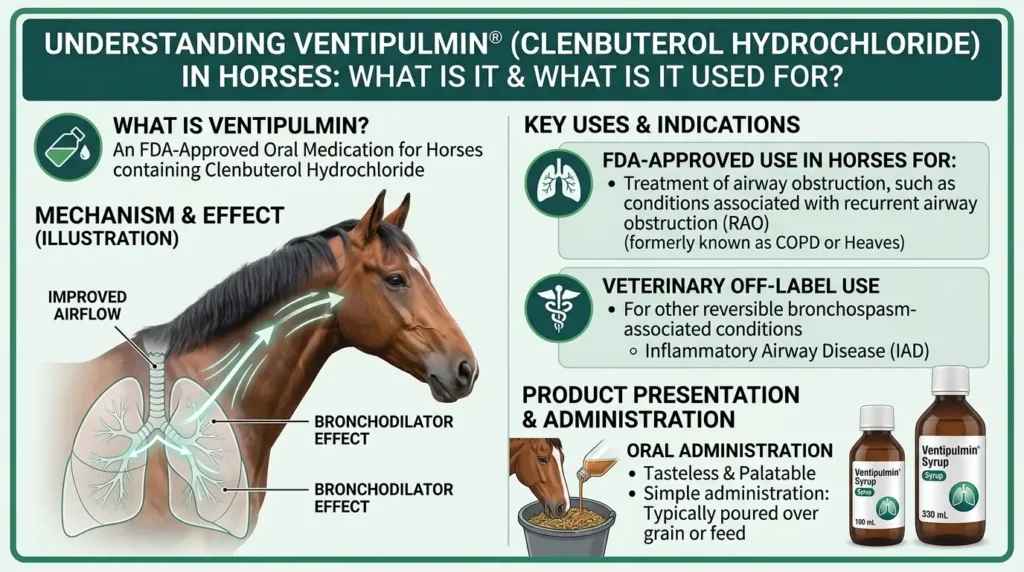
Oral clenbuterol hydrochloride is a Boehringer Ingelheim brand known as Ventipulmin Syrup for horses. It is FDA-approved to treat horses with airway obstruction, which is most commonly chronic obstructive pulmonary disease (COPD) – the disease that is now called recurrent airway obstruction (RAO) or heaves. It is also used off-label by the vets to treat other reversible bronchospasm-associated breathing issues, including inflammatory airway disease (IAD).
It is available as a tasteless, palatable 100 ml and 330 ml syrup, to be poured over grain, where the horse is expected to ingest it together with its normal feed.
How Ventipulmin Dosage Works in Horses
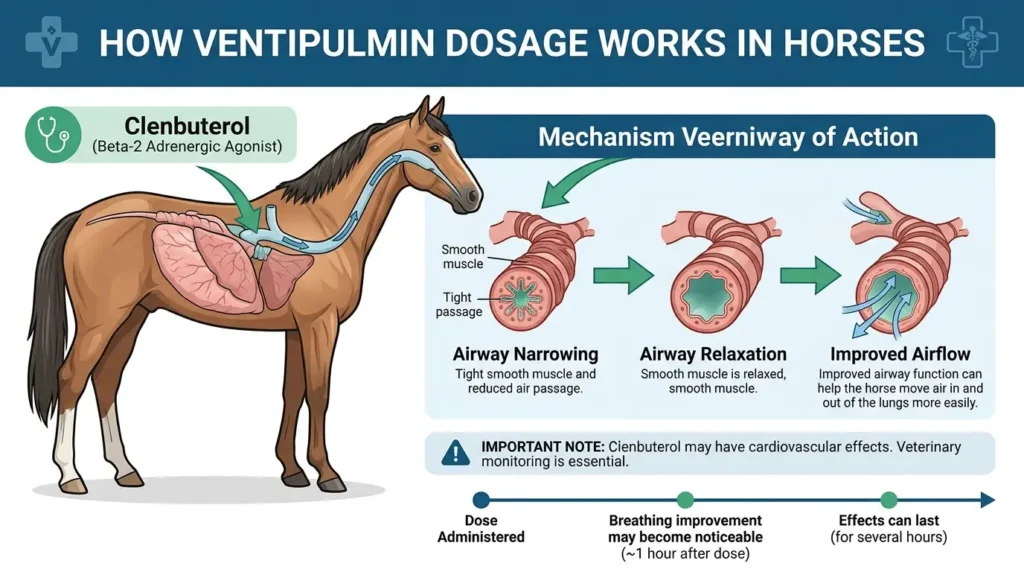
Clenbuterol is a beta-2 adrenergic agonist. Put simply: it dilates the smooth muscle that lines the airways of the horse (bronchodilation), and becomes more effective in clearing the mucus, which in combination allows letting the horse move air in and out of the lungs easily.
It is selective enough to receptors on beta-2 that it has a relatively modest effect on the heart at label doses – but not none, hence cardiovascular monitoring is important (see below).
The majority of horses exhibit a clear increase in breathing after about an hour of a dose and effects typically take several hours before the next predetermined treatment.
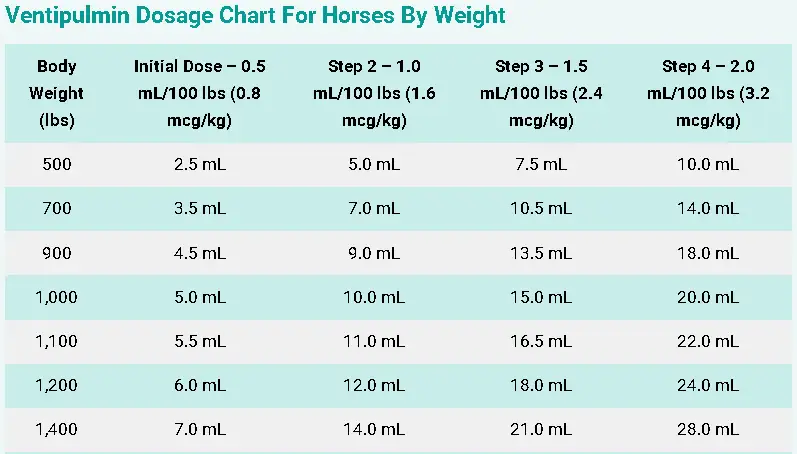
Ventipulmin Dosage Chart For Horses By Weight
The dosage chart is the official U.S. prescribing information of Ventipulmin ( NADA 140-973 ) reproduced by weight so you can find the number of your horse directly.
| Body Weight (lbs) | Initial Dose – 0.5 mL/100 lbs (0.8 mcg/kg) | Step 2 – 1.0 mL/100 lbs (1.6 mcg/kg) | Step 3 – 1.5 mL/100 lbs (2.4 mcg/kg) | Step 4 – 2.0 mL/100 lbs (3.2 mcg/kg) |
| 500 | 2.5 mL | 5.0 mL | 7.5 mL | 10.0 mL |
| 700 | 3.5 mL | 7.0 mL | 10.5 mL | 14.0 mL |
| 900 | 4.5 mL | 9.0 mL | 13.5 mL | 18.0 mL |
| 1,000 | 5.0 mL | 10.0 mL | 15.0 mL | 20.0 mL |
| 1,100 | 5.5 mL | 11.0 mL | 16.5 mL | 22.0 mL |
| 1,200 | 6.0 mL | 12.0 mL | 18.0 mL | 24.0 mL |
| 1,400 | 7.0 mL | 14.0 mL | 21.0 mL | 28.0 mL |
| 1,600 | 8.0 mL | 16.0 mL | 24.0 mL | 32.0 mL |
| 1,800 | 9.0 mL | 18.0 mL | 27.0 mL | 36.0 mL |
Each dose in this chart is given twice daily (b.i.d.).
Step-Up (Titrating) Dosage Schedule
Ventipulmin Dosage For Horses does not come in a single dose across the entire course of treatment, it is a “treat to effect” regimen:
- Days 1–3 (6 treatments): Start at 0.5 mL/100 lbs (0.8 mcg/kg), twice daily.
- No improvement? Move to 1.0 mL/100 lbs (1.6 mcg/kg) for the next 3 days.
- Still no improvement? Move to 1.5 mL/100 lbs (2.4 mcg/kg) for 3 days.
- Still no improvement? Move to 2.0 mL/100 lbs (3.2 mcg/kg) – the maximum label dose – for 3 days.
- Maximum dose not responding at all? The horse is said to be unresponsive to clenbuterol and the treatment is to be discontinued. Don’t continue blowing things out of proportion.
When you have found the dose that is working, that is the dose you remain on, you do not have to continue to increase the dose.
How Long Can a Horse Stay on Ventipulmin?
The effective dose is 30 days. The label at the end of the period requests the withdrawal of the drug to observe whether the symptoms reoccur. Should they, the 30-day course may be reiterated – but each time the step-up titration must be repeated at the initial dosage rather than by commencing again at the previous effective dosage of the horse.
How to Administer Ventipulmin Syrup Correctly
- Shake gently (see label on your particular bottle) in case it is separated.
- Soon replace the safety cap with the plastic dispensing cap, which came in the box.
- Place a dispensing tip with a needle-free oral syringe.
- Fill up the precise volume that is prescribed – here body weight as determined by a scale becomes more important than an estimation.
- Add it to the grain part of the feed and not the hay portion of the feed to ensure that the horse receives all the dose in a single feeding.
- Replace dispensing tip cover with each use to avoid leaking and evaporation.
- Take twice a day with an interval of about 12 hours to ensure the blood levels are maintained.
Hint: When your horse is a lousy eater and cannot eat all the grain, discuss with your vet combining it into a small, more desirable meal first, then the rest of the ration should be fed afterward – another frequent cause of horses appearing to no longer respond is under-dose.
Canada / EU / UK Ventipulmin: A Different Concentration
When you compare notes with someone on Ventipulmin for horses outside of the U.S. do not think that the numbers will match. Ventipulmin Syrup (Canadian) and European formulations are 25 mcg per mL clenbuterol (as compared to 72.5 mcg per mL in the U.S.), administered twice daily, using a metered pump that delivers 4 mL per dose, which is calibrated to approximately 125 kg (275 lbs) of body weight.
The action time of that formulation is given as about 8 hours after one dose, with a range of about 12 hours with repeated doses twice a day.
Bottom line: never take any dose other than the one that is printed on the label of your particular bottle.
Ventipulmin Side Effects in Horses
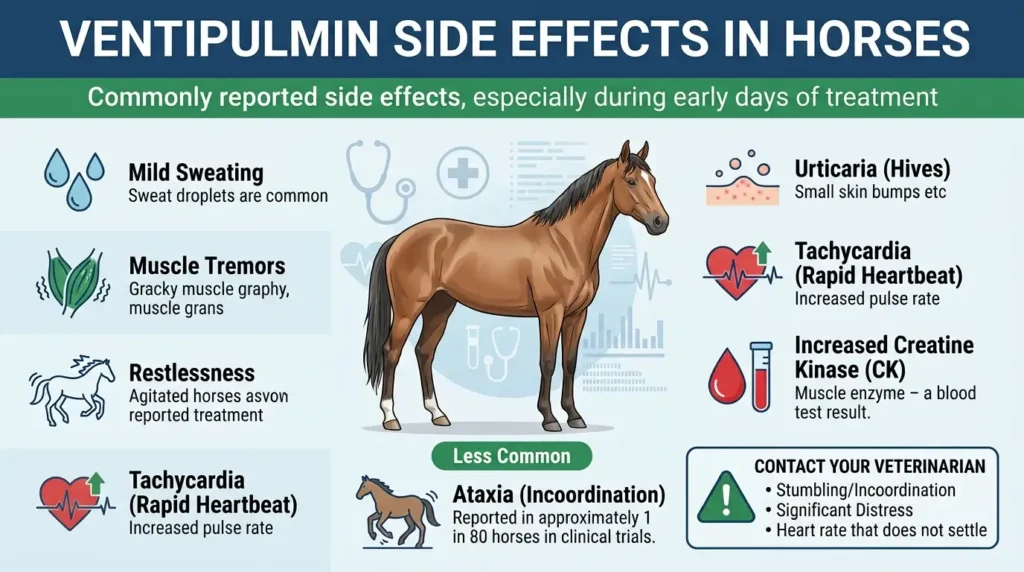
As listed in the FDA label, and clinical trials provided to the FDA to be approved, the most frequently reported effects tend to be observed during the initial days of treatment and resolved as the horse adapts and include:
- Mild sweating
- Muscle tremors
- Restlessness
- Urticaria (hives)
- Tachycardia (rapid heartbeat)
- High creatine kinase (CK) – a muscle enzyme.
Incidences In small percentage of horses ataxia (incoordination) was reported in clinical trials (approximately 1 in 80). When stumbling, a lot of distress, or a heart rate that fails to settle, call your vet instead of letting it go.
Warnings, Contraindications & Who Should NOT Get Ventipulmin
- Cardiovascular impairment: Due to the known effect of tachycardia, Ventipulmin cannot be used in horses that are suspected of having heart problems.
- Pregnant mares nearing foaling: Clenbuterol relaxes uterine smooth muscle and may interfere with the delivery capability – it must not be administered to mares that are about to foal.
- Breeding stock: The impact of Ventipulmin dose on the fertility of breeding animals such as stallions and broodmares has not been established yet and therefore breeding animals should be used carefully with consultation to your vet.
- Not on food animals: Clenbuterol is not allowed to be extralabeled in food animals, and horses treated with it are not fit to be eaten.
- Human beings: Store out of reach of children and use with caution – accidental human ingestion may result in an increase in heart rate and blood pressure and changes. Call a doctor in case that occurs.
Ventipulmin Drug Interactions
- Beta-blockers (beta-adrenergic blocking agents): Directly inhibit the action of clenbuterol, which is supposed to be the effect of Ventipulmin.
- Corticosteroids: It is not possible to combine them, as they have the possibility to increase peripheral vasodilating effect with the use of clenbuterol.
- Oxytocin and prostaglandin F2-alpha: Ventipulmin inhibits both, directly pertaining to foaling and reproductive management – flag any Ventipulmin administration to your vet if these medications are also involved in the strategy.
- Other sympathomimetics: Co-administration of clenbuterol with other stimulant-type bronchodilators or adrenergic medications is potentially dangerous and may only be undertaken under direct veterinary care.
It is advisable to always provide your vet with a complete list of whatever the horse is on at the moment including supplements before putting him on Ventipulmin Medication.
Ventipulmin and Competition Horses (Withdrawal & Testing)
Clenbuterol is a legal, FDA-approved therapeutic but it is also a Beta-2 agonist with performance-related effects at higher doses or at a longer duration, which is why most competition and racing organizations have stringent regulation on its use, and some of them completely ban its use in the near future of competition.
The withdrawal times differ greatly depending on the organization (USEF, FEI, individual racing jurisdictions) and are not a standard of the FDA label. Always check with your veterinarian and the most recent rules of the particular governing body to be sure of the latest information on current withdrawal guidance before a show or race with a competition horse.
Storage & Handling
- Store at or below 25°C (77°F).
- Avoid freezing.
- Store the safety cap at times the bottle is not in use.
- Store away, not accessible to children and pets.
Common Dosing Mistakes to Avoid
- Receiving a uniform dose of the entire treatment rather than stepping up.
- Estimation of body weight rather than scale or weight tape – a 200 lb error in estimation of weight does affect dose.
- Confusion of the U.S. and Canada/EU concentrations when searching the dosage information online.
- Raising the amount of dose beyond the limit (2.0 mL/100 lbs) when a horse is not responding, rather than halting and reevaluating with a veterinarian.
- Dropping the 30-day withdrawal check, and simply continuing treatment without re-vetting.
Myth vs. Fact
| Myth | Fact |
| “More Ventipulmin Dosage means faster relief.” | Exceeding the labeled step-up schedule doesn’t speed recovery – it increases the risk of tachycardia, tremors, and other side effects. |
| “Ventipulmin cures COPD/heaves.” | It manages symptoms by relaxing the airway; it doesn’t cure the underlying inflammatory condition. Environmental management (dust, hay quality, turnout) still matters. |
| “All Ventipulmin bottles are dosed the same way.” | The U.S. product (72.5 mcg/mL) and the Canada/EU product (25 mcg/mL) are different concentrations with different dosing math. Always check your bottle. |
| “It’s safe to keep a horse on it indefinitely.” | The label calls for a 30-day maximum at the effective dose, followed by a withdrawal period to reassess. |
You May Also Like to Read:
- Dormosedan Dosage For Horses: Calculator, Chart & Safe Guide
- Benadryl Dosage For Horses: Calculator, Chart & Safe Guide
FAQs
What are the uses of Ventipulmin Syrup in horses?
Ventipulmin (clenbuterol) is approved by FDA to treat horses with airway blockage caused by chronic obstructive pulmonary disease (COPD/heaves), and is also used off-label to treat other breathing conditions caused by reversible bronchospasm.
How many days will a horse remain on Ventipulmin?
The most effective dose is recommended to be used for no longer than 30 days, after which the drug should be discontinued to determine whether or not the symptoms reappear.
What are side effects of Ventipulmin in horses?
The most frequent ones are mild sweating, muscle tremors, restlessness, hives, and an increased heart rate, which is characteristic in the initial few days of treatment. High levels of creatine kinase and, in extreme cases, ataxia have also been reported.
Will Ventipulmin injure the heart of a horse?
Ventipulmin may lead to tachycardia (increased heart rate) in a few horses and hence should not be used in horses that are suspected to have cardiovascular impairment. This should be checked in any horse on it.
Does Ventipulmin have any safety in pregnant mares?
It is not recommended to be administered to mares toward the end of pregnancy because it may relax the uterus and disrupt delivery. Its impact on breeding stallion and broodmare fertility has not been determined.
Does Ventipulmin Syrup for horses have any interaction with other drugs?
Yes. It is beta-blocker antagonistic, should not be used concomitantly with corticosteroids without veterinary advice, and it is oxytocin and prostaglandin F2-alpha antagonistic.
Is Ventipulmin the same as clenbuterol?
The active ingredient of Ventipulmin Syrup is clenbuterol hydrochloride. The terms clenbuterol and Ventipulmin are sometimes used interchangeably in informal discussions, but the branded product is Ventipulmin, which is approved by the FDA.
How fast is Ventipulmin drug acting?
An increasing number of horses will improve their breathing within approximately an hour of a dose, but the time of response can be variable.
Is it okay to administer Ventipulmin to a show or race horse?
Withdrawal times are not required and are specific to your particular competition, which is why veterinary advice should be followed carefully, including any applicable withdrawal times.
Why will my horse no longer respond to Ventipulmin?
This may occur because the dose was not increased sufficiently, because the horse is not taking its full grain ration (and thus its full dose), or because the underlying condition is not clenbuterol-responsive. Any dose increase should be discussed with your veterinarian.
Is Ventipulmin a prescription drug?
Yes. Federal law limits Ventipulmin to use by or on the direction of a licensed veterinarian.
Should I do anything because I suspect my horse had too much Ventipulmin?
Get in touch with your veterinarian. An overdose may result in serious tachycardia, perspiration, and shaking in addition to the mild reactions associated with regular use.
Final Thoughts
One of the most useful aids to assist a horse with COPD, heaves, or another reversible airway obstruction to breathe more easily is ventipulmin, but it’s a prescription medication that is titrated, not a standard measurement. The easiest way out is always to weigh your horse correctly, begin at the marked starting dose, use the step-up method only when necessary, and keep your veterinarian informed with you at each step – particularly not to continue it beyond 30 days, or to use it concomitantly with other drugs.
When administered properly, most horses are capable of withstanding it and are demonstrating beneficial relief in days.
This article is educational and is based on the currently approved FDA prescribing information of Ventipulmin Syrup in the U.S. It should not replace veterinary care – never use without first verifying with the veterinarian who examined your horse.