Turmeric Dosage for Horses: Chart, Calculator & Safe Guide to Feeding the Right Amount by Weight
Written & Reviewed By: Medshorse Team
Last Updated: November 2026
Turmeric looks harmless. It sits in your kitchen cupboard, and horse owners scoop it into feed buckets every day. Yet one question causes more confusion than any other: how much is actually right?
The honest answer on turmeric dosage for horses is that nobody has set an official dose. Getty Equine Nutrition says an appropriate dosage has not been established. Turmeric Life says there is no set dose. What exists is a handful of guidelines and product labels, and their numbers range from 2.4 g a day to 20 g a day.
This guide lines those sources up in one weight-based chart and a free calculator. You will see where each number comes from, how to start low, how to build up, and when to stop. It is written for healthy adult horses and ponies and does not replace advice from your vet.
Disclaimer: This article is for general education and is not veterinary advice. Product names mentioned, including Turmeric, belong to their respective owners, and MedsHorse is not affiliated with them. Always follow your veterinarian’s instructions and the current product label.
Quick answer: turmeric dose for a 500 kg (1,100 lb) horse
Weigh the powder, split it across two feeds, and build up slowly.
Check with your vet first if your horse takes any medication, is pregnant or nursing, is still growing, or has a stomach, liver, kidney or blood problem.
How Much Turmeric Should You Give a Horse Per Day?
For a 500 kg (1,100 lb) adult horse, start with about 2.4 g of turmeric powder a day, then build toward 5 to 10 g a day, split across two feeds. The Reverdy label allows 1 to 3 g per 100 kg, which is 5 to 15 g for this horse. Raise the amount gradually and stop at the lowest dose that suits your horse.
The 2.4 g figure comes from Tribute Equine Nutrition, which describes up to 2.4 g a day as a commonly suggested safe guideline for horses. The label range comes from Reverdy. Between them, they set a cautious floor and a clear ceiling.
Why You Will See Different Turmeric Doses Online
If you have searched this topic before, you have probably felt whiplash. One page gives a few grams, another says a tablespoon. Here is what each source actually says.
| Source | Amount mentioned | What to know |
|---|---|---|
| Tribute Equine Nutrition | Up to 2.4 g per day | A commonly suggested safe guideline for adult horses. The same article says horses have been given 12 to 20 g daily in research settings over short periods without adverse effects. |
| Reverdy turmeric powder label | 1 to 3 g per 100 kg per day (5 to 15 g for a 500 kg horse, 3 to 9 g for a 300 kg pony) | Given in two feeds for 3 weeks, then repeated if necessary. The label advises against use in horses with stomach or liver and bile problems. |
| Getty Equine Nutrition (Dr Juliet Getty) | 1 tablespoon a day for maintenance, 2 tablespoons for a therapeutic course | She states that an appropriate dosage for horses has not been established. A US tablespoon is about 15 mL, which is roughly 7.5 g using the label conversion of 1 mL to about 0.5 g. |
| Turmeric Life (Dr Doug English, veterinarian) | No set dose. Start with 1 teaspoon of the turmeric mix twice a day and raise it each week | Based on watching how the individual horse responds. |
| StreamZ | No dose given | Advises starting with small amounts, watching for reactions, and consulting a vet or equine nutritionist. |
The differences come down to purpose. Label doses aim for everyday feeding. Research doses were chosen to test effects over a short time. None of the sources claims its number is the ideal long-term dose, and that is why a start-low approach matters.
Daily turmeric powder amounts compared for a 500 kg horse
Grams per day. The gold bar is the middle of this guide’s chart.
Turmeric Dosage Chart for Horses by Weight
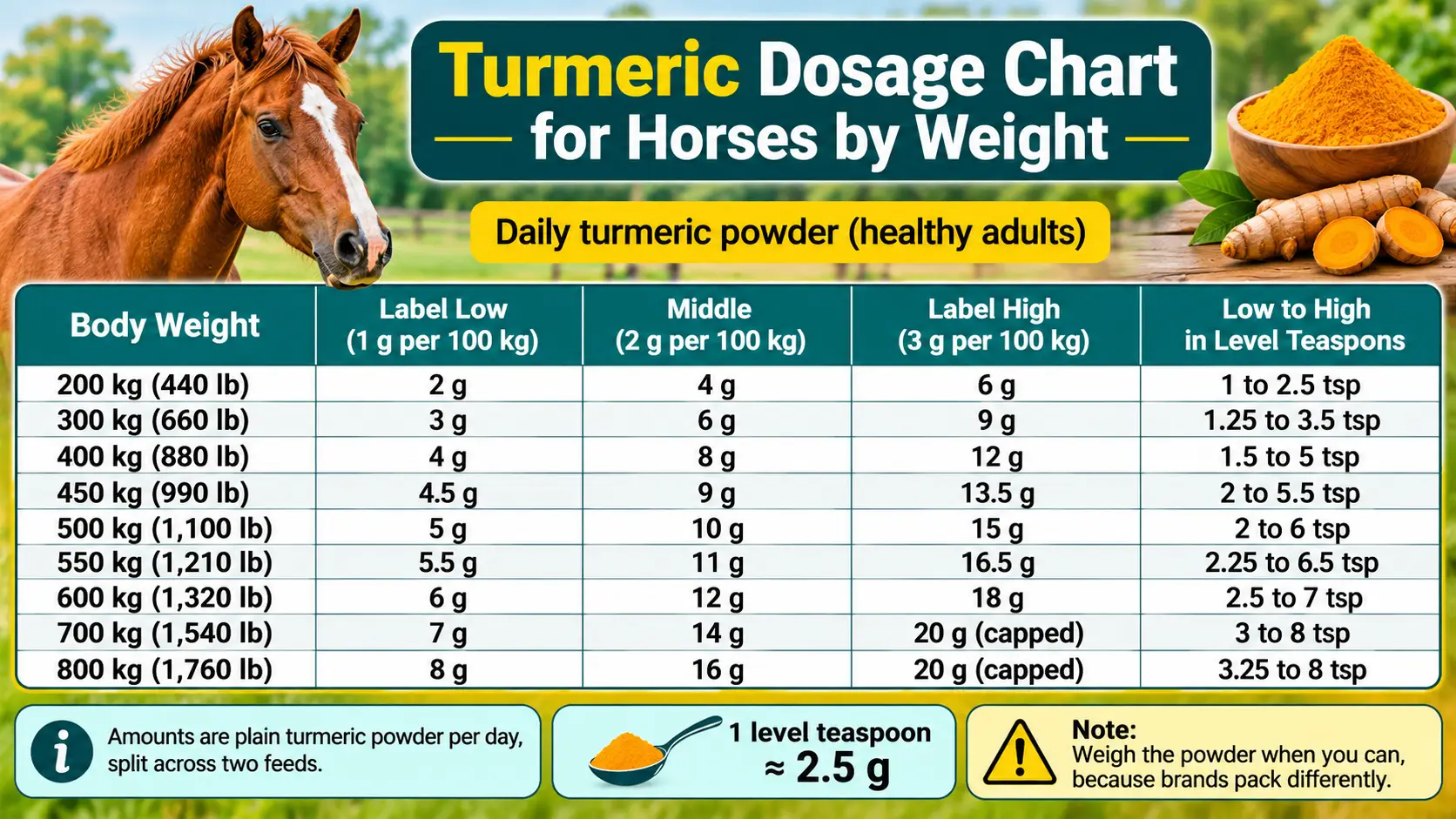
The chart turns the Reverdy label into one range per body weight. The low column is 1 g per 100 kg and the high column is 3 g per 100 kg, which are the two ends of the label. The middle column is 2 g per 100 kg. Daily amounts are capped at 20 g, the top of the research range Tribute describes.
Daily turmeric powder by body weight (healthy adults)
| Body weight | Label low (1 g per 100 kg) | Middle (2 g per 100 kg) | Label high (3 g per 100 kg) | Low to high in level teaspoons |
|---|---|---|---|---|
| 200 kg (440 lb) | 2 g | 4 g | 6 g | 1 to 2.5 tsp |
| 300 kg (660 lb) | 3 g | 6 g | 9 g | 1.25 to 3.5 tsp |
| 400 kg (880 lb) | 4 g | 8 g | 12 g | 1.5 to 5 tsp |
| 450 kg (990 lb) | 4.5 g | 9 g | 13.5 g | 2 to 5.5 tsp |
| 500 kg (1,100 lb) | 5 g | 10 g | 15 g | 2 to 6 tsp |
| 550 kg (1,210 lb) | 5.5 g | 11 g | 16.5 g | 2.25 to 6.5 tsp |
| 600 kg (1,320 lb) | 6 g | 12 g | 18 g | 2.5 to 7 tsp |
| 700 kg (1,540 lb) | 7 g | 14 g | 20 g (capped) | 3 to 8 tsp |
| 800 kg (1,760 lb) | 8 g | 16 g | 20 g (capped) | 3.25 to 8 tsp |
Amounts are plain turmeric powder per day, split across two feeds. One level teaspoon is about 2.5 g, based on the label conversion of 1 mL to roughly 0.5 g. Weigh the powder when you can, because brands pack differently.
A few notes on reading the chart:
- Use real body weight. Guessing from a breed chart is the easiest way to overdose. Use a weigh tape or a scale.
- Ponies follow the same maths. The Reverdy label lists 3 to 9 g for a 300 kg pony, which matches the low and high columns.
- Start below the low column if you want to be extra careful. Tribute’s 2.4 g guideline is lower than the label dose for a 500 kg horse.
- The high column is for short courses. The label runs 3 week courses and repeats them if necessary.
- Foals, yearlings and pregnant or nursing mares are not covered. Tribute says safety has not been established for them, and the Reverdy label advises against use in pregnant and lactating mares.
Turmeric Dosage Calculator for Horses
Enter your horse’s weight, pick a stage, and the calculator returns grams per day, grams per feed, teaspoons and millilitres. It never shows more than 20 g a day.
Introduce gradually into the ration. Mix well with cereals or pelleted feed.
Distribute twice daily if possible.
Length of treatment: 3 weeks. Repeat if necessary. Consult your vet for advice.
Do not give to horses that are hypersensitive or allergic to turmeric, or that have gastric or hepatobiliary problems.
Safety has not been established in pregnant or lactating mares or in young growing horses. Ask your vet first.
Stop and call your vet if you see digestive upset or signs of an allergic reaction.
Dose is based on the Reverdy Turmeric 1kg feeding guide.
© medshorse.com
How These Dosage Ranges Were Built
The low and high columns come straight from the Reverdy label, which lists 1 to 3 g per 100 kg of body weight, 5 to 15 g for a 500 kg horse and 3 to 9 g for a 300 kg pony. The cautious start comes from Tribute’s guideline of up to 2.4 g a day.
The advice to start small and raise the dose each week comes from Turmeric Life. The middle column and the 20 g cap are simple steps within those published numbers.
What the ranges are not: an approved veterinary dose. Getty Equine Nutrition states that an appropriate dosage for horses has not been established, so treat the chart as a careful starting point and let your horse’s response guide you.
How to Start Feeding Turmeric to Your Horse
Start small, build weekly and watch the manure. Dr Doug English of Turmeric Life points out that turmeric does not stay in the body past several hours, so little and often is best, and he suggests raising the dose each week until a comfortable maintenance level is found.
The schedule below uses a 500 kg horse as the example. Scale it with the chart for other weights.
Build-up plan for a 500 kg horse
About 1 level teaspoon, split into two feeds. Watch appetite and manure.
The lower label dose, about 2 level teaspoons across two feeds if all is normal.
Raise only if needed. Settle on the lowest amount that suits your horse.
The label’s upper dose for a 3 week course. Do not go beyond it without your vet.
How to Mix Turmeric Into Feed
- Weigh the dose. A cheap kitchen scale beats a heaped spoon every time.
- Split it into two feeds where you can. Turmeric Life says once a day is still helpful if that is all you can manage.
- Dampen the feed well. Turmeric Life reports that horses accept it better when the feed is dripping wet.
- Add a little fat if the ration has none. Turmeric Life suggests coconut, olive or linseed oil, and says you can leave the oil out if the feed already contains fat. You can compare oil amounts in our guide to camelina oil dosage for horses.
- Keep notes. Record the date, dose, manure quality and how your horse moves.
Golden Paste Ratio for Horses
Turmeric Life’s ratio is 10 mL of turmeric (a dessert spoon), 5 to 10 mL of oil and about 16 grinds of fresh black pepper, with water added to make a paste. Double everything when you double the turmeric. Count only the turmeric toward your daily dose.
If you make a batch, keep it in the fridge between feeds. Cooking the paste helps, but it is not critical, and mixing dry turmeric with oil and pepper into the feed also works.
Spoon sizes differ by country. Turmeric Life lists 1 teaspoon as 5 mL and 1 dessertspoon as 10 mL. A tablespoon is 15 mL in the US, UK and Canada and 20 mL in Australia.
Turmeric Powder, Curcumin Extract and Golden Paste: Do the Doses Change?
Yes, and this is where many owners go wrong. The chart above is for plain turmeric powder only. Other forms carry very different amounts of curcumin, the active compound.
| Form | Curcumin content | How to dose it |
|---|---|---|
| Plain turmeric powder | Roughly 2 to 3 percent | Use the chart in grams. At 3 percent, 10 g of powder holds about 300 mg of curcumin. |
| Golden paste | Same as the turmeric inside | Count only the turmeric. Oil and pepper do not count toward the dose. |
| High-potency curcumin capsules | Around 95 percent | Turmeric Life says these are not recommended for animals. Do not convert from the powder chart. |
Tribute notes that curcumin makes up only about 2 percent of the turmeric root, and StreamZ puts it at 2.5 to 3 percent. That is why a gram of powder delivers very little curcumin, and why products with different curcumin levels cannot share one dose.
Absorption: Do Horses Need Oil and Black Pepper?
Curcumin is poorly absorbed, with oral bioavailability of around 1 percent according to Tribute. Fat helps because curcumin dissolves in it. Piperine from black pepper raised curcumin absorption by 2000 percent in humans and about 154 percent in rats.
Tribute adds that horses have shown benefits in studies without pepper, and that more research is needed to know whether pepper helps them. So pepper is optional. Turmeric Life still includes it in its basic recipe.
Turmeric Side Effects and Safety Limits for Horses
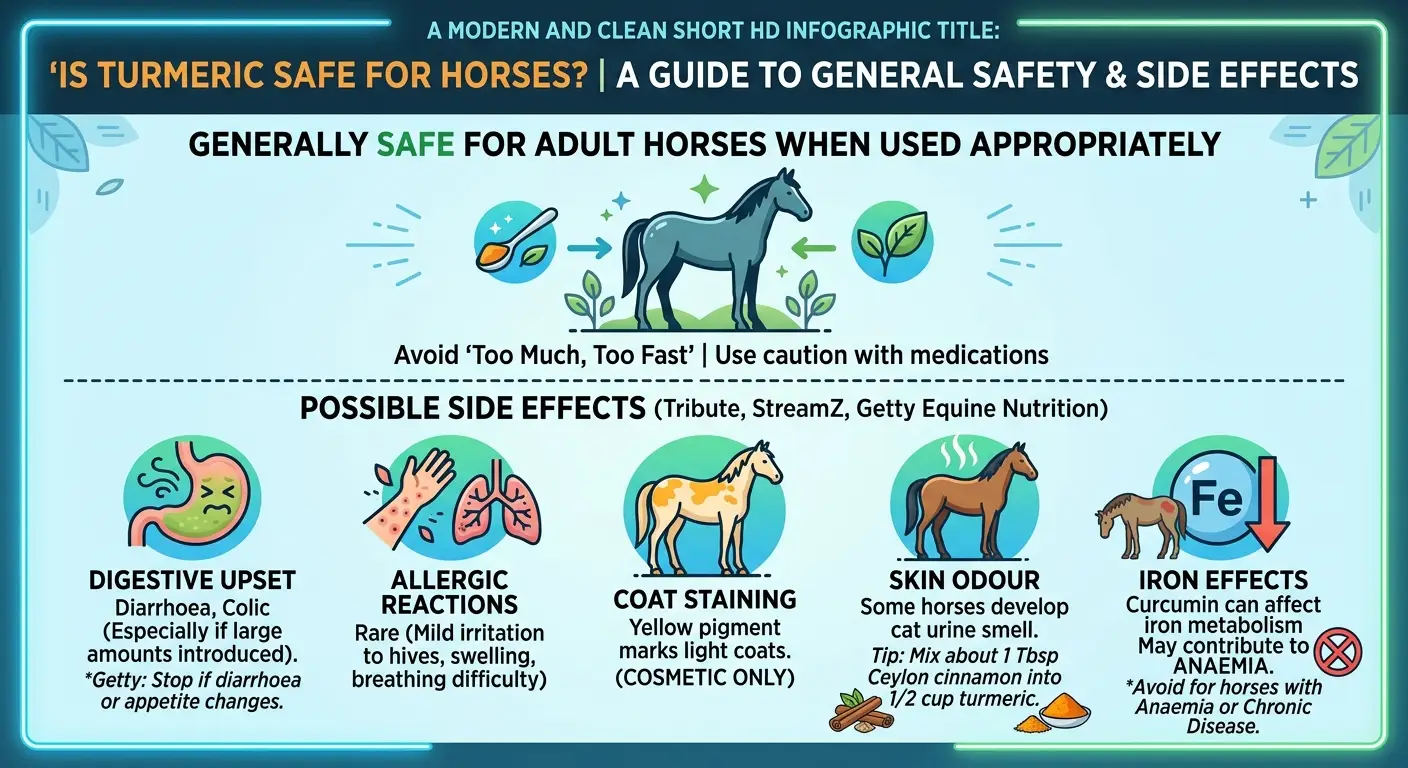
Tribute describes turmeric as generally safe for adult horses when used appropriately. Most problems come from feeding too much too fast, or from combining it with medication.
Possible Side Effects
- Digestive upset. Tribute and StreamZ both report diarrhoea or colic in some horses, particularly when turmeric is introduced in large amounts. Getty advises stopping if diarrhoea or appetite changes occur.
- Allergic reactions. Rare, from mild skin irritation to hives, swelling or breathing difficulty.
- Coat staining. The yellow pigment can mark light coats. This is cosmetic.
- Skin odour. Some horses develop a cat urine type smell. Turmeric Life suggests mixing about 1 tablespoon of Ceylon cinnamon into half a cup of turmeric.
- Iron effects. StreamZ says curcumin can affect iron metabolism and contribute to anaemia, and advises against turmeric for horses with anaemia or chronic disease.
Medication Interactions and Health Conditions
Dr Getty says turmeric slows blood clotting, advises stopping it before planned surgery, and advises not giving NSAIDs together with turmeric. StreamZ adds that turmeric could strengthen the effect of blood-thinning drugs.
So talk to your vet before pairing turmeric with phenylbutazone, flunixin or firocoxib. If your horse is on one of them, our guides to bute dosage for horses, Banamine dosage for horses and Equioxx dosage for horses explain the doses your vet is working with.
Ulcers deserve a mention too. The Reverdy label advises against turmeric in horses with stomach or liver and bile problems, while Tribute describes a study in which turmeric with devil’s claw did not worsen ulcers. Because the advice differs, ask your vet.
If your vet has prescribed treatment, keep it running and read our omeprazole dosage for horses guide for context.
Ask your vet before starting if your horse
- Is pregnant or nursing
- Is still growing (foals, weanlings, yearlings)
- Takes NSAIDs, blood thinners or other regular medication
- Has a stomach, liver, bile duct or kidney problem
- Has been diagnosed with anaemia or a chronic disease
- Has surgery planned
- Is about to compete
Stop feeding and call your vet if you see
- Loose manure or diarrhoea
- Loss of appetite
- Pawing, rolling or other colic signs
- Hives, swelling or skin reactions
- Laboured breathing
Kidney Disease and Competition Horses
StreamZ notes that evidence on curcumin and kidney health is mixed, with harm seen in rats at very high doses and protection in other studies, and recommends consulting a vet before feeding turmeric to a horse with kidney disease.
For competition, the Reverdy label recommends stopping at least 72 hours before an event, because it cannot guarantee the product is free of substances prohibited under FEI and racing codes. Check your own governing body’s rules.
Can Turmeric Replace Bute or Equioxx?
No. Dr Getty reports that her own off-the-track Thoroughbred with bone chips did as well on turmeric as he had on a low dose of bute, but that is one horse. StreamZ stresses that turmeric should only be a complementary approach and never a replacement for prescribed medication.
Any change to pain relief should be planned with your vet. If your horse needs a firocoxib product, our firocoxib dosage for horses guide covers the weight-based numbers.
How Long Should You Feed Turmeric?
The Reverdy label runs 3 week courses and says to repeat them if necessary. Turmeric Life suggests raising the dose each week until a healthy maintenance level is found and checking for any change in your horse.
Dr Getty stepped her horse down from two tablespoons to one after two months, relying on more only when needed. A sensible approach is to review at about four weeks, keep the lowest amount that seems to help, and stop if nothing has changed.
Common Turmeric Feeding Mistakes
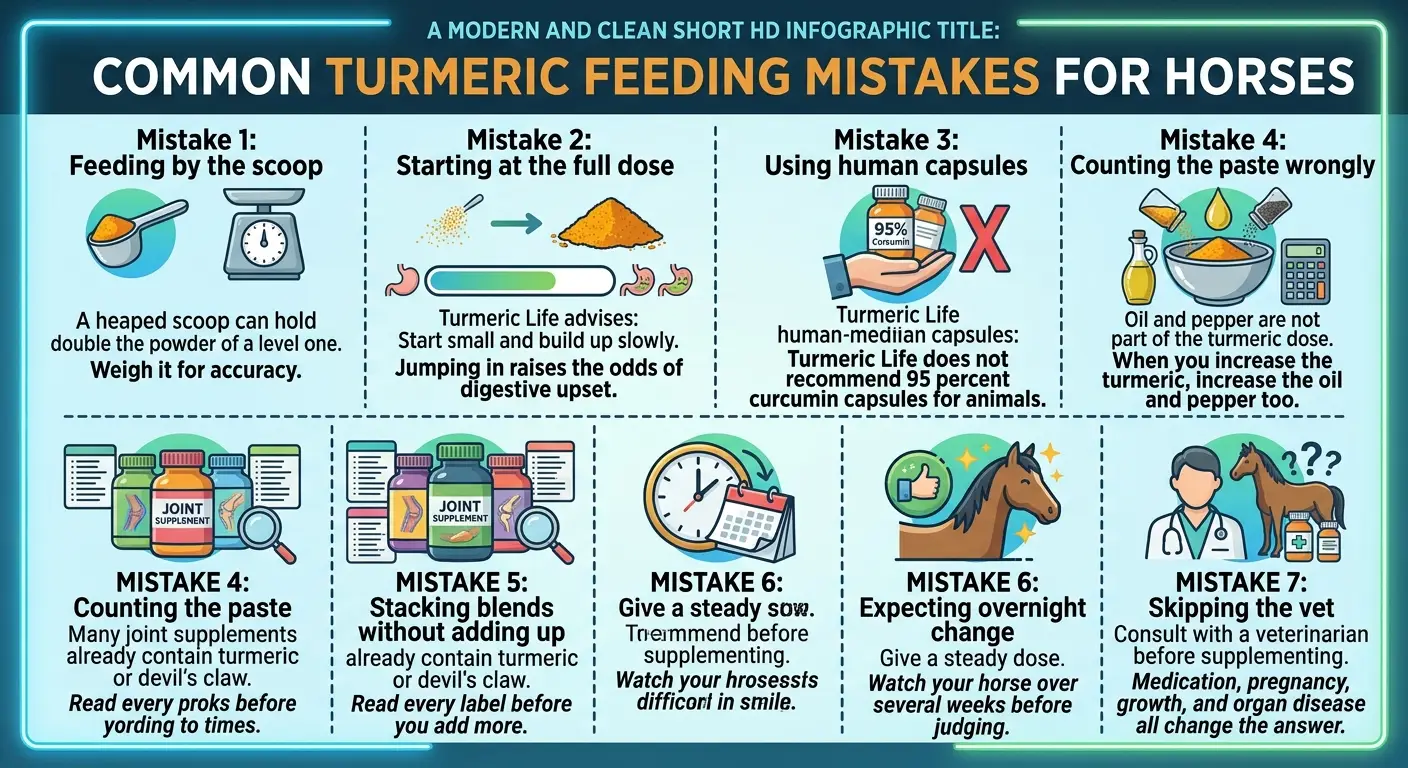
- Feeding by the scoop. A heaped scoop can hold double the powder of a level one. Weigh it.
- Starting at the full dose. Turmeric Life advises starting small and building up. Jumping in raises the odds of digestive upset.
- Using human capsules. Turmeric Life does not recommend 95 percent curcumin capsules for animals.
- Counting the paste wrongly. Oil and pepper are not part of the turmeric dose. When you increase the turmeric, increase the oil and pepper too.
- Stacking blends without adding up. Many joint supplements already contain turmeric or devil’s claw. Read every label before you add more.
- Expecting overnight change. Give a steady dose and watch your horse over several weeks before judging.
- Skipping the vet. Medication, pregnancy, growth and organ disease all change the answer.
Key Takeaways on Turmeric Dosage for Horses
- There is no official dose. Use the Reverdy label range of 1 to 3 g of powder per 100 kg a day as a working range for healthy adults.
- Start cautiously, with up to 2.4 g a day for a 500 kg horse, and raise the dose each week.
- Split the daily amount across two feeds and dampen the feed.
- Do not exceed 3 g per 100 kg or 20 g a day without your vet.
- Powder, paste and concentrated capsules are not interchangeable.
- Ask your vet first for pregnant or nursing mares, growing horses and horses on NSAIDs or blood thinners.
- Stop at the first sign of diarrhoea, appetite loss or colic.
FAQs
How much turmeric should I give my horse per day?
There is no official dose. A practical working range for healthy adults is 1 to 3 g of turmeric powder per 100 kg of body weight daily, based on the Reverdy label. For a 500 kg (1,100 lb) horse that is 5 to 15 g. Start with up to 2.4 g a day and raise it each week.
How much turmeric for a 1,000 lb horse?
A 1,000 lb horse weighs about 454 kg. Start with about 2.4 g a day for a week, then move to the label range of about 4.5 to 13.6 g a day, which is roughly 2 to 5.5 level teaspoons. Weigh the powder on a kitchen scale and split it across two feeds.
Can horses have turmeric every day?
Yes, healthy adult horses are commonly fed turmeric daily. The Reverdy label runs 3 week courses and repeats them if necessary, and one nutritionist kept feeding her horse for months at a lower dose. Long-term data is limited, so review the benefit every four weeks and stop if nothing has changed.
Does turmeric need black pepper for horses?
Not proven. Black pepper raised curcumin absorption by 2000 percent in humans, but Tribute says it is not yet known whether it helps horses, and horses have shown benefits in studies without it. Turmeric Life still includes pepper in its basic recipe, so it is optional.
Is turmeric safe for horses with ulcers?
A 28 day study of 12 Thoroughbreds described by Tribute found that turmeric with devil’s claw did not cause or worsen ulcers. However, the Reverdy label advises against turmeric in horses with stomach problems, so ask your vet and keep any prescribed ulcer treatment in place.
Can I give turmeric with bute, Banamine or Equioxx?
Ask your vet first. Dr Getty advises not giving NSAIDs together with turmeric, and StreamZ says turmeric may strengthen the effect of blood-thinning drugs. Never swap or stack pain medication on your own.
Can turmeric replace Equioxx or bute?
No. Dr Getty reports that her own horse did well after moving from bute to turmeric, but that is one case. StreamZ stresses that turmeric should only be a complementary approach and never a replacement for prescribed treatment. Plan any change with your vet.
What is the best form of turmeric for horses: powder, paste or capsules?
Plain turmeric powder fed with a little fat is the simplest form, and golden paste is the same turmeric cooked into a paste. Turmeric Life does not recommend capsules with 95 percent curcumin for animals, so follow the product label exactly and do not convert doses by guesswork.
How long does turmeric take to work in horses?
The sources give no fixed timeline. The Reverdy label runs 3 week courses, and Turmeric Life suggests raising the dose each week while watching your horse. Allow about four weeks at a steady dose, track stiffness and mood in a notebook, and then reassess.
How many teaspoons of turmeric equal 10 grams?
About 4 level teaspoons, using the Reverdy label conversion of 1 mL of powder to roughly 0.5 g and a teaspoon of 5 mL. Powders pack differently between brands, so a kitchen scale is more accurate than any spoon.
Can pregnant mares, nursing mares or foals have turmeric?
Safety has not been established in pregnant or lactating mares or in young growing horses, according to Tribute, and the Reverdy label advises against use in pregnant and lactating mares. Talk to your vet before feeding turmeric to any of them.
Will turmeric stain my horse or change the smell of the skin?
It can. The yellow pigment may stain light coats, and some horses develop a cat urine type smell on the skin. Turmeric Life suggests mixing about 1 tablespoon of Ceylon cinnamon into half a cup of turmeric to reduce it.
Should I stop turmeric before a competition?
The Reverdy label recommends stopping at least 72 hours before taking part in any competition, because it cannot guarantee the absence of substances prohibited by the FEI and racing codes. Check your own governing body’s rules as well.
What happens if a horse eats too much turmeric?
Large amounts can cause diarrhoea or colic, particularly when turmeric is introduced quickly. Tribute notes that horses have been given 12 to 20 g daily in research over short periods without adverse effects, but that is not a reason to go higher. Stop feeding it and call your vet if signs appear.
Can I give my horse human turmeric capsules?
Not advised. Turmeric Life says commercial capsules with high levels of curcumin, around 95 percent, are not recommended for use with animals. Use plain turmeric powder or an equine product with clear label directions.
Does turmeric help horses with arthritis?
Early research suggests it may calm inflammatory pathways in joint disease, and Dr Getty cites improved lameness scores with a curcumin formula. Clinical research in horses is still limited, so treat turmeric as a supportive extra and not a stand-alone treatment.
Your Next Steps
Weigh your horse, find the row on the chart, and write down your start dose. Feed it for a week, then raise it to the next step if manure and appetite stay normal. Keep a short daily note on stiffness and mood, and review at about four weeks. If your horse takes medication or is in any of the groups listed above, call your vet before the first scoop.
Turmeric can be a useful, low-cost extra for many adult horses, but it works best as one part of a plan that includes good forage, steady exercise and veterinary care.