Firocoxib Dosage for Horses: Weight Chart, Calculator and the Safe Way to Dose Tablets, Paste and Injection
Written & Reviewed By: Medshorse Team
Last Updated: October 2026
You are holding a 57 mg tablet, and your horse weighs about 1,050 pounds. Is that the right amount? Under the US label, yes: one tablet once daily covers horses from 800 to 1,300 pounds. But the correct firocoxib dosage for horses depends on the form you have, your horse’s true weight and how many days of treatment have already passed.
This guide gives you the labeled dose for every form, a weight-based dosage chart, a calculator, step-by-step dosing tips, side effects and the situations where firocoxib is the wrong choice. Everything is checked against FDA-approved labels, European product information and peer-reviewed research, last reviewed in October 2026.
Firocoxib is prescription-only, so treat this as education and let your veterinarian set the final plan.
Disclaimer: This article is for general education and is not veterinary advice. Product names mentioned, including Firocoxib, belong to their respective owners, and MedsHorse is not affiliated with them. Always follow your veterinarian’s instructions and the current product label.
Firocoxib Dosage for Horses at a Glance
The labeled firocoxib dose for horses is 0.1 mg/kg (0.045 mg/lb) by mouth once daily, for no more than 14 days across all forms. A 1,000 lb horse needs about 45 mg orally. That equals one 57 mg tablet, four marks on the paste syringe, or 2 mL of injection given by a vet.
Prescription only. Not for horses intended for human consumption. Sources: FDA-approved labels on DailyMed and FDA Animal Drugs.
Firocoxib Dosage Calculator for Horses
Type in your horse’s weight and the calculator returns the daily oral dose in milligrams, the tablet answer, the paste syringe setting and the injection volume. It uses the exact figures printed on the FDA labels.
Firocoxib Dosage Calculator for Horses
Enter your horse’s body weight to calculate the mathematical daily dose estimate using the supplied 0.1 mg/kg reference.
Calculated Dose Estimate
Important dosage information
Supplied weight-based reference: 0.1 mg/kg of body weight, once daily.
Supplied tablet reference: One 57 mg tablet orally once daily for horses weighing 800–1,300 lb, for up to 14 days. It may be given with food.
The tablet reference and weight-based calculation may not produce the same amount. Do not use this calculator to decide whether to split tablets or change a prescribed dose. Follow the product label and your veterinarian’s instructions.
A weight tape gives an estimate, and the label stresses accurate body weight because dosing errors in either direction matter. If your horse is between sizes, a livestock scale at a vet clinic or feed store gives a better number than a guess.
Firocoxib Dosage Chart by Horse Weight
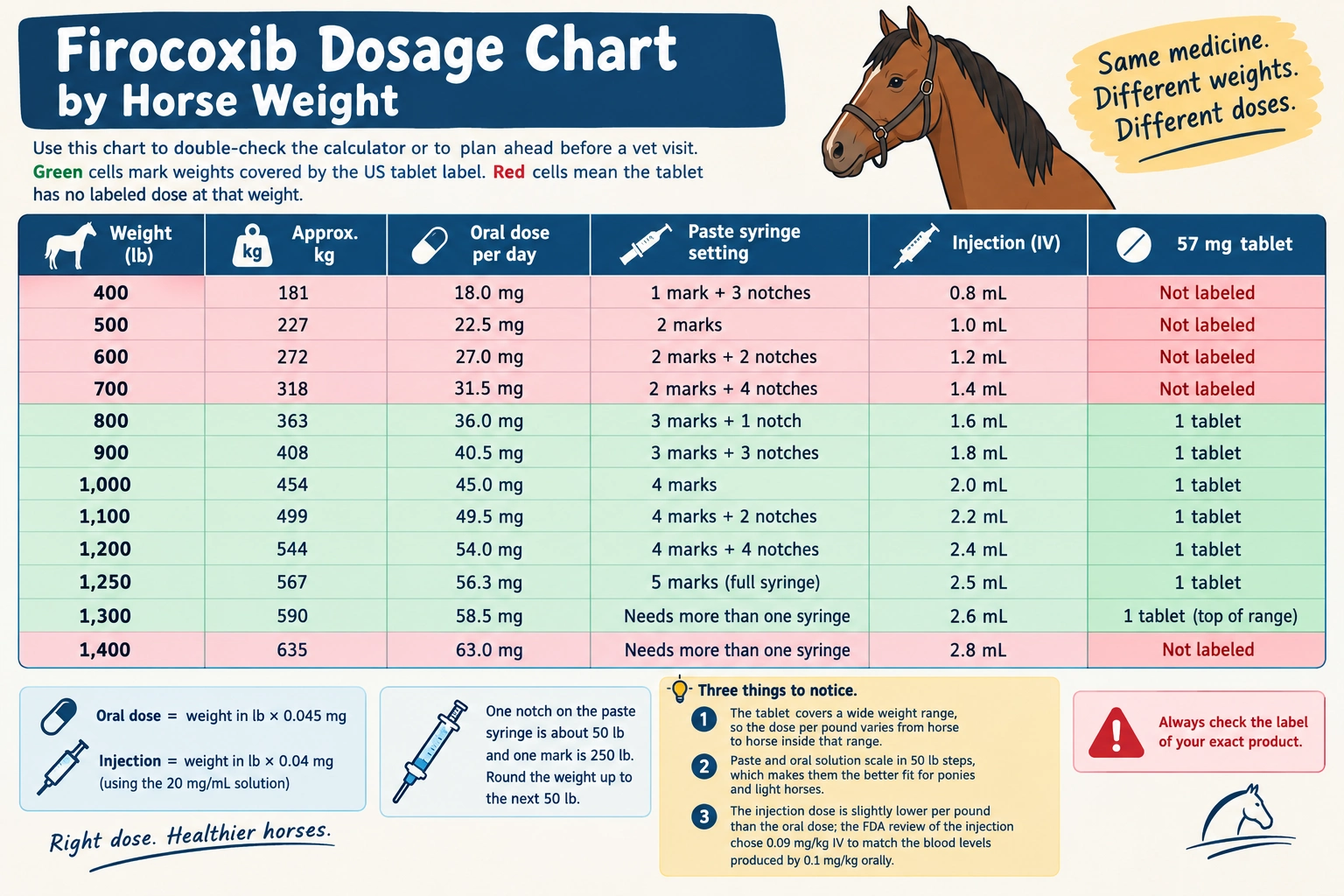
Use this chart to double-check the calculator or to plan ahead before a vet visit. Green cells mark weights covered by the US tablet label. Red cells mean the tablet has no labeled dose at that weight.
| Weight (lb) | Approx. kg | Oral dose per day | Paste syringe setting | Injection (IV) | 57 mg tablet |
|---|---|---|---|---|---|
| 400 | 181 | 18.0 mg | 1 mark + 3 notches | 0.8 mL | Not labeled |
| 500 | 227 | 22.5 mg | 2 marks | 1.0 mL | Not labeled |
| 600 | 272 | 27.0 mg | 2 marks + 2 notches | 1.2 mL | Not labeled |
| 700 | 318 | 31.5 mg | 2 marks + 4 notches | 1.4 mL | Not labeled |
| 800 | 363 | 36.0 mg | 3 marks + 1 notch | 1.6 mL | 1 tablet |
| 900 | 408 | 40.5 mg | 3 marks + 3 notches | 1.8 mL | 1 tablet |
| 1,000 | 454 | 45.0 mg | 4 marks | 2.0 mL | 1 tablet |
| 1,100 | 499 | 49.5 mg | 4 marks + 2 notches | 2.2 mL | 1 tablet |
| 1,200 | 544 | 54.0 mg | 4 marks + 4 notches | 2.4 mL | 1 tablet |
| 1,250 | 567 | 56.3 mg | 5 marks (full syringe) | 2.5 mL | 1 tablet |
| 1,300 | 590 | 58.5 mg | Needs more than one syringe | 2.6 mL | 1 tablet (top of range) |
| 1,400 | 635 | 63.0 mg | Needs more than one syringe | 2.8 mL | Not labeled |
Oral dose = weight in lb × 0.045 mg. Injection = weight in lb × 0.04 mg, using the 20 mg/mL solution. One notch on the paste syringe is about 50 lb and one mark is 250 lb; round the weight up to the next 50 lb. Always check the label of your exact product.
Three things to notice. First, the tablet covers a wide weight range, so the dose per pound varies from horse to horse inside that range. Second, paste and oral solution scale in 50 lb steps, which makes them the better fit for ponies and light horses.
Third, the injection dose is slightly lower per pound than the oral dose; the FDA review of the injection chose 0.09 mg/kg IV to match the blood levels produced by 0.1 mg/kg orally.
What Is Firocoxib and How Does It Work in Horses?
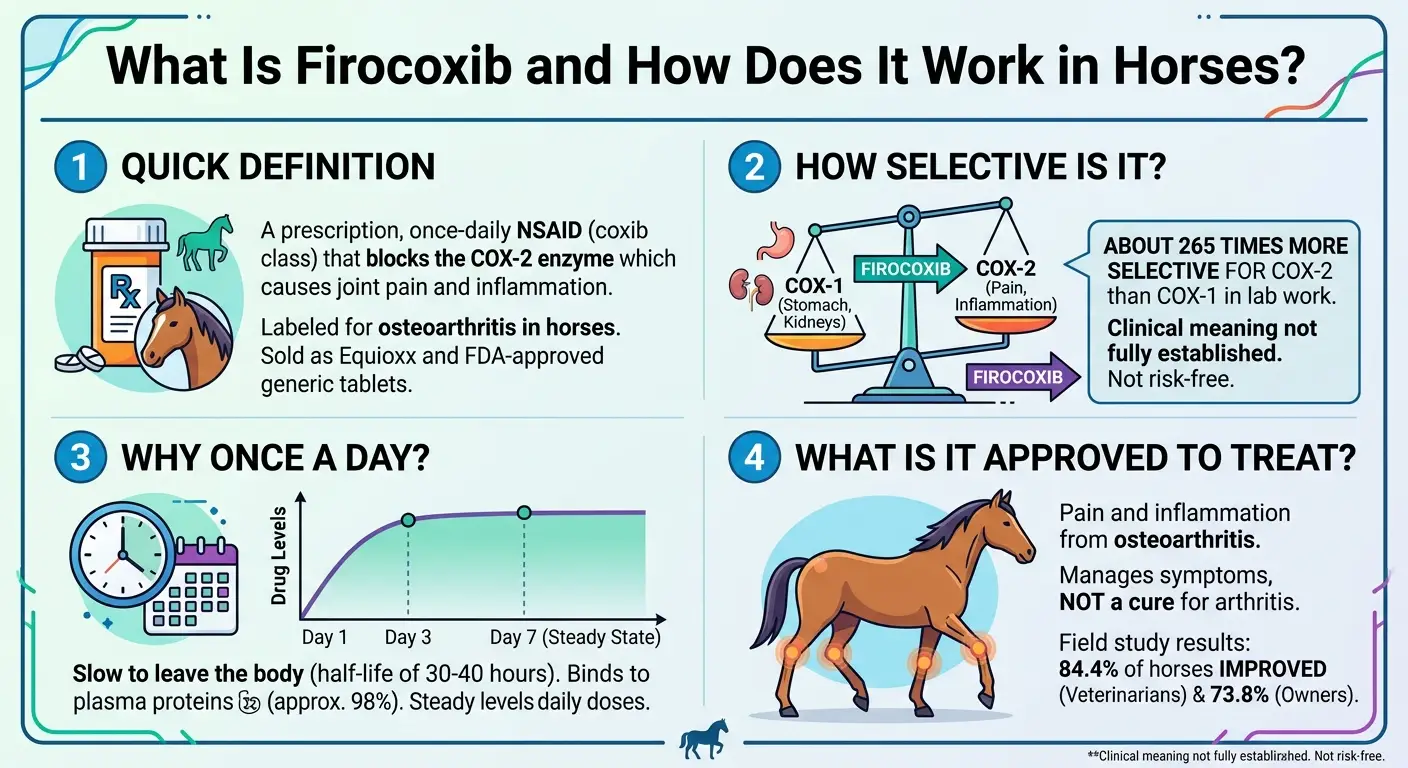
Firocoxib is a prescription, once-daily NSAID in the coxib class. It blocks the COX-2 enzyme that drives joint pain and inflammation. In horses it is labeled for osteoarthritis and sold as Equioxx and as FDA-approved generic tablets.
Firocoxib belongs to the same broad family as bute and Banamine, but it is built to be more selective. Most NSAIDs block two enzymes, COX-1 and COX-2. COX-1 helps protect the stomach lining and keeps blood flowing to the kidneys. COX-2 is the one that ramps up in an inflamed joint.
How selective is it?
In laboratory work cited in a 2014 review in Veterinary Medicine: Research and Reports, firocoxib was about 265 times more selective for COX-2 than for COX-1. The FDA label adds an honest caveat: the clinical meaning of that lab selectivity has not been established. In practice, selective does not mean risk-free.
Why is it dosed only once a day?
Firocoxib is slow to leave the body. Its half-life in horses averages 30 to 40 hours, and about 98% of it binds to plasma proteins. That long half-life means one dose a day is enough, and it also means the drug accumulates. The label notes that steady levels build after roughly 6 to 8 daily doses.
What is it approved to treat?
The US label covers control of pain and inflammation linked to osteoarthritis in horses. In the field study behind the label, 84.4% of horses given the paste were judged improved by veterinarians and 73.8% by owners. It manages symptoms; it is not a cure for arthritis.
Firocoxib Dosage by Form: Tablet, Paste, Oral Solution and Injection
The active ingredient is identical across forms, but the way you measure the dose is not. Mixing up the steps for one form with another is a common source of errors.
| Form | Strength | Labeled dose | Who gives it | Key detail |
|---|---|---|---|---|
| Chewable tablet | 57 mg | 1 tablet once daily for horses 800 to 1,300 lb | Owner | Can be hand-fed with or without feed; up to 14 days |
| Oral paste | 0.82% (about 56.8 mg per 6.93 g syringe) | 0.045 mg/lb (0.1 mg/kg) once daily | Owner | Each mark treats 250 lb; round weight up to the next 50 lb |
| Oral solution | Varies by product | 0.045 mg/lb (0.1 mg/kg) once daily | Owner | Use only the supplied syringe; each line equals 50 lb |
| Injection | 20 mg/mL | 0.04 mg/lb (0.09 mg/kg) IV once daily for up to 5 days | Veterinarian | Paste can follow for up to 9 more days; total never above 14 |
Sources: Equioxx and generic firocoxib labels (DailyMed, FDA Animal Drugs, Boehringer Ingelheim). Regional labels may differ.
Firocoxib tablets (57 mg)
The US label for brand and generic tablets reads one 57 mg tablet by mouth once daily for horses weighing 800 to 1,300 lb, for up to 14 days. Manufacturer information from Boehringer Ingelheim puts that range at roughly 0.04 to 0.07 mg per pound.
The tablets can be fed by hand or with a little food. If you are comparing brands, see our guide to Equioxx dosage for horses.
In the UK and EU, the licensed 57 mg tablet is limited to horses weighing 450 to 600 kg, and the authorization advises other firocoxib forms outside that range.
Firocoxib oral paste
The paste is dosed at 0.045 mg/lb once daily. Each full mark on the syringe treats 250 lb, and each notch stands for about 50 lb. To pick your setting, round your horse’s weight up to the nearest 50 lb. If the weight is already an exact 50 lb step, do not round up. A single 6.93 g syringe treats horses up to about 1,250 lb.
Firocoxib injection
The injection is for intravenous use only and is given by a veterinarian. The labeled dose is 0.04 mg/lb (0.09 mg/kg) once daily for up to 5 days. If more treatment is needed, paste can follow at 0.045 mg/lb for up to 9 more days. The total course, injection plus paste, still tops out at 14 days.
Firocoxib for ponies and small horses
The tablet label gives no dose below 800 lb, so a 500 lb pony cannot be dosed accurately from a 57 mg tablet. The paste and oral solution are dosed per pound in 50 lb steps. A 500 lb pony would need about 22.5 mg a day. Do not guess at a half or quarter tablet; ask your vet which form fits.
How to Give Firocoxib to Your Horse, Step by Step
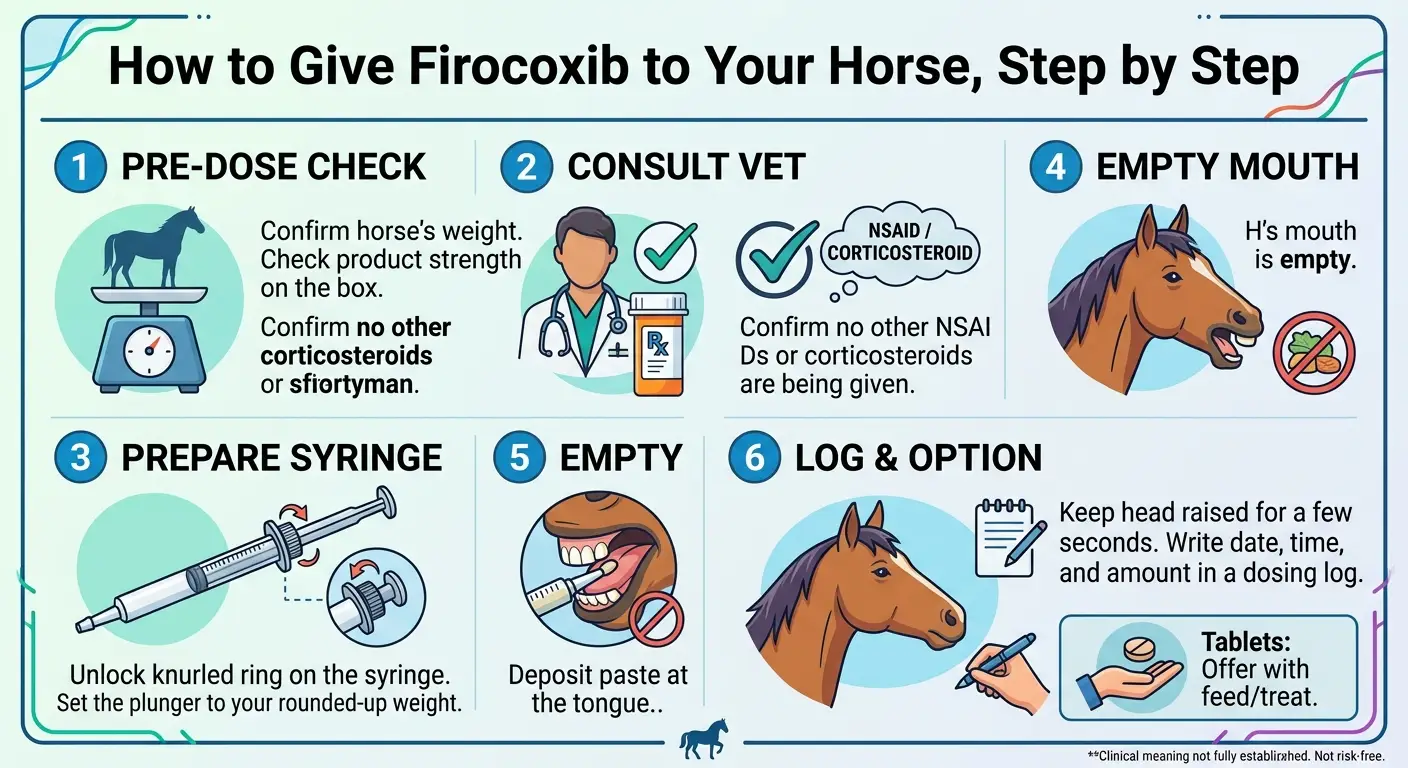
Giving the right amount only counts if the horse actually swallows it. Follow this routine for paste:
- Confirm the current weight and the product strength on the box.
- Check with your vet that no other NSAID or corticosteroid is on board.
- Unlock the knurled ring on the syringe and set the plunger to your rounded-up weight.
- Make sure the horse’s mouth is empty, then insert the tip at the gap between the front and back teeth.
- Deposit the paste at the base of the tongue and keep the head slightly raised for a few seconds.
- Write down the date, time and amount in a dosing log.
For tablets, offer the tablet in your palm with a small amount of feed or a treat. European guidance recommends glancing in the mouth afterward to confirm it was swallowed. If the horse spits it out, do not give a second one on your own; call your vet for advice.
How Long Can a Horse Stay on Firocoxib?
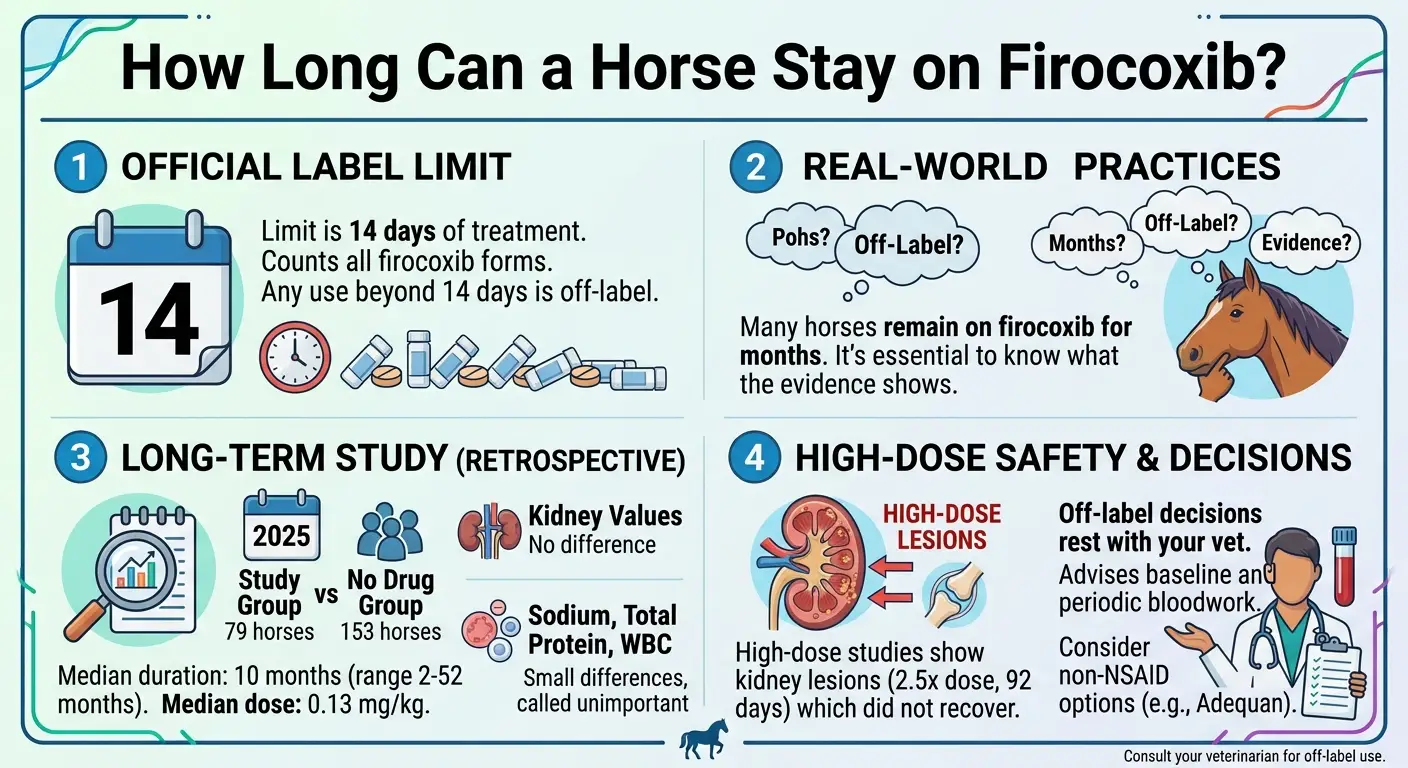
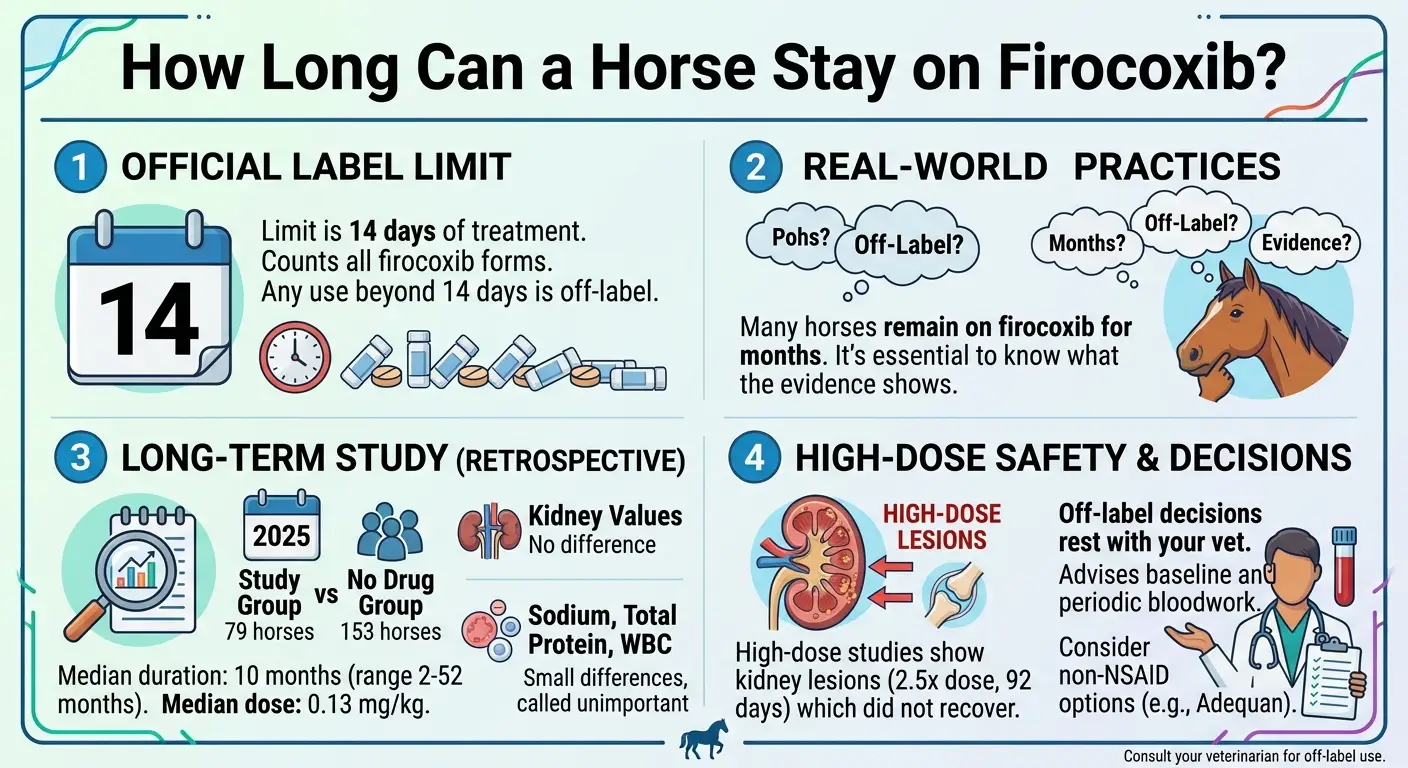
The label limit is 14 days of treatment, counting every firocoxib form together. Many owners still hear about horses on firocoxib for months, so it helps to know what the evidence shows.
A 2025 retrospective study in the Journal of Veterinary Internal Medicine compared 79 horses on long-term firocoxib with 153 horses not on it. The treated horses had been on the drug for a median of 10 months, with a range of 2 to 52 months, at an average dose of about 0.13 mg/kg.
Kidney values (BUN and creatinine) did not differ between groups. Small differences appeared in sodium, total protein and white blood cell count, which the authors called clinically unimportant.
That is reassuring but limited. It was a retrospective study, the long-term group was older, owner compliance could not be verified, and horses that stopped the drug because of problems could have dropped out of the data. The authors themselves note that oral firocoxib is labeled for 14 days.
Higher-dose safety studies point the same way. In a 92-day study, kidney lesions appeared in every treated group, including horses at 2.5 times the recommended dose, and the kidney changes did not recover during follow-up.
Any use beyond 14 days is an off-label decision that belongs with your vet, ideally with baseline and periodic bloodwork, as the label advises for any NSAID. Ask whether non-NSAID joint options, such as Adequan dosage for horses, fit your horse’s case.
How Long Does Firocoxib Take to Work?
Most horses show improvement within about a week. Because firocoxib builds up gradually, it can feel slower than bute at first.
Source: FDA-approved label (DailyMed) and Donnell and Frisbie, 2014. Individual horses vary.
In the field studies cited in the 2014 review, lameness assessments were made at day 7 and day 14, and improvement was most rapid within the first 7 days. One force-plate study reported measurable gains as early as day 2.
Researchers have also tested a one-time 0.3 mg/kg loading dose to reach steady levels faster. That is not on the label, so it should only ever be used on a vet’s instruction.
What the Research Says About Firocoxib’s Effectiveness
Firocoxib has been compared with bute and with another NSAID in controlled field trials. The results below come from the FDA label and from the 2014 review by Donnell and Frisbie.
Label field study (paste, 240 horses evaluated)
Firocoxib vs phenylbutazone (253 horses, 14 days)
Firocoxib vs vedaprofen (96 lame horses, 14 days)
These are separate trials with different designs, so compare within each group, not across groups. The firocoxib vs bute and firocoxib vs vedaprofen differences in overall improvement were not statistically significant. Sources: FDA label; Donnell and Frisbie, 2014 (Vet Med Res Rep).
The pattern is consistent. Firocoxib performs about as well as bute for overall lameness and may help more on pain on palpation, joint circumference and range of motion over 14 days. The same review concluded that firocoxib relieves symptoms but has no proven disease-modifying effect on osteoarthritis.
Firocoxib vs Bute: Which Is Better for Horses?
Neither is better for every horse. Your vet weighs cost, speed of relief, the horse’s gut and kidney health and whether the horse competes. For a closer look at the older drug, see our guide to bute dosage for horses.
| Measure | Firocoxib (paste) | Phenylbutazone (paste) |
|---|---|---|
| Daily dose used | 0.1 mg/kg | 4.4 mg/kg |
| Enzyme targeted | COX-2 preferential | COX-1 and COX-2 (non-selective) |
| Overall lameness improved | 85% | 87% (no significant difference) |
| Pain on manipulation improved | 75% | 50% |
| Joint circumference improved | 35% | 13% |
| Range of motion improved | 45% | 30% |
| Horses with reported health or behaviour issues | 3 of 123 (2.4%) | 4 of 119 (3.4%) |
Source: Doucet et al., 2008, as summarised in Donnell and Frisbie, 2014 (PMC7337192). The authors of the review judged firocoxib’s onset to be slower than bute at the recommended dose.
The key trade-off: bute works fast and costs less, while firocoxib is given once daily at a precise weight-based dose and is more selective for COX-2. Do not give them together. The sections below explain why.
Firocoxib Side Effects in Horses and Warning Signs
At the labeled dose, serious problems are uncommon. In the US field studies of 127 horses on firocoxib paste, the reported events were mild, such as diarrhea, loose stool and excitation. A large clinical series of roughly 470 horses reported adverse effects in fewer than 1%, mostly lip swelling, mild colic and small mouth ulcers.
The most characteristic issue is the mouth. In a 42-day safety study at the recommended dose, firocoxib delayed healing of existing oral ulcers and raised the number of new oral ulcers compared with controls. At 3 and 5 times the dose, oral ulcers rose over 30 days.
Kidney changes, including papillary necrosis in one horse at the labeled dose in the 42-day study, were seen in higher-dose and longer studies.
Source: firocoxib label client information sheet. Serious NSAID reactions can happen without warning, so check the mouth and manure daily.
Treatment should stop if appetite drops, colic appears, manure changes or the horse turns lethargic. Horses at greatest risk are those that are dehydrated, on diuretics, or already have kidney, liver or heart disease. Make sure your horse has constant access to clean water during treatment.
Who Should Not Get Firocoxib, and What Not to Combine It With
Skip firocoxib, or ask your vet first, in these situations:
- The horse is allergic to firocoxib or has had a reaction such as hives or facial swelling to aspirin or another NSAID.
- The horse is dehydrated, has kidney, liver or heart disease, or has a history of gastrointestinal ulcers.
- The horse is under one year old, or is a breeding, pregnant or lactating animal. The US label says safety has not been evaluated, and the EU authorization says not to use it in these animals.
- The horse is taking another NSAID such as Banamine or bute, or a systemic corticosteroid such as dexamethasone.
The combination rule matters because stacking anti-inflammatories raises the chance of ulcers and organ stress. Read our guides on Banamine dosage for horses and dexamethasone dosage for horses to see why those drugs should never overlap with firocoxib.
Switching from one anti-inflammatory to another also needs an appropriate washout period, and your vet should set it.
Firocoxib does not treat stomach ulcers. If your horse is prone to them, ask your vet about gastric protection, and read our omeprazole dosage for horses guide for background.
Withdrawal Times, Competition and Legal Notes
In the US, firocoxib is a prescription drug and is not for horses intended for human consumption. In the EU, the paste and tablets carry a 26-day withdrawal period for meat and offal. The tablets are also not authorized for animals producing milk for human consumption.
Competition rules for NSAIDs change by sport, region and year, and some bodies limit how many NSAIDs may be present at once. Check the current medication rules of your governing body before showing, racing or hauling to an event, and ask your vet how long to stop before competing.
Common Firocoxib Dosing Mistakes to Avoid
- Guessing the weight instead of measuring it.
- Using a tablet for a horse under 800 lb or over 1,300 lb.
- Forgetting to round the paste setting up to the next 50 lb step.
- Giving firocoxib together with bute, Banamine or a steroid.
- Running the course longer than 14 days without a vet’s direction.
- Doubling up after a missed dose or after a spat-out tablet.
- Storing tablets where dogs or other animals can reach them. The label specifically warns about accidental ingestion by pets.
Expert Tips for Safer Firocoxib Use
- Ask your vet about baseline bloodwork before starting, since the label recommends it for any NSAID.
- Keep a dosing log with date, time, form and amount.
- Look inside the mouth and check manure once a day for the whole course.
- Keep fresh water available at all times.
- Store the product out of reach of children, dogs and other pets.
- Report suspected side effects to the manufacturer or to the FDA at 1-888-FDA-VETS.
Key Takeaways and Next Steps
- The labeled dose is 0.1 mg/kg (0.045 mg/lb) by mouth once daily for up to 14 days, across all firocoxib forms.
- One 57 mg tablet is labeled only for horses of 800 to 1,300 lb. Use paste or oral solution for other weights.
- Paste settings are rounded up to the next 50 lb step; the injection is IV only and given by a vet.
- Never combine firocoxib with other NSAIDs or corticosteroids.
- Check the mouth, appetite, manure and water intake daily and stop if anything changes.
- Use the calculator and chart above to prepare questions, then confirm every dose with your veterinarian.
If your horse needs pain control beyond 14 days, book a vet visit now rather than waiting for the course to end. Bring the product box, your dosing log and your horse’s current weight.
FAQs
What is the firocoxib dosage for horses?
The labeled firocoxib dose for horses is 0.1 mg/kg (0.045 mg/lb) by mouth once daily for up to 14 days. That is about 45 mg a day for a 1,000 lb horse. The injection, given only by a vet, is 0.04 mg/lb intravenously once daily for up to 5 days. Total treatment with any firocoxib form should not exceed 14 days.
How much firocoxib does a 1,000 lb horse get?
A 1,000 lb horse gets about 45 mg of firocoxib by mouth once daily. In practice that is one 57 mg tablet, which the US label covers for horses of 800 to 1,300 lb, or four marks on the paste syringe. The IV injection works out to 40 mg, or 2 mL of the 20 mg/mL solution, given by a vet.
How many mg of firocoxib per pound is safe for a horse?
The labeled oral dose is 0.045 mg per pound, which equals 0.1 mg per kg, once daily. Higher doses are not recommended. In label safety studies, doses of 3 to 5 times this amount increased oral ulcers and caused kidney changes in some horses. Do not raise the dose unless your veterinarian tells you to.
What is the firocoxib dose for a pony or small horse?
The dose is the same 0.045 mg/lb once daily, but the 57 mg tablet has no labeled dose below 800 lb. A 500 lb pony needs about 22.5 mg a day. Paste and oral solution are measured in 50 lb steps, so they usually suit ponies better. Ask your vet which form to use.
Can I split a firocoxib tablet for my horse?
The US label gives the dose only as one whole 57 mg tablet for horses weighing 800 to 1,300 lb and does not describe a half-tablet dose. For lighter horses, ask your vet whether paste, which is dosed in 50 lb steps, is a safer fit than cutting tablets.
How long can a horse be on firocoxib?
The label limit is 14 days, counting tablets, paste, oral solution and injection together. A 2025 study found few lab changes in horses treated for a median of 10 months, but that was a retrospective study and longer use is off-label. Only extend treatment if your vet agrees and monitors your horse.
How long does firocoxib take to work in horses?
Most horses improve within about a week. Firocoxib has a half-life of 30 to 40 hours, and steady blood levels build after roughly 6 to 8 daily doses, so relief can feel gradual. Some studies saw gains by day 2. Any faster-acting loading dose is off-label and only for a vet to decide.
Can I give firocoxib with bute, Banamine or dexamethasone?
No. The label says to avoid giving firocoxib with other NSAIDs such as bute, Banamine, aspirin or ketoprofen, and with systemic corticosteroids such as dexamethasone or prednisolone. Combining them raises the risk of stomach ulcers and kidney problems. Ask your vet about the correct washout time when switching drugs.
Does firocoxib cause ulcers in horses?
Firocoxib is less likely to harm the stomach lining than non-selective NSAIDs, but it is not ulcer-proof. At the labeled dose, safety studies found more mouth ulcers and slower healing of existing ones. At higher doses some horses developed gastric ulcers. Check the mouth daily and stop if sores appear.
What are the signs of firocoxib side effects or toxicity?
Watch for sores on the tongue, lips or gums, scabs or redness around the mouth, reduced appetite, changes in drinking or urination, colic, loose manure, lethargy, yellow gums or eyes, and weight loss. Stop the drug and call your veterinarian right away if you see any of these signs.
What happens if I give my horse too much firocoxib?
Call your veterinarian right away. In label safety studies, doses above the recommended amount increased mouth ulcers and caused kidney lesions, and some kidney changes did not recover. One extra dose is less worrying than repeated overdosing, but do not wait to see what happens. Have the product box and the amount given ready.
Is firocoxib safe for foals, pregnant mares or breeding horses?
Safety has not been evaluated in horses under one year old, breeding horses, or pregnant and lactating mares, according to the US label. The EU authorization advises against use in breeding, pregnant and lactating animals. Ask your veterinarian about safer options for these horses.
Can firocoxib be given with food?
Yes. The US tablet label says firocoxib tablets may be given with food, and the Equioxx tablet is made to be hand-fed with or without feed. Check that the horse swallows the tablet. Paste should be placed at the base of the tongue after the horse has finished any feed in its mouth.
Is firocoxib the same as Equioxx, and do I need a prescription?
Equioxx is the brand name of firocoxib from Boehringer Ingelheim, and FDA-approved generic firocoxib tablets also exist. In the US, all firocoxib products for horses require a prescription from a licensed veterinarian. They are not for horses intended for human consumption.
Can I use firocoxib in a competition horse?
Rules differ by sport, country and year, and many governing bodies restrict NSAIDs. In the EU, the meat and offal withdrawal period is 26 days. Check your current competition medication rules and ask your vet how long to stop treatment before an event.
What is the firocoxib injection dose for horses?
Firocoxib injection is given only into a vein by a veterinarian at 0.04 mg/lb (0.09 mg/kg) once daily for up to 5 days. The solution is 20 mg/mL, so a 1,000 lb horse gets 2 mL. If more treatment is needed, paste can follow for up to 9 more days, for a total of 14.
Sources and Further Reading
- Firocoxib Tablets for Horses label, DailyMed (FDA)
- OstiCoxib EQ firocoxib tablets label, Drugs.com Veterinary
- Equioxx tablets product page, Boehringer Ingelheim Animal Health
- Equioxx injection labeling, FDA Animal Drugs
- 21 CFR 522.930, Firocoxib injection conditions of use
- Equioxx 57 mg chewable tablets, NOAH Compendium (UK)
- Equioxx 8.2 mg/g oral paste, EU Veterinary Medicines database
- Donnell and Frisbie, Use of firocoxib for the treatment of equine osteoarthritis (2014)
- Carli and Fielding, Long-Term Firocoxib Use in Horses, J Vet Intern Med (2025)