Camelina Oil Dosage for Horses: Dosage Chart, Calculator and Safety Guide for Every Weight and Feeding Goal
Written & Reviewed By: Medshorse Team
Last Updated: October 2026
Camelina oil dosage for horses usually falls between 30 and 60 mL a day for an average 500 kg (1,100 lb) horse, fed with the daily ration. Ponies and miniatures get about 15 to 30 mL, and large draft horses get up to 90 mL on the labels we checked.
That sounds simple, but the labels do not all agree, the university research used a much bigger dose, and some horses (easy keepers, insulin resistant horses, mares in foal) need extra care.
This guide sorts it out using manufacturer labels, peer reviewed horse studies and government feeding advice. Every source is linked at the end, and the information was checked in October 2026.
Disclaimer: General education only, not veterinary advice. Brand names belong to their owners and MedsHorse is not affiliated with them. Follow your vet and the product label.
Key Takeaways
- Typical label dose: 30 to 60 mL a day for a 400 to 600 kg horse, 15 to 30 mL for ponies and miniatures, up to 90 mL for draft horses.
- Start low: build up over 1 to 2 weeks to avoid loose manure.
- What it is: a plant oil with about 33 to 39 percent omega-3 (ALA), plus natural vitamin E.
- What is proven: University of Guelph trials found it safe and comparable to flax and canola oil for skin, coat and blood fatty acids.
- What is not proven: we found no published horse trial showing it treats joint pain, calms horses or manages laminitis.
- Calories count: 30 mL adds about 250 kcal, so weigh or tape your horse regularly.
How Much Camelina Oil Should You Feed a Horse?
Feed 30 to 60 mL (1 to 2 fl oz) of camelina oil per day to an average 400 to 600 kg horse. Reduce to 15 to 30 mL for ponies and miniatures, and raise to 60 to 90 mL for large horses. Start at one third of the target amount and build up over 1 to 2 weeks.
Camelina Oil Dosage for Horses Calculator
Enter your horse’s weight to see the label range, a safe step-up plan and how long a bottle will last. The calculator uses the same weight tiers as the chart above.
Camelina Oil Dosage Calculator for Horses
Enter your horse’s body weight to calculate the recommended daily amount based on the supplied dosage guide.
Recommended Daily Amount
Administration: Give by mouth once daily, during or after mealtime.
This calculator follows the dosage information supplied for Camelina Oil. Confirm the current product label and consult your veterinarian for advice specific to your horse.
How the calculator works
It places your horse in a weight tier taken from the manufacturer labels, then shows the label range for that tier. The calorie figure multiplies the oil by 9 kcal per gram, and the step-up plan starts at one third of the low end. The plan is a cautious feeding practice based on general advice to introduce oils gradually. It is not a rule printed by a camelina brand.
What Do Camelina Oil Labels Say About Dosage?
Brands base their directions on different weight groups and feeding frequencies. That is why one label says 30 mL and another says 60 mL for a similar horse. Neither is wrong. They are simply set for different feeding plans.
| Brand | Label feeding directions | Notes from the label |
|---|---|---|
| Smart Earth Camelina | 30 mL once or twice daily with feed, based on a 1,000 lb horse. Miniature horses: 15 mL total per day. | Start with a smaller amount if the horse is fussy, then adjust. Sold in Canada as a low risk veterinary health product. |
| Canpressco (sold by Toklat) | Once daily, during or after a meal. Under 400 kg: 30 mL. 400 kg or more: 60 mL. | Single ingredient, cold pressed. Lists 36 percent omega-3, 20 percent omega-6 and 34 percent omega-9. |
| Signe Cameline | Once daily in feed. Under 2 years: 30 mL. 200 to 400 kg: 30 mL. 400 to 600 kg: 60 mL. 600 to 900 kg: 90 mL. | Introduce gradually. Vet advice recommended for horses with bleeding disorders and for pregnant or lactating mares. |
| Canpressco feed database entry (Mad Barn) | Oils can be introduced at 30 mL a day, then increased based on calorie needs. | General starting point for added oil, not a weight chart. |
The takeaway is that 30 mL is the common starting point across brands. Most average sized horses end up between 30 and 60 mL. Only one of the brands we reviewed lists a tier above 60 mL.
What the Research Says About Camelina Oil Dose in Horses
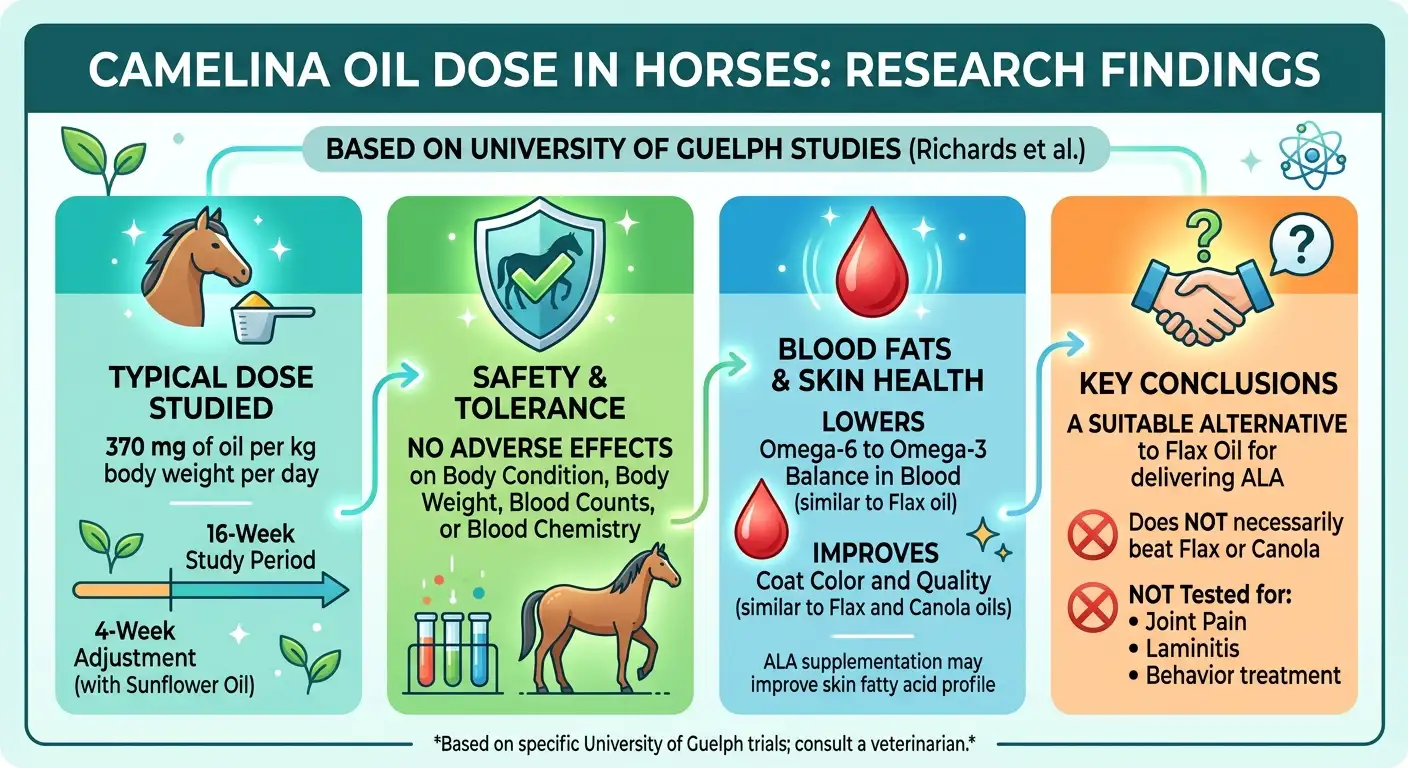
Camelina oil has been studied in horses far less than flaxseed or fish oil, but real trials now exist. They come from a University of Guelph team led by Taylor Richards, Scarlett Burron and Anna Kate Shoveller.
The University of Guelph horse trials
- Dose used: 370 mg of oil per kg of body weight per day, for 16 weeks, after a gradual 4 week adjustment period using sunflower oil.
- Safety: Camelina oil caused no adverse effects on body condition, body weight, blood counts or blood chemistry in the Animal journal study.
- Blood fats: Camelina and flax oil lowered the omega-6 to omega-3 balance in the horses' blood.
- Skin and coat: Camelina performed the same as canola and flax oil. All three oils improved coat color and quality in the Journal of Animal Science study.
- Skin fatty acids: A follow up study of 24 horses suggested that ALA supplementation may improve the fatty acid profile of the skin.
The authors conclude that camelina oil is a suitable alternative to flax oil for delivering ALA in equine diets. They did not conclude that it beats flax or canola, and they did not test joint pain, laminitis or behavior treatment claims.
Why the research dose is bigger than the label dose
The trial dose works out to roughly 185 g of oil, or about 200 mL, for a 500 kg horse. That is more than three times the highest label amount for the same horse. Researchers use a high, measurable dose to see an effect. Labels are written for everyday feeding and calorie control.
The honest answer is that no one has yet tested whether the 30 to 60 mL label dose produces the same results as the 200 mL research dose. You can see the gap in the chart below.
Label Doses vs Research Dose vs General Oil Limit
What we still do not know
- No published horse trial shows camelina oil relieves arthritis or joint stiffness.
- No published horse trial shows it calms nervous horses or improves insulin sensitivity.
- Whether horses convert camelina's ALA into EPA and DHA efficiently has not been fully studied. Researchers have seen EPA and DHA appear in the blood after ALA feeding, which suggests some conversion.
- Claims on brand websites, such as calmer behavior or help with Cushing's disease, come from customer feedback rather than controlled studies.
What Is Camelina Oil and What Is in It?
Camelina oil is a vegetable oil pressed from the seeds of Camelina sativa, a hardy crop also called false flax. It is rich in alpha-linolenic acid (ALA), a plant omega-3 fatty acid that horses cannot make themselves, and it carries natural vitamin E that helps protect the oil from going rancid.
Exact numbers vary by brand and crop year. The labels we reviewed list roughly 33 to 39 percent omega-3, 14 to 20 percent omega-6 and 28 to 34 percent omega-9. Smart Earth states an omega-3 to omega-6 ratio of 1.2 to 1.6 parts omega-3 for every 1 part omega-6.
Vitamin E content is reported at about 150 IU per 100 mL by Mad Barn. Signe Cameline reports 114 mg of total tocopherols per 100 g. Like all fats, camelina oil supplies 9 kcal per gram.
ALA (Omega-3) Content of Common Horse Oils
Flax oil has more ALA, but it spoils faster and is usually kept cool. Camelina oil has less ALA but a better supply of natural tocopherols, which gives it longer shelf life. Smart Earth quotes a one year shelf life at room temperature away from light.
Benefits of Camelina Oil for Horses: What Is Supported and What Is Not
Coat and skin condition
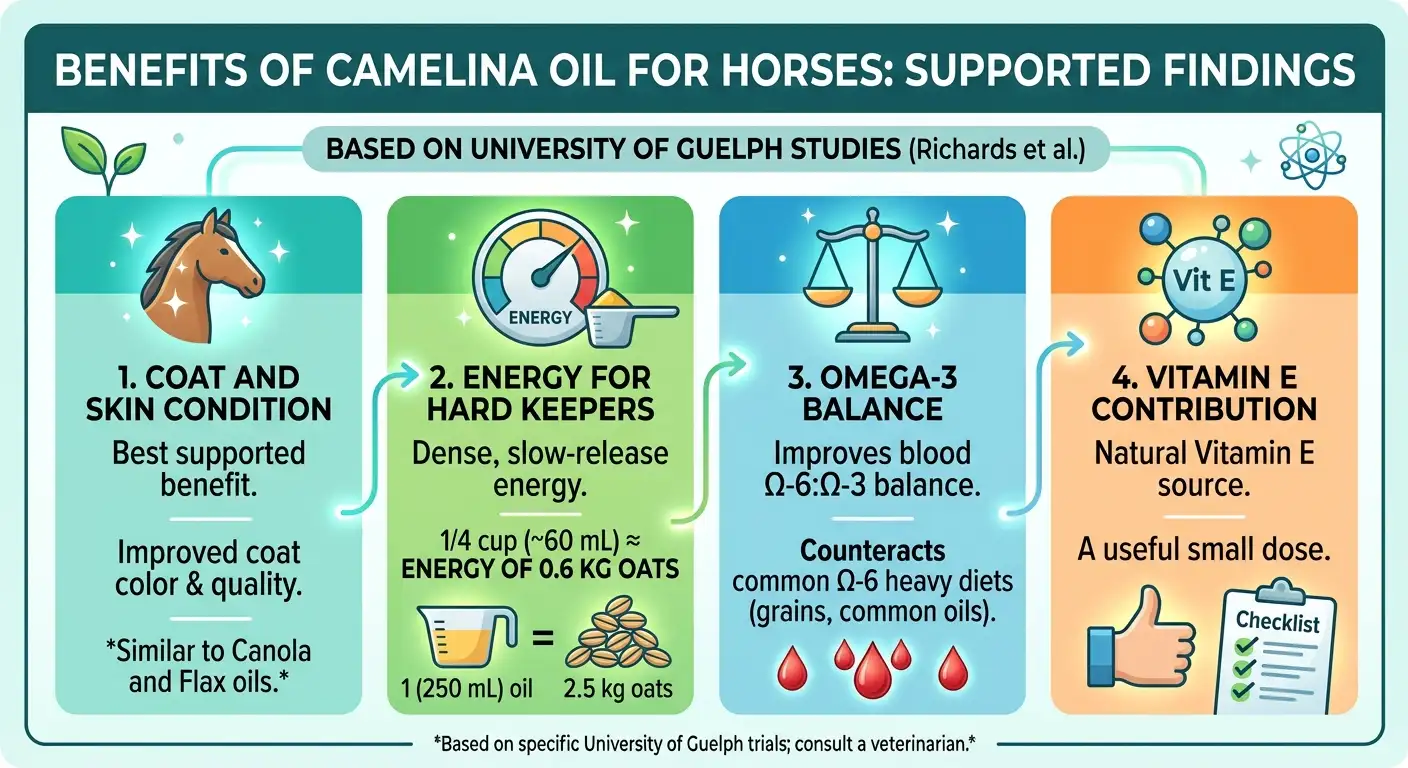
This is the best supported benefit. In the Guelph skin and coat trial, horses fed camelina oil showed improved coat color and quality, though canola and flax oil did just as well. If shine is your goal, camelina is one good option, not the only one.
Calories for hard keepers
Oil is a dense, slow release energy source. A quarter cup (60 mL) is roughly the energy of 0.6 kg of oats, based on the standard figure that 250 mL of oil equals about 2.5 kg of oats. This makes camelina oil useful for thin horses and seniors who cannot eat more bulk.
Omega-3 balance
Many horse diets are heavy in omega-6 from grain and common oils such as corn or sunflower. Adding an omega-3 rich oil can improve that balance. In the trial, blood omega-6 to omega-3 status improved in horses fed camelina oil.
Vitamin E
Camelina oil carries natural vitamin E. A typical 500 kg horse needs at least 500 to 1,000 IU a day, and optimal intake is often cited at 2,000 to 4,000 IU. A small dose of camelina oil helps, but it will not replace a proper vitamin E source.
Pros
- Single ingredient, easy to dose
- Natural omega-3 (ALA) and vitamin E
- Studied in horses with no adverse health effects
- Comparable to flax and canola for skin and coat
- Better shelf stability than flax oil
- Palatable for most horses
Cons
- No published trials for joints, calming or laminitis
- Less ALA than flax oil
- No direct EPA or DHA, unlike fish or algal oil
- Adds calories, which matters for easy keepers
- Label cautions for pregnant, lactating and bleeding disorder cases
- Usually costs more than canola or soy oil
How to Feed Camelina Oil to Your Horse Step by Step
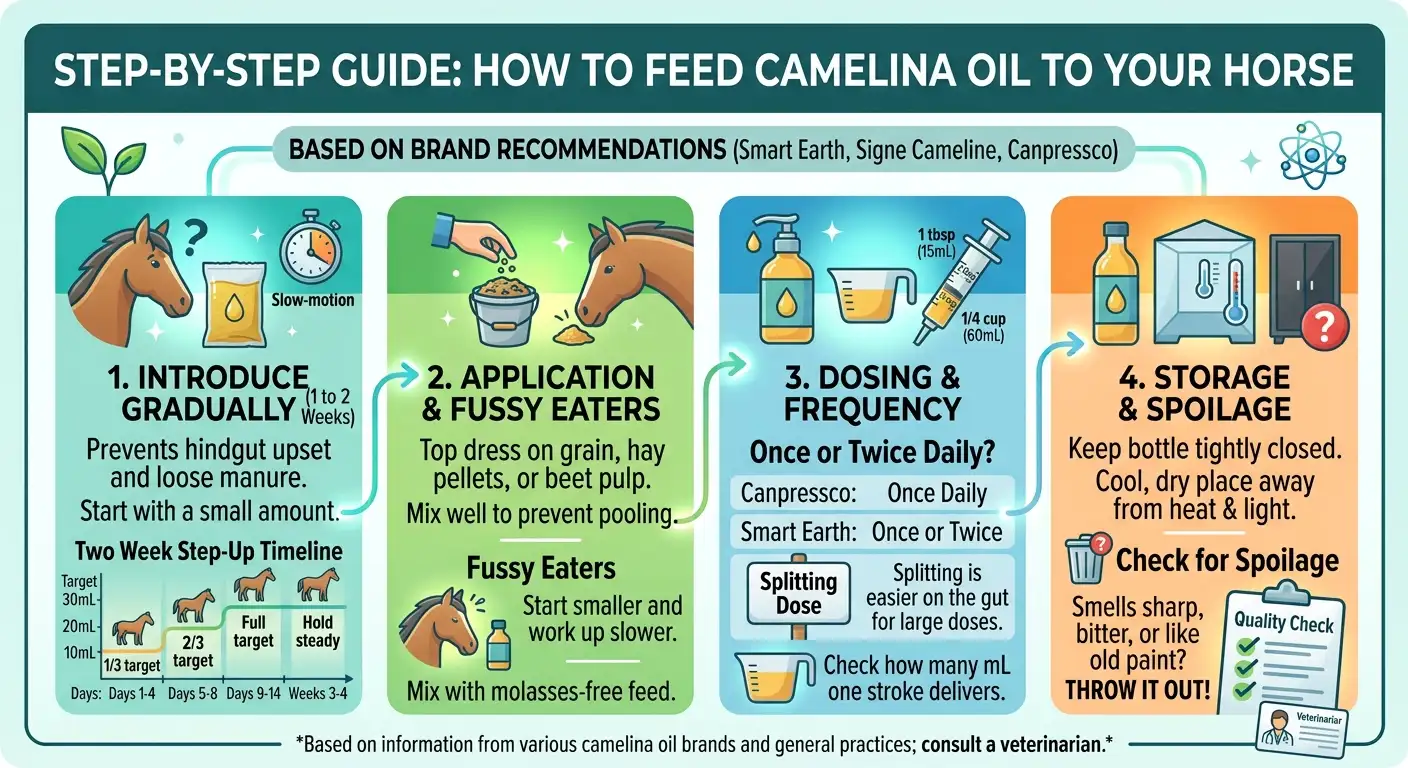
Introduce camelina oil gradually over 1 to 2 weeks. A sudden jump in dietary fat can upset the hindgut and cause loose manure. Smart Earth and Signe Cameline both advise starting with a smaller amount and building up.
Two Week Step-Up Timeline (Example Amounts per Day)
Target 30 mL: give 10 mL.
Target 60 mL: give 20 mL.
Target 30 mL: give 20 mL.
Target 60 mL: give 40 mL.
Give 30 mL or 60 mL as chosen.
Top dress it on a small meal
Smart Earth recommends top dressing the oil on grain or feed. Drizzle it over a small handful of hay pellets, soaked beet pulp or chaff and mix it in so the oil does not pool at the bottom of the bucket.
Fussy eaters
If your horse refuses it, go back to a smaller amount and work up more slowly. Smart Earth suggests drizzling a smaller amount on feed first. Mixing it with a little molasses free feed can help.
Once a day or twice a day?
Both are used. Canpressco and Signe Cameline say once daily. Smart Earth says once or twice. Splitting the dose is a sensible choice if your horse is on the high end of the range, because smaller amounts per meal are easier on the gut. One feed company advises splitting oil into smaller meals when feeding more than 25 mL per 100 kg a day.
Measuring without a pump
Use a clean measuring cup or oral syringe. One tablespoon is about 15 mL, two tablespoons is 30 mL (1 fl oz), and a quarter cup is 60 mL. Bottle pumps are handy, but check how many mL one stroke delivers because it varies by brand. Signe Cameline lists one pump as roughly 30 mL.
Storage
Keep the bottle tightly closed, out of direct light and away from heat. Smart Earth says room temperature is fine, while Signe Cameline recommends a cool, dry place. If the oil smells sharp, bitter or like old paint, throw it out.
Camelina Oil Dosage for Special Situations
Miniature horses and ponies
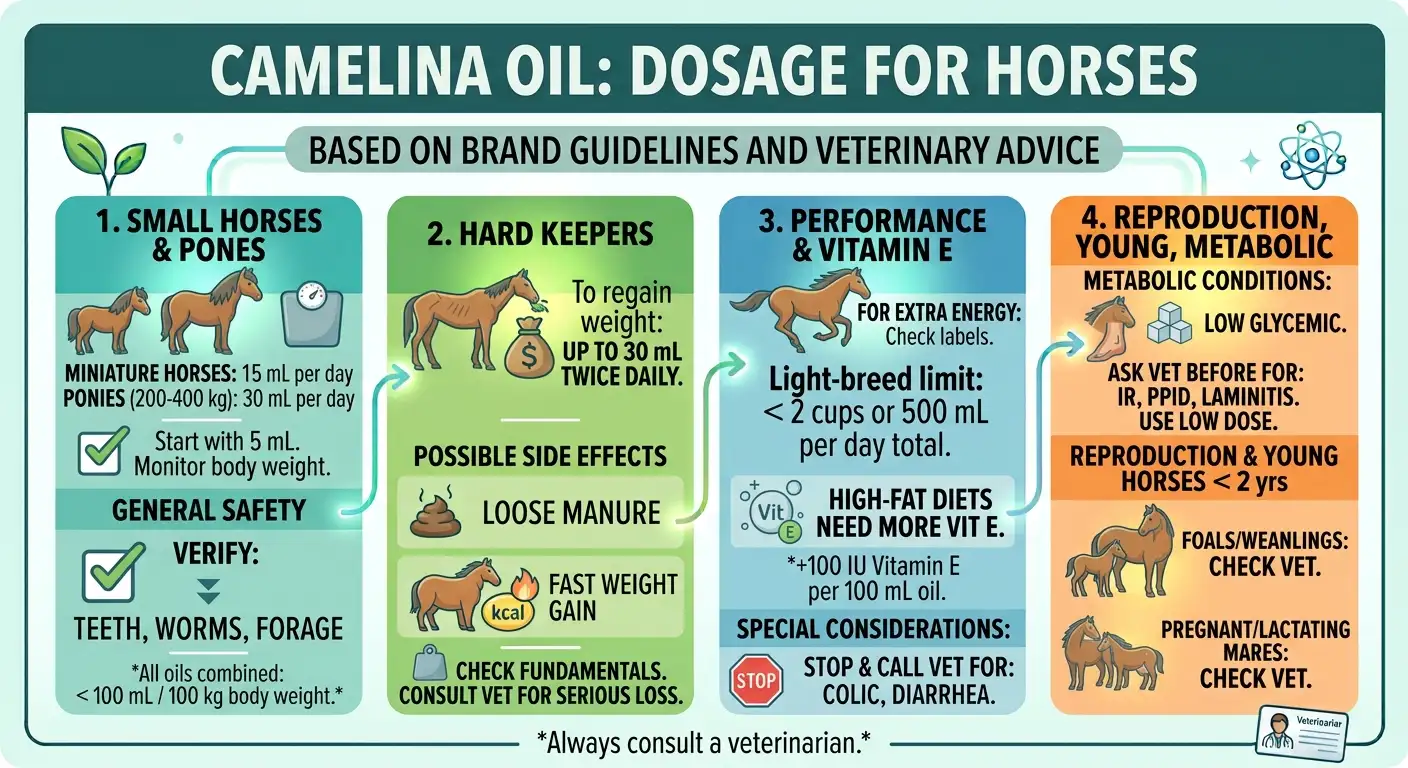
Smart Earth recommends 15 mL a day in total for miniature horses. Ponies in the 200 to 400 kg range follow the 30 mL tier on the Canpressco and Signe labels. Minis gain weight easily, so start with 5 mL and watch the body condition score.
Hard keepers, seniors and weight gain
Smart Earth suggests up to 30 mL twice a day to help horses regain weight. That is a marketing statement, not a trial result, but it is in line with how oils are used in practice. For serious weight loss, check teeth, worming and forage quality first, and ask your vet or an equine nutritionist to plan the diet.
Easy keepers, EMS, PPID and laminitis
Oil does not raise blood sugar the way grain does, and Signe Cameline notes its low glycemic profile. Smart Earth says its oil is laminitis safe. Those are manufacturer statements, and no horse trial has tested camelina oil in insulin resistant horses.
Because oil is calorie dense, an overweight horse can still gain weight on it. If your horse has EMS, PPID (Cushing's disease) or a laminitis history, talk with your vet before you begin, keep the dose at the low end, and track weight and cresty neck changes.
Performance horses
Hard working horses may use oil for extra calories. Alberta Agriculture says most adult light-breed horses should get no more than 2 cups of oil a day in total, and Victoria Agriculture says no more than 500 mL. Camelina labels sit far below that.
Since high fat diets raise antioxidant needs, one UK feed company suggests an extra 100 IU of vitamin E for every 100 mL of oil. Ask a nutritionist before going over 100 mL a day.
Foals and young horses
Signe Cameline lists 30 mL a day for horses under 2 years. No trial data supports camelina oil in foals, and a growing horse's diet is sensitive to energy and mineral balance. Check with your vet before feeding it to a weanling or yearling.
Pregnant and lactating mares
Smart Earth and Pipestone Farm Supply print a caution against use in pregnant or lactating animals. Signe Cameline says the wording is a Health Canada labeling requirement for low risk veterinary products and that no data suggests harm, but there are no long term studies either. Ask your vet before feeding it to a mare in foal or with a foal at foot.
Is Camelina Oil Safe for Horses? Side Effects and Limits
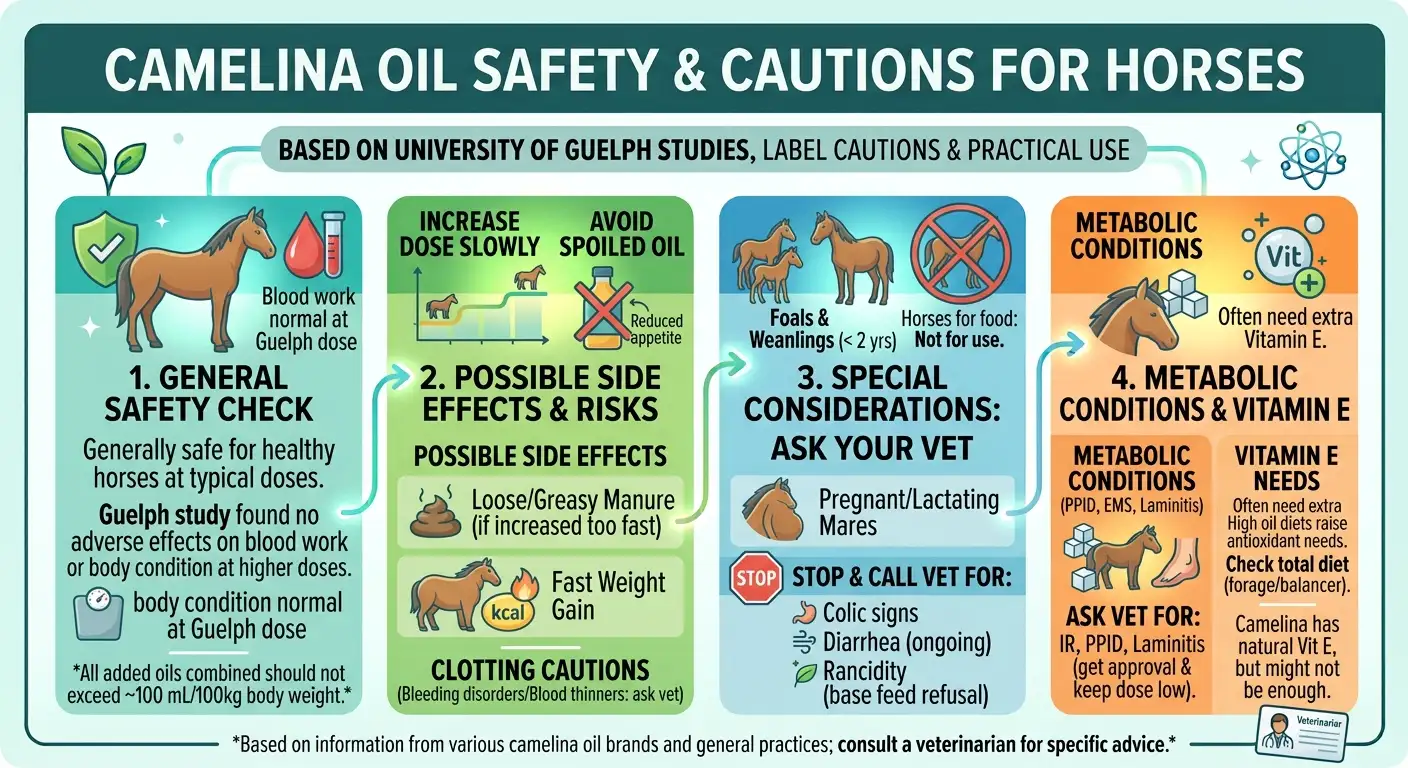
Yes, camelina oil is considered safe for healthy adult horses at label doses. The Guelph trial found no adverse effects on blood work or body condition at about four times the typical label amount. Problems usually come from feeding too much too fast, spoiled oil, or ignoring label cautions.
Safety Checklist Before You Start
- Bleeding disorders or blood thinners: the label says do not use or ask a vet first. Omega-3 oils can affect clotting in some species.
- Pregnant or lactating mares: label caution applies. Ask your vet.
- Horses intended for food: labels state not for use in food animals.
- Insulin resistance, PPID or laminitis: get vet approval and keep the dose low.
- Foals and weanlings: ask your vet first.
- Stop and call your vet if you see colic signs, ongoing diarrhea or fast weight gain.
Possible side effects
- Loose or greasy manure if you increase the dose too fast.
- Weight gain, because 30 mL adds about 250 kcal.
- Reduced appetite for the base feed if the oil is rancid.
- Possible effects on clotting in horses with bleeding disorders, which is why the label cautions exist.
How much oil is too much?
General feeding advice for any added oil is up to about 100 mL per 100 kg body weight, which is 500 mL for a 500 kg horse. That ceiling applies to all oils combined, including oil in your feed. Camelina label doses of 30 to 60 mL are a small slice of it. Do not stack camelina oil on top of other oils without counting the total.
Do horses need extra vitamin E?
Often yes, once oil intake goes up. Camelina oil carries natural vitamin E, but high oil diets raise antioxidant needs. Check that your total diet, including forage and any balancer, meets your horse's vitamin E needs. Fresh grass is a rich source, while hay loses vitamin E during storage.
Common Mistakes When Feeding Camelina Oil
- Starting at the full dose on day one.
- Guessing body weight instead of using a weight tape.
- Forgetting to cut back other fats, such as rice bran or oil rich feeds, when adding camelina oil.
- Expecting a quick joint or calming effect. Coat changes are usually the first thing owners notice, and they take weeks.
- Leaving the bottle open or in a hot tack room so the oil goes rancid.
- Feeding the oil to an overweight horse without adjusting the rest of the ration.
- Using a dog or human camelina product without checking the dose for horses.
How Long Will a Bottle of Camelina Oil Last?
Divide the bottle size in mL by the daily dose. A 3.78 L jug lasts 126 days at 30 mL, which matches what Smart Earth reports.
| Container size | At 30 mL a day | At 60 mL a day | At 90 mL a day |
|---|---|---|---|
| 3.78 L (1 US gallon) jug | 126 days | 63 days | 42 days |
| 4 L bottle | 133 days | 66 days | 44 days |
| 13.25 L pail | 441 days | 220 days | 147 days |
| 18.9 L (5 US gallon) pail | 630 days | 315 days | 210 days |
Camelina Oil vs Flax, Canola and Fish Oil for Horses
Camelina oil sits in the middle of the plant oils. It has more omega-3 than canola oil, less than flax oil, and better stability than flax. In the Guelph trials, skin and coat results were the same for all three.
If your goal is direct EPA and DHA, fish oil or algal oil supply them without relying on conversion. The Guelph team notes that fish oil is often not palatable to horses. If your goal is simply a balanced, calorie containing oil with natural vitamin E, camelina is a reasonable choice.
Camelina Oil in Your Horse's Wider Supplement Plan
Camelina oil works best as one part of a balanced diet, not a stand alone fix. If hoof and coat quality is your focus, check your biotin dosage for horses and your overall mineral balance too. A kelp dosage for horses guide helps if you are weighing seaweed based mineral sources.
For stiffness or soreness, remember that camelina oil is a nutritional supplement, not a treatment. Ask your vet about the proper Adequan dosage for horses or Equioxx dosage for horses when a real joint problem is diagnosed. If nerves are the problem, a separate look at CBD dosage for horses may be more relevant than an omega-3 oil.
FAQs
How much camelina oil should I give my horse per day?
Most adult horses get 30 to 60 mL (1 to 2 fl oz) a day. Ponies and miniatures get 15 to 30 mL, and large draft horses up to 90 mL on label directions. Start with one third of the target amount and build up over 1 to 2 weeks.
Can I give my horse too much camelina oil?
Yes. Too much oil, or raising the dose too fast, can cause loose manure and unwanted weight gain. General guidance caps all added oil at about 100 mL per 100 kg of body weight a day. Label doses of camelina oil are well below that limit.
How much camelina oil for a miniature horse or pony?
Smart Earth recommends 15 mL a day in total for miniature horses. Ponies of 200 to 400 kg follow the 30 mL tier used by Canpressco and Signe Cameline. Begin with a small amount, such as 5 mL, and watch body condition closely.
How long does camelina oil take to work in horses?
Coat and skin changes usually take several weeks. The University of Guelph trials ran for 16 weeks, with measurements at 2, 4, 8 and 16 weeks. Do not expect fast results, and do not raise the dose to speed things up.
Is camelina oil safe for horses with laminitis, EMS or Cushing's disease?
Brands say it is suitable, because oil is low in sugar and starch, but no horse trial has tested this. Oil is calorie dense, so overweight horses can still gain weight. Ask your vet first and keep the dose at the low end of the range.
Can camelina oil help a horse gain weight?
It can add calories. A 30 mL dose supplies roughly 250 kcal, and Smart Earth suggests up to 30 mL twice a day for weight gain. If a horse stays thin, check teeth, parasite control and forage first, and ask your vet or a nutritionist.
Is camelina oil better than flaxseed oil for horses?
Not necessarily. Flax oil has more ALA, about 56 percent versus 35 percent. Camelina oil has more natural vitamin E and keeps longer. In Guelph horse trials, skin and coat results were the same, so the better choice depends on price, taste and storage.
Is camelina oil better than fish oil for horses?
They do different jobs. Camelina oil supplies ALA, while fish and algal oils supply EPA and DHA directly. Horses may convert some ALA to EPA and DHA, but this is not fully studied. Fish oil can also be less palatable to horses.
Should I feed camelina oil once or twice a day?
Either works. Canpressco and Signe Cameline say once daily, and Smart Earth says once or twice. Splitting the amount into two meals is gentler on the gut when you feed the higher end of the range.
Does camelina oil need refrigeration?
No. Smart Earth states room temperature storage away from direct light is fine, with a shelf life of about one year. Signe Cameline recommends a cool, dry place. Keep the lid tight, and discard oil that smells sharp or bitter.
Can I feed camelina oil to a pregnant or lactating mare?
Labels print a caution for pregnant and lactating animals. Signe Cameline says it is a Health Canada labeling requirement and that no data suggests harm, but long term studies are missing. Ask your vet before feeding it to a mare.
What are the side effects of camelina oil in horses?
The most common issues are loose manure and weight gain when the dose is too high or raised too quickly. Rancid oil can also put a horse off its feed. Labels advise caution for horses with bleeding disorders or on blood thinners.
Do horses need extra vitamin E with camelina oil?
Camelina oil provides about 150 IU of natural vitamin E per 100 mL, but high oil diets increase antioxidant needs. One UK feed company advises an extra 100 IU for every 100 mL of oil. Check that the whole diet meets your horse's vitamin E needs.
Can foals or young horses have camelina oil?
Signe Cameline lists 30 mL a day for horses under 2 years, but no trials support use in foals. Growing horses need a carefully balanced diet, so ask your vet before adding camelina oil to a weanling or yearling ration.
How do I measure camelina oil without a pump?
Use a measuring cup or oral syringe. One tablespoon is about 15 mL, two tablespoons is 30 mL (1 fl oz), and a quarter cup is 60 mL. If you use a pump, check how many mL it delivers per stroke, since this differs by brand.
Final Recommendations and Next Steps
For most adult horses, 30 to 60 mL of camelina oil a day, built up slowly and adjusted to body condition, is a practical and well tolerated amount. It is a decent source of omega-3, vitamin E and calories, and the Guelph data back its safety and skin and coat results.
- Weigh your horse with a tape and find the right tier in the dosage chart.
- Start at one third of the target amount and build up over 1 to 2 weeks.
- Track manure, body weight and body condition score every 2 to 4 weeks.
- Ask your vet first if your horse is pregnant, a foal, insulin resistant, has PPID, or has a bleeding disorder.
- Store the oil cool, dark and sealed, and replace it if it smells off.
Remember that this article provides general information based on manufacturer labels and published research. It is not a substitute for advice from your veterinarian or an equine nutritionist.
Sources and Further Reading
- Richards et al. (2023). Camelina, flaxseed and canola oil on skin and coat in horses. Journal of Animal Science
- Burron et al. (2023). Camelina, flaxseed and canola oil on plasma fatty acids and health parameters in horses. Animal
- University of Guelph study on skin fatty acid profile and immune responses in horses fed camelina oil
- University of Guelph study on camelina and algal oil, behavior and plasma fatty acids in young horses
- Mad Barn: Camelina Oil for Horses
- Smart Earth Camelina: Equine FAQs
- Toklat: Camelina Oil for Horses (Canpressco)
- Signe Cameline: Camelina oil omega-3 for horses
- Pipestone Farm Supply: Camelina oil for horses and dogs
- Health Canada: About List C, Veterinary health products
- Agriculture Victoria: Feed requirements of horses
- Alberta Agriculture: Feeding working and performance horses
- Wynnstay: The benefits of feeding oil to horses