Equioxx Dosage For Horses: Calculator, Chart & Safe Guide
If your veterinarian just gave your horse Equioxx medication to help with his stiff, sore joints, you’re likely to have one question in mind before you start: How much do I give? The answer is 0.1mg per kilogram (kg) or 0.045mg per pound (lb) of body weight, 1 time per day, for a maximum of 14 days. However, the form, reading the syringe and knowing what to look for are just as important as the number itself.
This guide will take you through everything step by step according to the official label approved by the FDA, allowing you to dose with confidence and knowing when to call your veterinarian.
Equioxx® Oral Paste Dosage Calculator
Firocoxib · For horses only
This tool calculates dosing for Equioxx (firocoxib) Oral Paste only, based on the product’s labeled dosage of 0.045 mg/lb (0.1 mg/kg) once daily. It does not cover Equioxx Tablets or Injection. Always confirm dosing with your veterinarian.
Calculated Dosage
0.045 mg/lb (0.1 mg/kg)
Important Notes
This calculator is for informational and reference purposes only and does not replace professional veterinary guidance. Always confirm dosing, duration of treatment, and suitability of Equioxx for this horse with a licensed veterinarian before administration.
© medshorse.com
Quick Facts
- Drug: Firocoxib is a COX-2 selective NSAID (brand name Equioxx)
- Standard dose: 0.1 mg/kg (0.045 mg/lb) of body weight, One time a day.
- Max labeled duration: 14 days duration.
- Forms: Oral paste, 57 mg tablets and injectable solution forms are available.
- Prescription status: Veterinary prescription required (Rx only)
- Not for: Humans, or horses intended for human consumption
Key Takeaways
- Equioxx dosage for horses should be dosed according to your horse’s body weight and not as a straight dose — always weigh or estimate the weight of your horse before you dose.
- Label dose for paste, tablets and injectable is the same: 0.1mg/kg once a day.
- Labelled treatment length is 14 days, however over this period is associated in practice but only under direct veterinary supervision and monitoring.
- The 57 mg tablet is only indicated for horses between 800–1,300 lbs. The paste and/or injectable is generally lighter or heavier depending on the horse size to ensure proper dosage.
- Be alert for mouth ulcers, colic, diarrhea, or dark urine/jaundice which may indicate an adverse reaction and should be reported to your veterinarian immediately.
What is Equioxx (Firocoxib) For Horses?
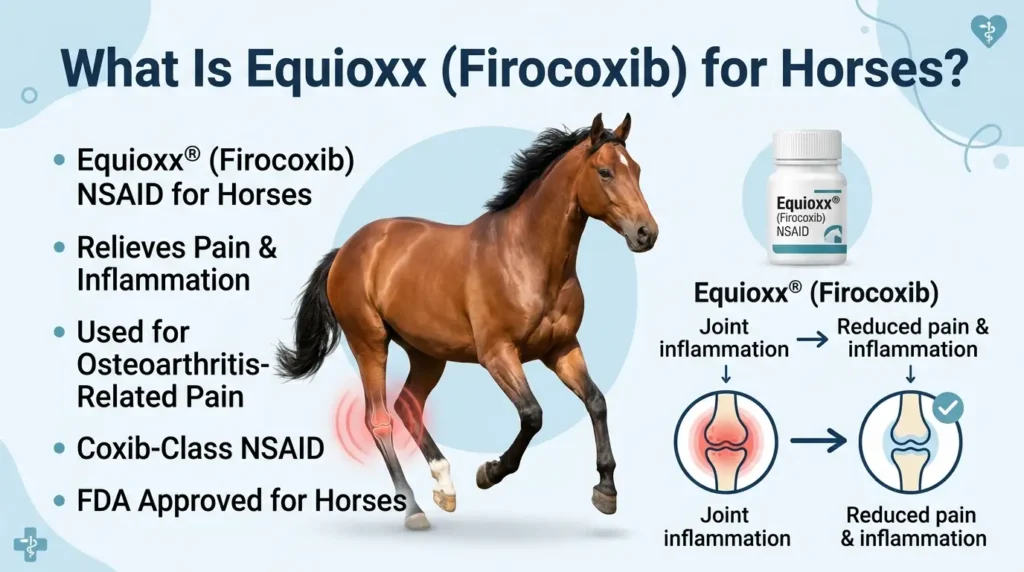
Equioxx is the brand name for firocoxib, a non-steroidal anti-inflammatory drug (NSAID) made by Boehringer Ingelheim. The first FDA-approved coxib-class NSAID ever specifically for horses, it treats pain and inflammation related to osteoarthritis.
How Equioxx Works
Firocoxib is one of a class of drugs known as COX-2 selective inhibitors. There are two principal types of Cyclooxygenase (COX) enzymes:
- COX-2 is the enzyme that makes chemicals (prostaglandins) that cause pain, swelling, and inflammation.
- COX-1 is important for maintaining the protective lining of the stomach, proper blood clotting and blood flow to the kidneys.
Older NSAIDs such as phenylbutazone (also known as “bute”) affect both COX-1 and COX-2, which is why they work, but these drugs are more likely to cause stomach ulcers and stress in the kidneys.
Firocoxib is designed to selectively inhibit COX-2, while sparing COX-1, hence its reputation as a ‘gentler’ COX-2 inhibitor (but it does not come without risk).
What Equioxx Treats in Horses
The FDA label is for the control of pain and inflammation due to osteoarthritis (OA) in horses. Commonly used by vets for:
- Age-related joint degeneration
- Persistent lameness in the hock, knee or fetlocks
- Joint pain after exercise in performance horses with diagnosed OA
Unlike flunixin (Banamine) which is used for pain in colic, Equioxx is approved and proven to be safe for use in horses with osteoarthritis.
Equioxx Dosage for Horses
Standard Dosage Formula
The dose is the same regardless of the form used:
0.1 mg/kg (0.045 mg/lb) of body weight, once daily.This is true for both the oral paste and 57 mg tablets as well as the injectable solution — just the method of delivery differs.
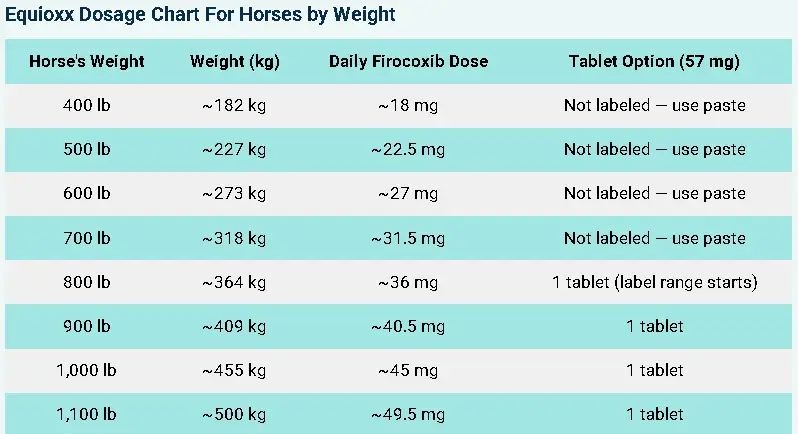
Equioxx Dosage Chart For Horses by Weight
For quick reference use this chart. Always ask your vet for the exact dosage as it is based on your horse’s actual and current body weight (not an approximation off a scale).
| Horse’s Weight | Weight (kg) | Daily Firocoxib Dose | Tablet Option (57 mg) |
| 400 lb | ~182 kg | ~18 mg | Not labeled — use paste |
| 500 lb | ~227 kg | ~22.5 mg | Not labeled — use paste |
| 600 lb | ~273 kg | ~27 mg | Not labeled — use paste |
| 700 lb | ~318 kg | ~31.5 mg | Not labeled — use paste |
| 800 lb | ~364 kg | ~36 mg | 1 tablet (label range starts) |
| 900 lb | ~409 kg | ~40.5 mg | 1 tablet |
| 1,000 lb | ~455 kg | ~45 mg | 1 tablet |
| 1,100 lb | ~500 kg | ~49.5 mg | 1 tablet |
| 1,200 lb | ~545 kg | ~54 mg | 1 tablet |
| 1,300 lb | ~591 kg | ~58.5 mg | 1 tablet (label range ends) |
| 1,400 lb | ~636 kg | ~63 mg | Not labeled — use paste |
| 1,500 lb | ~682 kg | ~67.5 mg | Not labeled — use paste |
Dosages are based on 0.045 mg/lb and rounded to the nearest half milligram. This chart is not intended to be used in place of a prescription from your veterinarian.
Key takeaway from the chart: The 57 mg tablet is a fixed-dose tablet that is intended to be used in horses ranging from 800 lbs to 1300 lbs. If your horse falls outside of that range, the label is not going to recommend the use of tablets — your vet will likely turn to the oral paste (or injectable) as that can be administered more precisely to the exact weight of your horse.
Equioxx Tablets vs. Paste vs. Injectable
| Form | Best For | Dosing Precision | Notes |
| Oral Paste | Any weight, especially horses outside 800–1,300 lb | High — adjustable in 50 lb increments | Can be given with or without food |
| 57 mg Tablets | Horses weighing 800–1,300 lbs | Fixed dose (1 tablet/day) | Small, palatable, easy to hand-feed |
| Injectable Solution | Horses that can’t take oral medication, or when a vet wants IV/IM control | Administered by a veterinarian | Not typically given by owners |
How to Read the Equioxx Paste Syringe
The oral paste syringe is graduated by the body weight of 50 lbs, NOT milligrams. The correct way to dose it:
- Weigh your horse (or take a close estimation with a weight tape).
- Round the weight up to the nearest 50 lb. Don’t round up if your horse is right on a 50 lb mark.
- Adjust the plunger ring to that weight marking, following the syringe’s instructions.
- Place the entire dose on the back of the tongue or in the feed, as directed by your veterinarian.
Each syringe is good for one horse up to 250 lbs of body weight per full dial; be mindful of the number of “loads” your horse needs.
How Long Can a Horse Take Equioxx?
The FDA label states that Equioxx dosage for horses is only to be used for a 14-day period for the oral paste or the tablets. That’s not a random figure – in target animal safety studies, horses treated with the recommended dose of firocoxaz for more than 30 days developed signs of toxicity, a factor in the label limiting use to 14 days.
In real life, some horses with chronic arthritis are on firocoxib for months on end, which is off label and extended use, but under veterinary supervision – with regular bloodwork to monitor kidney and liver function.
A veterinarian should decide on the need for an extension or restart of a course of Equioxx treatment and should not be decided on by the individual on their own judgment.
How to Give Equioxx to a Horse
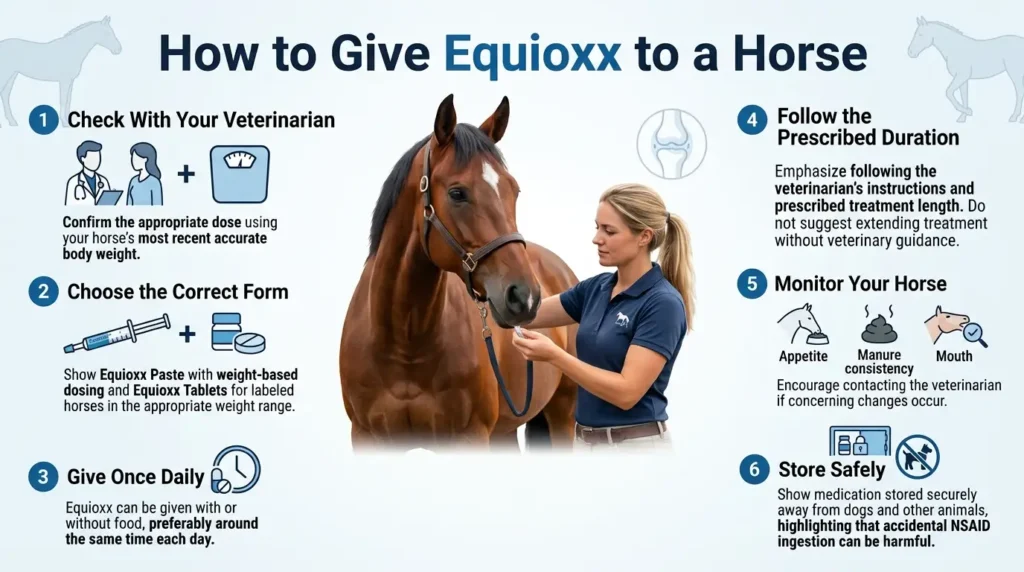
- Always double check with your veterinarian using the most recent accurate body weight of your horse.
- Select the correct dosage form: Paste, which has precise weight based dosing; or Tablets, which are for horses between 800 and 1300 lbs.
- Give once a day, with or without food, at about the same time every day.
- Follow the days – most prescriptions have a specific length of time, and often it is up to 14 days on label.
- Monitor your horse for the first several days for changes in appetite, consistency of manure and condition of the mouth.
- Store it safely — keep it away from dogs and other animals as dogs and cats are sensitive to NSAIDs and it can be harmful if ingested by accident.
Equioxx Side Effects in Horses
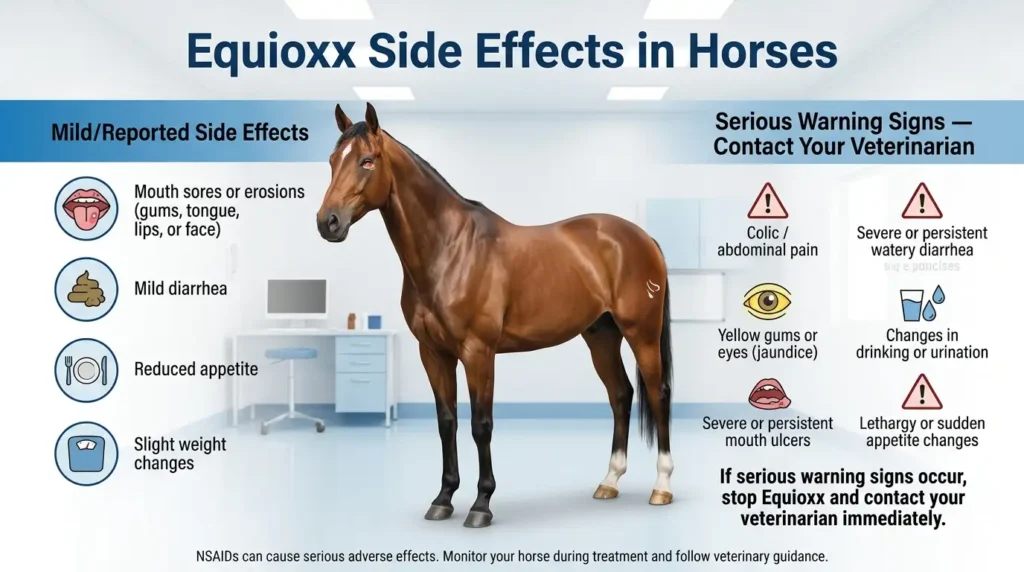
Mild, Common Side Effects
Equioxx horse dosage is well tolerated by most horses. Side effects do happen, but they are usually mild and may go away without the need to discontinue the medication. Reported effects include:
- Gum, tongue, lip, or facial sores (erosions)
- Mild diarrhea
- Loss of appetite or slight changes in weight.
Serious Warning Signs (Call Your Vet)
Stop the medication and contact your veterinarian immediately if you notice:
- Colic (crying, signs of tummy pain)
- Severe, watery or chronic diarrhea – this could be a sign of right dorsal colitis, a serious NSAID bowel disorder.
- Icterus (jaundice) — yellowing of the gums or whites of the eyes which may indicate liver involvement
- Drinking more or urination, or less – may be signs of kidney stress
- Severe mouth ulcers that do not improve and get better.
- Lethargy or an abrupt change in appetite
As with all NSAID’s, severe side effects may occur without warning and, in rare cases, can result in death, which is why it is important to monitor the horse during treatment, even if he or she looks good.
Equioxx Overdose: Signs and What to Do
Commonly, the greatest danger of overdosing on Equioxx paste is a small overdose every day such as using an incorrect weight estimate, giving a second dose if not already given, or giving another NSAID at the same time.
Overdose or toxicity may be evidenced by oral ulcers, colic, diarrhea, dark or tarry manure (GI bleeding), jaundice or excessive thirst/urination.
If an overdose is suspected: Call your vet or an equine emergency line right away. Don’t wait and watch to see if the symptoms go away alone, the toxicity of NSAIDs in horses can move rapidly, and early veterinary intervention leads to a better outcome.
Equioxx Drug Interactions and Contraindications
Do not use Equioxx in combination with:
- Other NSAids (bute, Banamine/flunixin, aspirin): use in combination increases risk of GI ulcers and kidney damage
- Corticosteroids: also increases GI and systemic risk.
- Other nephrotoxic (kidney stressing) drugs, not monitored closely by vets
It has been applied in field trials in conjunction with vaccines, deworming agents (anthelmintic) and antibiotics without any known problems; however, combinations of drugs should be tested first by your veterinarian, particularly when NSAID use is combined with diuretics such as furosemide, as some research shows a potential interaction regarding kidney function in dehydrated or stressed horses.
Which Horses Should Not Take Equioxx?
Do not use or consult your vet unless your horse:
- Kown sensitivity/allergy to firocoxib or any other NSAID
- Is dehydrated or hypotensive (low blood pressure)
- Has pre-existing kidney or liver dysfunction
- Is pregnant (safeness in pregnant/breeding horses is unknown)
- Is very young, geriatric or otherwise medically compromised (without a vet’s note)
Prior to treatment, and at intervals during longer treatment regimens, bloodwork (hematology and serum chemistry) is routinely performed for any NSAID, including Equioxx.
Equioxx vs. Bute vs. Banamine
| Equioxx (Firocoxib) | Phenylbutazone (“Bute”) | Banamine (Flunixin) | |
| Drug class | COX-2 selective NSAID | Non-selective NSAID | Non-selective NSAID |
| Primary use | Osteoarthritis pain/inflammation | General pain, inflammation, fever | Colic pain, inflammation, fever |
| GI ulcer risk | Lower (COX-1 sparing) | Higher | Higher |
| Dosing frequency | Once daily | 1–2x daily | 1–2x daily |
| Labeled duration | Up to 14 days | Short-term, vet-directed | Short-term, vet-directed |
| Cost | Higher | Lower | Lower |
Bottom line: Equioxx is often the drug of choice for long-term care of joint problems because of its relative safety with regard to the gastrointestinal tract, while bute and Banamine continue to be popular for the treatment of acute pain and fever.
This isn’t a simple trade-off, it is just a question of which drug is appropriate, depending on the condition being treated, and that’s determined by your vet.
Cost of Equioxx for Horses
Equioxx is a prescription product and will generally be more expensive than generic NSAIDs such as bute. Actual prices will vary according to the retailer, number of tablets and geographical location and will also be subject to change over time, see your vet or a licensed equine pharmacy for the current price, do not rely on a fixed price shown here.
Myth vs. Fact
Myth: “Equioxx is COX-2 selective and therefore has zero risk of stomach ulcers.
Fact: It isn’t zero risk, it’s less risk than non-selective NSAIDs. GI and kidney problems may still occur, particularly via overdosing or prolonged use.
False: “The dose of paste can just be ‘eyeballed'”.
Fact: The syringe is calibrated for weight, accuracy (scale or weight tape) is important for safe and effective dosage.
Myth: “If it’s 14 days, then it’s 28 days and it will be twice as effective.
Fact: Size isn’t always a good thing. An extended use increases the risk of toxicity and requires vet directed monitoring, not just a longer refill.
Common Mistakes Horse Owners Make With Equioxx
- Using a weight tape or scale to estimate body weight
- Administering Equioxx with bute or Banamine without veterinary supervision
- Taking more medication than is prescribed “just in case”
- Not noticing the early symptoms, such as a slight mouth lesion, and not pointing them out to a veterinarian
- Keeping it in a place that is accessible to a dog or other pet
You May Also Like to Read:
- Cetirizine Dosage For Horses: Calculator, Chart & Safe Guide
- Excede Dosage For Horses: Calculator, Chart & Safe Guide
FAQs
How much Equioxx should you give a horse?
0.1 mg/kg (0.045 mg/lb) of body weight, given once daily, for up to 14 days on the label.
What’s the Equioxx dosage for a 1000 lb horse?
Around 45 mg of firocoxib daily — one 57 mg tablet is the labeled tablet dose for horses in the 800–1,300 lb range, or an equivalent paste dose set to that weight.
If my horse weighs 700 lbs can I give him Equioxx tablets?
The 57 mg tablet is only approved for horses 800-1,300 lbs. Oral paste is the labeled product for lighter (or heavier) horses as it is dosed precisely by weight.
How long is it safe for a horse to be on Equioxx?
Label lasts up to 14 days. For chronic arthritis, longer courses do occur but supervised and monitored by the vet.
Can Equioxx for horses be used daily for long periods of time?
The risk of extended use is increased when compared to the 14-day course as labeled. It can be used long term in some horses, but under close observation of a veterinarian monitoring bloodwork and clinical signs.
May Equioxx be administered with feed?
Yes – both the paste and tablets can be given with or without food.
What are the symptoms of a severe Equioxx reaction?
Persistent or severe diarrhea, discoloration of gums/eyes (jaundice), increased or decreased thirst, increased or decreased urination and mouth ulcers. If these occur call your vet immediately.
May Equioxx be given in conjunction with bute or Banamine?
No – because the combination of NSAIDs increases the risk of GI ulcers and kidney damage. Never mix non-steroidal anti-inflammatory drugs unless instructed to do so by a veterinarian.
Equioxx is similar to firocoxib.
Yes. Firocoxib is the active ingredient; Equioxx is the brand name made by Boehringer Ingelheim.
Is Equioxx safe for pregnant mares?
Safety has not been determined in pregnant or breeding horses. Use in pregnant mare is not recommended without your vet’s advice.
If my horse is given too much Equioxx?
Look for oral ulcers, colic, diarrhea, dark manure or jaundice and call your veterinarian or an equine emergency service — do not wait for symptoms to go away.
Are Equioxx safe for dogs or humans?
Equioxx is for the use of horses only. Do not allow other pets or children to have contact with it; contact a physician if accidentally ingested.
Is Equioxx a prescription drug?
Yes. Equioxx can only be dispensed by or on the order of a licensed veterinarian.
Final Thoughts
Equioxx Dosage For Horses is a well-studied, specifically designed NSAID for the treatment of equine osteoarthritis and has a decreased GI risk profile compared with older NSAIDs for most horses. However, “safer” does not equate to “risk free” — accurate weight-based dosing, adherence to the prescribed course length, and knowledge of the warning signs of a bad reaction, are the things that keep a horse safe on this medication.
If you’re unsure about any dose, symptom or length of treatment, your veterinarian should be the last person you turn to – this guide is here to help you ask better questions and find problems early.