Chlorpheniramine Dosage for Horses: Safe Calculator, Weight Chart and What Your Vet Wants You to Know
Written & Reviewed By: Medshorse Team
Last Updated: October 2026
A horse with hives, a mane rubbed down to the crest, or a puffy muzzle sends most owners straight to the tack-room medicine shelf. Chlorpheniramine is one of the older antihistamines vets use for this.
The chlorpheniramine dosage for horses listed in the Papich veterinary drug handbook is 0.25 mg per kg of body weight, given by mouth every 12 hours, as summarised by Vet-eBooks. For a 500 kg (about 1,100 lb) horse, that is 125 mg per dose.
That figure is a starting point for a conversation with your vet, not a license to dose at home. Other published sources list higher rates, the drug is used off-label in horses in many countries, and it can show up in a drug test.
This guide gives you the numbers, a weight-based calculator and chart, and the safety details that most short articles skip.
Disclaimer: This article is for general education and is not veterinary advice. Always follow your vet’s instructions and the product label. MedsHorse is not affiliated with any brands mentioned.
What Is Chlorpheniramine and How Does It Work in Horses?
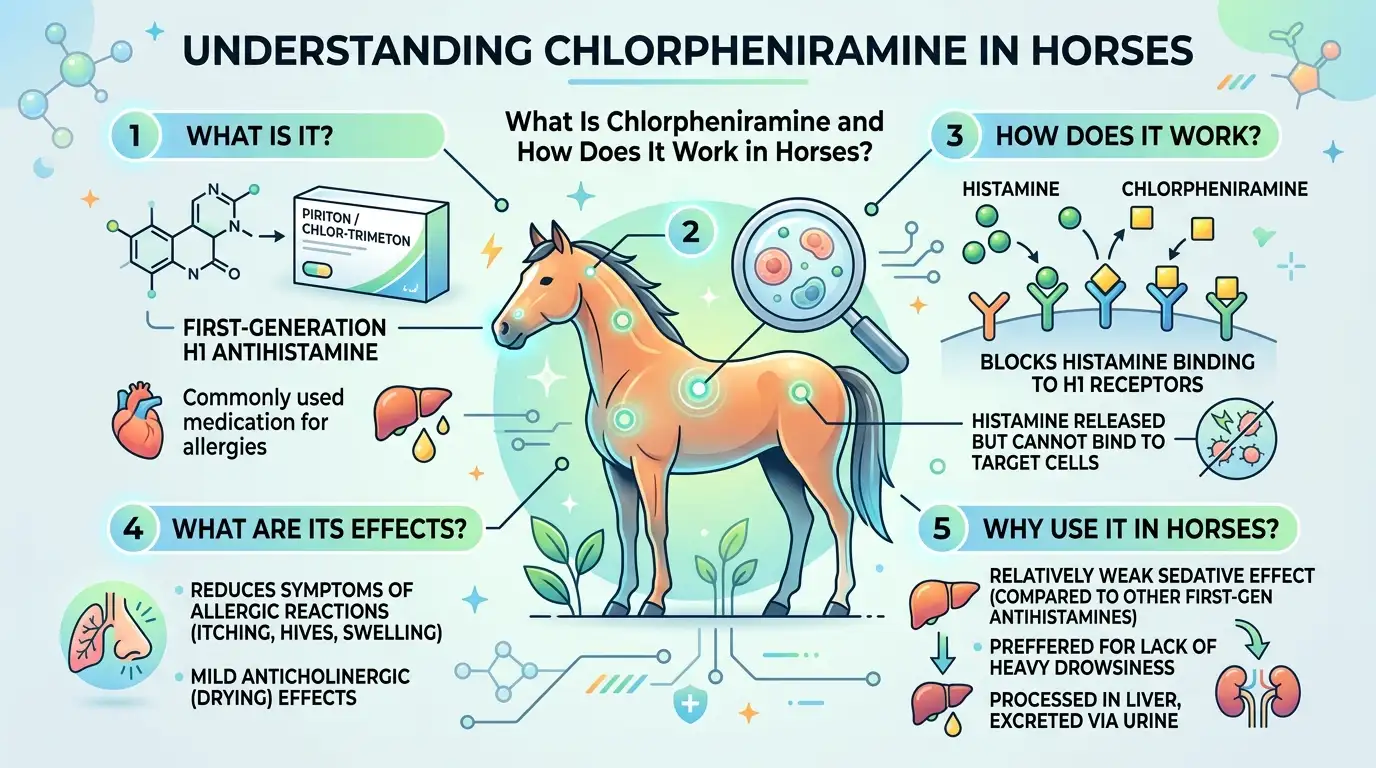
Chlorpheniramine (also spelled chlorphenamine, and sold as Piriton or Chlor-Trimeton in people) is a first-generation H1 antihistamine. It blocks histamine from binding to H1 receptors, which is the step that produces itching, hives and swelling during an allergic reaction. It does not stop histamine from being released. It only keeps histamine from acting on cells.
It also has mild anticholinergic (drying) effects, and it is broken down in the liver, with metabolites and unchanged drug leaving through the urine. One veterinary manufacturer notes that its sedative effect is relatively weak compared with other first-generation antihistamines, which is part of why vets sometimes prefer it over heavier options.
What Is Chlorpheniramine Used for in Horses?
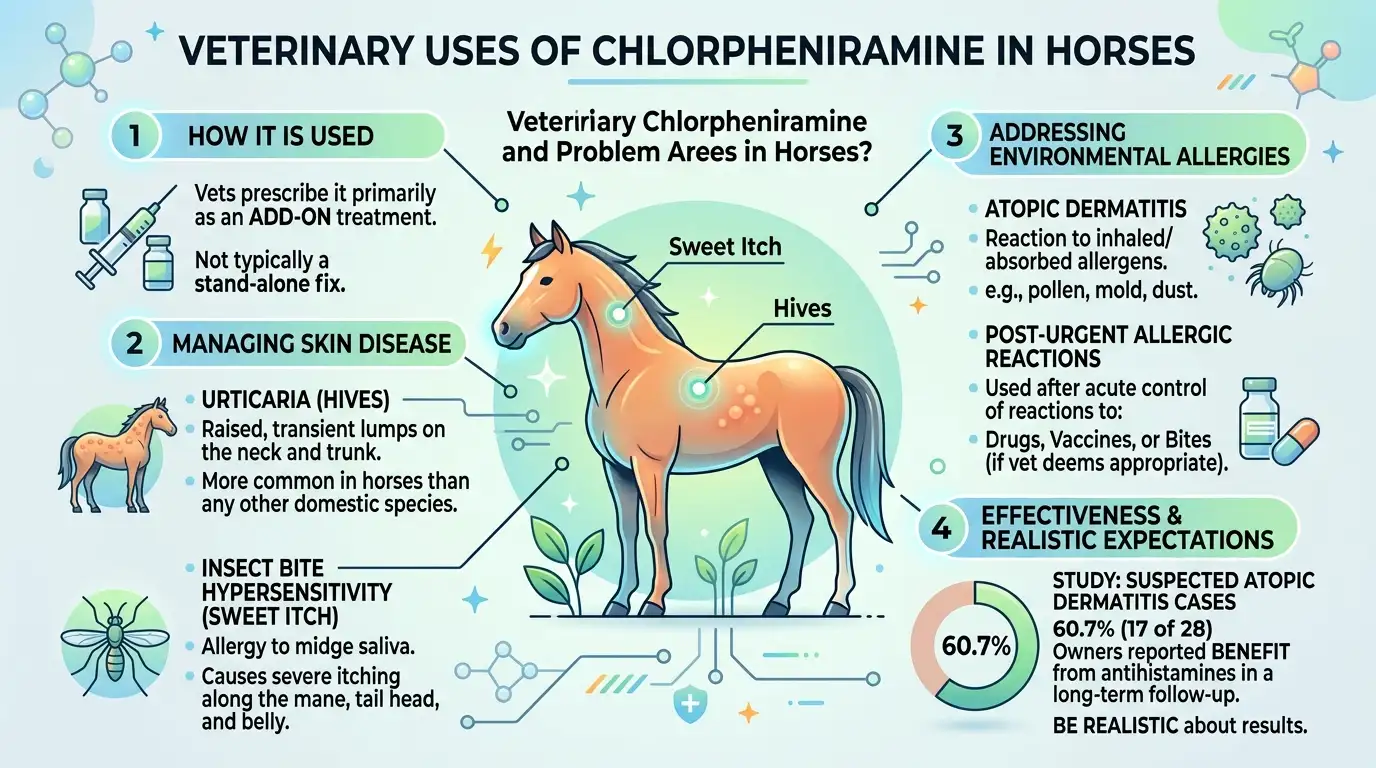
Vets use chlorpheniramine for allergic skin disease in horses, mainly as an add-on rather than a stand-alone fix. The common targets are:
- Urticaria (hives): raised, often transient lumps on the neck and trunk. Urticaria is more common in horses than in any other domestic species.
- Insect bite hypersensitivity (sweet itch): an allergy to midge saliva that causes itching along the mane, tail head and belly.
- Atopic dermatitis: a reaction to inhaled or absorbed allergens such as pollen, mould and dust.
- Allergic reactions to drugs, vaccines or bites: where your vet judges an antihistamine appropriate after the urgent problem is controlled.
Be realistic about results. In a long-term follow-up of suspected equine atopic dermatitis cases, owners reported benefit from antihistamines in 17 of 28 horses (60.7%). The same follow-up reported benefit from corticosteroids in 33 of 35 (94.3%) and from allergen-specific immunotherapy in 9 of 14 (64.3%). Antihistamines helped most horses a bit. They were not the strongest tool.
Chlorpheniramine Dosage for Horses: What Veterinary Sources Say
There is no single universal equine dose, so here is how the main references compare. Doses are for adult horses and are shown as published.
| Source | Published dose | Route and frequency | Context |
|---|---|---|---|
| Vet Times (Coates, 2017) | 0.25–0.5 mg/kg | Twice daily | Adjunct for sweet itch and summer allergies |
| Papich handbook, as summarised by Vet-eBooks | 0.25 mg/kg | Oral, every 12 hours | Urticaria and pruritus |
| dvm360 proceedings (Senter) | 200 mg per horse | Twice daily (BID) | Atopic dermatitis antihistamine options |
| Rooyan Darou injectable label (10 mg/mL) | 0.4–0.5 mg/kg, listed as 20 mL for horses | Subcutaneous or intramuscular (label also lists intraperitoneal); frequency not stated on the page | Allergic disorders, insect bites |
This article uses the Papich rate of 0.25 mg/kg orally every 12 hours for every calculation. Other references list higher figures: Vet Times goes up to 0.5 mg/kg, dvm360 lists 200 mg per horse (about 0.4 mg/kg for a 500 kg horse), and the injectable label lists 0.4–0.5 mg/kg. Treat those as questions for your vet, not as rates to use from this page.
The MSD Veterinary Manual’s antihistamine table for skin disease lists chlorpheniramine for cats and dogs only, with no horse entry, which is a reminder that equine dosing rests on a thinner evidence base.
Also note that the Vet Times and dvm360 figures are clinician-level guidance from veterinary dermatology sources, and the Rooyan Darou figure comes from a manufacturer product page for a product that may not be sold where you live.
The sources reviewed for this article do not give a defined maximum treatment length for horses, and none of them gives equine data on how quickly it starts working. Your vet decides how long a trial should run and when to reassess.
Chlorpheniramine Dosage Calculator for Horses
Enter your horse’s weight. The calculator applies the Papich rate of 0.25 mg/kg every 12 hours. If your vet supplies a liquid or paste, add its strength in mg/mL to see the volume per dose. Use a weight tape or scale, because guessing weight is a common source of dosing error.
This tool is for checking your math before you speak with your vet, not for choosing a dose on your own.
Chlorpheniramine Dosage Calculator for Horses
Enter your horse’s weight to calculate the oral dose.
Calculated dose
Dose per administration
0mg
Frequency
q12h(twice daily)
Total daily dose
0mg / day
Weight used: 0 kg • Dose rate: 0.25 mg/kg PO every 12 hours.
This calculator is for educational purposes only. Always confirm the dose and product with your veterinarian before treating your horse.
© medshorse.com
How the Math Works, Step by Step
- Get an accurate weight in kg. If you only have pounds, divide by 2.2.
- Use the mg/kg rate your vet recommends. The Papich rate used on this page is 0.25 mg/kg every 12 hours.
- Multiply weight by rate. 500 kg × 0.25 mg/kg = 125 mg per dose.
- Convert to volume using the concentration on the label. As an example only, a liquid at 10 mg/mL gives 125 mg ÷ 10 mg/mL = 12.5 mL. The strength printed on your product is what counts.
- Re-check the decimal point. A misplaced decimal turns 12.5 mL into 125 mL or 1.25 mL. Have your vet confirm the final volume.
Chlorpheniramine Dosage Chart for Horses by Weight
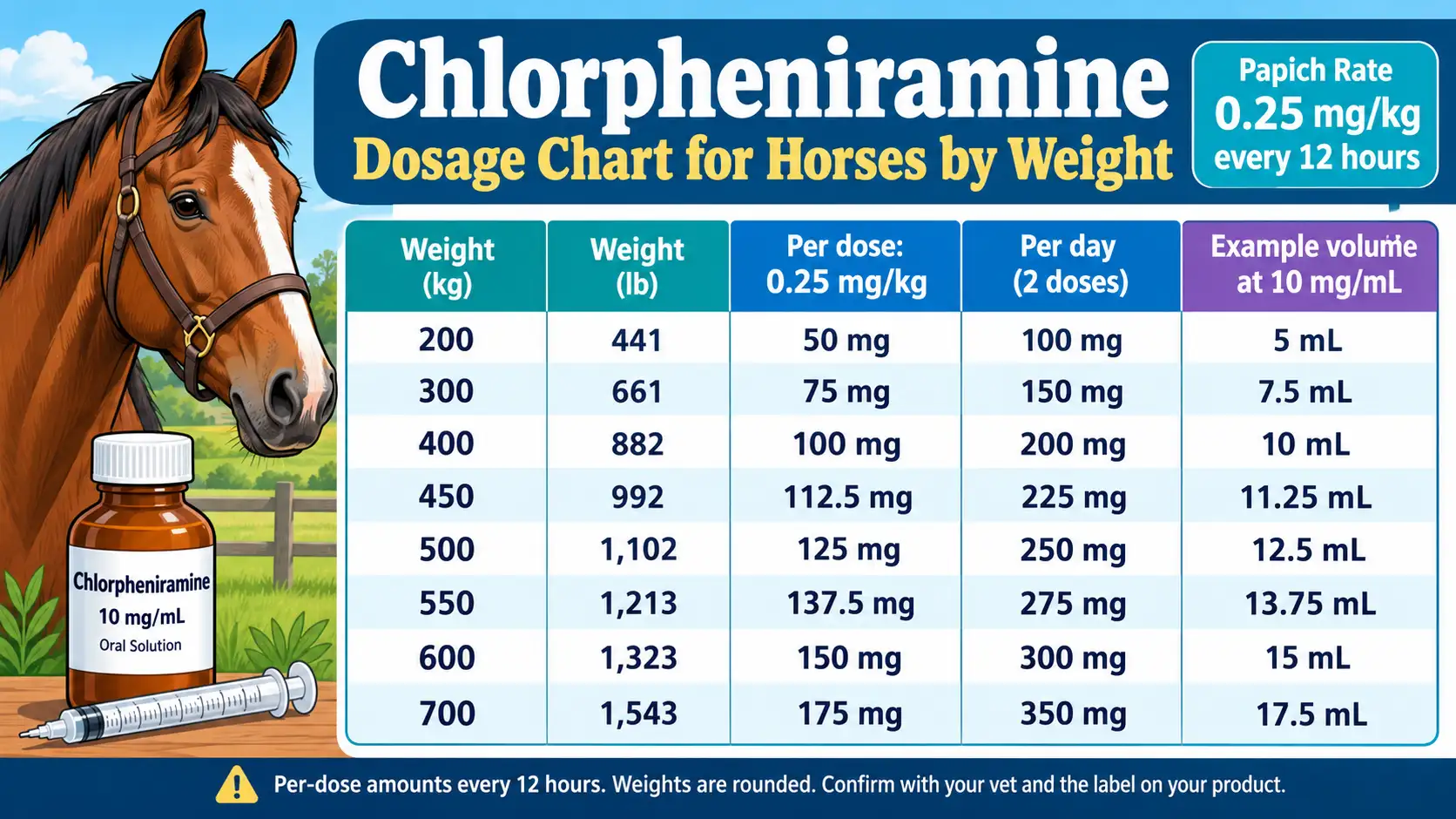
This chart applies the Papich rate of 0.25 mg/kg every 12 hours to common adult weights. Each row shows the dose per administration and the daily total for two doses. The last column is an example only, for a liquid supplied at 10 mg/mL.
| Weight (kg) | Weight (lb) | Per dose: 0.25 mg/kg | Per day (2 doses) | Example volume at 10 mg/mL |
|---|---|---|---|---|
| 200 | 441 | 50 mg | 100 mg | 5 mL |
| 300 | 661 | 75 mg | 150 mg | 7.5 mL |
| 400 | 882 | 100 mg | 200 mg | 10 mL |
| 450 | 992 | 112.5 mg | 225 mg | 11.25 mL |
| 500 | 1,102 | 125 mg | 250 mg | 12.5 mL |
| 550 | 1,213 | 137.5 mg | 275 mg | 13.75 mL |
| 600 | 1,323 | 150 mg | 300 mg | 15 mL |
| 700 | 1,543 | 175 mg | 350 mg | 17.5 mL |
Worked Example: A 500 kg Horse With Hives
Say your vet confirms hives and recommends the Papich rate of 0.25 mg/kg every 12 hours. For a 500 kg horse, one dose is 125 mg and the daily total is 250 mg. If your vet supplies a liquid at 10 mg/mL, that dose is 12.5 mL. A 1,000 lb horse is about 454 kg, so the dose is roughly 113 mg every 12 hours.
Ponies, Miniatures and Foals
Weight-based dosing scales down for ponies in principle, but small errors matter more in small animals. For ponies, miniatures and foals, let your vet calculate the dose. One manufacturer page lists a smaller injectable volume for foals than for adult horses, but a foal’s dose is not something to work out from a chart.
Injectable, Tablets or Compounded: Which Form Do Horses Get?
The Papich entry is an oral dose, and the forms differ a lot in practicality. Human chlorpheniramine tablets are typically 4 mg, so a 125 mg dose would be about 31 tablets. That is why horse dosing is often done with a liquid, powder or paste prepared at your vet’s direction. Injectable products carry their own label rates (0.4–0.5 mg/kg on the one label reviewed), so never convert an oral dose to an injection yourself.
Check that any product you use contains chlorpheniramine alone. Multi-symptom human cold and allergy products often combine it with other active ingredients that have not been studied in horses, and those products are not a substitute for a vet-supplied formulation.
Does Chlorpheniramine Work for Sweet Itch?
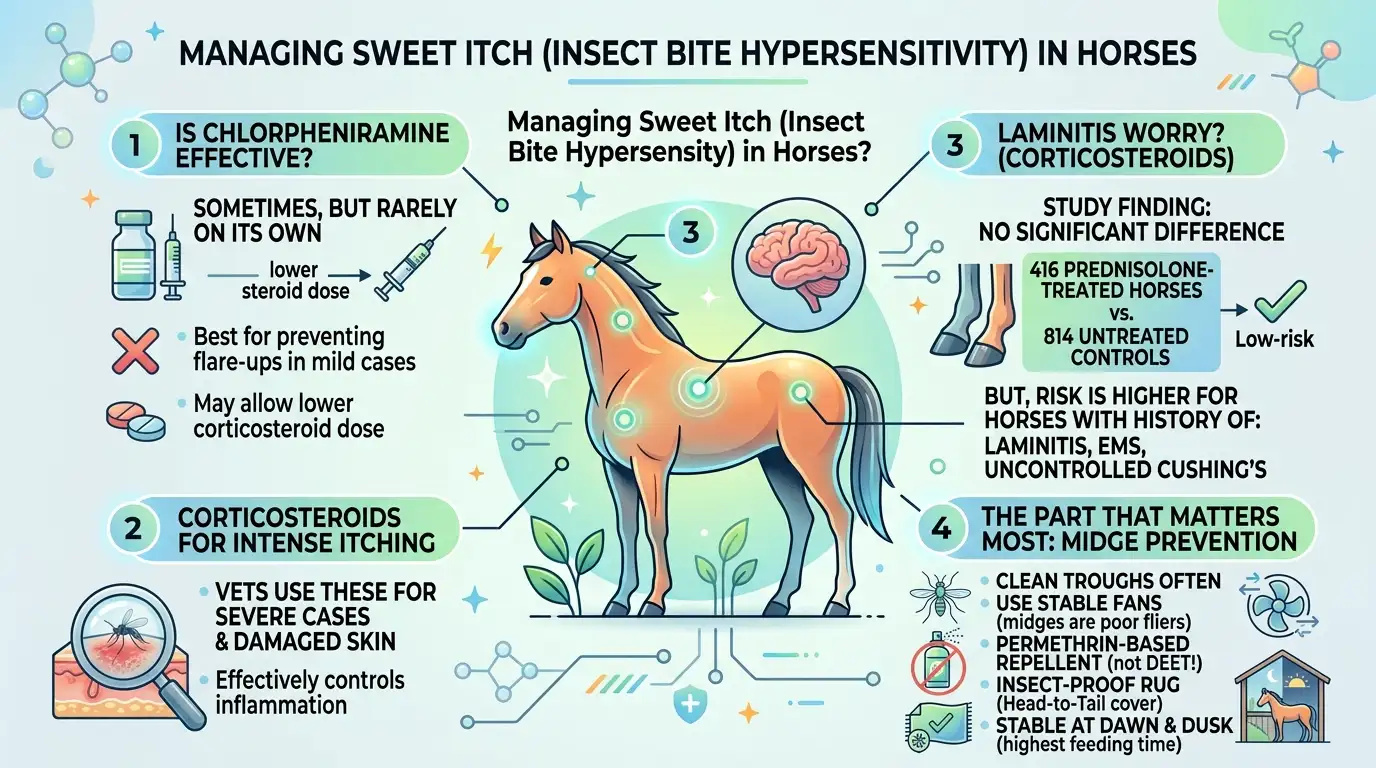
Sometimes, but rarely on its own. Vet Times notes that antihistamines are generally ineffective as the only treatment for insect bite hypersensitivity. They are still worth trying in milder cases, where they may allow a lower corticosteroid dose or help prevent flare-ups. Sweet itch cannot be cured, only managed, and it often gets worse each year.
When itching is intense and the skin is damaged, vets generally turn to corticosteroids first. If you want to understand that option, our guide to dexamethasone dosage for horses explains how steroid dosing works. Steroids raise a laminitis worry for many owners. One study cited by Vet Times found no significant difference in laminitis between 416 prednisolone-treated horses and 814 time-matched controls.
Horses with a history of laminitis, uncontrolled Cushing’s disease or equine metabolic syndrome carry higher risk, so that decision belongs with your vet.
Keep the Midges Off: The Part That Matters Most
No tablet beats keeping the bite from happening. Culicoides midges feed most at dawn and dusk, are poor fliers and rarely travel more than 1–2 km from standing water. The practical steps from the veterinary sources are:
- Stable susceptible horses at dawn and dusk, and on overcast, humid days.
- Run stable fans, since midges struggle in moving air.
- Use an insect-proof rug that covers the head, neck, belly and tail head.
- Apply a permethrin-based repellent, which lasts several days. Products with DEET are generally not recommended because they can cause irritation and sweating.
- Clean water troughs often, avoid boggy clay pasture and remove manure piles to reduce breeding sites.
Chlorpheniramine vs Other Antihistamines for Horses
Chlorpheniramine is one of several antihistamines horses may receive. Here is how published doses and drug-testing guidelines compare. The doses are not directly comparable across columns, because the testing studies used fixed doses and routes.
| Antihistamine | Vet Times (per kg) | dvm360 (per horse) | CPMA elimination guideline (dose tested) |
|---|---|---|---|
| Chlorpheniramine | 0.25–0.5 mg/kg twice daily | 200 mg twice daily | 72 h (75 mg IM, single dose) |
| Hydroxyzine | 1–2 mg/kg twice or three times daily | 400–600 mg, 2–3 times daily | 96 h (500 mg PO twice daily for 5 days) |
| Diphenhydramine | 1–2 mg/kg twice or three times daily | 300–400 mg twice daily | 48 h (250 mg IM or 500 mg PO, single dose) |
| Cetirizine | 0.2–0.4 mg/kg twice daily | Not listed | 72 h (200 mg PO, single dose) |
| Doxepin | Not listed | 300–400 mg twice daily | Not in the CPMA table |
For hives specifically, the dvm360 proceedings single out hydroxyzine as the most effective antihistamine. Chlorpheniramine’s selling point is its relatively mild sedation. If you are weighing options, read our guides on Benadryl dosage for horses and cetirizine dosage for horses. Never combine two antihistamines unless your vet tells you to.
Chlorpheniramine Side Effects in Horses
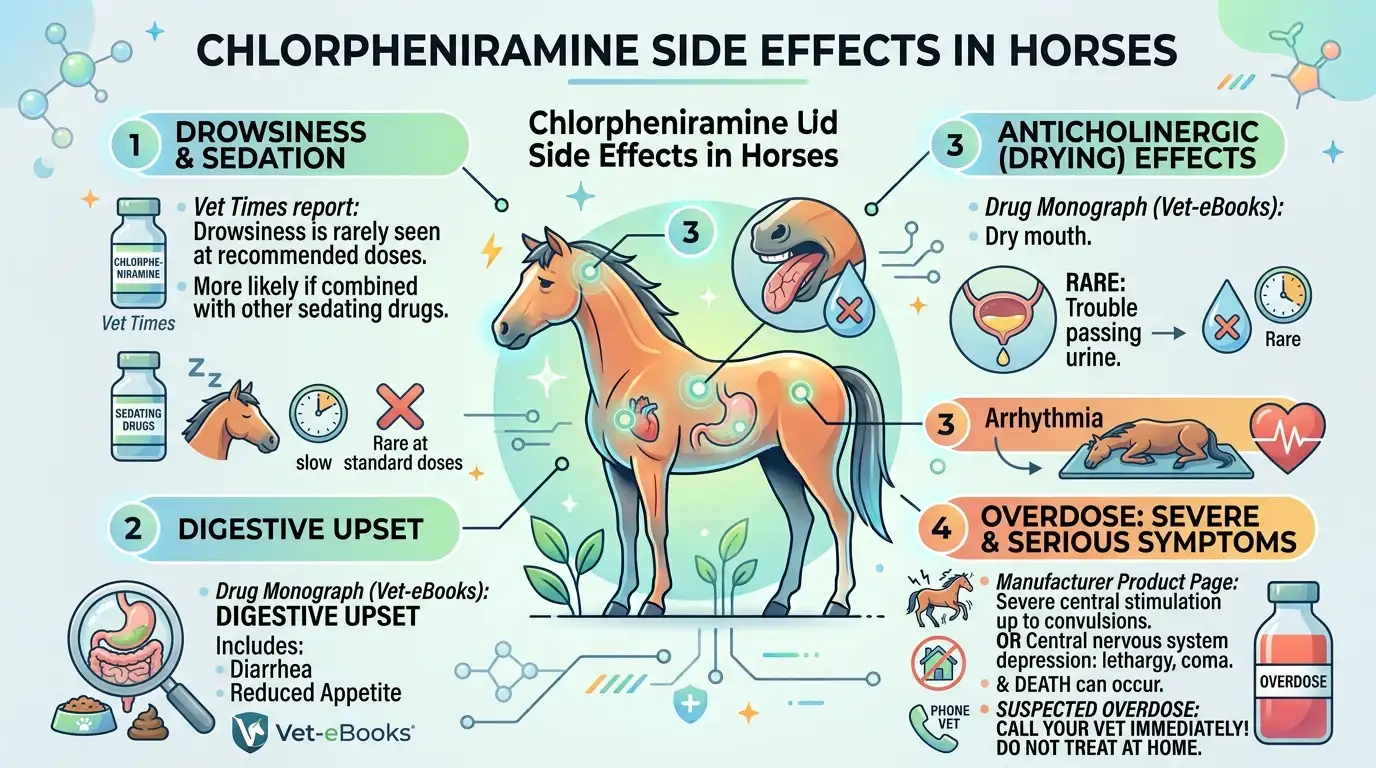
Vet Times reports that drowsiness is rarely seen at recommended doses. Still, as a first-generation antihistamine, chlorpheniramine can cause:
- Drowsiness or mild sedation, more likely if combined with other sedating drugs.
- Digestive upset, including diarrhea or reduced appetite.
- Drying (anticholinergic) effects, such as dry mouth and, rarely, trouble passing urine.
- Fast heart rate and arrhythmia at high doses, and a lower seizure threshold, based on the drug monograph summarised by Vet-eBooks.
Overdose is more serious. A manufacturer product page describes severe stimulation up to convulsions, or central nervous system depression progressing to lethargy and coma, and notes that respiratory depression and death can occur. If you suspect an overdose, call your vet immediately. Do not try to treat it at home.
When Not to Use Chlorpheniramine: Cautions and Interactions
Tell your vet about every condition and medication before the first dose. The product and monograph sources list these cautions:
- Angle-closure glaucoma and other eye pressure problems.
- Gut and urinary obstruction: paralytic ileus, pyloric stenosis, bladder neck stricture and prostate enlargement. Because horses are prone to colic, ask your vet how the drying effect applies to your horse.
- Heart disease, high blood pressure or an overactive thyroid.
- Seizure disorders, because the drug class can lower the seizure threshold.
- Severe liver or kidney disease, since the drug is processed in the liver and cleared through the urine.
- Pregnancy and lactation: the sources reviewed for this article describe safety data as limited, so the vet weighs benefit against risk.
On interactions, other CNS depressants add to sedation, so ask before combining it with sedatives such as those in our acepromazine dosage for horses and Dormosedan dosage for horses guides. Other drugs with drying effects can stack with it. Antihistamines may also partly counteract the blood-thinning effect of heparin or warfarin.
Chlorpheniramine and Drug Testing in Competition Horses
If your horse competes, this section matters. The dvm360 proceedings state that antihistamines must be withdrawn before most shows and competitions. The Canadian Pari-Mutuel Agency (CPMA) publishes elimination guidelines, and for chlorpheniramine it lists a single 75 mg intramuscular dose (Inactihist) in 8 horses with a 72-hour guideline.
Read that number carefully:
- It describes a single 75 mg dose, which is lower than the 125 mg per-dose figure for a 500 kg horse in the chart above. The CPMA table has no entry for repeated or higher doses, or for oral forms.
- CPMA stresses its figures are guidelines only and may not apply to compounded products or match foreign regulations and laboratory methods.
- A manufacturer page lists a withdrawal time of “none” for its injectable, but that entry does not address sport drug testing.
Rules differ by sport, country and governing body. Check your current rulebook, ask your vet to document the dose and date, and build in a generous margin before any event.
If Your Horse Is Due for Allergy Testing
Antihistamines interfere with intradermal allergy testing. The dvm360 proceedings list a 10-day withdrawal for antihistamines before testing, along with 3 weeks for oral steroids and 6 weeks for long-acting injectable steroids.
The author adds that these times are not set in stone and some horses can be tested sooner. Your dermatology vet will set the schedule.
Hives, Swelling and Emergencies: What an Antihistamine Will Not Fix
Hives usually fade within 24 to 48 hours. A lump that stays in one spot longer than that is probably not hives, and your vet may look for other causes. Large swellings on the muzzle and eyelids, called angioedema, are often a drug reaction, with procaine penicillin G named as a leading example.
If your horse recently received an antibiotic, read our guide to penicillin dosage for horses and tell your vet about the timing. Reactions can also follow shots, so see our overview of core horse vaccines to understand what your horse received.
Chlorpheniramine is not an emergency drug. Severe breathing difficulty, coughing with audible wheezing, or collapse needs a vet right away, because acute airway episodes are treated with other drugs.
For a coughing, wheezy horse in summer, ask about airway-focused options such as those in our Ventipulmin dosage for horses guide, and note that Vet Times says NSAIDs are not effective for this type of inflammatory airway disease.
Horses that cannot take steroids may be offered NSAIDs for allergic skin disease instead, according to Vet Times. For that discussion, our Bute dosage for horses page covers the basics.
Common Mistakes Horse Owners Make With Antihistamines
- Dosing by guesswork. Estimating weight by eye can push the dose well off target. Use a tape or scale.
- Using a human combination product. Cold and allergy products often contain extra ingredients not studied in horses.
- Mixing up mg and mL. Always check the concentration on the label before converting a dose to volume.
- Relying on the pill alone. For sweet itch, fans, rugs and stabling at dusk do more than any antihistamine.
- Forgetting the calendar. A dose given days before a show can still matter for drug testing.
- Treating a swollen muzzle at home. Facial swelling can progress fast. Call the vet first.
- Your vet has examined the horse and confirmed an allergic cause.
- You weighed the horse with a tape or scale.
- You know the exact product, its concentration in mg/mL, and that it contains chlorpheniramine only.
- The dose in mg and the volume in mL have both been confirmed by your vet.
- Your vet knows about every other drug, supplement and sedative the horse receives.
- You have checked competition dates against drug-testing rules.
- You are logging the date, time and dose of every administration.
Key Takeaways and Next Steps
- The Papich horse dose is 0.25 mg/kg orally every 12 hours. For a 500 kg horse that is 125 mg per dose, or 250 mg per day.
- Chlorpheniramine is an add-on for allergic skin disease. Owners reported benefit from antihistamines in 17 of 28 atopic horses, versus 33 of 35 for steroids.
- For sweet itch, midge control matters more than any pill.
- Overdose can cause convulsions or severe depression. Use weight-based math checked by your vet.
- CPMA lists 72 hours after a single 75 mg IM dose. Repeated or higher doses are not covered, so build in a margin before competing.
- Swollen muzzle, wheezing or collapse is an emergency, not an antihistamine problem.
Your next step is simple: write down your horse’s weight, the product name and its mg/mL strength, then call your vet with the calculator results in hand. Ask whether 0.25 mg/kg every 12 hours suits your horse, whether any higher rate is appropriate, how long to run a trial, and what to watch for.
That short conversation is the safest way to use this drug.
FAQs
What is the chlorpheniramine dosage for horses?
The Papich veterinary drug handbook lists 0.25 mg per kg of body weight, given orally every 12 hours, for horses with urticaria or itching. For a 500 kg (1,100 lb) horse that is 125 mg per dose. Other references list higher rates, so your vet should choose the exact dose for your horse.
How much chlorpheniramine can I give a 1,000 lb horse?
A 1,000 lb horse weighs about 454 kg, so 0.25 mg/kg works out to roughly 113 mg per dose, given every 12 hours, or about 227 mg per day. Confirm the dose and any liquid volume with your vet first.
How often can you give a horse chlorpheniramine?
Sources that specify frequency say twice daily, or every 12 hours. They do not set a maximum treatment length for horses, so your vet decides how long a trial should last and when to reassess.
Is chlorpheniramine safe for horses?
It is used in horses at vet-directed doses, and Vet Times reports that drowsiness is rarely seen. Overdose can cause convulsions, severe depression and respiratory depression, and it is not suitable for every horse. Use it only under veterinary guidance.
What is chlorpheniramine used for in horses?
Vets mainly use it as an add-on for allergic skin conditions such as hives, sweet itch and atopic dermatitis. It blocks histamine at H1 receptors, but it is not a substitute for emergency treatment of severe allergic reactions.
Can I give my horse human chlorpheniramine tablets?
Human tablets are typically 4 mg, so an adult horse dose would take dozens of tablets, and multi-symptom products may contain other ingredients that have not been studied in horses. Ask your vet which form to use rather than improvising.
Does chlorpheniramine make horses sleepy?
Its sedative effect is described as relatively weak, and Vet Times says drowsiness is rarely seen in horses. Combining it with other sedatives can add to sedation, so tell your vet about every drug your horse receives.
What is the difference between chlorpheniramine and Benadryl for horses?
Both are first-generation antihistamines. Papich lists chlorpheniramine for horses at 0.25 mg/kg orally every 12 hours, while Vet Times lists diphenhydramine (Benadryl) at 1–2 mg/kg two or three times daily. CPMA lists a shorter elimination guideline for diphenhydramine, 48 hours versus 72 hours for the single doses tested. Your vet chooses between them.
Is chlorpheniramine better than cetirizine for horses?
Neither is clearly better in the sources reviewed. Vet Times lists cetirizine at 0.2–0.4 mg/kg twice daily, while Papich lists chlorpheniramine at 0.25 mg/kg every 12 hours. The dvm360 proceedings single out hydroxyzine as most effective for hives.
Will chlorpheniramine cause a positive drug test in horses?
It can. The CPMA lists a 72-hour elimination guideline after a single 75 mg intramuscular dose, but it has no data for repeated or higher doses. Rules vary, so check your governing body and allow a generous margin.
Does chlorpheniramine work for sweet itch in horses?
Rarely on its own. Vet Times says antihistamines are generally ineffective as the sole treatment for sweet itch but may help milder cases or allow a lower steroid dose. Midge control is the most important step.
What are the signs of chlorpheniramine overdose in horses?
A manufacturer product page describes severe stimulation up to convulsions, or depression progressing to lethargy and coma, and notes that respiratory depression can occur. If you see these signs, call your vet immediately.
Can pregnant mares or foals have chlorpheniramine?
Safety data in pregnancy and lactation are limited in the sources reviewed, and foals need a vet-calculated dose. Do not give it to a pregnant mare, nursing mare or foal without veterinary approval.
How long does chlorpheniramine take to work in horses?
The sources reviewed do not give onset times for horses, so any figure would be a guess. Ask your vet what improvement to expect and when to reassess.
Can chlorpheniramine be given with steroids?
Vets often combine them. Vet Times notes antihistamines may allow a lower corticosteroid dose in milder cases. Your vet decides whether to use both and at what doses.
How do I calculate a chlorpheniramine dose for a pony?
The math is the same, weight in kg times mg/kg, but small errors matter more in small animals. Ask your vet to calculate it, and use a weight tape rather than a guess.
Sources and Further Reading
- Vet Times: Coates H. Dealing with sweet itch and other summer allergies in horses (6 March 2017)
- dvm360: Senter D. Allergic skin diseases of the horse (Proceedings)
- Agriculture and Agri-Food Canada: Canadian Pari-Mutuel Agency Elimination Guidelines (equine drug control)
- Vet-eBooks Vet Drugs List: Chlorphenamine, horse entry (Papich) 0.25 mg/kg PO q12h; table also summarises the BSAVA Small Animal Formulary
- MSD Veterinary Manual: Antihistamine dosages for integumentary disease in animals
- Rooyan Darou: Chlorhistamin (chlorpheniramine 10 mg/mL injectable) product information