Written & Reviewed By Medshorse Team
Last Updated: Sep 2026
Penicillin Dosage for Horses: Sodium penicillin G, Potassium penicillin G, Procaine penicillin G, Ampicillin sodium, Imipenem cilastatin sodium
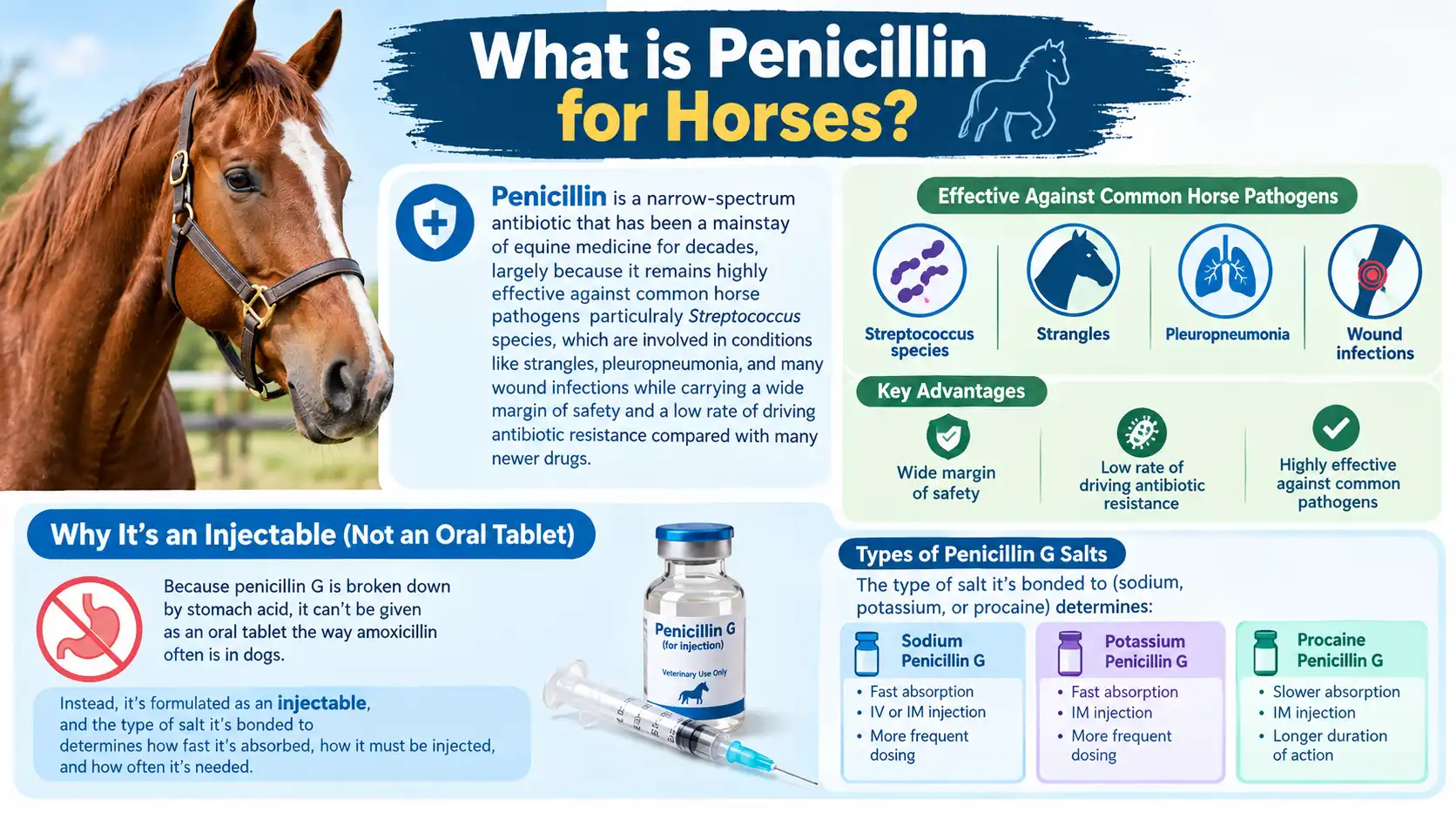
Penicillin is a narrow-spectrum antibiotic that has been a mainstay of equine medicine for decades, largely because it remains highly effective against common horse pathogens particularly Streptococcus species, which are involved in conditions like strangles, pleuropneumonia, and many wound infections while carrying a wide margin of safety and a low rate of driving antibiotic resistance compared with many newer drugs.
Because penicillin G is broken down by stomach acid, it can’t be given as an oral tablet the way amoxicillin often is in dogs. Instead, it’s formulated as an injectable, and the type of salt it’s bonded to (sodium, potassium, or procaine) determines how fast it’s absorbed, how it must be injected, and how often it’s needed.
Disclaimer: This guide is for education only. Penicillin is a prescription-only veterinary drug, and getting the dose, route, or product wrong can seriously injure or kill a horse. Never give penicillin to a horse without a veterinarian directing the exact product, dose, and injection site. If you’re reading this because a vet already prescribed penicillin and you just want to double-check the numbers, use the chart below as a cross-reference not a substitute for their instructions.
Penicillin Dosage Calculator for Dogs
Enter your dog’s weight and selected medication to estimate a dose range.
Estimated Dose
| Medication | |
| Regimen used | |
| Route | |
| Frequency | |
| Weight used |
For educational reference only — not a substitute for veterinary advice. Always confirm dosing, route and suitability with a licensed veterinarian before administering any medication.
Key Takeaways
- Penicillin comes in three forms used in horses sodium, potassium, and procaine — and they are not interchangeable in dose, route, or frequency.
- Procaine penicillin G is for intramuscular (IM) injection only. Accidental injection into a vein can trigger a "procaine reaction" a frightening, sometimes fatal, neurological event.
- Potassium penicillin G carries meaningful potassium load and needs caution in horses with HYPP (hyperkalemic periodic paralysis) or kidney disease.
- Dosing is always calculated by the horse's actual body weight in kilograms, not by a flat "cc per horse" rule of thumb.
- When penicillin resistance or treatment failure is a concern, vets may move to ampicillin or, in reserved cases, imipenem-cilastatin.
Penicillin Dosage for Horses Guidlines
Veterinarians typically dose penicillin in horses based on the specific form of the drug:
- Sodium penicillin G: 10,000–20,000 U/kg IV or IM every 6 hours, or 20,000–25,000 U/kg IV every 6–8 hours
- Potassium penicillin G: 20,000–25,000 U/kg IV every 6 hours
- Procaine penicillin G: 22,000–44,000 U/kg IM every 12–24 hours
In resistant ("refractory") infections, vets have used doses as high as 44,000 U/kg. These numbers only make sense in the context of which salt form is used, how it's injected, and how often all covered in detail below.
The Three Forms of Penicillin Used in Horses
| Form | Route | Speed of Action | Typical Use Case |
|---|---|---|---|
| Sodium penicillin G | IV or IM | Fast onset, short duration | Acute or severe infections needing rapid, high blood levels |
| Potassium penicillin G | IV only | Fast onset, short duration | Similar to sodium form; used where sodium load is a concern |
| Procaine penicillin G | IM only (never IV) | Slower onset, longer "depot" duration | Routine infections where less-frequent dosing is preferred |
Sodium and potassium penicillin G are highly water-soluble, so they're given intravenously for a rapid, high peak concentration. Procaine penicillin G is far less soluble; it forms a slow-releasing depot in the muscle, which is why it's dosed less often but that same property means it must never enter a vein directly (more on why in the safety section below).
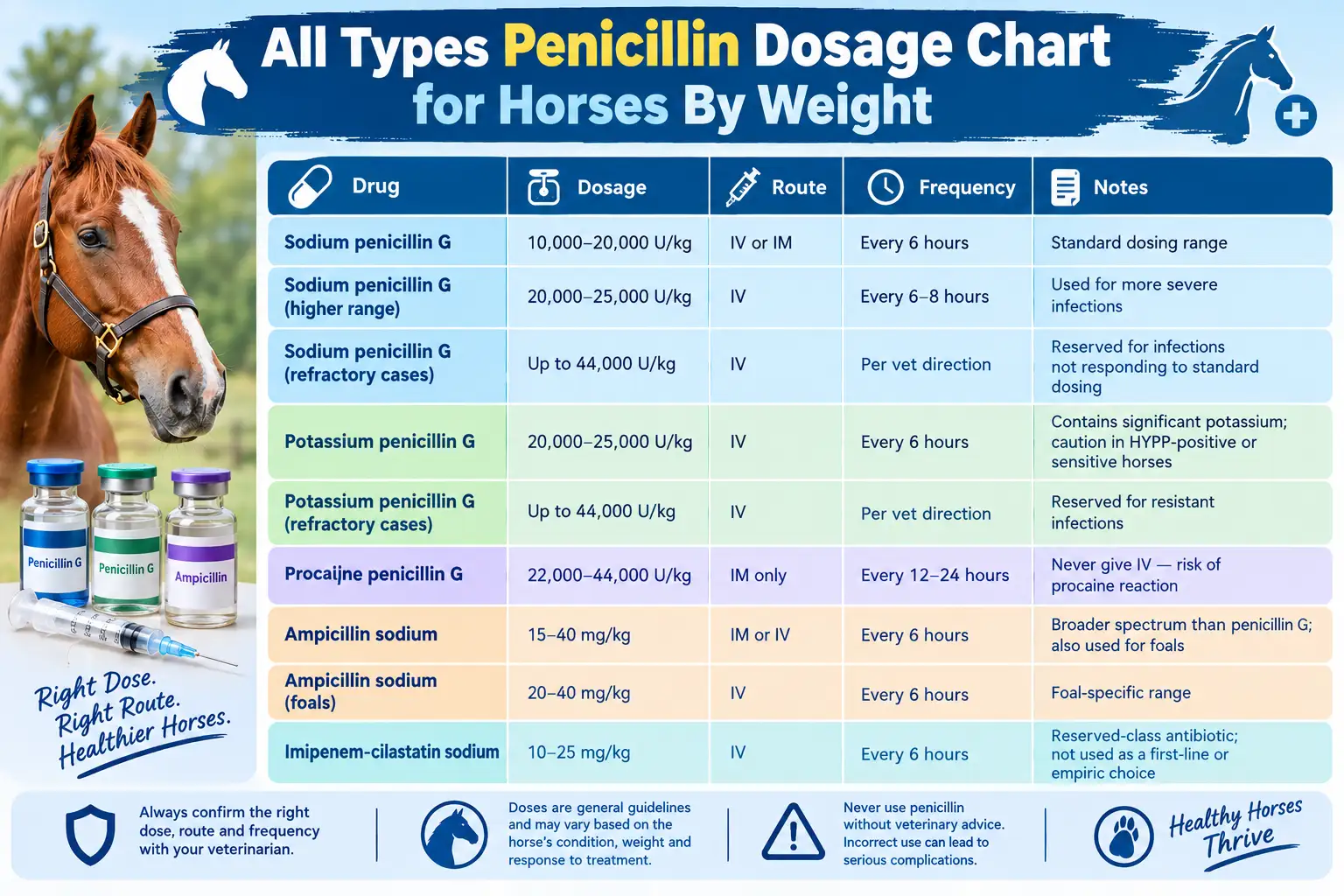
All Types Penicillin Dosage Chart for Horses By Weight
| Drug | Dosage | Route | Frequency | Notes |
|---|---|---|---|---|
| Sodium penicillin G | 10,000–20,000 U/kg | IV or IM | Every 6 hours | Standard dosing range |
| Sodium penicillin G (higher range) | 20,000–25,000 U/kg | IV | Every 6–8 hours | Used for more severe infections |
| Sodium penicillin G (refractory cases) | Up to 44,000 U/kg | IV | Per vet direction | Reserved for infections not responding to standard dosing |
| Potassium penicillin G | 20,000–25,000 U/kg | IV | Every 6 hours | Contains significant potassium; caution in HYPP-positive or sensitive horses |
| Potassium penicillin G (refractory cases) | Up to 44,000 U/kg | IV | Per vet direction | Reserved for resistant infections |
| Procaine penicillin G | 22,000–44,000 U/kg | IM only | Every 12–24 hours | Never give IV — risk of procaine reaction |
| Ampicillin sodium | 15–40 mg/kg | IM or IV | Every 6 hours | Broader spectrum than penicillin G; also used for foals |
| Ampicillin sodium (foals) | 20–40 mg/kg | IV | Every 6 hours | Foal-specific range |
| Imipenem-cilastatin sodium | 10–25 mg/kg | IV | Every 6 hours | Reserved-class antibiotic; not used as a first-line or empiric choice |
What This Looks Like for an Average-Sized Horse
Dosing math can be easier to picture with a real example. For a 500 kg (about 1,100 lb) adult horse — a common average weight for a mature light-breed horse — the calculated dose ranges would fall roughly as follows. These are illustrative math only, not a substitute for a veterinarian's specific prescription and product-label instructions:
- Sodium penicillin G: 5,000,000–10,000,000 units per dose at the standard range, up to 12,500,000 units at the higher range
- Potassium penicillin G: 10,000,000–12,500,000 units per dose
- Procaine penicillin G: 11,000,000–22,000,000 units per dose
- Ampicillin sodium: roughly 7.5–20 grams per dose
- Imipenem-cilastatin: roughly 5–12.5 grams per dose
Because injectable penicillin is supplied in different concentrations (units per mL) by different manufacturers, the actual volume drawn into the syringe varies by product this is exactly why the prescribing vet, not a general chart, determines the final mL amount for a specific bottle.
How Penicillin Is Given: IM vs. IV, and Why the Difference Matters
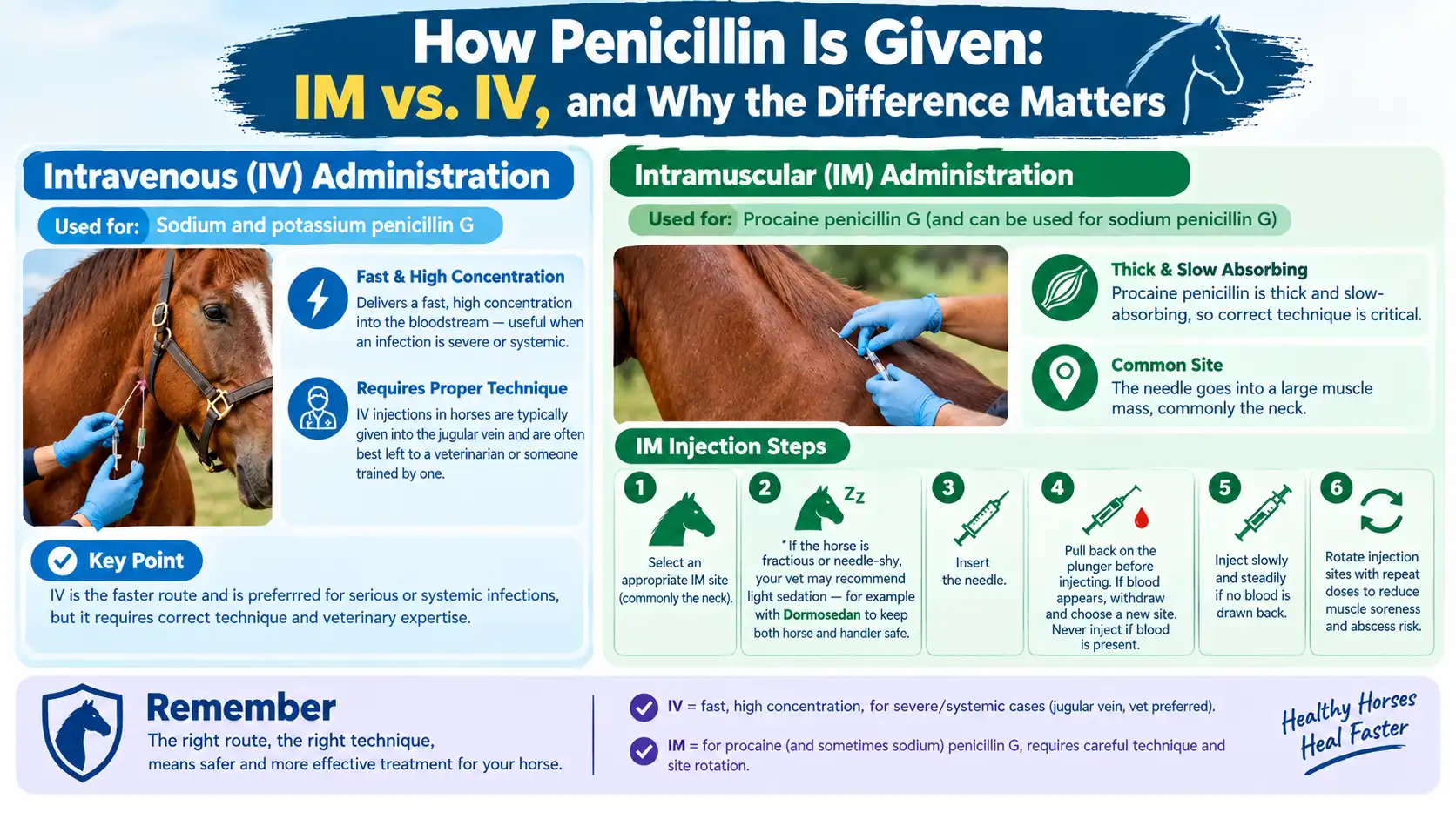
Intravenous (IV) administration is used for sodium and potassium penicillin G. It delivers a fast, high concentration into the bloodstream useful when an infection is severe or systemic. IV injections in horses require correct technique (typically into the jugular vein) and are often best left to a veterinarian or someone trained by one.
Intramuscular (IM) administration is used for procaine penicillin G (and can be used for sodium penicillin G as well). The needle goes into a large muscle mass, commonly the neck. Because procaine penicillin is thick and slow-absorbing, correct technique is critical:
- Select an appropriate IM site (commonly the neck).
- If the horse is fractious or needle-shy, your vet may recommend light sedation — for example with a product like Dormosedan to keep both the horse and handler safe during injection.
- Insert the needle.
- Pull back on the plunger before injecting. If blood appears in the syringe, the needle is in a blood vessel — withdraw and choose a new site. Never inject if blood is present.
- Inject slowly and steadily if no blood is drawn back.
- Rotate injection sites with repeat doses to reduce muscle soreness and abscess risk.
Procaine Reaction: The Safety Issue Every Horse Owner Should Know
This is the single most important safety concept in equine penicillin use, and it's frequently confused with an allergic reaction, but it isn't one.
A "procaine reaction" happens when procaine penicillin is accidentally introduced into a blood vessel instead of the muscle. Because procaine has a local anesthetic effect, when it reaches the brain rapidly through the bloodstream it can cause sudden, dramatic central nervous system stimulation: the horse may appear panicked, snort, spin, stagger, or even have a seizure-like episode and fall.
It typically lasts only a few minutes, and most horses recover, but the horse can injure itself or a handler while it's happening. There is no antidote; management is keeping the horse and people safe from injury until it passes.
By contrast, a true anaphylactic (allergic) reaction to penicillin is a separate, immune-mediated event. It can include hives, swelling, difficulty breathing, colic-like signs, or collapse, and is considered a veterinary emergency requiring immediate treatment a horse that has had a prior anaphylactic reaction to penicillin generally should not receive it again.
Emergency treatment, directed by a vet, often includes a fast-acting corticosteroid such as dexamethasone and an antihistamine such as Benadryl (diphenhydramine).
Reducing the risk:
- Always draw back on the syringe before injecting IM procaine penicillin.
- Never inject procaine penicillin into a vein.
- Keep procaine penicillin refrigerated per the product label.
- Rotate and vary injection sites, since repeated injections in the same spot are associated with more reactions.
- Have a plan (and ideally a second person present) for the first few doses of any new antibiotic course, in case a reaction occurs.
Potassium Penicillin and HYPP: Why It Matters
Potassium penicillin G injectable solutions carry a meaningful amount of potassium (roughly 1.7 mEq per million units). For most horses this isn't clinically significant, but it becomes important in horses with:
- Hyperkalemic periodic paralysis (HYPP) a genetic muscle disorder, most common in Quarter Horses, Paints, Appaloosas, and related crossbreds, in which high blood potassium triggers muscle tremors, weakness, or paralysis episodes
- Kidney disease or other conditions affecting the body's ability to regulate potassium
In these horses, vets typically avoid potassium penicillin G or monitor potassium levels closely, favoring the sodium form instead where IV penicillin is still needed.
Common Side Effects and Reactions
| Reaction Type | What It Looks Like | Urgency |
|---|---|---|
| Procaine reaction (IM procaine penicillin only) | Sudden agitation, snorting, spinning, brief seizure-like episode | Stay calm, keep horse and people safe; usually resolves in minutes; call vet |
| Anaphylaxis / allergic reaction | Hives, swelling, difficulty breathing, colic signs, collapse | Emergency — call vet immediately |
| Injection site swelling or soreness | Firm, warm, or painful area at injection site | Monitor; call vet if it worsens or an abscess forms |
| Autoimmune hemolytic anemia (uncommon) | Lethargy, fever, pale gums, weight loss, dark urine | Call vet |
When Vets Choose an Alternative to Penicillin G
Penicillin G isn't effective against every bacterium, and resistance does occur. When penicillin isn't the right fit, common next steps include:
- Ampicillin sodium a broader-spectrum option in the same drug family, dosed at 15–40 mg/kg IM or IV every 6 hours in adult horses, and 20–40 mg/kg IV every 6 hours in foals.
- Imipenem-cilastatin sodium a "reserved class" antibiotic dosed at 10–25 mg/kg IV every 6 hours, kept in reserve for resistant infections rather than used as a first-choice or empiric treatment, to help slow the development of resistance to this last-line drug class.
FAQs
How much penicillin should I give my horse?
The dose depends on which penicillin form your vet has prescribed and the horse's exact body weight. As a general range, sodium and potassium penicillin G run 10,000–25,000 U/kg, and procaine penicillin G runs 22,000–44,000 U/kg — but only a veterinarian should set the actual dose and schedule for your horse.
Can I give penicillin to my horse myself?
Only under a veterinarian's direction, with a specific product, dose, and injection technique. Procaine penicillin in particular requires careful technique to avoid a procaine reaction.
How often is penicillin given to horses?
Sodium and potassium penicillin G are typically given every 6 hours (sometimes every 6–8 hours). Procaine penicillin G is longer-acting and typically given every 12–24 hours.
What happens if procaine penicillin accidentally goes into a vein?
It can cause a procaine reaction sudden agitation, disorientation, spinning, or a brief seizure-like episode. This is a different event from an allergic reaction and usually resolves within minutes, though the horse can be injured while it's happening.
Is penicillin safe for foals?
Vets do use penicillin in foals, often alongside other antibiotics like ampicillin, but foal dosing and monitoring differ from adult horses and should always be directed by a veterinarian familiar with the foal's case.
Can horses be allergic to penicillin?
Yes. True penicillin allergy in horses causes signs like hives, swelling, breathing difficulty, or collapse, and is generally considered a reason to avoid penicillin in the future.
Why does procaine penicillin need to be refrigerated?
Refrigeration is part of the labeled storage requirement for procaine penicillin G products and is thought to help reduce the risk of adverse reactions.
What's the difference between sodium and potassium penicillin G?
Both are fast-acting, water-soluble forms given IV. The main practical difference is potassium content potassium penicillin G carries more potassium per dose, which matters for horses with HYPP or kidney issues.
Can penicillin be given orally to horses?
No. Penicillin G is broken down by stomach acid and isn't formulated as an oral product for horses; it's given by injection.
How long does a course of penicillin usually last?
Treatment length depends on the infection being treated and the horse's response and is determined by the prescribing veterinarian it's not a fixed number of days across all cases.
Are there withdrawal times for horses treated with penicillin?
Withdrawal periods (relevant if a horse could ever enter the food supply) depend on the specific product label and local regulations, and a veterinarian or the product's labeling should be consulted directly for that information.
What if my horse's infection doesn't improve on penicillin?
This is one reason vets sometimes move to higher "refractory" dosing or switch to a different antibiotic class, such as ampicillin, based on clinical response or culture and sensitivity results.
Is procaine penicillin G the same as regular penicillin?
It's the same active drug (penicillin G) bonded to a different carrier salt (procaine) that changes how it's absorbed and how it must be injected it is not interchangeable in dosing or route with the sodium or potassium forms.