Uniprim Dosage For Horses: Calculator, Chart & Complete Guide
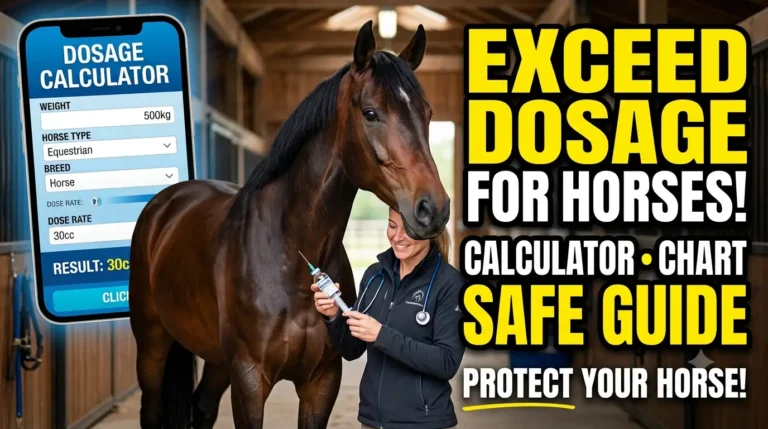
Uniprim Horse Dosage Calculator
Recommended Daily Dosage
- Frequency: Administer once daily.
- Method: Mix the dose into a small amount of tasty feed and give by mouth.
- Treatment Length: Typically given for 5–10 days (or as directed by your veterinarian).
- Water: Ensure plenty of fresh water is available at all times during treatment.
When your vet has prescribed your Uniprim dosage for horse, you likely have just one thing in mind: the proper dose, quick. This guide will provide you with that – an instant calculator, a printable chart, and worked-out examples, and all the rest you should know to administer this antibiotic safely and know when to call your vet or not.
Quick answer: Standard Uniprim dosage for horses is 3.75 grams per 110 lbs (50kg) of body weight, administered once a day in a small portion of feed, in a course of which your veterinarian decides (usually 5-7 days).
Key Takeaways
- Uniprim is a prescription (RX) oral antibiotic powder containing sulfadiazine and trimethoprim, produced by Neogen to treat horses.
- The dosage is constantly 3.75 g/110 lbs (50 kg) administered as a single dose, in feed.
- A 1,100 lb (500 kg) horse is treated with one day of one 37.5 g packet, one level 67 cc scoop or two level 32 cc scoops.
- Uniprim for horses dosage is approved by FDA (ANADA 200-033) to treat strangles, respiratory infection, urogenital infection, wounds, and abscesses in horses.
- Never administer without a prescription given by your veterinarian and never assume that you can just go by a chart and know how long you need to take the medication.
What Is Uniprim For Horses?
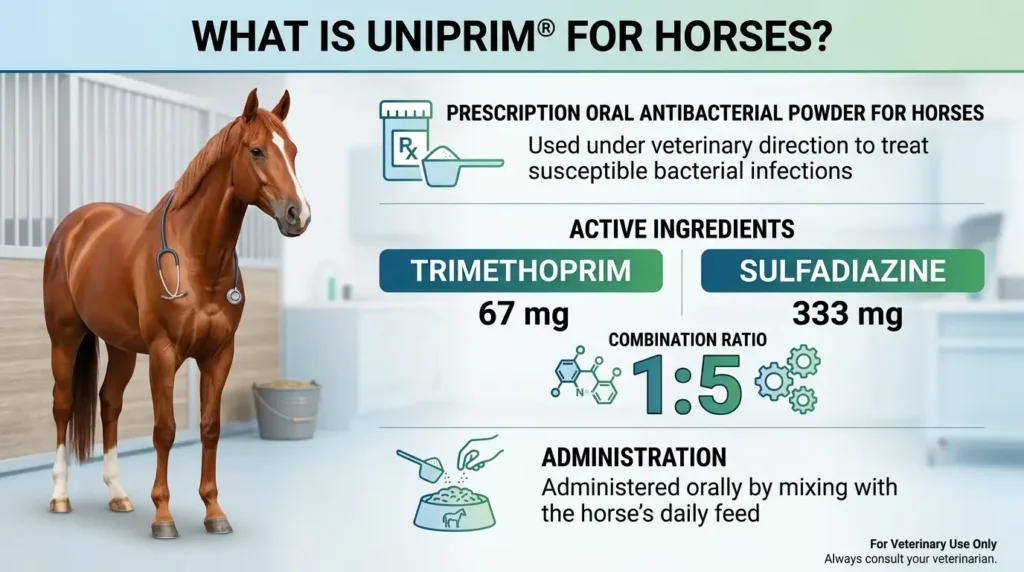
Uniprim (trimethoprim and sulfadiazine) is a prescription-only, oral antibacterial powder of horses that occurs under the brand Uniprim and is produced by Neogen Corporation. It is administered by mixing it in the daily feed of a horse, instead of injecting or administering it in the form of a paste to control a wide variety of bacterial infections.
Active Ingredients — Trimethoprim & Sulfadiazine
Each gram of Uniprim Powder contains:
| Ingredient | Amount per gram |
| Trimethoprim | 67 mg |
| Sulfadiazine | 333 mg |
The two are used in a combination of 1 part trimethoprim: 5 parts sulfadiazine weight. That ratio is not random, but rather a combination of the strongest antibacterial effect of the least amount of drug researchers discovered.
How Uniprim Works in a Horse’s Body
Trimethoprim and sulfadiazine attack bacteria on two angles simultaneously, hence the combination is effective compared to either of the two drugs.
- The mechanism of action of trimethoprim is to prevent the production of a compound known as tetrahydrofolic acid by the bacteria by blocking the activity of an enzyme, known as dihydrofolate reductase.
- Sulfadiazine, similar to the other sulfa drugs, inhibits another step in the same bacterial pathway, competing with para-aminobenzoic acid.
This combines to produce a sequential, two-fold blockade of bacterial metabolism – it not only starves bacteria of the nucleic acids and proteins that they require to survive and reproduce, but it is also normally bactericidal (it kills bacteria, not slows down their metabolism).
Importantly, such a pathway is not present in the same manner in the cells of the horse, as horses do not produce their own folic acid as bacteria do, thus the drug combination attacks the bacteria, but leaves the normal folate metabolism of the horse undisturbed.
Once a horse swallows a dose of drug mixed with feed, the drug is absorbed relatively rapidly: the drug trimethoprim gets peak blood levels about 1.5 hours after administration, and sulfadiazine gets peak levels somewhere between 2.5 and 6 hours. The half-life of Trimethoprim in the blood is approximately 2 to 2.5 hours and sulfadiazine persists longer, with half life of about 4 to 5.5 hours.
This is some of why once-a-day dosing suffices, despite the fact that the individual half-lives appear short – trimethoprim concentrates in tissues (lungs, kidney, liver) at higher levels than the level of the drug could be measured in the blood.
What Is Uniprim Used For in Horses?
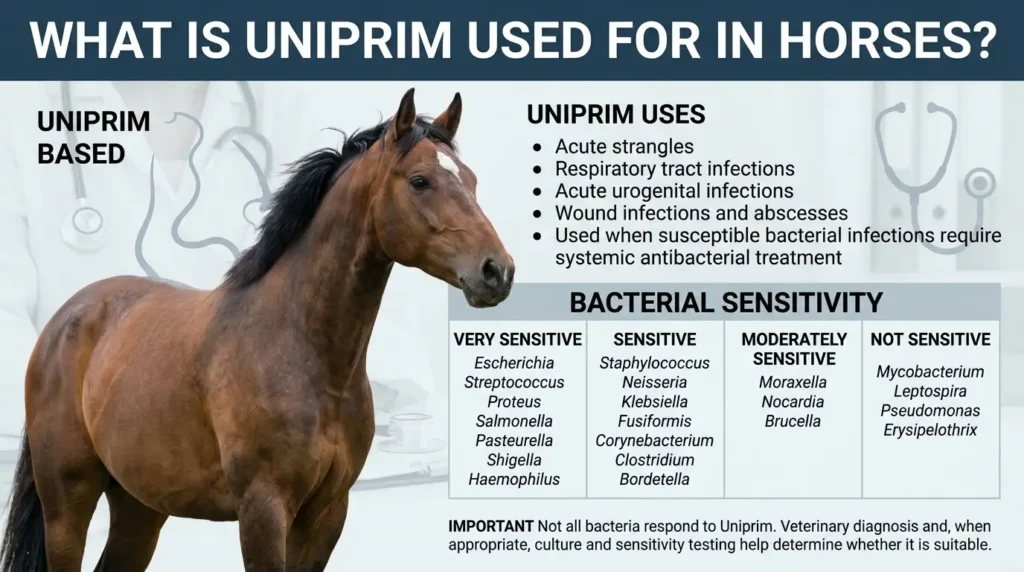
Uniprim horse dose is recommended in horses in cases where a powerful, systemic antibacterial effect on sensitive organisms is required – i.e. in the management of bacterial infections in acute strangles, respiratory tract infections, acute urogenital infections, and wound infections and abscesses. Foals also tolerate it well, and this is one of the reasons why vets grab it in barns with young stock.
Bacteria Uniprim Treats
Not all bacteria will react identically to trimethoprim and sulfadiazine. According to lab (in vitro) testing of the label approved by the FDA:
| Sensitivity | Bacteria genera |
| Very sensitive | Escherichia, Streptococcus, Proteus, Salmonella, Pasteurella, Shigella, Haemophilus |
| Sensitive | Staphylococcus, Neisseria, Klebsiella, Fusiformis, Corynebacterium, Clostridium, Bordetella |
| Moderately sensitive | Moraxella, Nocardia, Brucella |
| Not sensitive | Mycobacterium, Leptospira, Pseudomonas, Erysipelothrix |
Why it is important: when your horse is infected with an organism in the not sensitive column, Uniprim is not the correct antibiotic, the reason is precisely this that is why you go to the vet and rely on a diagnosis (often with a culture and sensitivity test) before prescribing, and not treatment.
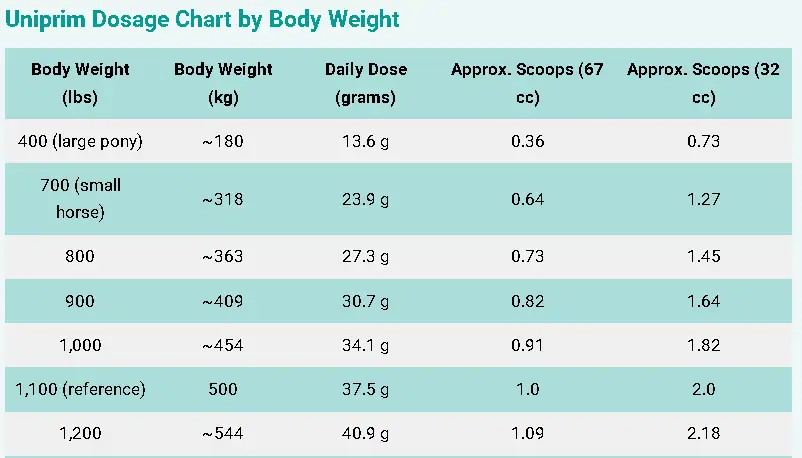
Uniprim Dosage Chart by Body Weight
A quick tip: Use this chart as a quick reference or to sanity-check the calculator. Ponies to draft-cross horses are usually weighted.
| Body Weight (lbs) | Body Weight (kg) | Daily Dose (grams) | Approx. Scoops (67 cc) | Approx. Scoops (32 cc) |
| 400 (large pony) | ~180 | 13.6 g | 0.36 | 0.73 |
| 700 (small horse) | ~318 | 23.9 g | 0.64 | 1.27 |
| 800 | ~363 | 27.3 g | 0.73 | 1.45 |
| 900 | ~409 | 30.7 g | 0.82 | 1.64 |
| 1,000 | ~454 | 34.1 g | 0.91 | 1.82 |
| 1,100 (reference) | 500 | 37.5 g | 1.0 | 2.0 |
| 1,200 | ~544 | 40.9 g | 1.09 | 2.18 |
| 1,400 (draft-cross) | ~635 | 47.7 g | 1.27 | 2.55 |
Volumes of scoop are based on the assumption of loosely filled, agitated, and gently agitated volume of scoop powder: see the scoop table below, which indicates which scoop size ships with which package.
Worked example: The minimum daily amount of Uniprim required by a 1,000 lb Quarter Horse is 34.1 g of Uniprim. When you use the 1125 g packet or 12 kg box (which includes a 67 cc scoop), then it is a little less than one level scoop a day. In case you are using a jar or pail (32 cc scoop) this is slightly less than two level scoops per day.
How to Give Uniprim to Your Horse (Step-by-Step)
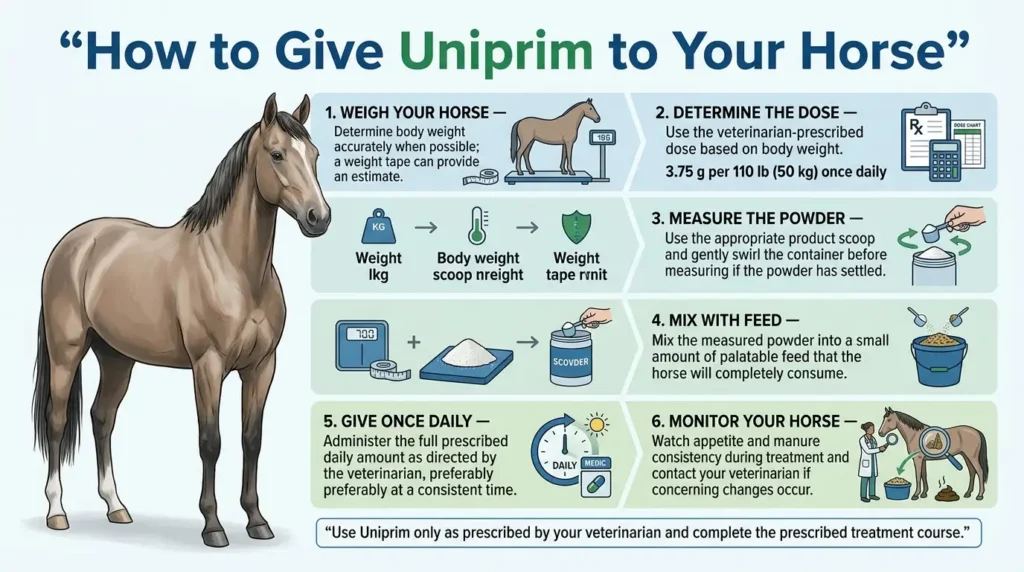
The Uniprim dosage for horses prescribed is 3.75 g of Uniprim Powder per 110 lbs (50 kg) of body weight per day given in a small amount of palatable food orally in one dose per day.
- Weigh your horse. Weigh the livestock scale used (where available), or reasonably estimate the weight with a weight tape – the dose directly depends on this.
- Determine or find daily dose by the calculator or chart above.
- Scoop the powder with the right scoop that fits your package (see table below). The product can settle after some time, so lightly swirl the container then scoop the product to obtain a proper reading.
- Add to a small portion of palatable feed – just enough that your horse will finish it in a single meal instead of adding it to a full grain ration that your horse may selectively eat.
- Take the entire course that your vet recommended and take it as a single dose each day at a similar time of day.
- Monitor manure consistency and appetite during treatment (see the Side Effects section below).
Uniprim Scoop Conversion Table (All Package Sizes)
A 37.5 g packet is enough to treat a 1,100 lb (500 kg) horse in a day. In addition to the single-dose packet, the sizes of the scoops by package include:
| Package Size | Scoop Provided | Scoop Needed for 37.5 g (1,100 lb / 500 kg horse, 1 day) |
| 37.5 g packet | Pre-measured, no scoop needed | 1 whole packet |
| 1,125 g packet | 67 cc scoop | 1 level, loose-filled 67 cc scoop |
| 12 kg box | 67 cc scoop | 1 level, loose-filled 67 cc scoop |
| 200 g jar | 32 cc scoop | 2 level, loose-filled 32 cc scoops |
| 400 g jar | 32 cc scoop | 2 level, loose-filled 32 cc scoops |
| 1,200 g jar | 32 cc scoop | 2 level, loose-filled 32 cc scoops |
| 2,000 g pail | 32 cc scoop | 2 level, loose-filled 32 cc scoops |
Pro tip: when you have a horse that does not weigh in whole scoops (most horses), it is easier to weigh the dose you are giving each day on a small gram scale than to count scoopfuls of a fraction of a scoop – a 10-15 dollar digital kitchen scale is good enough and eliminates the guesswork.
How Long Should a Horse Take Uniprim?
Single daily dose and 5 to 7 days is the standard regimen of treatment. In case of an acute infection, therapy must be continued 2 to 3 days after clinical improvement – when your horse is feeling better, you have a tendency to stop and that is a typical error that will allow the infection to relapse. In case the improvement has not occurred in 3 to 5 days then the diagnosis should be reconsidered by your vet and not just by extending the period of using the same antibiotic.
Note on conflicting information: you will find some retail listings which mention a treatment window of up to 5 to 10 days. The legal binding source of information, the FDA-approved product label, states 5-7 days as the typical course with a 2 -3 day post-symptom extension. Never exceed or take less than the number of days which have been prescribed to your horse by your veterinarian; the label range is not a replacement of a prescription.
Uniprim Dosage Benefits For Horses
- Bactericidal effect (not slowing bacterial growth) with rapid action against a wide spectrum of gram-positive and gram-negative bacteria.
- One-dose a day on the oral route – none of the intravenous injections, or frequent visits to the veterinarian only to give the medication.
- Ready-made, convenient, once-daily dosing with easy, customizable, and precise dosing in a variety of horse sizes.
- Well tolerated by foals, useful in breeding and youngstock operations.
- They are sold in any size of a package of five, and with two flavors (apple or regular), so that every size of a barn may have its package to suit.
- Active even on certain sulfonamide-resistant strains: a combination of trimethoprim/sulfadiazine has a significantly lower minimum inhibitory concentration against sulfadiazine-resistant strains of E. coli and Proteus than sulfadiazine alone, implying that it can still be used in cases where a direct sulfa drug would fail.
- Low toxicity in general – acute oral LD50 in rats and mice exceeds 5g per kg, which is a very broad range considering the therapeutic dose.
Uniprim Side Effects in Horses
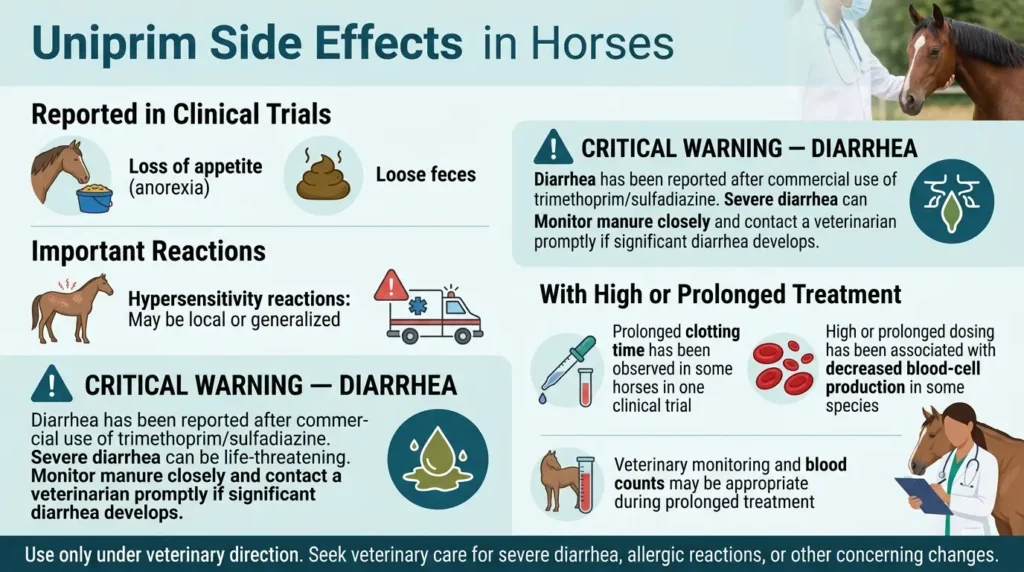
Uniprim dose for horses is well tolerated by most horses but you must be aware of what to be on the alert.
Reported in clinical trials: There was one case of anorexia (loss of appetite) and one case of loose feces reported in clinical trials of the drug.
Hypersensitivity reactions: individual horses can experience hypersensitivity reactions that have either local or generalized effects, which are often non-fatal, and anaphylactoid reactions are also possible, but uncommon. The antidote to use in case of a severe reaction is epinephrine – this is an emergency with a veterinary.
Diarrhea – a true post-approval safety signal: horses have been known to have diarrhea in the course of trimethoprim and sulfadiazine administration once the drug became commercially available, and this diarrhea may be lethal. This is the most crucial side effect which should be actively monitored.
Blood-related effects with high or long dosing: in one of two clinical trials, which used high doses or doses long, clotting time was prolonged in some horses – but this effect was not observed in a second, similar, trial, and might have been due to the underlying infection rather than the drug itself.
High, long-lasting dosing has also been reported to cause slight, to moderate, decreases in blood cell production in a few species, which is reversible either by discontinuing the drug or with folinic acid (leucovorin).
This precisely is the reason why platelet, white blood cell and red blood cell counts should be periodically checked in long-term treatment, and why Uniprim is not usually administered over long courses without monitoring of the veterinary blood.
What to Do if You See Diarrhea or Loose Manure
In case of alteration in the fecal consistency of your horse during treatment, then discontinue the use of Uniprim and report to your veterinarian. Waiting to see whether it will solve itself is not an option this is among the few expressly mentioned stop and call the vet commands on the whole label.
Uniprim Risks, Warnings & Contraindications
Trimethoprim and sulfadiazine should not be used in horses that show marked liver parenchymal damage, blood dyscrasias (blood disorders), or that have a history of sulfonamide sensitivity.
The federal law limits this drug to be used by, or ordered by, a licensed veterinarian, this drug is not an over-the-counter product, no matter which retailer is selling it.
Do not use Uniprim in horses intended for human consumption.
Horses That Should NOT Take Uniprim
- Known liver-damaged horses.
- Horses that already have blood disorders (blood dyscrasias).
- Horses that have a history of sulfonamide (sulfa drug) sensitivity or allergy.
- Horses to be fed on by human beings.
Pregnancy and Breeding Considerations
The impact of trimethoprim and sulfadiazine on pregnancy has not been declared. On the positive side, to date, no adverse impact on stallion spermatogenesis has been observed with the recommended dose, or subsequent to this dose.
Since no one has determined how safe it is during pregnancy, it is always best to talk to your veterinarian about using in a pregnant or breeding mare before starting treatment.
General precaution: horses undergoing sulfonamide treatment must be well-supplied with water at all times, as sufficient hydration aids in eliminating the drug by the kidneys and minimizes the possibility of crystal formation in the urine, which is a common class-effect of sulfa drugs.
Uniprim Drug Interactions
The unofficial Uniprim label lacks an official drug-interaction table. With that said, trimethoprim and sulfadiazine are representatives of well-researched drug classes, and the basic concepts of veterinary pharmacology related to this type of drug should be familiar to you: never use Uniprim in combination with any other drug or supplement without checking with the prescribing veterinarian:
- Other drugs that act on the folate-pathway (including pyrimethamine, occasionally used to treat equine protozoal myeloencephalitis) may, as a class effect, add to the folate-related blood effects when used in combination with drugs containing trimethoprim – the combination should only occur under strict veterinary supervision and observation.
- The sulfonamides can be antagonized chemically by local anesthetics based on PABA (like procaine-based products), as sulfa drugs are effective by competing with PABA in bacteria.
- Protein-bound drugs of high affinity (anticoagulants and some anticonvulsants) are susceptible to react with sulfonamides at the protein-binding level within blood, a general characteristic of sulfa drugs as a group.
This does not override the opinion of your vet in any way, it is included to remind you what questions to ask in case your horse is taking any other medicine, supplement, or dewormer when on a Uniprim course.
Uniprim vs. Other Sulfa Antibiotics (SMZ-TMP)
Both Uniprim medication and generic SMZ-TMP (sulfamethoxazole/trimethoprim) medications combine trimethoprim with a sulfa medication, and act by the same dual-blockade mechanism. The practical differences horse owners are concerned about:
| Uniprim | Generic SMZ-TMP | |
| Sulfa component | Sulfadiazine | Sulfamethoxazole |
| FDA approval for horses | Yes — ANADA #200-033 | Varies by product/manufacturer |
| Flavoring | Apple flavor option available | Usually unflavored |
| Palatability data on label | Purpose-built and tested for horses | Often adapted from other species |
| Foal tolerance | Specifically noted as well tolerated by foals | Not always specifically studied |
Both classes of drugs are prescribed by a veterinarian and have the same general precautions of sulfonamides (hydration, blood monitoring on long-term use, history of sulfa-sensitivity).
How Uniprim Is Sold (Sizes, Flavors, Storage)
Uniprim Powder for Horses is available in 37.5 g packets, 1,125 g packets, 200 g jars, 400 g jars, 1,200 g jars, 2,000 g pails, and 12 kg boxes. Uniprim, which comes in an Apple flavor, is offered in 37.5 g packets, 1125 g packets, 200 g jars, 400 g jars, 1200 g jars, and 2000 g pails (only regular flavor is offered in a 12 kg box).
Storage: store Uniprim at 25°C (77°F) or less – a typical, climate controlled tack room or feed room shelf will do; no hot trailers or direct sun.
Common Mistakes When Dosing Uniprim
- Estimating the weight of the horse as opposed to a scale or weight tape – this is the most common dosing mistake.
- Rounding scoops loosely rather than with level, gently-settled scoops as the label indicates.
- Discontinuation of treatment when the horse appears to have improved, rather than completing the course of treatment plus the 2-3 day buffer.
- Instead of giving the horse a small, tasting dose of a substance, they will put the entire dose in a large grain meal that the horse may not consume, instead of a small, tasting dose that the horse will consume entirely.
- Not paying attention to a change in the manure consistency and stopping and calling the vet immediately.
- Using the leftover Uniprim used in a previous disease, without a new veterinary diagnosis–different infections require different antibiotics.
Myth vs. Fact
| Myth | Fact |
| “Uniprim is available over the counter.” | Federal law restricts Uniprim to use by, or on the order of, a licensed veterinarian — a prescription is required. |
| “More scoops will clear the infection faster.” | The dose is fixed by body weight; overdosing doesn’t speed recovery and increases the risk of side effects like diarrhea. |
| “You can stop as soon as the horse looks fine.” | Treatment should continue for 2 to 3 days after clinical signs resolve to prevent relapse. |
| “Loose manure during treatment is normal and can be ignored.” | Diarrhea during treatment can be fatal — stop the drug and call your vet immediately if manure changes. |
| “Uniprim works on any horse infection.” | Some bacteria, like Pseudomonas and Mycobacterium, are not sensitive to Uniprim — it only works on susceptible organisms your vet has identified or strongly suspects. |
You May Also Like to Read:
- Sucralfate Dosage For Horses: Calculator, Chart & Safe Guide
- Penicillin G Dosage For Horses: Calculator, Chart & Safe Guide
FAQs
What is Uniprim used for in horses?
Uniprim medicine is employed in treatment of acute strangles, respiratory tract infection, acute urogenital infection, wound infection and abscesses in horses.
What is the length of time required by a horse on Uniprim?
The typical regimen is 1 dose daily, 5 to 7 days, continued 2 to 3 days post clinical signs. Never exceed the recommended length of prescription by your vet.
What would you do in case there was no improvement after a few days?
In case of no improvements in an acute infection, after 3 to 5 days, the diagnosis should be reconsidered – it could indicate that the infection is not caused by a bacterium which is sensitive to this medication.
Is Uniprim safe for foals?
Yes – UNIPrim Powder for Horses is non-toxic to foals, but the dosage is always determined by the actual weight of the foal and must be given under the guidance of a vet.
Is Uniprim safe for pregnant mares?
It has not been officially established to have an effect on pregnancy and hence a special consultation with your veterinarian is necessary, balancing the risk of infection against the unknown.
My horse has diarrhea on Uniprim, what should I do?
Discontinue the drug now and call your veterinarian – do not wait.
Is it possible to take Uniprim with other drugs?
The label does not specify the drug interactions, although sulfonamide/trimethoprim combinations are capable of interaction as a class effect with other folate-affecting drugs and some anesthetics. Never leave out any medication and supplements that your horse is taking.
What horses are Uniprim contraindicated with?
Trimethoprim and sulfadiazine should not be administered to horses with a marked liver damage, or with blood dyscrasias or a known history of sulfonamide sensitivity.
Is it possible to use Uniprim in meat production horses?
No. Uniprim is not to be used in horses that are to be fed to humans.
What is the storage of Uniprim?
Keep Store Uniprim at or below 25 C (77 F), in a dry place without direct heat exposure.
What are the sizes of Uniprim?
Uniprim comes in 37.5 g packets, 1,125 g packets, 200 g jars, 400 g jars, 1,200 g jars, 2,000 g pails and 12 kg boxes, and is available with an apple flavor in most sizes.
Do I require prescription in order to purchase Uniprim?
Yes. The federal law limits this drug to be used by or under the prescription of a licensed veterinarian.
Final Thoughts
Uniprim dosage for horses is an FDA-approved antibiotic that has long been used in horse barns, and has been found to do its job well over the decades – but only under the right dose. The arithmetic is easy (3.75 g to 110 lbs, daily), but you can do it wrong by scooping scoops with your fingers or estimating your horse’s weight, and by attempting to eke out a course a day or two long.
Enter the calculator and chart above to get the number just right, take the exact amount of days to give it as prescribed by your vet, and never overlook a change in manure – that is the only symptom on this whole label that you should put an immediate stop to treatment. Used as such, Uniprim is safe, effective and truly convenient method of treating a broad spectrum of bacterial infections in the horse, both foal and full draft.
This article is informative and not a substitute to veterinary consultation. Uniprim is a prescription medication – under no circumstances should you ignore the specifications of your veterinarian to your horse.