Gentamicin for Horses: Dosage Chart, Calculator, Side Effects & What Your Vet Wants You to Know
Your vet just said “gentamicin,” and now you are looking at a vial label wondering if the number you were given makes sense. That is a fair worry. Gentamicin for horses is a powerful antibiotic with a narrow safety margin, so small dosing mistakes matter.
This guide gives you the standard dose, a weight-based dosage chart, a calculator, and the safety details your vet is quietly watching. Every figure comes from veterinary school guides, the Merck Veterinary Manual, product labels, or published studies, and each one is credited.
Medically reviewed by: Medshorse Team
Last reviewed October 2026.
Disclaimer: All information in this guide is provided for educational purposes only and should never replace professional veterinary advice. Gentamicin can cause kidney damage even at therapeutic doses, and no margin of safety has been established. In plain terms, the line between a working dose and a harmful one is thin. Make Sure to Administer this medicine with your vet advice only.
Quick answer
The most widely cited adult dose is 6.6 mg/kg IV once every 24 hours. For a 500 kg (1,100 lb) horse using 100 mg/mL solution, that is about 33 mL. Your vet sets the final dose and checks the kidneys.
Prescription drug. This article is education, not a substitute for your vet’s dose. Never change a dose, route or length of treatment on your own.
What Is Gentamicin and How Does It Work in Horses?
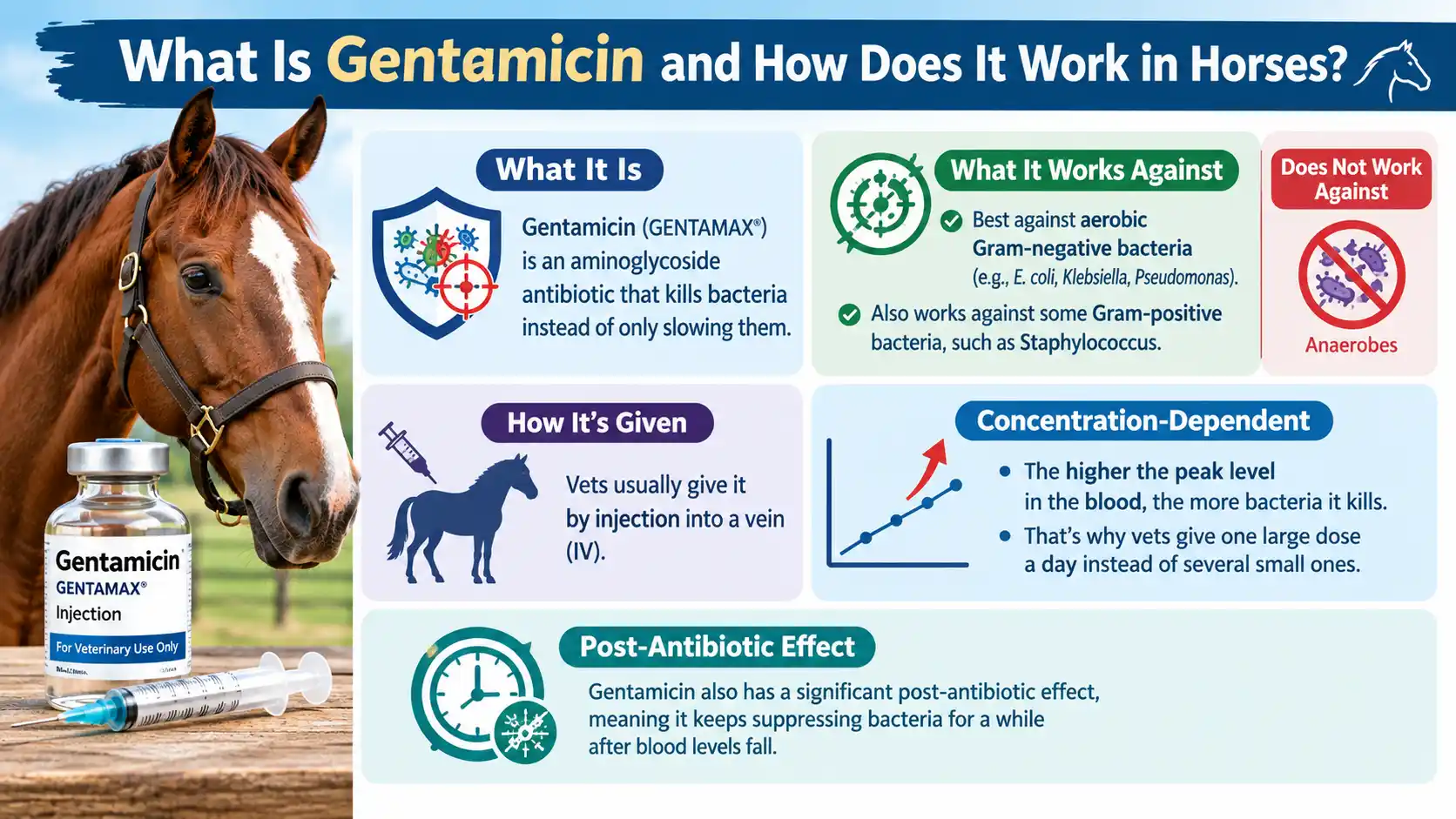
Gentamicin GENTAMAX® is an aminoglycoside antibiotic that kills bacteria instead of only slowing them. In horses it works best against aerobic Gram-negative bacteria, plus some Gram-positive ones such as Staphylococcus. It does not work against anaerobes. Vets usually give it by injection into a vein.
It is a “concentration-dependent” drug. The higher the peak level in the blood, the more bacteria it kills. That is why vets give one large dose a day instead of several small ones. Gentamicin also has a significant post-antibiotic effect, meaning it keeps suppressing bacteria for a while after blood levels fall.
The catch: gentamicin spreads through the fluid outside cells, gets into tissues poorly, and leaves the body mostly through the kidneys. That last point explains most of its risks.
What gentamicin treats in horses
What gentamicin does not treat
Is gentamicin prescription-only?
Yes. Gentamicin products carry a veterinary-prescription restriction. In the US, Ohio State lists the systemic equine doses as extra-label use, meaning the vet is applying the drug in a way not printed on the label.
The GENTAMAX® product on DailyMed is approved only for intrauterine use in mares. In the UK, Genta-Equine is authorised for lower respiratory tract infections in non-food-producing horses.
The University of Minnesota’s large animal surgery notes put it plainly: gentamicin is rarely given by owners and is typically given by veterinarians or in hospital settings.
Gentamicin Dosage for Horses
The standard adult dose is 6.6 mg/kg IV every 24 hours, IM injection causes muscle irritation. Remember that Neonatal foals < 2 weeks of age, may require higher daily dosing and longer dosing intervals as decide by your veterinarian.
Dosage Guidelines:
Adult horse, systemic
6.6 mg/kg IV every 24 h
Sources: Ohio State; UK label (3–5 days); UMN
Foal under 2 weeks
12 mg/kg IV every 36 h
Sources: Ohio State; Merck Vet Manual. The UK label advises against use in foals.
Foal over 2 weeks
6.6 mg/kg IV every 24 h
Sources: Ohio State; Merck Vet Manual
Uterine infusion (mares)
2.0–2.5 g in 200–500 mL sterile saline, daily
3–5 days during estrus. Sources: Ohio State; DailyMed
Regional limb perfusion
1 g, or one-third of the systemic dose, in 30–60 mL saline
Source: Ohio State
Hospital, drug-level guided
7.7–9.7 mg/kg IV every 24 h
Sources: Merck Vet Manual; Bauquier et al. Vet decision only.
All doses are for veterinarian-directed use. Amber card = used under blood-level monitoring, not a starting dose to self-select.
Gentamicin dosage chart for horses by weight
To work out the volume yourself: weight in kg × 6.6 ÷ 100 = mL of 100 mg/mL solution. If your vial says 50 mg/mL, the volume doubles. Always read the concentration on your own vial.
| Weight (kg) | Weight (lb) | Dose (mg) | Volume (mL) |
|---|---|---|---|
| 150 | 330 | 990 | 9.9 |
| 250 | 550 | 1,650 | 16.5 |
| 350 | 770 | 2,310 | 23.1 |
| 400 | 880 | 2,640 | 26.4 |
| 450 | 990 | 2,970 | 29.7 |
| 500 | 1,100 | 3,300 | 33.0 |
| 550 | 1,210 | 3,630 | 36.3 |
| 600 | 1,320 | 3,960 | 39.6 |
| 700 | 1,540 | 4,620 | 46.2 |
| 800 | 1,760 | 5,280 | 52.8 |
Lb values are rounded (1 kg = 2.2 lb). This chart shows arithmetic, not a prescription. Use the weight and dose your vet gives you.
Worked example: A 1,000 lb gelding weighs about 454 kg. At 6.6 mg/kg that is roughly 3,000 mg, or about 30 mL of 100 mg/mL solution.
Expert tip: The weight in the formula matters as much as the dose. The UK label says bodyweight should be determined as accurately as possible to avoid under- or overdosing. A weigh scale beats a guess, and a weight tape beats a guess by eye.
Gentamicin dose calculator for horses
Enter your horse’s weight, pick the dose your vet prescribed, and check the concentration on your vial. The calculator does the maths and nothing else.
Gentamicin dose calculator for horses
Select the case, enter body weight, then press Calculate Dose.
For veterinarian-directed use only. Check your product label and local regulations. Gentamicin can damage kidneys and hearing; hydration and monitoring are important.
Why some vets dose higher than 6.6 mg/kg
You may see 7.7 to 9.7 mg/kg in the Merck Veterinary Manual and wonder which number is right. Both appear in the literature because they answer different questions. The 6.6 mg/kg figure is the standard, and the product-label dose in the UK. The higher range comes from hospitals that measure gentamicin in the blood.
A retrospective study in the Journal of Veterinary Internal Medicine looked at 65 hospitalized horses (99 sets of peak and trough samples). It found that doses of 7.7 mg/kg or more produced higher peaks, and those horses were 3.6 times more likely to reach a peak above 32 µg/mL.
The authors supported a starting dose of 7.7 to 9.7 mg/kg IV once daily, with the dose then tailored by drug monitoring.
Target peaks also depend on the bacteria. The UK label suggests a peak of about 16 to 20 µg/mL.
The Gentaject product sheet describes aiming for a peak-to-MIC ratio of 8 to 10, and MIC (minimum inhibitory concentration) differs from one bacterium to the next.
In plain terms: a tougher bug needs a higher peak. That judgement belongs to your vet and the lab.
Peak blood level: once daily vs three times daily
Adult horses, IV gentamicin for 10 days (Godber et al., 1995)
Neither regimen caused nephrotoxicosis in this small study of healthy adult horses. Healthy horses and 10 days do not mirror a sick horse in a hospital, so monitoring still matters.
What hospital monitoring found
Bauquier et al., J Vet Intern Med: retrospective study, hospitalized horses, 2002–2010
Why the old 2.2 mg/kg three-times-daily plan faded out
Older references still list 2.2 mg/kg three times a day. The Minnesota notes say that once-daily 6.6 mg/kg is safer because it gives the biggest bacterial kill with the fewest side effects. The Godber study above supports the same idea: far higher peaks and no extra kidney injury in healthy adult horses.
Gentamicin for Foals: Dose and Cautions
The recommended gentamicin dosage is12 mg/kg IV every 36 hours for foals under 2 weeks old and 6.6 mg/kg IV every 24 hours for foals over 2 weeks.
Some source states that the use of GENTAMAX® Gentamicin has not been established in foals, that neonates clear gentamicin more slowly, and that foals are at higher risk of kidney injury, so use in foals is not recommended. Both views are real.
Gentamicin for Mares: Intrauterine Dose
For uterine infections, the recommended dosage is 20 to 25 mL (2.0 to 2.5 g) of gentamicin sulfate solution per day for 3 to 5 days during estrus.
Each dose is diluted in 200 to 500 mL of sterile saline and infused under aseptic technique. Ohio State lists the same dose.
Two details matter. The label says the product is not spermicidal, but treatment should not be given on the day of breeding.
And it is an intrauterine product. Do not use it for systemic injection. Ohio State’s pharmacy stocks separate injectable and intrauterine formulations for this reason.
Regional Limb Perfusion With Gentamicin
In regional limb perfusion, a vet delivers antibiotic into the veins of a limb to reach infected joints or tissue at high local concentrations.
1 g, or one-third of the systemic dose, diluted to 30 to 60 mL with sterile saline. Minnesota notes that amikacin is the more common choice for this procedure. This is a vet-performed technique, not a home treatment.
Gentamicin IV vs IM in Horses: Which Route Is Used?
IV is the standard route IM injection causes muscle irritation. Treat IM as a vet-directed exception rather than a convenient shortcut, especially because repeated injections into nearby sites can cause local reactions.
How Long Do Horses Stay on Gentamicin?
3 to 5 consecutive days for lower respiratory infections. For other conditions vet decides based on culture results, how the horse responds and lab trends. If your horse is still on gentamicin after about a week, ask how kidney values are being tracked.
Monitoring Gentamicin: Peak, Trough and Kidney Tests
Gentamicin monitoring means checking two things: whether blood levels are high enough to kill the bacteria (the peak) and low enough between doses to spare the kidneys (the trough).
This is Advised: Close monitoring of kidney values in blood (creatinine and urea) and urinalysis such as the GGT-to-creatinine ratio, plus fluid therapy if needed to keep the horse hydrated.
What a monitored gentamicin course can look like
- Before the first doseConfirm accurate weight, check hydration and get a kidney baseline (creatinine, urea).
- Dose given IVOnce daily at the dose your vet calculated.
- Peak sample, about 30 minutes laterThe study above measured peaks 30 minutes after dosing. Confirms the dose reached an effective level.
- Trough sample, before the next doseA low trough (the study used under 2 µg/mL) shows the drug is clearing.
- During the courseRepeat kidney bloodwork and urinalysis; adjust dose or stop if values worsen.
- After the last doseRecheck the horse and, if advised, kidney values.
Note: Ohio State says therapeutic drug monitoring helps optimize dosing and keep trough levels low to avoid nephrotoxicity. The exact sampling schedule above is an example of how hospitals approach it, not a protocol for you to run.
Gentamicin Side Effects in Horses
Kidney damage (nephrotoxicity)
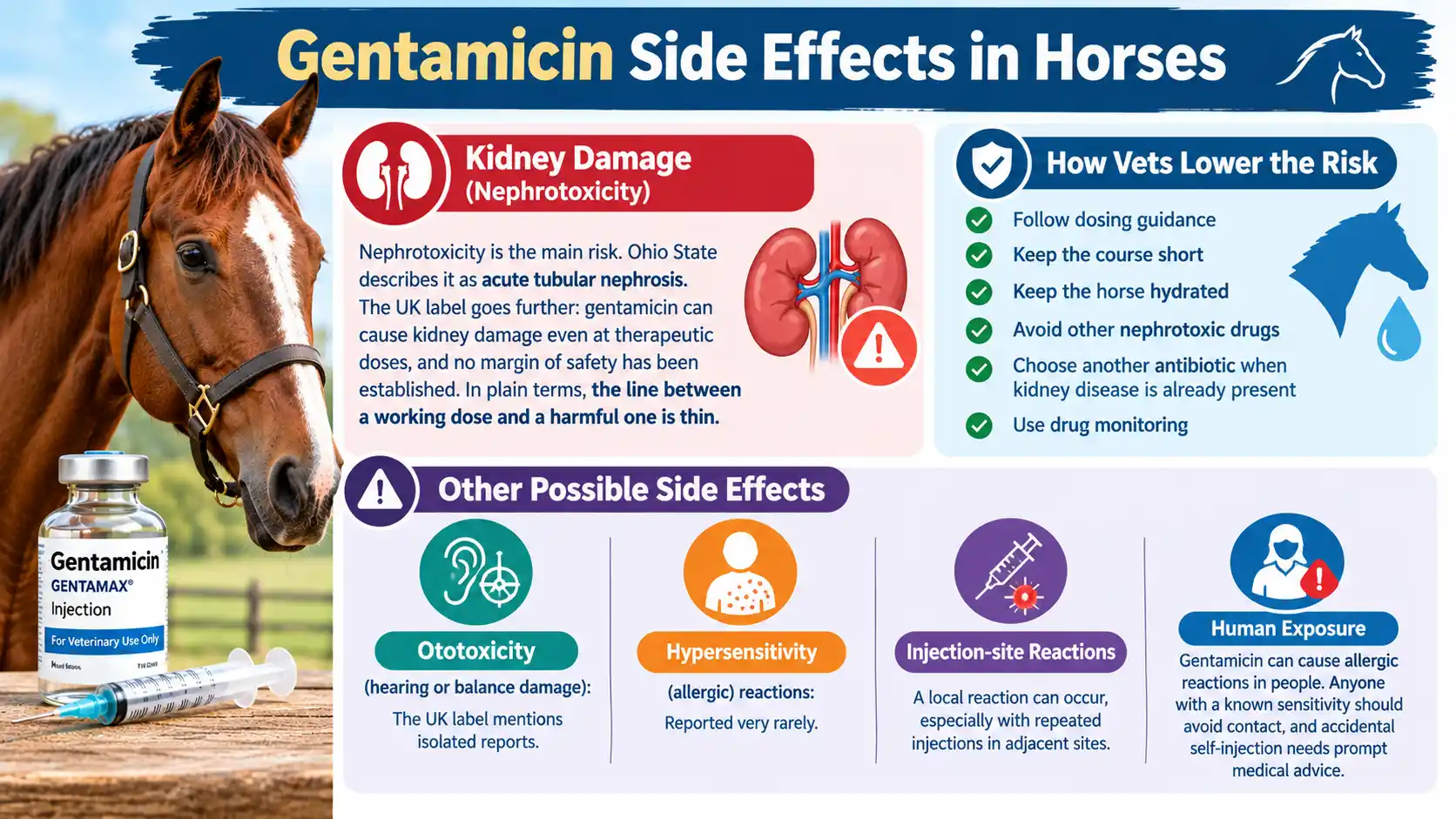
Nephrotoxicity is the main risk. Ohio State describes it as acute tubular nephrosis. The UK label goes further: gentamicin can cause kidney damage even at therapeutic doses, and no margin of safety has been established. In plain terms, the line between a working dose and a harmful one is thin.
Ohio State lists the ways vets lower that risk: follow dosing guidance, keep the course short, keep the horse hydrated, avoid other nephrotoxic drugs, choose another antibiotic when kidney disease is already present, and use drug monitoring.
Other possible side effects
- Ototoxicity (hearing or balance damage): the UK label mentions isolated reports.
- Hypersensitivity (allergic) reactions: reported very rarely.
- Injection-site reactions: a local reaction can occur, especially with repeated injections in adjacent sites.
- Human exposure: gentamicin can cause allergic reactions in people. Anyone with a known sensitivity should avoid contact, and accidental self-injection needs prompt medical advice.
Higher-risk horses: raise these with your vet first
- Dehydration
- Known kidney disease (the UK label says not to use in known renal dysfunction)
- Fever, endotoxemia or sepsis
- Older horses
- Neonatal foals
- Pregnancy (safety unknown; fetal kidney effects seen in lab animals)
- Other nephrotoxic drugs on board
Tell your vet promptly if you notice
- Eating or drinking less than usual
- A change in how much your horse urinates
- Unusual dullness or depression
- Swelling or heat at an injection site
- Hives, swelling or trouble breathing (possible allergy; treat as an emergency)
Kidney injury can be silent early, which is why labs matter more than appearances.
Gentamicin Drug Interactions in Horses
The UK label asks for particular caution when gentamicin is given with NSAIDs, furosemide and other aminoglycosides. It says the product should not be used together with other aminoglycosides or with drugs known to cause kidney or ear damage.
Many sick horses are also on pain relief, so this comes up constantly. If your horse is on flunixin, phenylbutazone or firocoxib, check our dosing guides for Banamine, bute and Equioxx dosage for horses, then ask your vet whether that pairing is right for this horse.
The Minnesota notes call out dehydrated animals on gentamicin plus NSAIDs as a special concern. Do not stop or start any of these on your own.
Common Gentamicin Mistakes Horse Owners Should Avoid
What to Ask Your Vet Before Starting Gentamicin
Questions worth asking
- Is gentamicin the right drug for the bacteria we are treating? Was a culture done?
- What dose in mg/kg and mL, by which route, and for how many days?
- How is my horse’s weight being measured?
- Which kidney tests will you run, and when?
- Will you check peak and trough levels?
- Is my horse hydrated enough, or does he need fluids?
- Are any current medications (especially NSAIDs) a problem?
- Which warning signs should make me call you the same day?
Key Takeaways
Gentamicin for horses in brief
- The standard adult dose is 6.6 mg/kg IV every 24 hours, about 33 mL of 100 mg/mL for a 500 kg horse.
- Hospitals may use 7.7–9.7 mg/kg when blood levels are monitored. That is a vet’s decision.
- It covers Gram-negative aerobes. It does not cover anaerobes or abscesses.
- Kidney damage is the main risk, so hydration, short courses and lab checks are essential.
- Use extra caution with NSAIDs, furosemide and other aminoglycosides.
- Foal dosing is hospital-level care, and the UK label advises against use in foals.
FAQs
How much gentamicin do you give a 1,000 lb horse?
A 1,000 lb horse weighs about 454 kg. At 6.6 mg/kg that is roughly 3,000 mg, or about 30 mL of 100 mg/mL solution. Your vet’s prescription and your vial’s strength override this example.
How often can you give gentamicin to a horse?
Once every 24 hours in adults. Foals under 2 weeks are dosed every 36 hours in the references reviewed.
Can you give gentamicin to a horse IM?
It is used in practice, but IV is the standard and labeled route. Merck notes IM injection causes muscle irritation, so IM is a vet-directed exception.
How long can a horse be on gentamicin?
The UK label gives 3 to 5 consecutive days for lower respiratory infections. Ohio State advises keeping courses as short as possible to protect the kidneys.
Is gentamicin safe for horses?
It can be used safely when dosed correctly, with good hydration and monitoring, but it has a narrow safety margin. The UK label states it can cause kidney damage even at therapeutic doses.
What are the side effects of gentamicin in horses?
The main one is kidney damage (nephrotoxicity). Others include rare ototoxicity, very rare allergic reactions and local reactions at injection sites.
What bacteria does gentamicin cover in horses?
Aerobic Gram-negative bacteria such as E. coli, Klebsiella, Enterobacter, Proteus and Pseudomonas aeruginosa, plus Staphylococcus and Streptococcus species. It does not cover anaerobes.
Can I give gentamicin with bute or Banamine?
Only if your vet approves it.P articular caution with NSAIDs because both can stress the kidneys.
Sources and Further Reading
- Ohio State University, Gentamicin [Equine], Antimicrobial Use Guidelines
- Merck Veterinary Manual, Dosages of Aminoglycosides
- Texas A&M, Gentamicin in Adult Horses
- NOAH Compendium, Genta-Equine 100 mg/ml, Clinical particulars
- DailyMed, Gentamax 100 (intrauterine) label
- University of Minnesota, Large Animal Surgery: Equine Antibiotics
- Bauquier et al., Plasma Peak and Trough Gentamicin Concentrations in Hospitalized Horses, J Vet Intern Med
- Godber et al. (1995), Single vs multiple daily gentamicin in horses
Disclaimer: This article is for general education and does not replace a licensed veterinarian’s examination, diagnosis or prescription. Dosing, route and duration must be set by your vet for your horse’s condition, kidney function and medications.