Licorice Root Dosage for Horses: Weight Chart, Calculator and the Safety Rules Every Owner Should Know
Written & Reviewed By: Medshorse Team
Last Updated: October 2026
A scoop of licorice root powder looks harmless. It smells sweet, most horses eat it without fuss, and plenty of supplement labels call it gentle on the gut. But licorice is not a neutral herb. The compound that makes it sweet, glycyrrhizin, changes how the body handles cortisol and potassium.
Licorice root dosage for horses is not standardized. Retail labels run from about 2 g per 100 kg of body weight to 60 g a day for a large horse, and no controlled equine study has set a safe dose for whole root powder. The most conservative labels sit near 2–4 g per 100 kg (10–20 g for a 500 kg horse), fed in short cycles.
This guide gives you a weight chart, a calculator, the one ulcer study behind most of the hype, and the safety rules that matter: who should skip licorice, what too much looks like, and why your vet belongs in the loop. Everything comes from published research, product labels and equine nutrition sources listed at the end. Where the evidence is thin, we say so.
Disclaimer: This article is for general education and is not veterinary advice. Product names mentioned, including Licorice Root, belong to their respective owners, and MedsHorse is not affiliated with them. Always follow your veterinarian’s instructions and the current product label.
- No controlled equine study has set a safe dose for whole licorice root powder. Retail labels range from about 2 g per 100 kg to 60 g a day.
- The most conservative labels point to 2–4 g per 100 kg per day (10–20 g for a 500 kg horse), fed for no more than two to three weeks at a time.
- The only equine-family ulcer study used 12 donkeys for 7 days and an extract, not powder.
- Glycyrrhizin slows cortisol breakdown and can lower potassium. Skip licorice for pregnant mares, and get your vet’s approval first for PPID, EMS, insulin resistance, laminitis, or kidney, liver or heart disease.
- Sources disagree on whether licorice counts as a doping substance, so check your competition rules before feeding.
- Licorice is not a replacement for omeprazole or other veterinary ulcer care.
How Much Licorice Root Can a Horse Have? The Quick Answer
For a 500 kg (1,100 lb) horse, the lowest published label rates work out to roughly 10–20 g of licorice root powder a day, about one to two level tablespoons, for a short cycle of two to three weeks. Higher rates exist, but nothing in the equine literature backs them.
- Conservative range: 2–4 g per 100 kg per day, drawn from the lowest labels (Equine Technology lists 2–3 g per 100 kg; Mane Event lists 10–20 g per 500 kg).
- Duration: no more than three weeks at a time, according to Sanoanimal, then a break.
- Form: these numbers are for plain root powder. Extracts, DGL and decoctions are dosed differently.
- Never: feed to pregnant mares. Ask your vet first about PPID, EMS, insulin resistance, laminitis, or kidney, liver and heart disease.
- Always: weigh the dose, and check competition rules.
What Is Licorice Root, and What Does It Do in Horses?
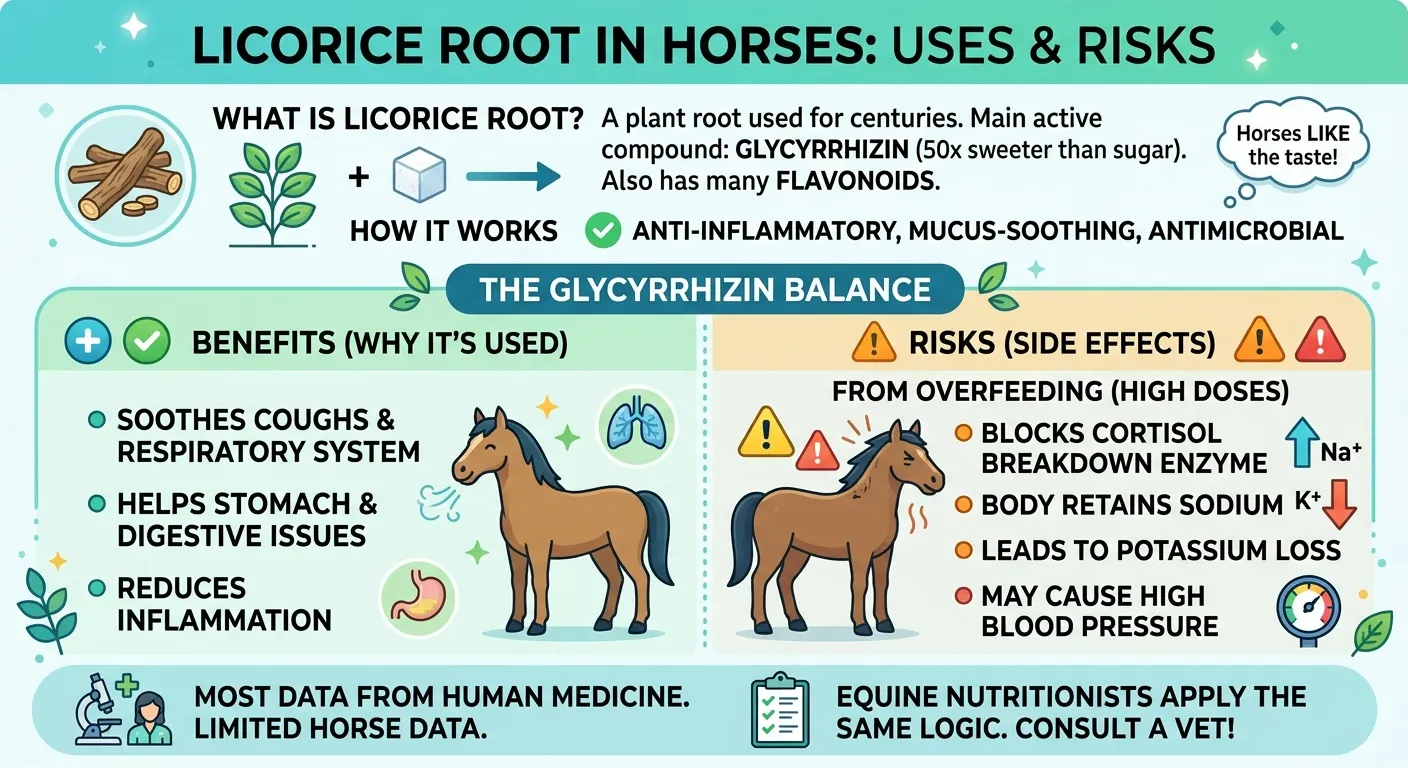
Licorice root (Glycyrrhiza glabra, also spelled liquorice) is the dried root of a legume native to southern Europe, the Mediterranean and parts of Asia. People have used it for coughs and stomach complaints for around 3,000 years, and equine supplement makers now sell it as a powder, extract or blend.
Its main active compound is glycyrrhizin, which is about 50 times sweeter than household sugar. The root also carries dozens of flavonoids, including liquiritin and liquiritigenin. Together they explain the anti-inflammatory, mucus-soothing and antimicrobial effects people attribute to the herb.
Horses tend to like the taste, which is one reason it is so easy to overfeed.
Why glycyrrhizin is both the benefit and the risk
Glycyrrhizin and its breakdown products block an enzyme called 11β-hydroxysteroid dehydrogenase type 2, which normally converts cortisol into inactive cortisone.
With the enzyme blocked, cortisol lingers and can stimulate mineralocorticoid receptors, so the body holds on to sodium and loses potassium (2021 review in Frontiers in Nutrition, in people).
That one mechanism explains both the herb’s anti-inflammatory kick and its best-documented side effects. A 2017 toxicology review names high blood pressure and low potassium as the most important ones. Most of that detail comes from human medicine. Equine data are thinner, but equine nutritionists apply the same logic, and so should you.
Licorice Root Dosage for Horses Chart by Body Weight
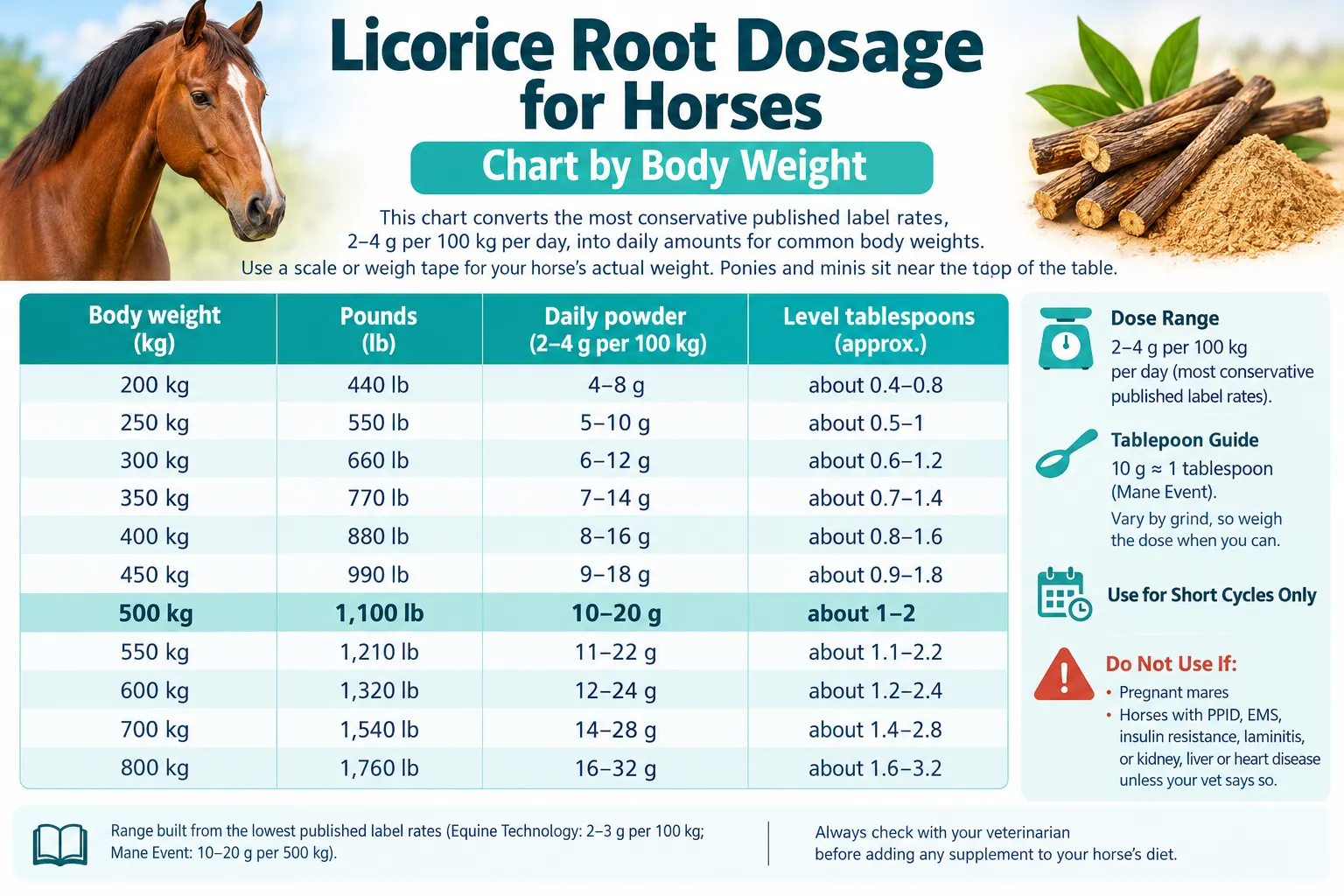
This chart converts the most conservative published label rates, 2–4 g per 100 kg per day, into daily amounts for common body weights. Use a scale or weigh tape for your horse’s actual weight. Ponies and minis sit near the top of the table.
| Body weight | Pounds | Daily powder (2–4 g per 100 kg) | Level tablespoons (approx.) |
|---|---|---|---|
| 200 kg | 440 lb | 4–8 g | about 0.4–0.8 |
| 250 kg | 550 lb | 5–10 g | about 0.5–1 |
| 300 kg | 660 lb | 6–12 g | about 0.6–1.2 |
| 350 kg | 770 lb | 7–14 g | about 0.7–1.4 |
| 400 kg | 880 lb | 8–16 g | about 0.8–1.6 |
| 450 kg | 990 lb | 9–18 g | about 0.9–1.8 |
| 500 kg | 1,100 lb | 10–20 g | about 1–2 |
| 550 kg | 1,210 lb | 11–22 g | about 1.1–2.2 |
| 600 kg | 1,320 lb | 12–24 g | about 1.2–2.4 |
| 700 kg | 1,540 lb | 14–28 g | about 1.4–2.8 |
| 800 kg | 1,760 lb | 16–32 g | about 1.6–3.2 |
Range built from the lowest published label rates (Equine Technology: 2–3 g per 100 kg; Mane Event: 10–20 g per 500 kg). Tablespoon figures use Mane Event’s “10 g ≈ 1 tablespoon” and vary by grind, so weigh the dose when you can. Use for short cycles only. Not for pregnant mares, or for horses with PPID, EMS, insulin resistance, laminitis, or kidney, liver or heart disease, unless your vet says so.
Treat the chart as a ceiling for a first trial, not a target. Start at the lower figure, keep it there, and stop at the end of the cycle. Tablespoon measures are approximate: Mane Event’s label equates about 10 g with a tablespoon, but one retailer’s 50 ml scoop weighs about 23 g, so grind and brand change the numbers.
Why published licorice doses do not agree
Pull up five licorice products and you get five answers. Equine Technology lists 2–3 g per 100 kg. Mane Event lists 10–20 g per 500 kg. Equus Health lists about 30 g for horses and 18 g for ponies. Just Horse Riders suggests 20–30 g for horses under 450 kg and 30–60 g above that.
Sources: product pages and a retailer blog listed in the sources section. Equus Health does not state a body weight for its 30 g horse rate. Just Horse Riders’ range is for horses of 450 kg and over.
Three things drive the gap. First, no equine dose-finding trial exists for whole root powder. Second, glycyrrhizin content varies: figures quoted in the literature run from roughly 3% to 14% depending on origin, harvest time and analysis method. Third, many labels are written for general maintenance rather than for any therapeutic goal.
Do not try to convert the research dose into powder. The donkey study used a standardized extract at 17.6 mg per kg per day. Scaled to a 500 kg animal that is about 8.8 g of extract, but extract potency is not the same as root powder.
Licorice Root Dosage Calculator for Horses
Enter your horse’s weight to get the conservative daily range, the approximate tablespoon equivalent and the amount a 14-day cycle will use.
Licorice Root Dosage Calculator for Horses
Enter your horse’s details to estimate the daily licorice root dose.
© medshorse.com
If you tick any of the health flags, the calculator shows no dose at all. For those horses the right amount is zero until your vet says otherwise.
How Long Can Horses Stay on Licorice Root?
The short answer is two to three weeks at a time. Sanoanimal recommends a cycle of two weeks on, two weeks off and two weeks on, followed by a longer break, because glycyrrhizin slows the breakdown of cortisol and aldosterone. One retailer, by contrast, allows up to three consecutive months.
The two ceilings differ by a factor of four to six. Because licorice affects cortisol and potassium, the shorter window is the safer reading. Anything longer should be agreed with your vet.
If your vet agrees to anything longer, ask whether a potassium and electrolyte check makes sense, and whether your horse’s blood pressure, hydration and overall condition should be monitored.
What the Research Says About Licorice for Horse Ulcers
Ulcer support is the main reason owners buy licorice, so it is worth knowing exactly what the evidence shows. The key paper is Ahmadnejad, Jalilzadeh-Amin and Sykes (2022) in the Journal of Equine Veterinary Science.
Researchers split 12 donkeys into three groups. One group got a placebo. One got phenylbutazone (bute) at 4.4 mg per kg by mouth twice a day. The third got the same bute plus a Glycyrrhiza glabra root extract at 17.6 mg per kg once a day.
After seven days of gastroscopy, the bute-only group had lesions up to grade 3 out of 4 in the glandular stomach. The licorice group had only mild changes, with the worst being grade 1 out of 4 in two animals. The placebo group did not change.
Blood work told a similar story. Glucose fell and the liver enzymes ALT and ALP rose in the bute-only group, while only ALP rose in the licorice group. Kentucky Equine Research reported no side effects attributable to the licorice during the week.
What the study does and does not prove
- It suggests: a licorice extract may reduce NSAID-related damage to the glandular stomach lining over a short period in donkeys.
- It does not show: that licorice heals existing ulcers, that it works the same way in horses, or that it helps squamous ulcers.
- It does not show: anything beyond seven days, any comparison with omeprazole, or that long-term use is safe.
- It used an extract, not the powder most owners buy.
Kentucky Equine Research lists the research-proven ways to manage glandular gastric disease: less stress and exercise, possibly less grain, more turnout, and veterinary drugs such as omeprazole with or without sucralfate or misoprostol. If you suspect ulcers, start with a scope and your vet’s plan.
Our guides on omeprazole dosage for horses and sucralfate dosage for horses cover the standard options. Some owners also look into glutamine dosage for horses as part of gut support, which is another conversation to have with your vet.
Licorice and bute: a conversation for your vet
Because the study fed licorice alongside bute, some owners assume it makes bute safe for the stomach. It does not. If your horse needs an NSAID, ask your vet about gastric protection rather than adding licorice yourself. You can read about bute dosage for horses to understand why the stomach is a concern in the first place.
Cough, Headshaking and Fertility: What Else Is Licorice Used For?
Cough. Licorice has a long traditional use as an expectorant, and equine herbal sources describe it for chronic dry coughs. Sanoanimal adds that a cure is only possible if the causes of the cough are also addressed. We found no controlled equine trials proving it works.
A persistent cough needs a vet to find the cause, whether dust, allergy or infection, before any supplement is added.
Headshaking. A German patent application DE102009046710A1, refused in 2017, claimed licorice at 1–10 g per 100 kg reduced headshaking. The account is anecdotal, built on a handful of horses and no controlled comparison. Even so, the inventor’s own data are a useful warning.
In his main case, as the dose climbed to 8.5 g per 100 kg, the horse’s cortisol rose from 1.9 to 7.8 µg/dL and potassium fell from 4.2 to 3.2 mmol/L. Both moved back toward earlier values when the dose was cut. Headshaking has many causes, and options such as cetirizine dosage for horses belong in a vet-led plan.
Fertility. One supplier promotes licorice for fertility, while several others warn against feeding it to pregnant mares. Those claims point in opposite directions, so ask a reproduction vet rather than relying on a product label.
Is Licorice Root Safe for Horses? Risks, Side Effects and Who Should Skip It
Safety depends on the dose, the duration and the horse. The 2017 toxicology review classes licorice and glycyrrhizin salts as moderately toxic, and lists low potassium, slow gut transit, reduced enzyme activity, high blood pressure, older age and female sex as factors that raise the risk in people. No equine upper limit has been established.
Individual susceptibility matters. A case report in Clinical Kidney Journal described severe low potassium and muscle breakdown in a person eating an estimated 1.5 g of licorice a day. That is a rare human case, not a horse dose, but it shows why “a little” is not automatically safe.
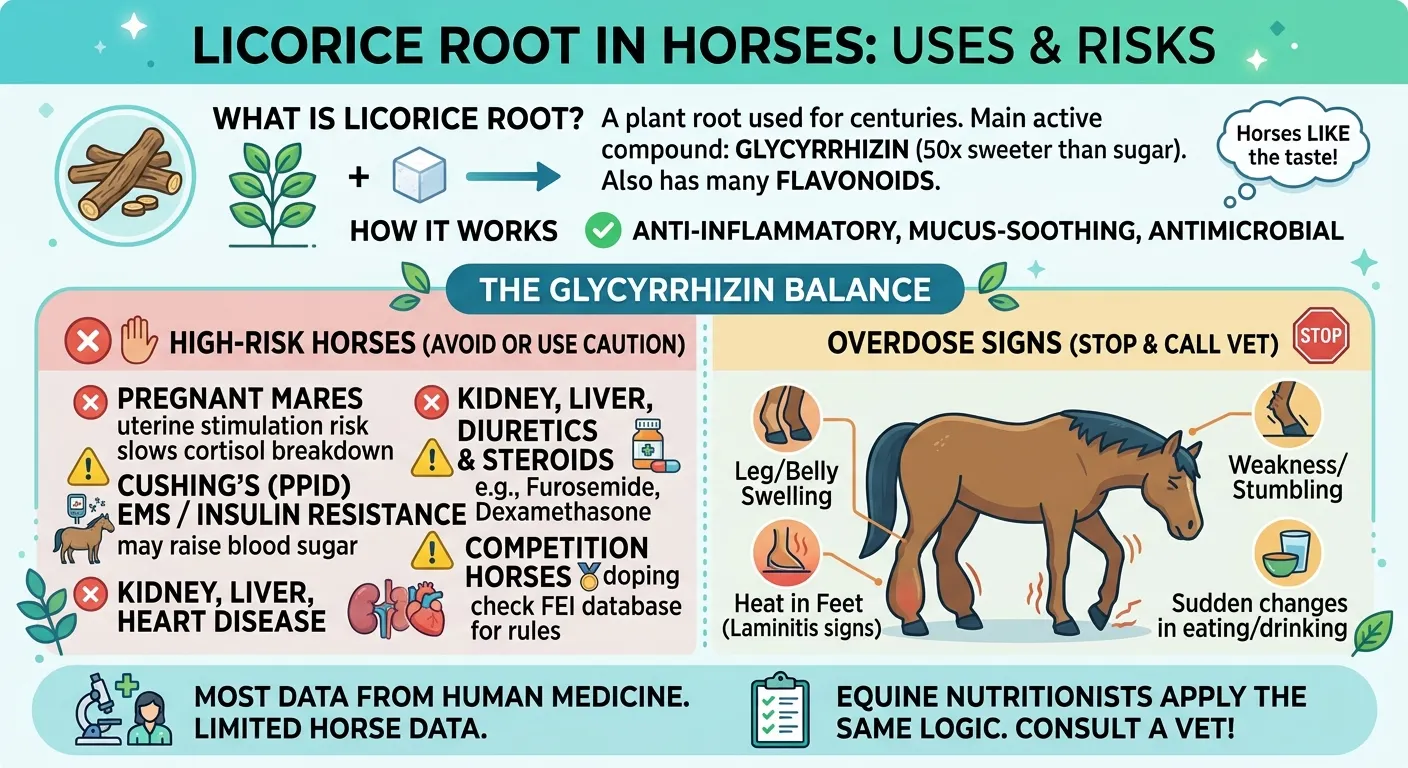
Horses that should not get licorice root
Several suppliers and Sanoanimal say not to feed it. One supplier cites uterine-stimulating effects.
Licorice slows cortisol breakdown. Sanoanimal advises against it in horses with Cushing’s signs.
Sanoanimal says licorice can raise blood sugar. Adored Beast suggests DGL instead, but equine data are thin.
Raised cortisol is suspected of triggering laminitis. The evidence is unclear, so the cautious advice is to skip it.
Sanoanimal lists impaired organ function as a reason not to feed licorice.
One label warns against combining licorice with potassium-depleting diuretics and digoxin-based drugs.
Sources disagree on doping status. Check your rulebook before feeding.
Metabolic horses deserve the most caution. Licorice is not a corticosteroid, but by slowing cortisol breakdown it nudges in the same direction, and University of Liverpool’s equine team notes that horses with Cushing’s, EMS or obesity are the ones to worry about with steroids.
That is an inference rather than a proven effect of licorice in horses, which is exactly why a vet should weigh in.
If you are managing insulin resistance, see our guide to metformin dosage for horses. If you are researching PPID supplements, our chasteberry dosage for horses guide covers another herb that owners ask about.
Signs of too much licorice root
Reports from horse owners, retailers and the human literature point to the same short list of warning signs. Stop the supplement and call your vet if you see any of them.
- Swelling of the legs, sheath or belly
- Muscle weakness, stumbling or reluctance to move
- Heat in the feet, a strong digital pulse or shifting weight, which are signs of laminitis
- A sudden change in drinking, urinating, appetite or attitude
Drug and supplement interactions
One supplier warns against feeding licorice alongside potassium-depleting diuretics and digoxin-based drugs. Furosemide is a common example of a potassium-depleting diuretic, so tell your vet if your horse receives it.
Licorice may also add to the effect of corticosteroids, so mention it if your horse is on a drug such as dexamethasone dosage for horses.
Competition and drug testing
Sources disagree. Sanoanimal states that glycyrrhizin falls under doping rules, while some suppliers describe their licorice as compliant with competition rules.
Because rules differ between federations and change over time, check the FEI Prohibited Substances Database or your national governing body before feeding a horse that competes.
How to Feed Licorice Root to Your Horse
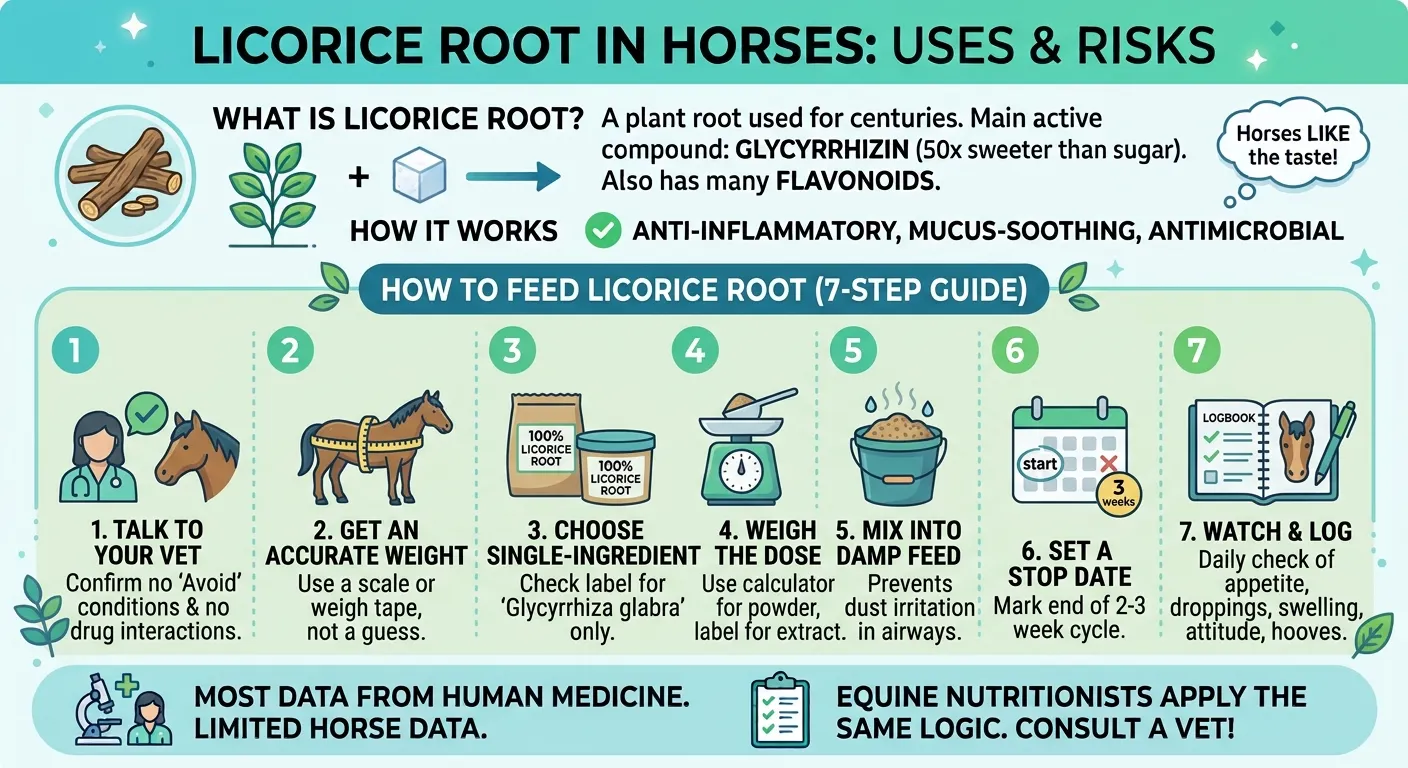
- Talk to your vet. Confirm your horse has no condition on the “avoid” or “vet first” list, and that nothing in the medicine cabinet interacts.
- Get an accurate weight. Use a scale or weigh tape, not a guess.
- Choose a single-ingredient product. The label should say licorice root (Glycyrrhiza glabra) and state the form: powder, extract or DGL.
- Weigh the dose. Use the chart or calculator for powder. Follow the product’s own label for extracts.
- Mix it into damp feed. The powder is dusty and can irritate the airways if fed dry.
- Set a stop date. Write the end of the two-to-three-week cycle on the calendar before you start.
- Watch and log. Note appetite, droppings, swelling, attitude and hoof warmth each day.
If you prefer a decoction, Sanoanimal’s method is to scald 2–3 teaspoons of licorice root with ¼ to 1 litre of boiling water, simmer for 10–15 minutes over low heat, strain, and feed the liquid. It explains that the raw root is hard for horses to break down, which is why it recommends boiling it or using an extract.
Common Licorice Root Mistakes
- Feeding for months without a break because the horse “looks better”
- Using one product’s scoop size for another product
- Switching between powder, extract and DGL without changing the dose
- Adding licorice to a Cushing’s or insulin-resistant horse without asking the vet
- Treating suspected ulcers with herbs instead of getting a scope
- Feeding licorice to a mare that might be pregnant
- Ignoring competition rules until a test is due
When to Call Your Vet
- Before starting licorice in any horse with a health condition or on any medication
- If you suspect ulcers: poor appetite, girthiness, weight loss, a dull coat or low-grade colic
- If a cough lasts more than a few days, or comes with a nasal discharge or fever
- If you see any sign on the stop-and-call list above
- If you want to use licorice for longer than two to three weeks
Final Word: What to Do Next
Licorice root is a real herb with real pharmacology, which is why it can both help and harm. The evidence for ulcer support is promising but narrow: one seven-day study in 12 donkeys. The dosing for powder rests on product labels, not trials.
If you decide to try it, get your vet’s approval, weigh your horse, start at 2 g per 100 kg, stop after two to three weeks, and watch for swelling, weakness and laminitis signs. If the goal is ulcer care, put veterinary treatment first and treat licorice, if used at all, as a supporting extra.
FAQs
How much licorice root should I give my horse per day?
The most conservative published label rates work out to about 2–4 g of licorice root powder per 100 kg of body weight per day, which is roughly 10–20 g for a 500 kg horse. Some retail products list 30–60 g, but no controlled equine study supports those amounts. Feed it in short cycles and check with your vet first.
How much licorice root powder does a 1,000 lb horse need?
A 1,000 lb horse weighs about 454 kg, so the conservative 2–4 g per 100 kg range gives roughly 9–18 g a day, or about 1–2 level tablespoons. Powder density varies, so weigh the dose on a kitchen scale when you can.
How long can a horse stay on licorice root?
The equine feeding team at Sanoanimal advises no more than three weeks at a time, with a break between cycles, because glycyrrhizin slows the breakdown of cortisol and aldosterone. One retailer’s label allows up to three consecutive months. The shorter window is the safer reading, and anything longer should be agreed with your vet.
Can licorice root help horses with ulcers?
It may help protect the stomach lining, but the evidence is thin. The only equine-family study found, in 12 donkeys, showed that licorice root extract reduced the severity of bute-induced glandular gastric lesions over seven days. It did not test existing ulcers, horses, or a comparison with omeprazole, so it should not replace veterinary treatment.
Is licorice root safe for horses with Cushing’s disease or insulin resistance?
Usually not without veterinary approval. Glycyrrhizin slows the breakdown of cortisol, and equine nutrition sources advise against licorice in horses with Cushing’s signs, insulin resistance or laminitis risk. Some herbalists suggest deglycyrrhizinated licorice (DGL) for these horses, but equine safety data for DGL are limited, so ask your vet first.
Can pregnant mares have licorice root?
No. Several suppliers and equine nutrition sources say not to feed licorice to pregnant mares, and one supplier cites uterine-stimulating effects. Some sellers promote licorice for fertility, so if you are breeding, ask a reproduction vet rather than relying on a product label.
Will licorice root cause a positive drug test?
It depends on the rules. Sanoanimal states that glycyrrhizin falls under doping rules, while some suppliers market their licorice as compliant with competition rules. Rules differ between federations and change over time, so check the FEI Prohibited Substances Database or your national governing body before competing.
What are the side effects of too much licorice root in horses?
Reports and reviews point to low potassium, sodium and fluid retention, swelling, high blood pressure, and possible kidney strain with prolonged use. In people, severe overuse has caused muscle weakness and muscle breakdown. Equine upper limits have not been established, so stop feeding and call your vet if you see swelling, weakness or signs of laminitis.
What is the difference between licorice root powder and DGL for horses?
Licorice root powder contains glycyrrhizin, the compound linked to raised cortisol activity and potassium loss. DGL has the glycyrrhizin removed, which is why some practitioners prefer it for metabolic or sport horses. The equine ulcer study used a whole-root extract, so DGL’s benefits in horses are less proven.
Can I feed my horse black licorice candy?
No. Candy cannot be dosed accurately, it contains sugar, and the amount of licorice root in it varies. If you want licorice for your horse, use a labeled equine licorice root product and measure the dose by weight.
Does licorice root help a horse with a cough?
Licorice has a long history as an expectorant and cough remedy, and equine herbal sources describe it for dry coughs. We found no controlled equine trials proving it works. A persistent cough needs a vet to find the cause, such as dust, allergy or infection, before any supplement is added.
Can I give licorice root with bute or omeprazole?
Do not combine them on your own. In the donkey study, licorice extract was fed alongside phenylbutazone as a controlled seven-day experiment. If your horse needs an NSAID or ulcer medication, ask your vet whether licorice has any place in the plan.
How do I measure licorice root powder without a scale?
One retailer equates about 10 g with roughly one tablespoon, but grind and brand change the weight. A 50 ml scoop of one UK licorice product weighs about 23 g. A cheap kitchen scale removes the guesswork, so weigh a test scoop once and mark it.
Does licorice root help with headshaking in horses?
There is no controlled research showing that it does. A German patent application, later refused, described headshaking relief in a handful of horses, but that account is anecdotal. Headshaking has many causes, so get a vet exam before trying supplements.
Sources and Further Reading
- Ahmadnejad M, Jalilzadeh-Amin G, Sykes BW. Prophylactic effects of Glycyrrhiza glabra root extract on phenylbutazone-induced EGGD. J Equine Vet Sci, 2022
- Kentucky Equine Research: Glandular gastric ulcers, getting to the root of management
- Nazari S, Hosseinzadeh H. Toxicological effects of Glycyrrhiza glabra (licorice): a review. Phytotherapy Research, 2017
- Yoshino T et al. Clinical risk factors of licorice-induced pseudoaldosteronism. Frontiers in Nutrition, 2021
- Low-dose liquorice ingestion resulting in severe hypokalaemic paraparesis. Clinical Kidney Journal, 2014
- Sanoanimal: Herbal advice, liquorice
- Adored Beast: Licorice root for horses
- University of Liverpool: Steroids and laminitis
- FEI Prohibited Substances Database information page
- German patent application DE102009046710A1 (refused; anecdotal)
- Product labels reviewed: Equine Technology, Mane Event, Equus Health, Just Horse Riders