Mycosorb for Horses: Dosage Chart, Free Calculator & Safety Guide to Feed It the Right Way
Written & Reviewed By: Medshorse Team
Last Updated: October 2026
Mycosorb for horses is a yeast-based mycotoxin binder that you mix into the daily feed. The standard rate is 2 g per 100 kg of bodyweight, which works out to 10 g for a 500 kg horse. For higher-risk feed or grazing, the label rate goes up to 4 g per 100 kg (20 g for the same horse).
Here is the catch. You cannot see, smell or taste mycotoxins, and hay that looks perfect can still carry them. So most owners end up guessing at the dose and the timing.
This guide takes the guesswork out. You get a weight-based dosage chart, a free calculator, a side-by-side look at how retailers word their feeding rates, what the research on horses really shows, and the safety checks worth doing before the first scoop. Retailer details were checked in October 2026.
Disclaimer: This article is for general education and is not veterinary advice. Mycosorb is a registered trademark of Alltech. MedsHorse is not affiliated with Alltech. Always follow your veterinarian’s instructions and the current product label.
Rates are from Alltech-based retailer listings. Always follow the label on the container you bought.
What Is Mycosorb for Horses?
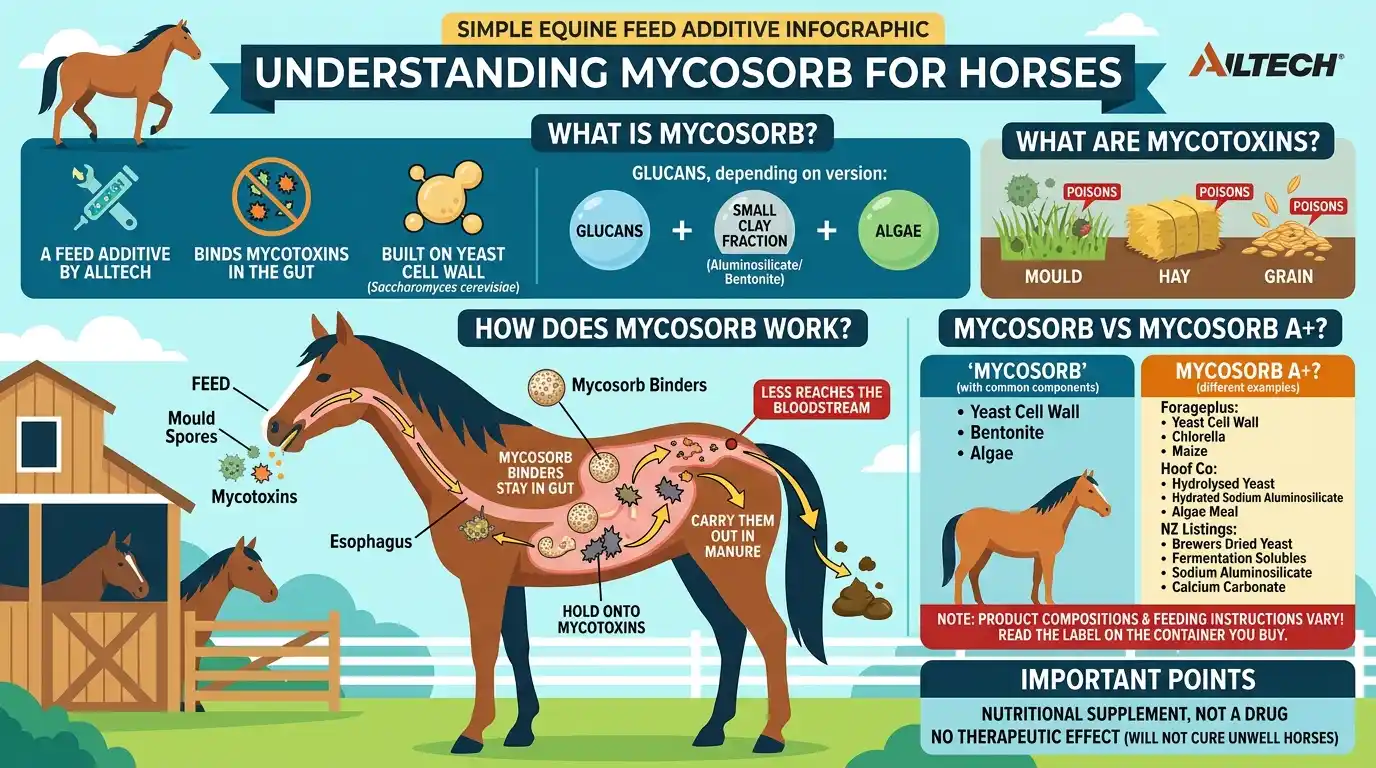
Mycosorb is a feed additive made by Alltech that binds mycotoxins in the gut. It is built on glucans from the cell wall of yeast (Saccharomyces cerevisiae). Depending on the version, it also contains a small clay fraction (aluminosilicate or bentonite) and algae.
Mycotoxins are poisons made by moulds growing on pasture, hay, haylage and grain. A binder stays in the gut, holds onto them and carries them out in the manure, so less reaches the bloodstream.
It is a nutritional supplement, not a drug. The Balanced Equine product page states that it has no therapeutic effect, so it will not cure a horse that is already unwell.
Mycosorb vs Mycosorb A+: What Is the Difference?
Retail listings are not identical. Forageplus lists yeast cell wall, bentonite, chlorella and maize for Mycosorb A+ Equine. The Hoof Co lists hydrolysed yeast, hydrated sodium aluminosilicate and algae meal. Two NZ listings (Horselands and Equestrian Central) show brewers dried yeast, fermentation solubles, sodium aluminosilicate and calcium carbonate.
That suggests more than one version of the product is in circulation. Read the label on the container you actually buy, because the feeding instructions can differ too.
How Does Mycosorb Work in a Horse’s Gut?
Mycosorb works by adsorption. Toxins stick to the surface of the yeast cell wall and clay particles as feed moves through the gut, and the bound complex leaves in the manure instead of being absorbed.
Two limits matter. A binder only acts on toxins still in the gut, so it cannot undo damage already done. And no binder catches every mycotoxin equally well, which is why testing your forage still matters.
Why Do Mycotoxins Matter for Horses?
Horses are among the most sensitive animals to fumonisin, a toxin found in mouldy corn. It causes equine leukoencephalomalacia (ELEM), a brain disease that can end in death, according to the Texas A&M Veterinary Medical Diagnostic Laboratory.
The FDA guidance recommends that corn and corn by-products fed to horses stay under 5 ppm fumonisin and make up no more than 20% of the diet. That keeps the finished feed around 1 ppm.
The quieter end of the problem is just as real. In trials involving Alltech’s yeast-wall polymer, horses fed grain naturally contaminated with Fusarium toxins ate less and lost weight. Not dramatic poisoning, just a horse that stops thriving for no obvious reason.
The main toxins, where they come from and what they are linked to.
| Mycotoxin | Typical source | Why it matters in horses |
|---|---|---|
| Fumonisins | Mouldy corn and corn by-products | Linked to ELEM, a brain disease that can be fatal. Horses are very sensitive. |
| Aflatoxins | Warm-climate or stressed grain crops | Known mainly for liver damage. |
| Ochratoxins | Stored grains | Potent kidney toxins. |
| DON, zearalenone and other Fusarium toxins | Wheat, corn and forage in temperate climates | Reduced feed intake and weight loss in horse trials. |
| Ergot and endophyte alkaloids | Ergot-infected paspalum, some endophyte ryegrass | Tremors and staggering; some pastures are also linked to photosensitivity on pink skin. |
Signs overlap with many other illnesses. Only a lab test of your forage confirms which toxins are present.
Mycosorb Dosage for Horses: Chart by Bodyweight
Feed 2 g of Mycosorb per 100 kg of bodyweight daily as the standard dose, or up to 4 g per 100 kg when feed quality is a known concern. For a 500 kg horse that is 10 g standard and 20 g high. Both rates are quoted on Horselands, Equestrian Central and The Hoof Co listings.
Standard = 2 g per 100 kg. High = 4 g per 100 kg.
| Horse | Weight (kg) | Weight (lb) | Standard dose | High dose |
|---|---|---|---|---|
| Pony | 200 | 441 | 4 g | 8 g |
| Cob | 300 | 661 | 6 g | 12 g |
| Light horse | 400 | 882 | 8 g | 16 g |
| Medium horse | 450 | 992 | 9 g | 18 g |
| Average adult | 500 | 1,102 | 10 g | 20 g |
| Warmblood | 550 | 1,213 | 11 g | 22 g |
| Large warmblood | 600 | 1,323 | 12 g | 24 g |
| Draft cross | 700 | 1,543 | 14 g | 28 g |
Weigh the powder on a kitchen scale. Scoop sizes vary between products, so a scoop is only a rough guide.
Standard Rate or High Rate?
Start with the standard rate for general protection. Move to the high rate when you have a specific reason: a wet or late harvest, a new batch of hay you cannot test, or a lab result showing toxins. The Hoof Co describes the higher 4 g per 100 kg rate for affected horses.
For context, the Guelph horse trials dosed the polymer at 0.2% of the diet. A horse eating about 10 kg of feed a day would get 20 g, the same as the high rate (that conversion is my own arithmetic, not a figure from the studies).
Mycosorb Dosage by Type of Horse
- Ponies and minis: dose by weight, not by the adult scoop. A 200 kg pony needs 4 g at the standard rate.
- Foals and yearlings: guidance is thin. Forageplus lists one 10 ml scoop (about 9 g) a day, while the weight-based rule gives roughly 3 to 6 g for most young stock. Ask your vet.
- Adults in light work: 10 g for a 500 kg horse at the standard rate. Forageplus lists one 15 ml scoop (about 13.5 g).
- Moderate to hard work: Forageplus lists two 10 ml scoops (about 18 g). The Alltech-based high rate is 20 g for 500 kg.
- Breeding mares: Forageplus lists the same 18 g plan. Confirm with your vet first.
Mycosorb for Horses Calculator: Find Your Horse’s Dose
Enter your horse’s weight, pick a rate and container size, and the calculator shows the daily dose, the amount per feed and how many days the container will last.
© medshorse.com
Why Do Retailers Quote Different Mycosorb Rates?
Different retailers quote different rates because they follow different labels. Some use grams per 100 kg, others use scoops tied to workload, and the formulations are not all identical.
What each listing says for an average 500 kg adult horse.
| Source | Stated rate | 500 kg horse |
|---|---|---|
| Horselands and Equestrian Central (NZ, Alltech text) | Standard 2 g per 100 kg; high 4 g per 100 kg | 10 g standard, 20 g high |
| The Hoof Co (AU) | 2 g per 100 kg; up to 4 g per 100 kg for affected horses | 10 g, up to 20 g |
| Forageplus (UK), Mycosorb A+ Equine | Scoops by workload: foals/yearlings 10 ml; light work 15 ml; moderate work and breeding mares 2 x 10 ml | About 13.5 g (light work) to 18 g (hard work, mares) |
Forageplus lists a 10 ml scoop as about 9 g and a 15 ml scoop as about 13.5 g. For an average adult its plan sits between the standard and high rates.
How to Feed Mycosorb Step by Step
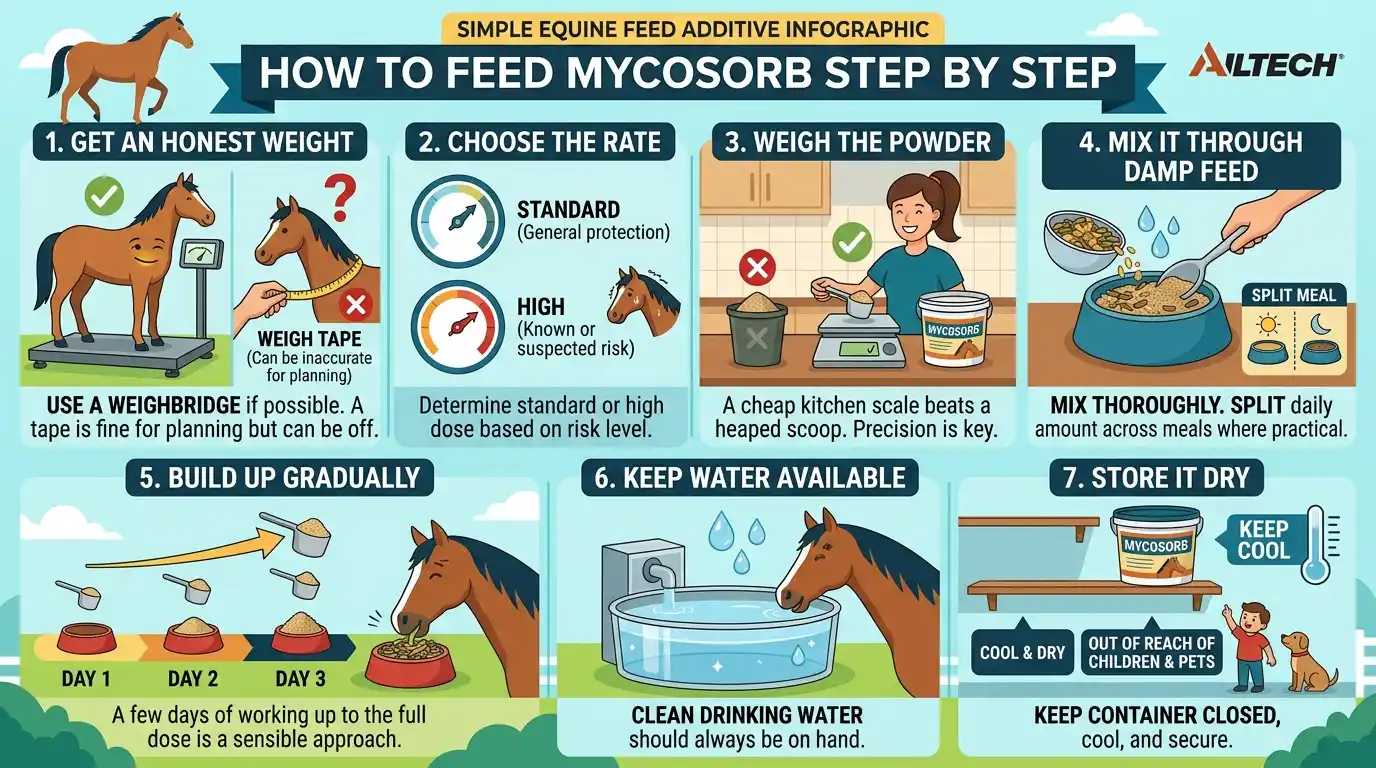
- Get an honest weight. Use a weighbridge if you can. A weigh tape is fine for planning, but it can be off by a noticeable margin.
- Choose the rate. Standard for general protection, high for known or suspected risk.
- Weigh the powder. A cheap kitchen scale beats a heaped scoop.
- Mix it through damp feed. The Hoof Co advises mixing thoroughly and splitting the daily amount across meals where practical.
- Build up gradually. Retailers advise a gradual introduction. A few days of working up to the full dose is a sensible approach for fussy eaters.
- Keep water available. Clean drinking water should always be on hand.
- Store it dry. Keep the container closed, cool and out of reach of children and pets.
How Long Does a Container Last, and What Does It Cost?
A 1 kg container lasts about 100 days at 10 g a day, or about 50 days at 20 g. A small pony on 4 g a day can stretch the same container to roughly 250 days.
Days of feeding per container size.
| Container | 10 g/day (500 kg, standard) | 20 g/day (500 kg, high) | 4 g/day (200 kg pony) |
|---|---|---|---|
| 500 g | 50 days | 25 days | 125 days |
| 1 kg | 100 days | 50 days | 250 days |
| 2 kg | 200 days | 100 days | 500 days |
| 3 kg | 300 days | 150 days | 750 days |
| 4.9 kg | 490 days | 245 days | 1,225 days |
Example cost per day from October 2026 retailer listings (1 kg).
| Retailer (1 kg price) | Cost/day at 10 g | Cost/day at 20 g |
|---|---|---|
| The Hoof Co (AU$29.95) | AU$0.30 | AU$0.60 |
| Horselands (NZ$39.90, sale price) | NZ$0.40 | NZ$0.80 |
| Equestrian Central (NZ$44.99) | NZ$0.45 | NZ$0.90 |
| Forageplus (£15.95, own scoop plan) | £0.22 at 13.5 g | £0.29 at 18 g |
Prices change and formulations differ between sellers, so compare cost per day only after checking the label.
Does Mycosorb Work? What the Research Says
The best horse-specific evidence is a pair of 2005 trials that tested Alltech's glucomannan polymer on horses fed contaminated grain. The results were encouraging in one trial and neutral on intake in the other.
Horses fed grain naturally contaminated with Fusarium mycotoxins, with and without 0.2% glucomannan polymer.
| Trial | What happened without the binder | What the binder did |
|---|---|---|
| Non-exercising horses (feed intake, serum chemistry, blood counts) | Feed intake fell. Serum GGT (a liver enzyme) was higher on days 7 and 14. | Intake was higher than on the unsupplemented contaminated diet. GGT was lower on days 7 and 14. |
| Exercised horses (21-day trial with a treadmill test) | Feed intake fell and horses lost weight. | No change in feed intake versus the unsupplemented contaminated diet. |
Sources: AGRIS/FAO records of both studies. Results are from 21-day trials with one toxin type (Fusarium).
Read those results with care. Both trials were short, both tested Fusarium toxins only, and the company behind the product has promoted the work. I could not find independent replication in horses.
Alltech's retailer text also cites more than 55 peer-reviewed in vivo trials, but those span dairy, beef, pigs, poultry, pets and aquaculture as well as horses. So the honest summary is: plausible mechanism, some supportive horse data, and room for more independent research.
When Should You Use Mycosorb?
Binders earn their place as an extra layer of protection when mould risk is higher than usual. Common situations include:
- Hay or haylage from a wet or late harvest
- A new batch of forage you cannot test yet
- Moving to paddocks with weeds, ergot-prone grasses or heavy tree cover
- Seasonal pasture changes, which The Hoof Co flags as a higher-risk period
- Grain or feed of uncertain storage history
When it is not the answer: visibly mouldy or dusty hay should be thrown out, not rescued with a supplement. And a horse that is already unwell needs a vet. For a clearer picture of what is actually in your forage, a laboratory mycotoxin panel will tell you which toxins are present.
Mycosorb vs Other Toxin Binders
The main binder families are yeast cell wall, clay, and blends of the two. Mycosorb A+ listings describe a blend, which aims to cover several toxin classes at once.
A general guide. Always check the label of the specific product.
| Binder type | Typical materials | Strength | Watch-outs |
|---|---|---|---|
| Yeast cell wall | Glucans and mannans from S. cerevisiae | Marketed as broad-spectrum; retailers say mineral binding is limited | Performance varies by toxin; horse data is limited |
| Clay | Bentonite, sodium aluminosilicate | Classically used against aflatoxins | Balanced Equine says clay-based binders can bind minerals; weaker on many Fusarium toxins |
| Blend | Yeast wall, clay fraction, algae | Aims to cover several toxin classes at once | Ratios are proprietary; versions differ between sellers |
Other products exist, such as Elitox (listed by Balanced Equine as an alternative) and Mycotoxins T5X (listed by a South African retailer as a Mycosorb substitute). Check their labels the same way.
Is Mycosorb Safe for Horses?
Mycosorb is sold as a feed supplement and is fed daily at the label rate, but published safety data in horses is limited. I could not find overdose studies. Retailers advise staying within the stated rate unless an equine nutrition professional says otherwise.
The practical issue most owners report is palatability, which a gradual introduction handles. Beyond that, the safest approach is to follow the label and run through this checklist.
- Weigh your horse and the powder rather than guessing
- Read the label on your container; versions and rates differ
- Introduce gradually and keep clean water available
- Stay within the label rate unless your vet or nutritionist advises more
- Remove visibly mouldy or dusty feed; a binder is not a fix
- Check the ingredient list if your horse is insulin resistant (some listings include maize)
- Ask your vet first for foals, pregnant or lactating mares, and horses on oral medication
- Check competition drug-testing rules before using any supplement
- Store dry and away from children and pets
Insulin-Resistant and Laminitic Horses
Balanced Equine describes Mycosorb A+ as safe for laminitis-prone and insulin-resistant horses. Still, the ingredient list varies, and the Forageplus listing includes maize as a carrier. If your horse's insulin is being monitored, confirm with your vet.
For horses on the metformin dosage for horses protocol, a binder does not replace diet management.
Broodmares and Foals
Both Forageplus and The Hoof Co position it for breeding horses, but I found no pregnancy-specific safety trials. Talk to your vet before starting a mare, and get weight-based advice for foals.
Horses on Oral Medication
In principle, any adsorbent in the gut could bind other substances. I found no horse-specific interaction study, so ask your vet whether to space the binder away from oral medicines.
Competition Horses
The listed ingredients are common feed ingredients, but supplements are not individually approved by sport regulators. Check your governing body's rules and keep batch details on file.
Signs of a Mouldy-Feed Problem: When to Call Your Vet
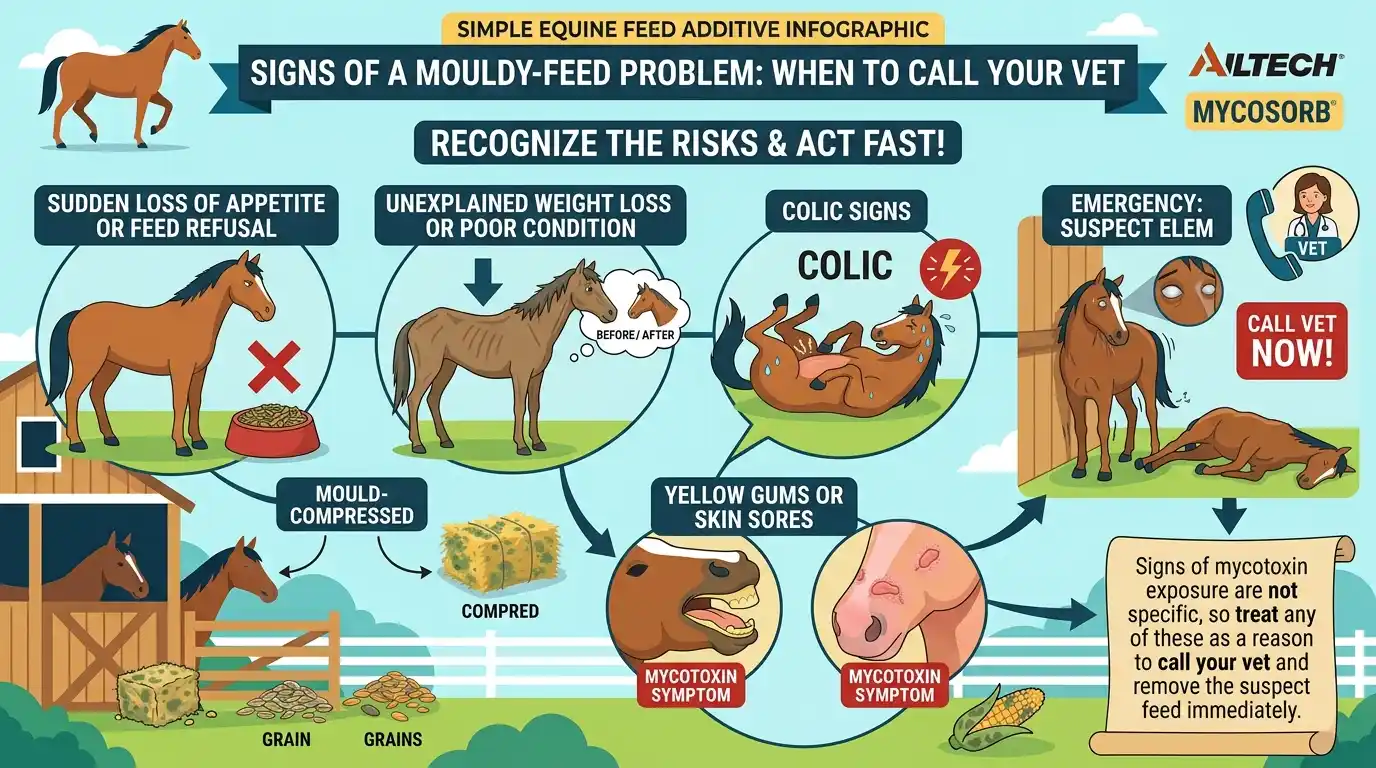
Signs of mycotoxin exposure are not specific, so treat any of these as a reason to call your vet and remove the suspect feed:
- Sudden loss of appetite or feed refusal
- Unexplained weight loss or poor condition
- Colic signs
- Yellow gums or skin sores on pink, sun-exposed skin
- Emergency: stumbling, circling, head pressing, blindness or collapse (possible ELEM)
Common Mistakes to Avoid
- Feeding it to mouldy hay and hoping. Bin visibly spoiled forage.
- Guessing with scoops. Scoop weights differ between products.
- Using the adult dose for a pony or foal. Dose by weight.
- Assuming more is better. There is no published evidence that doubling the high rate adds benefit.
- Skipping the label. Versions of the product differ.
- Using it to treat illness. It is preventive, not therapeutic.
Using Mycosorb Alongside Other Supplements
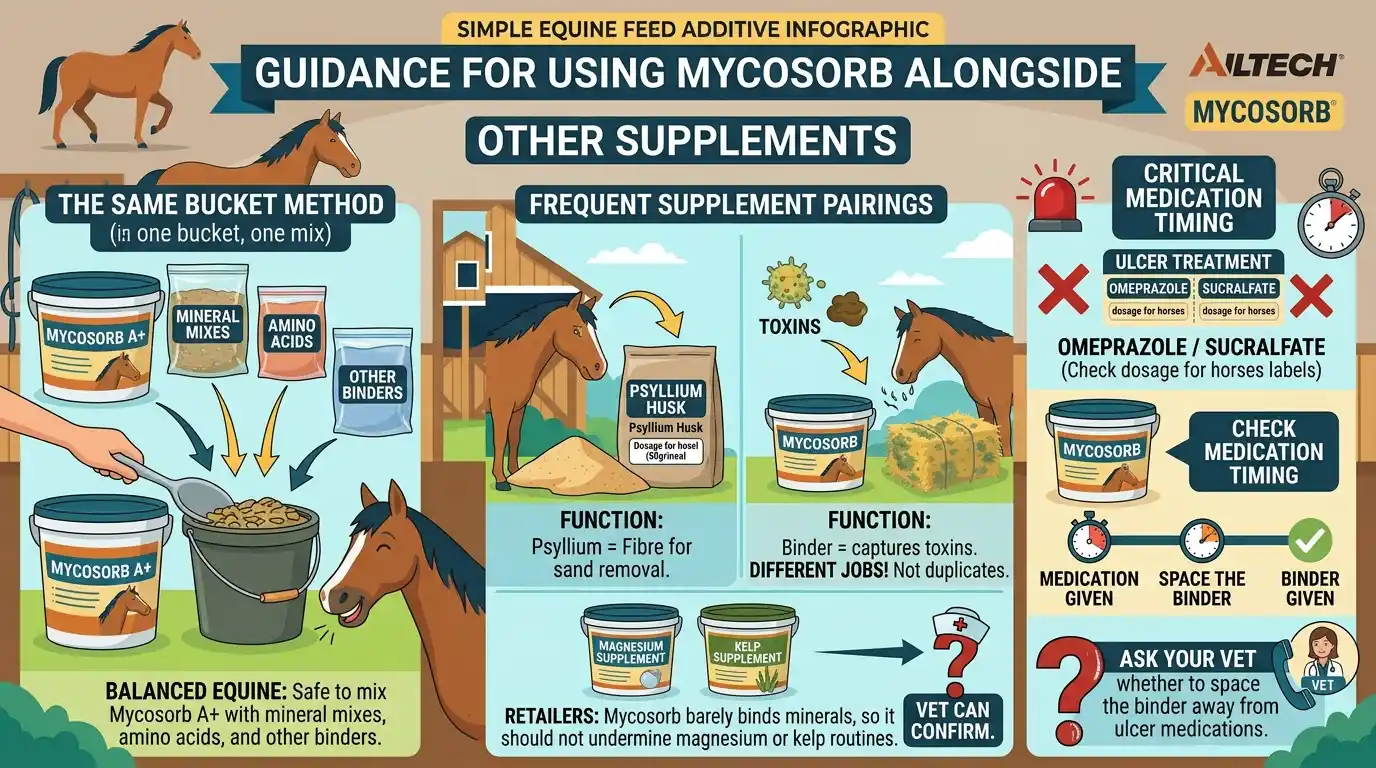
Balanced Equine says Mycosorb A+ can be fed in the same feed as its mineral mixes, amino acids and other binders. In practice that means one bucket, one mix.
A few pairings come up often. A psyllium husk dosage for horses plan and a binder do different jobs (fibre for sand, binder for toxins), so they are not duplicates.
Retailers say Mycosorb barely binds minerals, so it should not undermine a magnesium dosage for horses routine, though your vet can confirm. The same goes for the kelp dosage for horses guidance.
If your horse is on ulcer treatment, such as the omeprazole dosage for horses or the sucralfate dosage for horses, ask your vet whether to space the binder away from the medication.
Final Recommendations: Should You Feed Mycosorb?
Mycosorb is a reasonable extra layer of protection if your forage or pasture carries a higher mould risk. Start at 2 g per 100 kg, move to 4 g per 100 kg when risk is clear, weigh the powder, and treat it as support, not a cure.
Your next steps: weigh your horse, plug the number into the calculator above, read your container's label, and bin anything visibly mouldy. If you have a specific worry (a sick horse, a pregnant mare, an insulin-resistant horse), bring your vet in before you start.
- Standard dose: 2 g per 100 kg daily. High dose: 4 g per 100 kg.
- A 500 kg horse needs 10 g (standard) or 20 g (high) a day.
- Retailer rates and scoop sizes differ, so follow your own label and weigh the powder.
- Horse research is supportive but limited and not fully independent.
- It is a supplement, not a treatment. Mouldy feed must still go in the bin.
- Ask your vet about foals, broodmares, insulin resistance and oral medication.
FAQs
What is Mycosorb for horses?
Mycosorb is a feed additive from Alltech that binds mycotoxins in a horse's gut. It is based on yeast cell wall and, depending on the version, a small clay fraction and algae. The bound toxins pass out in the manure. It is a supplement, not a treatment for sick horses.
How much Mycosorb should I feed my horse?
The standard rate on Alltech-based listings is 2 g per 100 kg of bodyweight a day, and the high rate is 4 g per 100 kg. Scoop-based labels such as Forageplus use set amounts by workload instead. Always follow the label on the product you actually bought.
How much Mycosorb for a 500 kg horse?
A 500 kg (about 1,100 lb) horse gets 10 g a day at the standard rate and 20 g a day at the high rate. If you feed twice daily, split the amount between meals and weigh it on a kitchen scale rather than guessing with a spoon.
Can you give a horse too much Mycosorb?
I could not find published overdose studies in horses. Retailers advise staying within the stated feeding rate unless an equine nutrition professional says otherwise. There is no evidence that going above the high rate adds benefit, so stick to the label and ask your vet if you are tempted to go higher.
How long does Mycosorb take to work?
Binding happens in the gut as feed passes through, so the product is working from the first feed. Visible changes are a different matter. There is no published timeline for horses, and many exposures produce no obvious signs. If your horse is unwell, see your vet rather than waiting for a supplement to act.
Can I feed Mycosorb every day?
Yes, labels describe daily feeding. Some owners feed it year-round, others only during risk periods such as wet harvests, new hay batches or pasture changes. The Hoof Co notes that mycotoxins can occur in pasture all year in Australia, with risk rising at seasonal changes.
Does Mycosorb bind vitamins and minerals?
Retailers including Forageplus and Balanced Equine say it has very limited ability to bind vitamins and minerals, unlike some clay-only binders. Independent horse studies on this point are limited, so keep feeding a balanced ration and tell your vet if you see changes in condition or blood results.
Is Mycosorb safe for insulin-resistant or laminitic horses?
Balanced Equine describes it as safe for laminitis-prone and insulin-resistant horses. Ingredients vary by version, though, and the Forageplus listing includes maize. Read the label on your container and confirm with your vet, especially if your horse's insulin is being monitored.
Can pregnant or lactating mares have Mycosorb?
Forageplus lists a feeding rate for breeding mares and The Hoof Co says its product suits breeding horses. There are no horse-specific safety trials in pregnancy that I could find, so check with your vet before starting a broodmare.
Can Mycosorb treat mould poisoning or colic?
No. It is a preventive supplement that binds toxins in the gut. A horse showing colic, stumbling, blindness, head pressing, jaundice or sudden appetite loss needs a vet straight away, and the suspect feed should be removed.
What is the difference between Mycosorb and Mycosorb A+?
Retail listings show different ingredients. Some list yeast cell wall, aluminosilicate and algae for Mycosorb A+, while other listings show brewers yeast, fermentation solubles and calcium carbonate. Dose instructions can differ too, so follow the label on your container.
Can I mix Mycosorb with other supplements?
Yes. Balanced Equine says it can be fed in the same feed as its mineral mixes, amino acids and other binders. Mix it through damp feed with your other supplements, and ask your vet about timing if your horse takes oral medication.
Can Mycosorb make mouldy hay safe to feed?
No. Visibly mouldy or dusty hay should not be fed, binder or not. Binders reduce absorption of some toxins but do not neutralise them all. Test or replace suspect forage, and use a binder only as an extra layer of protection.
Is Mycosorb allowed in horse competition?
The listed ingredients are common feed ingredients such as yeast, clay and algae, but supplements are not individually approved by sport regulators. Check your governing body's rules and keep the product batch details on file before competing, especially under FEI or national drug-testing rules.
How long does a 1 kg container of Mycosorb last?
At 10 g a day for a 500 kg horse, 1 kg lasts about 100 days. At the 20 g high rate it lasts about 50 days. A 200 kg pony on 4 g a day gets roughly 250 days from the same container.
How do I get a fussy horse to eat Mycosorb?
Mix the measured dose thoroughly through damp feed and introduce it gradually over several days. Divide the daily amount between meals if your horse eats more than once a day, and make sure clean water is always available.
Sources and Further Reading
- U.S. FDA: Guidance for Industry, Fumonisin Levels in Human Foods and Animal Feeds
- Texas A&M Veterinary Medical Diagnostic Laboratory: Fumonisin Facts
- Raymond, Smith and Swamy (2005): Fusarium-contaminated grains, feed intake, serum chemistry and hematology of horses, with a glucomannan adsorbent (AGRIS/FAO)
- Raymond, Smith and Swamy (2005): Fusarium-contaminated grains in exercised horses (AGRIS/FAO)
- Alltech (manufacturer of Mycosorb)
- Forageplus: Mycosorb A+ Equine product page
- The Hoof Co: Mycosorb A+ product page
- Balanced Equine: Mycosorb A+ product page
- Horselands: Mycosorb Toxin Binder
- Equestrian Central: Mycosorb Alltech