
Omeprazole Dosage For Horses: Calculator, Chart & Safe Guide
Maybe your horse just came back from a gastroscopy with an ulcer diagnosis. Maybe you’re heading into a stressful show season and want to get ahead of it. Either method, the question is the same: how much omeprazole, and how often?
The answer depends on your horse’s weight and which of three dosing goals you’re working toward – treatment, tapering, or prevention. Here’s the full breakdown, backed by FDA and manufacturer dosing data.
Once your horse has been scoped and diagnosed by a veterinarian, use the calculator below to find out an exact number, then look in the chart below to verify.
Omeprazole Dosage Calculator For Horses
GastroGard® Paste Dosage for Horses & Foals
Calculated Dosing Results
This tool is for informational and educational reference purposes only and does not replace professional veterinary guidance, diagnosis, or treatment. Always consult a licensed veterinarian before administering medication.
© medshorse.com
Key Takeaways
- Omeprazole dosage for horses is a proton pump inhibitor (PPI) which scientists use to decrease stomach acid to allow ulcers to heal.
- Dose for treatment: 4mg/kg per day for 4 weeks. Maintenance dose: 2mg/kg for further 4 weeks. Prevention dose: 1 mg/kg a day.
- Gastrogard (prescription) and the new FDA approved generic Gastrobim treat active ulcers at higher doses and Ulcergard (over the counter) treats ulcers at a lower dose and is therefore for prevention.
- Discontinuation of omeprazole can cause rebound acid hypersecretion, increasing the risk of ulcer formation.
- Do not dose a horse from a human or dog omeprazole product, as the amount and frequency of dose is different for horses.
- Taking vet diagnosis and follow-up into account, the total cost of a full course of treatment (4-8 weeks) is $350-$1000+ USD.
What Is Omeprazole and How Does It Work in Horses?
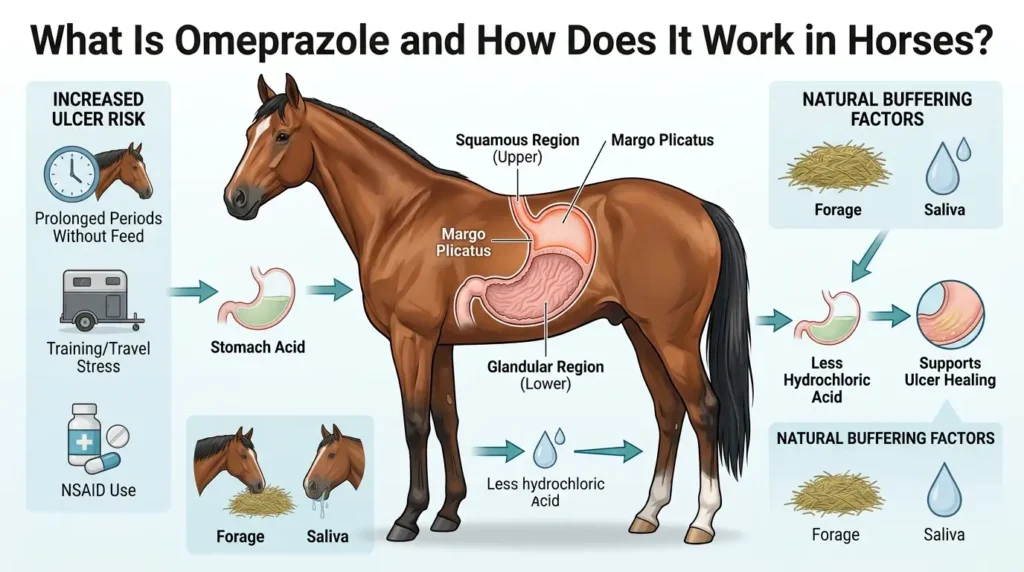
In horses, omeprazole medication is a proton pump inhibitor (PPI) that treats and prevents equine gastric ulcer syndrome (EGUS) — erosions that can cause pain in the stomach lining. It is the active ingredient of the FDA approved products GastroGard® (prescription) and UlcerGard® (OTC) and the newer FDA approved generic product Gastrobim for use in horses and foals 4 weeks of age or older.
A horse’s stomach secretes acid all day long (up to a few gallons per day) to break down a steady stream of forage. That acid is not buffered by a protective mucous coat in the upper (squamous) portion of the stomach, instead it is buffered by the saliva and chewed forage. If a horse is not fed for too long, or if he/she has to travel, train or strain, or are on long-term NSAIDs, that buffer is gone and the unprotected lining is burned, which creates ulcers.
Omeprazole horse dosage is an inhibitor that prevents the enzyme hydrogen-potassium ATPase from the acid-producing (parietal) cells of the stomach from producing hydrochloric acid by binding to it. The stomach pH increases with less acid being produced, and the damaged tissue can heal. These cells are constantly replaced, and for omeprazole to work, it must be administered on a daily basis, as it does not have a long lasting effect after a single or two doses.
How The Omeprazole For Horse Dosage Calculator Work
Input your horse’s body weight for an exact daily amount of Omeprazole For Horse milligrams for each treatment phase. This tool utilizes the same mg/kg calculations listed in the FDA approval notice and the UlcerGard prescribing information and is not intended to replace a veterinary diagnosis or prescription.
If you want to do the math by hand:
Dose (mg) = Body weight (kg) × mg/kg dose rate
For example, if the horse weighs 1,100 lb, then its weight in kg is approximately 499; at the treatment rate of 4 mg/kg: 499 × 4 = 1,996 mg of omeprazole per day, which rounds to the nearest labeled setting of the syringe’s dial, which is 400 mg/day.
Omeprazole Dosage Chart for Horses By Weight
This chart shows the milligrams of active omeprazole needed per day at each of the three standard dose rates. Paste products such as GastroGard and UlcerGard will have a weight dial on the syringe, which will usually be set to the correct weight for the horse rather than the horse owner having to calculate how much is in a gram of paste, however, this dial is important if you need to use a compounded suspension or are comparing different products.
| Body Weight | Treatment Dose (4 mg/kg) | Maintenance Dose (2 mg/kg) | Prevention Dose (1 mg/kg) |
| 600 lb (272 kg) | 1,089 mg | 545 mg | 272 mg |
| 700 lb (318 kg) | 1,270 mg | 635 mg | 318 mg |
| 800 lb (363 kg) | 1,452 mg | 726 mg | 363 mg |
| 900 lb (408 kg) | 1,633 mg | 816 mg | 408 mg |
| 1,000 lb (454 kg) | 1,814 mg | 907 mg | 454 mg |
| 1,100 lb (499 kg) | 1,996 mg | 998 mg | 499 mg |
| 1,200 lb (544 kg) | 2,177 mg | 1,089 mg | 544 mg |
| 1,300 lb (590 kg) | 2,359 mg | 1,179 mg | 590 mg |
| 1,400 lb (635 kg) | 2,540 mg | 1,270 mg | 635 mg |
Note on UlcerGard specifically: According to the official label, a horse 600-1200lbs should receive one dose (¼ tube) a day; and over 1200lbs should receive 2 doses (½ tube) a day — that is just the 1mg/kg dose on the official label pre-measured into tube fractions.
Treatment Dose (4 mg/kg)
This is the dose once ulcers have been diagnosed by a veterinarian using the gastroscope. S. is administered once a day on an empty stomach whenever possible, for at least 4 weeks and rescoped or reassessed before discontinuation.
Maintenance / Tapering dose of 2 mg/kg.
Most veterinarians will then maintain omeprazole dosage for horse at half the dose for treatment for 4 more weeks after the initial 4 weeks. The step-down strategy aims to lessen the risk of rebound acid hypersecretion, which is a sudden increase of stomach acid that may occur when you abruptly stop taking omeprazole, leading to a recurrence of ulcers.
Prevention Dose (1 mg/kg)
This reduced dose is reserved for horses that do not currently have a diagnosis of ulcers, but are an known high-risk horse during a period of stress: trailering, showing, barn change, high stress training.
This lower dose, specifically, is also FDA approved for use in UlcerGard and research cited in equine pharmacy literature has determined it to be effective in the treatment of milder squamous ulceration in some cases (a vet should confirm that this is appropriate before using it as a treatment).
GastroGard vs. UlcerGard vs. Generic/Compounded Omeprazole
| GastroGard® / Gastrobim (generic) | UlcerGard® | Compounded omeprazole suspension | |
| Purpose | Treats existing ulcers | Prevents ulcers in at-risk horses | Treats or prevents, per vet’s compounded formula |
| Dose | 4 mg/kg daily, then 2 mg/kg daily | 1 mg/kg daily | Varies — set by prescribing vet |
| Prescription required? | Yes | No (OTC) | Yes |
| Form | Oral paste | Oral paste | Oral liquid suspension, often combined with cimetidine or sucralfate |
| FDA approved? | Yes | Yes | Compounded — not individually FDA-approved, but legal under veterinary compounding rules |
| Typical horse weight range on label | All adult horses and foals 4+ weeks | 600 lb and up | Set by prescription |
Takeaway: The recommended standard of care for horses with diagnosed ulcers is the FDA approved treatment rates for GastroGard or generic equivalent (Gastrobim). Unlike higher dose products, UlcerGard is a preventative for horses that have not been diagnosed with ulcers.
Compounded suspensions may be used occasionally because the horse cannot tolerate paste, or because of cost, but compounded products do not necessarily need to be tested for bioequivalence to GastroGard like an FDA-approved generic and the accuracy of dosing relies on the compounding pharmacy.
How to Give Omeprazole to a Horse (Step-by-Step)
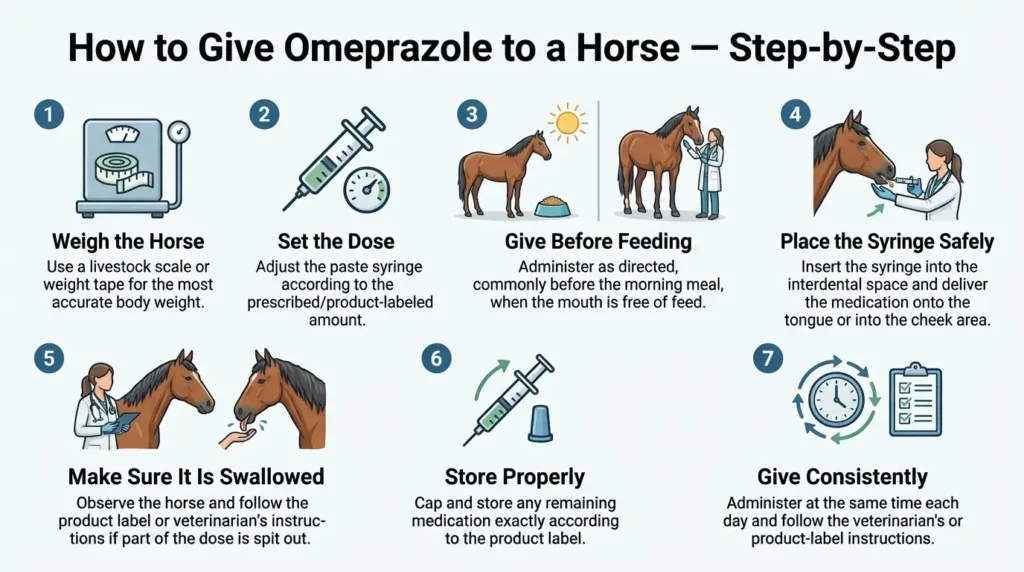
- Weigh your horse, use a weight tape/livestock scales — dosing based on a “guesstimate” weight is one of the most common mistakes made.
- Adjust the paste syringe dial to your horse’s body weight, or measure the amount of liquid suspension indicated.
- Make sure there’s no feed in the horse’s mouth. For the most consistent absorption, omeprazole is usually administered before the morning meal, on an “empty stomach.
- Put the syringe into the gap between front and back teeth (interdental space) and place the dose onto the back of the tongue or directly into the cheek pouch.
- Supervise to ensure that the entire dose is swallowed. Most labels will indicate that if the horse spits out part of the dose, re-dose must be given.
- Properly store the syringe: cap the syringe and store it at 68-77°F (20-25°C) until it is used again if there is any remaining fluid.
- Give it at the same time every day. Unlike many other medicines, it is more important to take a once a day PPI exactly as prescribed each day, as otherwise acid levels will return to normal in between doses.
How Long Should a Horse Stay on Omeprazole?
A typical treatment course lasts about 8 weeks; 4 weeks at full treatment dose followed by 4 weeks at the maintenance dose. Based on the follow up gastroscopy, your vet may shorten or lengthen this period.
Sometimes longer treatment courses or a second drug are needed, as research has shown that although omeprazole is generally more effective against squamous ulcers, studies including the University of Illinois affiliated equine study comparing the effectiveness of omeprazole versus sucralfate have shown that it is not as consistently effective against glandular ulcers.
Long-term or repeated courses can be used in performance horses that have chronic exposure to stress, but no course should be used indefinitely without reevaluation by a vet, especially as performance horses have to make digestive trade-offs as discussed in the next section.
Uses and Benefits of Omeprazole in Horses
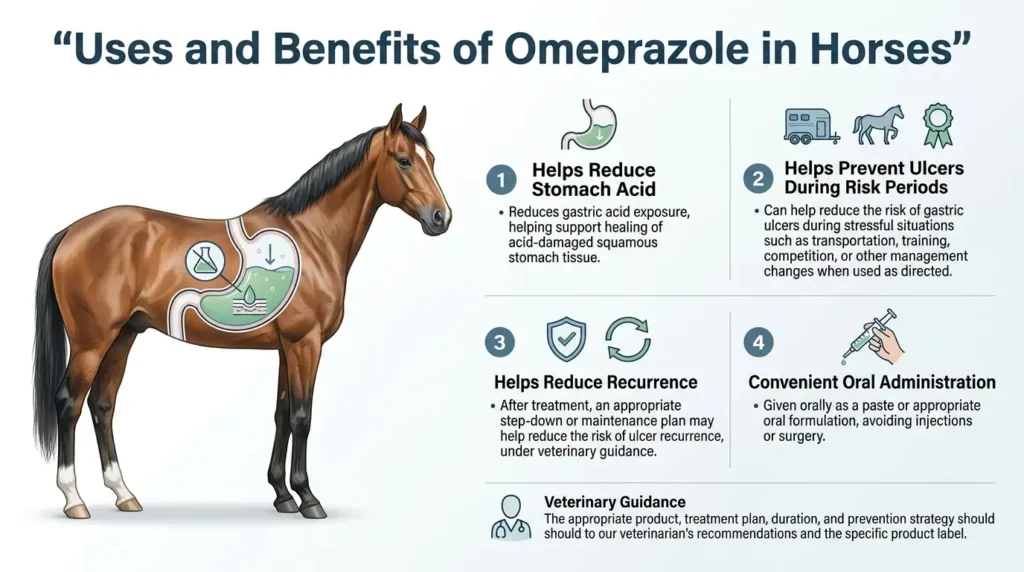
- Controls acid to allow the equine squamous stomach to heal.
- Helps prevent ulcers during periods of known stress (such as when being transported by trailer, during competition or in the stall).
- When used properly as a step down (treatment-then-maintenance) protocol, it reduces risk of recurrence.
- Non-invasive (daily) dosing — no injections, surgery, but rather oral paste or liquid.
Various techniques available, including brand-name, FDA-approved GastroGard; newer generic Gastrobim; prevention, OTC UlcerGard.
Side Effects and Risks
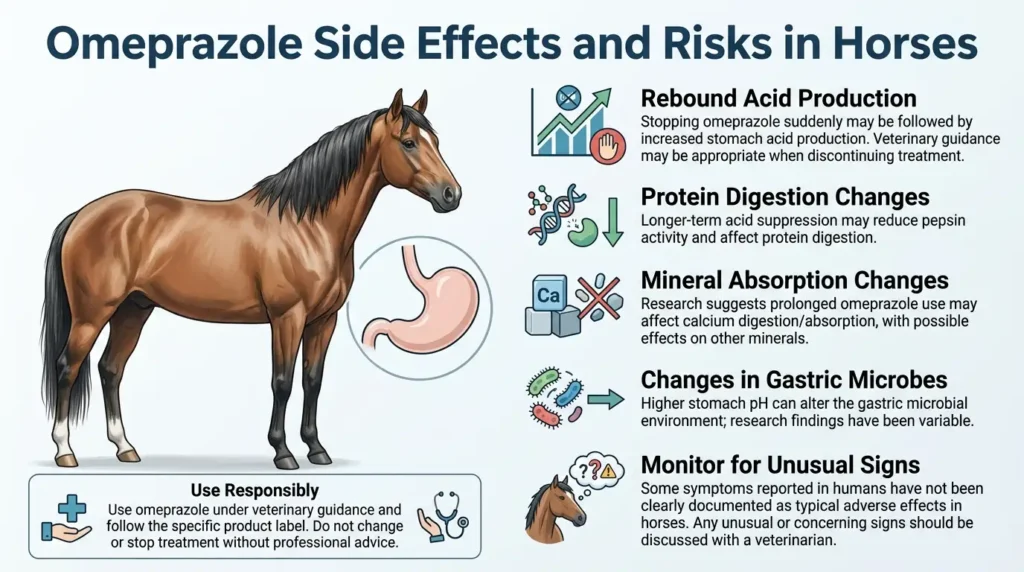
If applied properly under veterinary supervision, there are few adverse reactions in horses. However, there are several known and plausible horse owner risks associated with acid suppression:
- Rebound acid hypersecretion (RAH): This is a sudden increase in acid production in response to stopping omeprazole, due to increased gastrin production, a hormone that stimulates acid release. There is a biological rationale for tapering rather than stopping cold—as gastrin levels have been seen to double after approximately 2 weeks of omeprazole use.
- The stomach acid triggers an enzyme called pepsin, which initiates the digestion of food protein, but is less effective in the absence of stomach acid. Pepsin activation can be reduced by acid suppression, and in one Arabian horse study, protein digestion was measurably decreased after approximately 11 days of omeprazole.
- Decreased mineral uptake: studies have shown that omeprazole medication affects the digestion of calcium in horses after approximately 3 weeks of the normal treatment dose and one study of cells indicated that omeprazole may also interfere with magnesium.
- Changes in gastric microbial ecology: Gastric pH increases, which decreases some of the acid barrier that normally restricts growth of bacteria. The results have varied between the disciplines of equine research; some have reported a low degree of change in the diversity of bacteria, while others observed no difference in clinical attributes.
- Symptoms seen in human patients (headache, stomach pain, nausea and diarrhea) have not been documented in the horse, however uncharacteristic symptoms should be reported to the owner’s veterinarian.
All this does not mean that omeprazole is unsafe if used as indicated — it is still the standard of care for EGUS. It does imply that extended courses should be supervised by vets, they should be faded and not cut short, as well as accompanied by appropriate dietary measures that can be beneficial for digestion and mineral uptake.
Drug Interactions and Precautions
- NSAIDs (phenybutazone, flunixin): Ulcers are a serious risk factor with long term NSAID use, especially glandular ulcers. Wherever possible, reduce the duration of NSAID therapy but it is common practice to use omeprazole along with any required NSAID therapy.
- Other acid-reducing medications (cimetidine, sucralfate): There are other products that contain omeprazole along with cimetidine (an H2 blocker) or sucralfate (mucosal coating agent) and may be used to increase protection especially in glandular disease or in very sick horses – again, these combinations should be prescribed and dosed by a veterinarian, NOT put together by yourself!
- Other drugs that are absorbed in the stomach: Omeprazole medication treatment increases pH, which can theoretically interfere with the absorption of other drugs that are taken by mouth. Be sure to let your veterinarian know about all medications and supplements currently being used before beginning omeprazole treatment.
- Pregnant Mares: UlcerGard is not labelled as safe in pregnant mares — use in breeding stock under vet direction.
- Foals: Gastrobim and GastroGard-type products are recommended for foals 4 weeks of age and older, and may require specific veterinary dosage for foals under 4 weeks of age.
- Not for human use: Equine preparations and formulations of omeprazole are for horses. Ensure that they are kept away from children and if swallowed by a human being, contact a doctor.
- Racing/competition horses: Be sure to know the current withdrawal times and medication rules for the governing body (USEF, FEI, or state racing commission) before the horse is to be raced/competed as these rules change and vary by organization.
Omeprazole Cost for Horses
The prices can differ from region to region and product to product, but here is a general idea of the cost based on published GastroGard prices:
| Item | Approx. Cost (USD) |
| One GastroGard tube (6.15 g) | ~$35 |
| Tubes needed for a 500 kg horse, per week | ~2–3 tubes |
| Full 4-week treatment course | ~$350+ (about 10 tubes) |
| 4-week maintenance/taper course (half dose) | Roughly half the tube count of the treatment phase |
| Full 8-week treatment + taper, vet exam and follow-up scoping included | Often $600–$1,000+ |
| Generic (e.g., Gastrobim) or compounded suspension | Frequently lower than brand-name GastroGard, but confirm with your vet/pharmacy since pricing varies widely |
With these costs in mind, many veterinarians and owners consider prevention, via feeding management, turnout, and minimizing empty-stomach time, to be the most cost-effective long-term treatment, and only use full-dose omeprazole for dogs that are diagnosed with GERD.
Myth vs. Fact
| Myth | Fact |
| “UlcerGard and GastroGard are basically the same thing.” | They contain the same active ingredient and concentration, but are dosed and labeled for different purposes — UlcerGard for prevention at 1 mg/kg, GastroGard for treatment at 4 mg/kg. |
| “You can stop omeprazole as soon as symptoms improve.” | Symptom improvement doesn’t confirm healing. Stopping early or abruptly raises the risk of rebound acid hypersecretion and ulcer recurrence. |
| “More omeprazole works faster.” | Dosing above the labeled rate doesn’t have established evidence of faster healing and increases the risk of the digestive side effects described above. Stick to the labeled mg/kg rate unless your vet specifies otherwise. |
| “If it works for humans, human omeprazole dosing applies to horses.” | Human OTC omeprazole products are not equine-labeled, and horse dosing (mg/kg) is different from typical human dosing. Use only equine-labeled or vet-prescribed compounded products. |
Common Dosing Mistakes to Avoid
- Estimating Guessing weight rather than measuring weight using a scale or weight tape.
- An abrupt withdrawal from treatment, rather than a gradual one, when the horse “appears to be better.”
- Taking the dose with a full tummy as this can affect how well the dose is absorbed.
- Doing an old “ulcer protocol” on a different horse that hasn’t been diagnosed in the past rather than obtaining a current gastroscopy.
- Giving compounded suspension the same dose as paste without checking with the pharmacy on the mg/mL dose.
You May Also Like to Read:
- Acepromazine Dosage For Horses: Calculator, Chart & Safe Guide
- Equioxx Dosage For Horses: Calculator, Chart & Safe Guide
FAQs
How much omeprazole dosage should be given to horses?
The 4 mg/kg (1.8 mg/lb) treatment dose is used once daily for 4 weeks with maintenance dose of 2 mg/kg (0.9 mg/lb) once daily for 4 weeks.
How much UlcerGard dosage should horses get?
UlcerGard is dosed at 1 mg/kg once daily — about ¼ of a tube for horses 600–1,200 lb, and ½ a tube for horses over 1,200 lb.
Is it possible for me to overdose my horse on omeprazole?
Giving more than the recommended treatment rate has not been proven to speed up healing and can cause digestive problems, such as decreased protein and mineral absorbency. Please adhere to all labelled or vet prescribed dosing.
What is the difference between GastroGard and UlcerGard?
They have the same active ingredient and are the same concentration; GastroGard is prescription-only and higher dose for treating existing ulcers, while UlcerGard is OTC and lower dose to prevent ulcers.
What is the longest length of time a horse can be on omeprazole?
Most treatment plans last for 4-8 weeks. Sometimes longer courses are used for chronic cases, but this should be reevaluated by a veterinary specialist using gastroscopy and not as a life-long prescription.
What should I do if I forget to take a dose?
If a dose is missed, continue with the normal dose schedule as soon as the missed dose is noticed. Don’t double up the next dose. If doses are frequently missed, then it can lead to poor acid control and it can delay healing.
Will omeprazole treatment cure an ulcer?
No. It will heal the existing ulcer by inhibiting the acid but it does not alter the risk factors (diet, stress, workload). After treatment, there is a chance of ulcers recurring if things are not managed.
Is Omeprazole safe for foals?
Yes – omeprazole has FDA approved products labeled for foals 4 weeks of age and older at veterinary directed dosing.
Do horses need a prescription for omeprazole?
GastroGard, Gastrobim and compounded suspensions must be prescribed by a vet. To prevent ulcers, UlcerGard can be bought over the counter.
How is squamous ulcers treated vs. glandular ulcers?
There is more evidence for omeprazole healing squamous ulcers (the upper stomach). Glandular ulcers, which are ulcers deeper in the stomach, do not always respond as well to omeprazole alone and sometimes require combination therapy for this reason, it is important that gastroscopy is performed to determine the diagnosis before the protocol is chosen.
Is it OK to use human Omeprazole on my horse?
No. Only use products designed for horses or a veterinarian compounded formulation and dose specifically by your horse’s weight.
Is it safe to use omeprazole in pregnant mares?
The safety to pregnant mares has not been evaluated in the UlcerGard label and breeding stock use should be supervised by a veterinarian.
Final Thoughts
Once you know your horse’s weight and what phase you are on, giving the right dose of omeprazole is not difficult: 4 mg/kg for treatment, 2 mg/kg for tapering and 1 mg/kg for prevention. The more important element in ulcer management is consistency—take the medication at the same time each day on an empty stomach, do not stop the course short, and do not stop the medication abruptly (cold turkey).
Add that to the management changes that have taken place: increased turnout, more forage, less empty stomach time, and you’ve solved the ulcer you’re looking at and the problem that caused it. This guide is intended to facilitate the conversation with your veterinarian about dose, duration, and whether or not a lower cost generic or compounded product is appropriate for your horse, not to replace it.