Ivermectin Dosage For Horses: Calculator, Chart & Safe Guide
The most common error with a seemingly normal horse is a missed ivermectin dose – and the easiest to avoid once the math is learned. This guide will provide you with the exact formula for calculating the correct dose, a convenient chart for reference by weight, and safety information veterinarians would want a horse owner to know before reaching for the syringe.
Quick facts: Standard ivermectin Dosage For horses is 200mcg/kg (or 0.2mg/kg) of body weight, and it is a single oral dose. This is a full 1.87% paste syringe that treats one 1250 pound horse. Always measure; never guess.
Ivermectin Dosage Calculator for Horses
Reference tool for estimating equine ivermectin dosing
Dosage Results
Key Takeaways
- Horses should be treated using a correct dosage of ivermectin, which is 200 mcg/kg (0.2 mg/kg) body weight administered via the mouth, one time only.
- Ivermectin medication is available in two popular formulations: ivermectin 1.87% oral paste or ivermectin 1 % liquid drench.
- A full 1,87% paste syringe is the correct amount for a 1250 lb horse: smaller horses will require less than one syringe.
- Ivermectin is active against most strongyles, ascarids, pinworms, threadworms, bots, but is not active against tapeworms and not sufficiently effective against the encysted small strongyle larvae.
- The overdose risk is low with ivermectin as it has a wide margin of safety in horses, but accurate estimation of weight remains important.
- Always take the advice of your veterinarian with regard to the establishment of a parasite control program rather than deworming on a set calendar.
What Is Ivermectin?
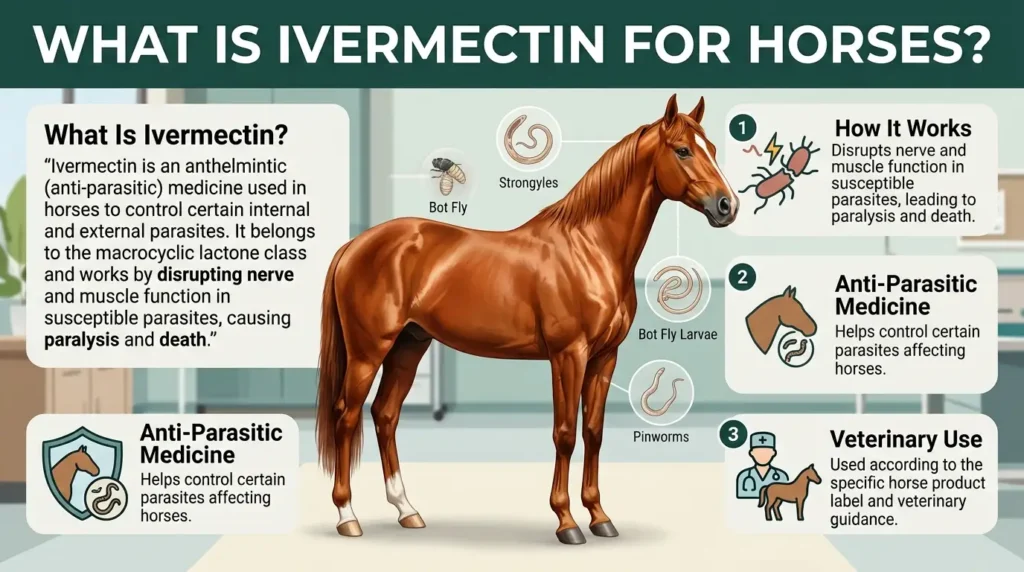
Ivermectin for horses is an anthelmintic (anti-parasitic) drug that is used to control internal and external parasites in horses. It is a member of a group of drugs known as macrocyclic lactones, which are produced by a bacterium (streptomyces avermitilis) that lives in the soil. In the United States, ivermectin is available over the counter (OTC) for treating horses, and is one of the most popular dewormers used in the equine industry.
It disrupts the function of nerves and muscles in sensitive parasites, resulting in nerve paralysis and death of the parasites, with little effect on the horse at the labelled dose.
What is Ivermectin Dosage for Horses
Ivermectin for horses is recommended at 200 micrograms per kilogram body weight (mcg/kg) (0.2 mg/kg) as a single oral dose. This rate is identical for both the paste and the liquid drench, only the quantity of product to be applied to the cattle changes.
The Dosage Formula
To work out the dose for yourself:
- Weigh your horse in pounds or kilograms (not approximate, use a weight tape or livestock scale).
- Multiply by the dose rate:
- In kg: weight (kg) × 200 mcg = total dose in mcg
- In lb: weight (lb) × 91 mcg = total dose in mcg (this is the lb-equivalent of 200 mcg/kg)
- Convert to the volume of the product using the concentration:
- 1.87% paste = 18,700 mcg of ivermectin per gram of paste
- 1% liquid drench = 10,000 mcg of ivermectin per mL
Example: A 1,000 lb horse needs 1,000 × 91 mcg = 91,000 mcg (91 mg) of ivermectin. With 1.87% paste, that’s 91,000 ÷ 18,700 ≈ 4.87 grams of paste.
Ivermectin Dosage Chart for Horses By Weight
These charts are based on the Ivermectin Dosage For Horses typical dose rate of 200mcg/kg or 91mcg/lb. Always weigh your horse and not estimate, and check against your product label as syringe markings can vary slightly from one brand to the next.
Paste (1.87%) Dosage Chart
| Horse Weight (lb) | Horse Weight (kg) | Ivermectin Needed (mg) | Paste Needed (g) |
| 400 | 181 | 36.4 mg | 1.95 g |
| 600 | 272 | 54.6 mg | 2.92 g |
| 800 | 363 | 72.8 mg | 3.89 g |
| 1,000 | 454 | 91.0 mg | 4.87 g |
| 1,100 | 499 | 100.1 mg | 5.35 g |
| 1,250 | 567 | 113.8 mg | 6.08 g (full syringe) |
| 1,500 | 680 | 136.5 mg | 7.30 g (1.2 syringes) |
A standard syringe (such as a 6.08g syringe) contains a solution calibrated to treat a 1,250 lb horse completely with a 1.87% solution. Horses in excess of 1250 lbs need more than one syringe or a larger capacity tube.
Liquid Drench (1%) Dosage Chart
| Horse Weight (lb) | Horse Weight (kg) | Ivermectin Needed (mg) | Drench Needed (mL) |
| 400 | 181 | 36.4 mg | 3.6 mL |
| 600 | 272 | 54.6 mg | 5.5 mL |
| 800 | 363 | 72.8 mg | 7.3 mL |
| 1,000 | 454 | 91.0 mg | 9.1 mL |
| 1,250 | 567 | 113.8 mg | 11.4 mL |
| 1,500 | 680 | 136.5 mg | 13.7 mL |
Some liquid products are labeled as some percentage of 1% for a quantity of kg (e.g., 1 mL per 50 kg); always check your product label.
How to Give Ivermectin to a Horse (Step-by-Step)
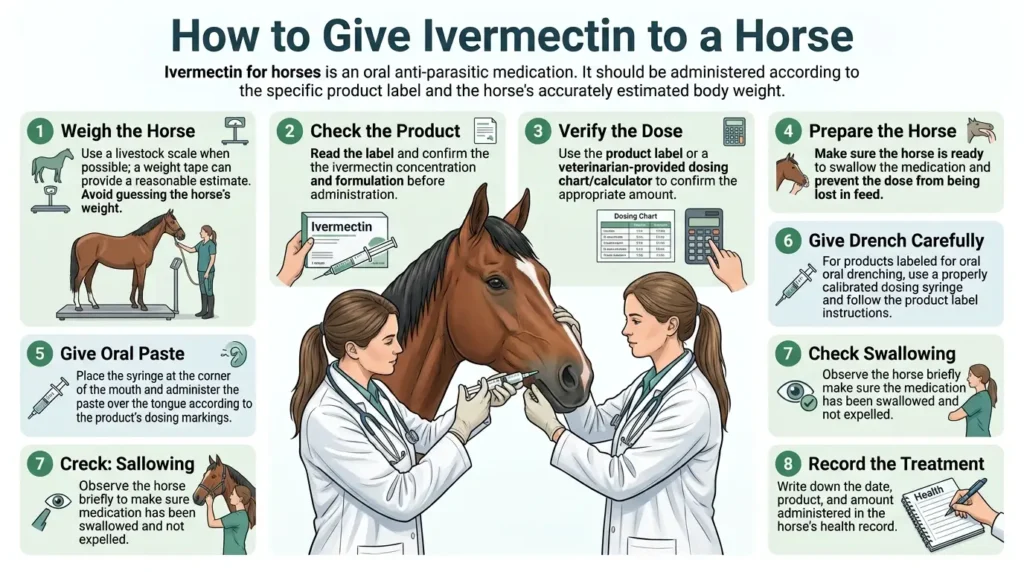
- Weigh your horse. Ideally use a livestock scale, but use a weight tape as a reasonable estimate. The most frequent cause of dosing error is by guessing by eye.
- Check the product concentration listed on the tube or bottle (paste usually 1.87% or drench 1%).
- Using the above chart or the calculator, calculate or verify the dose.
- Remove the food from the horse’s mouth before giving the medicine, ensure that the whole dose gets swallowed not mixed with the hay.
- Paste: Syringe in the corner of the mouth, over the tongue and push plunger to the appropriate weight mark. To promote swallowing, position the head up for a short time.
- For drenching: Fill a calibrated dosing syringe with the proper amount and give orally according to the instructions on the product label.
- Monitor the horse for a few minutes to ensure dose is swallowed and not spat out.
- Document on your horse’s health log the date, product and dose administered – this is important to track egg reappearance periods and when the next treatment should occur.
What Does Ivermectin Treat in Horses? (Uses)
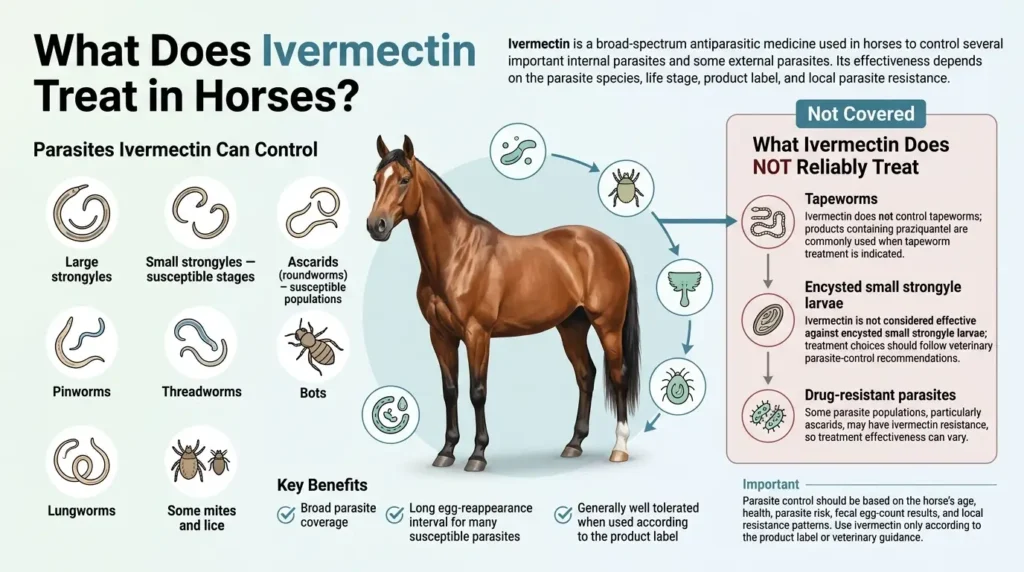
Ivermectin treatment is indicated for control and treatment of a wide variety of internal and external parasites in horses, such as large and small strongyles, ascarids, pinworms, threadworm, bots, and some mites and lice.
Parasites Ivermectin Kills
- Large strongyles (Strongylus vulgaris, S. edentatus and S. equinus) including migrating larval stages
- Large strongyles — adults only
- Roundworms (ascarids) in numbers that are still susceptible (see Resistance section)
- Pinworms (Oxyuris equi)
- Threadworms (Strongyloides westeri)
- Bots (oral and gastric stages of Gasterophilus spp.)
- Lungworms (Dictyocaulus arnfieldi)
- Some off-label mites and lice
What Ivermectin Does NOT Treat
- Tapeworms (Anoplocephala perfoliata) – Tapeworms do not have the receptors that ivermectin targets and require an additional product containing praziquantel.
- Ivermectin for horses dosage has a relatively short elimination half-life (4 days or so) and is eliminated from the bloodstream too rapidly to effectively kill the encysted small strongyle larvae. Generally, moxidectin is recommended to use during this stage.
- There are some populations of ascarids that have known resistance (see below).
Benefits of Ivermectin for Horses
- One dose of broad spectrum control of the most prevalent and most threatening internal parasites.
- Long egg reappearance time (8-14 weeks) – fewer treatments per year in many programs than older classes of dewormers.
- Large margin of safety at the labelled dose and appropriate for the majority of healthy adult horses.
- Single dose – no multi-day dosing required.
- Minimizes the potential for colic that can be caused by S. vulgaris, one of the more severe effects of untreated large strongyle infection.
Is Ivermectin Safe for Horses? (Side Effects & Overdose)
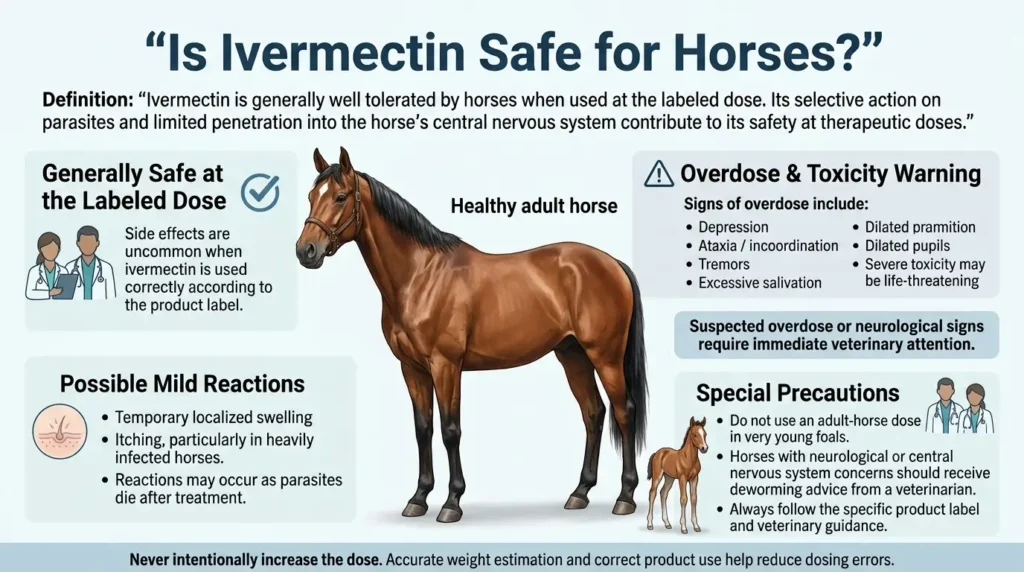
Yes — if administered properly, ivermectin is safe for horses. Ivermectin is selectively toxic because the type of nerve receptor it targets in parasites is not found in the same form in mammals and a horse’s blood-brain barrier prevents the drug from reaching its own central nervous system.
It is that combination that makes a therapeutic dose that kills a parasite have little effect on the horse that is carrying the parasite.
Common, Mild Reactions
Side effects at the proper dosage are rare. Reportedly, some horses, especially those with very heavy infestations and a high number of microfilaria of the neck threadworm have experienced some localized swelling or itching immediately following treatment, which is believed to be due to the dying out of parasites and not the drug itself.
Overdose & Toxicity Signs
Ivermectin toxicity in horses is uncommon and usually occurs when given at doses 10 times or more the normal dose, and has been reported in young horses due to a mistake. Watch for:
- Depression
- Ataxia (incoordination)
- Tremors
- Excessive salivation
- Mydriasis (dilated pupils)
- Death in severe cases
Do not wait and see if symptoms go away, contact your veterinarian or local equine emergency clinic immediately if you suspect an overdose.
Horses That Should Not Receive Ivermectin
- Do not administer ivermectin medicine to a horse without specific veterinary advice, if the horse has diagnosed or suspected central nervous system disease (C.N.S. Disease) such as EPM (Equine Protozoal Myeloencephalitis) or encephalitis.
- Very young foals should not be dewormed with an adult horse dose, but should be dewormed as part of a veterinarian designed deworming program (see Foals section below).
Ivermectin Drug Interactions in Horses
In the published literature there are few documented, clinically confirmed drug interactions unique to ivermectin in horses. What is known is that ivermectin is a substrate of P-glycoprotein, which is a multi-functional transport protein that is used to pump the drug out of cells – this is one of the reasons why this drug is generally well tolerated in mammals because the P-glycoprotein is used to pump the ivermectin away from the sensitive tissue.
There are a few practical measures that are good to talk to your veterinarian:
- Do not use more than one macrocyclic lactone dewormer (ivermectin, moxidectin, abamectin, doramectin) at the same time — it does not help and it provides an additional and unnecessary drug exposure.
- As a general rule, inform your veterinarian if your horse is receiving other drugs, particularly drugs that impact the central nervous system, before deworming.
- Do not treat with ivermectin if your horse is exhibiting any neurological symptoms for any reason, but rather consult your veterinarian first.
Horse Ivermectin vs. Human Ivermectin – Why It Matters
A point to note, explicitly: equine ivermectin paste and human ivermectin tablets are NOT the same. (Note: search interest in this has been rising over the last few years.)
- Horse paste is much thicker and higher volume – it’s formulated for an animal that can weight 1000+ lb, and flavours, thickeners and carriers are selected to be palatable to and stable in a barn – not for human safety testing.
- Regulatory agencies, such as the FDA have said that no studies have been done on the safety of animal-formulated ivermectin products in humans, and all labels of equine ivermectin products clearly say they are for oral use in horses, only.
- When comparing a product that’s formulated for a half ton animal to one that’s formulated for a human being, a “same active ingredient” argument fails to take into account dosing accuracy, inactive ingredients, and absorption.
If someone in your family has a valid need for ivermectin as a human drug, it’s a discussion with a doctor and a human pharmacy, not a horse’s medicine cabinet.
How Often Should You Deworm a Horse With Ivermectin?
The answer is not the same for everyone — now the deworming of horses has shifted from “deworming all horses at a certain time of year” to a more individual and strategic approach.
Strategic (Targeted) Deworming
The majority of veterinarians are now suggesting that treatment should be based on:
- Before treatment, fecal egg counts (FEC) to determine each horse’s parasite burden
- Fecal egg count reduction tests (FECRT) at 10-14 days post deworming to verify that the dewormer is effective (reduction less than 95% is cause for concern for resistance)
- The horse’s age, health status, and risk of exposure (foals, senior horses, and horses that shed a lot should be monitored more closely)
- Reservations of refugia: keeping some parasites alive in some horses, to delay the emergence of resistance.
Foals, Pregnant Mares & Special Cases
- Usually, foals are treated at 6-8 weeks old for the first time and then at regular intervals according to the foal’s requirements as determined by the veterinary practitioner.
- Pregnant and breeding mares are usually part of a routine parasite control program, however, correct timing and product selection should be determined for each individual mare in consultation with your veterinarian.
- Yearlings, foals and mares should be especially monitored in any parasite control program as young and breeding horses are more susceptible to the effects of a heavy parasite load.
Ivermectin Resistance: What Every Owner Should Know
Ivermectin resistance in parasites is well documented and is occurring. Especially in the case of ascariids (roundworms), populations have developed a resistance to ivermectin and the drug might not have the desired effect when given properly.
In addition, the egg reappearance time has been progressively decreasing in some populations after even ivermectin treatment — indicating pressure for resistance in absence of outright treatment failures.
That’s why blanket deworming based on the calendar is becoming obsolete – using too often a class of dewormers makes parasites more likely to withstand. Working with your veterinarian, implementing a FEC-guided program is your best bet at keeping ivermectin effective on your farm.
Ivermectin vs. Other Horse Dewormers
| Feature | Ivermectin | Moxidectin | Fenbendazole (Benzimidazole) | Pyrantel Pamoate |
| Drug class | Macrocyclic lactone | Macrocyclic lactone | Benzimidazole | Tetrahydropyrimidine |
| Standard dose | 200 mcg/kg | 400 mcg/kg | 5–10 mg/kg | 6.6 mg/kg |
| Egg reappearance period | ~8–14 weeks | ~12–17 weeks | Shorter | Shorter |
| Encysted small strongyles | Limited efficacy | Effective | Effective (5-day double dose) | Not effective |
| Tapeworms | No (needs praziquantel combo) | No (needs praziquantel combo) | No | Effective at double dose |
| Bots | Yes | Yes | No | No |
Characteristics in the table are based on general class-level statements found in the veterinary literature; always check the product label for specific claims as product formulations and combination products vary.
Common Mistakes When Dosing Ivermectin
- Estimating rather than measuring weight. Even a ‘rough’ estimation by sight can result in a 100-200 lb under or over dose with real, meaningful consequences for the horse.
- Administering the remaining half dose from an old syringe without making the calculation for the current horse’s weight.
- Deworming at a fixed time instead of deworming according to the parasites burden, which accelerates resistance.
- When ivermectin drug for horses alone doesn’t work, assuming one dewormer treats all (including tapeworms and encysted larvae).
- Failure to clear the feed from the mouth before it is swallowed, with some of the dose being lost in the hay.
Myth vs. Fact
Myth: “The more ivermectin that is used, the more parasites will be controlled.
Fact: ‘more is not better’ when it comes to overdose and only makes the already slim risk of side effects greater. What is of importance is the ability to dose correctly by weight.
Myth: “My horse is 1,250 lbs so I should give my horse the entire tube of paste.
Fact: The tube is marked with weight indicators on the plunger to be calibrated for use – only use the part that corresponds to your horse’s weight.
Myth: “Horse ivermectin is not that different from human ivermectin.
Truth: They are formulated, concentrated and tested on completely different species. Equine paste is only for horses.
Myth: Rustlers should deworm all horses using a set schedule.
Fact: Current best practice is to use faecal egg counts to work out an individual treatment schedule per horse.
You May Also Like to Read:
- Omeprazole Dosage For Horses: Calculator, Chart & Safe Guide
- Acepromazine Dosage For Horses: Calculator, Chart & Safe Guide
FAQs
How much ivermectin do you give a horse?
The recommended dosage is 200mcg/kg (0.2mg/kg) body weight in a single oral dose: about 4.9 grams of 1.87% paste for a 1000 lb horse.
Is ivermectin safe for horses?
Yes, if given on actual weight of the horse. It is toxic but has a large margin of safety; true toxicity usually requires about ten times the normal dosage.
Is it possible for horses to overdose ivermectin Dosage?
Although it’s possible, it’s rarely caused by the dose that’s labeled, and more likely to be due to a significant dosing mistake. Symptoms are depression, ataxia, tremors and dilated pupils; consult your veterinarian immediately if you think that an overdose has occurred.
Will ivermectin work on tapeworms in horses?
No, tapeworms do not have the receptors that ivermectin acts on, and a product that contains praziquantel is required for control of tapeworms.
How often can you deworm a horse with ivermectin?
There is no standard time interval; timing is dependent on the faecal egg count and individual risk factors of each horse now.
Ivermectin paste vs. liquid drench, what is the difference?
They both provide the same amount of the active ingredient, ivermectin, (200mcg/kg), but the concentrations (1.87% paste vs 1% drench) and application method differ, which will affect the volume of product used.
Is it safe to apply horse Ivermectin paste to my dog or other pets?
No. Product labels specify the species for which the product is designed: Ivermectin for equines should not be administered to other species as it can result in serious reactions.
What is the difference between horse and human ivermectin?
They have varying concentrations and inert ingredients and equine products are designed to be given orally to horses.
How can you tell if ivermectin has been effective on your horse?
A fecal egg count reduction test is performed approximately 10-14 days post treatment and is used to compare egg counts before and after treatment — if there is less than a 95% reduction, it may mean there is resistance.
Is it safe to give ivermectin to pregnant mares?
Generally, Ivermectin is part of a breeding mare’s and pregnant mare’s parasite control program, however this should be discussed with the veterinarian on a case-by-case basis for your mare.
At what age should foals get their first dose of ivermectin deworming?
Usually, foals have their initial treatment at 6 to 8 weeks of age; treatment is then based on the veterinarian’s recommendation.
Why some parasites are developing resistance against ivermectin?
Resistant populations of parasites, particularly ascarids, have been able to survive and reproduce, and transmit this resistance to their offspring, over decades from overuse and improper dosing.
Final Thoughts
That is why Ivermectin dosage for Horses is one of the most useful tools in equine parasite control – it’s easy to use correctly; a single weight based dose, administered orally, will provide protection against many of the most important parasites. It is almost always the wrong things, and not the drug, that cause problems — such as failing to weigh-in, assuming the dose or being on autopilot, rather than by actual need.
The calculator and the charts above are provided to determine the precise dosage for your horse, but should be used as a guide and not a substitute for your veterinarian. The best you can do to create a deworming program that is effective for years rather than just one season is to work with a veterinarian who has a good understanding of your horse’s history, the levels of parasite pressure on your farm, and the resistance levels of your area.