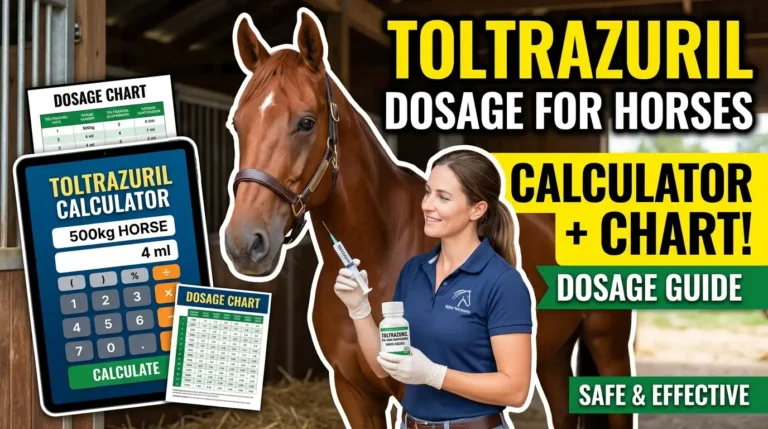
Panacur Dosage for Horses: Calculator, Weight-Based Chart & Complete Safety Guide
Panacur® Dosage Calculator for Horses
Accurate Fenbendazole dosing based on body weight & parasite indication
The most common horse care mistake is to give the wrong type of dewormer dose, and one of the most expensive mistakes to repeat. Panacur (fenbendazole) is given at varying dosage, depending on the infection you are treating: adult strongyles and pinworms are treated with the same rate, and encysted small strongyles require an entirely different 5-day regimen.
This guide not only breaks down the precise amount of Panacur dosage for horses to administer, but also lets you compute it immediately based on the weight of your horse, and covers the safety information that most product pages omit.
Quick Answer: Panacur Dosage at a Glance
- Large strongyles, small strongyles, pinworms: 2.3 mg/lb (5 mg/kg), single dose. One 25 g syringe treats a 1,100 lb horse.
- Ascarids in foals/weanlings under 18 months: 4.6 mg/lb (10 mg/kg), single dose. One 25 g syringe treats a 550 lb horse.
- Encysted small strongyle larvae (Power Pac protocol): 4.6 mg/lb (10 mg/kg) once daily for 5 consecutive days. One syringe per 550 lb of body weight, per day.
What Is Panacur (Fenbendazole) and How Does It Work?
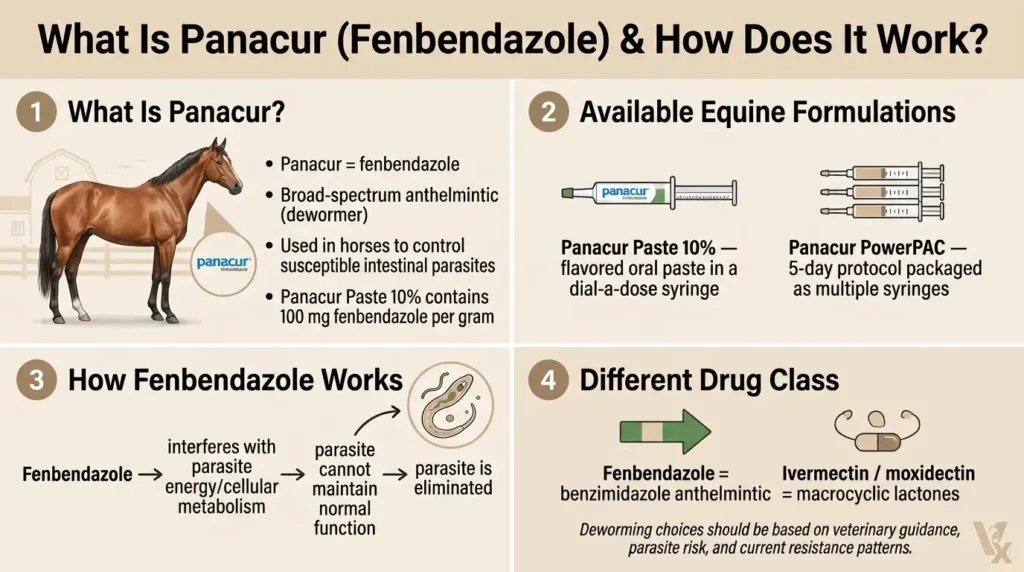
Fenbendazole is the brand name of a broad-spectrum anthelmintic (dewormer) called panacur, produced by Merck Animal Health. It is FDA approved to use in horses and cattle, and the equine product is available as a flavored paste in dial-a-dose syringe.
Active Ingredient and Formulations
Panacur Paste 10% is a flavored (artificial apple-cinnamon) liquid containing 100 mg of fenbendazole per gram. It's available as:
- Panacur Paste 10% 25 g syringe, use as a single dose or as multi-dose.
- Panacur PowerPAC - 5-day encysted-larvae protocol five 57 g syringes packaged together.
- Panacur Suspension 10% - a liquid suspension (100 mg/mL) that is more frequently administered to cattle, by a veterinarian.
How Fenbendazole Kills Parasites
The antiparasitic effect of fenbendazole for horses is thought to occur by blocking energy metabolism within the parasite, basically cutting off its functioning and survival.
Since this process interferes with the normal cell metabolism but not the nervous system (as ivermectin does), fenbendazole is thought to be a different drug "class" which is precisely why it comes in handy during a deworming rotation with ivermectin or moxidectin - it helps to counteract resistance that can develop with repeated use of the same drug class.
Panacur Dosage Chart by Horse Weight
The following table is constructed based on the approved product label by the FDA. Dose (mL/mg) is the standard single dose, in this case, the daily dose multiplied by 5 is the total course in the 5-day protocol.
| Horse Weight | Dose at 2.3 mg/lb (5 mg/kg) — Strongyles/Pinworms | Dose at 4.6 mg/lb (10 mg/kg) — Ascarids / Daily Power Pac Dose |
| 100 lb | 2.3 mL | 4.6 mL |
| 200 lb | 4.6 mL | 9.2 mL |
| 300 lb | 6.9 mL | 13.8 mL |
| 400 lb | 9.2 mL | 18.4 mL |
| 500 lb | 11.5 mL | 23.0 mL |
| 550 lb | 12.65 mL (≈1 full 25 g syringe at this rate for a 1,100 lb horse — see note) | 12.65 mL (1 full syringe at this rate) |
| 1,000 lb | 23.0 mL | 46.0 mL |
| 1,100 lb | 25.3 mL (1 full syringe) | 50.6 mL |
| 1,500 lb | 34.5 mL | 69.0 mL |
Note: mL values above are taken as per the official dosing table of Merck at the 5 mg/kg and 10 mg/kg rates. The one syringe treats X lb that you will find on the package is simply a simplified version of the same numbers when using a single 25 g syringe - 1,100lb at the 2.3 mg/lb rate or 550lb at the 4.6 mg/lb rate.
Standard Dose (2.3 mg/lb) — Large Strongyles, Small Strongyles, Pinworms
To treat large strongyles, small strongyles, and pinworms, the labeled dose is 2.3 mg/lb (5 mg/kg) and administered as a single dose. A 1,100 lb horse can be dewormed at this rate with one 25 g syringe.
Higher Dose (4.6 mg/lb) — Foals, Weanlings, Ascarids
In foals and weanlings less than 18 months of age, where the roundworms (ascaris) are a major problem, the labeled dose is 4.6 mg/lb (10 mg/kg) as a single dose. A single 25 g syringe is calculated to deworm a 550 lb horse at this rate - twice the strongyle dose per pound, and this is the reason why the shorthand which is half-weight carries the name of the syringe.
5-Day Power Pac Protocol — Encysted Small Strongyles
Encysted small strongyle larvae (the hypobiotic early third-stage, late third-stage and fourth-stage cyathostome larvae) and fourth-stage Strongylus vulgaris larvae need a different dose: 4.6 mg/lb (10mg/kg) administered once a day over 5 days. One syringe per 550 lb of body weight, daily throughout the course - this is the only regimen marketed as the Panacur PowerPAC.
The 5-day larvicidal protocol of fenbendazole is remarkable as it is an FDA-approved treatment that targets all developmental stages of encysted strongyles, a parasite stage that most dewormers fail to reach their full extent.
What Does Panacur Treat in Horses? (Uses)
Panacur Paste 10% is marked to treat and control:
- Large strongyles (Strongylus edentatus, S. equinus, S. vulgaris)
- Small strongyles (cyathostomins), with encysted early third-stage, late third-stage, and fourth-stage larvae.
- Pinworms (Oxyuris equi)
- Ascarids/roundworms (Parascaris equorum)
- Arteritis due to fourth stage larvae of Strongylus vulgaris.
Panacur for horses dosage is also indicated as used in combination with a known product of trichlorfon where bot fly larvae (Gasterophilus spp.) are also required to be treated - fenbendazole itself is not effective against bots.
How to Give Panacur Paste to a Horse (Step-by-Step)
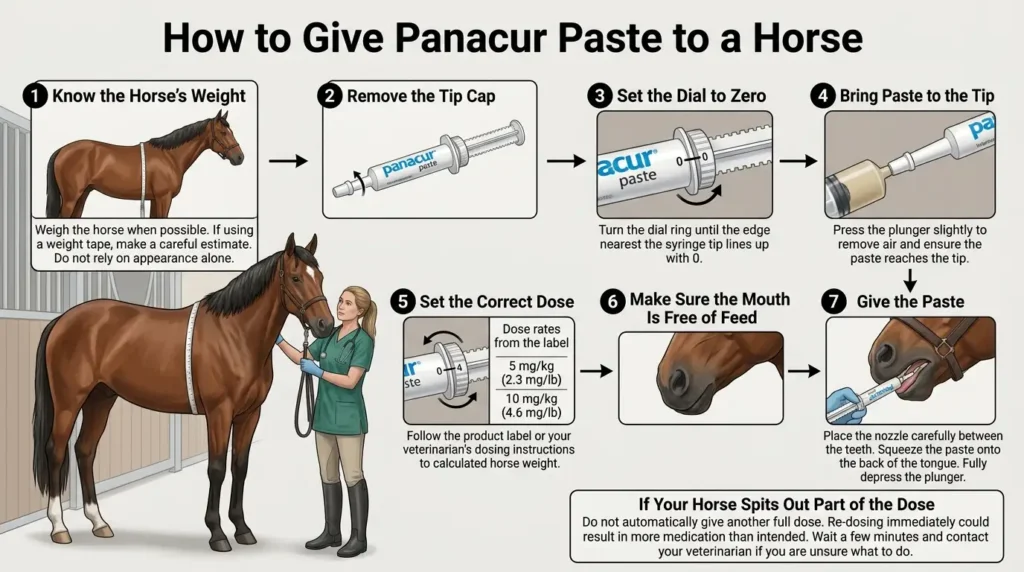
- Have your horse weighed, or have a good guess at its weight with a weight tape - do not just look at it.
- Take off the tip cap of the syringe.
- Turn the dial ring until the edge nearest the tip lines up with zero.
- Press the plunger down a bit to push the paste to the tip and remove any air.
- Adjust the dial ring to the graduation of your horse at the rate of 5 mg/kg (2.3 mg/lb). At the rate of 10 mg/kg (4.6 mg/lb), make the dial twice the weight of your horse.
- Make sure your horse's mouth is free of feed before dosing.
- Push the syringe nozzle between the teeth (the part where a bit is) and squeeze the paste onto the back of the tongue, pushing the plunger to its full extent.
When your horse spits out a portion of the dose, do not necessarily re-dose again, a full re-dose on top of a partial dose may take your horse over the desired amount. Wait a few minutes and, whenever you are in doubt, call your vet instead of making a guess.
Panacur Benefits for Horse Owners
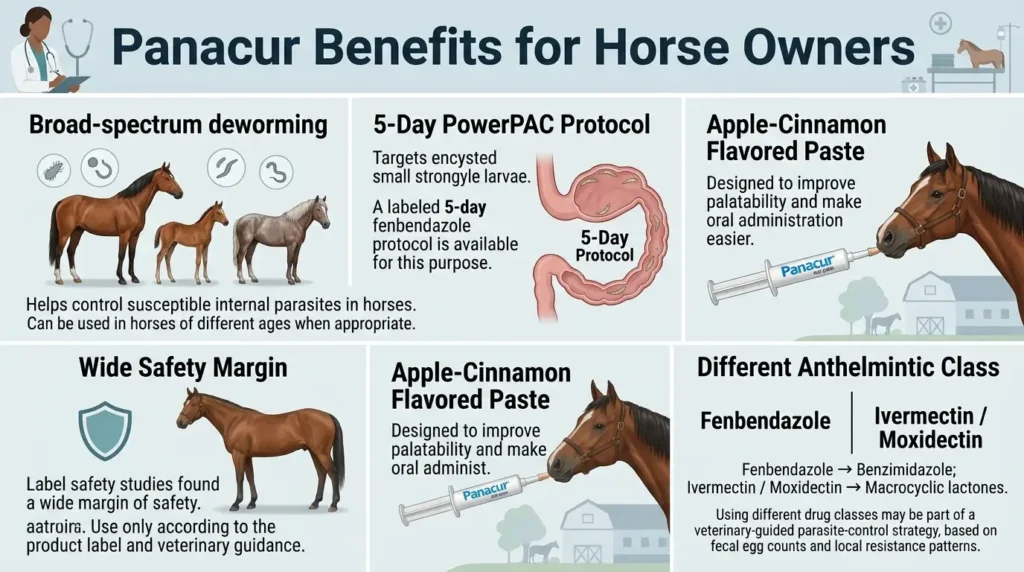
- Wide coverage against the most common internal parasites affecting horses of all ages, including foals and seniors.
- Larvicidal activity against encysted strongyles that are small (5 days protocol) - one of the few FDA-approved protocols that targets larvae that are not only in the intestine but also in the gut wall.
- Palatable formulation. The apple-cinnamon flavored paste is mostly acceptable, which is important to the horses that resist oral dosing.
- Wide margin of safety in label studies. Even in controlled safety studies at single doses many times greater than the labeled rate, and at repeated high doses per day over 15 days (see Side Effects section below), side effects could not be determined.
- Not a similar mode of action with ivermectin/moxidectin, so it can be a valuable rotational partner in a resistance-management plan.
Panacur Side Effects in Horses
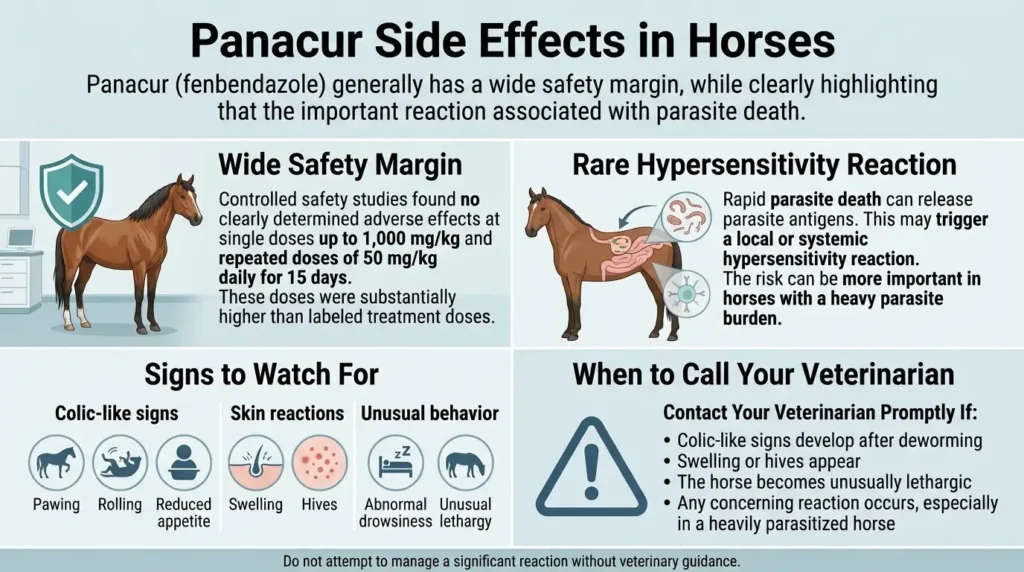
The side effects of Panacur Paste 10% could not be determined in well controlled safety studies at single doses up to 454 mg/lb (1,000 mg/kg) and with 15 consecutive daily doses of 22.7 mg/lb (50 mg/kg), which was many times higher than the labeled doses.
With that said, there is a particular reaction that is named out on the label: especially at higher doses, the death of parasites can cause antigens to be released during the process of their death, leading to a local or systemic hypersensitivity response in the horse. This is not peculiar to Panacur, but is a recognized effect of good dewormers in general, particularly in horses which bear a heavy load of parasites.
The label recommends symptomatic treatment of such reactions, which in practice means calling your veterinarian in case of swelling, hives, colic-like symptoms, or unusual lethargy following deworming a heavily parasitized horse.
When to call your vet after deworming:
- Signs of colic (pawing, rolling, lack of appetite) in the hours after dosing
- Swelling, skin reactions, or hives.
- Abnormal drowsiness or sadness.
- Any response in a horse that has a heavy load of parasites.
Panacur Safety, Risks & Precautions
Pregnant Mares and Stallions
Panacur Paste 10% has been tested in pregnant mares at every stage of gestation and in stallions at a dosage up to 11.4 mg/lb (25 mg/kg) - no adverse effect on reproduction was observed in the studies. The 5-day Power Pac protocol (4.6 mg/lb/day over 5 days) has however not been specifically tested on the safety of stallions or pregnant mares.
When you are thinking of the 5-day protocol in a breeding animal, discuss it with your veterinarian first, instead of thinking that the single-dose safety data can be automatically applied to the multi-day regimen.
Foals
The higher dose of the label (4.6 mg/lb) is specifically aimed at foals and weanlings less than 18 months old, where ascarid infections are frequent and potentially cause severe complications, such as intestinal obstruction in severely infected young horses.
Always verify recent, correct body weight prior to administration - young horses are fast gainers and one of the most frequent mistakes that owners make is to use an old body weight estimate, which will result in an underdose.
Hypersensitivity Reactions After Deworming
As mentioned earlier, proper deworming of a highly infested horse may in itself result in a response as the dying parasites release antigens. One of the reasons to deworm on a reasonable schedule (to avoid accumulation of parasite burden to extreme levels) and to observe any horse closely several hours after the first-time or high-parasite-load deworming.
General Warnings
- Do not use in humans; keep away of children.
- Do not feed to horses that are to be eaten by humans.
- Panacur Paste 10% has no known contraindications when used concomitantly with an approved trichlorfon product to control bot — but never ignore the label of the trichlorfon product itself to see its warning.
Panacur Drug Interactions
The Panacur Paste 10% label does not indicate any contraindications, and it is specifically stated that it may be used with an approved trichlorfon product (to treat bot flies, as fenbendazole itself does not treat bot flies). In addition to that particular combination, other drug-interaction information regarding equine use is not found on the current FDA label.
Even when your horse is already on other drugs, especially those used in a chronic condition, it is always good practice to list all products you are administering before introducing a new dewormer, just because label studies cannot be able to take into account every individual health scenario.
Panacur Paste vs. Panacur PowerPAC vs. Panacur Suspension
| Feature | Panacur Paste 10% | Panacur PowerPAC | Panacur Suspension 10% |
| Form | Apple-cinnamon paste, dial-a-dose syringe | Same paste, packaged as five 57 g syringes | Oral liquid, 100 mg/mL |
| Typical use | Single-dose treatment of strongyles, pinworms, ascarids | 5-day protocol for encysted small strongyles | Typically used in cattle; can be used in horses under veterinary direction |
| Syringe size | 25 g | 57 g × 5 | N/A (bottle, dosed by volume) |
| Dosing frequency | One-time | Once daily × 5 days | Per veterinarian's directions |
| Best for | Routine deworming rotation | Horses with confirmed or suspected encysted small strongyle burden | Farm/ranch settings dosing cattle, or equine use under vet supervision |
Panacur vs. Ivermectin vs. Moxidectin: Which Dewormer Should You Use?
It is not a better or worse comparison, but a different job comparison and it is the key to responsible parasite management to understand the difference.
- Ivermectin and moxidectin are macrocyclic lactones; they act on the nervous system of the parasite and are very effective against adult strongyles, bots, and (moxidectin in particular) some encysted small strongyle stages.
- Fenbendazole (Panacur) is a benzimidazole; it acts by interfering with the energy metabolism of the parasites. Its 5-day regimen is a unique, FDA-approved path to encysted small strongyles.
- Why rotation is important: repeated use of the same drug class provides parasites with additional opportunities to acquire resistance to the same drug class. The most recent best-practice strategy suggested by equine parasitologists is a parasite management program based on fecal egg counts, not a set calendar, with a rotation of drug classes where necessary.
Due to the current prevalence of dewormer resistance in most classes of drugs, the correct option to use in your horse is a fecal egg count and your local parasite pressures - this is a discussion that you really need to have with your veterinarian and not a blanket recommendation.
Common Dosing Mistakes to Avoid
- Estimating weight rather than measuring. Weight tape or scale is two-minute and helps to avoid underdose (ineffective treatment, risk of resistance), as well as overdose that is not necessary.
- Mixed up the two single dose rates. 2.3 mg/lb is for strongyles/pinworms; 4.6 mg/lb is for ascarids in young horses. Applying the lower rate at which the higher rate should be applied under-treats the target parasite.
- Initiating the 5-day protocol and premature termination. Only when all the 5 daily doses are administered, the encysted-larvae protocol is effective as indicated.
- Not clearing the syringe tip before dosing. There may be old, dried paste in the tip that will not give you the actual dose you are giving.
- Re-dosing following spit-out without information on the amount lost. This may lead to accidental overdose.
You May Also Like to Read:
- Magnesium Dosage for Horses: Calculator, NRC Chart & Complete Safety Guide
- Lutalyse Dosage for Horses: The Complete Chart, Calculator & Safety Guide
FAQs
How much Panacur do I give a 1,000 lb horse?
The amount of paste that a 1,000 lb horse requires is 23 mL at the standard rate of 2.3 mg/lb (strongyles and pinworms). The same horse requires 46 mL at the 4.6 mg/lb rate (in the case of ascarids, or in the case of each day of the 5-day encysted-larvae protocol).
What is the amount of Panacur I give a foal?
In foals and weanlings where ascarids are a problem, and are less than 18 months old, the dose is 4.6 mg/lb (10 mg/kg) as a single dose - twice the strongyle rate. Always weigh on an up-to-date correct weight, as foals put on weight rapidly.
What's the difference between the 2.3 mg/lb dose and the 4.6 mg/lb dose?
The target of 2.3mg/lb (5mg/kg) is against large strongyles, small strongyles and pinworms. The popular 4.6 mg/lb (10 mg/kg) is used to target ascarids in young horses as a single dose, and also as the daily dose in the encysted small strongyle (Power Pac) protocol, taken over 5 consecutive days.
Is it safe to give Panacur to a pregnant mare?
Single-dose regimen has been tested in pregnant mares during all gestation periods, and up to a dose of 11.4 mg/lb, without any negative reproductive effect observed. The 5 day encysted-larvae protocol has not been specifically tested in terms of safety in pregnant mares, and thus, consult your vet before administering it to a broodmare.
Is it possible to overdose a horse on Panacur?
Even in its own controlled safety studies, the label did not find side effects even at single doses many times higher than the treatment dose (454 mg/lb) or at 15 days of a much higher dose per day. However, hard to overdose according to lab tests is not the same as dose it loosely always dose to the real weight of your horse and call your vet in case you are ever confused about how much was actually administered.
What would occur in case I underdose my horse?
The label particularly cautions that underdosing can lead to ineffective treatment and can promote resistance of the drug by the parasites. This is among the most significant reasons to weigh (not guess) your horse prior to dosing.
Is it possible to use Panacur in combination with ivermectin?
Panacur does not include ivermectin as a contraindication, but the two are not normally used concomitantly as a standard treatment, but are normally rotated on a schedule based on fecal egg counts instead of being used together. Ask your vet what they think should be the place of these in the overall parasite-control plan of your horse.
What is the size of syringe that I require when it comes to my horse?
A single 25 g syringe covers a 1,100 lb horse at the 2.3 mg/lb rate, or a 550 lb horse at the 4.6 mg/lb rate. With bigger horses, or with the 5-day regimen, you might require more than one syringe - the calculator above will tell you how much paste (and how many syringes) your horse requires.
What is the frequency of deworming my horse with Panacur?
No universal time period exists - the label you have now suggests basing your decision to treat your farm with parasites on fecal tests and your history of parasite infestation, and then validating the treatment by performing a follow-up fecal egg count reduction test, as opposed to deworming your farm on a regular schedule whether you need it or not.
Final Thoughts
The dosage of Panacur is not that difficult to figure, however, when you consider the reasons behind the two different dosage rates: 2.3 mg/lb to the daily parasites (strongyles, pinworms) and 4.6 mg/lb to ascarids in young horses or the entire 5-day treatment against encysted small strongyles.
It is getting the right weight and equating it to the appropriate rate that actually makes or breaks the treatment. Enter that number on this page to find that number in seconds, cross-check it with the chart, and when you are uncertain about your horse, its health or age or reproductive status, take your vet into the decision and not a guess.
One of the easiest things you can do to the long-term gut health of your horse is a properly dosed, properly timed deworming, and one of the easiest to do incorrectly without a clear reference such as this.