Berenil Dosage for Horses: Weight Chart, Free Calculator and the Safe Way to Use This Diminazene Injection
Written & Reviewed By: Medshorse Team
Last Updated: November 2026
Berenil dosage for horses comes down to one number: 3.5 mg of diminazene per kg of body weight. That equals 1 mL of Berenil R.T.U. (70 mg/mL) for every 20 kg, given by deep intramuscular injection, with a total dose that should never pass 57 mL.
That sounds simple until you’re standing in the stable with a syringe. A 500 kg horse gets 25 mL. A 1,200 kg draft horse does not get 60 mL, because the label caps the total at 57 mL. And the dose printed on a leaflet for a dog, a cow or a different country can look quite different.
This guide gives you a label-based dosage chart, a free calculator, worked examples, overdose warning signs, and a plain-English look at how well diminazene actually works in horses. Use it to understand the numbers and catch mistakes.
Your vet still decides whether Berenil is the right drug for your horse and how it’s used. Product details were checked against MSD Animal Health labels in November 2026.
Disclaimer: This article is for general education and is not veterinary advice. Product names mentioned, including Berenil, belong to their respective owners, and MedsHorse is not affiliated with them. Always follow your veterinarian’s instructions and the current product label.
What Is the Correct Berenil Dosage for Horses?
The South African MSD label for horses and cattle gives 3.5 mg of diminazene per kg of body mass, injected intramuscularly. With 70 mg/mL solution that is 1 mL per 20 kg. The total should not exceed 4.0 g of diminazene (57 mL), even in very heavy animals.
Berenil R.T.U. for horses: the label numbers
Diminazene 70 mg/mL, MSD Animal Health (South Africa label, Reg. No. G2702)
Always follow the leaflet in your own box and your vet’s instructions. Labels differ between countries.
What Is Berenil R.T.U.?
Berenil R.T.U. is a ready-to-use injectable antiprotozoal made by MSD Animal Health. Its active ingredient is diminazene aceturate, which targets the blood parasites behind babesiosis (piroplasmosis) and trypanosomiasis. “R.T.U.” means ready to use, so it is a solution and there is nothing to mix.
Formulations vary by market. The South African label lists diminazene at 70 mg/mL. The Egyptian and Indian MSD pages list the same 70 mg/mL of diminazene aceturate plus 375 mg/mL of phenazone.
Other companies sell diminazene products too, some as powders with different strengths. That is why you should never carry dose math from one product to another.
What Does Berenil Treat in Horses?
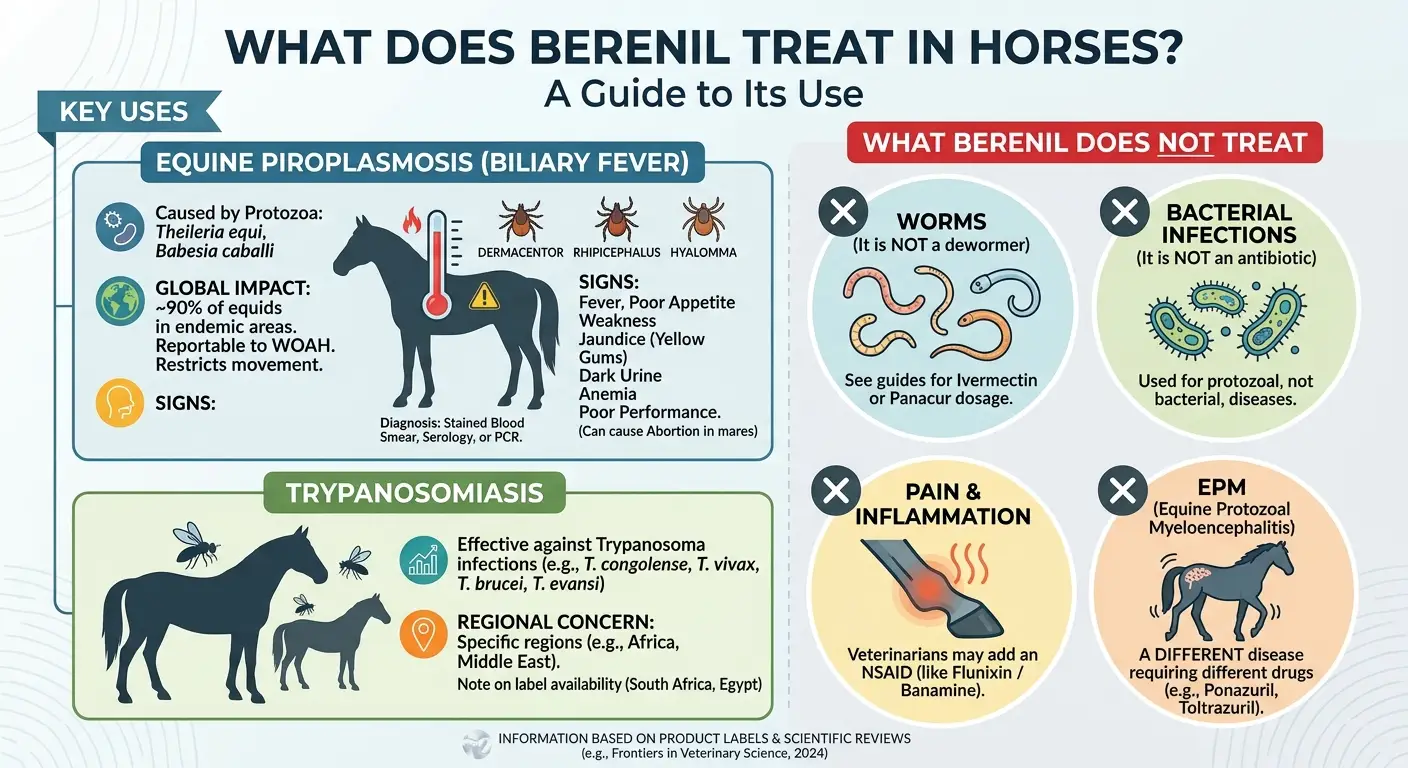
In horses, Berenil is used against protozoal blood infections. The South African label lists biliary fever in horses, and the Egyptian label also covers trypanosomiasis and mixed blood-parasite infections. It does not treat worms, bacteria, pain or neurological protozoa.
Equine Piroplasmosis (Biliary Fever)
Equine piroplasmosis is caused by Theileria equi and Babesia caballi, spread by ticks such as Dermacentor, Rhipicephalus and Hyalomma. A 2024 review in Frontiers in Veterinary Science notes that almost 90% of the world’s equids (over 100 million animals) live in endemic areas, and that the disease is reportable to WOAH and restricts international horse movement.
Typical signs include fever, poor appetite, weakness, jaundice (yellow gums), dark urine, anemia and poor performance. In pregnant mares it can also cause abortion. Vets confirm it with a stained blood smear, serology or PCR. Treating on a hunch is risky, because other illnesses can look similar.
Trypanosomiasis
The Egyptian MSD label names Trypanosoma congolense, T. vivax, T. brucei and T. evansi. The South African label says Berenil is effective against Trypanosoma infections. Trypanosomiasis is mostly a concern in specific regions, and your vet will know whether it is relevant where you live.
What Berenil Does Not Treat
- Worms: it is not a dewormer. For parasite dosing, see our guides to ivermectin dosage for horses and Panacur dosage for horses.
- Bacterial infections: it is not an antibiotic.
- Pain and inflammation: if your vet adds an NSAID such as flunixin, read our Banamine dosage for horses guide first.
- EPM: equine protozoal myeloencephalitis is a different disease with different drugs. See ponazuril dosage for horses and toltrazuril dosage for horses.
Berenil Dosage Chart for Horses by Weight
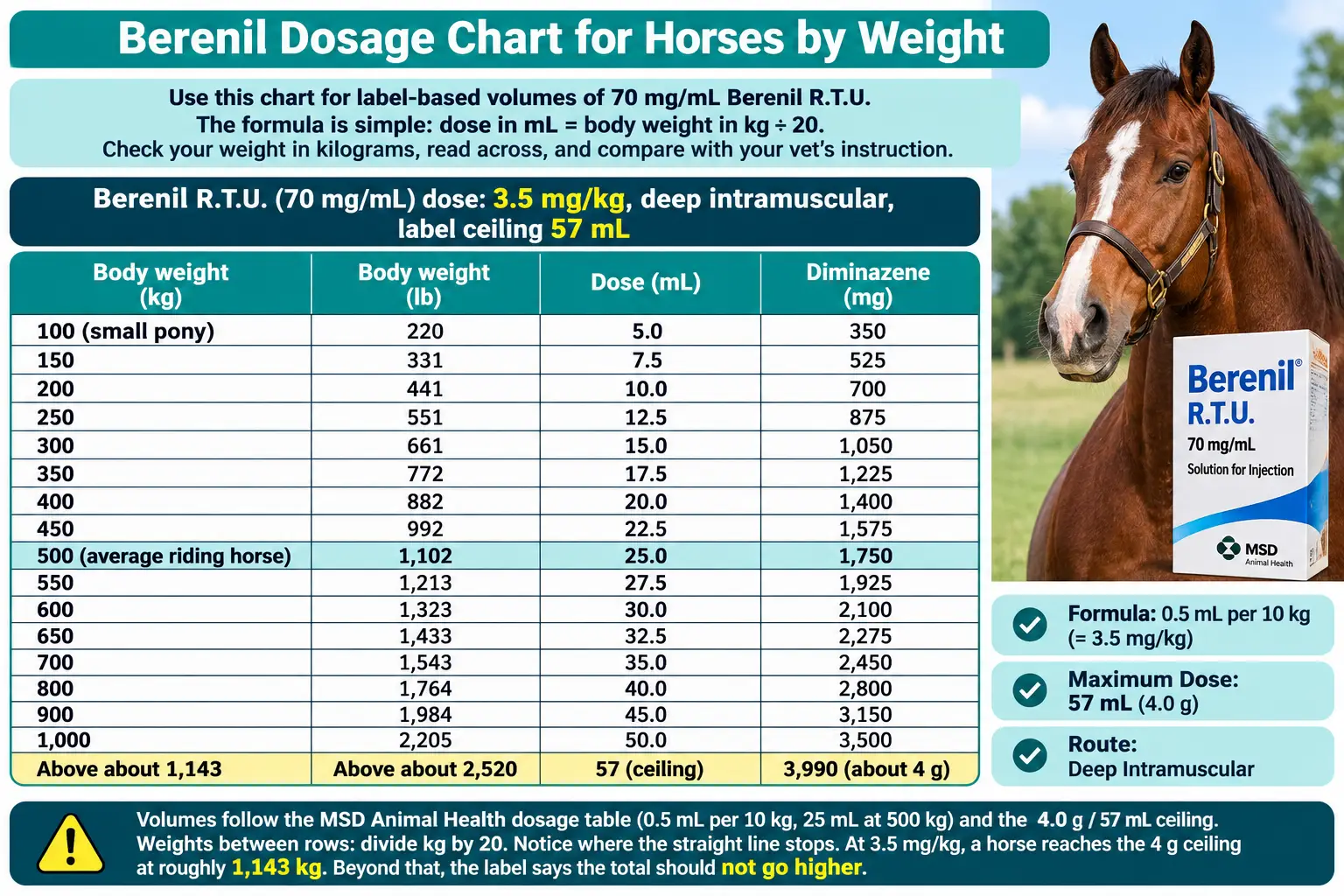
Use this chart for label-based volumes of 70 mg/mL Berenil R.T.U. The formula is simple: dose in mL = body weight in kg ÷ 20. Check your weight in kilograms, read across, and compare with your vet’s instruction.
| Body weight (kg) | Body weight (lb) | Dose (mL) | Diminazene (mg) |
|---|---|---|---|
| 100 (small pony) | 220 | 5.0 | 350 |
| 150 | 331 | 7.5 | 525 |
| 200 | 441 | 10.0 | 700 |
| 250 | 551 | 12.5 | 875 |
| 300 | 661 | 15.0 | 1,050 |
| 350 | 772 | 17.5 | 1,225 |
| 400 | 882 | 20.0 | 1,400 |
| 450 | 992 | 22.5 | 1,575 |
| 500 (average riding horse) | 1,102 | 25.0 | 1,750 |
| 550 | 1,213 | 27.5 | 1,925 |
| 600 | 1,323 | 30.0 | 2,100 |
| 650 | 1,433 | 32.5 | 2,275 |
| 700 | 1,543 | 35.0 | 2,450 |
| 800 | 1,764 | 40.0 | 2,800 |
| 900 | 1,984 | 45.0 | 3,150 |
| 1,000 | 2,205 | 50.0 | 3,500 |
| Above about 1,143 | Above about 2,520 | 57 (ceiling) | 3,990 (about 4 g) |
Notice where the straight line stops. At 3.5 mg/kg, a horse reaches the 4 g ceiling at roughly 1,143 kg. Beyond that, the label says the total should not go higher. The chart below shows the same thing as a graph.
Berenil dose rises in a straight line, then hits the 57 mL ceiling
The line is dose = weight ÷ 20. The dashed line is the 57 mL total the label says not to exceed.
Free Berenil Dose Calculator for Horses
Type in your horse’s weight and the calculator applies the label rate of 3.5 mg/kg (1 mL per 20 kg) and the 57 mL ceiling. It only works for 70 mg/mL Berenil R.T.U. Check your vial strength before you trust any result.
Berenil Dosage Calculator for Horses
Berenil R.T.U. (diminazene 70 mg/mL) – deep intramuscular injection© medshorse.com
How to Calculate the Berenil Dose Step by Step
Four steps get you to the right number. Do them in order every time, even if you have dosed this horse before.
- 1Get a real weightUse a scale if you can. A weight tape is only an estimate.
- 2Divide kg by 20The answer is the dose in mL of 70 mg/mL Berenil R.T.U. Working in pounds? Divide by about 44.
- 3Check the 57 mL ceilingIf the answer is above 57 mL, the label total of 4.0 g still applies.
- 4Plan the injection sitesDivide large volumes between sites and give them deep into muscle.
Two more examples show why the check in step 3 matters:
- 200 kg pony: 200 ÷ 20 = 10 mL. A single site is usually enough.
- 1,200 kg Shire: 1,200 ÷ 20 = 60 mL on paper, but the label ceiling is 57 mL. Use 57 mL at most and talk to your vet before dosing a horse this size.
Why accuracy matters: a 10% weight error is a 10% dose error. On a 500 kg horse that is 2.5 mL, and the margin between a working dose and an overdose is not something to gamble with. Berenil’s own label warns that overdosing or repeat dosing can cause toxic effects on the central nervous system.
How to Give Berenil to a Horse
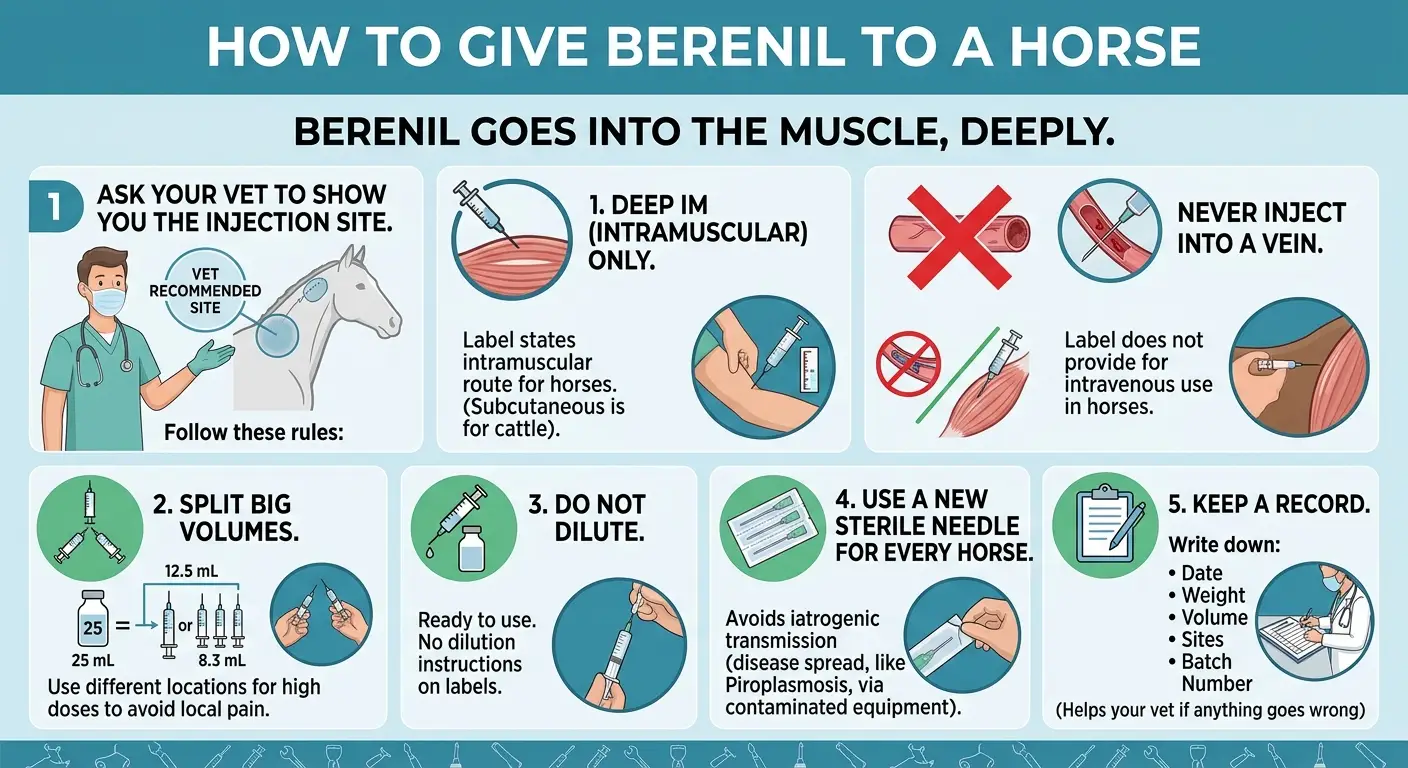
Berenil goes into the muscle, deeply. The South African label gives intramuscular injection as the route for horses (subcutaneous is for cattle only). Ask your vet to show you the injection site, then follow these rules:
- Deep IM only. The label does not provide for intravenous use in horses, so never inject into a vein.
- Split big volumes. The label advises using different locations for high doses to avoid local pain. A 25 mL dose, for example, would be three sites at 10 mL or less.
- Do not dilute. It is ready to use, and the labels reviewed give no dilution instructions.
- Use a new sterile needle for every horse. The 2024 Frontiers review notes that piroplasmosis can spread through contaminated needles and equipment (iatrogenic transmission).
- Keep a record. Write down the date, weight, volume, sites and batch number. It helps your vet if anything goes wrong.
Berenil Dosage Differences Between Labels
Not every Berenil leaflet says the same thing. If you read three websites you may see three sets of numbers. Here is how the MSD pages for South Africa, Egypt and India compare, which is why the leaflet in your box and your vet’s advice always come first.
| Detail | South Africa | Egypt | India |
|---|---|---|---|
| Strength | Diminazene 70 mg/mL | Diminazene aceturate 70 mg + phenazone 375 mg per mL | Same as Egypt |
| Standard dose | 3.5 mg/kg (1 mL per 20 kg) | 3.5 mg/kg (1 mL per 20 kg) | 5 to 10 mL per 100 kg (listed for cattle) |
| Higher doses mentioned | None | Doubled for some trypanosomes and T. annulata; up to 8 mg/kg for resistant strains | Upper range for stubborn trypanosomiasis |
| Total ceiling | 4.0 g (57 mL) | 4 g (57 mL) | 56 mL |
| Route | Horses: IM | Deep IM preferred | Deep IM or subcutaneous (neck) |
| Meat withdrawal | 21 days | 20 days | 20 days |
| Storage | 25 °C or below, away from sunlight | Below 25 °C, away from sunlight | Below 30 °C, away from light, do not freeze |
One more difference worth knowing: dog dosing is not a scaled-down horse dose. The South African label gives dogs a strict single injection and warns it must never be exceeded or repeated, and the Egyptian label expresses the dog dose differently again. Never use horse dose math for a dog.
Berenil Side Effects and Overdose Signs in Horses
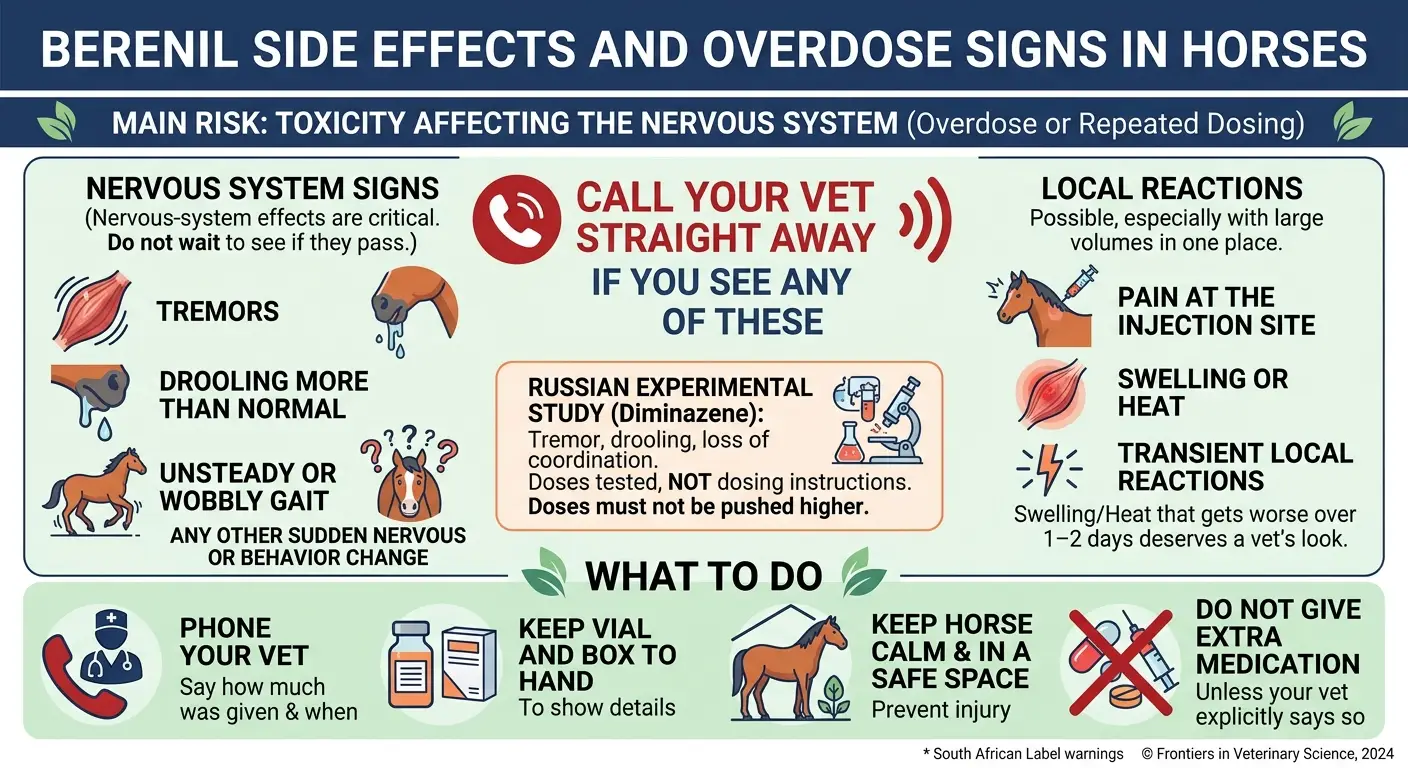
The main risk is toxicity affecting the nervous system after an overdose or repeated dosing. The South African label states this directly. Watch your horse closely for the first hours after any injection.
Call your vet straight away if you see any of these
Signs reported with diminazene toxicity include nervous-system effects. Do not wait to see if they pass.
- Tremors
- Drooling more than normal
- Unsteady or wobbly gait
- Any other sudden nervous or behavior change
- Phone your vet and say how much was given and when
- Keep the vial and box to hand
- Keep the horse calm and in a safe space
- Do not give extra medication unless your vet says so
A Russian experimental study of diminazene in horses reported tremor, drooling and loss of coordination in some animals at the doses tested, which eased within about an hour. That was research on dose levels, not a dosing instruction, but it shows why the figures in this guide should not be pushed higher.
Local reactions can happen too. The labels mention pain at the injection site when large volumes go in one place, and one related product leaflet describes transient local reactions. Swelling or heat that gets worse over a day or two deserves a vet’s look.
Safety Rules Every Horse Owner Should Follow
- Never exceed 57 mL in total, whatever the horse’s weight.
- Don’t repeat the dose on your own. The label’s only repeat-dose statement is a warning that repeated dosing can cause toxicity. Any second injection is your vet’s call.
- Confirm the strength on the vial. This guide assumes 70 mg/mL. Other strengths change the volume completely.
- Buy from a licensed source and check the registration number and expiry date. The South African product is registered as G2702 under Act 36 of 1947.
- Keep it away from children, uninformed people and other animals, and dispose of needles and empty vials by local rules.
Withdrawal Period and Storage
The South African label says animals should not be slaughtered for human consumption within 21 days of the last treatment (the Egyptian and Indian pages say 20 days).
Whether that applies to your horse depends on whether it can enter the food chain where you live, so check your local rules and any competition medication policy. Store the vial at 25 °C or below, out of sunlight, unless your leaflet says otherwise.
Foals, Pregnant Mares and Sick Horses
None of the labels reviewed gives separate dosing for foals, pregnant mares, or horses that are dehydrated or have kidney or liver problems. Treat that silence as a reason to call your vet, not as permission.
One published case report describes a vet treating a 118 kg colt with B. caballi at 3.5 mg/kg twice, a week apart; the colt did not improve markedly and the plan was reassessed. It is a single case and not a protocol.
Common Berenil Dosing Mistakes
- Guessing the weight. A tape or an eyeball estimate turns straight into a dosing error.
- Mixing up product strengths. A 70 mg/mL vial and a different diminazene product need different volumes.
- Putting the whole dose in one spot. Large single injections are the cause of the local pain the labels warn about.
- Repeating “just in case”. The label’s only comment on repeat dosing is a toxicity warning.
- Treating without a diagnosis. Fever and jaundice have more than one cause, and a blood test settles it.
- Reusing needles between horses. That is a known way to pass blood parasites on.
- Forgetting the ticks. Treating a horse does nothing about the ticks that infected it.
How to Prevent Piroplasmosis So You May Never Need the Syringe
Prevention is cheaper and safer than treatment, and it matters more because no vaccine exists for piroplasmosis. Berenil is not a vaccine either, so keep your routine shots current with our guide to the 9 core horse vaccines. Beyond that:
- Check your horse for ticks daily in tick season, especially the ears, mane, belly and under the tail.
- Use a tick-control program your vet recommends for your region.
- Never share needles, syringes or dental and surgical equipment between horses.
- Ask about testing before buying, importing or traveling with a horse, since piroplasmosis is reportable and affects movement.
Berenil Safety Checklist Before You Inject
Tick every box first
- My vet has confirmed the diagnosis and agreed to this treatment.
- The vial says 70 mg/mL and is in date.
- I have a measured, recent weight in kg.
- I have calculated the dose (kg ÷ 20) and checked it is 57 mL or less.
- I have a new sterile needle and a correctly sized syringe.
- I know the injection sites and how I will split the volume.
- My vet’s number is in my phone in case of tremors or drooling.
- I will write down the date, volume, sites and batch number.
Key Takeaways
Berenil dosage for horses in brief
- Label dose: 3.5 mg/kg, which is 1 mL of 70 mg/mL Berenil R.T.U. per 20 kg.
- Route: deep intramuscular injection, divided across sites for large volumes.
- Total ceiling: 4.0 g of diminazene, or 57 mL, whatever the horse weighs.
- Overdose or repeat dosing can cause nervous-system toxicity. Call your vet at the first tremor.
- Diminazene is one option. Imidocarb and buparvaquone are the main alternatives named in a 2024 review.
- Labels differ by country, so follow your own leaflet and your vet.
FAQs
What is the Berenil dose for a horse?
The South African MSD label gives 3.5 mg of diminazene per kg of body mass by deep intramuscular injection. With Berenil R.T.U. at 70 mg/mL, that is 1 mL for every 20 kg. The total should not exceed 57 mL (4.0 g). Your vet decides the exact plan.
How much Berenil do I give a 500 kg horse?
At the label rate, a 500 kg horse receives 25 mL of 70 mg/mL Berenil R.T.U., which is 1,750 mg of diminazene. That volume is normally split between injection sites. Confirm the weight and the plan with your vet first.
What is the maximum Berenil dose for a horse?
The label says the total dose should not exceed 4.0 g of diminazene, which is 57 mL of Berenil R.T.U., even for heavier animals. On the standard rate a horse reaches that ceiling at roughly 1,143 kg.
How do I calculate Berenil for horses?
Divide the horse’s weight in kilograms by 20 to get the dose in mL of 70 mg/mL solution. For pounds, divide by about 44. If the answer is above 57 mL, the label ceiling applies instead.
Can Berenil be given to horses intravenously?
No. The South African label gives intramuscular injection as the route for horses, and none of the labels reviewed provides for intravenous use. Inject deep into muscle and never into a vein.
Can I repeat a Berenil dose?
Only if your vet tells you to. The label gives no repeat schedule for horses and warns that overdosing or repeated dosing can cause toxic disturbances of the central nervous system.
What are the signs of Berenil overdose in horses?
The label warns of toxic effects on the central nervous system. A research study in horses reported tremor, excessive drooling and loss of coordination in some animals. Call your vet immediately if you see these or any sudden nervous signs.
What does Berenil treat in horses?
Berenil is an antiprotozoal. The South African label lists biliary fever (piroplasmosis) in horses, and the Egyptian label also lists trypanosomiasis and mixed blood-parasite infections. It does not treat worms, bacteria or pain.
Is Berenil the same as imidocarb?
No. Berenil contains diminazene aceturate, while imidocarb dipropionate is a different drug. A 2024 review names imidocarb and buparvaquone as the main drugs now used for equine piroplasmosis, so ask your vet which suits your horse.
Can I use the dog dose of Berenil for a horse?
No. Dog dosing is different. The South African label gives dogs one strict injection that must not be exceeded or repeated. Never use one species’ dose for another.
How fast does Berenil work in horses?
The labels reviewed do not state a response time for horses. The South African label says further redwater cases in cattle outbreaks should stop within 24 hours, but that does not transfer to horses. Your vet will recheck your horse and may repeat blood tests.
Does Berenil cure equine piroplasmosis for good?
Not always. A 2024 review reports that horses can clear Babesia caballi on their own, while Theileria equi usually causes persistent infection and some isolates resist drugs. Follow-up testing by your vet is the only way to know.
What is the withdrawal period for Berenil?
The South African label says not to slaughter animals for human consumption within 21 days of the last treatment, and the Egyptian and Indian pages say 20 days. Whether this applies to your horse depends on local food-chain rules, so ask your vet.
How should I store Berenil?
The South African and Egyptian labels say to store it at or below 25 °C, protected from sunlight. The Indian label says below 30 °C, away from light and not frozen. Follow the leaflet in your own box.
How many horses does one vial of Berenil treat?
A 100 mL vial holds enough for 2,000 kg of body weight at the label rate, about four 500 kg horses. A 20 mL vial covers only 400 kg, so it is not enough for a single 500 kg horse, which needs 25 mL.
Can foals or pregnant mares have Berenil?
None of the labels reviewed gives separate dosing for foals or pregnant mares. That is a reason to call your vet, not a green light. Only a vet should decide whether and how to treat these horses.
Final Thoughts: Dose by Weight, Stay Under the Ceiling, Call Your Vet
The Berenil is easy to state and easy to get wrong: 3.5 mg/kg, 1 mL per 20 kg, deep intramuscular, and never more than 57 mL in total. Almost every problem described in this guide traces back to one of three things: a guessed weight, the wrong product strength, or a repeated dose nobody asked for.
Next steps: get an accurate weight, confirm the diagnosis and the plan with your vet, run the numbers through the calculator above, and keep your vet’s number handy for the first few hours after the injection.
This guide is educational information drawn from manufacturer labels and published research. It is not veterinary advice, and it does not replace a diagnosis or prescription from a licensed vet who has examined your horse.
Sources and Further Reading
- MSD Animal Health South Africa: Berenil R.T.U. product page and package insert
- MSD Animal Health Egypt: Berenil RTU
- MSD Animal Health India: Berenil Vet 7% RTU
- Mendoza et al. (2024), Frontiers in Veterinary Science: New insights in the diagnosis and treatment of equine piroplasmosis
- Rashid et al. (2008), Tropical Animal Health and Production: Comparative efficacy of diminazene diaceturate and diminazene aceturate for babesiosis in horses
- Ememe et al., Sokoto Journal of Veterinary Sciences: Babesia caballi infection in a 6-month-old colt
- Khristianovsky and Belimenko, KnE Life Sciences: Diminazene aceturate for the treatment of pet babesiosis