Bee Pollen Dosage for Horses: Weight Chart, Free Calculator and a Safe Way to Start (What Labels and Studies Really Say)
Written & Reviewed By: Medshorse Team
Last Updated: November 2026
Bee pollen dosage for horses is one of those topics with no single agreed number. The Mane Event label says 30 g a day for a 500 kg horse, mixed into feed. The ESC Laboratoire label says 50 g a day for a 550 kg horse for three weeks, renewable if necessary. Those two doses are close, but they are not the same.
Here is the catch: there is no official, vet-approved dose for bee pollen in horses. This guide builds its chart and calculator on those two labels, compares them with the two published horse studies, and explains the safety limits the sellers give.
Disclaimer: This article is for general education and is not veterinary advice. Product names mentioned, including Bee Pollen, belong to their respective owners, and MedsHorse is not affiliated with them. Always follow your veterinarian’s instructions and the current product label.
Bee Pollen Dosage for Horses: The Short Answer
The two labels this guide uses give 30 g a day for a 500 kg horse (Mane Event) and 50 g a day for a 550 kg horse (ESC Laboratoire). That is about 0.06 to 0.09 grams per kilogram, or roughly 27 to 41 grams daily for a 1,000 lb horse. Start low and ask your vet first.
Key takeaways: bee pollen dosage for horses
- No official dose exists. This guide builds its dosing on two product labels: Mane Event and ESC Laboratoire.
- Label range: 0.06 to 0.09 g per kg of body weight per day, which is about 27 to 41 g for a 1,000 lb (454 kg) horse.
- Duration: Mane Event lists a daily dose mixed into feed. ESC Laboratoire says 50 g a day for 3 weeks, renewable if necessary, and asks you to check with your vet.
- The studies fed more: 60 g a day (older horses, 30 days) and about 65 g of pollen a day (horses in training, 42 days). That is above both labels for a 500 kg horse (30 g and 45 g).
- Ask your vet first if your horse has a pollen allergy, is pregnant or nursing, has insulin resistance or laminitis, or competes under drug-testing rules. ESC suggests stopping before official tests, usually about 72 hours.
What Is Bee Pollen, and Why Do Horse Owners Feed It?
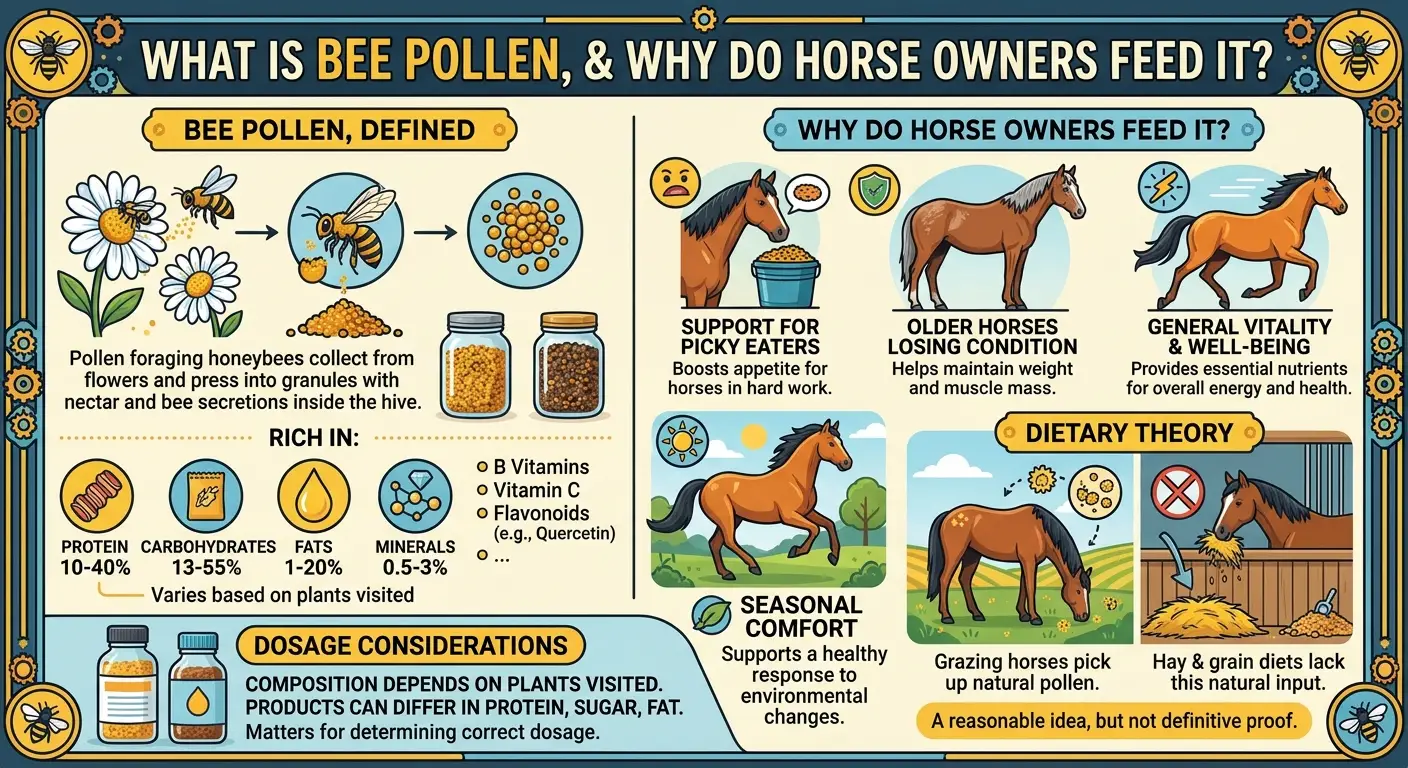
Bee pollen is the pollen foraging honeybees collect from flowers and press into granules inside the hive. A review chapter describes it as a mixture of nectar, bee secretions and pollen grains, rich in protein, carbohydrate, fat, vitamins and minerals.
Bee pollen, defined
Bee pollen is flower pollen that worker honeybees pack into small granules with nectar and their own secretions. It is not honey, royal jelly or propolis. Its makeup changes with the plants the bees visited, so one jar can differ a lot from another.
Typical ranges reported in the research literature: protein 10 to 40%, carbohydrate 13 to 55%, fat 1 to 20%, minerals 0.5 to 3%.
Owners usually reach for it for four reasons: a picky eater in hard work, an older horse that is losing condition, general vitality, or seasonal comfort. ESC Laboratoire, for example, says its pollen is a source of protein (about 30% on its label), B vitamins, vitamin C and flavonoids such as quercetin.
Proponents also say that hay-and-grain diets lack the pollen horses pick up while grazing, a point made in Horse Sport’s nutrition notes. That is a reasonable idea, but it is not proof that a horse needs pollen.
Because the composition depends on the plants the bees visited, two products can differ in protein, sugar and fat. That matters for dosing, and we come back to it in the safety section.
Is There an Official Bee Pollen Dose for Horses?
No. Bee pollen is not an essential nutrient, so horse nutrition standards do not list a requirement for it. It is also a feed supplement rather than a drug, so there is no tested, approved dose to quote.
What exists instead are manufacturer labels, a couple of small studies, and the habits of trainers and owners. This guide builds its dosing on two labels you can check yourself, Mane Event and ESC Laboratoire, and uses the studies for context.
Bee Pollen Dosage Calculator for Horses
Use the calculator below to turn your horse’s weight into a daily amount. Pick the Mane Event or ESC Laboratoire label rate, and it also gives you a ramp-up schedule.
Bee Pollen Dosage Calculator For Horses
Precautions for use: not recommended in pregnant or lactating mares. Formulated for equidae. Close well after use. Store in a cool and dry place. Keep out of the reach of children.
Anti-Doping Control: This product may contain natural contaminants that can make an anti-doping test positive, and we recommend that it be discontinued before an official test. Ask a veterinarian for advice on waiting time (usually 72 hours).
Always Verify By Your Vet. Before Giving Any Medication.
© medshorse.com
How the calculator works
The formula is simple: body weight in kg x grams per kg = daily grams. The two rates come straight from the product pages:
- Mane Event: 30 g daily per 500 kg horse, mixed into feed. That is 0.06 g/kg.
- ESC Laboratoire: 50 g a day added to the basic ration of an adult 550 kg horse, for 3 weeks, renewed if necessary. That is 0.09 g/kg.
What the Mane Event and ESC Laboratoire labels say
The cautions sit right next to the doses, so here is both side by side. Mane Event is a 100% pure Western Australian pollen sold with a horse dosage rate. Its page says allergic reactions are possible in rare cases, tells you to discontinue and consult your vet if adverse effects occur, and states that no therapeutic claim is made.
ESC Laboratoire asks you to check with your vet before use or extension, and adds the precautions on pregnancy and drug testing covered in the safety section below.
What the two labels say
Mane Event (Australia)
Product: 100% pure Western Australian bee pollen, forest sourced, not farmed
Dose: 30 g daily per 500 kg horse, mixed into feed
Caution: rare allergic reactions possible; discontinue and consult your vet if adverse effects occur
ESC Laboratoire (France)
Product: 100% bee pollen granules
Dose: 50 g a day added to the ration of an adult 550 kg horse, for 3 weeks, renewed if necessary
Cautions: not recommended for pregnant or lactating mares; may trigger a positive anti-doping test
Bee Pollen Dosage Chart for Horses by Weight

Prefer a quick lookup? This chart applies the two label rates to common horse sizes. Find your horse’s weight, then choose a column. If you are unsure, start with the Mane Event column.
Bee pollen dosage chart for horses by weight (daily amount)
| Horse weight | Mane Event label 0.06 g/kg | ESC Laboratoire label 0.09 g/kg |
|---|---|---|
| 250 lb (113 kg) Miniature horse | 6.8 g 0.2 oz | 10 g 0.4 oz |
| 500 lb (227 kg) Pony | 14 g 0.5 oz | 21 g 0.7 oz |
| 800 lb (363 kg) Small horse or Arabian | 22 g 0.8 oz | 33 g 1.2 oz |
| 1,000 lb (454 kg) Average riding horse | 27 g 1.0 oz | 41 g 1.5 oz |
| 1,100 lb (499 kg) Warmblood or Quarter Horse | 30 g 1.1 oz | 45 g 1.6 oz |
| 1,200 lb (544 kg) Large riding horse | 33 g 1.2 oz | 49 g 1.7 oz |
| 1,400 lb (635 kg) Large warmblood | 38 g 1.3 oz | 58 g 2.0 oz |
| 1,800 lb (816 kg) Draft horse | 49 g 1.7 oz | 74 g 2.6 oz |
Mane Event: 30 g daily per 500 kg horse, mixed into feed. ESC Laboratoire: 50 g a day for an adult 550 kg horse, for 3 weeks. Figures are rounded.
Weigh your horse with a weight tape or a scale rather than guessing, since a 100 lb error changes the amount noticeably. Weigh the pollen too. Granule size changes how much a scoop holds, so a kitchen scale beats a scoop.
Can you feed more to performance or recovery horses?
Neither label gives a higher dose for hard-working horses. ESC Laboratoire says its pollen suits periods of intensive training or convalescence, and it gives the same 50 g amount. The two studies used about 60 to 65 g a day, which is more than either label for a 500 kg horse, but each tested only one amount.
Going beyond the labels has not been tested against a lower dose, so talk with your vet or an equine nutritionist first, and check that your other supplements do not already contain pollen.
Mane Event vs ESC Laboratoire: How the Two Labels Compare
The labels agree on the basics but differ on amount and duration. This chart scales each one to a 500 kg horse.
Daily amounts compared, scaled to a 500 kg (1,100 lb) horse
Green = label dose scaled by body weight. Gold = fixed daily amount from a study that did not report body weights, so it cannot be scaled.
| Mane Event | ESC Laboratoire | |
|---|---|---|
| Label dose | 30 g daily per 500 kg horse, mixed into feed | 50 g a day for an adult 550 kg horse |
| Rate per kg | 0.06 g/kg | 0.09 g/kg |
| For a 1,000 lb (454 kg) horse | About 27 g | About 41 g |
| Duration | Daily; no end date given | 3 weeks, renewed if necessary; ask your vet before extending |
| Product | 100% pure Western Australian bee pollen, forest sourced, not farmed | 100% bee pollen granules; about 30% protein and 10.7 g carbohydrate per 100 g on the label |
| Stated precautions | Rare allergic reactions possible; stop and consult your vet if adverse effects occur | Not recommended for pregnant or lactating mares; may contain natural contaminants that can trigger a positive anti-doping test; stop before official tests, usually about 72 hours |
| Price seen, November 2026 | AUD 35 per 500 g, about AUD 2.10 per 30 g dose (listing showed sold out) | EUR 52.60 per kg, about EUR 2.63 per 50 g dose |
Prices will change, so check the seller pages before you order.
How to Feed Bee Pollen to Your Horse, Step by Step
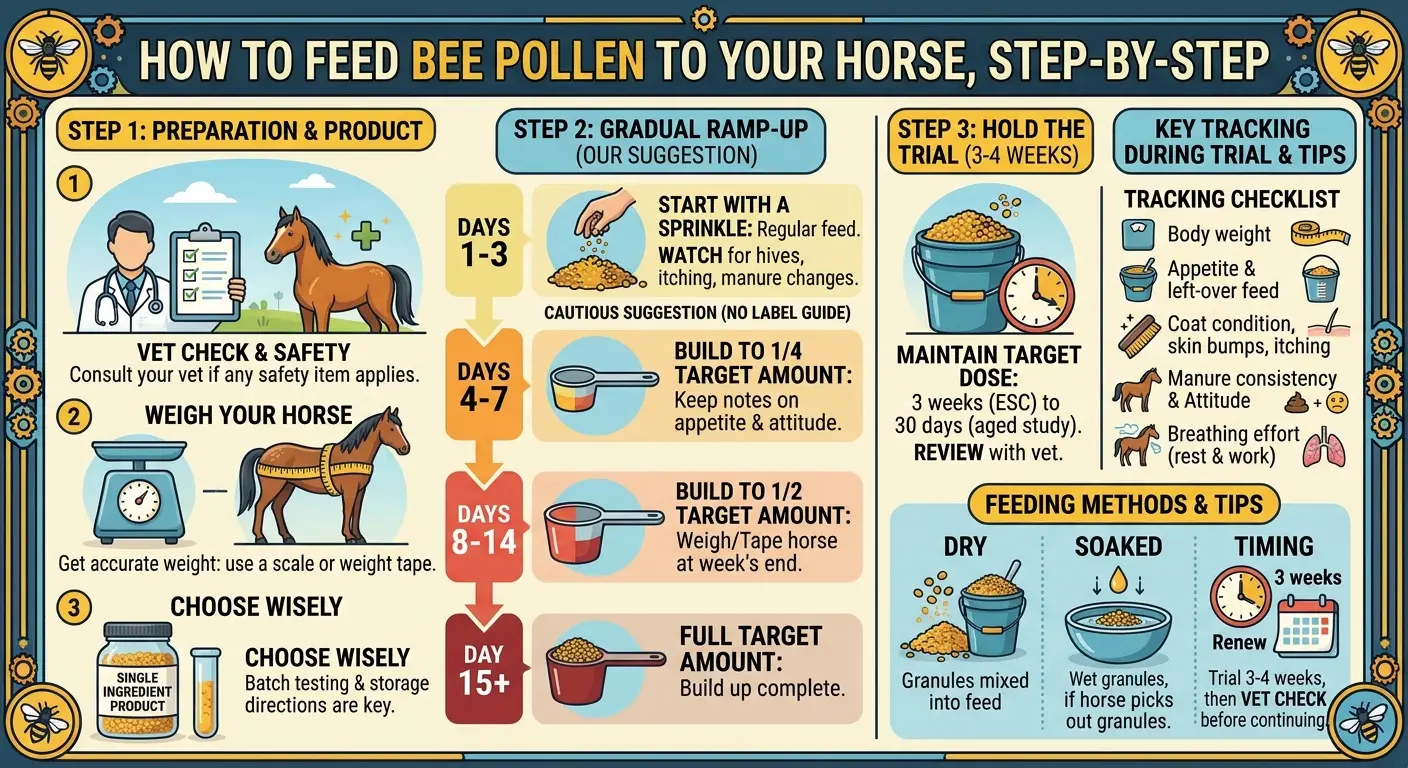
- Check with your vet if any item in the safety checklist below applies.
- Get an accurate weight with a weight tape or scale.
- Choose a single-ingredient product with batch testing and storage directions.
- Start with a sprinkle on top of the regular feed for the first few days. Neither label gives a ramp-up, so this is our cautious suggestion.
- Build up over about two weeks using the schedule below.
- Hold the target amount for 3 to 4 weeks (ESC’s course is 3 weeks; the aged-horse study ran 30 days), then review what changed with your vet.
A gradual ramp-up plan (our suggestion; neither label gives one)
Days 1 to 3
A sprinkle on top of the regular feed. Watch for hives, itching or a change in manure.
Days 4 to 7
About one quarter of your target amount. Keep notes on appetite and attitude.
Days 8 to 14
About half of your target amount. Weigh or tape your horse at the end of this week.
Day 15 onward
Full target amount. ESC’s course is 3 weeks; review with your vet at 3 to 4 weeks.
Dry, soaked or mixed into feed?
Mane Event says to mix it into feed, and ESC Laboratoire says to add it to the basic ration. The aged-horse study soaked the pollen in water. Soaking is a sensible thing to try if your horse picks out the granules and leaves them at the bottom of the bucket.
How long should you feed it?
There is no standard length. Mane Event lists a daily dose with no end date. ESC Laboratoire suggests three weeks and says the course can be renewed if needed, after asking your vet. The aged-horse study ran 30 days.
A trial of 3 to 4 weeks with notes is a sensible middle path, followed by a vet check before you continue.
What to track during the trial
- Body weight or weight-tape measurement, weekly
- Appetite and how much hay and feed is left over
- Coat condition and any skin bumps, itching or swelling
- Manure consistency and attitude
- Breathing effort at rest and after work
Bee Pollen Benefits for Horses: What Is Proven and What Is Marketing
Benefit claims run far ahead of the evidence. This table separates what has some horse data from what is mostly sales copy.
Claims versus evidence
| Common claim | What we found | Evidence level |
|---|---|---|
| Improves appetite and feed intake | One 10-horse pilot in training horses supports it | Limited |
| Supports blood values in older horses | One 16-horse study; abstract only reports blood measures | Limited |
| Boosts stamina and performance | Pilot found no change in heart rate or blood values; a Horse Journal summary says performance gains were not shown | Not supported |
| Relieves seasonal allergies | No controlled horse trial found; pollen itself can trigger reactions | None found |
| Improves coat, hooves and immunity | Mostly manufacturer and owner statements | None found |
Bee pollen for horses: pros and cons
What speaks in its favor
- Dense in protein, B vitamins and plant compounds
- Small pilot found better feed intake in horses in training
- Older horses held steadier blood values in one 30-day study
- Low daily volume; easy to mix into feed
What speaks against it
- No official dose and almost no horse research
- Allergic reactions are possible
- Quality and nutrient content vary between products
- May create doping-test problems
- Performance claims lack support
If your horse’s coat or hooves are the real concern, a diet check comes first. Biotin is the better-studied route for hooves, and our biotin dosage for horses guide explains how to dose it. If anemia has actually been diagnosed, that is a different job entirely; see the Red Cell dosage for horses guide and work with your vet.
Likewise, if seasonal allergies are what brought you here, read our spirulina dosage for horses guide as another commonly used option, and keep in mind that no controlled trial shows either supplement treats allergies.
Bee Pollen Side Effects and Safety Risks
Allergic reactions
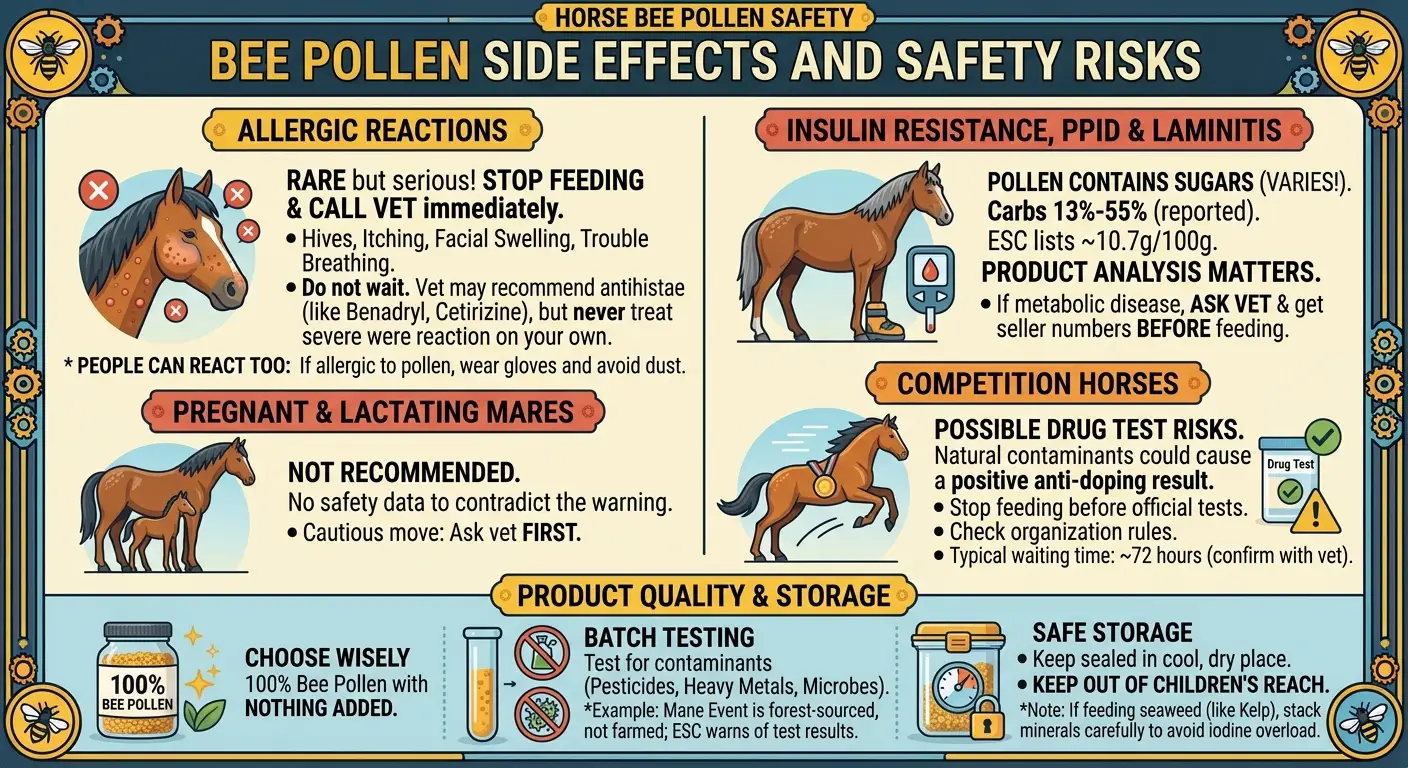
Mane Event warns that, in rare cases, an allergic reaction to pollen may occur. Signs include hives, itching, facial swelling or trouble breathing. Stop feeding it and call your vet right away. Do not wait to see if it passes.
Your vet may recommend an antihistamine, and our guides on Benadryl dosage for horses and cetirizine dosage for horses explain how those drugs are usually dosed, but never treat a serious reaction on your own.
People can react too. If you are allergic to pollen, wear gloves and avoid breathing the dust when you scoop it.
Insulin resistance, PPID and laminitis
Pollen contains sugars, and the amount varies. The literature reports carbohydrate from 13% to 55%, while the ESC Laboratoire label lists about 10.7 g per 100 g. That spread is why the product’s own analysis matters.
If your horse has metabolic disease, ask your vet before adding it and ask the seller for the numbers.
Pregnant and lactating mares
ESC Laboratoire says its product is not recommended in pregnant or lactating mares. We found no safety data to contradict that, so the cautious move is to ask your vet first.
Competition horses
ESC Laboratoire also warns that natural contaminants in the pollen could cause a positive anti-doping result, and suggests stopping before official tests, with a typical waiting time of about 72 hours that your vet can confirm. Rules differ by organization, so check yours.
Product quality and storage
- Choose 100% bee pollen with nothing added.
- Ask whether each batch is tested for pesticides, heavy metals and microbes. Mane Event describes its pollen as forest sourced and not farmed, while ESC Laboratoire warns that natural contaminants can show up in drug tests.
- Keep it sealed in a cool, dry place and out of children’s reach, as ESC Laboratoire advises.
- If you also feed seaweed, add up your minerals using our kelp dosage for horses guide so you do not stack iodine unknowingly.
Safety checklist: talk to your vet first if any of these apply
- Your horse has had hives, swelling or breathing trouble after bee products or pollen exposure.
- Your mare is pregnant or nursing (ESC Laboratoire advises against it).
- Your horse has insulin resistance, PPID (Cushing’s) or a history of laminitis.
- Your horse has liver or kidney disease, or is on a managed protein intake.
- Your horse competes under drug-testing rules.
- Your horse is a foal or a very small pony. We found no dosing data for either.
- Your horse already eats a supplement that lists bee pollen.
Should you try bee pollen? A quick decision path
Yes: do not feed it. Call your vet. No: go to the next question.
Yes: ask your vet first. No: go to the next question.
Yes: ask your vet and get the product’s carbohydrate analysis first. No: go to the next question.
Yes: check your governing body’s rules and the product’s withdrawal advice. No: go to the next question.
Start with a sprinkle and follow the ramp-up plan.
Common Mistakes When Dosing Bee Pollen
- Guessing with a scoop. Weigh it at least once so you know what your scoop holds.
- Starting at the full amount. A slow build lets you spot a reaction early.
- Judging after one week. The studies ran 30 and 42 days.
- Doubling because it is natural. No study shows extra pollen helps more.
- Stacking supplements that already contain pollen. Read every label.
- Using it to mask a problem. Weight loss, poor appetite or a dull coat deserve a vet check.
Conclusion: Start Low, Track Results and Involve Your Vet
The honest answer to the dosage question is a range, not a number. The two labels point to roughly 27 to 41 g a day for a 1,000 lb horse. The two studies used about 60 to 65 g, which is more than either label gives for a 500 kg horse. The evidence for benefits is thin, and the risks, mainly allergy, are small but real.
If you decide to try it, here are your next steps:
- Run the safety checklist and call your vet if anything applies.
- Weigh your horse and use the calculator to pick a starting amount.
- Begin with a sprinkle and follow the two-week ramp-up.
- Track weight, appetite, coat and manure for 3 to 4 weeks.
- Review the results with your vet before continuing.
FAQs
How much bee pollen should I give my horse per day?
There is no official dose. The two labels used in this guide work out to about 0.06 to 0.09 grams per kilogram per day, or roughly 27 or 41 grams for a 1,000 lb horse. Start with a sprinkle, build up gradually and check with your vet.
Is there an official dose of bee pollen for horses?
No. Bee pollen is a feed supplement, not an approved drug, and it is not an essential nutrient. Doses come from manufacturer labels and a small number of studies, so they differ from product to product.
Can horses eat bee pollen every day?
Mane Event lists a daily dose mixed into feed, while ESC Laboratoire suggests 50 grams a day for three weeks, renewable if necessary after asking your vet. No long-term safety study in horses was found, so review the plan with your vet after three to four weeks.
How long does bee pollen take to work in horses?
Nobody can say for certain. The aged-horse study measured results after 30 days and the Michigan State pilot ran 42 days. Give a fair trial of three to four weeks and track appetite, weight and coat rather than expecting overnight changes.
What are the side effects of bee pollen in horses?
The main risk is an allergic reaction, which can show up as hives, itching, swelling or breathing trouble. Stop feeding it and call your vet if you see any of these. Mane Event describes reactions as rare, but they can happen.
Can bee pollen help a horse gain weight?
It may help indirectly. A small pilot in horses in training found better feed intake with a bee pollen blend. No study shows direct weight gain, so first rule out dental problems, parasites and an unbalanced ration.
Is bee pollen good for senior horses?
One 30-day study in horses aged 15 to 26 found that 60 grams a day kept some blood values steadier through autumn. It was small and short, so treat it as a promising lead and discuss it with your vet.
Can bee pollen help horses with allergies?
Some sellers market it for seasonal allergies, but we found no controlled horse trial supporting that claim. Pollen can also trigger reactions, so use caution and talk with your vet about proven allergy options.
Can I give bee pollen to a pregnant or lactating mare?
ESC Laboratoire says its pollen is not recommended for pregnant or lactating mares, and no safety data was found. Ask your vet or an equine nutritionist before feeding it to a broodmare.
Is bee pollen safe for horses with laminitis or insulin resistance?
It depends on the product. Carbohydrate content in the literature ranges from 13 to 55 percent, while the ESC Laboratoire label lists about 11 grams per 100 grams. Ask your vet and request the product’s analysis before feeding it.
Will bee pollen cause a positive drug test in competition horses?
It might. ESC Laboratoire warns that natural contaminants can cause a positive anti-doping result and suggests stopping before official tests, usually about 72 hours. Check your governing body’s rules and ask your vet.
Should I soak bee pollen before feeding it?
You can. The aged-horse study soaked the pollen in water, while the Mane Event label simply says to mix it into feed. Soaking is worth trying if your horse picks out the granules or leaves them at the bottom of the bucket.
Can I give bee pollen to a foal?
None of the sources we reviewed give a foal dose, and the studies used adult horses. Do not feed bee pollen to a foal unless your vet recommends it and sets the amount.
How do I choose a good bee pollen supplement for horses?
Look for a single ingredient, a clear dose per body weight, batch testing for pesticides and contaminants, and honest claims. Because pollen varies by plant source, a guaranteed analysis is a good sign.
Sources and Further Reading
- Mane Event Equestrian Supplies: Bee Pollen Premium Grade (dosage rate)
- ESC Laboratoire: 100% pure bee pollen for horses (instructions and precautions)
- PubMed: 2006 bee pollen pilot study in Arabian horses (Michigan State University)
- PubMed: Bee pollen supplementation to aged horses influences several blood parameters (2020)
- Mad Barn Research Bank summary of the 2020 aged-horse study
- Horse Sport: Nutrition Notes on bee pollen
- Horse Canada: Can bee pollen help my horse eat more?
- Bentham Science: Phytogenic and phytochemical feed additives (bee pollen chapter)
Important note
This guide is educational and is not veterinary advice. Bee pollen is a feed supplement, not an approved drug. Always check with your veterinarian before changing your horse’s diet, especially if your horse has a medical condition, is pregnant or competes.