Beta Alanine Dosage for Horses: Weight-Based Chart, Free Calculator and a Safety Guide for Performance Horses
Written & Reviewed By: Medshorse Team
Last Updated: November 2026
Beta Alanine dosage for horses on most product labels is 10 g per 100 kg of body weight, which works out to 50 g for a 500 kg horse. Brands differ on how long to feed it and whether to feed it daily, so the right plan depends on your horse’s workload. This guide gives you the chart, a calculator and the safety limits.
Most owners hit the same wall. One label says daily, another says only on work days, a third says start eight weeks before the season. Meanwhile the research used amounts far higher than any tub suggests. Here everything is lined up side by side, so you can build a plan that fits your horse’s weight, workload and competition calendar.
This article is written for owners, riders and trainers of performance horses. It is educational and does not replace your vet, who knows your horse’s health history.
Disclaimer: This article is for general education and is not veterinary advice. Product names mentioned, including Beta Alanine, belong to their respective owners, and MedsHorse is not affiliated with them. Always follow your veterinarian’s instructions and the current product label.
Beta Alanine Dosage for Horses at a Glance
The CEN label gives three feed rates. The standard rate is 10 g per 100 kg of body weight before exercise. The loading rate is 50 g daily for 30 days before racing or competition, and the maintenance rate is 50 g on training or competition days only.
What Is Beta Alanine and How Does It Work in Horses?
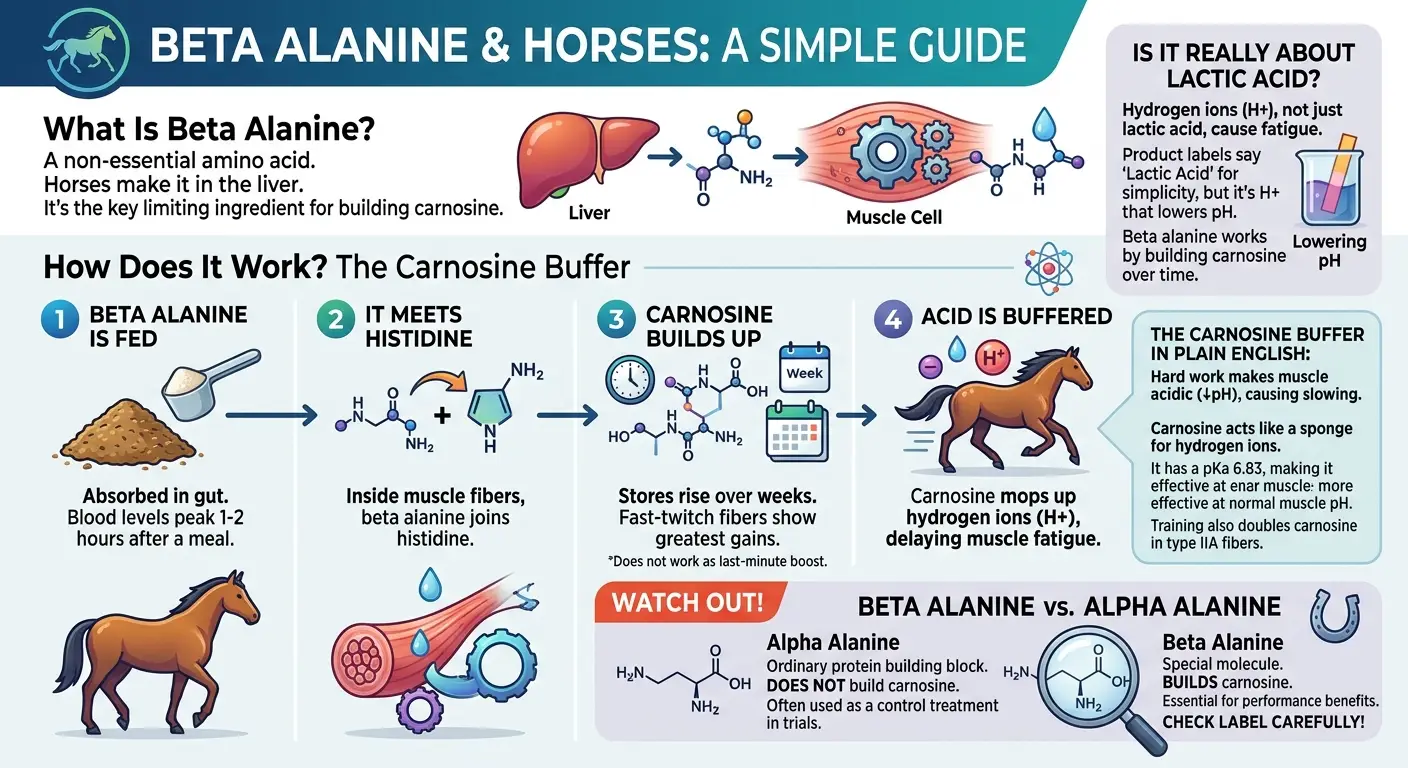
Beta alanine is a non-essential amino acid that horses can make in the liver. Muscle cells combine it with histidine to build carnosine, a molecule that soaks up hydrogen ions during hard exercise. Beta alanine is the limiting ingredient, so feeding extra gives muscle more raw material to build carnosine.
The Carnosine Buffer in Plain English
Fast, hard work makes muscle more acidic. That acidity is one of the things that forces a horse to slow down. Carnosine sits inside the muscle fibre and mops up hydrogen ions as they appear, which helps hold the pH steadier for longer.
Horse muscle already carries a lot of carnosine. Research from Mark Dunnett’s doctoral work found that carnosine has a pKa of 6.83, which makes it an effective buffer at normal muscle pH. The same work showed that extensive, partly anaerobic training doubled carnosine in type IIA fibres.
In other words, fitness work builds your horse’s buffer too. Beta alanine is a way to give that process more supplies.
Is It Really About Lactic Acid?
Product labels talk about lactic acid. Physiologists point instead to the hydrogen ions released during intense effort, which lower muscle pH. Carnosine buffers those ions.
The label shorthand is close enough for feeding purposes, but it explains why beta alanine does nothing in the minutes before a race. It works by building carnosine over time.
Beta Alanine vs Alpha Alanine
Alpha alanine is the ordinary protein building block found in feed. It does not build carnosine. That is why a 2024 horse trial used alpha alanine as the control treatment. When you shop, check that the label says beta alanine, not just alanine.
Beta Alanine Dosage Chart for Horses by Weight
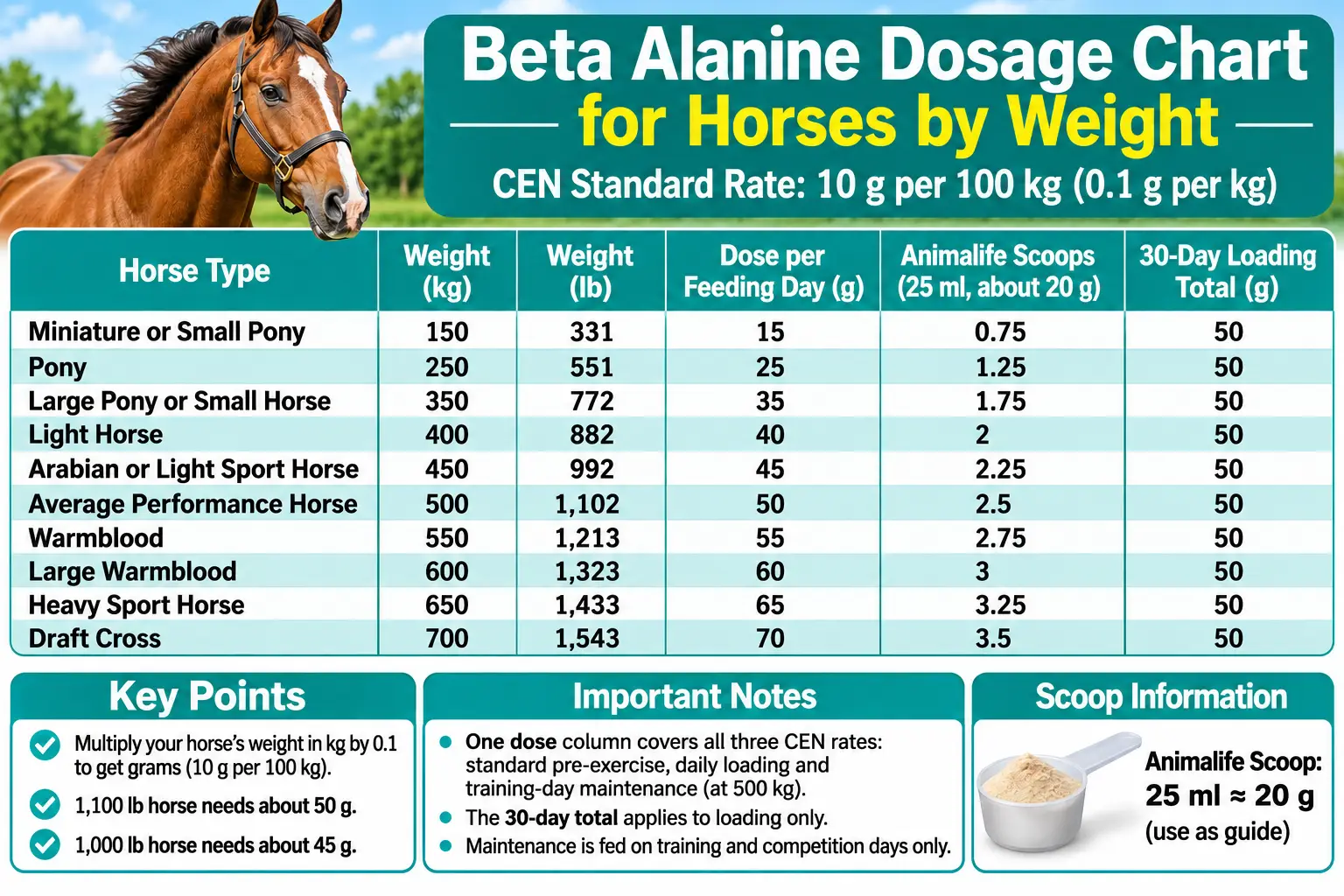
To find the dose, multiply your horse’s weight in kilograms by 0.1 to get grams. This is the CEN standard rate of 10 g per 100 kg, and it gives the 50 g loading and maintenance amounts at 500 kg. If you only know pounds, divide by 22. A 1,100 lb horse needs about 50 g, and a 1,000 lb horse needs about 45 g.
| Horse type | Weight (kg) | Weight (lb) | Dose per feeding day (g) | Animalife scoops (25 ml, about 20 g) | 30-day loading total (g) |
|---|---|---|---|---|---|
| Miniature or small pony | 150 | 331 | 15 | 0.75 | 50 |
| Pony | 250 | 551 | 25 | 1.25 | 50 |
| Large pony or small horse | 350 | 772 | 35 | 1.75 | 50 |
| Light horse | 400 | 882 | 40 | 2 | 50 |
| Arabian or light sport horse | 450 | 992 | 45 | 2.25 | 50 |
| Average performance horse | 500 | 1,102 | 50 | 2.5 | 50 |
| Warmblood | 550 | 1,213 | 55 | 2.75 | 50 |
| Large warmblood | 600 | 1,323 | 60 | 3 | 50 |
| Heavy sport horse | 650 | 1,433 | 65 | 3.25 | 50 |
| Draft cross | 700 | 1,543 | 70 | 3.5 | 50 |
Use a weigh tape or a livestock scale for your horse’s weight. Guessing is the most common reason doses drift. A 50 kg error on a horse is a 5 g error in the tub, which is small, but errors in the scoop size are much larger.
A kitchen scale accurate to 1 g costs very little and removes the guesswork. Scoops are a convenience, not a measuring tool, because powder packs differently from tub to tub.
Beta Alanine Dosage Calculator for Horses
Enter your horse’s weight below. Pick the CEN feed rate you are using, and the calculator gives the dose, a possible morning and evening split, the 30-day loading total and how long your tub will last. Everything runs in your browser and nothing is stored.
© medshorse.com
Do the maths once and write the number on the tub lid. Then recheck whenever your horse gains or loses a noticeable amount of weight.
Loading, Maintenance and Off-Season Plan
Most brands suggest starting 30 days to 8 weeks before the season, feeding the label dose daily during that lead-in, then continuing through competition and stopping during rest. The details differ by brand, so the timeline below shows both sets of directions.
- 1Lead-in: 30 days to 8 weeks before the seasonIntroduce the powder gradually. CEN suggests 50 g daily for 30 days for a 500 kg horse. Animalife suggests the 10 g per 100 kg rate starting 6 to 8 weeks out.
- 2Season: training and competitionAnimalife continues the rate through the season. CEN suggests 50 g only on high performance days (training and competition).
- 3Rest or off-season: stop feedingBoth brands say to stop during rest periods and out of season. Restart the lead-in before the next campaign.
The Loading Stage
On the CEN label, the loading rate is 50 g daily for 30 days prior to racing or competition. Loading exists because carnosine rises slowly. In the 1999 Thoroughbred study, carnosine in the fast-twitch type IIB fibres had risen significantly in five of six horses after 30 days.
That timeline is where the 30-day loading advice on CEN’s label comes from. Plan your start date backwards from your first big event.
The Maintenance Stage
The CEN maintenance rate is 50 g, based on a 500 kg horse, fed only on high performance days: training and competition. On rest days there is none. Brands disagree here. Animalife keeps feeding daily through the season, while CEN uses the same 50 g only on hard-work days.
We did not find a published horse trial comparing the two approaches, so either choice rests on manufacturer experience rather than head-to-head evidence. Pick one, keep it consistent and note how your horse recovers.
How to Introduce It Gradually
Both Animalife’s directions and the Yili horse trial point to a gradual start. The researchers began with about 10 g per horse mixed into concentrate, because the additive can put horses off their feed, and built up to the full dose. The ramp below is a common-sense schedule, not a published protocol.
How to Feed Beta Alanine to Your Horse, Step by Step

Beta alanine is a fine powder that goes into the normal feed. Follow these steps to get the dose right every time.
- Get an accurate weight. Use a scale or weigh tape and recheck monthly during the season.
- Work out the grams. Multiply kilograms by 0.1, or use the calculator above.
- Weigh the powder. Use a gram scale. Level scoops vary between brands.
- Mix it into damp feed. Damp feed helps the powder cling and keeps your horse from sorting it out.
- Split the daily amount. Animalife advises dividing it between morning and evening feeds where applicable.
- Keep water available. Offer clean water at all times.
- Log it. Record start date, dose, appetite and how your horse recovers after hard sessions.
- Store it properly. Keep the lid on, in a cool, dry place out of direct sunlight.
What Does the Research Say About Beta Alanine in Horses?
The science supports the mechanism. Feeding beta alanine raises carnosine in horse muscle. Evidence that it makes horses faster rests on one small 2024 trial, which is the only controlled performance study we found. That is encouraging but not conclusive.
The 1999 Thoroughbred Study
Researchers fed six Thoroughbreds beta alanine at 100 mg per kg of body weight three times a day, plus a little histidine, for 30 days. Muscle carnosine rose in fast-twitch type IIA and IIB fibres in all six horses, with the clearest gains in type IIB fibres.
Horses that absorbed more beta alanine built more carnosine. The study measured muscle chemistry, not race times, and the horses were not in training.
The 2024 Yili Horse Trial
A team in China split twelve young Yili stallions, averaging 346.5 kg, into two groups of six. One group received 300 mg per kg per day of beta alanine and the other received the same amount of alpha alanine, for 30 days.
The beta alanine group ran 1,000 m about 13.29 seconds faster, an improvement of 12.01% against controls. They also showed higher antioxidant markers and quicker recovery of blood gas values after the race.
What Human Research Adds
A meta-analysis of human trials found a median performance gain of 2.85% after a median total of 179 g of beta alanine.
The benefit showed up in efforts lasting 60 to 240 seconds and longer than 240 seconds, but not in efforts under 60 seconds. Horses are not people, so treat this as a clue about which events might benefit, not a promise.
Why Research Doses Are Higher Than Label Doses
Both studies used about three times the label amount for a month. The 1999 team reported no adverse physiological or behavioural effects in their six horses, and the Yili team started low and built up to avoid appetite loss.
That is reassuring for short-term safety, but it is not permission to triple the dose at home. Horses in research are monitored daily and fed controlled diets.
What the Research Cannot Tell You
- Whether the speed gain holds in other breeds, ages, mares or older horses.
- Whether daily feeding beats feeding only on work days.
- How long carnosine stays elevated after you stop feeding.
- Long-term safety beyond about a month of supplementation.
- Whether beta alanine prevents tying-up. We found no controlled trial showing it does.
Which Horses Benefit Most From Beta Alanine?
Horses doing repeated high-intensity efforts lasting about one minute or longer are the best candidates. That includes racehorses, event horses on cross-country day, polo ponies, barrel horses and hard-working show jumpers. Leisure horses and horses in rest gain little from it.
Racing, eventing, polo, barrel racing, jumping or fast endurance work.
No Wait. Beta alanine is for the build-up to the season, not year-round.
Hacking, light schooling or rest. Spend your money on forage quality, fitness and a balanced diet instead.
Call your vet first. Exertional muscle problems have several different causes and need a diagnosis.
What About Tying-Up?
Some product pages say beta alanine may help horses prone to tying-up. We did not find a controlled trial that proves it.
The Merck Veterinary Manual explains that chronic exertional rhabdomyolysis includes several different problems, such as type 1 and type 2 polysaccharide storage myopathy, malignant hyperthermia and recurrent exertional rhabdomyolysis. Each needs its own diet and exercise plan.
If your horse has tied up, get a diagnosis before adding supplements. Your vet may talk about diet, electrolytes, our magnesium dosage for horses guide or medication such as methocarbamol for horses for acute episodes.
Is Beta Alanine Safe for Horses?
At label rates, beta alanine appears low risk. Animalife states there are no known negative side effects when it is fed in the correct amounts, and the 1999 research team saw no adverse effects at about three times that rate for a month. Long-term data are limited, so dose carefully and check with your vet.
The Tingling Question
In people, the main reported side effect of beta alanine is paresthesia, a harmless tingling sensation, and the International Society of Sports Nutrition position stand notes that smaller split doses reduce it. Horses cannot tell us if they feel it.
We found no equine reports of this effect, but splitting the daily amount between two feeds is sensible and matches Animalife’s advice.
Check With Your Vet First If Your Horse
- Has kidney or liver disease, or any ongoing medical condition.
- Is pregnant, nursing or a foal. We found no controlled safety data for these groups.
- Is on medication or a veterinary diet.
- Has a history of tying-up, colic or poor appetite.
Competition Rules and Supplement Quality
Beta alanine is a feed supplement, not a veterinary drug, so it is not regulated the same way. Check the rules of your governing body or racing authority before using any supplement, and ask the manufacturer about batch testing. Choose a single-ingredient product with a clear label so you know exactly what is in the tub.
Before you start
- Your vet has cleared the plan
- You know your horse’s weight
- You have a gram scale
- The tub lists beta alanine, not alpha alanine
- You checked competition rules
- You set a stop date for the off-season
Stop and call your vet if you see
- Feed refusal or a sudden drop in appetite
- Loose droppings or colic signs
- Restlessness, rubbing or skin twitching after feeding
- Stiffness, sweating or reluctance to move after work
- Any unexplained change in behaviour
Common Beta Alanine Mistakes to Avoid
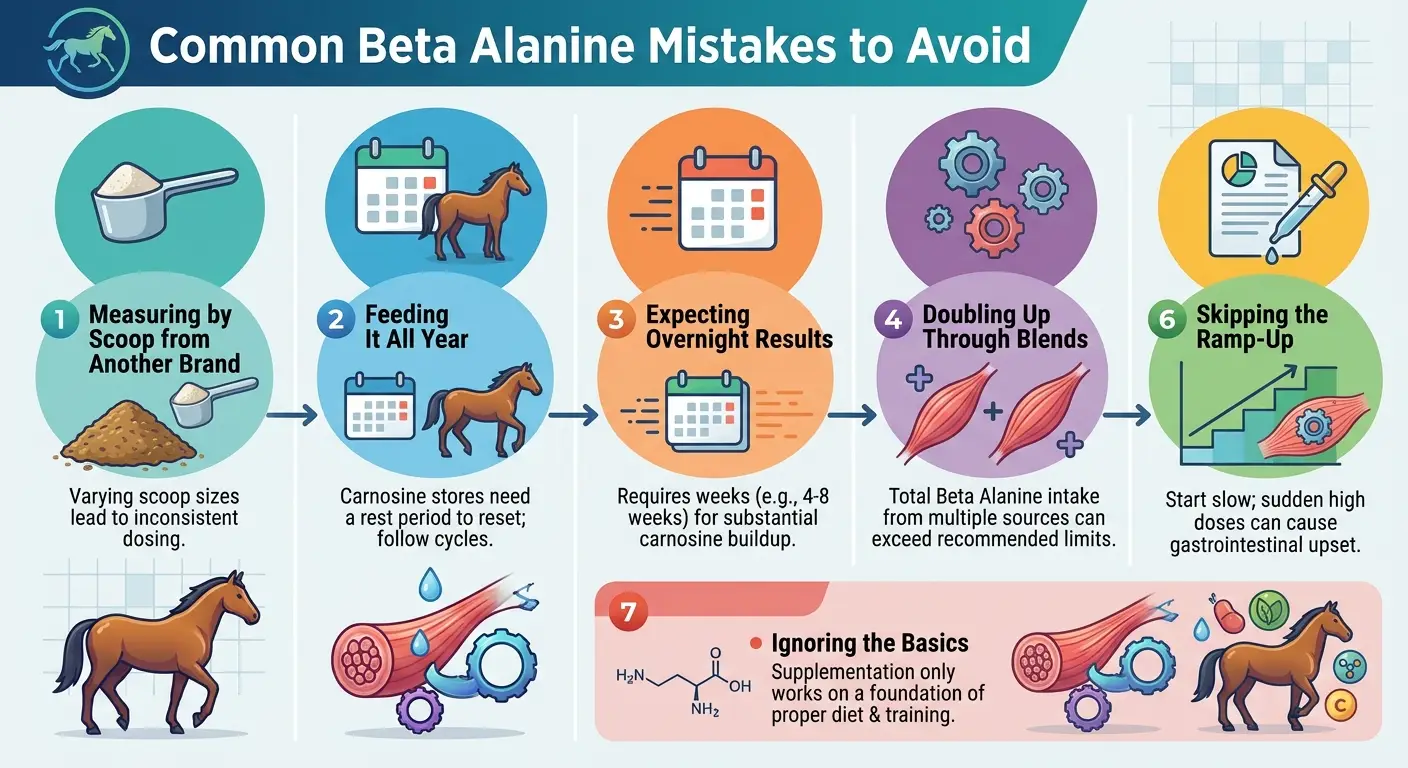
- Measuring by scoop from another brand. A scoop from one tub can hold a very different weight from another. Weigh the powder.
- Feeding it all year. Both brands we reviewed say to stop during rest and the off-season.
- Expecting overnight results. Carnosine builds over weeks, so a dose on race morning does very little.
- Doubling up through blends. Mad Barn’s feed database lists several multi-ingredient products that already contain beta alanine, including Uckele Muscle EQ, Bluebonnet Muscle Recharge and Ramard Total Topline. Check every label so you do not stack sources.
- Copying research doses. Studies used about three times the label rate under close monitoring.
- Skipping the ramp-up. A sudden full dose can put some horses off their feed.
- Ignoring the basics. Fitness, forage, electrolytes and rest matter more than any single supplement.
Beta Alanine vs Other Muscle and Recovery Supports
Beta alanine does one specific job. It does not replace electrolytes, minerals or a solid training plan. This table shows where each support fits.
| Support | What it is | Main job | When it is fed |
|---|---|---|---|
| Beta alanine | Amino acid, carnosine precursor | Builds muscle buffering capacity for hard efforts | Daily for weeks before and during the season |
| Magnesium | Mineral | Supports normal nerve and muscle function | Daily, based on the diet |
| Electrolytes | Sodium, potassium, chloride and others | Replace what sweat removes | Around hard work and hot weather |
| Glutamine | Amino acid | Often fed for gut and recovery support | Daily or around stress |
If you want to build out a recovery routine, see our glutamine dosage for horses guide. Horses in heavy work with low iron may also be discussed with your vet alongside Red Cell dosage for horses, which covers the label rules and iron safety points.
How Much Does Beta Alanine for Horses Cost?
Price depends on pack size and country. Using two retailer listings seen in November 2026, the daily cost for a 500 kg horse at 50 g is below.
| Listing | Pack price | Cost per 50 g | 30-day loading cost |
|---|---|---|---|
| Animalife 900 g (UK) | GBP 29.99 | GBP 1.67 | GBP 50 |
| Equine Performance CEN 3 kg (Australia) | AUD 189.95 | AUD 3.17 | AUD 95 |
Key Takeaways and Next Steps
- The standard label dose is 10 g per 100 kg, or about 50 g for a 500 kg horse.
- Beta alanine works by building carnosine over weeks, so start 30 days to 8 weeks before the season.
- Stop feeding during rest and the off-season.
- Weigh powder in grams and split the daily amount between two feeds.
- Research supports the mechanism, and one small 2024 trial suggests a speed benefit, but long-term evidence is limited.
- Do not use it as a tying-up treatment. Get a diagnosis first.
Your next step is simple. Weigh your horse, run the numbers in the calculator, then book a short chat with your vet before the lead-in begins. Write down your start date, your stop date and the dose, and review how your horse recovers after the first few hard sessions.
FAQs
How long does beta alanine take to work in horses?
Expect weeks, not days. In the 1999 Thoroughbred study, muscle carnosine rose over 30 days of feeding. Manufacturers suggest starting 30 days to 8 weeks before the season. Beta alanine given on race morning will not act as an instant buffer.
Can I feed beta alanine every day?
Yes, during the lead-in and, on Animalife’s directions, through the season. CEN suggests daily feeding for 30 days, then the same amount only on training and competition days. Both brands say to stop during rest periods and the off-season.
Is beta alanine safe for horses?
At label rates it appears low risk. Animalife reports no known negative side effects at correct amounts, and researchers saw no adverse effects in six Thoroughbreds fed about three times that rate for 30 days. Long-term data are limited, so check with your vet, especially for horses with health conditions.
Does beta alanine cause tingling in horses?
Tingling, called paresthesia, is the main side effect reported in people. We found no equine reports of it, but horses cannot describe sensations. Splitting the daily amount between two feeds is sensible. Watch for restlessness, rubbing or skin twitching after feeding and call your vet if you see them.
Can beta alanine prevent tying-up in horses?
Some product pages suggest it may help, but we found no controlled trial proving it prevents tying-up. Tying-up has several causes, including polysaccharide storage myopathy and recurrent exertional rhabdomyolysis, each needing its own management. Get a veterinary diagnosis before adding supplements.
What is the difference between beta alanine and alpha alanine?
Alpha alanine is a common protein building block found in feed. Beta alanine is a different form that muscle uses to make carnosine, the acid buffer. A 2024 horse trial used alpha alanine as the control treatment, so check that your label says beta alanine.
Can ponies have beta alanine?
Dosing is weight-based, so a 250 kg pony would get about 25 g at the label rate. Ponies rarely do the repeated high-intensity work that beta alanine targets, and we found no research in ponies. Ask your vet whether it makes sense for yours.
Should a horse in light work or on rest get beta alanine?
Probably not. Beta alanine suits horses doing repeated high-intensity efforts, and both brands say to stop feeding during rest periods and the off-season. For light work, forage quality, fitness and a balanced diet matter far more.
Should I feed beta alanine before or after exercise?
CEN’s label says 10 g per 100 kg before exercise, while Animalife advises splitting the daily amount between morning and evening feeds. Because beta alanine works by building carnosine over weeks, consistent daily feeding matters more than exact timing. Blood levels peak about one to two hours after a meal.
How do I mix beta alanine into my horse’s feed?
Stir the weighed powder into damp feed and introduce it gradually. In the Yili trial, researchers began with about 10 g per horse mixed into concentrate to avoid appetite loss, then built up to the full dose. Offer fresh water at all times.
Does beta alanine work for endurance horses?
We found no horse-specific endurance trial. Human research shows benefits in efforts longer than about 60 seconds, so endurance horses may gain something during fast sections, but that is a reasonable guess rather than proof. Hydration, electrolytes and fitness remain the priority.
Is beta alanine allowed in competition?
Beta alanine is a feed supplement, not a veterinary drug, but rules differ between governing bodies and racing authorities. Check your organisation’s rules before use, choose a single-ingredient product and ask the manufacturer about batch testing to reduce contamination risk.
Can foals or pregnant mares have beta alanine?
We found no controlled safety data for foals, pregnant mares or nursing mares. One brand says younger horses can be fed it, but without studies it is better to ask your vet first. Foals and broodmares rarely need a performance buffer.
What happens if I give my horse too much beta alanine?
No toxic dose has been established for horses. Researchers used about three times the label rate for 30 days without reported problems, but they monitored the horses daily. If your horse refuses feed, has loose droppings or seems unwell after an overdose, stop feeding and call your vet.
Sources and Further Reading
- Dunnett M, Harris RC. Influence of oral beta-alanine and L-histidine supplementation on the carnosine content of the gluteus medius. Equine Veterinary Journal Supplement, 1999.
- Li X and colleagues. Effect of beta-alanine on the athletic performance and blood amino acid metabolism of speed-racing Yili horses. Frontiers in Veterinary Science, 2024.
- Dunnett M. Carnosine metabolism and function in the thoroughbred horse. Doctoral thesis, The Open University, 1996.
- Hobson RM and colleagues. Effects of beta-alanine supplementation on exercise performance: a meta-analysis. Amino Acids, 2012.
- Trexler ET and colleagues. International Society of Sports Nutrition position stand: beta-alanine. Journal of the International Society of Sports Nutrition, 2015.
- Merck Veterinary Manual. Exertional myopathies in horses.
- Mad Barn Equine Feed Database. Beta-alanine ingredient analysis.
- Product directions: CEN Beta Alanine at N and W Livestock, CEN Beta Alanine at Equine Performance and Animalife Beta Alanine.
This article is for education only and is not veterinary advice. Beta alanine is a feed supplement, not a licensed medicine. Always consult your veterinarian before changing your horse’s diet or adding supplements, especially if your horse has a health condition, is pregnant or nursing, or competes under drug and supplement rules.