Barley Grass Powder Dosage for Horses: Chart, Calculator and Safe Feeding Guide
Written & Reviewed By: Medshorse Team
Last Updated: October 2026
Barley grass powder dosage for horses depends on the horse’s live weight. A general recommendation from Annimally is about 50 to 80 g a day for small horses and ponies, about 100 to 150 g for large horses, and up to 200 g for seniors or sick horses.
Because barley grass is very nutrient rich, it should be added to the diet slowly. This guide turns those figures into a simple chart and calculator, and explains who should check with a vet first.
Disclaimer: This article is for general education and is not veterinary advice. Product names mentioned, including Barley Grass Powder, belong to their respective owners, and MedsHorse is not affiliated with them. Always follow your veterinarian’s instructions and the current product label.
Below you will find the chart, a calculator, a step by step feeding guide and a clear list of horses that need a vet check first. We also explain what is really in the powder, because sales pages for it often promise far more than the evidence supports.
What Is the Right Barley Grass Powder Dosage for Horses?
According to Annimally, the correct amount depends on live weight. Small horses and ponies get about 50 to 80 g daily. Large horses get about 100 to 150 g. Seniors or sick horses can get up to 200 g a day to support recovery. The powder should be introduced to the diet slowly.
Where the Dosage Figures Come From
The dose figures in this guide come from Annimally’s guide to barley grass for horses. We have not added, rounded or adjusted any of them. Two limits are worth knowing.
- The source gives ranges for groups of horses, not a figure for every body weight. It does not say where a small horse ends and a large horse begins, so ask your vet which group yours belongs to.
- The source says to add the powder slowly but does not give a step by step schedule. Your vet can tell you how fast to build up for your horse.
Other product pages we reviewed were less helpful for dosing. Nouvelle Research sells bulk barley grass powder for horses and states that dosing guidelines are not included. Country Park sells an organic powder and describes how it is dried and milled, but its text is written mostly for people.
Green Idea sells a small tub for people at 1 to 2 g of standardized extract a day, which is not comparable to whole leaf powder for a horse.
What the Research Says and Does Not Say
We did not find a controlled study in horses that sets a barley grass dose or proves a health benefit. What exists is nutrient analysis from manufacturers and general feeding knowledge. Some retail pages go further and claim the powder helps with cancer, diabetes or Cushing’s disease.
Those claims come from human wellness marketing, not from equine trials, so treat them with caution.
Barley Grass Powder Dosage Chart for Horses
This chart shows the daily amounts exactly as Annimally lists them. Find the group that fits your horse, then confirm the amount with your vet.
| Horse group | Daily amount | Where it sits on a 0 to 200 g scale |
|---|---|---|
| Small horses and ponies | About 50 to 80 g | |
| Large horses | About 100 to 150 g | |
| Seniors or sick horses | Up to 200 g | 0 g200 g |
Source: Annimally. The seniors and sick horses figure is a ceiling, shown as a pale bar. Add the powder slowly. Metabolic horses, HYPP horses, pregnant or nursing mares and foals need a vet check first.
The upper figure for seniors and sick horses is a ceiling quoted from one retailer, not a research based dose. Older and unwell horses are also the ones most likely to have PPID, kidney changes or dental problems, so involve your vet before using anything near that amount.
Barley Grass Powder Dosage Calculator for Horses
Pick the group that fits your horse and the calculator shows Annimally’s daily range in grams and ounces. If you add your scoop size and price per kg, it also shows scoops per day and the cost for 30 days.
Barley Grass Powder Dosage Calculator For Horses
Enter your horse’s weight and press Calculate Dose to see the daily feeding recommendation.
How to Estimate Your Horse's Weight
Annimally says the dose depends on live weight, so it helps to know yours. A weigh bridge is best, and a weight tape is a decent second choice. If you only have a tape measure, the standard formula is heart girth squared times body length, divided by 11,877.
Measure both in centimeters and the answer comes out in kilograms. Measure girth just behind the elbows and length from the point of the shoulder to the point of the buttock.
The result is an estimate. Check it again every few months, because a horse that gains or loses weight may need a different amount.
How to Measure the Powder Without Guessing
Fine green powder packs differently from brand to brand. One retailer lists about 4 g per level teaspoon, but your product may differ. Weigh one level scoop on a kitchen scale, write the number on the lid and use that scoop every time. Never scoop heaped or by eye.
How to Feed Barley Grass Powder Step by Step
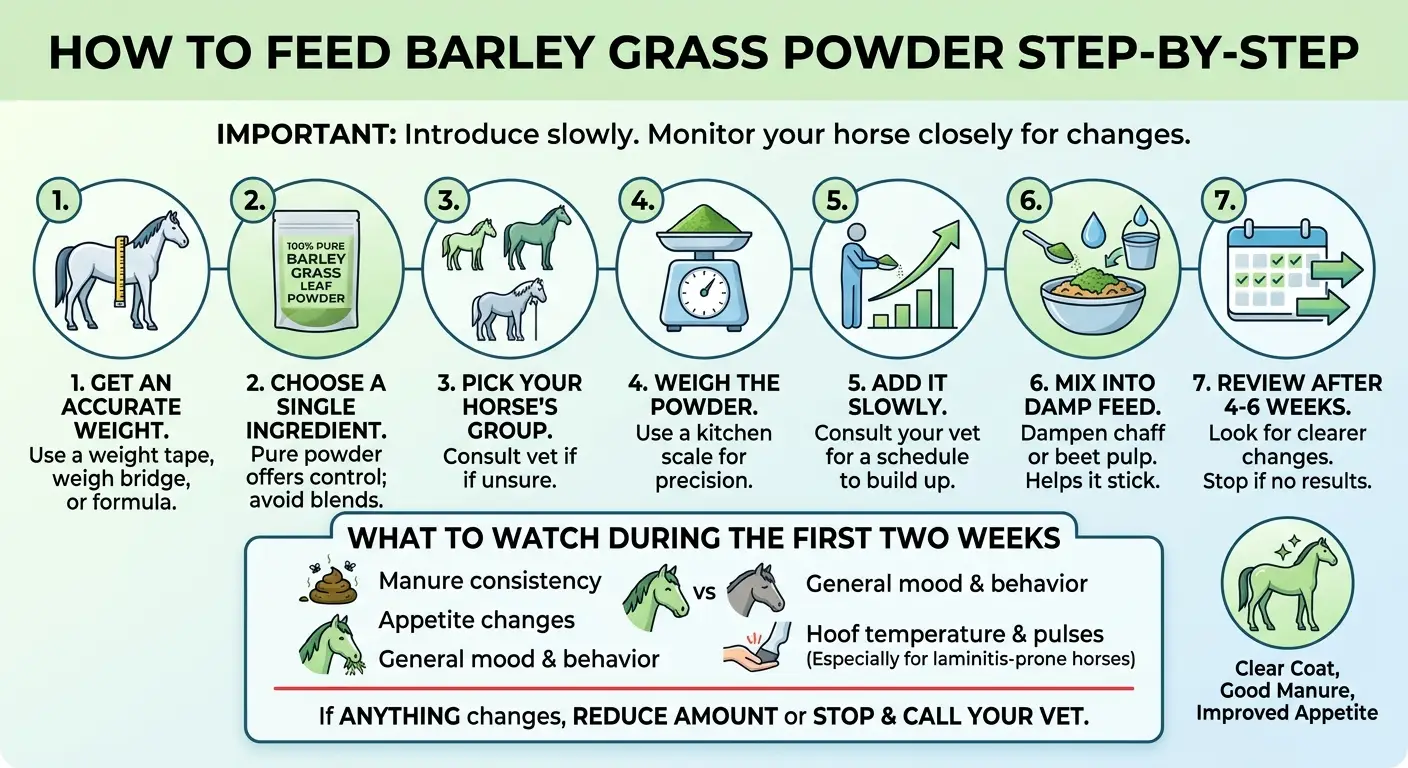
Annimally stresses that barley grass is very nutrient rich and should be worked into the diet slowly. Treat it the way you would any new feed: one product at a time, with a close eye on your horse.
- Get an accurate weight. Use a tape, a weigh bridge or the formula above.
- Choose a single ingredient product. Pure barley grass leaf powder lets you control the amount. Blends hide how much you are actually giving.
- Pick your horse's group. Small horse or pony, large horse, or senior or sick horse. Ask your vet if you are unsure.
- Weigh the powder. Use a kitchen scale, not a guess.
- Add it slowly. The source does not give a schedule, so ask your vet how quickly to build up to your horse's amount.
- Mix it into a damp feed. A handful of chaff or soaked beet pulp with the powder stirred through helps it stick and stops it blowing away.
- Review after four to six weeks. If you cannot point to a clear change in coat, manure quality or appetite, it is reasonable to stop.
What to Watch During the First Two Weeks
Look at the manure, the appetite and the horse's general mood. Check hoof temperature and digital pulses on any horse with a history of laminitis. If anything changes, reduce the amount or stop and call your vet.
What Is Barley Grass Powder and What Is in It?
Barley grass powder is the dried, finely milled young leaf of the barley plant (Hordeum vulgare), harvested before the grain forms. It is a fibrous green powder, not a grain. Annimally describes it as rich in vitamin C and vitamin E, calcium, magnesium and potassium, chlorophyll, crude fiber and crude protein.
One other supplier describes harvesting at peak growth, drying at 40 to 45 degrees Celsius for 20 to 24 hours, steam pasteurizing and milling to a very fine powder.
The nutrient numbers below come from human food labels and ingredient spec sheets, because that is where analyses are published. No equine analysis was available for us to quote, so treat them as a guide to the range, not a promise for your tub.
Range across seven commercial labels and spec sheets. Each bar shows the low to high value.
Two details are worth knowing. Horses make their own vitamin C, so the vitamin C figures on green powder labels matter far less for a horse than for a person. And the potassium figure is high compared with most feeds, which is why we raise it again in the safety section.
Maintenance figures above come from the National Research Council's Nutrient Requirements of Horses.
Barley Grass vs Barley Grain vs Fresh Grass
Barley grass powder is not barley grain. This is the biggest point of confusion in search results, and mixing the two up can hurt a metabolic horse.
| Feature | Barley grass powder | Barley grain | Fresh pasture grass |
|---|---|---|---|
| Plant part | Young dried leaf | Seed | Growing leaf and stem |
| Main carbohydrate | Fiber, with low labeled sugars | Starch, about 55 percent non structural carbohydrate in one feed database | Sugars and fructans that swing with weather and time of day |
| Typical use | Small daily top up | Energy feed, often processed | Grazing |
| Concern for metabolic horses | Check analysis and potassium | Generally avoided | Often restricted |
| Interchangeable? | No | No | No |
The grain figure comes from the Mad Barn equine feed database, which lists barley grain entries with non structural carbohydrate around 55 percent and notes the risk of digestive upset when it is overfed. Fresh grass is variable: Kentucky Equine Research explains how stressed or fast growing cool season grasses store sugar as fructan.
Possible Benefits of Barley Grass Powder for Horses
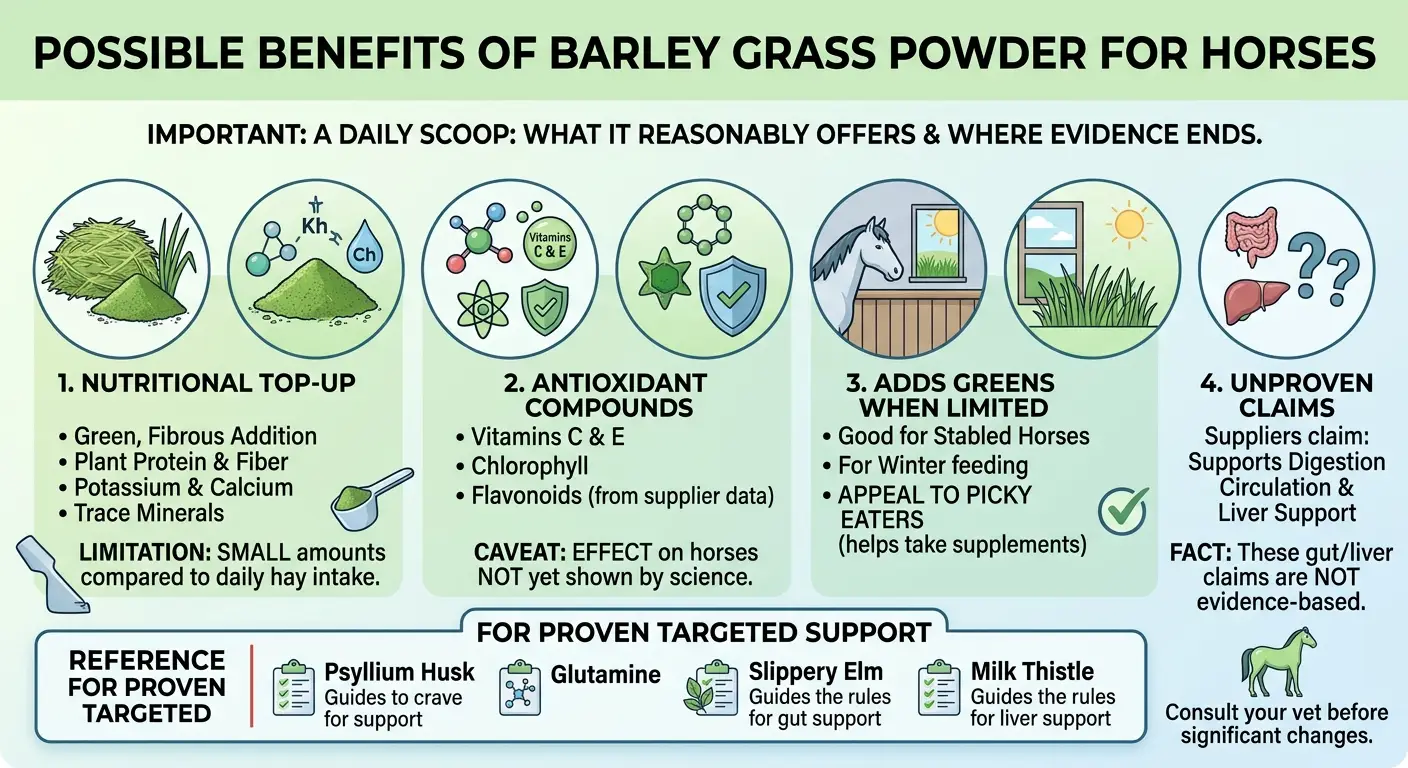
Here is what a daily scoop can reasonably offer, and where the evidence ends.
- A green, fibrous top up. It adds plant protein, fiber, potassium, calcium and some trace minerals, though in small amounts compared with hay.
- Antioxidant compounds. Annimally points to vitamins C and E, chlorophyll and antioxidants, and supplier spec sheets list flavonoids. Whether they change anything in a horse has not been shown.
- A way to add greens when grass is limited. Stabled horses and horses in winter may like the taste, which can also help picky eaters take other supplements.
- Gut and liver claims are unproven. Some suppliers say it supports digestion, circulation or the liver. If gut support is your goal, our guides on psyllium husk dosage for horses, glutamine dosage for horses and slippery elm dosage for horses explain options with their own dosing rules. For liver support, see our milk thistle dosage for horses guide.
Barley Grass Powder Dosage Adjustments for Different Horses
- Ponies and small horses. Annimally lists about 50 to 80 g a day. Ponies are more prone to laminitis, so be extra careful and talk to your vet if your pony is overweight or cresty.
- Large horses. Annimally lists about 100 to 150 g a day.
- Senior or sick horses. Annimally says up to 200 g a day to support recovery. Seniors often have PPID, dental problems or kidney changes, so a vet check first is wise. A damp mash is easier to chew.
- Performance horses. The source gives no separate figure for workload. Use the group that matches your horse's size, check your competition rules and choose a batch tested product.
- Hard keepers. The powder is low in calories, around 270 kcal per 100 g on human labels, so it will not help a thin horse gain weight. A proper calorie feed will.
- Easy keepers. Follow the metabolic guidance in the next section.
Who Should Be Careful or Skip Barley Grass Powder?
Most healthy adult horses handle a green powder well when it is added slowly. These groups need a vet conversation first.
Insulin Resistant, EMS, PPID and Laminitis Prone Horses
Commercial powders list between 0 and about 9 g of sugar per 100 g. That is a small amount next to the sugar a horse eats from forage. The catch is that a standard food label may not capture fructans, the storage sugars that worry laminitis prone horses.
Ask the manufacturer for a full analysis of water soluble carbohydrate, starch and fructan before you start.
Management of these horses is led by your vet, with diet, exercise and sometimes medication. Your vet may also bring up options such as magnesium dosage for horses or metformin dosage for horses. Barley grass powder is not a treatment for any of these conditions, and the figures in this guide were not written for metabolic horses.
HYPP and Potassium
Horses with hyperkalemic periodic paralysis need tightly controlled potassium intake. With around 3.4 to 3.8 g of potassium per 100 g, barley grass powder is a high potassium supplement. It is a small share of what hay supplies, but these horses are managed with narrow margins, so only your vet should decide.
Competition Horses
Rules vary by organization. Check your governing body, such as the FEI Clean Sport program for international competition, and ask the maker for a certificate of analysis showing the batch was tested for contaminants.
Barley Grass Powder Side Effects and When to Stop
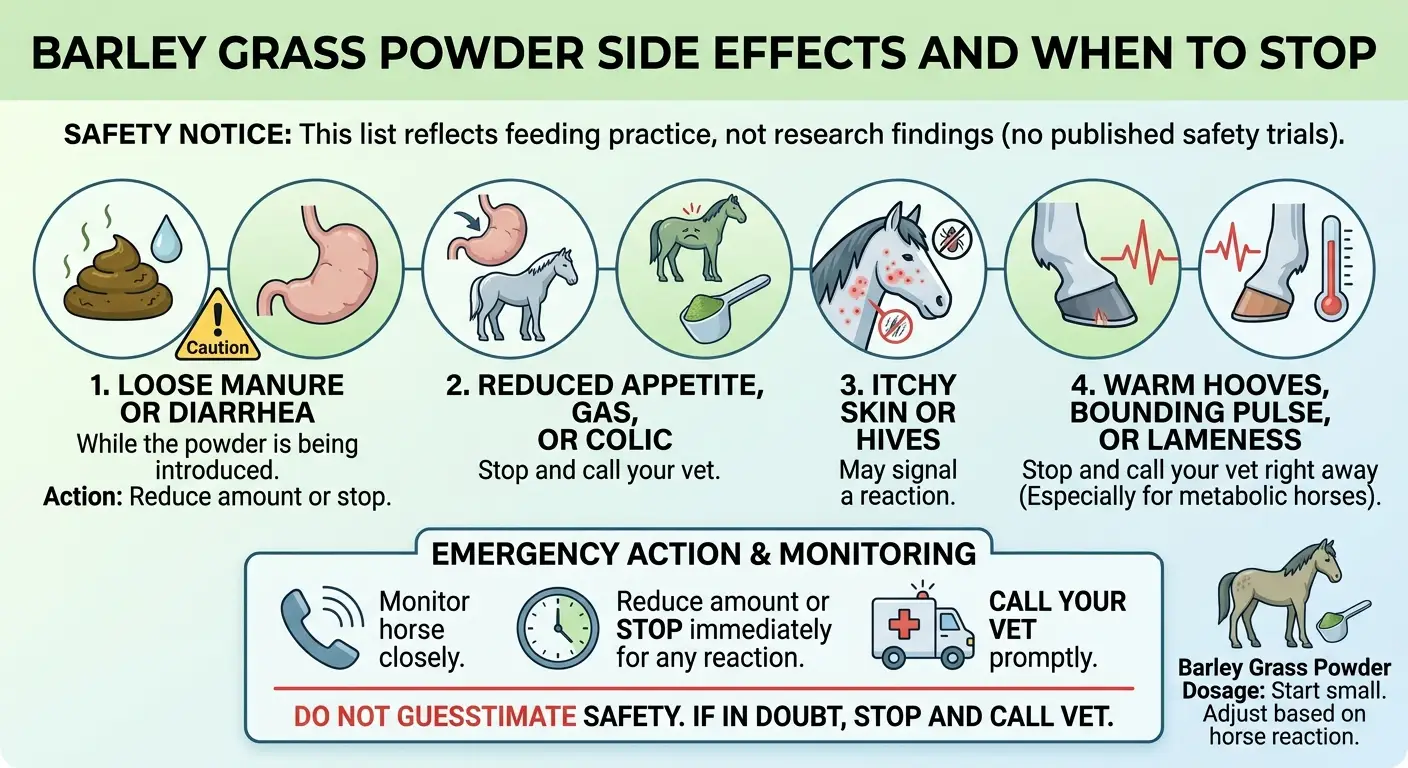
No safety trials in horses have been published, so this list reflects general feeding practice, not research findings.
- Loose manure or diarrhea while the powder is being introduced. Reduce the amount or stop.
- Reduced appetite, gas or signs of colic. Stop and call your vet.
- Itchy skin or hives, which may signal a reaction.
- Warm hooves, a bounding digital pulse or new lameness, especially in metabolic horses. Stop and call your vet right away.
How to Choose a Quality Barley Grass Powder
Two powders with the same name can be very different. Annimally advises buying high quality product without additives, gently processed to preserve nutrients, organic where possible and from a reputable seller with transparent information. Use this checklist.
- Single ingredient. The label should say barley grass or barley leaf and nothing else.
- Young leaf only. Avoid anything that mentions grain, seed heads or straw.
- Gentle drying and fine milling. This helps keep the color and nutrients. Organic certification helps lower pesticide worries.
- Batch testing. Ask for a certificate of analysis. One supplier spec sheet lists limits for lead, arsenic, mercury and cadmium, plus yeast, mold, E. coli and Salmonella. That is the kind of detail to look for.
- Clear horse dosing. If the seller gives no horse dose at all, ask your vet.
- Fresh smell. It should smell grassy, never musty. Store it sealed in a cool, dry, dark place.
What It Costs
Prices differ a lot between sellers. This table shows the pack prices we saw on the retailer pages when this guide was written, with the price per kg worked out from them. Use it with the calculator above to estimate your own monthly cost.
Currencies differ, prices change, and one of these is a bulk ingredient sold in small bags.
| Seller and pack | Pack price | Price per kg |
|---|---|---|
| Greendale PureFeed, 3 kg bag | NZ$90 | NZ$30 |
| Greendale PureFeed, 5 kg bag | NZ$135 | NZ$27 |
| Greendale PureFeed, 20 kg bag | NZ$460 | NZ$23 |
| Country Park organic, 1 kg | AU$55 | AU$55 |
| Nouvelle Research bulk, 500 g | US$63 | US$126 |
Prices were seen on retailer pages in 2026 and are not converted between currencies.
Common Mistakes When Feeding Barley Grass Powder
- Adding the full amount on day one instead of introducing it slowly.
- Measuring by eye instead of weighing.
- Swapping juice powder, pellets and leaf powder gram for gram.
- Confusing barley grass with barley grain.
- Adding several new green supplements at the same time, so you cannot tell which one caused a problem.
- Using it as a replacement for forage or a balanced feed.
- Skipping the vet check in a horse with metabolic signs.
Expert tip: keep a simple feed diary. Note the date, the amount, the manure and any change in behavior. If something goes wrong, you will know exactly when and at what amount.
Pros and Cons of Barley Grass Powder for Horses
- Adds fiber, plant protein and minerals
- Single ingredient and easy to portion
- Often well accepted when mixed into damp feed
- Low labeled sugar
- Shelf stable when stored dry
- No equine studies on dose or benefit
- High in potassium
- Labels may not show fructans
- Quality varies and can be pricey
- Makes only a small nutritional contribution
Barley Grass Powder Compared With Other Green Supplements
Barley grass powder is one of several green or algae based supplements. Each has its own dosing rules and cautions. Our spirulina dosage for horses and kelp dosage for horses guides cover the two you are most likely to compare.
Kelp in particular is high in iodine, which is a different concern from the potassium and sugar questions here.
Whatever you choose, add one product at a time and leave at least two weeks before adding the next. That way you will know which one is doing what.
Key Takeaways
- Small horses and ponies: about 50 to 80 g a day.
- Large horses: about 100 to 150 g a day.
- Seniors or sick horses: up to 200 g a day, with your vet's input.
- Barley grass is very nutrient rich, so add it to the diet slowly.
- It is not barley grain and it is not a forage replacement.
- No equine studies set a dose, so follow your vet and the product label.
- Get a vet check first for metabolic, HYPP, kidney, pregnant or foal cases.
FAQs
How much barley grass powder should I give my horse per day?
Annimally recommends about 50 to 80 g a day for small horses and ponies, about 100 to 150 g for large horses, and up to 200 g for seniors or sick horses. The right amount depends on live weight. Add it to the diet slowly and ask your vet if your horse has any health condition.
How much barley grass powder for a large horse?
Annimally lists about 100 to 150 g a day for large horses. The source does not say where a small horse ends and a large horse begins, so ask your vet which group your horse belongs to. Introduce the powder slowly.
How much barley grass powder should a pony get?
Annimally lists about 50 to 80 g a day for small horses and ponies. Ponies are more prone to laminitis, so check with your vet first if your pony is overweight or cresty, and add the powder slowly.
Can insulin resistant or laminitis prone horses have barley grass powder?
Ask your vet first. Powder labels list low sugar, but those figures may not capture fructans, so request an analysis of sugar, starch and fructan. The general amounts in this guide were not written for metabolic horses.
How long does barley grass powder take to work in horses?
There is no equine research showing a timeline. Owners often judge coat, manure quality and appetite after four to six weeks of steady feeding. If you see no clear change by then, stopping is a reasonable decision.
Can horses eat barley grass powder every day?
Annimally gives its amounts as daily figures, so it is normally fed every day as a top up to the usual diet. Keep the amount steady, weigh it, and review the need every few months with your vet or an equine nutritionist.
Can senior horses have more barley grass powder?
Annimally says seniors or sick horses can have up to 200 g a day to support recovery. That is a ceiling from one retailer, not a research based dose. Older horses often have PPID, dental or kidney issues, so ask your vet before using it.
Is barley grass powder the same as barley grain for horses?
No. Barley grain is the seed and is high in starch, with non structural carbohydrate near 55 percent in one feed database. Barley grass powder comes from the young leaf before the grain forms. Do not swap one for the other.
Can I give barley grass powder with other supplements?
Usually yes, but introduce one new product at a time so you can spot a reaction. Avoid stacking several green or mineral products without checking the totals, especially potassium, calcium and iron. A nutritionist or vet can review the full list.
What are the side effects of barley grass powder in horses?
No equine safety studies are published, so this list reflects general feeding practice. Watch for loose manure, reduced appetite, gas, skin reactions or any hoof heat. Stop feeding and call your vet if you see colic signs or lameness.
How do I measure barley grass powder without a scale?
Weigh one level scoop on a kitchen scale, then use that same scoop every time. One retailer lists about 4 g per level teaspoon for a fine powder, but brands vary a lot. Never guess by eye for a daily amount.
Can I mix barley grass powder with feed?
Yes. Stirring the powder into a damp feed helps the fine powder cling to chaff and stops it blowing away. Annimally does not give mixing instructions, so follow the label of your product.
Is barley grass powder safe for pregnant or nursing mares?
Ask your vet before feeding it. No studies cover barley grass powder in pregnant or nursing mares, and young foals have different needs. A balanced mare and foal feed and good forage come first.
Is barley grass powder high in sugar?
Commercial labels list between 0 and about 9 g of sugar per 100 g, so the amount in a daily scoop is small. Labels may not show fructans, though, so metabolic horses need a proper analysis from the maker.
What is the difference between barley grass powder and barley grass juice powder?
Barley grass juice powder is made from the pressed juice and is more concentrated than whole leaf powder, with a different fiber content. Labels are not interchangeable, so follow the instructions for the exact product you buy and never swap them gram for gram.
Can barley grass powder replace hay or pasture?
No. A 500 kg horse eats around 10 kg of forage a day, so even 100 to 150 g of powder adds only a small share of fiber. It is a top up, not a forage substitute.
Will barley grass powder cause problems in a drug test?
Rules differ by organization. Check your governing body's list and ask the manufacturer about batch testing for contamination before you compete.
Your Next Step
Barley grass powder can be a reasonable green top up for a healthy adult horse when it is added slowly and weighed carefully. Work out whether your horse counts as a small horse or pony, a large horse, or a senior or sick horse, check the amount with your vet and use the calculator to plan your scoops. Write down what you see, and stop if anything looks off.
If your horse is insulin resistant, has Cushing's disease, has HYPP or is pregnant, take this guide to your vet and ask for a decision before you buy anything. A vet who knows your horse will give you a better answer than any chart.
Sources and Further Reading
- Annimally guide to barley grass for horses
- National Research Council, Nutrient Requirements of Horses
- Mad Barn equine feed database entry for barley
- Kentucky Equine Research on sugar accumulation in grass
- FEI Clean Sport
- U.S. FDA Animal and Veterinary information
- Association of American Feed Control Officials
This article is for general education. It is not a substitute for advice from a licensed veterinarian who knows your horse. Supplement amounts on retail pages are not regulatory standards.