Glutamine Dosage for Horses: Dosage Chart, Calculator and Safety Guide for Gut Health, Ulcers and Recovery
Written & Reviewed By: Medshorse Team
Last Updated: October 2026
Your horse’s gut and muscles work around the clock, and glutamine is one of the amino acids they lean on most. So how much should you actually feed?
Glutamine dosage for horses has no official, regulator-approved number. One UK supplier, Forageplus, lists 10 to 30 grams per day for an average 500 kg horse, which is about 20 to 60 mg per kg of body weight. This guide turns that range into a weight chart, a calculator and clear safety rules.
Disclaimer: This article is for general education and is not veterinary advice. Brand names belong to their owners and are not affiliated with MedsHorse. Always follow your veterinarian’s instructions and the product label.
- There is no FDA approved or NRC set glutamine dose for horses. Every number you see comes from product labels or small studies.
- Forageplus lists 10 to 30 g per day for an average 500 kg (1,100 lb) horse, depending on need and workload. One 10 ml scoop is about 15 g.
- Healthy horses on good forage and a balanced ration usually make enough glutamine on their own.
- Glutamine supports the gut lining and immune cells. It is not a replacement for ulcer medication.
- Ask your vet first if your horse has ulcers, colic history, liver or kidney disease, or is pregnant.
What Is Glutamine in Horses?
Glutamine is the most abundant free amino acid in the body. Cells that line the intestine and cells of the immune system burn it as fuel, and muscle tissue makes and stores it.
Under normal conditions horses produce enough on their own. That is why it is classed as a non-essential amino acid, as Mad Barn explains.
Why Demand Can Rise
Blood glutamine drops after hard exercise and during lactation. In a study of 31 Quarter Horse mares, untreated mares lost 11 to 35 percent of their blood glutamine from the first month after foaling onward.
Heavy training, gut disease such as ulcers or colitis, and general stress are the other reasons owners and vets consider supplementing. Succeed Equine lists these same situations.
Does Every Horse Need It?
No. Forage and protein feeds already supply glutamine. Mad Barn also points out that gut products need fairly high glutamine levels to be worth feeding.
If your horse is healthy, sound and on a balanced ration, a glutamine supplement is probably an extra rather than a need.
Glutamine Dosage for Horses: How Much Is Safe?
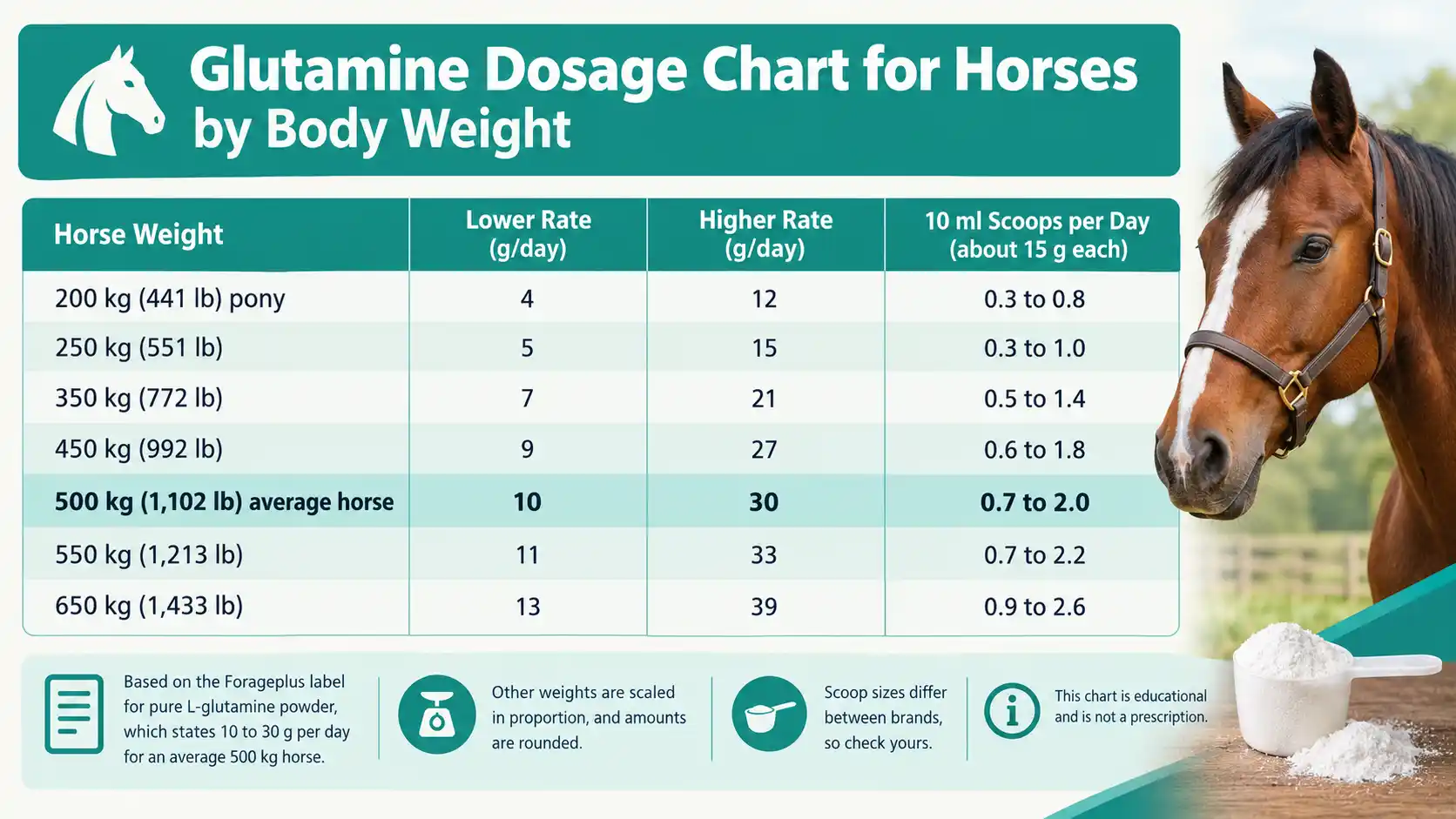
The reference range used here comes from the Forageplus label for its 100% L-glutamine powder: 10 to 30 g per day for an average 500 kg horse. That works out to about 20 to 60 mg per kg of body weight per day, so a 250 kg pony would get roughly 5 to 15 g.
The label ties the rate to the horse’s needs and activity level, so heavier work sits toward the higher end.
| Horse Weight | Lower Rate (g/day) | Higher Rate (g/day) | 10 ml Scoops per Day (about 15 g each) |
|---|---|---|---|
| 200 kg (441 lb) pony | 4 | 12 | 0.3 to 0.8 |
| 250 kg (551 lb) | 5 | 15 | 0.3 to 1.0 |
| 350 kg (772 lb) | 7 | 21 | 0.5 to 1.4 |
| 450 kg (992 lb) | 9 | 27 | 0.6 to 1.8 |
| 500 kg (1,102 lb) average horse | 10 | 30 | 0.7 to 2.0 |
| 550 kg (1,213 lb) | 11 | 33 | 0.7 to 2.2 |
| 650 kg (1,433 lb) | 13 | 39 | 0.9 to 2.6 |
How This Chart Was Built
Here is where the numbers come from.
- Product label: Forageplus lists 10 to 30 g per day for an average 500 kg horse and says one 10 ml scoop is approximately 15 g. The label does not require splitting the dose and suggests feeding it after exercise or as part of the daily supplement routine.
- Scaling: Forageplus gives the range for a 500 kg horse only. We scaled it in proportion to body weight, which gives about 20 to 60 mg per kg per day.
- Other products differ: Platinum Performance lists 9,000 to 36,000 mg twice daily for a 1,000 lb horse, which is a higher range. Formula 707 ULZERless provides 2.5 g of L-glutamine per scoop, mixed with other ingredients.
- Research is higher still: A German steeplechase trial used 20 g per 100 kg (about 100 g for a 500 kg horse) for just four days around training. That was a short research protocol, not a feeding recommendation.
The takeaway is that no single standard exists. Always follow the label of the exact product you buy.
Glutamine Dosage Calculator for Horses
Enter your horse’s weight to see the daily range. If you know how many grams of glutamine are in one scoop of your product, the calculator also shows how many scoops that equals per day.
Glutamine Dosage Calculator For Horses
Enter your horse’s weight and feed rate level to estimate the daily glutamine dose in grams and scoops.
Recommended Daily Dose
Horse weight used: 0 kg
Full range for this horse: 0 g to 0 g per day
If split into two feeds: 0 g (0 scoops) per feed
Based on 10 to 30 grams per day for an average 500 kg horse. 1 x 10 ml scoop is approximately 15 grams. This is a guide only, please consult your veterinarian for advice specific to your horse.
© medshorse.com
What the Research Actually Shows
Glutamine research in horses is small and mostly short term. Here is what each study did and found.
| Horses | What Was Given | What Was Found |
|---|---|---|
| Steeplechase horses in peak training | 20 g per 100 kg for 4 days before and on training day | Blood glutamine rose significantly. No side effects in behavior or blood counts. |
| 31 lactating Quarter Horse mares | 50 g or 100 g daily of a glutamine and glutamate blend | Treated mares kept steady blood glutamine. Untreated mares dropped 11 to 35 percent. |
| 4 Arabian mares, about 380 kg | 1, 2 or 4 percent glutamine and glutamate blend in concentrate | Only the 4 percent level raised blood glutamine, at 6 hours. No clinical problems. |
| 33 endurance horses, 80 to 160 km rides | Oral glutamine for 30 days before and 14 days after the race | Immune markers responded differently in supplemented horses. The dose was not stated in the summary reviewed. |
| 33 endurance horses, no supplement | Observation only | Serum glutamine did not change across the race, but ammonia rose, which suggests glutamine was being used. |
What does that mean in practice?
- Glutamine can raise blood levels in horses, though results vary by dose and form.
- The trials were small, often with fewer than 35 animals.
- Researchers note that glutamine metabolism in horses has not been extensively studied.
- No trial I found proves that glutamine heals gastric ulcers or prevents colic.
That honesty matters. Glutamine is a reasonable supportive tool, but the evidence does not justify big promises.
Glutamine Dosage for Horses by Situation
Horses Prone to Ulcers or Gut Upset
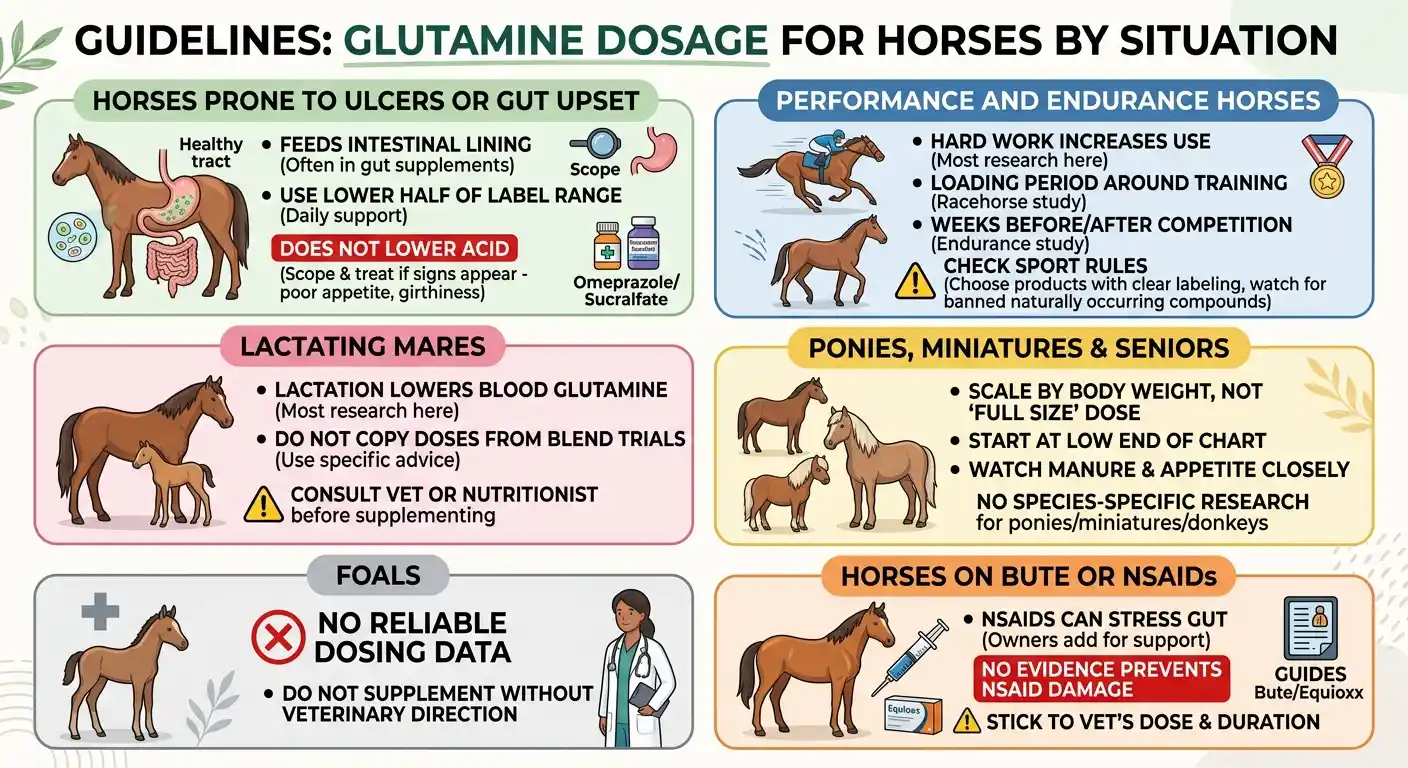
Glutamine feeds the cells that line the intestine, which is why it shows up in so many gut supplements. Many owners use the lower half of the label range as daily support.
It does not lower stomach acid. If your horse has ulcer signs such as poor appetite, girthiness or weight loss, your vet needs to scope and treat. Our guides to omeprazole dosage for horses and sucralfate dosage for horses explain the medications vets commonly use.
Performance and Endurance Horses
Hard work can increase glutamine use, and this is where most of the research sits. The racehorse trial used a short loading period around training, while the endurance work supplemented for weeks before and after competition.
Check your sport’s rules before feeding anything. Platinum Performance warns that supplements may contain naturally occurring compounds that are banned in some sports, so choose products with clear labeling.
Lactating Mares
Lactation lowers blood glutamine, and the Brazilian trial showed that supplementation held levels steady. That trial used a glutamine and glutamate blend, so do not copy its gram amounts with pure glutamine powder. Ask your vet or an equine nutritionist before supplementing a mare in foal or nursing.
Ponies, Miniatures and Seniors
Scale by body weight, not by what a full size horse gets. There is no species specific research for ponies, miniatures or donkeys, so start at the low end of the chart and watch the manure and appetite closely.
Foals
There is no reliable dosing data for foals. Do not supplement a foal without veterinary direction.
Horses on Bute or Other NSAIDs
Long courses of anti-inflammatories can stress the gut, and some owners add glutamine for support. No evidence I found shows that it prevents NSAID related damage. If your horse is on one, read our guides to Bute dosage for horses and Equioxx dosage for horses, and stick to the vet’s dose and duration.
How to Give Glutamine to a Horse
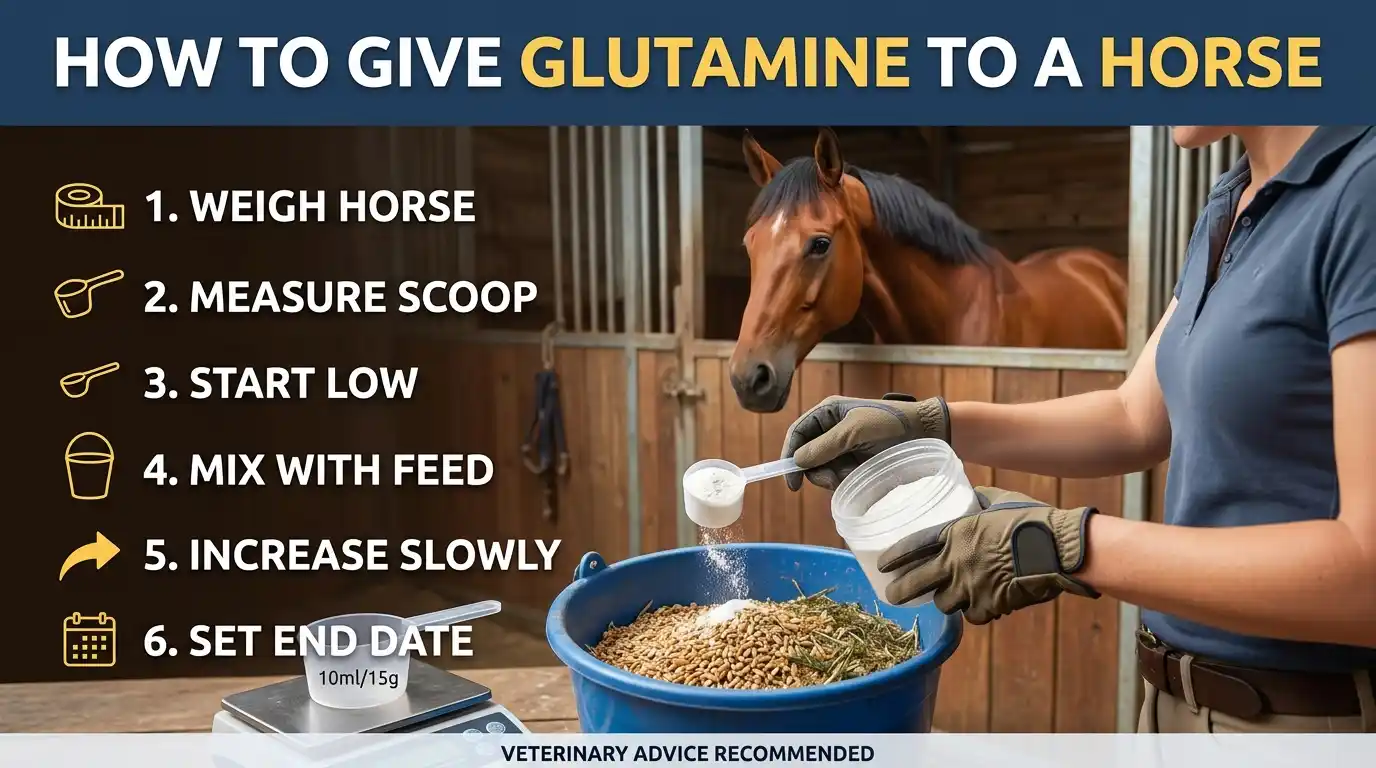
- Weigh or tape your horse. Guessing weight is the most common source of dosing errors.
- Check the scoop. Forageplus lists its 10 ml scoop as about 15 g, but scoops vary by brand and by blend.
- Start low. Begin at the lower rate for a few days and watch appetite and manure.
- Mix it into feed. Stir the powder into a small, damp meal. Forageplus suggests feeding it after exercise or as part of the daily routine, and some other products split the amount across two meals.
- Raise slowly if needed. Move toward the higher rate only for heavier workloads and with your vet’s approval.
- Set an end date. Trials ran from 4 days to about 7 weeks. Reassess every few weeks.
Timing matters a little. In one study, free glutamine raised blood levels within the first 90 minutes after feeding, so giving it with a meal is a sensible habit.
| Option | What It Does | Status |
|---|---|---|
| Glutamine | Fuels gut lining and immune cells | Nutritional supplement with no approved treatment claim |
| Omeprazole | Reduces stomach acid | Approved products exist, such as GastroGard, and require a vet |
| Sucralfate | Forms a protective coating over damaged tissue | Prescribed by vets, often alongside acid suppression |
Side Effects and Safety Rules
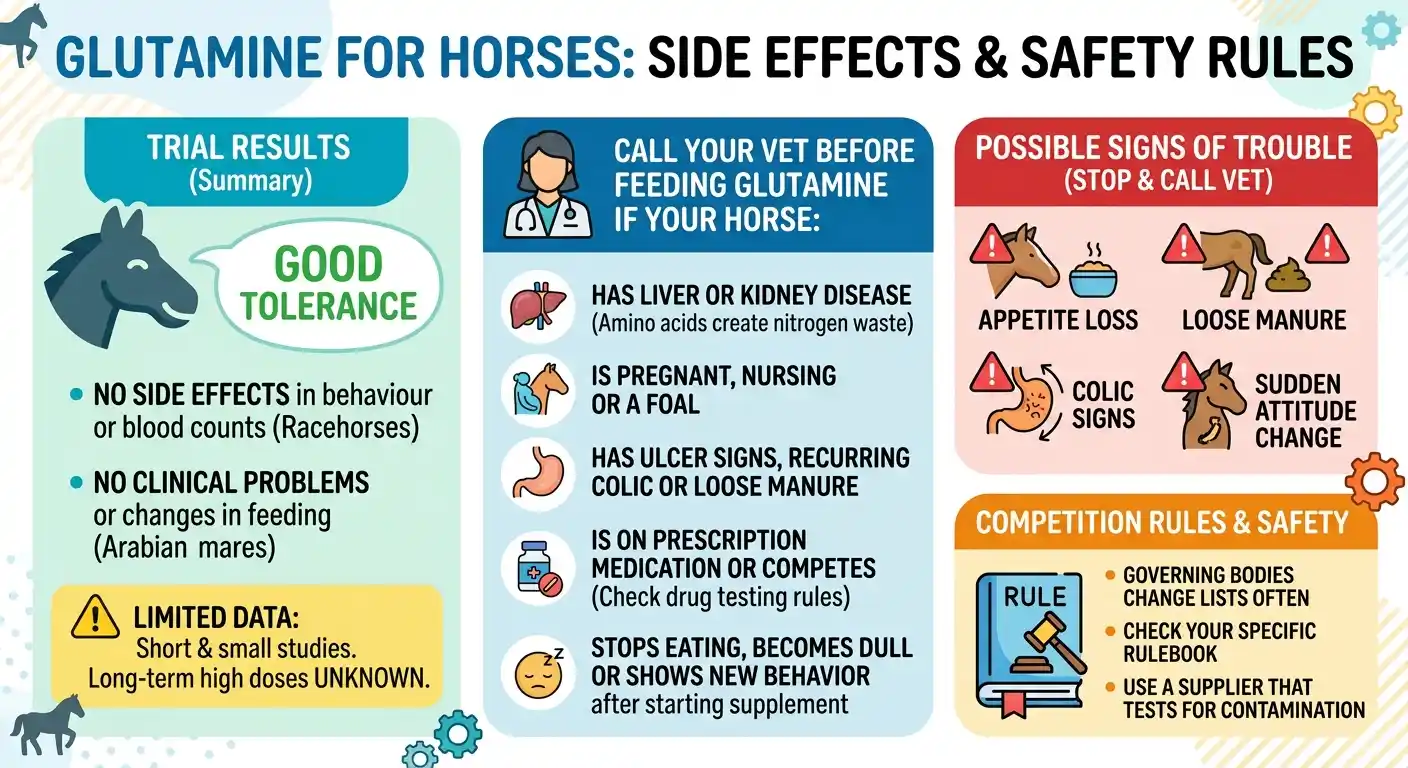
In the trials above, horses tolerated glutamine well. The racehorse study reported no side effects in behavior or blood counts, and the Arabian mares showed no clinical problems or changes in feeding behavior.
That is encouraging, but the studies were short and small. Long term safety at high doses has not been established.
- Has liver or kidney disease, since amino acids are broken down into nitrogen waste
- Is pregnant, nursing or a foal
- Has current ulcer signs, recurring colic or ongoing loose manure
- Is on prescription medication or competes under drug testing rules
- Stops eating, becomes dull or shows new behavior changes after starting a supplement
Possible Signs of Trouble
No toxicity syndrome has been documented at label doses. Still, stop and call your vet if you see appetite loss, loose manure, colic signs or a sudden change in attitude after starting any supplement.
Competition Rules
Governing bodies change their lists often, and I could not confirm every rulebook. Check yours, and use a supplier that tests for contamination.
Common Mistakes to Avoid
- Guessing body weight. Use a weight tape or scale.
- Copying human or dog doses. Horse digestion is very different.
- Assuming blend doses equal pure glutamine. Many products mix glutamine with other ingredients.
- Treating ulcers with a supplement alone. Get a vet diagnosis.
- Feeding it forever without review. Reassess every few weeks.
- Stacking several gut products. Many contain glutamine already, so you can double up without realizing.
Smart Next Steps
Start by asking whether your horse really needs it. If it does, use the chart and calculator, begin at the lower rate, and review after a few weeks.
If you are also working on calm and muscle function, our guide to magnesium dosage for horses covers another common supplement. For horses with sand or hindgut concerns, see psyllium husk dosage for horses.
Glutamine is a helpful supporting player. Your vet’s diagnosis, a good forage based diet and consistent management still do the heavy lifting.
FAQs
How much glutamine should I give my horse daily?
There is no official dose. One UK label, Forageplus, lists 10 to 30 grams per day for an average 500 kg horse, which is about 20 to 60 mg per kg. Start at the low end and ask your vet before going higher.
What is the glutamine dosage for a 1,000 lb horse?
A 1,000 lb horse weighs about 454 kg. Scaling the Forageplus range of 10 to 30 grams per day for a 500 kg horse gives roughly 9 to 27 grams per day. Start at the low end and check with your vet.
How many scoops of glutamine should I give my horse?
Forageplus lists one 10 ml scoop as about 15 grams. For a 500 kg horse, 10 to 30 grams is roughly two thirds of a scoop to two scoops per day. Scoop sizes differ between brands, so check yours.
Can a horse have too much glutamine?
Long term safety at high doses has not been established. Trials reported no side effects, but they were short and small. Stop and call your vet if appetite drops, manure loosens or colic signs appear.
Does glutamine help horses with ulcers?
Glutamine fuels the cells that line the gut, so it is used as support. I found no controlled trial showing it heals ulcers. Vets treat ulcers with acid suppressing medication such as omeprazole.
Can glutamine replace omeprazole?
No. Omeprazole lowers stomach acid, while glutamine is a nutritional supplement without an approved treatment claim. Ask your vet before changing any ulcer treatment.
How long does glutamine take to work in horses?
No standard timeline exists. In studies, blood glutamine rose within about 90 minutes to 6 hours after feeding, while supplementation periods ran from 4 days to about 7 weeks. Reassess your goals every few weeks.
Should I give glutamine once or twice a day?
The Forageplus label does not require splitting the dose and suggests feeding it after exercise or as part of the daily routine, while some other labels split the amount into two feedings. Follow your product label and mix the powder into a small damp meal.
Is glutamine safe for pregnant or lactating mares?
A lactation study used 50 or 100 grams daily of a glutamine and glutamate blend and kept blood glutamine steady. That is not a pure glutamine dose, so talk to your vet before supplementing a mare.
Can I give glutamine to ponies, miniatures or donkeys?
Scale the amount by body weight and start at the low end. There is no species specific research for ponies, miniatures or donkeys, so check with your vet first.
Is glutamine banned in horse competition?
I could not confirm every rulebook. Check your governing body, and choose tested products because some supplements contain naturally occurring compounds that are banned in some sports.
Does glutamine help horses recover after exercise?
Blood glutamine can fall after hard exercise, and supplements can raise it. Results are mixed, though. One endurance study found no change in serum glutamine across races, so benefits are not guaranteed.
Is L-glutamine the same as glutamine?
L-glutamine is the form of glutamine found in nature and used in supplements. When a label says L-glutamine, it refers to the active amino acid your horse uses.
Sources and Further Reading
- Forageplus Glutamine Plus product page and feed rates
- Platinum Performance L-Glutamine product label
- Mad Barn: L-Glutamine ingredient overview
- Succeed Equine: L-Glutamine for Horses
- Glutamine and Glutamate Supplementation Increases the Levels of These Amino Acids in the Milk of Pasture-fed Mares
- Influence of Glutamine and Glutamate Supplementation in the Blood Levels of Horses
- Glutamine, antioxidant status and steeplechase horses (Munich thesis)
- Evaluation of glutamine, ammonia and cortisol in endurance horses
- Immunosuppressive effect of exercise in endurance horses supplemented with glutamine (USP thesis)