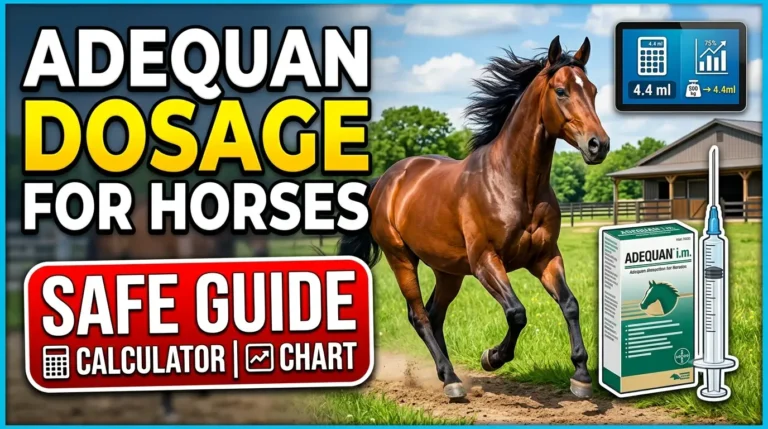
Banamine Dosage for Horses: Calculator, Chart & Safe Dosing Guide
When your horse is suffering from pain, colic or a fever, all you want is the right dose at the right time. While the standard dose of Banamine for horses is 0.5 mg per pound (1.1 mg per kg) of body weight once a day, your veterinarian’s advice is the safest dose for your horse, depending on your horse’s condition and the reason for treatment.
This guide provides you with a complete dosage chart, an easy to use calculator system and safety information that most horse owners don’t hear until things go wrong.
Before we delve deeper, one important note: In most cases Banamine is a prescription drug and dosing decisions, particularly for colic, should always include your veterinarian. This article should be used as a reference for education purposes only and not as a replacement for veterinary care. When your horse is colicing, don’t take the time to work out a dose before you call your vet, call first.
Banamine® Dosage Calculator For Horses
Accurate dosage calculation for equine musculoskeletal pain & inflammation relief
Calculated Dosage Results
© medshorse.com
Key Takeaways
- Once a day for up to 5 days, Standard dose: 0.5 mg/lb (1.1 mg/kg).
- There are 50 mg of flunixin per mL in injectable Banamine solution; 1 mL is administered per 100 lb of body weight.
- Paste is applied in a similar fashion; 50 mg for every 100 lbs of fish, according to syringe markings.
- Do not self-administer injectable Banamine intramuscularly (IM) because of a very rare but potentially fatal risk of clostridial myositis. IV administration should only be done by a veterinarian; owners can safely give the paste or injectable solution orally.
- Check with your vet for dosage and administration, particularly in cases of colic, foals, pregnant mare or horses with kidney problems.
What is Banamine and How Does It Work?
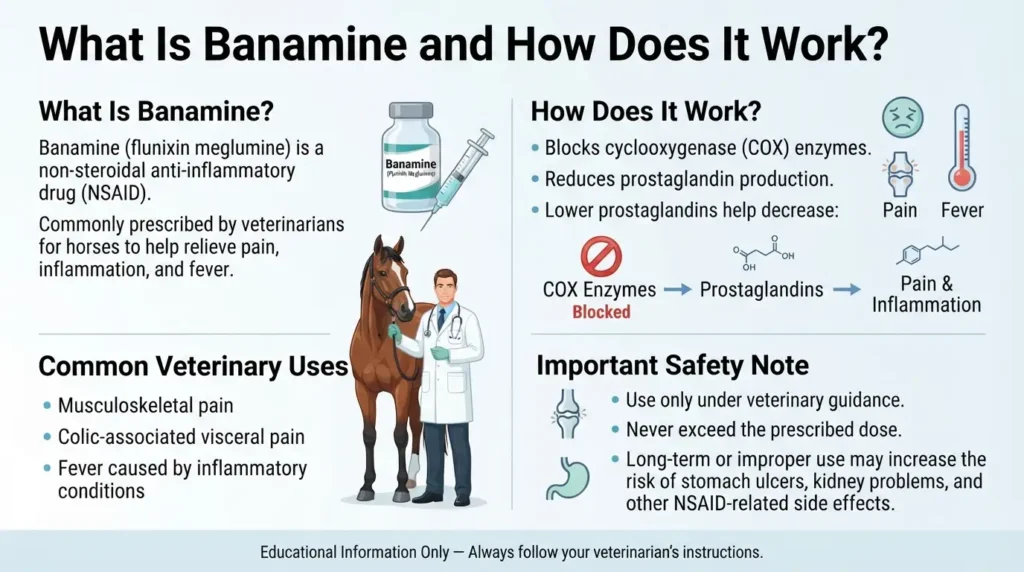
Banamine (Merck Animal Health) is a nonsteroidal anti-inflammatory drug (NSAID) called flunixin meglumine. It blocks the production of compounds that cause pain, inflammation and fever.
It is most commonly used by vets for:
- Soothe the pain of colic (visceral, gut pain)
- Musculoskeletal pain – strains, sprains, pain due to laminitis
- Fever — to decrease fever caused by infection or inflammation
- Post surgery or eye pain (in some cases, on veterinary instructions)
It is available as an injectable solution, an oral paste and oral powder/granules (which can also be compounded by specialty pharmacies).
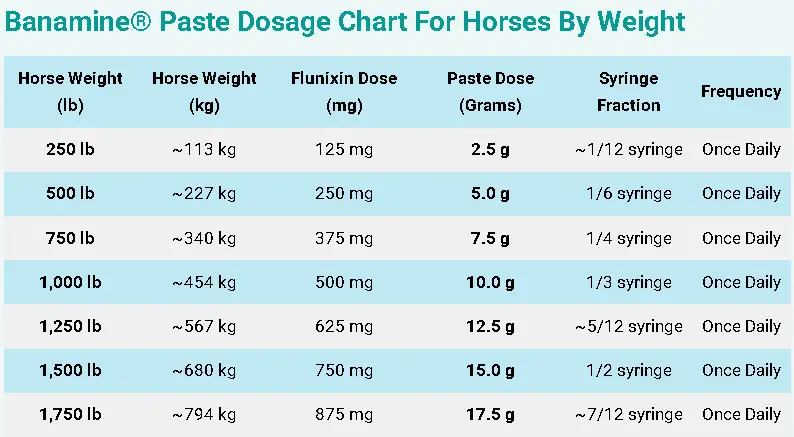
Banamine® Paste Dosage Chart For Horses By Weight
Here is the reference dosage chart for Banamine® Paste (1500 mg Flunixin per 30 g syringe / 50 mg Flunixin per gram of paste) based on the standard recommended dosage of 0.5 mg per lb of body weight once daily.
| Horse Weight (lb) | Horse Weight (kg) | Flunixin Dose (mg) | Paste Dose (Grams) | Syringe Fraction | Frequency |
| 250 lb | ~113 kg | 125 mg | 2.5 g | ~1/12 syringe | Once Daily |
| 500 lb | ~227 kg | 250 mg | 5.0 g | 1/6 syringe | Once Daily |
| 750 lb | ~340 kg | 375 mg | 7.5 g | 1/4 syringe | Once Daily |
| 1,000 lb | ~454 kg | 500 mg | 10.0 g | 1/3 syringe | Once Daily |
| 1,250 lb | ~567 kg | 625 mg | 12.5 g | ~5/12 syringe | Once Daily |
| 1,500 lb | ~680 kg | 750 mg | 15.0 g | 1/2 syringe | Once Daily |
| 1,750 lb | ~794 kg | 875 mg | 17.5 g | ~7/12 syringe | Once Daily |
| 2,000 lb | ~907 kg | 1,000 mg | 20.0 g | 2/3 syringe | Once Daily |
Important Administration Notes
- Indication: Alleviation of inflammation and pain associated with musculoskeletal disorders in horses.
- Concentration: Each 30 g syringe contains 1,500 mg of flunixin equivalent (50 mg flunixin per gram of paste).
- Treatment Duration: Recommended once daily. One 30 g syringe treats a 1,000-lb horse once daily for 3 consecutive days.
- Disclaimer: This chart is for reference and informational purposes only. Always consult a licensed veterinarian prior to administering medication.
Quick facts:
- The Banamine solution is for injection, and contains 50 mg of Banamine in every 1 mL, which means that each 100 lb of weight will need one mL, and so on.
- Paste syringes are already calibrated in 250 lb increments, and read to give 125 mg flunixin per 250 lbs, not by estimation.
- Treatment is usually limited to 5 consecutive days unless a re-check is done by a vet.
Using Banamine® Safely in Horses
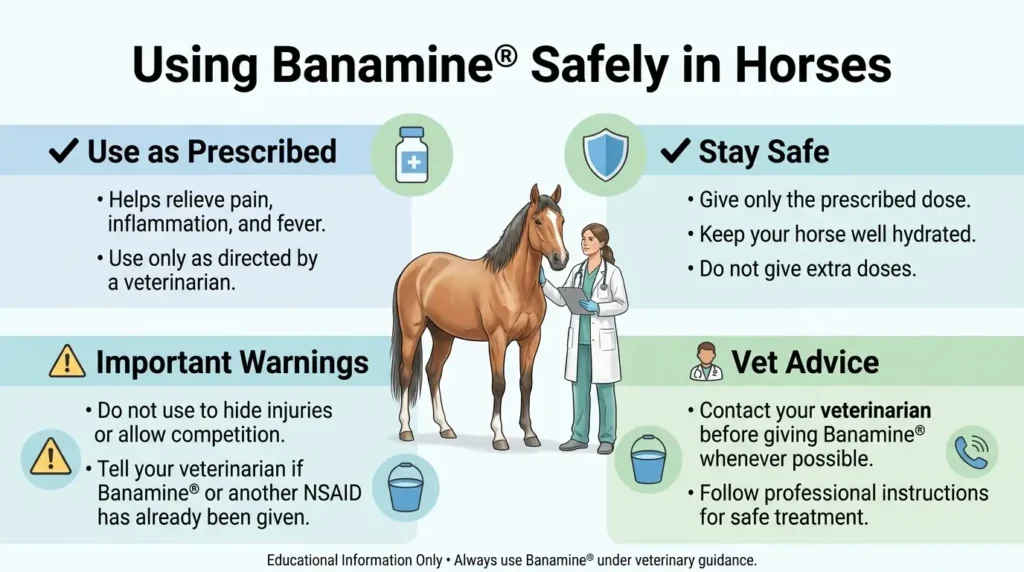
- Flunixin meglumine (Banamine®) is a medication that when administered properly, is effective in controlling pain, inflammation and fever in horses; many veterinarians recommend keeping this medication in an equine first aid kit.
- Banamine Dosage For Horses is also used to alleviate inflammation and pain associated with musculoskeletal disorders in horses.
- Improper administration may result in serious and potentially life threatening side effects and it is important to administer the drug at the correct dosage, route and frequency as prescribed by a veterinarian.
- Gastroprotectant drugs may be recommended to minimize gastrointestinal side effects and gastric and colonic ulcers.
- Banamine® will reduce the risk of kidney damage in horses because it will keep your horse well hydrated.
- Route of Administration is important: Banamine® is not recommended for use in horses by injection into muscles (IM) or into veins (IV) because of potential complications.
- Banamine® should not be used to cover an injury or to provide a pain-killing effect to allow a horse to compete, or to disguise the problem prior to a pre-purchase examination.
- Always let your veterinarian know if Banamine® or another NSAID has been given before examining a horse for colic or any other reason; this helps to avoid accidental overdosing and toxicity; preferably call your veterinarian before administering anything, as veterinarians may want to examine the horse while symptoms are unmasked.
Banamine Dosage Calculator: How to Work Out the Right Dose
There is no need to use any application to calculate this; it is just a formula. The manual approach vets take is as follows:
Step 1: Determine what your horse’s weight is. If possible, weigh the livestock using a livestock scale. If not, a weight tape (looped around the girth) can give a reasonable estimate of weight – this is better than eyeing it up, which is especially useful for younger horses and/or those that are built differently.
Step 2: Take the weight (in lbs) and multiply by 0.5. This will allow you to get the total dose in milligrams.
Dose (mg) = Body weight (lbs) × 0.5
Example: A 950-lb horse → 950 × 0.5 = 475 mg of flunixin.
Step 3: Change to volume (injectable solution). Each mL of injectable Banamine is 50 mg; therefore, divide your total amount by 50.
Volume (mL) = Total dose (mg) ÷ 50
Example: 475 mg ÷ 50 = 9.5 mL.
Step 4: When using paste, don’t do a calculation, the syringe is pre-measured to be used in this way.
For those who prefer to use kilograms rather than pounds:
Dose (mg) = Body weight (kg) × 1.1
Example: A 450 kg horse → 450 × 1.1 = 495 mg.
A field “rule of thumb” is that it is easy to misestimate a horse’s weight by 100–150 lbs with the naked eye and this can have a significant impact on the dose. A scale, or a weight tape will always be more accurate than a guess, and is especially important when precision is required—such as when doses of medication are administered.
IV, IM, or Oral? Selecting an Appropriate Path
That’s where many horse owners go wrong, so I’m going to say it.
| Route | Who should give it | Onset | Notes |
|---|---|---|---|
| Intravenous (IV) | Veterinarian only | Within ~2 hours | Fastest relief; requires correct jugular vein technique. Accidental injection into the carotid artery can cause seizures. |
| Intramuscular (IM) | Not recommended for owners | Similar to IV | Carries a rare but serious risk of clostridial myositis (a bacterial muscle infection) — covered in detail below. |
| Oral (paste, powder, or the injectable solution given by mouth) | Safe for owners to administer | Active blood levels within about 15 minutes; peak effect in 12–16 hours | The safest self-administration route. Many vets recommend simply squirting the injectable solution into the mouth instead of injecting it IM. |
The danger of IM injection, which most owners are not aware: Banamine may irritate muscle tissue in the area of the injection. In very rare situations, this irritation allows the dormant spores of the bacteria Clostridium to multiply, which are present in normal muscle.
This causes clostridial myositis (myonecrosis), a rapidly spreading and sometimes lethal infection.
Warning signs include:
- Increased swelling, heat or “crackling” (gas under the skin) at the site of the injection.
- Fever and lethargy
- Discoloration of the gums
- Lack of mobility or colic symptoms
The symptoms can manifest in a few days or within hours. If any of these symptoms occur following an injection, this is an emergency and requires prompt action, and treatment, and your vet should be called immediately – survival rates can be good if rapid and aggressive treatment is given.
The bottom line: if you or a barn hand have Banamine on hand that you need to dose your horse before the vet comes, it is safer to squirt it into your horse’s mouth rather than IM inject it.
Banamine for Colic: What You Need to Know
Banamine is one of the most common first response drugs for colic in horses as it is effective in the reduction of visceral pain. However, there’s a catch to know:
Banamine may help to dull the signs of pain that your vet needs to diagnose the colic. One horse might appear normal after a dose, but have a major problem going on under the surface, such as twisted gut. This is why vets want to know when and how much Banamine was used prior to their arrival, and why “Banamine and wait and see” is not considered to be prudent alone.
If your horse exhibits signs of colic (pawing, rolling, looking at flank, decreased bowel sounds or none, eating habits) :
- Ask your veterinarian, first and foremost — do not administer anything.
- Take as directed by them for dose, route, and time.
- Record exactly what time and how much you administered to your horse and the signs you observed before and after administration so you can report it accurately.
How Often Can You Give a Horse Banamine?
Follow normal label instructions to apply once every 24 hours for up to 5 days. Frequent use or using it for longer than the recommended time without veterinary supervision may lead to unwanted side effects, especially to the stomach lining and kidneys.
If your horse requires more pain or fever control after 5 days, they should see a veterinarian, not more NSAid’s.
Banamine Side Effects and Risks in Horses
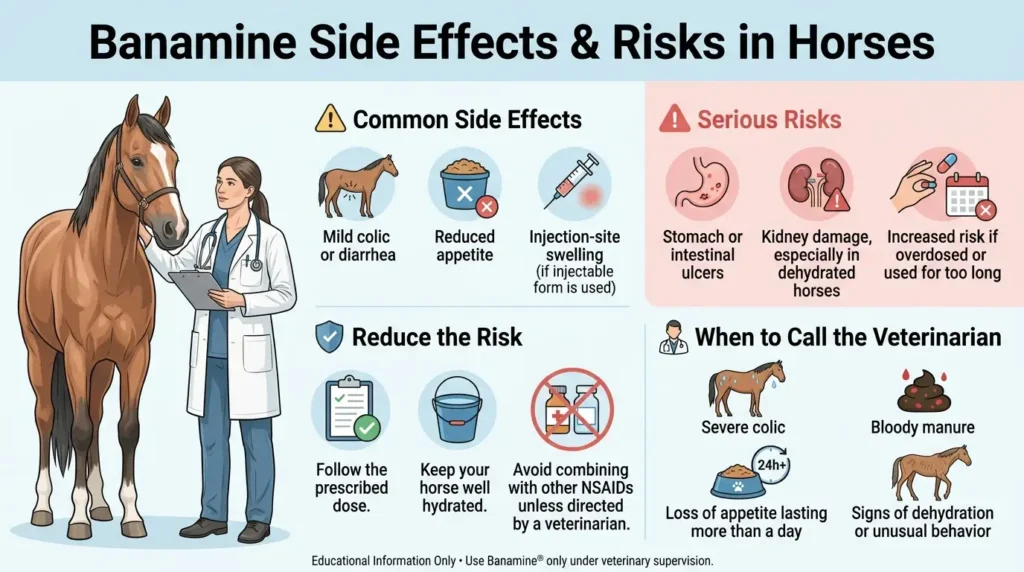
Used correctly, Banamine is well-tolerated by most healthy horses. Overdosing, use for a long period of time, dehydration or use in horses prone to kidney or GI problems tend to cause problems. Watch for:
- GI ulceration – decreased appetite, slight signs of colic or dark/tarry manure with long-term use
- Kidney stress – particularly in a dehydrated horse, as NSAIDs cause decreased blood flow to the kidneys.
- Injection site reactions (swelling, sensitivity or in rare cases of IM, clostridial myositis, see above)
- Signs of intra-arterial injection (when IV misplaced) — short-lived incoordination, muscle weakness or agitation; these effects will pass but do need urgent veterinary treatment.
When not to use Banamine without veterinary guidance:
- Foals or very young horses
- For pregnant mares (Safety has not been determined for Banamine paste alone).
- Use with other NSAIDs or corticosteroids (such as phenylbutazone/”bute”) without veterinary supervision — combination of anti-inflammatories increases the risk of ulcers and kidney problems.
- In dehydrated horses
- Horses that are known to have hypersensitivity to flunixin meglumine.
Banamine (Flunixin Meglumine) for Horses: Key Precautions
- Banamine is a cyclo-oxygenase inhibitory NSAID, which can be gastrointestinal and renal toxic; sensitivity to adverse drug effects varies.
- Horses at greatest risk for renal toxicity are those receiving concurrent diuretic therapy, with pre-existing renal, cardiac and/or hepatic dysfunction, and those that are dehydrated.
- Do not mix Banamine drug for horses with other anti-inflammatory drugs (other NSAIDs or corticosteroid) or only do so under close observation to reduce the risk of gastrointestinal ulceration.
- Do not administer more than one NSAID at a time as giving multiple NSAIDs together increases the chance of side effects.
- Banamine should not be given more often than every 12 hours except under veterinary supervision. A common mistake owners make is over-dosing, particularly if your dog is experiencing persistent pain or symptoms of colic.
- Do not use Flunixin meglumine in horses that are known to be sensitive to the drug.
- Banamine (injection and paste) has not been evaluated in regard to its effect on pregnancy.
At or after the recommended dosage, Banamine Paste has not been found to have any harmful effects on the spermatogenesis of a stallion.
No studies have been performed on the activity of Banamine when used in combination with other drugs; caution should be used when giving Banamine to horses that need additional/adjunctive therapy.
Banamine vs. Bute (Phenylbutazone): Quick Comparison
| Factor | Banamine (Flunixin) | Bute (Phenylbutazone) |
|---|---|---|
| Best for | Visceral/colic pain, fever | Musculoskeletal pain, lameness |
| Onset | Fast (~15 min oral, ~2 hrs peak systemic effect) | Slower onset, longer-acting |
| Common forms | Injectable, paste, powder | Paste, powder, tablets |
| Typical dose | 0.5 mg/lb (1.1 mg/kg) once daily | Varies by product; vet-directed |
| Can they be combined? | Not recommended without vet supervision — increases ulcer/kidney risk | Same |
Myth vs. Fact
Myth: “A little extra Banamine medicine can’t hurt and will work better.
Fact: More is NOT better; it increases both ulcer and kidney damage risk but doesn’t increase pain relief effectiveness. Follow the directions on the label.
Myth: “As long as I rotate sites and give injections into my muscles, it’s OK.
Fact: Site rotation will NOT remove the risk of clostridial myositis. Oral is better, safer than IM, for owners to give.
Myth: “If Banamine medication helps with the colic pain, then the colic is “solved”.
Fact: Relief of pain does not equal solution. Some severe colics (such as displacement or torsion) may appear to be better for a short time after Banamine and then progress as before. Be sure to keep your vet informed.
FAQs
What amount of Banamine can you feed to a horse?
The usual dosage is 0.5 mg per lb. (1.1 mg per kg) of body weight, one dose a day. That equates to 500 mg (10 mL of injectable solution) for a 1,000-lb horse.
How many times can you give a horse Banamine?
Every 24 hours for up to 5 days unless directed by your veterinarian.
Is it OK to give Banamine to my horse by injection (IM)?
It’s not recommended. Clostridial myositis is a rare but serious potential side effect of IM injection that is a bacterial infection. Owners can take them orally, which is safer.
How long does it take for Banamine to work in a horse?
It is rapidly absorbed when given orally, and has a peak effect of about 12-16 hours. Onset is usually in 2 hours when given IV by a vet.
Is there a danger of over dosing a horse with Banamine?
Yes. If taken in excess, it can cause ulcers and kidney damage. Research referred to on the label showed that a 3-fold dose could be administered daily for 10 days without causing any adverse reactions in healthy horses, but that is not a margin that could be safely applied at home — only the dose recommended on the label should be tried.
Can Banamine be given to pregnant mare?
The effects on pregnancy is not known specifically for the paste product; use in pregnant mares is recommended only under the supervision of a veterinarian.
Is it safe to administer Banamine in conjunction with bute (phenylbutazone)?
Never combine NSAIDs without veterinary guidance as this increases the risk of ulcer and kidney stress.
So, what is the difference between Banamine paste and injectable solution administered orally?
They both contain the same drug and dose (0.5 mg/lb) and the injectable solution can be safely administered orally rather than injected; many vets feel that this is a better alternative to giving as an IM injection, especially when administered by the owner.
What is the difference between Banamine and flunixin meglumine?
Yes — Banamine dose is the brand name while flunixin meglumine is the active ingredient. Compounded and generic versions contain the same active ingredient but should also be administered on the veterinarian’s advice.
Do horses develop a tolerance to Banamine?
In horses, tolerance is not as predictable as in other species where opioid administration is concerned and so the requirement for higher doses of a drug is unlikely to be related to tolerance over time, but rather the need for veterinary re-thinking of the treatment for the underlying condition.
How soon after withdrawal will Banamine be completely out of a horse’s system if it is used for a horse to compete?
It takes different regulatory bodies and formulations different times to withdraw. Please keep in mind these time frames change periodically and please consult the current guidelines from your competition’s governing body (e.g., USEF or FEI) and your veterinarian.
Final Thoughts
The Banamine Dosage For Horses isn’t too difficult to calculate, which is the key to getting it right: half a milligram per pound, one dose per day for up to five days. It’s all that stuff around that number that keeps your horse safe: weight, oral versus IM, warning signs, and your vet as a team player, not a last resort.
In fact, it is a good idea to have Banamine in your barn’s first-aid kit. Just be sure it has a plan: be sure to know the approximate weight of your horse before you start, know how to read the syringe markings and know that the first call — not the last — when something looks wrong is your veterinarian’s number.