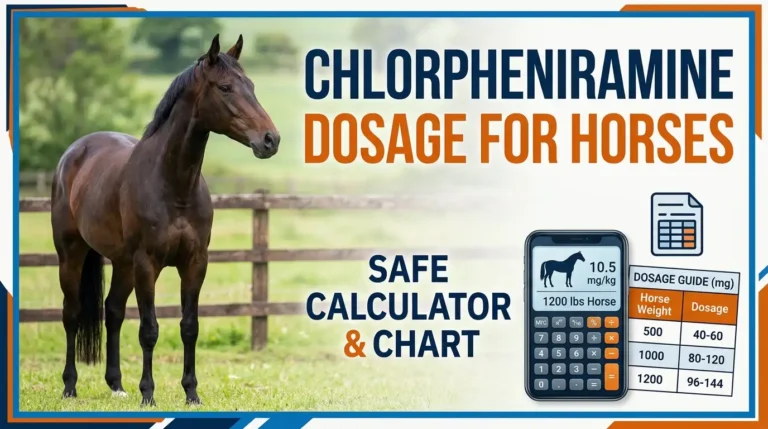
ReBalance Dosage for Horses: Weight Chart, Free Calculator and the Safe Way to Treat EPM
Written & Reviewed By: Medshorse Team
Last Updated: October 2026
The labeled ReBalance dosage for horses is 4 mL per 110 lb (50 kg) of body weight, given by mouth once a day. That equals 20 mg/kg of sulfadiazine and 1 mg/kg of pyrimethamine. Most horses stay on it for 90 to 270 days, depending on how they respond.
That is a long course, and the margin for error is smaller than most owners expect. Double the dose and the bone marrow takes the hit. Skip the monthly blood work and a problem can build quietly.
This guide gives you the full weight chart, a working calculator and the safety rules from the FDA-approved DailyMed label, so you can follow your vet’s plan with confidence.
ReBalance is a prescription drug for equine protozoal myeloencephalitis (EPM). Use this page to understand and double check your dose, not to start treatment on your own.
Disclaimer: This article is for general education and is not veterinary advice. Product names mentioned, including ReBalance, belong to their respective owners, and MedsHorse is not affiliated with them. Always follow your veterinarian’s instructions and the current product label.
ReBalance labeled dose for horses
4 mL
per 110 lb (50 kg) of body weight, by mouth, once a day
Active drugs
Sulfadiazine 20 mg/kg and pyrimethamine 1 mg/kg
Strength per mL
250 mg sulfadiazine and 12.5 mg pyrimethamine
Usual course
90 to 270 days, based on response
Timing
At least 1 hour before hay or grain
Monitoring
Complete blood count every month
Prescription only. Always follow your veterinarian’s written plan.
What Is ReBalance Antiprotozoal Oral Suspension?
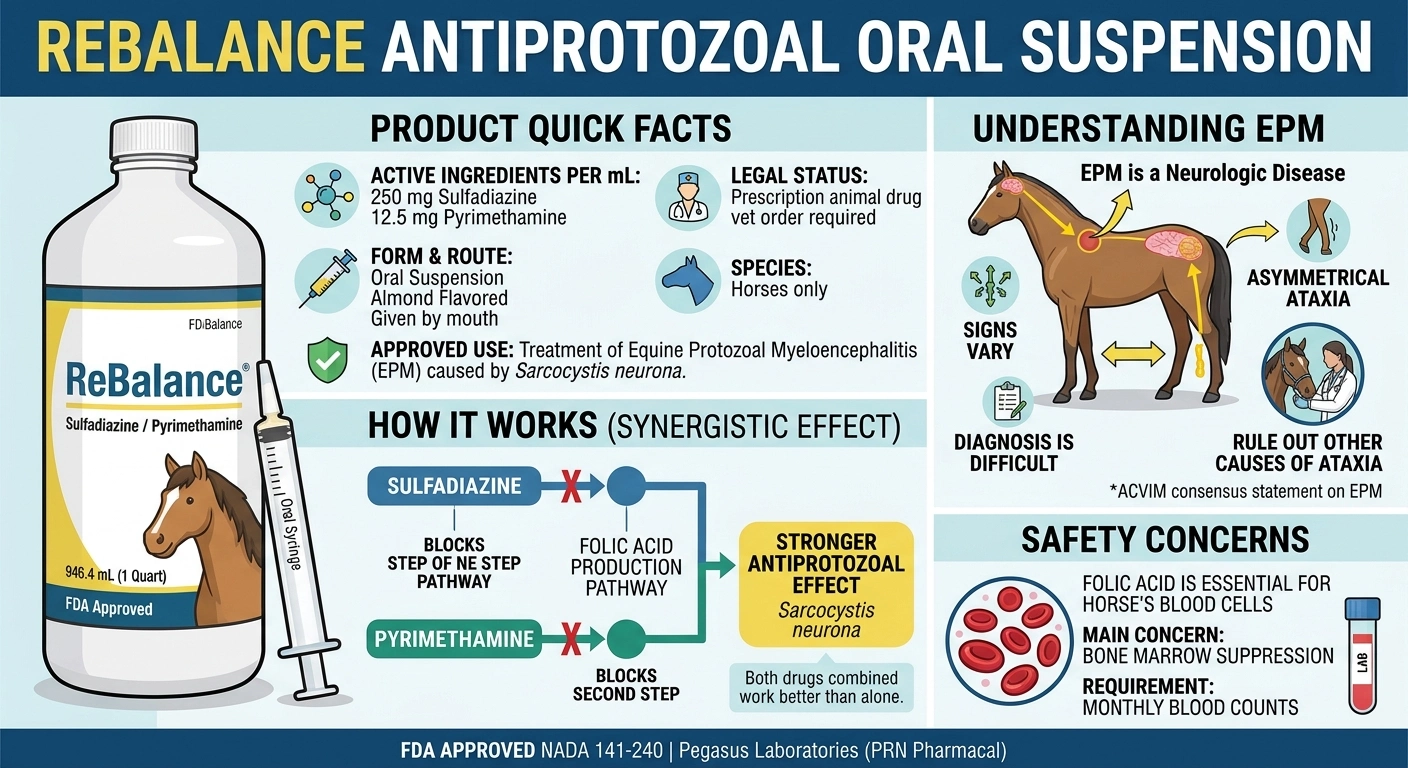
ReBalance is an FDA-approved prescription oral suspension for treating horses with equine protozoal myeloencephalitis (EPM) caused by Sarcocystis neurona. It combines two drugs, sulfadiazine and pyrimethamine, in a liquid that is dosed with an oral syringe.
It is approved under NADA 141-240 and made by Pegasus Laboratories, which is part of PRN Pharmacal. You can verify these details on the FDA-approved DailyMed label and the PRN Pharmacal product page.
| Product detail | What the label says |
|---|---|
| Active ingredients per mL | 250 mg sulfadiazine (as the sodium salt) and 12.5 mg pyrimethamine |
| Form and route | Oral suspension, almond flavored, given by mouth |
| Bottle size | 946.4 mL (1 quart) |
| Approved use | Treatment of EPM caused by Sarcocystis neurona |
| Legal status | Prescription animal drug, vet order required |
| Species | Horses only |
How ReBalance works
Sulfadiazine and pyrimethamine block folic acid production at two different steps in the same pathway. Together they have a stronger antiprotozoal effect than either one alone, which is why the label calls the combination synergistic.
That same folic acid pathway matters to your horse’s own blood cells. This is the reason bone marrow suppression is the main safety concern and why monthly blood counts are part of the plan.
What EPM looks like
EPM is a neurologic disease. Signs vary and no single sign is unique to it, so diagnosis can be difficult, as the ACVIM consensus statement on EPM explains. The label notes that EPM ataxia is usually asymmetrical and can affect the front limbs, the hind limbs or both. Your vet should rule out other causes of ataxia before treatment starts.
ReBalance Dosage for Horses: The Labeled Dose
The label dose is 20 mg/kg sulfadiazine and 1 mg/kg pyrimethamine daily, or 4 mL of ReBalance per 110 lb (50 kg) once per day. Because each mL holds a fixed amount of both drugs, one volume covers both.
| Measure | Labeled amount |
|---|---|
| Per 110 lb (50 kg) | 4 mL once daily |
| Per kilogram | 0.08 mL once daily |
| Per pound | About 0.036 mL once daily |
| Sulfadiazine | 20 mg/kg daily |
| Pyrimethamine | 1 mg/kg daily |
How to work out the dose yourself
- Get an accurate body weight, ideally from a scale.
- Divide the weight in pounds by 110, or the weight in kilograms by 50.
- Multiply the result by 4. That is the daily dose in mL.
- Example: a 1,100 lb horse is 1,100 / 110 = 10, and 10 x 4 = 40 mL per day.
- Compare your answer with the chart below and with your vet’s written dose.
Weight errors are the most common source of wrong doses. A weight tape is only an estimate, and a horse that has lost or gained condition during a months-long course may need a recheck. Ask your vet how often to update the weight.
ReBalance Dosage Chart by Horse Weight
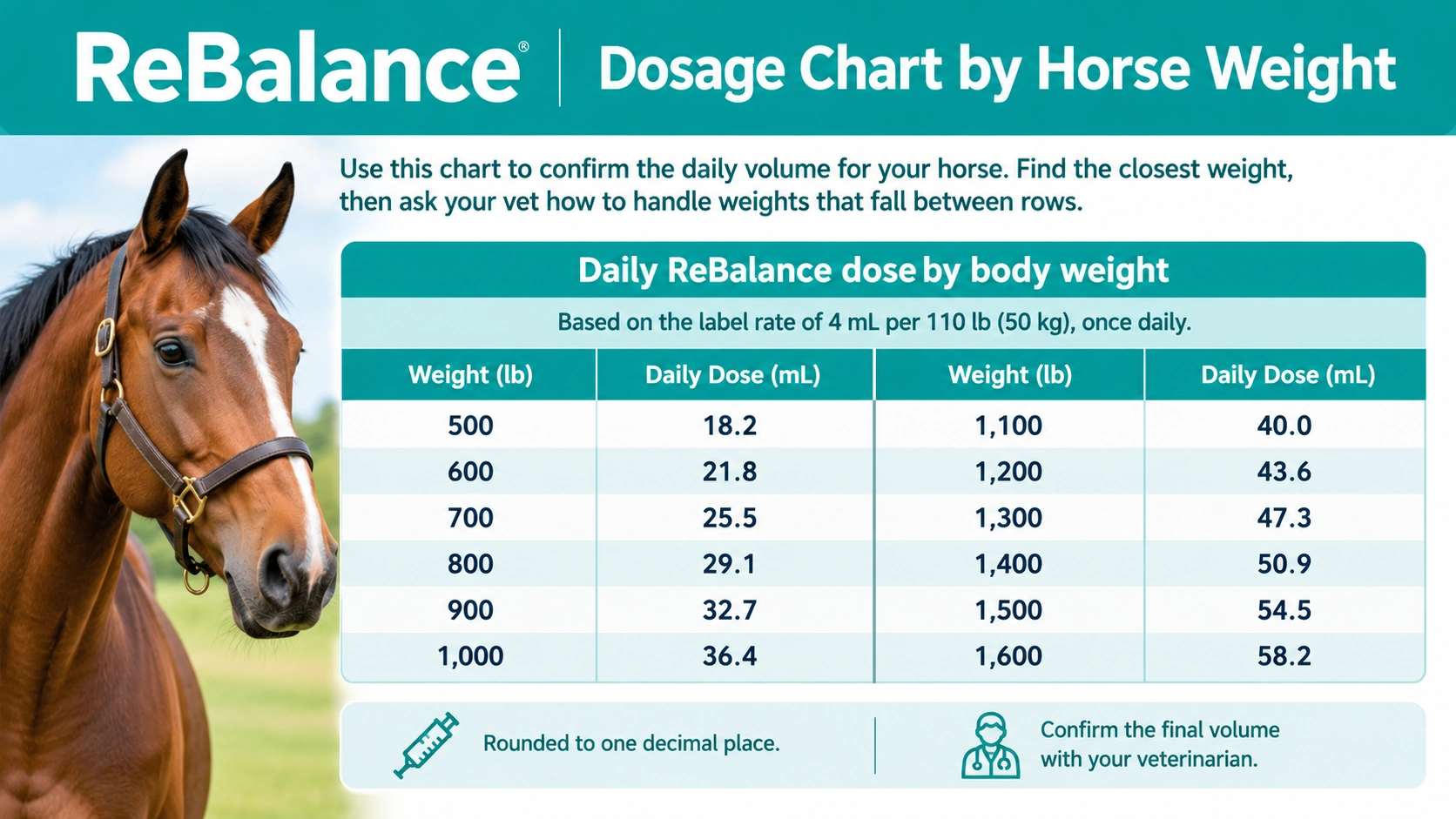
Use this chart to confirm the daily volume for your horse. Find the closest weight, then ask your vet how to handle weights that fall between rows.
Daily ReBalance dose by body weight
Based on the label rate of 4 mL per 110 lb (50 kg), once daily.
Rounded to one decimal place. Confirm the final volume with your veterinarian.
Dosage chart in pounds
| Weight (lb) | Weight (kg) | Daily dose (mL) | Sulfadiazine (mg) | Pyrimethamine (mg) | Days per 1 quart bottle |
|---|---|---|---|---|---|
| 300 | 136 | 10.9 | 2,727 | 136 | 86.8 |
| 400 | 181 | 14.5 | 3,636 | 182 | 65.1 |
| 500 | 227 | 18.2 | 4,545 | 227 | 52.1 |
| 600 | 272 | 21.8 | 5,455 | 273 | 43.4 |
| 700 | 318 | 25.5 | 6,364 | 318 | 37.2 |
| 800 | 363 | 29.1 | 7,273 | 364 | 32.5 |
| 900 | 408 | 32.7 | 8,182 | 409 | 28.9 |
| 1,000 | 454 | 36.4 | 9,091 | 455 | 26.0 |
| 1,100 | 499 | 40.0 | 10,000 | 500 | 23.7 |
| 1,200 | 544 | 43.6 | 10,909 | 545 | 21.7 |
| 1,300 | 590 | 47.3 | 11,818 | 591 | 20.0 |
| 1,400 | 635 | 50.9 | 12,727 | 636 | 18.6 |
| 1,500 | 680 | 54.5 | 13,636 | 682 | 17.4 |
| 1,600 | 726 | 58.2 | 14,545 | 727 | 16.3 |
| 1,700 | 771 | 61.8 | 15,455 | 773 | 15.3 |
| 1,800 | 816 | 65.5 | 16,364 | 818 | 14.5 |
| 2,000 | 907 | 72.7 | 18,182 | 909 | 13.0 |
Dosage chart in kilograms
| Weight (kg) | Weight (lb) | Daily dose (mL) | Sulfadiazine (mg) | Pyrimethamine (mg) |
|---|---|---|---|---|
| 200 | 441 | 16 | 4,000 | 200 |
| 250 | 551 | 20 | 5,000 | 250 |
| 300 | 661 | 24 | 6,000 | 300 |
| 350 | 772 | 28 | 7,000 | 350 |
| 400 | 882 | 32 | 8,000 | 400 |
| 450 | 992 | 36 | 9,000 | 450 |
| 500 | 1102 | 40 | 10,000 | 500 |
| 550 | 1213 | 44 | 11,000 | 550 |
| 600 | 1323 | 48 | 12,000 | 600 |
| 650 | 1433 | 52 | 13,000 | 650 |
| 700 | 1543 | 56 | 14,000 | 700 |
The label rounds 110 lb to 50 kg, so tiny differences can appear between the pound and kilogram charts. They are not clinically meaningful, and your vet’s number always wins.
Free ReBalance Dosage Calculator
Type in your horse’s weight to see the daily dose, the drug amounts and how many bottles a course needs.
© medshorse.com
How to Give ReBalance to Your Horse
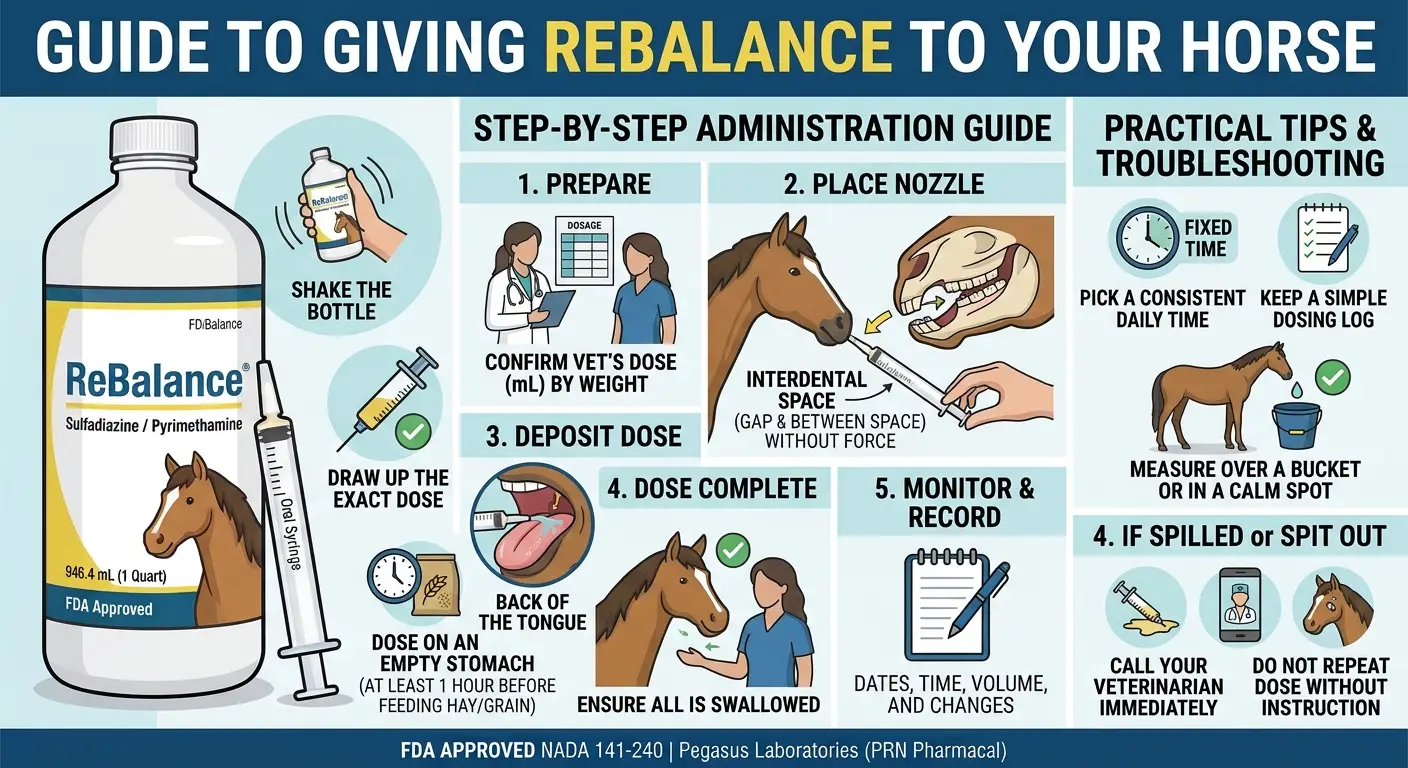
ReBalance is given by mouth with a dosing syringe, once a day, at least one hour before hay or grain. Shake it well first. Insert the nozzle through the interdental space and deposit the dose on the back of the tongue.
How to give ReBalance, step by step
Follows the administration directions on the product label.
Check the plan
Confirm your vet’s dose in mL for your horse’s current weight and the start date.
Shake the bottle
Shake well before every dose so the suspension is evenly mixed.
Draw up the dose
Fill an oral dosing syringe to the exact mark. Do not use kitchen spoons.
Dose on an empty stomach
Give it at least 1 hour before the horse eats hay or grain.
Place it on the tongue
Slide the nozzle through the gap between the front and back teeth and deposit the dose on the back of the tongue.
Practical tips from the barn
- Pick a fixed time each day so the empty stomach window is easy to protect.
- Keep a simple dosing log with date, time, volume and any changes in your horse. Your vet will want it at recheck visits.
- Measure over a bucket or in a calm spot so a head toss does not waste the dose.
- If your horse spits out or spills a large part of a dose, call your vet. The label does not say whether to repeat it.
How Long Does ReBalance Treatment Last?
The label says treatment length depends on clinical response, and the usual range is 90 to 270 days. A published industry review notes this is typically the longest course among the FDA-approved EPM drugs.
What a ReBalance treatment course looks like
The label gives a usual range of 90 to 270 days. Your vet sets the exact length.
Day 1 and the first days
Treatment starts. Worsened neurologic signs, called treatment crisis, can appear from the first few days.
Every month
A complete blood count is recommended each month to catch bone marrow suppression early.
Up to week 5
The treatment crisis window can extend to about 5 weeks, according to the label.
Around day 90
Minimum course length for most horses. The vet reassesses signs and may repeat testing to decide whether to continue.
Days 90 to 180
Treatment can continue in 30 day increments if the horse needs more time.
Up to day 270
A small number of horses in the field study were treated beyond 180 days, up to 270 days.
How much ReBalance you will need
A 1,000 lb horse uses about 36.4 mL per day, so one quart lasts roughly 26 days. Plan ahead for the whole course so your horse does not run out in the middle of treatment.
| Horse weight | Daily dose (mL) | 90 days (quarts) | 120 days (quarts) | 180 days (quarts) | 270 days (quarts) |
|---|---|---|---|---|---|
| 800 lb | 29.1 | 2.8 (buy 3) | 3.7 (buy 4) | 5.5 (buy 6) | 8.3 (buy 9) |
| 1,000 lb | 36.4 | 3.5 (buy 4) | 4.6 (buy 5) | 6.9 (buy 7) | 10.4 (buy 11) |
| 1,200 lb | 43.6 | 4.1 (buy 5) | 5.5 (buy 6) | 8.3 (buy 9) | 12.4 (buy 13) |
| 1,400 lb | 50.9 | 4.8 (buy 5) | 6.5 (buy 7) | 9.7 (buy 10) | 14.5 (buy 15) |
How Well Does ReBalance Work?
In the label’s field study, 16 of 26 horses (61.5 percent) that completed treatment at the labeled dose were counted as treatment successes. Success meant a negative CSF Western blot, or marked clinical improvement of two or more grades on a neurologic scale.
Field study results at the labeled dose
26 horses completed the study at the labeled dose (48 were assigned to that group).
Source: FDA-approved label effectiveness summary. The study used historical controls, meaning each horse was compared with its own pre-treatment signs.
Two honest limits apply. The study compared each horse with its own earlier signs rather than with a placebo group. And only the labeled dose was evaluated for effectiveness because the double dose caused too much toxicity.
Wider reviews put success for the main EPM drug classes at roughly 60 to 70 percent, according to a University of Kentucky research summary. No option works for every horse.
ReBalance Side Effects and Risks
The main risk is bone marrow suppression, which can cause anemia, leukopenia, neutropenia and thrombocytopenia. In the label safety data, these were more frequent and more severe at double the labeled dose.
Blood problems seen in the safety study
Share of cases with each finding in horses treated for at least 90 days.
Anemia
Low white blood cells (leukopenia)
Low neutrophils (neutropenia)
Low platelets (thrombocytopenia)
Double the labeled dose is not a recommended dose. It is shown here to explain why exact measuring matters. Source: FDA-approved label.
Other reported effects
- Loose stools, mostly in the first 30 days, and one case of diarrhea at the double dose.
- Reduced appetite, mostly in the first 90 days.
- Brief, mild colic in a few horses that resolved with little or no treatment.
- Hives, which resolved without lasting problems in the study.
- Seizures in one horse in the labeled dose group, which may relate to EPM damage in the central nervous system.
Treatment crisis
Some horses get worse before they get better. The label describes worsened neurologic deficits that can begin in the first few days and extend to about 5 weeks, possibly from inflammation around dying parasites. One horse in the labeled dose group had a marked worsening.
Do not stop or change the dose on your own if this happens. Call your vet. Supportive care may be adjusted, and some vets add anti-inflammatory medication. If your vet does, see our guides on the Banamine dosage for horses and the Previcox dosage for horses for how those drugs are dosed.
Why monthly blood counts matter
The label recommends a complete blood count every month. If counts fall, your vet may pause treatment or start support. The label notes that in some cases the diet was supplemented with folinic acid. In the dosing safety study, blood values returned to baseline 29 days after treatment ended.
What to report to your veterinarian
Call right away
- Seizures
- Sharp decline in balance or strength
- A horse that cannot stand
- Hives or swelling after a dose
- Signs of colic
Tell your vet this week
- Loose stool or diarrhea
- Reduced appetite or leaving feed
- Unusual tiredness or depression
- Pale gums, ask your vet whether this matters for your horse
- Any missed or spilled dose
Who Should Not Get ReBalance?
- Horses allergic to sulfonamides or pyrimethamine. The label lists known hypersensitivity as a contraindication.
- Horses intended for human consumption. The label says not to use it in these horses.
- Breeding stock and mares. Safe use in breeding horses, pregnancy and lactation has not been evaluated.
- Horses on other medications. Safety with other therapies has not been evaluated, so give your vet the full list.
ReBalance is for horses only and not for human use. Keep it out of the reach of children and wash your hands after handling.
Common ReBalance Dosing Mistakes
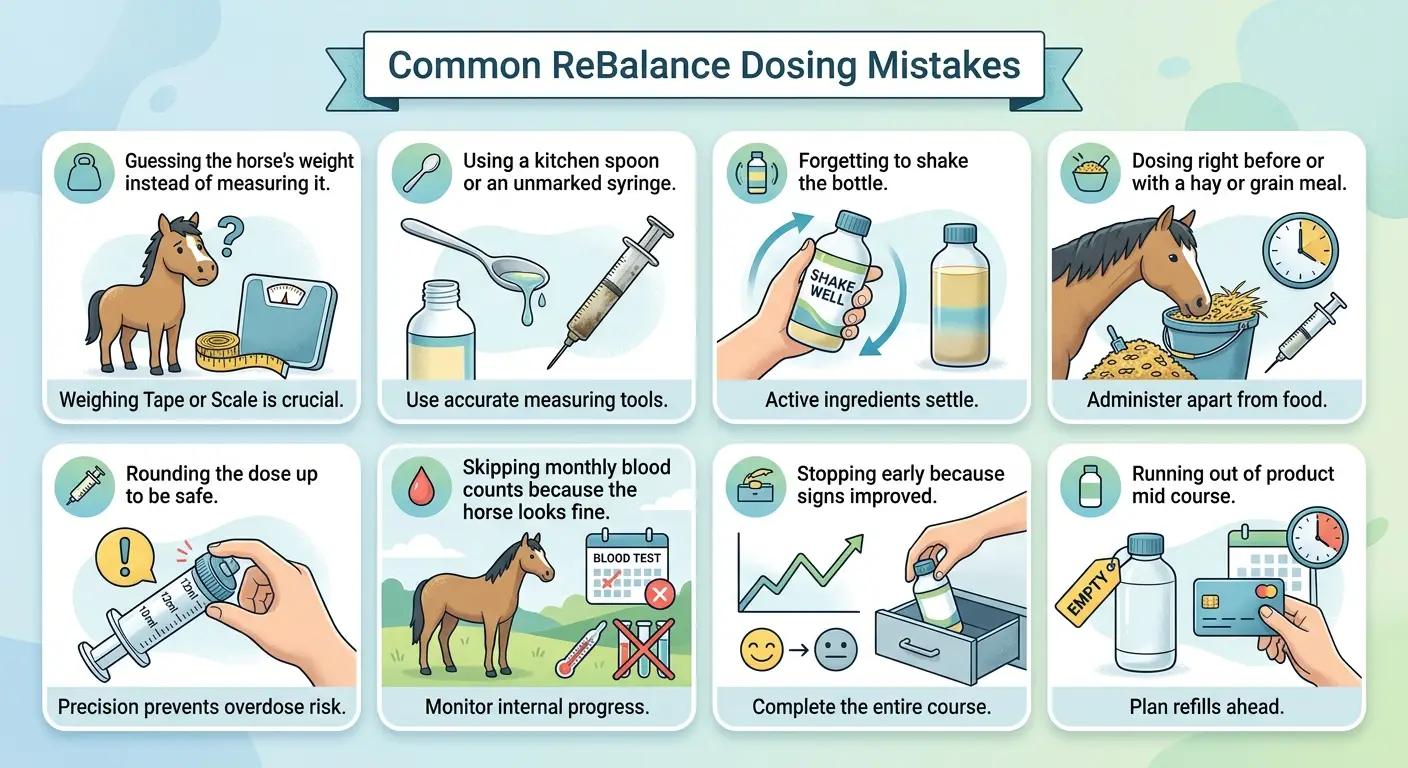
- Guessing the horse’s weight instead of measuring it.
- Using a kitchen spoon or an unmarked syringe.
- Forgetting to shake the bottle.
- Dosing right before or with a hay or grain meal.
- Rounding the dose up to be safe.
- Skipping monthly blood counts because the horse looks fine.
- Stopping early because signs improved.
- Running out of product mid course.
ReBalance vs Other EPM Treatments
ReBalance is one of several FDA-approved options for EPM. Your vet chooses based on severity, cost, ease of dosing and your horse’s history. Here is how the approved options compare, using figures from an industry review.
| Treatment | Form | Labeled dose | Typical duration | Notable points |
|---|---|---|---|---|
| ReBalance (sulfadiazine and pyrimethamine) | Oral suspension | 20 mg/kg and 1 mg/kg once daily | 90 to 270 days | Given on an empty stomach, needs monthly blood counts |
| Marquis (ponazuril) | Oral paste | 5 mg/kg | 28 days | Loading dose, given with vegetable oil |
| Protazil (diclazuril) | Pelleted top dress | 1 mg/kg | 28 days | Alfalfa based pellet fed in the ration |
Ponazuril is the generic name for toltrazuril sulfone. If your vet prefers that route, read our ponazuril dosage for horses and toltrazuril dosage for horses guides to see how that drug is dosed. Do not combine or switch EPM drugs without your vet.
Some vets also use sulfa combinations off label. Our sulfadiazine-trimethoprim dosage for horses guide covers that product on its own, and it is not interchangeable with ReBalance.
Storage and Handling
- Store at 68 to 77 degrees Fahrenheit. Excursions between 59 and 86 degrees are allowed.
- Protect it from freezing.
- Shake well before every use.
- Keep it in the original child resistant bottle and out of reach of children.
Where to Get ReBalance and What It Costs
You need a prescription from your veterinarian. PRN Pharmacal lists authorized sellers on its website, and your vet clinic or a licensed veterinary pharmacy can fill the order.
Prices change by seller and bottle and I could not verify current pricing, so check with your vet or pharmacy. Because a 1,000 lb horse can use about 3.5 quarts over 90 days, ask about the total cost of the full course, not just one bottle.
Preventing EPM and Supporting Recovery
- Store feed in sealed containers so wildlife cannot contaminate it. Opossums are the host that spreads the parasite.
- Feed hay and grain off the ground when you can.
- Reduce travel and other stress during treatment, since transport stress is a recognized EPM risk factor in the ACVIM consensus.
- Follow your vet’s rehabilitation and rest advice.
Key takeaways
- Label dose: 4 mL per 110 lb (50 kg) once a day.
- Give it at least 1 hour before hay or grain.
- Plan for 90 to 270 days and a monthly blood count.
- Never double the dose. It raises the risk of bone marrow suppression.
- Worse signs early on can be treatment crisis, so call your vet before changing anything.
FAQs
What is the ReBalance dosage for horses?
The labeled dose is 4 mL of ReBalance per 110 lb (50 kg) of body weight, given by mouth once a day. This equals 20 mg/kg of sulfadiazine and 1 mg/kg of pyrimethamine. Your veterinarian sets the final plan and treatment length.
How much ReBalance does a 1,000 lb horse get?
A 1,000 lb horse gets about 36.4 mL once a day at the labeled rate of 4 mL per 110 lb. A 1,100 lb horse gets 40 mL. Always confirm the exact volume with your veterinarian.
How many mL of ReBalance per pound of body weight?
The label rate works out to about 0.036 mL per pound, or 0.08 mL per kilogram. Multiply your horse’s weight by that number to get the daily dose in mL.
How long does a horse stay on ReBalance?
The label says the duration depends on clinical response, and the usual regimen runs 90 to 270 days. In the field study, treatment continued in 30 day increments after day 90 based on improvement and test results.
Should ReBalance be given with food?
No. The label directs you to give it at least one hour before feeding hay or grain. Shake the bottle well, place the syringe through the gap between the teeth, and deposit the dose on the back of the tongue.
What are the side effects of ReBalance in horses?
The most important risk is bone marrow suppression, which can cause anemia and low white blood cell, neutrophil and platelet counts. Other reported effects include loose stools, reduced appetite, mild colic, hives and rarely seizures.
Does ReBalance require blood work?
Yes. The label recommends a complete blood count every month during treatment to watch for anemia, leukopenia, neutropenia and thrombocytopenia. Your vet may pause treatment or add support if counts drop.
What is treatment crisis with ReBalance?
Treatment crisis is a worsening of neurologic signs that can begin in the first few days and last up to about 5 weeks. It may be an inflammatory reaction to dying parasites in the central nervous system. Call your vet if your horse gets worse.
How effective is ReBalance for EPM?
In the label field study, 16 of the 26 horses that completed treatment at the labeled dose (61.5 percent) were considered successes. The study compared horses with their own pre-treatment signs rather than a placebo group, so results should be read with that limit in mind.
Can I give a higher dose to speed up recovery?
No. At double the labeled dose, anemia, leukopenia and neutropenia were far more common and more serious, and treatment was interrupted over four times more often. Only the labeled dose was evaluated for effectiveness.
Is ReBalance safe for pregnant or lactating mares?
The label states that safe use in breeding horses, during pregnancy and in lactating mares has not been evaluated. Ask your veterinarian before using it in any mare or stallion.
Can I buy ReBalance without a prescription?
No. Federal law restricts ReBalance to use by or on the order of a licensed veterinarian. A vet needs to confirm the diagnosis and prescribe it for your horse.
Can horses that may enter the food chain get ReBalance?
No. The label warns not to use it in horses intended for human consumption. It is for horses only and not for human use.
What should I do if I miss a dose?
The label does not give missed dose instructions. Call your veterinarian for guidance and do not double up the next dose to make up for it.
How should ReBalance be stored?
Store it at 68 to 77 degrees Fahrenheit, with brief excursions to 59 to 86 degrees allowed, and protect it from freezing. Keep it out of reach of children and shake it well before each use.
Is ReBalance the same as sulfa and trimethoprim tablets?
No. ReBalance is an FDA-approved suspension of sulfadiazine and pyrimethamine. Some vets use other sulfa combinations off label, but products are not interchangeable and doses differ, so never swap them without veterinary direction.
Final Thoughts and Next Steps
ReBalance works through a steady daily dose over months, and that is what makes accuracy and monitoring so important. Stay at the labeled 4 mL per 110 lb, give it before feeding, and keep up the monthly blood counts.
Your next steps are simple. Confirm your horse’s weight, check the dose against the chart or calculator above, write down your vet’s schedule for rechecks and blood work, and call your vet early if anything changes.
Sources and further reading
- FDA-approved DailyMed label (Pegasus Laboratories, revised December 2023)
- PRN Pharmacal product page
- ACVIM consensus statement on EPM (Reed et al., J Vet Intern Med, 2016)
- University of Kentucky EPM research summary
- Treating EPM: best practices and watch outs, Insight Equine
- PRN Pharmacal authorized sellers
This article is for education and does not replace veterinary advice. ReBalance is a prescription drug, and your veterinarian should set the dose and monitor your horse.