Sulfadiazine-Trimethoprim Dosage For Horses: Calculator, Chart & Safe Guide
Horse Sulfadiazine / Trimethoprim Dosage Calculator
Calculate oral dosing for Equisul-SDT® Liquid Suspension or Generic Oral Powder.
That’s the short version. A complete discussion of what is Sulfadiazine-trimethoprim dosage for horses, how the dosage will work with various sizes of horses, how to administer it, what side effects to be aware of, and when a reaction requires a call to the vet rather than a wait and see attitude is provided below.
This article is composed as a source of education to horse owners and caretakers. It does not substitute a prescription or a visit to your veterinarian, who will verify dose, frequency and duration depending on the infection and health condition of your horse.
Quick answer: The FDA-approved dose of sulfadiazine-trimethoprim (brand name Equisul-SDT®) for horses is 24 mg combined active ingredients per kilogram of body weight (10.9 mg/lb), given orally twice a day for 10 days. For a 1,000 lb (454 kg) horse, that works out to about 10.9 mL of the 400 mg/mL oral suspension per dose, or roughly 2.7 mL per 100 lb. Generic trimethoprim-sulfadiazine powders and pastes are occasionally dosed a bit differently – up to 30 mg/kg in a single dose or twice a day – so the actual amount will always be different depending on the product and what your veterinarian has prescribed.
What Is Sulfadiazine-Trimethoprim?

Sulfadiazine-trimethoprim is an antibiotic mixture that is used to treat bacterial infections in horses. It combines two drugs, sulfadiazine and trimethoprim, which by themselves can only slow down bacteria, but when combined, actually kill them. Equisul-SDT is an oral suspension of horses, flavored with apples, which is the FDA-approved brand of Aurora Pharmaceutical.
The same drug combination is also available as Tribrissen, Tucoprim, Di-Trim or Uniprim, in powder, paste or tablet form, but only Equisul-SDT is currently approved by the FDA to be used in horses.
Drug Class: Potentiated Sulfonamide
Sulfadiazine-trimethoprim is a drug for horses that is part of a group of drugs known as potentiated sulfonamides – a sulfa drug that has been potentiated, or made stronger, by the addition of a second antibiotic of the diaminopyridine family.
A sulfonamide in itself is bacteriostatic (it prevents the multiplication of bacteria, but does not kill them directly). When trimethoprim is added, the two become a bactericidal combination, which is actively killing to bacteria that are susceptible.
How It Works (Mechanism of Action)
The two drugs disrupt the same bacterial pathway at two stages:
- Sulfadiazine inhibits an enzyme that bacteria utilize to turn para-aminobenzoic acid (PABA) into dihydrofolic acid – an initial step in the production of folic acid.
- Trimethoprim prevents this process, preventing dihydrofolic acid to become active folic acid.
To make proteins and reproduce, bacteria require folic acid. Horses, and other mammals, do not synthesize folic acid like bacteria do but obtain it through the diet, which is one of the reasons that this drug combination is specifically toxic to bacteria and not to the horse. It is also difficult to develop resistance to the pathway with only one mutation, as the pathway is blocked at two steps.
What Is Sulfadiazine-Trimethoprim Used to Treat in Horses?
FDA-Approved Use
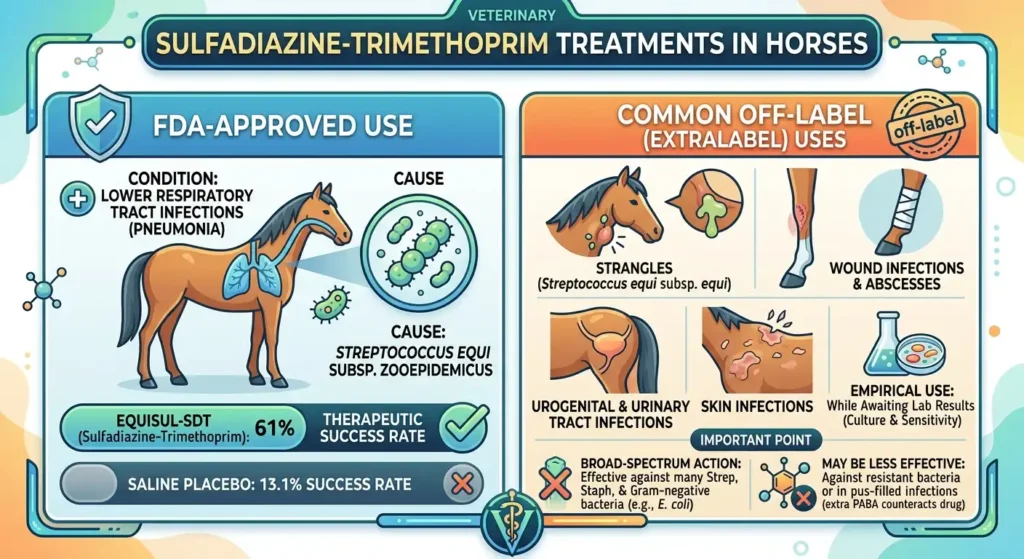
Equisul-SDT dosage for horses is approved by the FDA to treat only one condition: lower respiratory tract infections in horses caused by Streptococcus equi subsp. zooepidemicus, a bacterium that is a common cause of equine bacterial pneumonia and secondary respiratory infections.
In the critical field trial to the FDA, 61 percent of Equisul-SDT-treated horses were therapeutically successful, versus 13.1 percent of horses treated with saline placebo.
Common Off-Label (Extralabel) Uses
Other bacterial infections which veterinarians often treat with sulfadiazine-trimethoprim off-label (also called extralabel) include:
- Strangles (Streptococcus equi subsp. equi)
- Infection of wounds and abscesses.
- Urogenital and urinary tract infections.
- Skin infections
- Empirically, as awaiting bacterial culture and sensitivity results of a lab.
Off-label prescribing is a typical, lawful aspect of veterinary care when a licensed veterinarian decides it is suitable in the specific case – it just implies that it is not what is printed on the FDA label. This does not indicate that the drug is abused.
Important point: Sulfadiazine-trimethoprim is a broad-spectrum antibiotic that acts against most Streptococcus and Staphylococcus species and some gram-negative bacteria, such as E. coli. However, not all pathogens respond to any antibiotic – there are certain bacteria that are naturally resistant, and infections that are full of pus or dead tissue may counteract the effect of the drug since that material produces additional PABA that bacteria can use instead.
Sulfadiazine-Trimethoprim Dosage Chart for Horses
The FDA-approved dose of sulfadiazine-trimethoprim (brand name Equisul-SDT®) for horses is 24 mg combined active ingredients per kilogram of body weight (10.9 mg/lb), given orally twice a day for 10 days. For a 1,000 lb (454 kg) horse, that works out to about 10.9 mL of the 400 mg/mL oral suspension per dose, or roughly 2.7 mL per 100 lb. Generic trimethoprim-sulfadiazine powders and pastes are occasionally dosed a bit differently – up to 30 mg/kg in a single dose or twice a day – so the actual amount will always be different depending on the product and what your veterinarian has prescribed.
| Horse Weight | EQUISUL-SDT® Liquid(2.7 mL / 100 lb BID) | Oral Powder (24 mg/kg)(BID — q12h) | Oral Powder (30 mg/kg)(BID — q12h) | Oral Powder (30 mg/kg)(SID — q24h) |
| 500 lbs (227 kg) | 13.5 mL | 5.4 g (5,443 mg) | 6.8 g (6,804 mg) | 6.8 g (6,804 mg) |
| 750 lbs (340 kg) | 20.3 mL | 8.2 g (8,165 mg) | 10.2 g (10,206 mg) | 10.2 g (10,206 mg) |
| 1,000 lbs (454 kg) | 27.0 mL | 10.9 g (10,886 mg) | 13.6 g (13,608 mg) | 13.6 g (13,608 mg) |
| 1,100 lbs (499 kg) | 29.7 mL | 12.0 g (11,975 mg) | 15.0 g (14,969 mg) | 15.0 g (14,969 mg) |
| 1,200 lbs (544 kg) | 32.4 mL | 13.1 g (13,063 mg) | 16.3 g (16,329 mg) | 16.3 g (16,329 mg) |
| 1,500 lbs (680 kg) | 40.5 mL | 16.3 g (16,329 mg) | 20.4 g (20,412 mg) | 20.4 g (20,412 mg) |
Administration & Safety Guidelines
- EQUISUL-SDT® Oral Suspension: Shake well before use. Administer orally twice daily for 10 days. Insert an oral tip syringe into the bottle cap opening, invert the bottle to draw the calculated volume, and administer directly into the horse’s mouth.
- Oral Powder Formulations: Mix or top-dress with daily feed rations twice daily (q12h) or once daily (q24h) according to veterinary instructions.
- Active Ingredient Measurement: Gram figures represent total active drug combined (Sulfadiazine + Trimethoprim). Always verify specific powder concentrations on commercial brand packaging before dosing.
Generic Trimethoprim-Sulfadiazine Powder or Paste
Powder and paste product dosing (Tribrissen 2, Tucoprim 2, Di-Trim 2, Uniprim 2, and compounded formulas) is typically in the range of 24-30 mg/kg, administered either once or twice per day, depending on the infection treated.
These products differ in strength (mg/scoop or per gram), so there is no universal volume chart, always use the scoop or scale method indicated on the label of that particular product, and check the plan with your prescribing veterinarian.
Quick fact: The Merck Veterinary Manual gives two reference doses of trimethoprim-sulfadiazine in horses: 24 mg/kg PO q12h, or 30 mg/kg PO q1224h, which represents the range of different products and clinical scenarios.
How to Give Sulfadiazine-Trimethoprim to a Horse
- Shake the bottle thoroughly between doses – the suspension separates between doses.
- Fill up the prescribed volume with an oral dosing syringe.
- Place the syringe in the corner of the mouth of the horse, above the tongue, but at an angle, back of the mouth.
- Press the plunger gradually allowing the horse time to swallow instead of overdosing at once.
- Take on a relatively empty stomach. Food does not have a major effect on the absorption of sulfadiazine, but it does decrease the amount of trimethoprim absorbed – many vets suggest giving it prior to eating or with a small amount of food.
- Have fresh water at all times. Both medications are excreted mainly by the kidneys, and proper hydration will ensure that no crystals of sulfa are formed in the urine.
- Complete the entire course, though your horse may be looking and behaving better in a couple of days. One of the most widespread causes of antibiotic resistance is the premature termination.
What If You Miss a Dose?
Take the missed dose immediately you remember. When it is nearly time to take the next scheduled dose, do not take the missed dose but continue with the regular schedule – never take two doses to catch up. In case of uncertainty, call the office of your veterinarian; they might have to change the remaining schedule a little.
Side Effects of Sulfadiazine-Trimethoprim in Horses
Common, Mild Side Effects
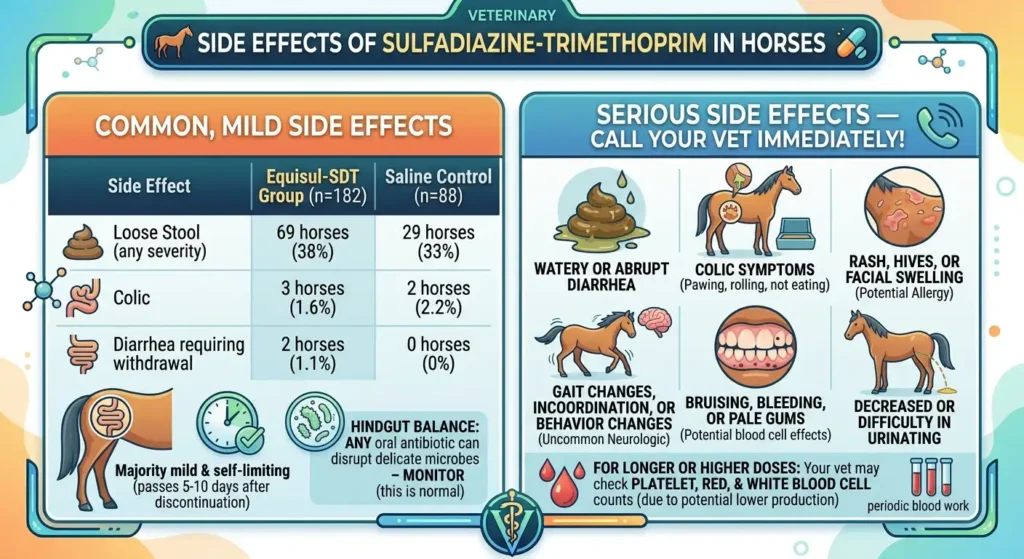
In the FDA field trial of 182 horses that received Equisul-SDT, the most common side effect was:
| Side Effect | Equisul-SDT Group (n=182) | Saline Control (n=88) |
| Loose stool (any severity) | 69 horses (38%) | 29 horses (33%) |
| Colic | 3 horses (1.6%) | 2 horses (2.2%) |
| Diarrhea requiring withdrawal | 2 horses (1.1%) | 0 horses (0%) |
Majority of loose stool is mild and self limiting and it passes within 5-10 days of discontinuation of the drug without any further treatment. Since horses depend on a huge, delicate population of hindgut bacteria to digest their food, any oral antibiotic has some risk of disturbing that microbial balance – this is normal and worth monitoring, not necessarily an emergency itself.
Serious Side Effects — Call Your Vet
Call your veterinarian immediately in case you observe:
- Diarrhea that is watery or a very abrupt and dramatic alteration of manure consistency.
- Colic symptoms (pawing, rolling, not eating, looking at the flank)
- Rash or hives on the skin, swelling or severe itch of the face (potential allergy)
- Gait changes, incoordination, or behavior changes (uncommon neurologic effects with potentiated sulfonamides)
- Bruising, bleeding, or pale gums (may indicate effects of blood cells with long-term or high-dose use)
- Decreased or difficulty in urinating.
In case your horse requires a longer or higher dose of potentiated sulfonamides than normal, your vet might periodically check platelet, red blood cell, and white blood cell counts by running blood work, as lower production of blood cells has been linked to extended or increased dosing of potentiated sulfonamides.
Overdose: Signs and What to Do
Sulfadiazine in this combination has the higher risk of overdose of the two drugs, trimethoprim has a large margin of safety even at multiple times the standard dose. Signs of sulfonamide overdose or toxicity can include:
- Profuse diarrhea
- Neurologic or behavior change or other signs.
- Facial swelling
- Colic
- Elevated liver enzymes
- Excessively high blood potassium (may cause heart arrhythmias)
- Decreased platelet counts (defective clotting)
In case of a recent overdose, your vet might administer gastrointestinal decontamination to reduce additional absorption, and then provide supportive care as the horse excretion of the drug occurs.
Who Should Not Take Sulfadiazine-Trimethoprim (Contraindications)
Contraindicated or should be used with caution in horses with:
- Sulfonamides, sulfadiazine, or trimethoprim known allergy.
- Liver disease – sulfonamides are metabolized by the liver, and, in exceptional cases, have been associated with severe liver damage.
- Pre-existing blood cell problems (low platelets, anemia, low white cell counts)
- Renal failure, as both medications are eliminated by the kidneys.
- Stressful conditions – stressed horses seem to be more susceptible to antibiotic related diarrhea.
It should not also be used on horses which are to be consumed as human food.
Pregnant and Lactating Mares
Equisul-SDT for horses has not been officially tested in the safe use in breeding, pregnant or lactating mares. Both drugs cross the placenta, and potentiated sulfonamide use during pregnancy has been associated with an increased risk of congenital abnormalities, possibly related to folate deficiency.
This is why it is usually not administered during the initial stages of pregnancy but is administered more regularly in later stages of gestation in certain situations such as placentitis, when the good of the mare is much greater than the harm – a decision made by your veterinarian and not at home.
Foals
Safety has never been assessed in horses younger than one year, but the drug is currently used regularly by veterinarians to treat some infections in neonatal foals under strict supervision. When administering doses to foals, a veterinarian with experience in neonatal care must always give instructions.
Drug Interactions to Watch For
Your veterinarian must know all medications and supplements that your horse is taking prior to starting with this antibiotic. Theoretical or reported interactions are:
- Detomidine – concomitant use has been associated with fatal arrhythmias in horses.
- Phenothiazine tranquilizers (e.g., acepromazine) – contraindicated according to the drug label.
- Digoxin – sulfadiazine-trimethoprim can increase digoxin blood levels.
- Warfarin and other anticoagulants – effects may be enhanced.
- Methenamine – can be insoluble in urine in combination.
- Antacids – may decrease absorption of sulfonamides when administered concomitantly.
- Other hepatic drugs such as amiodarone, rifampin and some ACE inhibitors or ARBs which may interact through common liver enzyme pathways.
An interaction that is not on this list does not imply it is necessarily safe, it is simply not necessarily studied. The best thing to do is to disclose everything to your vet.
Sulfadiazine-Trimethoprim vs. Other Equine Antibiotics
| Antibiotic | Class | Typical Use | Route | Bactericidal? |
| Sulfadiazine-trimethoprim | Potentiated sulfonamide | Respiratory infections, strangles, wounds, UTIs | Oral | Yes (combination) |
| Penicillin G | Beta-lactam | Strep infections, wound infections | Injectable (IM/IV) | Yes |
| Doxycycline | Tetracycline | Respiratory infections, Lyme disease | Oral | Bacteriostatic |
| Ceftiofur | Cephalosporin | Respiratory and soft-tissue infections | Injectable | Yes |
| Metronidazole | Nitroimidazole | Anaerobic infections, some GI infections | Oral | Yes |
The primary practical benefit of sulfadiazine-trimethoprim is that it is oral and has been specifically approved by the FDA to be used in horses, so at-home treatment is more convenient than injectable options, but the correct antibiotic is always dependent on the bacteria in question, which is why culture and sensitivity testing is important when it comes to anything beyond routine, presumptive treatment.
Equisul-SDT vs. Generic Trimethoprim-Sulfadiazine
| Factor | Equisul-SDT® | Generic TMS (powder/paste) |
| FDA approval for horses | Yes (NADA 141-360) | Varies — some are approved for other species and used off-label in horses |
| Form | Oral liquid, apple-flavored | Powder, paste, or tablet |
| Standard dose | 24 mg/kg q12h | 24–30 mg/kg q12–24h (product-dependent) |
| Ease of dosing | Pre-measured by weight-based mL chart | Requires scoop/scale measurement, varies by product strength |
| Documented field-study safety data in horses | Yes, FDA-reviewed | Varies by product and manufacturer |
They both may work when prescribed correctly. Equisul-SDT benefits as horse-specific FDA approval and a standardized concentration, whereas generic and compounded forms can be more flexible or less expensive depending on the pharmacy.
Storage and Handling
- Store upright at 59–86°F (15–30°C); brief excursions up to 104°F (40°C) are tolerated.
- Protect from freezing.
- Bottles that have a draw-off cap (280 mL and 560 mL) should be disposed of 60 days after the seal is removed – see the label on your particular product.
- Store out of view of children and other animals.
- Put on gloves or wash hands post-handling and do not touch the skin, eyes, and mouth – sulfonamides may cause allergic reactions in sensitive individuals.
Myth vs. Fact
| Myth | Fact |
| “Human Bactrim (sulfamethoxazole-trimethoprim) is the same as horse TMS, so I can use what’s in my medicine cabinet.” | The active drugs are related but not identical (sulfamethoxazole vs. sulfadiazine), doses differ by species, and human products aren’t tested or approved for horses. Never substitute human medication. |
| “If my horse looks better after 3 days, I can stop early.” | Stopping early risks relapse and contributes to antibiotic resistance. Finish the full prescribed course unless your vet tells you otherwise. |
| “Loose stool means I should stop the antibiotic immediately.” | Mild, self-limiting loose stool is common and often doesn’t require stopping treatment — but watery diarrhea, colic, or a horse that seems unwell does warrant a call to your vet. |
| “More medication will clear the infection faster.” | Higher-than-prescribed doses raise the risk of toxicity (including dangerous blood potassium changes) without necessarily improving how fast the infection resolves. Stick to the prescribed dose. |
Common Mistakes Horse Owners Make With This Antibiotic
- Use of an estimate of weight rather than a scale or weight tape. Mistakes in dosing normally begin with a wrong body weight.
- Not shaking the suspension, leading to inconsistent drug concentration between doses.
- Confusion between mg/kg and mg/lb in reading the various product labels.
- Discontinuation of treatment when the symptoms are improved, instead of taking the entire course.
- Late administration of a missed dose and doubling the subsequent dose instead of administering it according to missed-dose recommendations.
- When there is a difference in concentration and label instructions between manufacturers, assuming that all the products in the TMS category are dosed the same way.
You May Also Like to Read:
- Psyllium Husk Dosage for Horses: Calculator, Chart & Complete Feeding Guide
- Panacur Dosage for Horses: Calculator, Weight-Based Chart & Complete Safety Guide
FAQs
What is the use of sulfadiazine-trimethoprim in horses?
It is most frequently used to treat lower respiratory infections caused by bacteria, such as pneumonia due to Streptococcus equi subsp. zooepidemicus, and is often used off-label in the treatment of strangles, wound infections, abscesses, and urinary tract infections.
What is the frequency of administration of sulfadiazine-trimethoprim in horses?
Equisul-SDT is administered twice a day (after 12 hours). Certain generic products are marked to be given once or twice a day according to the formulation – see the instructions of your veterinarian.
Is it possible to use trimethoprim-sulfadiazine with feed and my horse?
Small portions of feed are usually okay, but administering it on a fairly empty stomach can enhance the absorption of trimethoprim. Take the advice of your vet.
Is diarrhea from this medication dangerous?
Light, self-limiting loose stool is typical and typically goes away with treatment. Liquid diarrhea, particularly with dehydration or colic, requires immediate veterinary care as it may progress rapidly in horses.
Is it possible to administer sulfadiazine-trimethoprim to pregnant mares?
It has not been tested on pregnant mares and is not used in early pregnancy, but is sometimes used later in pregnancy by vets in very particular cases where the benefits of the drug outweigh the risks. This decision should always be made by a veterinarian.
Is a prescription required?
Yes. The federal law limits the use of sulfadiazine-trimethoprim products to use or on the order of a licensed veterinarian.
Can foals be given this antibiotic?
It has not been formally tested on safety in horses less than one year old, although veterinarians do use it in foals closely supervised when clinically suitable. Always foal dosing should be vetted.
Is trimethoprim-sulfadiazine effective in treating strangles?
It is often off-label in the treatment of strangles due to Streptococcus equi subsp. equi, but treatment choices are determined by the stage of infection and the presence or absence of abscesses – not all cases of strangles are treated with antibiotics at the discretion of your vet.
What is the average length of treatment?
The respiratory infection course studied by FDA takes 10 days, although the time spent on off-label use (wounds, UTIs, strangles) depends on the infection and the determination of your veterinarian.
Is sulfadiazine-trimethoprim safe to handle by humans?
Only to use on animals. Individuals who are allergic to sulfa or trimethoprim must not come in contact with the skin, eyes and mouth, and those who accidentally ingest or have an allergy response must immediately seek medical help.
Final Thoughts
One of the most convenient equine antibiotics is sulfadiazine-trimethoprim for horses dosage, which is useful in treating a wide variety of common bacterial infections, comes in a convenient oral liquid form and has actual FDA field-study data on efficacy and safety. It is not a complex dosing calculation once you have the correct weight of your horse and the mg/kg rate of the particular product, but the fact that there is only a small difference between an effective dose and a dangerous dose is precisely the reason why this drug remains a prescription drug.
Check your sanity against what you have been told with the calculator and chart above, observe closely the consistency of manure and appetite during treatment, and finish the entire course prescribed by your veterinarian. In case of any uncertainty regarding a dose, side effect, or a dose omission, a quick call to the office of your vet is never the wrong decision.