Oxytetracycline Dosage for Horses: Chart, Calculator and the Safety Rules Every Owner Should Know Before Any Injection
Written & Reviewed By: Medshorse Team
Last Updated: October 2026
Oxytetracycline is one of the oldest antibiotics in the barn, and one of the easiest to get wrong. The usual reference oxytetracycline dosage for horses is 6.6 mg per kg of body weight, given slowly into a vein every 12 to 24 hours. That number looks simple.
The details around it (concentration, route, dilution, speed and your horse’s gut) are what keep a treatment safe.
This guide gives you a weight chart, a working calculator, the dose for each condition, and a plain look at why product labels disagree. It is written to help you ask better questions and double check math. It is not a replacement for your veterinarian.
Disclaimer: This article is for general education and is not veterinary advice. Product names mentioned, including Oxytetracycline, belong to their respective owners, and MedsHorse is not affiliated with them. Always follow your veterinarian’s instructions and the current product label.
What Is Oxytetracycline and How Does It Work in Horses?
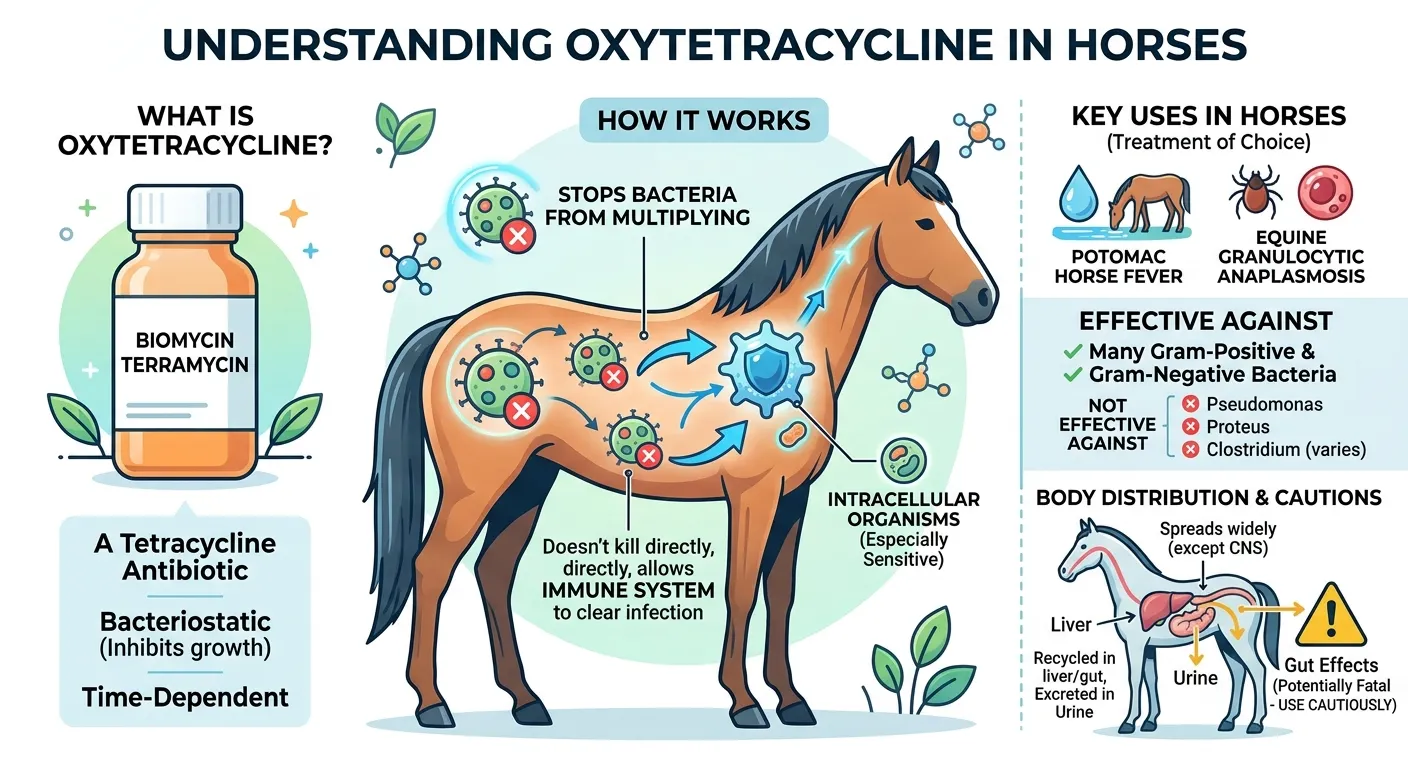
Oxytetracycline is a bacteriostatic, time-dependent tetracycline antibiotic. In plain terms, it stops bacteria from multiplying so the horse’s immune system can clear them. It works against many gram-positive and gram-negative bacteria, and intracellular organisms are especially sensitive.
According to the Ohio State University College of Veterinary Medicine guidelines, it spreads widely through the body except the central nervous system, is recycled through the liver and gut, and leaves mostly in urine.
It does not work against Pseudomonas or Proteus, and its effect on Clostridium varies. Common brand names include Biomycin and Terramycin.
Equine veterinarians reach for it for a few specific infections, which we cover below. The AAEP paper on long acting oxytetracycline notes that the drug is used cautiously in horses because of concerns over potentially fatal gut effects, yet it remains the treatment of choice for suspected or known Potomac horse fever and equine granulocytic anaplasmosis.
Oxytetracycline Dosage for Horses Chart by Weight
The chart below applies the 6.6 mg/kg IV reference dose listed in the MSD Veterinary Manual and the Ohio State guidelines. Pick your horse’s weight, then match the volume to the concentration printed on your vial. A 200 mg/mL vial needs half the volume of a 100 mg/mL vial for the same dose in milligrams.
Oxytetracycline dose chart for horses at 6.6 mg/kg IV
Reference math only. Your vet sets the final dose.
| Horse weight | Total dose | Volume at 100 mg/mL | Volume at 200 mg/mL |
|---|---|---|---|
| 200 kg (441 lb) pony | 1,320 mg | 13.2 mL | 6.6 mL |
| 300 kg (661 lb) | 1,980 mg | 19.8 mL | 9.9 mL |
| 400 kg (882 lb) | 2,640 mg | 26.4 mL | 13.2 mL |
| 450 kg (992 lb) | 2,970 mg | 29.7 mL | 14.9 mL |
| 500 kg (1,102 lb) | 3,300 mg | 33.0 mL | 16.5 mL |
| 550 kg (1,213 lb) | 3,630 mg | 36.3 mL | 18.2 mL |
| 600 kg (1,323 lb) | 3,960 mg | 39.6 mL | 19.8 mL |
| 700 kg (1,543 lb) | 4,620 mg | 46.2 mL | 23.1 mL |
How to Read the Chart
Start with weight, because dose scales with it. A weight tape is usually close enough for a healthy adult horse, but a scale is better for ponies, foals and thin or heavy horses. Guessing by eye is a common source of dosing errors.
Then read across to the volume that matches your product. The vet will also decide how much diluent to add, since some products allow dilution with saline and at least one UK data sheet says not to dilute its formulation.
Oxytetracycline Dose Calculator for Horses
Use this calculator to double check a dose your vet has already prescribed. Choose the dose rate your vet gave you, enter weight, and select the vial strength. It does the milligram and milliliter math instantly.
© medshorse.com
Worked Example: Oxytetracycline Dose for a 1,000 lb Horse
A 1,000 lb horse weighs about 454 kg. At 6.6 mg/kg, that is roughly 2,994 mg, so close to 3,000 mg. With a 100 mg/mL vial, the volume is about 30 mL. With a 200 mg/mL vial, it is about 15 mL.
Oxytetracycline Dose by Condition
The Ohio State guidelines list four main uses in horses, all extra-label. The drug is given IV, diluted and slowly. The length of treatment changes a lot between conditions, and Lyme disease is usually followed by a doxycycline course.
Treatment length by condition (bar scale: 4 weeks)
Some product labels also list strangles, bacterial pneumonia and enteritis in horses. A culture and sensitivity test helps your vet pick the right drug, so ask whether one makes sense before starting any antibiotic.
Related options your vet may weigh include penicillin dosage for horses, gentamicin for horses dosage chart and metronidazole dosage for horses.
Why Oxytetracycline Labels and Guidelines Disagree
If you read three labels, you may see three different horse doses. That is normal. Many oxytetracycline products are licensed for cattle or pigs, and horse use is often extra-label or comes with product-specific warnings. The table shows what the sources reviewed for this article actually say.
What different sources say about horse dosing
| Source | Horse dose and route | Key note |
|---|---|---|
| Ohio State vet guidelines | 6 to 6.6 mg/kg IV every 12 to 24 hours, by condition | Extra-label. Dilute and give slowly. Rapid IV can cause hypotension, collapse or kidney damage. |
| MSD Veterinary Manual | 6.6 mg/kg IV every 12 to 24 hours | Listed as extra-label drug use. |
| Engemycin 10% label (MSD Animal Health, South Africa) | 10 mg/kg IV or IM, which is 1 mL per 10 kg | IM in at least 2 sites, max 20 mL per site. IV over at least 1 minute. Lists strangles, pneumonia and enteritis for horses. |
| Elevet 100 mg/mL (AVet Health) | 5 mg/kg IM or IV (25 mL for 500 kg) | Long acting regimen not recommended for horses. Not for use with corticosteroids. Horse meat withholding period 28 days. |
| Biovet 10% solution | 3 to 5 mL per 100 kg, about 3 to 5 mg/kg | Label says not to give IV to horses, which conflicts with veterinary literature. A good reason to follow your vet, not a single label. |
| UK 100 mg/mL data sheet (NOAH Compendium) | 3 to 10 mg/kg IM or IV, repeated every 24 hours up to 5 treatments in total | Long acting regimen not advised for horses. Overdose is irritant, so avoid it especially in horses. |
100 mg/mL vs 200 mg/mL: Does the Difference Matter?
Yes. A 200 mg/mL vial holds twice the drug per milliliter. The milligram dose stays the same, but the volume drops by half. If someone draws up the 100 mg/mL volume from a 200 mg/mL vial, the horse gets double the intended dose.
Why Long Acting Products Are a Problem in Horses
The AAEP paper states that long acting oxytetracycline formulations are severely irritating when given IM to horses, so their use is avoided.
Several UK and Irish data sheets also say the prolonged action regimen is not advised or not recommended for horses. Cattle oxytetracycline on the farm shelf is not automatically a horse product.
How Oxytetracycline Is Given to Horses
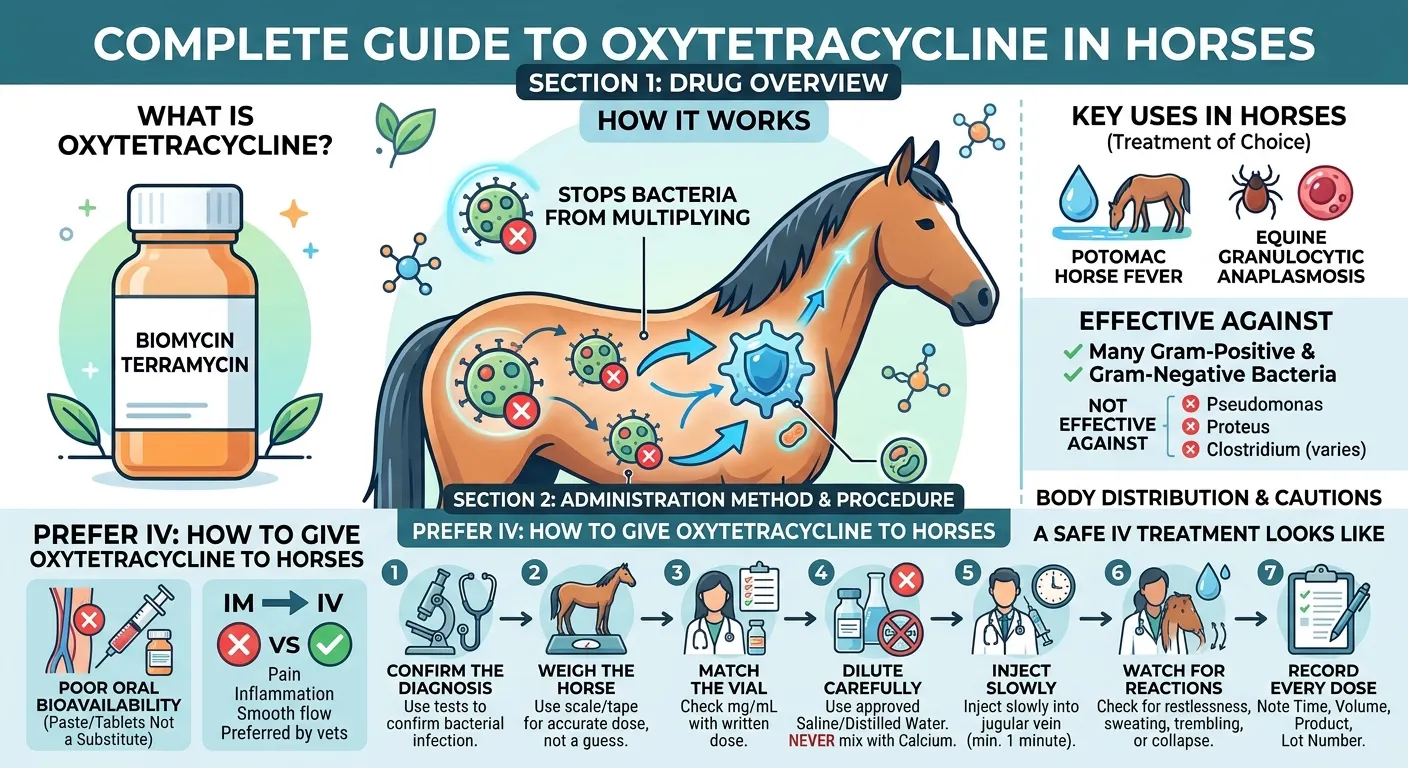
The drug usually goes into the jugular vein, slowly. Oxytetracycline has poor oral bioavailability, so tablets or paste are not a substitute. IM injections are used on some labels, but they can be painful and irritating in horses, which is why many vets prefer IV.
What a safe IV oxytetracycline treatment looks like
- Confirm the diagnosis. Ask whether a test supports oxytetracycline for this infection.
- Weigh the horse. Use a scale or weight tape, not a guess.
- Match the vial. Read the mg/mL and compare it with the vet’s written dose.
- Dilute only as the label allows. Use saline or distilled water where permitted. Never mix with calcium salts.
- Inject slowly into the vein. Labels call for at least one minute. Many protocols run slower.
- Watch the horse. Check for restlessness, sweating, trembling or collapse during and after.
- Record every dose. Note time, volume, product and lot number for the next visit.
Oxytetracycline Side Effects and Risks in Horses
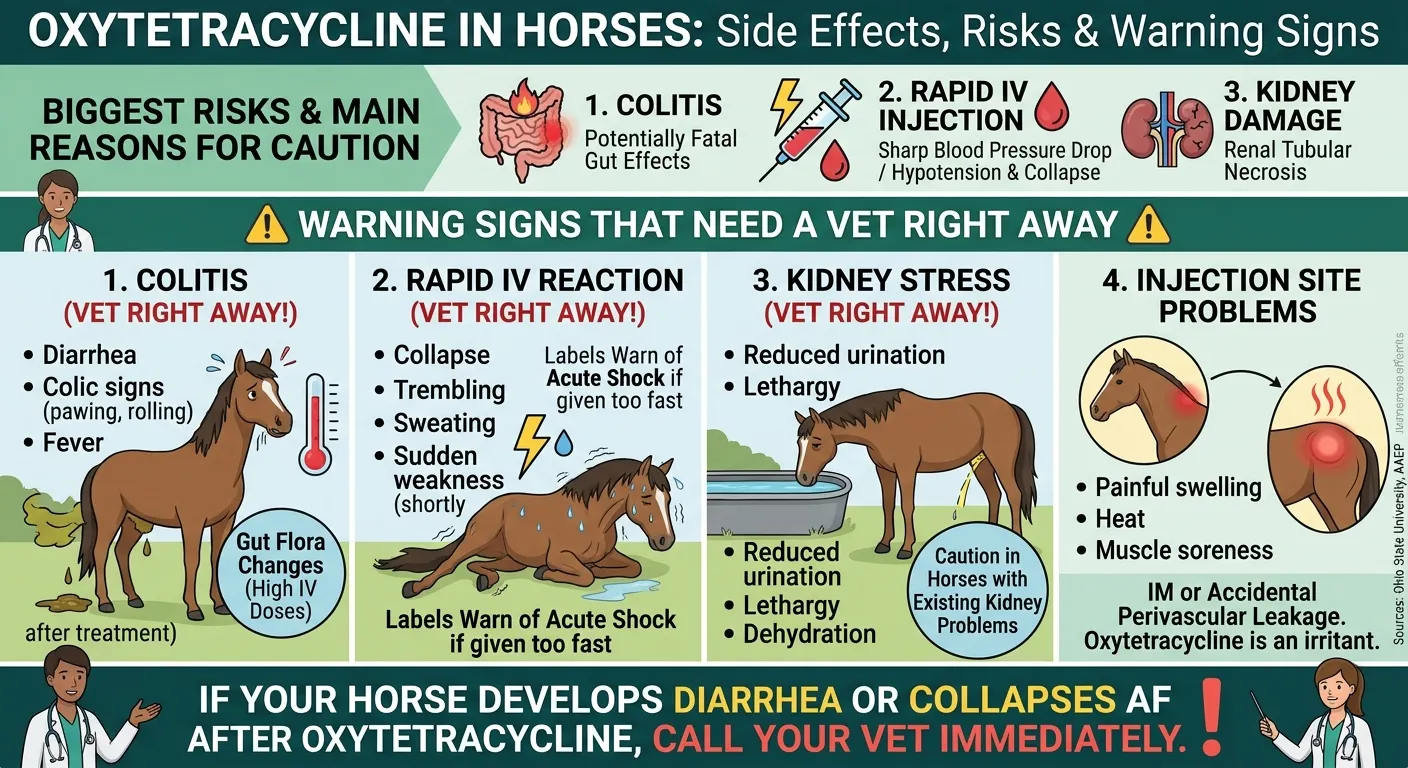
The biggest risks are colitis, a sharp drop in blood pressure from fast injection, and kidney damage. The AAEP paper describes potentially fatal gut effects as the main reason for caution. Ohio State warns that rapid IV administration can cause hypotension, collapse or renal tubular necrosis.
Warning signs that need a vet right away
Diarrhea, colic signs, fever, dullness or loss of appetite during or after treatment. Gut flora changes can follow high IV doses.
Collapse, trembling, sweating or sudden weakness shortly after injection. Labels warn of acute shock if given too fast.
Reduced urination, lethargy or dehydration. Use caution in horses with existing kidney problems.
Painful swelling or heat after IM or accidental perivascular leakage. Oxytetracycline is an irritant.
When Oxytetracycline Should Not Be Used in Horses
Avoid or use only with explicit vet approval in these situations:
- During treatment with corticosteroids. Several labels list this as a contraindication in horses. If your horse is on steroids, review dexamethasone dosage for horses with your vet first.
- Horses with kidney impairment.
- Horses with gut disturbances or under heavy stress. A UK data sheet advises caution in both.
- Known allergy to tetracyclines.
- Late pregnancy and young animals, because tetracyclines can discolor developing teeth, according to product labels.
- Any case where the vial is dark. Engemycin’s label says a darkened solution must be discarded.
Oxytetracycline vs Doxycycline for Horses
Both are tetracyclines, but they are used differently. Oxytetracycline is given IV in horses. The MSD Veterinary Manual lists doxycycline at 10 mg/kg by mouth every 12 hours (extra-label) and states it must never be given IV. Vets often use doxycycline as the oral follow up after IV treatment of Lyme disease.
Oxytetracycline vs doxycycline in horses
| Feature | Oxytetracycline | Doxycycline |
|---|---|---|
| Reference dose | 6.6 mg/kg IV every 12 to 24 hours | 10 mg/kg PO every 12 hours |
| Route | Slow IV (injectable) | Oral only, never IV |
| Oral absorption | Poor | Used orally in horses |
| Typical use | Short IV courses for anaplasmosis, Potomac horse fever, Lyme, proliferative enteropathy | Oral follow up, including after Lyme treatment |
| Main concern | Colitis, rapid IV collapse, kidney effects | Gut upset risk. Ask your vet to monitor. |
Other antibiotic choices depend on the infection and lab results. For comparison, see sulfadiazine-trimethoprim dosage for horses and Excede dosage for horses.
Oxytetracycline in Foals
Ohio State notes that oxytetracycline is also used for flexural limb deformity in foals, not because it kills bacteria but because of its effects on collagen-breaking enzymes, scarring and inflammation. This is a specialist use.
Foal dosing is not covered by the sources reviewed here, and I have not published a foal dose for that reason. If your foal has contracted tendons, your vet will build a plan around the foal’s weight and kidney health.
Common Mistakes Owners Make With Oxytetracycline
- Using the cattle dose per 10 kg on a horse without checking the label and route.
- Drawing up mL based on the wrong vial strength.
- Injecting too fast into the vein.
- Giving IM injections of a long acting product.
- Stopping early because the horse looks better.
- Combining it with corticosteroids without asking.
- Ignoring loose manure during treatment.
Withdrawal Times and Competition Rules
Withdrawal periods are set per product. The Elevet 100 mg/mL label lists 28 days before slaughter for human consumption in horses, and it adds that any change in dose, route or duration by the vet may extend the period. Engemycin lists 14 days for cattle meat, so never reuse another species’ number.
Show and sport bodies have their own medication rules, and I did not find a single standard that applies everywhere. Check your governing body’s current list and ask your vet about timing before you compete.
Questions to ask your vet before the first injection
- Which infection are we treating, and how do we confirm it?
- What is the exact mg/kg dose, and how many mL from my vial?
- Which route will you use, and who will give it?
- Should the product be diluted, and with what?
- How many days, and will a follow up drug like doxycycline be needed?
- Is my horse on any steroid or other drug that conflicts?
- What gut or kidney signs should make me call you?
- What are the withdrawal and competition timing rules?
Key takeaways
- The reference dose is 6.6 mg/kg IV every 12 to 24 hours, extra-label, given slowly.
- A 500 kg horse needs about 3,300 mg, or 33 mL of 100 mg/mL.
- Always check vial strength. 200 mg/mL means half the volume.
- Colitis, rapid IV collapse and kidney effects are the main risks.
- Avoid long acting products and IM use unless your vet directs it.
- Do not combine with corticosteroids where the label contraindicates it.
- Treatment length depends on the condition, from a few days to several weeks.
FAQs
What is the oxytetracycline dosage for horses?
The MSD Veterinary Manual lists 6.6 mg/kg IV every 12 to 24 hours as an extra-label dose for horses. Some product labels give different rates, from about 3 to 10 mg/kg. Your vet should confirm the dose for your horse’s condition.
How much oxytetracycline does a 1,000 lb horse need?
A 1,000 lb horse weighs about 454 kg. At 6.6 mg/kg, that is roughly 3,000 mg, or about 30 mL of a 100 mg/mL product or 15 mL of a 200 mg/mL product. Confirm with your vet before giving anything.
Can horses have oxytetracycline injections IM?
Some labels allow IM use, but long acting forms are severely irritating when injected into horse muscle according to the AAEP paper. Many vets prefer slow IV administration. Follow your vet’s instructions and the specific product label.
Is oxytetracycline safe for horses?
It is used by equine vets, but it carries real risks including colitis, collapse from fast IV injection and kidney damage. Safety depends on the right dose, product, route and speed, plus monitoring by a professional.
What is oxytetracycline used for in horses?
Ohio State lists anaplasmosis, Potomac horse fever, Lyme disease and proliferative enteropathy in foals. Some labels also list strangles, bacterial pneumonia and enteritis. Your vet decides whether it suits the infection.
Can I give oxytetracycline to my horse by mouth?
Oxytetracycline has poor oral bioavailability, so oral forms are not a substitute for the injection. Doxycycline, another tetracycline, is the oral option vets use in horses, at 10 mg/kg every 12 hours per the MSD Veterinary Manual.
How long does a horse stay on oxytetracycline?
It depends on the condition. Anaplasmosis is 5 to 7 days, Potomac horse fever up to 5 days, Lyme disease 7 to 10 days followed by doxycycline for 1 to 2 months, and proliferative enteropathy 2 to 4 weeks.
What are the side effects of oxytetracycline in horses?
Main concerns are colitis and diarrhea, hypotension and collapse after rapid IV injection, kidney stress and injection site irritation. Call your vet at once if you see diarrhea, colic signs or weakness.
Can I use cattle oxytetracycline on my horse?
Only with vet direction. Cattle products may be the same drug, but doses, routes and warnings differ, and several data sheets say long acting regimens are not advised or recommended for horses.
Can oxytetracycline be given with steroids?
Some labels, including Elevet and a UK data sheet, state it is contraindicated in horses during concomitant corticosteroid therapy. Tell your vet about any steroid your horse receives.
What is the difference between 100 mg/mL and 200 mg/mL oxytetracycline?
The 200 mg/mL vial has twice the drug per mL. The milligram dose is the same, but the volume is half. Using the wrong volume for the vial can double or halve the dose.
What should I do if my horse gets diarrhea after oxytetracycline?
Call your veterinarian right away. Antibiotic related colitis can become serious quickly, and your vet may stop the drug and start supportive care.
Is oxytetracycline used in foals?
Yes, in vet-directed cases. Ohio State notes its use for flexural limb deformity in foals because of its non-antimicrobial effects. Foal dosing should be set by a veterinarian.
Final Thoughts and Next Steps
The safe oxytetracycline dosage for horses comes down to four checks: the right weight, the right vial strength, the right route and the right speed. Use the chart and calculator to verify your vet’s numbers, not to replace them.
Your next step is simple. Write down your horse’s weight and the vial strength, then ask your vet to confirm the mg/kg dose, the mL volume and the planned days of treatment. If anything on the label looks different from what your vet told you, ask before the needle goes in.
Medical disclaimer: This article is for education and does not replace professional veterinary advice. Oxytetracycline is a prescription medicine in many regions, and horse use is often extra-label.
Sources and Further Reading
- Ohio State University College of Veterinary Medicine: Oxytetracycline (Equine)
- MSD Veterinary Manual: Dosages of Tetracyclines
- MSD Animal Health South Africa: Engemycin 10% label
- AVet Health: Elevet Oxytetracycline 100 mg/mL technical notes
- Biovet: Oxytetracycline 10% injectable solution leaflet
- AAEP 1999 via IVIS: Long Acting Oxytetracycline and Polyethylene Glycol in Horses
- NOAH Compendium: UK oxytetracycline data sheet