
Trazodone For Horses: Dosage Chart, Calculator Sedation, Risks & More
If your veterinarian has mentioned trazodone for your horse or you’ve seen it recommended for stall rest, anxiety, or a hospital stay you probably have two questions: does it actually work, and is it safe? The short answer is that trazodone can be a genuinely useful tool for confinement anxiety in horses, but it comes with real cardiovascular and behavioral risks, a narrow margin between “calm” and “over-sedated,” and a detail almost no one mentions it’s a banned substance in competition.
This guide pulls directly from the peer-reviewed equine pharmacokinetic studies, not marketing copy, so you know exactly what the science says.
Disclaimer: All information in this guide is provided for educational purposes only and should never replace professional veterinary advice.
What Is Trazodone, and Why Is It Used in Horses?
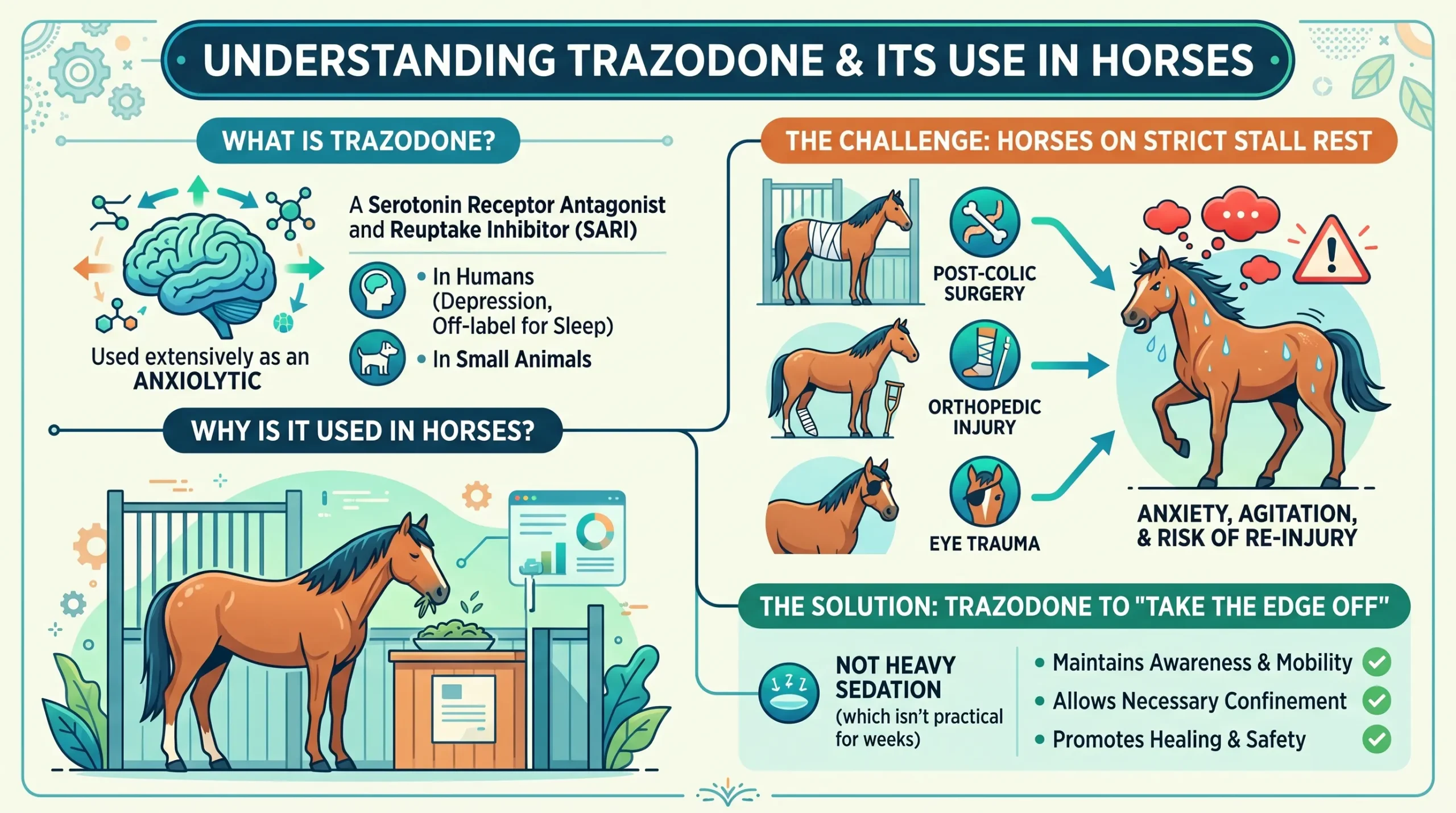
Trazodone is a serotonin receptor antagonist and reuptake inhibitor (SARI) used extensively as an anxiolytic in human and small-animal veterinary medicine. In people, it’s prescribed for depression and, more commonly today, off-label for sleep.
Horses are the newer frontier. Veterinary interest grew because horses on strict stall rest after colic surgery, orthopedic injury, or eye trauma often become so anxious or agitated that they risk re-injuring themselves.
Sedatives that knock a horse out completely aren’t practical for days or weeks of confinement, so clinicians started looking at trazodone as a way to take the edge off without heavy sedation.
How Much Trazodone Can I Give My Horse?
Trazodone dosing in horses is not one-size-fits-all. Published equine studies have used oral doses ranging from 2.5 mg/kg to 10 mg/kg, with most calming/anxiolytic effects seen in the 3.5–7.5 mg/kg range and higher doses (7.5–10 mg/kg) reserved for cases needing stronger sedation always under veterinary supervision.
There is no FDA-approved trazodone product for horses, so every dose is “extra-label” and should be prescribed by a veterinarian based on your horse’s weight, health status, and reason for treatment.
Below is a breakdown of the actual dosing data from peer-reviewed veterinary pharmacology studies, converted into both mg/kg and mg/lb so you can see exactly what’s been tested.
Trazodone Dosage Calculator for Horses
Estimate an extra-label trazodone dose range based on published equine dosing studies.
Estimated Trazodone Dose Range
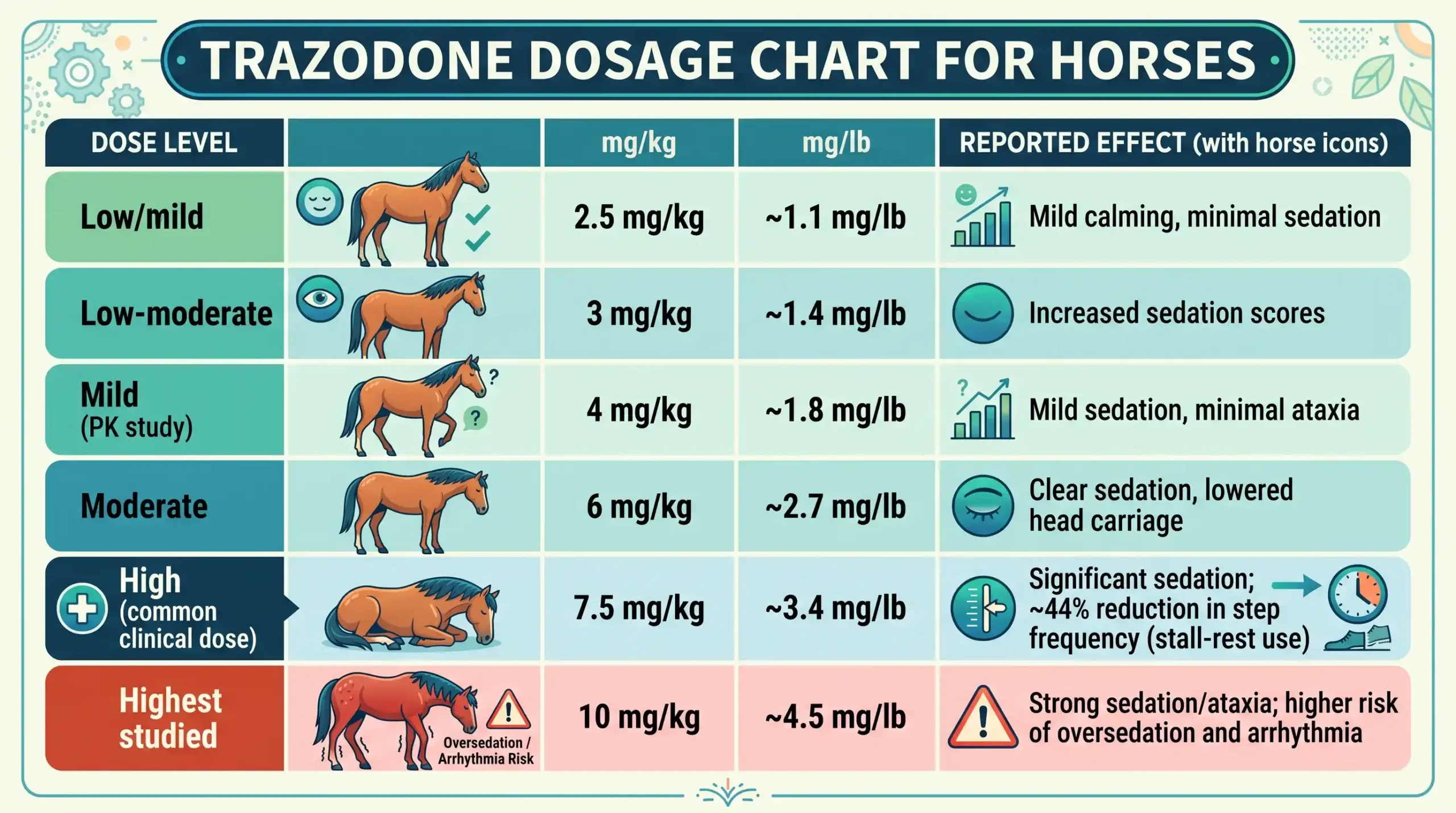
Trazodone Dosage Chart for Horses (mg/kg and mg/lb)
| Dose Level | mg/kg | mg/lb | Reported Effect |
|---|---|---|---|
| Low/mild | 2.5 mg/kg | ~1.1 mg/lb | Mild calming, minimal sedation |
| Low-moderate | 3 mg/kg | ~1.4 mg/lb | Increased sedation scores |
| Mild (PK study) | 4 mg/kg | ~1.8 mg/lb | Mild sedation, minimal ataxia in most horses |
| Moderate | 6 mg/kg | ~2.7 mg/lb | Clear sedation, lowered head carriage |
| High (common clinical dose) | 7.5 mg/kg | ~3.4 mg/lb | Significant sedation; ~44% reduction in step frequency (stall-rest use) |
| Highest studied | 10 mg/kg | ~4.5 mg/lb | Strong sedation/ataxia; higher risk of oversedation and arrhythmia |
What this looks like for an average-sized horse
For a typical 1,000 lb (454 kg) horse:
- 2.5 mg/kg ≈ 1,135 mg trazodone
- 6 mg/kg ≈ 2,725 mg
- 7.5 mg/kg ≈ 3,400 mg
- 10 mg/kg ≈ 4,540 mg
For a larger 1,200 lb (545 kg) horse:
- 2.5 mg/kg ≈ 1,360 mg
- 7.5 mg/kg ≈ 4,090 mg
- 10 mg/kg ≈ 5,450 mg
Since trazodone is typically dispensed in 50–300 mg human tablets, these clinical doses often work out to a large number of tablets per dose — which is one reason vets titrate carefully and sometimes start low.
How the Dosing Studies Break Down
Davis et al. (2018), Journal of Veterinary Pharmacology and Therapeutics: Six healthy horses received single oral doses of 7.5 and 10 mg/kg. Peak plasma levels occurred within 20–45 minutes, and the drug’s half-life ran about 7 hours.
In a separate review of 18 clinical cases at a veterinary teaching hospital, oral doses ranged from 2.5 mg/kg once daily up to 10 mg/kg twice daily, tailored to each horse’s response. Trazodone reduced problem behaviors (stall walking, weaving, pacing, kicking) in 17 of 18 horses, though 4 needed a dose reduction due to oversedation and 2 developed tolerance over time.
Knych et al. (2017), American Journal of Veterinary Research: Looked at a lower 4 mg/kg oral dose in horses undergoing fitness training and found it produced mild sedation with minimal ataxia in most animals, suggesting a dose-dependent response curve.
Hobbs et al. (2023), Journal of Veterinary Internal Medicine: Compared 2.5 mg/kg and 7.5 mg/kg given orally every 12 hours for 48 hours. Only the 7.5 mg/kg dose meaningfully reduced ambulatory step frequency (about a 44% drop), while 2.5 mg/kg had little measurable effect on movement.
Swanton et al. (2024), American Journal of Veterinary Research: Tested 3 mg/kg (low) and 6 mg/kg (high) doses and found both increased sedation scores, but interestingly the lower 3 mg/kg dose actually increased the amount of xylazine needed for subsequent sedation, complicating its use before procedures.
How Trazodone Works in a Horse’s Body
Trazodone is rapidly absorbed after oral administration in horses, with a peak plasma level at approximately 1.7 hours and a terminal half-life of approximately 7 hours. It’s metabolized into an active byproduct called m-chlorophenylpiperazine (m-CPP), which contributes to the drug’s effects, though the metabolite appears at low levels, making up only about 2.5% of total drug exposure.
Onset and duration: Expect noticeable sedation within roughly 1–2 hours of an oral dose, with effects that can persist up to 12 hours in some horses at higher doses. Because the half-life is around 7–10 hours, most protocols dose twice daily to maintain a steady effect — which is also why side effects can accumulate over several days of use.
What Vets Use Trazodone For in Horses
Stall rest and hospitalization anxiety
This is trazodone’s best-documented equine use. In a review of clinical cases, trazodone — used alone or alongside reserpine subjectively caused sedation and improved unwanted behaviors associated with stall rest in 94.4% of horses.
That’s a strong real-world success rate, though it comes from case review rather than a blinded trial.
Pre-anesthesia and procedural anxiolysis
Some hospitals give oral trazodone before anesthesia or before stressful handling (blood draws, catheter placement) to reduce fear-driven behavior. In one study, horses that were anxious about needles showed reduced shying and avoidance behavior after a 7.5 mg/kg dose.
That said, clinicians have also observed tachycardia and hypotension in some anesthetized horses given trazodone beforehand, so this use requires careful case selection.
Laminitis case management
Because reducing movement can help protect a laminitic horse’s feet, researchers tested whether trazodone would encourage horses to lie down more or walk less.
The results showed step frequency was significantly reduced by about 44% in horses given 7.5 mg/kg trazodone twice daily, but it did not change how often horses lay down or how long they stayed recumbent.
In other words: it may calm a laminitic horse enough to walk less, but it won’t reliably get them off their feet.
Side Effects and Safety Risks
Common side effects
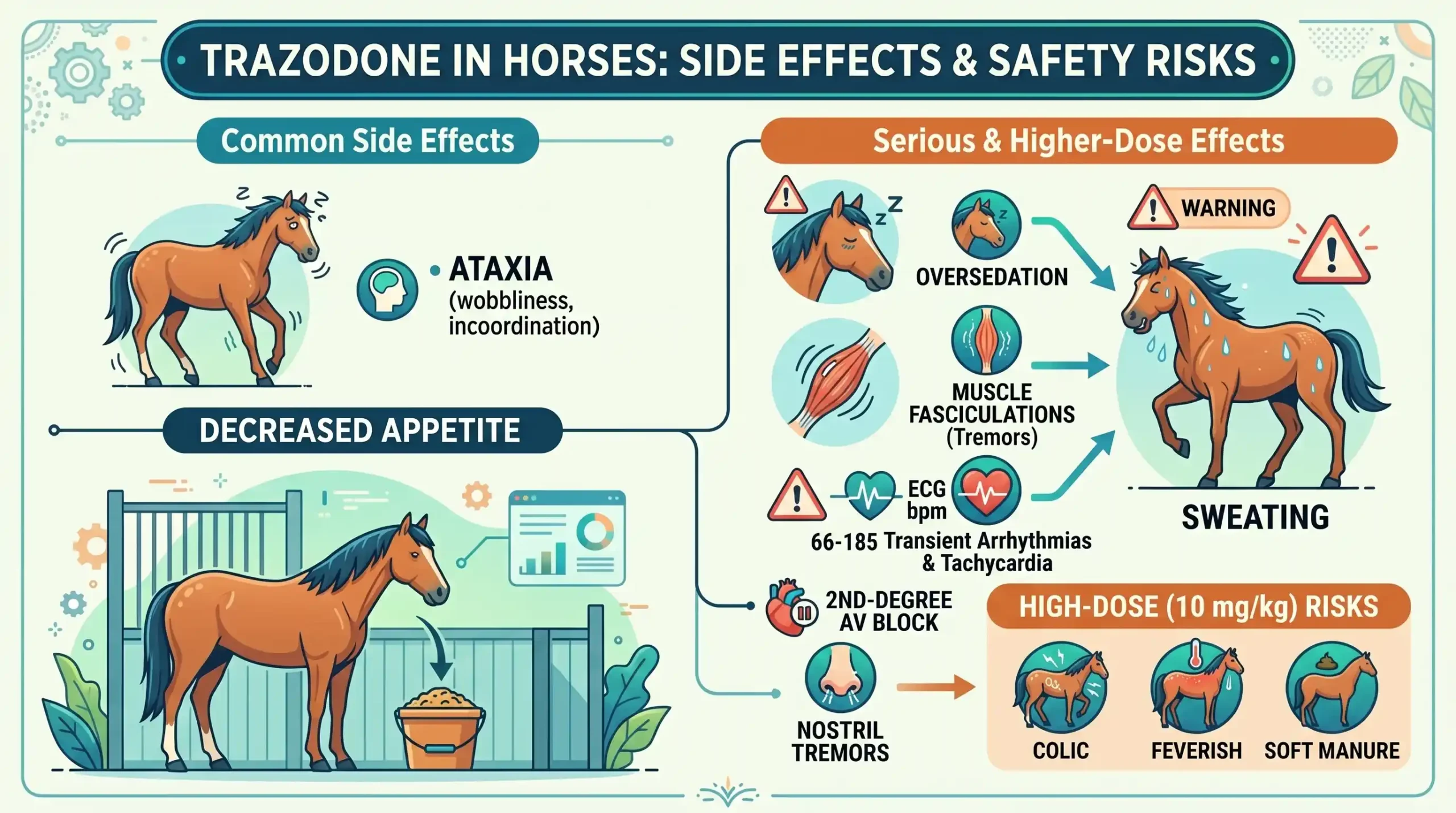
The most common adverse effects of oral trazodone in horses are ataxia (wobbliness/incoordination) and decreased appetite.
More serious or higher-dose effects
- Oversedation, muscle fasciculations, and transient arrhythmias have been reported in both experimental and clinical horses.
- One horse experienced a 55-minute episode of sinus tachycardia, with heart rate ranging from 66 to 185 bpm, along with muscle fasciculations and profuse sweating after a second dose.
- Some horses have shown minor, self-limiting adverse effects such as second-degree atrioventricular block and mild tremoring of the nostrils or muzzle.
- Colic, fever, and soft manure have been described in a horse given 10 mg/kg.
Horses that should not receive trazodone (or need extra caution)
- Because trazodone can cause ventricular irritability and possible QT interval prolongation, it should be used with caution in horses with pre-existing cardiac disease or on other drugs that prolong the QT interval.
- Horses already on other serotonergic medications (certain antidepressants, some pain medications) combining serotonergic drugs raises the risk of serotonin toxicity.
- If trazodone has been given daily and long-term, it should be tapered gradually typically over a minimum of 2 to 4 weeks rather than stopped abruptly, and tolerance with reduced drug effect has occurred in some horses after 14 to 21 days of use.
Trazodone vs. Other Equine Sedatives
| Drug | Class | Typical use case | Key trade-off |
|---|---|---|---|
| Trazodone | Serotonin antagonist/reuptake inhibitor | Stall rest anxiety, mild-to-moderate sedation | Cardiac risk at higher doses; onset takes 1–2 hours |
| Acepromazine | Phenothiazine tranquilizer | Short-term sedation, pre-procedure calming | Can cause hypotension; not for stallions (priapism risk) |
| Reserpine | Rauwolfia alkaloid | Long-term behavioral sedation | Slow onset (days); often combined with trazodone for refractory stall-rest cases, which performed better than reserpine alone |
| Diazepam | Benzodiazepine | Acute anxiolysis, seizures | Short-acting; heavily regulated |
Trazodone and Competition Drug Testing: What Owners Must Know
This is the section most trazodone articles skip, and it matters more than most owners realize. Because trazodone is sedating and could influence performance, it’s classified as a prohibited substance for competition horses under international and national equestrian rules.
This isn’t theoretical. In a case involving a horse competing at the Paris Olympic Games, trazodone was found in the horse’s blood after it had been present as an undeclared ingredient in a liquid feed supplement.
Investigators confirmed the contaminated supplement and used a segmented hair test from the horse’s tail to verify the exposure timeline. The outcome: the responsible person received a 5-month period of ineligibility, the horse was suspended for 2 months, and the entire national team’s results were disqualified.
The takeaway: if your horse competes under FEI, USEF, or similar rules, don’t assume a “calming supplement” is trazodone-free, and always ask your vet for a documented withdrawal period before any event never guess. Because plasma concentrations can remain detectable for up to 14 hours and hair testing can reveal exposure weeks later, a single accidental dose can carry consequences long after the horse feels normal again.
How to Give Trazodone to a Horse Safely
- Get an exact prescription from your vet: Dose, frequency, and duration should be individualized, not copied from a study or another horse’s protocol.
- Watch the first dose closely. Note heart rate, gait, and appetite for several hours; call your vet if you see stumbling, unusual sweating, or a racing pulse.
- Don’t combine with other sedatives or serotonergic drugs without your vet’s explicit sign-off.
- Never stop long-term use abruptly: Ask about a tapering schedule.
- Confirm withdrawal time before any competition, sale, or pre-purchase exam.
Read More:
FAQs
What is trazodone used for in horses?
Mainly to reduce anxiety and agitation during stall rest, hospitalization, or recovery from surgery or injury.
Is trazodone safe for horses?
It can be used safely under veterinary supervision, but it carries dose-dependent risks including ataxia, arrhythmias, and oversedation, and requires caution in horses with heart conditions.
How long does it take for trazodone to work in a horse?
One study reported a terminal half-life of nearly 10 hours at higher doses, meaning it can take well over a day to fully clear.
Can trazodone cause heart problems in horses?
Yes, it has been linked to ventricular irritability and possible QT interval prolongation, and cases of sinus tachycardia and AV block have been documented.
Is trazodone banned in horse competitions?
Yes. Because of its sedative and potentially performance-altering effects, it is classified as a prohibited substance under international equestrian anti-doping rules.
Can a supplement accidentally cause a positive trazodone test?
Yes, a documented case involved trazodone contaminating a liquid feed supplement, resulting in a doping violation at an elite competition.
Can trazodone be combined with other sedatives?
Sometimes vets pair it with reserpine for refractory stall-rest cases, but combining it with other sedating or serotonergic drugs should only be done under veterinary direction.
References:
- Davis, J.L., Schirmer, J., & Medlin, E. (2018). Pharmacokinetics, pharmacodynamics and clinical use of trazodone and its active metabolite m-chlorophenylpiperazine in the horse. Journal of Veterinary Pharmacology and Therapeutics, 41(3), 393–401.
https://pmc.ncbi.nlm.nih.gov/articles/PMC7167085/ - Hobbs, K., Luethy, D., Davis, J., Mallicote, M., Torcivia, C., Kulp, J., Stefanovski, D., Futterman, C., Cooper, F., & van Eps, A. (2023). The effects of orally administered trazodone on ambulation and recumbency in healthy horses. Journal of Veterinary Internal Medicine, 37(5), 1899–1906.
https://onlinelibrary.wiley.com/doi/10.1111/jvim.16821 - Swanton, W.E., Johnson, R., Zhao, Q., & Schroeder, C. (2024). Oral trazodone results in quantifiable sedation but does not result in a xylazine-sparing effect in healthy adult horses. American Journal of Veterinary Research, 85(11).
https://avmajournals.avma.org/view/journals/ajvr/85/11/ajvr.24.07.0185.xml - Joseph, E.J., Love, L., Mayakis, M., & Varner, K. (2025). Preanesthetic Administration of Trazodone Does Not Impact Anesthetic Recovery Scores in Horses. Animals, 15(19), 2907.
https://www.mdpi.com/2076-2615/15/19/2907 - Knych, H.K., Mama, K.R., Steffey, E.P., Stanley, S.D., & Kass, P.H. (2017). Pharmacokinetics and selected pharmacodynamics of trazodone following intravenous and oral administration to horses undergoing fitness training. American Journal of Veterinary Research, 78(10), 1182–1192.
https://avmajournals.avma.org/view/journals/ajvr/78/10/ajvr.78.10.1182.xml