Chasteberry Dosage for Horses: Weight Chart, Free Calculator and What the Research Really Says About Safety
Written & Reviewed By: Medshorse Team
Last Updated: October 2026
Chasteberry sits in a lot of tack rooms, usually next to a moody mare or a hairy senior who is late to shed. The tricky part is the scoop. Labels disagree, powders vary in density, and the herb acts on dopamine pathways, so it is not a harmless sprinkle.
Chasteberry dosage for horses usually falls between 5 and 20 grams of powder a day. A 500 kg (1,100 lb) horse typically gets about 10 grams, and ponies get roughly 2.5 to 5 grams. Follow your product label, and talk to your vet first if your horse has Cushing’s disease (PPID).
This guide gives you a weight chart, a calculator, product form conversions, a plain look at the research, and the safety rules most dosing pages skip. It is educational information and does not replace advice from your veterinarian.
Disclaimer: This article is for general education and is not veterinary advice. Product and brand names, including SmartPak, TriSana, Honeyvale Herbs, Annimally and Mad Barn, belong to their respective owners, and MedsHorse is not affiliated with them. Always follow your veterinarian’s instructions and the current product label.
What Is Chasteberry and What Does It Do in Horses?
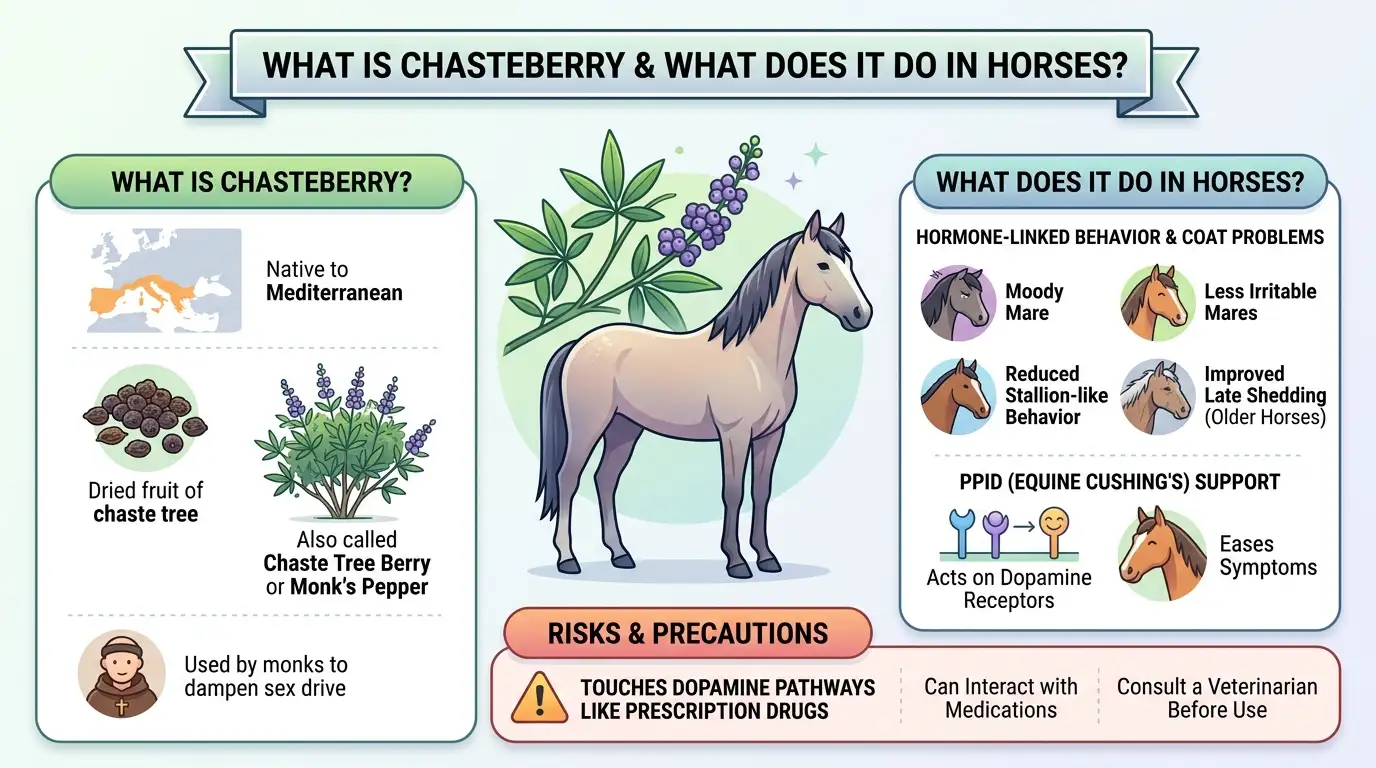
Chasteberry (Vitex agnus-castus) is the dried fruit of the chaste tree, a shrub native to the Mediterranean. It is also called chaste tree berry or monk’s pepper, a name that dates back to monks who used it to dampen sex drive.
Horse owners feed it for hormone-linked behavior and coat problems. The most common reasons are moody or irritable mares, stallion-like geldings, and older horses that shed late. Compounds in the berry appear to act on dopamine receptors, which is why it is also used as a PPID support herb.
That dopamine link explains both the appeal and the risk. A herb that touches the same pathway as prescription drugs can interact with them, which matters later in this guide.
Chasteberry Dosage for Horses: The Quick Answer
The typical chasteberry dose for an adult horse is 5 to 20 grams of powder once a day, with about 10 grams common for a 500 kg (1,100 lb) horse. One equine nutrition database lists a feeding rate of 5 to 20 grams per day for a 500 kg horse. Ponies get less, and larger horses sit at the top of the range.
These numbers come from product labels and feeding guides from TriSana, Honeyvale Herbs, Annimally and Mad Barn. They are manufacturer feeding rates, not clinical doses proven in trials. We found no official regulatory dose for horses.
Chasteberry Dosage Chart by Horse Weight
Expert tip: Weigh the powder on a kitchen scale at least once. Honeyvale Herbs lists 1 to 2 teaspoons as 5 to 10 grams, while TriSana lists 1 tablespoon as 7.5 grams. Density differs between products, so your scoop may not match anyone else’s.
Dosage by Product Form
Pure powder, pellets and liquid extracts contain very different amounts of chasteberry. Comparing grams of pellet with grams of pure powder is one of the most common dosing errors.Chasteberry Dose Calculator for Horses
Enter your horse’s weight to see a conservative, typical and upper figure. The calculator uses roughly 10, 20 and 40 mg per kg of body weight, capped at 20 g per day. That is simple arithmetic built from the published product ranges above, not a clinical dose.Follow the feeding directions provided by the manufacturer of the specific product you are using.
Do not use in pregnant or lactating animals unless directed by a veterinarian.
Do not use in immature, pregnant, or lactating animals.
Not for use in horses intended for food.
Consult a veterinarian before use if your horse is on medication or has a pre-existing condition.
How to Work Out the Dose Step by Step
- Weigh your horse with a weigh tape or scale. Guessing by eye is a common source of error.
- Pick the correct size class in the chart above, or use the calculator.
- Check whether your product is pure powder, pellet or liquid, and read its label.
- Start at the conservative figure for the first week.
- Move to the typical figure only if the horse eats it well and shows no digestive or skin changes.
- Do not go above the top of your product’s labeled range.
Dosage by Use: Mares, Geldings, Stallions and Seniors
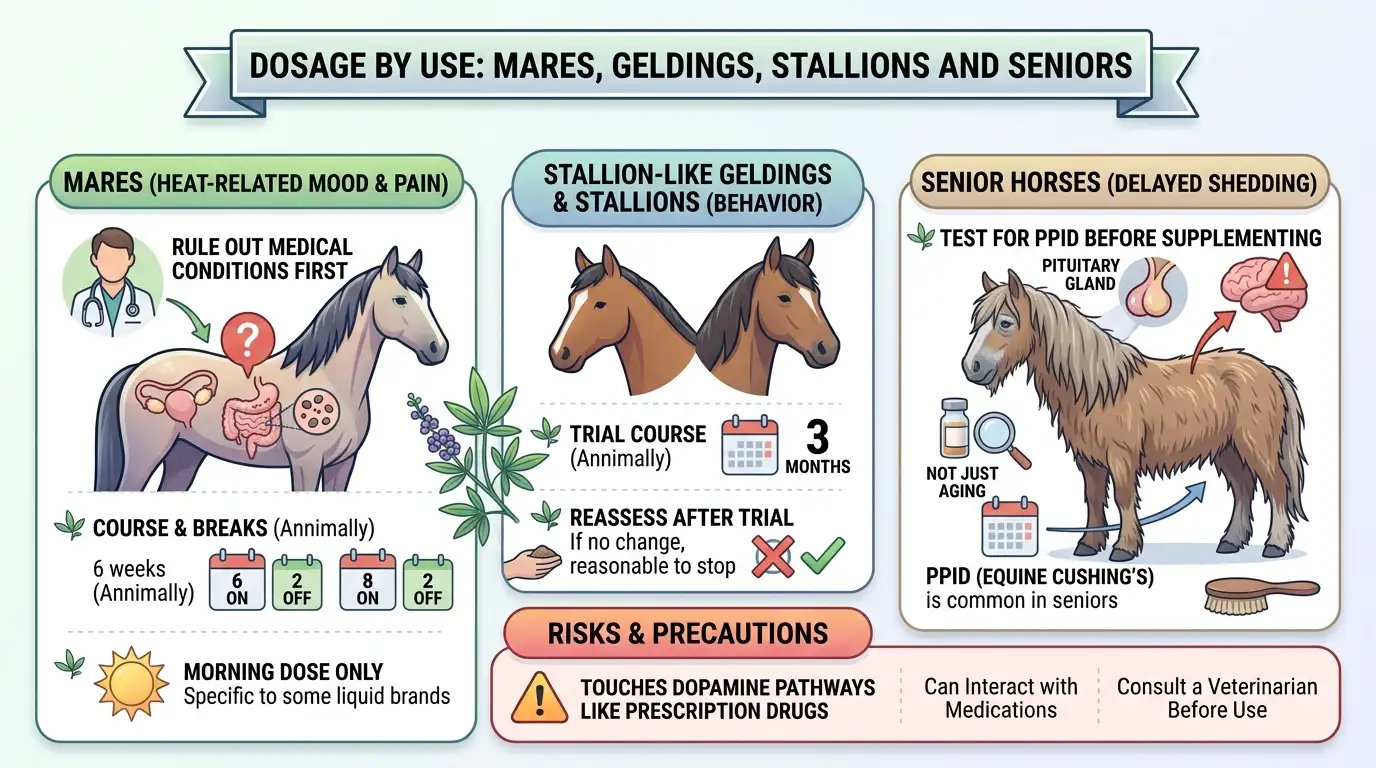
Mares with heat-related mood or pain behavior. Annimally suggests feeding in 6 to 8 week courses followed by a 2 week break. One liquid brand recommends giving the mare’s dose in the morning only. Rule out ovarian problems, back pain and ulcers with your vet first, since those mimic hormonal moodiness.
Stallion-like geldings and stallions. Annimally suggests trialing for about 3 months and then reassessing. If behavior is unchanged by then, stopping is reasonable.
Senior horses with a long, late-shedding coat. Delayed shedding is a classic sign of PPID, not just aging. Test before supplementing, as covered below.
How Long Does Chasteberry Take to Work?
Plan on 3 to 4 weeks before judging. Annimally gives that window, and owner reviews on SmartPak describe changes in mood within a few weeks and in shedding over a few months.
Results also vary widely between horses. Reviews of the same SmartPak product range from a horse that shed out faster to a mare that got worse. That spread is normal for a herb with limited controlled research.
Does Chasteberry Work? What the Research Says
The honest answer is that evidence is mixed, and the strongest data concern PPID rather than mare behavior.The New Bolton Center study compared a commercial vitex extract with pergolide and reported results that contradicted the claims made for chasteberry in equine Cushing’s. A later study of confirmed PPID horses found that those on chasteberry, alone or with pergolide, had much higher ACTH than horses on pergolide alone, suggesting chasteberry may interfere with the drug.
Is the picture all negative? Not quite. A German trial of a chasteberry-based preparation in 38 horses and ponies reported a positive effect on clinical presentation. The catch is that clinical signs and hormone control are different things. A better-looking coat does not prove the pituitary is under control.
For mare behavior, we could not find a controlled trial in horses. Most support comes from owner reports and manufacturer claims, so treat any promise of guaranteed results with caution.
Chasteberry and Cushing’s Disease (PPID)
Do not use chasteberry as the only treatment for PPID. Pergolide is the established treatment, and Dr. Kellon notes that chasteberry has never been documented to control the abnormal pituitary output. She also reports that symptoms can improve for a while while the underlying process continues unchecked.
If your horse has a long curly coat, muscle loss, a cresty neck or repeated laminitis, ask your vet for an ACTH test before buying a supplement. If your horse is already on pergolide, do not add chasteberry without your vet’s approval, because both act on dopamine receptors.
For insulin problems, ask about proper medication such as metformin dosage for horses rather than relying on herbs.
Chasteberry Safety, Side Effects and Who Should Avoid It
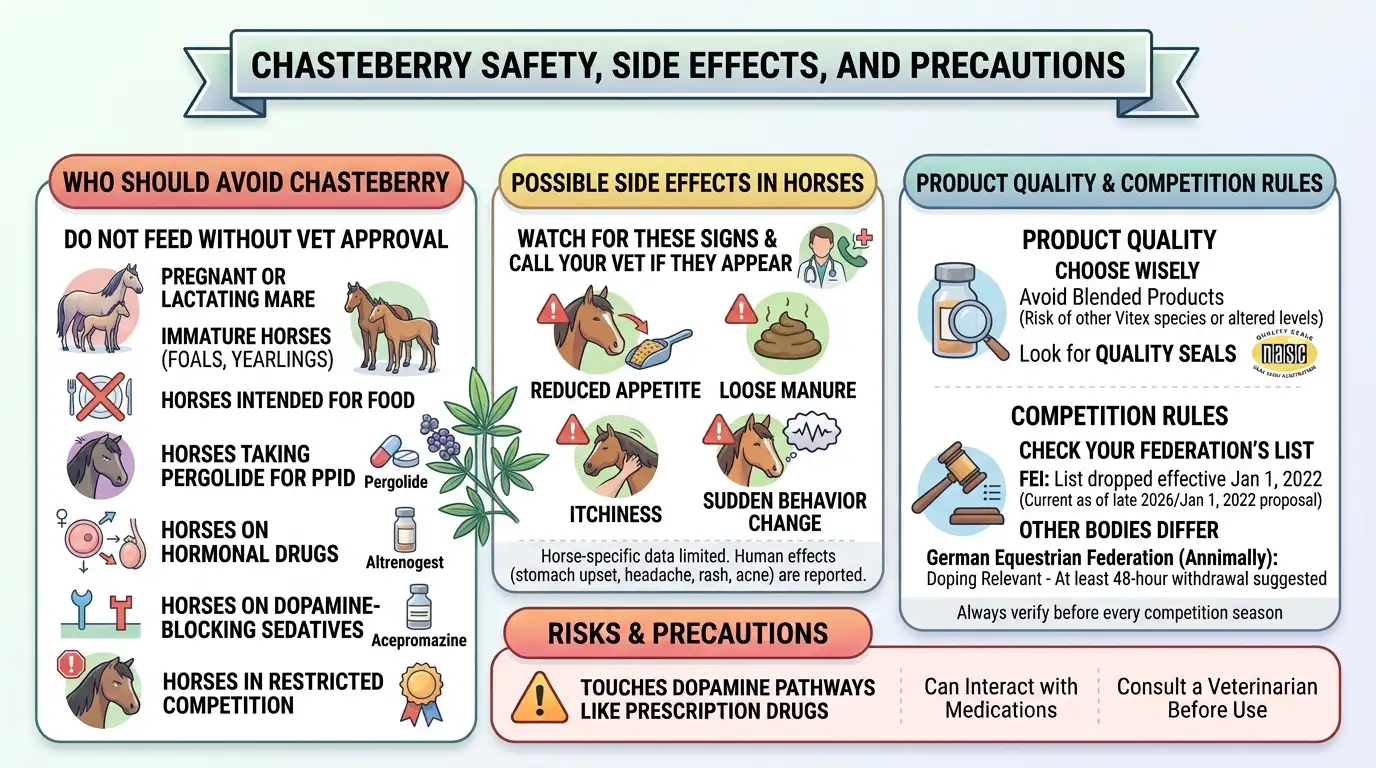
Possible side effects. Horse-specific data are limited. In people, reported effects include stomach upset, headache, rash and acne. In horses, watch for reduced appetite, loose manure, itchiness or a sudden change in behavior. Stop the supplement and call your vet if any appear.
Drug interactions. WebMD advises people to avoid chasteberry with dopamine-blocking drugs such as phenothiazines, and with hormone therapy. Acepromazine is a phenothiazine, so check your vet’s plan before combining it with chasteberry. See our guide to acepromazine dosage for horses for how that sedative is dosed, and ask about hormonal drugs such as altrenogest.
Product quality. WebMD reports that testing of human chasteberry supplements found some contained other Vitex species or altered levels of active compounds. Choose single-ingredient products from reputable brands with a quality seal such as NASC.
Competition rules. A proposal to list vitex agnus castus as a controlled substance under FEI rules was dropped from the list effective 1 January 2022. Other bodies differ. Annimally notes that the German Equestrian Federation treats it as doping relevant and suggests at least 48 hours before competing. Check your own federation’s current list before every season.Chasteberry Pros and Cons for Horses
Chasteberry Alternatives for Moody or Anxious Horses
If the goal is calmer behavior rather than hormone support, other options may fit better. Magnesium is widely used for nervous horses, so see the magnesium dosage for horses guide. Herbal calming blends may use hops, covered in our hops dosage for horses article. Some owners also ask about the CBD dosage for horses, though competition rules for CBD are stricter, so check them first.
Persistent aggression, sudden mood change or heat signs all year round are medical flags, not supplement problems. Call your vet.
Common Chasteberry Mistakes to Avoid
The first mistake is skipping the vet check, especially for a senior horse with a shaggy coat. The second is comparing grams across forms, such as treating a 3 g pellet serving like 3 g of pure powder.
The third is changing several things at once, like new feed, new supplement and new training, which makes results impossible to read. The last is feeding it to a mare that might be in foal.
FAQs
How much chasteberry should I give my horse per day?
Most products suggest 5 to 20 grams of chasteberry powder per day for an adult horse, with about 10 grams common for a 500 kg (1,100 lb) horse. Ponies usually get 2.5 to 5 grams. Always follow your product label and your vet’s advice.
What is the chasteberry dosage for a pony?
Honeyvale Herbs lists 2.5 to 5 grams daily for ponies, while Annimally lists 5 to 10 grams for small horses and ponies. Start at the low end and increase only if the pony tolerates it well.
How long does chasteberry take to work in horses?
Manufacturers commonly suggest allowing 3 to 4 weeks before judging results, and some suggest a three month trial for behavior problems. If nothing has changed by then, stop and review the cause with your vet.
Can I give chasteberry to a horse with Cushing’s disease (PPID)?
Only with your vet’s approval. Chasteberry has not been shown to control ACTH, and one study suggests it may interfere with pergolide. It should never replace prescribed treatment.
Does chasteberry help moody mares?
Many owners report calmer behavior, but we could not find controlled trials in horses. Rule out ovarian problems, pain and ulcers with your vet before starting a supplement.
Is chasteberry safe to feed long term?
No serious toxicity is widely reported in horses, but formal long-term safety studies are lacking. Some brands suggest courses of 6 to 8 weeks followed by a short break, and regular vet reviews are wise.
Can pregnant or lactating mares have chasteberry?
No. Product labels advise against use in pregnant, lactating or immature animals unless a veterinarian directs otherwise.
What are the side effects of chasteberry in horses?
Horse-specific data are limited. In people, reported effects include stomach upset, headache, rash and acne. Watch for reduced appetite, loose manure, itchy skin or behavior changes, and stop the supplement if any appear.
Can chasteberry cause a positive drug test?
A proposal to list vitex agnus castus under FEI rules was dropped from the list effective January 2022, but rules differ by federation. The German Equestrian Federation treats it as doping relevant, so check your own rules before competing.
Can I mix chasteberry with pergolide (Prascend)?
Only if your vet agrees. Both act on dopamine receptors, and a study reported higher ACTH in horses given chasteberry with pergolide than in horses given pergolide alone.
Which is better for horses: chasteberry powder, pellets or liquid?
Powder is flexible and low cost, pellets are pre-measured, and liquids suit horses that refuse powders. Strength differs greatly between forms, so follow the label and choose single-ingredient products from reputable brands.
How many teaspoons is 10 grams of chasteberry powder?
Honeyvale Herbs lists 1 to 2 teaspoons as 5 to 10 grams, so 10 grams is roughly 2 level teaspoons. Density varies by product, so weigh your scoop on a kitchen scale.
Can I give chasteberry with acepromazine or other sedatives?
Ask your vet first. Chasteberry may act on dopamine pathways, and WebMD advises people to avoid it with dopamine-blocking drugs such as phenothiazines. Acepromazine belongs to that drug class.
Does chasteberry help horses shed their winter coat?
Some owners and small studies report better coat shedding, but late shedding is a classic sign of PPID. Ask your vet for an ACTH test before relying on a supplement.
Conclusion and Next Steps
The right chasteberry dosage for horses is the one that matches your product label, your horse’s weight and your vet’s advice. For most adult horses that means about 5 to 20 grams of powder a day, started low and judged after 3 to 4 weeks.
Your next steps are simple. Weigh your horse, run the calculator, book a vet check if the signs involve coat, weight or repeated laminitis, and keep notes for eight weeks. If you see no change, stop and look for the real cause instead of raising the dose.
Sources and Further Reading
- Drugs.com Veterinary: Chaste Berry for Animal Use (Canada)
- WebMD: Chasteberry Uses and Risks
- BEVA: Primary care clinical guidelines on equine PPID
- The Horse: AAEP 2002, Vitex Agnus Castus Extract for Equine Cushing’s
- EquiMed: Use Caution Mixing Chastetree Berries with Pergolide
- NCCIH: Chasteberry