Anased Dosage for Horses: Dosage Chart, Calculator & Safety Guide for Xylazine 100 mg/mL
Written & Reviewed By: Medshorse Team
Last Updated: October 2026
The label dose of Anased (xylazine 100 mg/mL) for horses is 0.5 mL per 100 lb of body weight into a vein (IV), or 1 mL per 100 lb into a muscle (IM). For a 1,000 lb horse, that is 5 mL IV or 10 mL IM. Anased is prescription-only, so your veterinarian decides the final dose.
That sounds simple. Yet most mistakes with this drug come from small details: the wrong bottle strength, the wrong route, or a guessed body weight. This guide covers the label numbers, a weight chart, a calculator, and the safety rules that matter most.
Disclaimer: This article is for general education and is not veterinary advice. Product names mentioned, including Anased, Rompun and Dormosedan, belong to their respective owners, and MedsHorse is not affiliated with them. Anased is a prescription drug, so always follow your veterinarian’s instructions and the current product label.
(1.1 mg/kg)
(2.2 mg/kg)
(IM: 10-15 min)
after IM dose
What Is Anased and What Is It Used for in Horses?
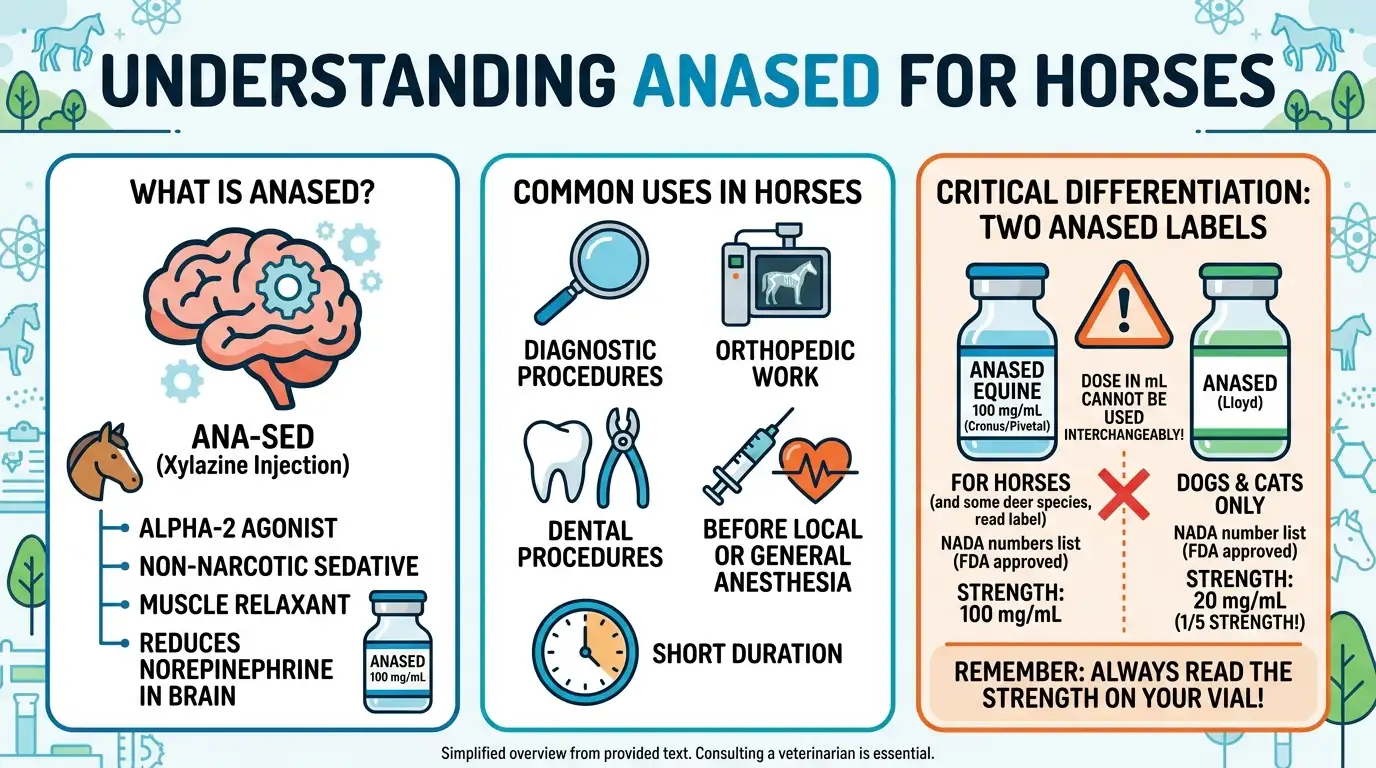
Anased is a brand of xylazine, an alpha-2 adrenoreceptor agonist. In plain terms, it is a non-narcotic sedative and muscle relaxant that vets use to calm horses for short procedures.
According to the label, it is used for diagnostic, orthopedic and dental work of short duration. It can also be given before local or general anesthesia. Xylazine works by acting on alpha-adrenergic receptors in the brain to reduce the release of norepinephrine.
Two Anased labels, one name
This trips people up. There is more than one Anased product on the market:
- Anased Equine Injection (Cronus Pharma): 100 mg/mL, FDA NADA 140-442, labeled for IV or IM use in horses only.
- AnaSed 100 mg/mL (Pivetal): NADA 139-236, labeled for horses and certain deer species.
- Older AnaSed 20 mg/mL (Lloyd): labeled for dogs and cats only.
The dog and cat product is one-fifth the strength of the horse product. A dose in mL from one label can never be used for the other. Always read the strength on your own vial first.
Anased Dosage for Horses: The Label Dose
The most recent equine label on DailyMed gives one dose per route, based on body weight.
| Route | Label dose (100 mg/mL) | In mg | Typical use |
|---|---|---|---|
| IV (into the jugular vein) | 0.5 mL per 100 lb | 0.5 mg/lb (1.1 mg/kg) | Faster onset, shorter effect |
| IM (into a muscle) | 1 mL per 100 lb | 1 mg/lb (2.2 mg/kg) | Slower onset, more gradual |
The IM dose is double the IV dose. That is by design, because IM absorption is slower. Giving the IM amount into the vein is one of the most dangerous mix-ups with this drug.
After injection, the label says to let the horse rest quietly until the full effect is reached.
Anased Dosage Chart for Horses by Weight
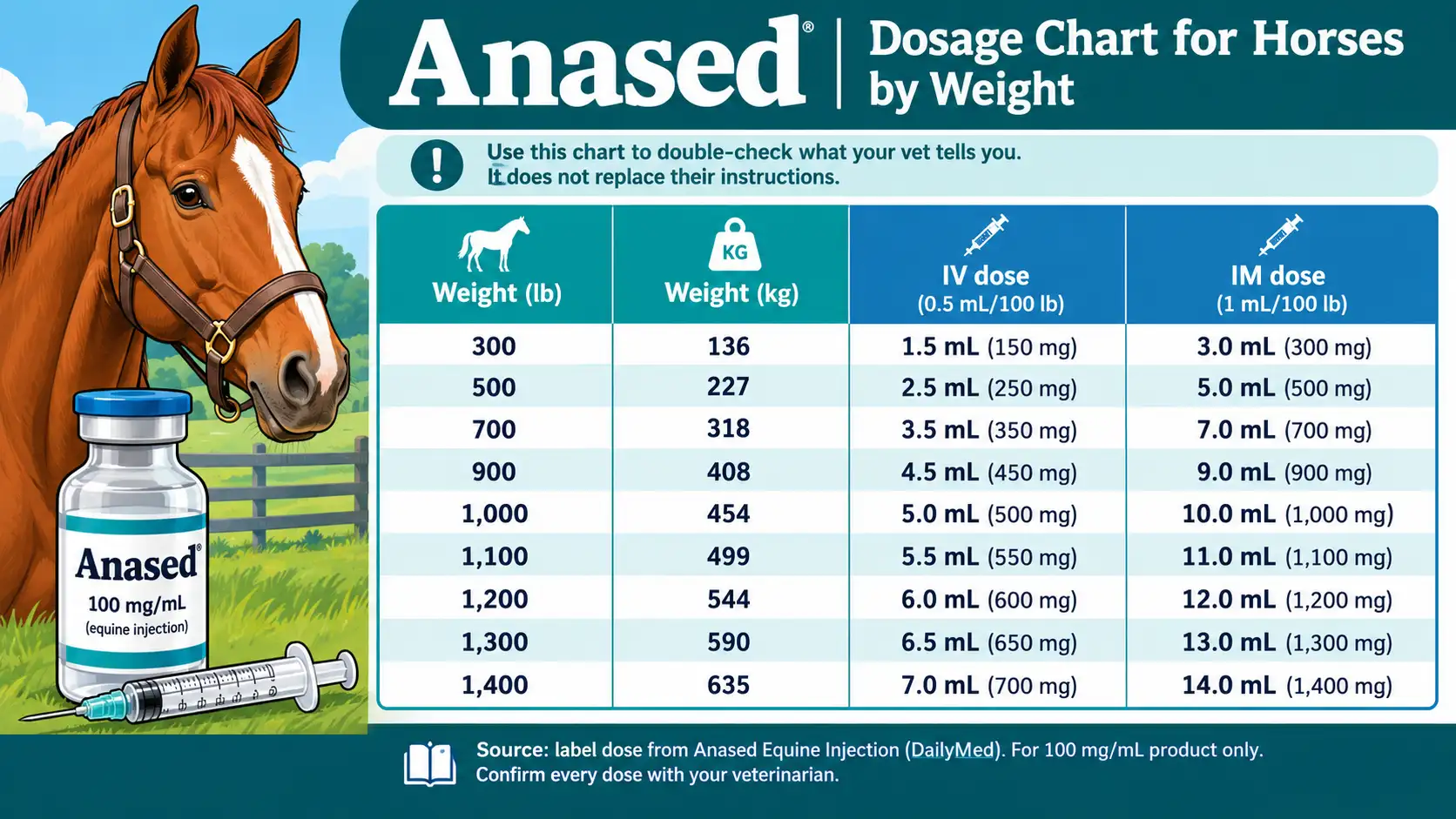
The label does not list separate doses for foals, miniature horses, donkeys or pregnant mares. If your animal is in one of those groups, your vet needs to decide.
Anased Dosage Calculator for Horses
Enter your horse’s weight, pick the route your vet prescribed, and compare the result with your vet’s instructions.Anased Dosage Calculator for Horses
For intravenous (IV) or intramuscular (IM) use in horses
Intravenous: 0.5 mL/100 lb body weight (0.5 mg/lb or 1.1 mg/kg). Intramuscular: 1.0 mL/100 lb body weight (1 mg/lb or 2.2 mg/kg). Always follow your veterinarian’s advice.
© medshorse.com
How to Calculate an Anased Dose by Hand
You can check any calculator with two quick methods.
Pounds method: divide body weight by 100, then multiply by 0.5 for IV or by 1 for IM.
Kilogram method: multiply body weight by 1.1 (IV) or 2.2 (IM) to get mg, then divide by 100 to get mL.
Here is a worked example for an 1,100 lb horse (about 500 kg):
- IV by pounds: 1,100 ÷ 100 = 11, then 11 × 0.5 = 5.5 mL
- IM by pounds: 11 × 1 = 11 mL
- IV by kilograms: 500 × 1.1 = 550 mg, then 550 ÷ 100 = 5.5 mL
Both methods agree. If they ever do not, stop and call your vet.
Expert tip: a scale beats a guess. Weight tapes and eyeballing are estimates, and the dose scales directly with weight.
IV vs IM Anased: Which Route Is Better?
Neither route is better in every case. They suit different jobs.
| Factor | IV | IM |
|---|---|---|
| Dose | 0.5 mL/100 lb | 1 mL/100 lb |
| Onset of deep sedation | 3-5 minutes | 10-15 minutes |
| Heart effects | More likely (partial AV block, bradycardia) | Less likely |
| Main risk | Wrong vessel (carotid) or perivascular injection | Slower, less predictable effect |
| Recovery | Complete within 30-40 minutes (label) | Sleep-like state typically 1-2 hours |
The label notes that IM xylazine produces only negligible effects on the cardiovascular and respiratory systems. IV administration can cause transient heart conduction changes, which atropine can counteract to a large degree.
How Long Does Anased Take to Work and Last?
Timing matters for planning farrier work, dental floats and transport.Analgesia (pain relief) from xylazine is shorter and less reliable than the sedation. The Pivetal label lists analgesia at 15 to 30 minutes. It is also variable, most often at the distal limbs, so a sedated horse may still react to a painful procedure.
What Not to Combine With Anased
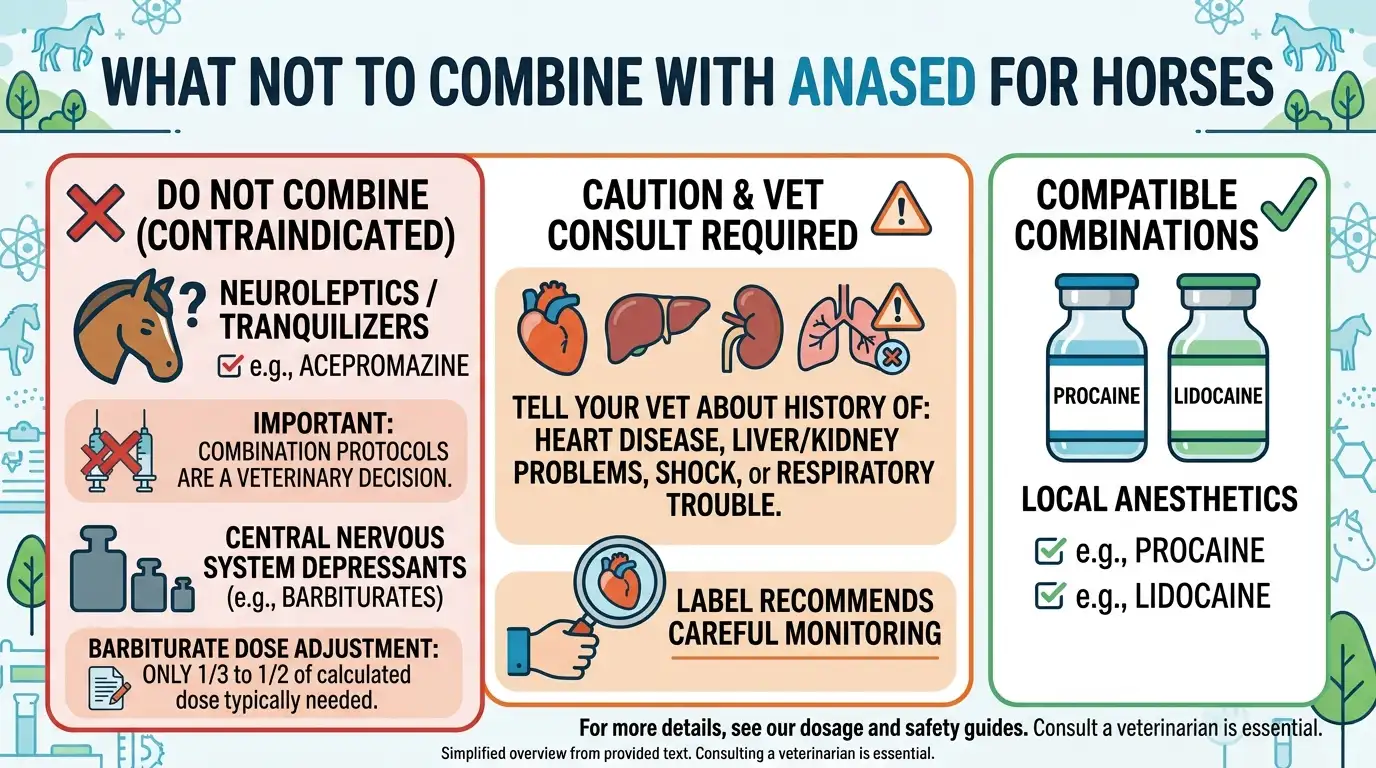
The label says Anased should not be used with neuroleptics or tranquilizers. That includes drugs in the same family as our acepromazine dosage for horses guide. Any combination protocol is a veterinary decision.
Anased also adds to other central nervous system depressants. For barbiturates used in anesthesia, the label says only about one-third to one-half of the calculated dose is typically needed to reach a surgical plane.
It can be used with local anesthetics such as procaine and lidocaine.
If your horse has a history of heart disease, liver or kidney problems, shock, or respiratory trouble, tell your vet before any sedation. The label says these horses need careful monitoring.
Anased Side Effects in Horses
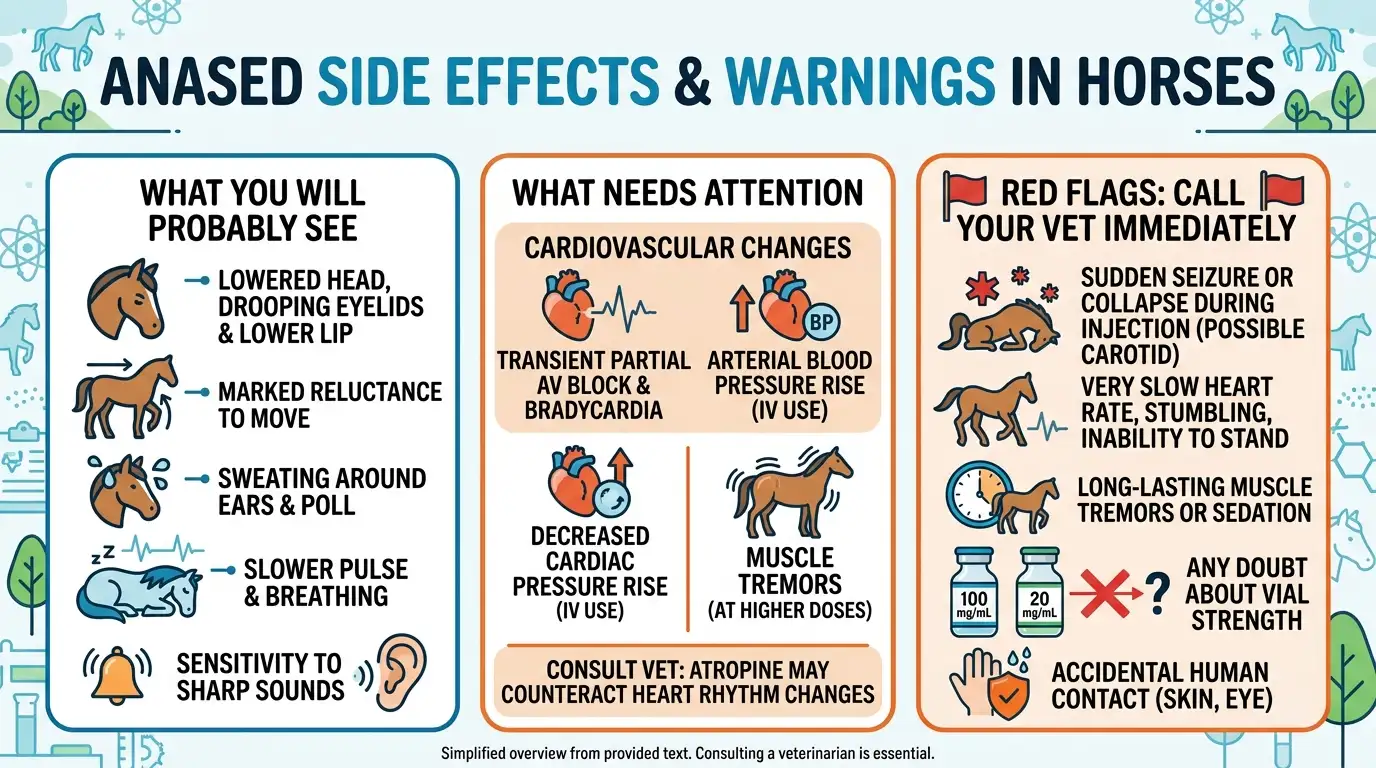
What you will probably see, per the label:
- Lowered head and drooping eyelids and lower lip
- A marked reluctance to move
- Sweating around the ears and poll
- Slower pulse and breathing, similar to natural sleep
- Sensitivity to sharp sounds during recovery
What needs attention:
- Transient partial AV block and bradycardia
- Decreased cardiac output
- A rise in arterial blood pressure after IV use
- Muscle tremors at higher doses
- Sudden seizure-like activity or collapse during injection (possible carotid injection)
- Very slow heart rate, stumbling, or inability to stay standing
- Muscle tremors or sedation lasting far longer than expected
- Any doubt about vial strength: 100 mg/mL (horse) vs 20 mg/mL (dog/cat)
- Accidental human injection, eye or skin contact
Can You Overdose a Horse on Anased?
Yes. The two equine labels describe safety studies a little differently:
- The Cronus label says horses tolerated 10 times the recommended dose, but doses of that size produced muscle tremors and long periods of sedation.
- The Pivetal label says horses were tested at 5 times the recommended dose, and doses of that magnitude may produce convulsions and long periods of sedation.
Those studies show the drug is not instantly fatal at higher doses. They do not give you room for error. A wrong weight, wrong vial or wrong route can all cause trouble well below those multiples.
Is Anased Safe for Humans to Handle?
Anased is not for use in humans. The label warns that active ingredients can be absorbed through skin, eyes and mucous membranes.
If exposure happens:
- Skin: wash with soap and water and remove contaminated clothing.
- Eyes: flush with water for 15 minutes, removing contact lenses first.
- Swallowed or self-injected: seek medical advice immediately and show the package insert. Do not drive, because sedation, loss of consciousness and blood pressure changes can occur.
People with cardiovascular disease, such as hypertension or ischemic heart disease, should take special precautions to avoid exposure. Pregnant women should be extra careful, since uterine contractions and lower fetal blood pressure may occur after accidental systemic exposure.
A sedated horse can also surprise you. The label warns that handling or sudden noise may trigger a defense reaction in an animal that looks heavily sedated. Keep the area calm and give a sedated horse space.
Anased vs Rompun vs Dormosedan

All three are alpha-2 agonist sedatives. The details differ.
| Feature | Anased (100 mg/mL) | Rompun (xylazine) | Dormosedan (detomidine) |
|---|---|---|---|
| Active ingredient | Xylazine | Xylazine | Detomidine |
| Typical IV reference dose | 1.1 mg/kg (label) | 1.1 mg/kg (Texas Tech) | 0.005-0.02 mg/kg (Kansas State) |
| Concentration listed in references | 100 mg/mL | 100 mg/mL | 10 mg/mL |
| Duration | Sleep-like state 1-2 hours (IM) | Similar to xylazine | Longer than xylazine (Kansas State) |
Do not translate a mL dose from one product to another. Different drugs and strengths mean very different volumes. For more detail, see our Rompun for horses dosage chart and Dormosedan dosage for horses guides. If you are weighing calmer options for handling or travel, our trazodone for horses dosage chart explains how that medication compares.
Is Anased Prescription-Only? Legal and Competition Notes
Yes. The label states that federal law restricts Anased to use by or on the order of a licensed veterinarian.
Two more points matter:
- Food animals: the label says not to use it in horses intended for human consumption.
- Controlled status: as of recent reporting, xylazine is not scheduled federally under the Controlled Substances Act, but the Combating Illicit Xylazine Act is pending in Congress. Some states regulate it, and at least one major distributor lists Anased with a Schedule IV tag. Ask your vet about the rules where you live.
If you compete, rules on medications vary by organization. We could not find a detection or withdrawal time on the labels, so ask your vet and check your rulebook rather than guessing.
Storage and Vial Handling
- Anased Equine Injection comes in a 50 mL multi-dose vial.
- Store at up to 25 °C (77 °F).
- Use within 28 days of first puncture, per the Cronus label.
- Write the opening date on the vial.
- Keep it out of reach of children.
Common Mistakes to Avoid
- Mixing up strengths. 100 mg/mL (horse) and 20 mg/mL (dog and cat) are very different products.
- Using the IM dose IV. The IM dose is double the IV dose.
- Guessing body weight. Use a scale when possible.
- Sedating then loading immediately. The label says transport works best after full effect and when the horse is stable standing.
- Assuming a sedated horse cannot kick. Defense reactions may not be diminished.
- Working in a noisy barn. Sedated horses are particularly sensitive to noise.
- Using an old opened vial. Discard after 28 days.
When to Call Your Vet
Call before sedating, not after, if:
- You are unsure of the dose, route or vial strength
- Your horse has heart, liver, kidney or breathing problems
- The horse is a foal, miniature, donkey, or pregnant mare
- Your horse is already on another sedative or tranquilizer
- You see any red flag listed above
Key Takeaways
- The label dose for Anased 100 mg/mL is 0.5 mL per 100 lb IV or 1 mL per 100 lb IM.
- Onset is 3 to 5 minutes IV and 10 to 15 minutes IM.
- Vets often adjust the dose, so follow their instruction over any chart.
- Do not combine with tranquilizers or neuroleptics unless your vet directs it.
- Never confuse the 100 mg/mL horse product with the 20 mg/mL dog and cat product.
- It is a prescription drug and is not for humans or for horses intended for food.
Next step: weigh your horse, confirm the vial strength, and ask your vet for the exact dose in writing before every sedation.
FAQs
What is the Anased dosage for horses?
The Anased Equine Injection (xylazine 100 mg/mL) label lists 0.5 mL per 100 lb (0.5 mg/lb or 1.1 mg/kg) for IV use and 1 mL per 100 lb (1 mg/lb or 2.2 mg/kg) for IM use. A 1,000 lb horse works out to 5 mL IV or 10 mL IM. Your veterinarian sets the final dose.
How much Anased do you give a 1,000 lb horse?
At the label dose, a 1,000 lb horse receives 5 mL (500 mg) IV or 10 mL (1,000 mg) IM of the 100 mg/mL product. Veterinary references list a wider range that starts as low as 0.2 mg/kg IV, so follow your vet’s instructions rather than assuming the label dose.
Can I give my horse Anased myself?
Anased is a prescription drug, and federal law restricts it to use by or on the order of a licensed veterinarian. IV injection carries real risks, including seizures and collapse if the needle ends up in the carotid artery, so injections should only be given as directed by your vet.
How long does Anased take to work in horses?
Deep sedation develops within 3 to 5 minutes after IV injection and within 10 to 15 minutes after IM injection. Let the horse rest quietly until the full effect is reached.
How long does Anased last in horses?
Deep sedation lasts 15 to 20 minutes, and a sleep-like state usually continues for 1 to 2 hours after an IM dose at the recommended dosage. The label says recovery is complete within 30 to 40 minutes after an IV injection.
Is Anased the same as Rompun?
Both contain xylazine. University dosing references list Rompun at 1.1 mg/kg IV and 2.2 mg/kg IM, which matches the Anased label. Always follow the label and your vet’s directions for the exact product you have.
Is horse Anased the same as the dog and cat version?
No. Anased Equine Injection is 100 mg/mL, while the older dog and cat Anased label describes a 20 mg/mL solution. That is a five-fold difference in strength, so never use a dose in mL from one product for the other.
What are the side effects of Anased in horses?
Common effects include a lowered head, drooping eyelids and lip, sweating around the ears and poll, slowed pulse and breathing, and sensitivity to sharp noises. Transient partial AV block, bradycardia and blood pressure changes can occur, especially after IV use.
Can you overdose a horse on Anased?
Yes. The Cronus label says horses tolerated 10 times the recommended dose but developed muscle tremors and long sedation, while the Pivetal label says 5 times the dose may cause convulsions and long sedation. These are safety study findings, not a margin for error.
Can Anased be combined with acepromazine or other tranquilizers?
The label says not to use Anased with neuroleptics or tranquilizers. Any combination decision belongs to your veterinarian.
Is Anased safe for pregnant mares, foals and ponies?
The equine label gives one dose per body weight and no separate instructions for foals, pregnant mares or miniature horses. Ask your veterinarian before using it in these animals.
Is there a reversal agent for Anased in horses?
The equine label does not list a reversal agent. It says atropine given before or after Anased can counteract heart rhythm changes. Yohimbine is mentioned for reversal on the dog and cat label, so discuss reversal with your veterinarian.
How long can I keep an opened vial of Anased?
Use the vial within 28 days of first puncture and store it at up to 25 C (77 F), per the Cronus label. Write the opening date on the vial.
What should I do if I accidentally inject myself with Anased?
Seek medical advice immediately and show the package insert to the physician. Do not drive, because sedation, loss of consciousness and blood pressure changes can occur. For skin contact wash with soap and water, and for eye contact flush with water for 15 minutes.
Can a sedated horse still kick?
Yes. The label warns that a horse that looks heavily sedated can still react to handling or sudden noise, because defense reactions may not be diminished. Keep the area quiet and avoid sudden movements.
Can I use Anased in a horse that will be eaten?
No. The label says not to use Anased in horses intended for human consumption.
Is Anased a controlled substance?
Xylazine is not scheduled federally under the Controlled Substances Act as of recent reports, but legislation is pending and some states regulate it. At least one major distributor lists Anased with a Schedule IV tag, so check your state rules with your vet.
Sources and Further Reading
- Anased Equine Injection label, DailyMed (Cronus Pharma)
- AnaSed 100 mg/mL for horses and Cervidae, Drugs.com Veterinary
- Recommended Horse Analgesic & Anesthetic Agents, Texas Tech IACUC
- Anesthetic Drugs and Dosages Commonly Used in Horses, Kansas State Veterinary Health Center
- AnaSed 20 mg/mL (dogs and cats) product sheet, Lloyd Inc.
- Covetrus product listing, AnaSed Equine 100 mg/mL
- Report suspected adverse reactions: FDA, www.fda.gov/reportanimalae, 1-888-FDA-VETS