Dormosedan Gel for Horses: Dosage Chart, Free Calculator, Onset Time & Safety Rules Every Owner Should Know
Written & Reviewed By: Medshorse Team
Last Updated: October 2026
Dormosedan gel for horses is a prescription sedative you squirt under the tongue, not down the throat. The FDA-approved label sets the dose at 0.018 mg per pound (0.040 mg/kg), which means 1.00 mL for a 330–439 lb horse and up to 3.00 mL for horses between 1,210 and 1,320 lb. A typical 1,000 lb horse gets 2.50 mL.
If you have ever tried to wrap a leg on a horse that won’t stand still, held a nervous gelding for the farrier, or sat through fireworks night with a horse spinning in the paddock, you already know why owners ask their vets about “dorm gel.” It lets you calm a healthy horse for non-painful jobs without a vet on the farm.
It is also easy to get wrong. The gel needs about 40 minutes to work, it must go under the tongue, it does nothing for pain, and handlers need gloves. This guide gives you the full dosage chart, a free calculator, step-by-step instructions, timing, side effects and safety rules, all taken from the label and Zoetis’ own product information, which we checked in October 2026.
Disclaimer: This article is for general education and is not veterinary advice. Dormosedan is a registered trademark of Orion Corporation, distributed by Zoetis under license. MedsHorse is not affiliated with Zoetis. Always follow your veterinarian’s instructions and the current product label.
Dormosedan Gel at a glance
Taken from the FDA-approved label and Zoetis product page
- Active ingredient
- Detomidine HCl, 7.6 mg per mL
- Label dose
- 0.018 mg/lb (0.040 mg/kg), under the tongue
- Syringe
- 3 mL, marked in 0.25 mL steps
- Minimum wait before starting
- 40 minutes
- Sedative effects last
- Approximately 90–180 minutes
- Full recovery
- Up to 3–4 hours
- Availability
- Prescription only (US)
- Pain relief
- None. Not for painful procedures
Not for human use. Wear impermeable gloves, keep it away from children, and give it only to the horse it was prescribed for.
What Is Dormosedan Gel for Horses?
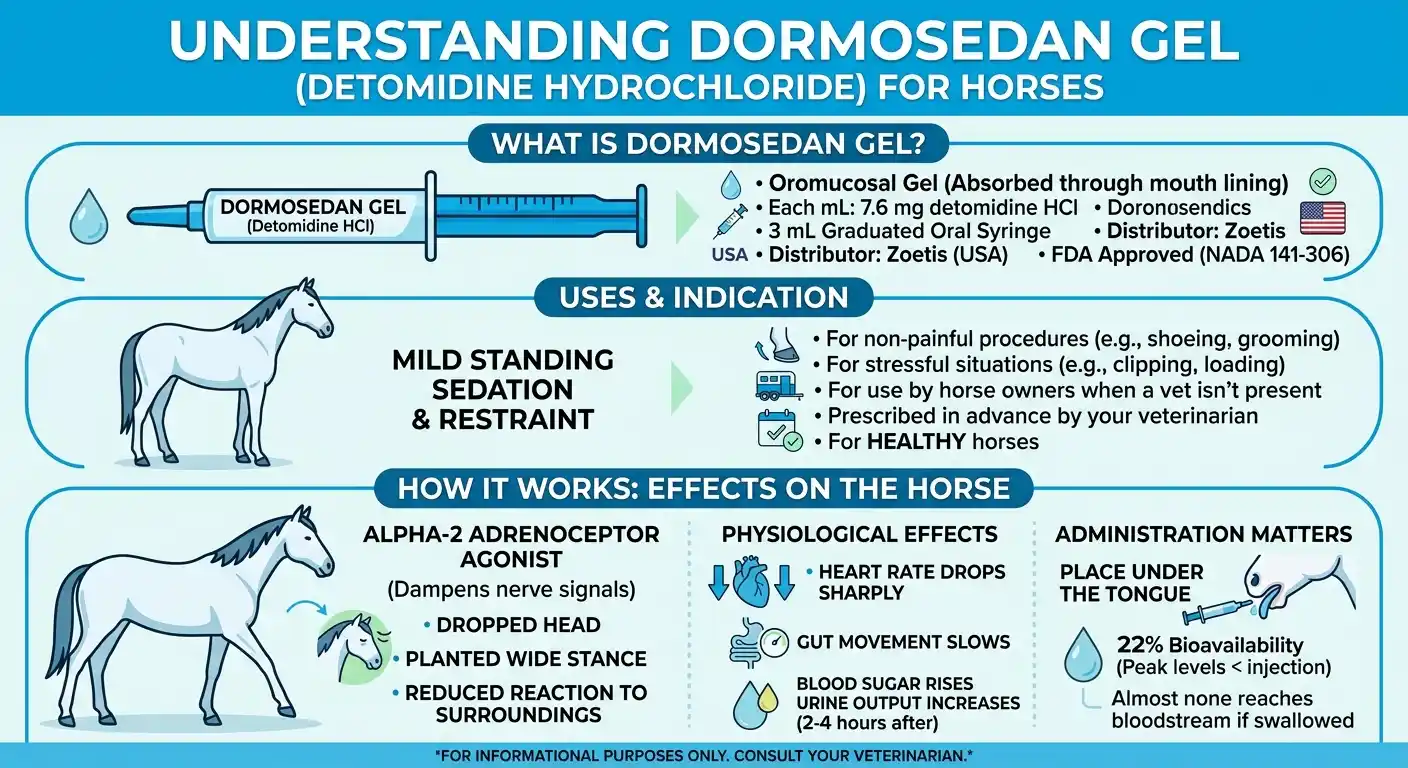
Dormosedan Gel (detomidine hydrochloride) is an oromucosal gel that sedates horses when absorbed through the lining of the mouth. Each mL holds 7.6 mg of detomidine HCl, and it comes as a blue gel in a 3 mL graduated oral syringe. The FDA approved it under NADA 141-306, and Zoetis distributes it in the US.
The label lists it for “sedation and restraint in horses.” In plain language, Zoetis describes it as a mild standing sedative that horse owners can give before non-painful procedures or stressful situations when a vet isn’t there. The company stresses that it should be used in healthy horses and prescribed in advance by your veterinarian.
How Dormosedan Gel Works
Detomidine is an alpha-2 adrenoceptor agonist. It dampens the nerve signals that keep a horse alert, so the head drops, the front legs plant in a wide stance and the horse reacts less to its surroundings.
The drug also changes how the body behaves. Blood pressure rises at first, then settles, while heart rate drops sharply. Gut movement slows, blood sugar rises, and urine output increases two to four hours after treatment. Those are normal drug effects, and they are why the label lists so many cautions.
Absorption is the key difference from an injection. The label reports 22% bioavailability and peak blood levels about 40% of those after an intramuscular injection. Almost nothing reaches the bloodstream if the gel is swallowed, which is why placement under the tongue matters.
How Much Dormosedan Gel For Horses?
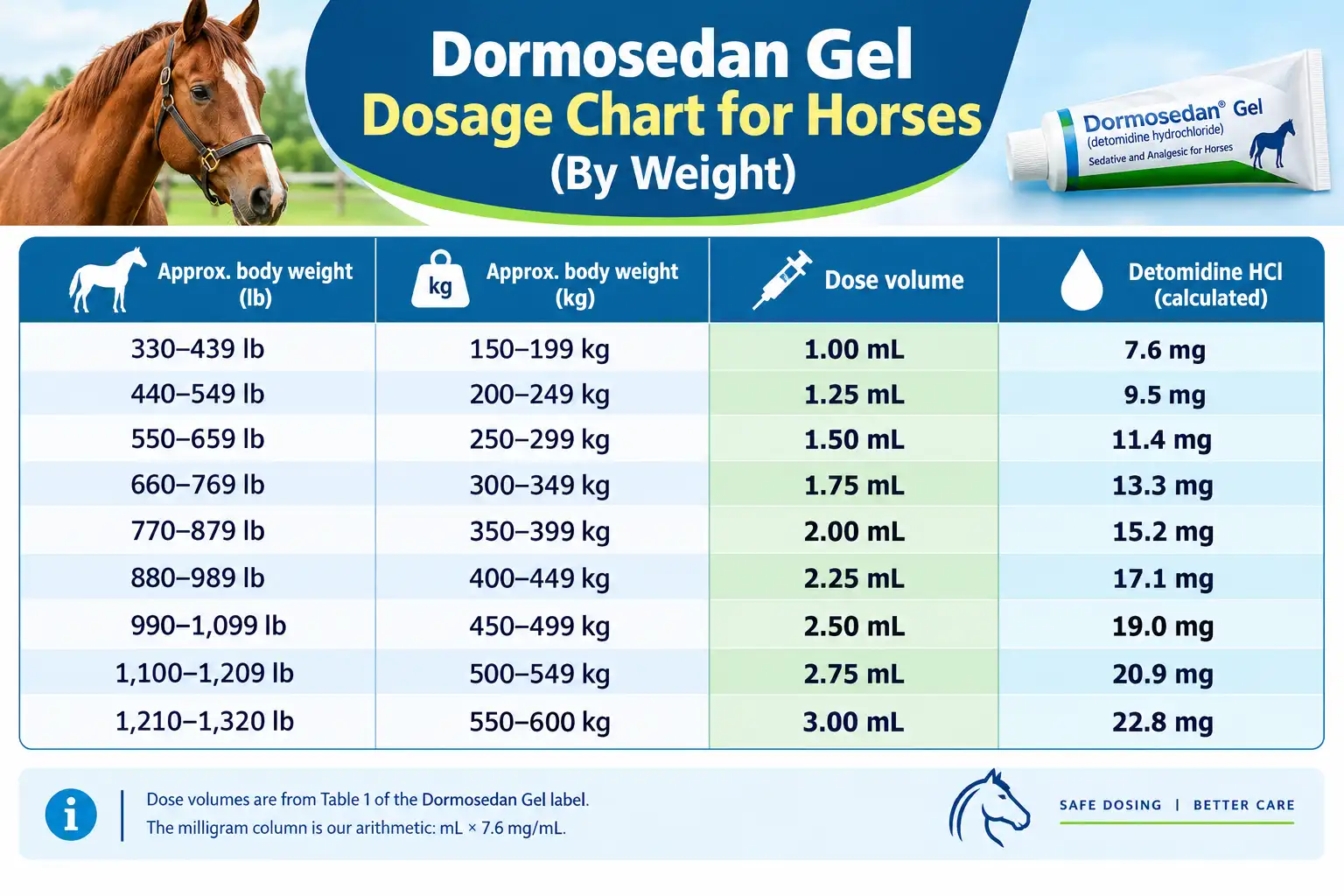
The label dose of Dormosedan Gel for horses is 0.018 mg per pound, or 0.040 mg/kg, given sublingually. The syringe delivers in 0.25 mL steps, so the volume runs from 1.00 mL for horses of 330–439 lb up to 3.00 mL for horses of 1,210–1,320 lb. Use the chart below, then confirm with your vet.
Dormosedan Gel Dosage for Horses Calculator
Dormosedan Gel Dosage Calculator For Horses
Sublingual sedation dose: 0.040 mg/kg (0.018 mg/lb)
Recommended sublingual dose
0 mg
Place the gel beneath the tongue of the horse. Do not allow it to be swallowed. The dosing syringe delivers the product in 0.25 mL increments. Always follow your veterinarian’s instructions and the product label.
© medshorse.com
Dormosedan Gel Dosage Chart for Horses (By Weight)
| Approx. body weight (lb) | Approx. body weight (kg) | Dose volume | Detomidine HCl (calculated) |
| 330–439 lb | 150–199 kg | 1.00 mL | 7.6 mg |
| 440–549 lb | 200–249 kg | 1.25 mL | 9.5 mg |
| 550–659 lb | 250–299 kg | 1.50 mL | 11.4 mg |
| 660–769 lb | 300–349 kg | 1.75 mL | 13.3 mg |
| 770–879 lb | 350–399 kg | 2.00 mL | 15.2 mg |
| 880–989 lb | 400–449 kg | 2.25 mL | 17.1 mg |
| 990–1,099 lb | 450–499 kg | 2.50 mL | 19.0 mg |
| 1,100–1,209 lb | 500–549 kg | 2.75 mL | 20.9 mg |
| 1,210–1,320 lb | 550–600 kg | 3.00 mL | 22.8 mg |
Dose volumes are from Table 1 of the Dormosedan Gel label. The milligram column is our arithmetic: mL × 7.6 mg/mL.
Dose at a glance: how much of the syringe you use
Bar length shows the share of the full 3 mL syringe. Based on Table 1 of the Dormosedan Gel label.
Always set the dosing ring to the volume your veterinarian prescribed for your horse.
Common Dormosedan Gel Doses by Horse Size
- 500 lb horse (small pony-sized or light horse): 440–549 lb band, 1.25 mL. The label hasn’t evaluated ponies, so ask your vet.
- 800 lb horse: 770–879 lb band, 2.00 mL.
- 1,000 lb horse: 990–1,099 lb band, 2.50 mL.
- 1,200 lb horse: 1,100–1,209 lb band, 2.75 mL.
- 1,300 lb horse: 1,210–1,320 lb band, 3.00 mL, the full syringe.
What If Your Horse Is Outside the Chart?
The chart covers 330 to 1,320 lb (150 to 600 kg). Horses outside that range, ponies, miniature horses and animals under one year are not covered by the label. Your veterinarian has to decide whether the gel is appropriate at all. Don’t estimate a dose yourself.
Why Accurate Weight Matters
Each band on the chart covers about 110 lb, so a weight tape that is off by a hundred pounds can push a horse into the wrong band. The label’s dose ranges show that horses at the bottom of each band get slightly more than 0.040 mg/kg and horses at the top slightly less. Zoetis recommends a weight tape or scale. A scale is better when you can get one.
Can You Give a Second Dose?
No. The label states that repeat dosing has not been evaluated, and Zoetis’ client sheet tells owners not to repeat the dose. If your horse isn’t sedated after 40 minutes, call your prescribing veterinarian. You may be dealing with a swallowed or spat-out dose, an excited horse, or a horse that doesn’t respond well to detomidine.
How to Give Dormosedan Gel to a Horse (Step by Step)
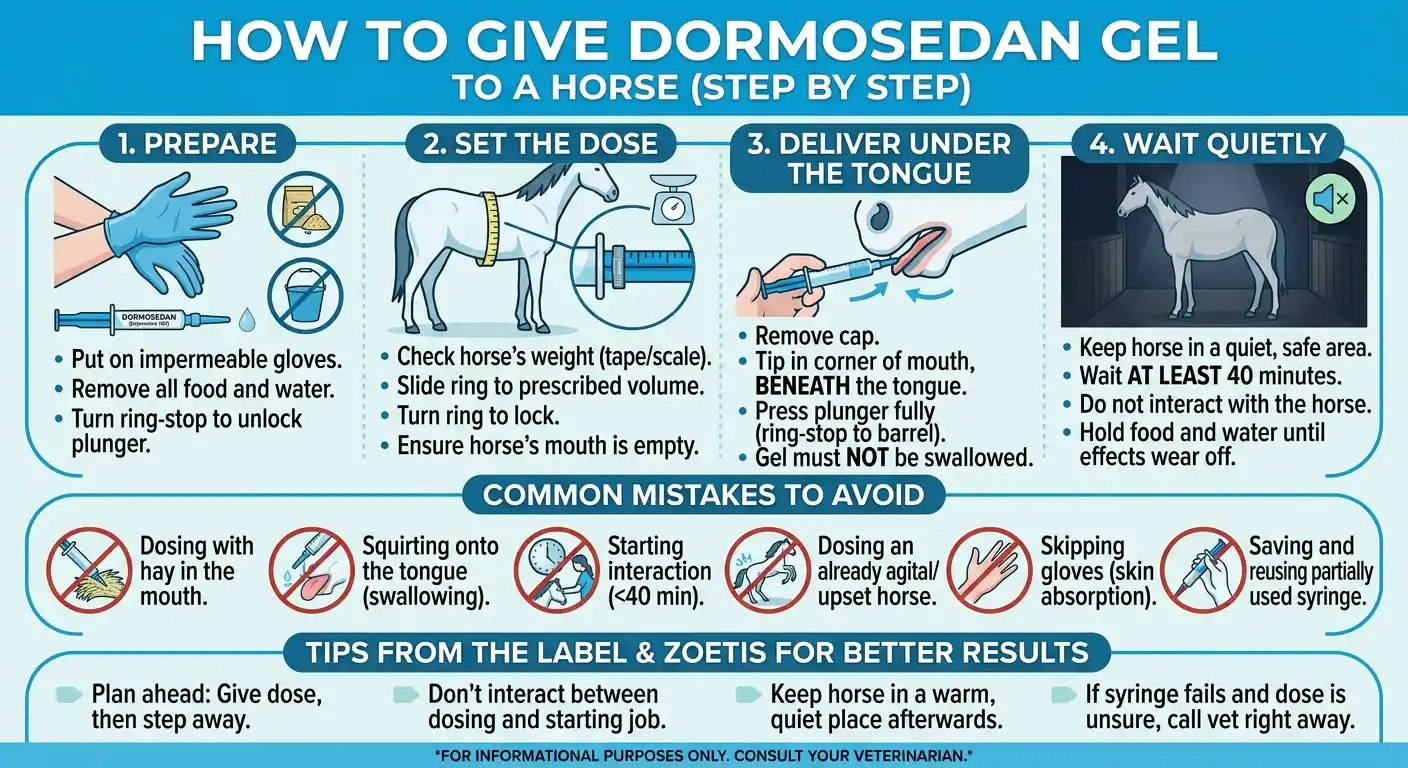
Give Dormosedan Gel with the horse’s mouth empty, food and water removed, and gloves on. Set the ring to the prescribed volume, place the tip under the tongue at the corner of the mouth, press the plunger fully, then leave the horse alone in a quiet spot for at least 40 minutes.
How to give Dormosedan Gel: 4 steps
Summarized from the label and Zoetis administration steps.
Prepare
- Put on impermeable gloves
- Take away all food and water
- Turn the ring-stop on the plunger until the ring slides freely
Set the dose
- Check weight with a tape or scale
- Slide the ring so the side nearest the barrel sits at the prescribed volume, then turn it to lock
- Make sure the mouth contains no feed
Deliver under the tongue
- Remove the cap and put the tip in the corner of the mouth, beneath the tongue
- Press the plunger until the ring-stop touches the barrel
- The gel is not meant to be swallowed
Wait quietly
- Recap the syringe, return it to the carton and discard it
- Keep the horse in a quiet, safe area for at least 40 minutes
- Hold food and water until the effects wear off
Common Mistakes to Avoid
Tips From the Label and Zoetis for Better Results
How Long Does Dormosedan Gel Take to Work and How Long Does It Last?
Plan on about 40 minutes for Dormosedan Gel to take effect and approximately 90–180 minutes of sedative effect. Recovery can take 3 to 4 hours. By comparison, the injectable form begins working in 2–4 minutes IV or 3–5 minutes IM, so the gel demands more patience.
What to expect after dosing
Timing is approximate. Nervous or excited horses can respond more slowly or less deeply.
- 0 minGel goes under the tongueFood and water already removed. Keep the horse quiet and undisturbed.
- 40 minEarliest time to start the taskThe label calls for a minimum of 40 minutes. Head lowers and front legs plant in a firm stance.
- 2 hoursKeep gloves on for mouth contactHandlers should avoid the horse’s mouth and saliva for at least 2 hours without impermeable gloves.
- 90–180 minTypical length of sedative effectApproximate range stated on the label. Individual horses vary.
- 3–4 hoursFull recoveryZoetis says recovery can take up to 3–4 hours. Keep the horse warm and quiet, and hold food and water.
- 240 minAll study horses recoveredIn the US field study, every treated horse had recovered by 4 hours.
In the label’s field study, 94% of gel-treated horses showed minimal, moderate or marked sedation at 40 minutes, versus 14% on placebo. Mild swaying was seen in 54% of treated horses at that point and moderate ataxia in 25%. For a small share, moderate to marked ataxia lasted longer: 5% at 90 minutes and 4% at 120 minutes.
Those numbers are why Zoetis calls it a “standing” sedative but still warns about unpredictable behavior. A swaying horse can lose its balance, and a sedated horse can still kick.
Why Some Horses Don’t Seem to Respond
The label explains that nervous or excited horses have high levels of natural adrenaline, which can reduce the effect of drugs like detomidine. Onset may be slow, and the depth and duration can be reduced or absent.
That is one reason to give the gel in a calm setting well ahead of time rather than as a last resort for a horse already in a panic.
What Is Dormosedan Gel Used For?
Zoetis lists farrier work, bandaging, basic first aid, fireworks, first-time supervised turnout of fractious horses on a dry lot, mane pulling, body clipping and sheath cleaning. All are non-painful, routine tasks where an anxious horse might otherwise be unsafe for itself and its handler.
How often did Dormosedan Gel get the job done?
US field study: 129 gel-treated and 42 placebo-treated horses in the effectiveness analysis. Success meant the procedure could be performed with at most some resistance.
Source: FDA-approved label (DailyMed), Effectiveness section. Clipping was the weakest result, a good reminder that this is a mild sedative.
The field study also shows where the gel helps most. It worked well for manual teeth floating, hoof care and prepuce cleaning, and least well for electric clipping, where only 48% of horses were successfully handled.
If your horse panics at clippers, ask your vet whether the gel is enough or whether a vet-administered plan makes more sense.
What Dormosedan Gel Is Not For
Dormosedan Gel doesn’t relieve pain. The label says plainly not to use it for painful procedures, and Zoetis says it is intended for healthy horses. That rules out sedating a horse that is colicky, lame or in pain to “take the edge off.” Pain needs a diagnosis and a different plan.
Our guides to Banamine dosage for horses and bute dosage for horses explain how those prescription pain medications are dosed, but the choice and the dose should always come from your vet, especially when the horse is hurting.
Dormosedan Gel Side Effects in Horses
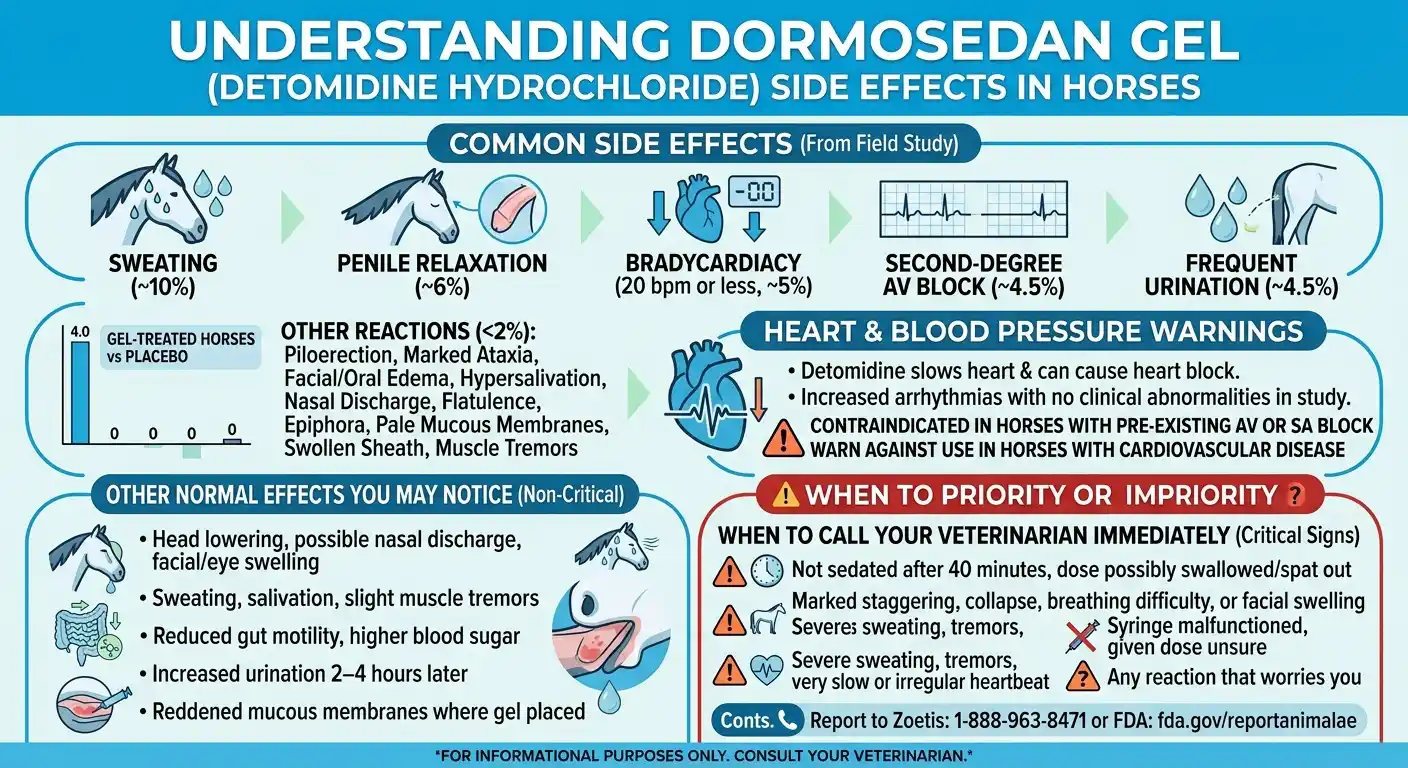
The most common side effects in the label’s field study were sweating (about 10% of gel-treated horses), penile relaxation (6%), a very slow heart rate of 20 beats per minute or less (5%), second-degree AV block (4.5%) and frequent urination (4.5%). None of these appeared in the placebo group.
| Reaction | Gel-treated horses (of 202) | Share | Placebo horses (of 68) |
| Sweating | 20 | 9.9% | 0 |
| Penile relaxation | 12 | 5.9% | 0 |
| Bradycardia (20 bpm or less) | 11 | 5.4% | 0 |
| Second-degree AV block | 9 | 4.5% | 0 |
| Frequent urination | 9 | 4.5% | 0 |
| Piloerection (raised hair) | 4 | 2.0% | 0 |
| Marked ataxia | 3 | 1.5% | 0 |
| Facial or oral edema | 3 | 1.5% | 0 |
| Hypersalivation | 2 | 1.0% | 0 |
| Nasal discharge | 2 | 1.0% | 0 |
| Flatulence | 1 | 0.5% | 0 |
| Epiphora (tearing) | 1 | 0.5% | 0 |
| Pale mucous membranes | 1 | 0.5% | 0 |
| Swollen sheath | 1 | 0.5% | 0 |
| Muscle tremors | 1 | 0.5% | 1 |
Adverse reactions in the US field study. Percentages are our calculation from the label counts.
Heart and Blood Pressure Effects
Detomidine slows the heart and can cause heart block. In the target-animal safety study at the label dose, ECGs showed increased vagally mediated arrhythmias in most horses, with no clinical abnormalities linked to them.
Even so, the label contraindicates the gel in horses with pre-existing AV or SA block and warns against use in horses with cardiovascular disease.
Other Effects You May Notice
- Head lowering with possible nasal discharge and temporary swelling around the face and eyes
- Sweating, salivation and slight muscle tremors
- Reduced gut motility and higher blood sugar
- Increased urination 2–4 hours after treatment
- Reddened mucous membranes where the gel was placed (seen in 2 of 8 horses in a lab study, and 2 of 6 in the safety study)
When to Call Your Vet Right Away
- The horse is still not sedated after 40 minutes, or you think the dose was swallowed or spat out
- Marked staggering, collapse, trouble breathing or facial swelling
- Severe sweating, tremors or a very slow, irregular heartbeat
- The syringe malfunctioned and you aren’t sure how much was given
- Any reaction that worries you
You can also report adverse reactions to Zoetis at 1-888-963-8471 or to the FDA at fda.gov/reportanimalae.
Dormosedan Gel Safety: Who Should Not Get It
Don’t use Dormosedan Gel in horses with known detomidine hypersensitivity, AV or SA block, respiratory disease or chronic kidney failure. The label also warns against use with cardiovascular, liver or kidney disease, shock, severe debilitation, or stress from extreme temperatures, fatigue or altitude. It is not for painful procedures.
Who should not get Dormosedan Gel
From the Contraindications, Warnings and Precautions sections of the label.
Do not use
- Known hypersensitivity to detomidine
- Pre-existing AV or SA heart block
- Respiratory disease
- Chronic renal (kidney) failure
- Cardiovascular disease, liver disease or kidney disease
- Shock, severe debilitation, or stress from extreme heat, cold, fatigue or high altitude
- Painful procedures (the gel gives no pain relief)
- Horses intended for human consumption
- Use with other sedatives (effects may be additive)
- Intravenous potentiated sulfonamides in a sedated horse (risk of fatal dysrhythmias)
Not studied: vet decision only
- Ponies and miniature horses (not evaluated)
- Horses younger than one year (not evaluated)
- Breeding, pregnant or lactating horses (not evaluated)
- A second dose if the first seems weak (repeat dosing not evaluated)
- Using a reversal agent (not evaluated with the gel)
Drug Interactions
The label says not to use the gel with other sedative drugs because the effects may be additive. Intravenous potentiated sulfonamides must also be avoided in sedated horses, since potentially fatal dysrhythmias may occur. If your horse takes any antibiotic, such as the combinations covered in our guide to sulfadiazine trimethoprim, tell your vet before you plan a sedation day.
If you’re comparing calming options, our guides to acepromazine and the trazodone explain those drugs separately. Don’t combine any of them with Dorm Gel unless your vet gives you instructions.
Handler Safety
Detomidine can be absorbed through your skin, eyes and mouth. After dosing, treated horses carry small amounts in saliva: up to 0.072 mg/mL at 30 minutes, under 1% of the gel’s concentration, and below 0.010 mg/mL by two hours. That is why Zoetis tells handlers to use gloves for any mouth contact for at least two hours.
Handler safety: protect yourself, too
- Wear impermeable gloves while handling the syringe and for at least 2 hours when touching the horse’s mouth.
- Gel on skin: wash with soap and water and remove contaminated clothing. In eyes: flush with water for 15 minutes. In your mouth: rinse without swallowing.
- After any accidental exposure or possible ingestion, seek medical attention right away and do not drive. Drowsiness, low blood pressure and a slow heart rate are possible.
- People with a history of cardiovascular disease (such as high blood pressure or a heart attack) should avoid direct exposure to the syringe.
- Keep out of reach of children. The label notes rare cases of detomidine misuse, so store it securely.
Dormosedan Gel vs. Injectable Dormosedan
Both products contain detomidine hydrochloride, but they are used very differently. The gel is a milder, slower, owner-administered sedative with no analgesia claim. The injectable is a stronger vet-administered sedative and analgesic. For the injectable, see our Dormosedan injectable for horses.
| Feature | Dormosedan Gel | Dormosedan injectable |
| Concentration | 7.6 mg/mL | 10 mg/mL |
| Route | Under the tongue (sublingual) | Intravenous or intramuscular |
| Label dose | 0.040 mg/kg (0.018 mg/lb) | 20 or 40 mcg/kg (0.2 or 0.4 mL per 100 kg) |
| Who gives it | Owner or handler, with a vet prescription | Veterinarian |
| Onset | About 40 minutes | 2–4 min IV, 3–5 min IM |
| Sedation duration | About 90–180 minutes | 30–90 min (20 mcg/kg), about 90 min–2 hr (40 mcg/kg) |
| Pain relief | None shown. Not for painful procedures | Labeled as a sedative and analgesic |
| Packaging | Single 3 mL oral syringe | 5 mL and 20 mL multidose vials |
Sources: Dormosedan Gel label (DailyMed) and Zoetis Dormosedan Dosing Reference Guide.
Dormosedan Gel Price, Prescription and Storage
Expect to pay about $30 for one 3 mL syringe. In October 2026, Chewy, Tractor Supply and PetSmart each listed it at $30.72, and one veterinary supplier listed a 10-pack at $300.72. A prescription is required, and your vet’s own pricing may differ.
| Item | What to know |
| Prescription | Required. Zoetis says you need an established client relationship with a veterinarian. |
| Typical price | About $30.72 per 3 mL syringe at major online pharmacies (October 2026). Prices change. |
| One syringe covers | Any horse in the label chart, up to 1,320 lb (600 kg). |
| Storage | Original package, 20–25°C (68–77°F). Excursions to 15–30°C allowed. |
| Leftovers | Don’t reuse partially used syringes. Ask your vet how to discard them. |
| Who it’s for | Only the horse it was prescribed for. |
Keeping It in Your Horse First-Aid Kit
Zoetis encourages owners to keep a syringe or two in the equine first-aid kit for bandage changes, hoof care and minor non-painful procedures. Talk to your vet about it before you need it. A calm horse in good health on a quiet day is far easier to plan around than an injured, panicking horse at midnight.
Using It Before Horse Shows or Racing
Rules vary, and many governing bodies restrict sedatives. The label does not give a competition withdrawal time, so check your association’s medication rules and ask your vet before dosing a horse that will compete.
Checklist: Before You Open the Syringe
- You have a current prescription for this horse from your vet
- The horse is healthy, adult and within 330–1,320 lb (150–600 kg)
- The job is non-painful, and you have not given any other sedative
- You weighed the horse with a tape or scale and checked the dose volume
- Impermeable gloves are on and food and water are removed
- The horse is calm, the mouth is empty and you have a quiet place to wait at least 40 minutes
- You know your vet’s number and the Zoetis adverse reaction line, 1-888-963-8471
Key Takeaways
- Dormosedan Gel is detomidine HCl at 7.6 mg/mL, dosed at 0.018 mg/lb (0.040 mg/kg) under the tongue.
- The label chart runs from 1.00 mL (330–439 lb) to 3.00 mL (1,210–1,320 lb) in 0.25 mL steps.
- Wait at least 40 minutes. Sedative effects last roughly 90–180 minutes, with recovery taking up to 3–4 hours.
- It gives no pain relief, so it’s the wrong tool for colic, lameness or painful procedures.
- Don’t repeat the dose, and don’t combine it with other sedatives without your vet.
- Handlers need impermeable gloves and extra caution for at least two hours after dosing.
- A sedated horse can still kick, so stay alert and keep the environment quiet.
Good horse care is mostly planning, which is what any qualities of a good horse owner does: talk to your vet early, have the right dose written down, and set up a calm day instead of reacting in a crisis.
FAQs
What is Dormosedan Gel used for in horses?
Dormosedan Gel is a prescription sedative for horses. The label lists it for sedation and restraint, and Zoetis positions it for non-painful procedures and stressful situations such as farrier work, bandaging, body clipping, mane pulling, sheath cleaning and fireworks. It does not relieve pain.
How much Dormosedan Gel do I give a 1,000 lb horse?
A 1,000 lb horse falls in the 990–1,099 lb band of the label chart, which is 2.50 mL. The label dose is 0.018 mg per pound (0.040 mg/kg). Always follow the volume your veterinarian prescribed.
How much Dormosedan Gel for a 1,200 lb horse?
A 1,200 lb horse falls in the 1,100–1,209 lb band, which is 2.75 mL on the label chart. Horses from 1,210 to 1,320 lb get 3.00 mL, the full syringe.
How long does Dormosedan Gel take to work?
The label calls for a minimum of 40 minutes between dosing and starting the task. Zoetis says it takes about 40 minutes for a horse to become fully sedated. Keep the horse quiet during that time.
How long does Dormosedan Gel last?
Sedative effects last approximately 90 to 180 minutes according to the label. Full recovery can take up to 3 to 4 hours, and in the US field study all treated horses had recovered by 240 minutes.
Can I give a second dose if my horse isn’t sedated?
No. Repeat dosing has not been evaluated, and the client information sheet says not to repeat the dose. If there is no sedation at 40 minutes, or you think some gel was swallowed or spat out, call your prescribing veterinarian.
Do you need a prescription for Dormosedan Gel?
Yes. It is a prescription drug in the United States, and Zoetis says you need an established client relationship with a veterinarian to get it. Online pharmacies will contact your vet to approve the prescription.
Can Dormosedan Gel be used for colic or other painful conditions?
No. The label says it does not provide analgesia and should not be used for painful procedures. A horse showing colic signs needs a veterinarian, not a sedative given at home.
Is Dormosedan Gel safe for ponies and miniature horses?
Its use in ponies and miniature horses has not been evaluated. The label chart also starts at 330 lb (150 kg). Ask your veterinarian before using it in a small equine.
What happens if my horse swallows the gel?
The gel is meant to be absorbed under the tongue. Swallowing could make it ineffective, because very little drug reaches the bloodstream from the gut. If sedation is inadequate at 40 minutes, call your vet instead of giving more.
Can I give it if my horse has hay in its mouth?
No. Make sure the mouth contains no feed, and remove access to food and water before dosing. Keep both away until the sedative effects wear off.
Can I touch my horse after giving Dormosedan Gel?
Yes, but wear impermeable gloves for any task involving the horse’s mouth for at least 2 hours. Avoid the mouth and saliva of a treated horse during that window. Saliva carries small amounts of detomidine.
Is Dormosedan Gel the same as injectable Dormosedan?
Both contain detomidine hydrochloride, but they are different products. The gel is 7.6 mg/mL, given under the tongue, and has no analgesic claim. The injectable is 10 mg/mL, given IV or IM by a vet, with sedation and analgesia on its label.
Can I combine Dormosedan Gel with other sedatives like acepromazine?
Not on your own. The label says not to use it with other sedative drugs because the effects may be additive. If your vet wants a combination, follow their written instructions.
Can pregnant mares or young foals have Dormosedan Gel?
It has not been evaluated in breeding, pregnant or lactating horses, or in horses under one year old. Your vet should decide.
Can I reverse Dormosedan Gel if my horse is too sleepy?
The label states that using an alpha-2 reversal agent with Dormosedan Gel has not been evaluated. Call your veterinarian if the horse seems overly sedated, and keep it warm, quiet and safe.
How should Dormosedan Gel be stored?
Store it in the original package at 20–25°C (68–77°F), with excursions allowed between 15 and 30°C. Keep it away from children and secure it against misuse.
How much does Dormosedan Gel cost?
Major online pharmacies listed a single 3 mL syringe at about $30.72 in October 2026, and one retailer listed a 10-pack at about $300.72. Prices and clinic markups vary, and a prescription is still required.
Can I use Dormosedan Gel before a horse show or race?
Check the rules first. Many governing bodies restrict sedatives, and the label does not give a competition withdrawal time. Ask your vet and read your association’s medication rules before you dose.