Buscopan Dosage for Horses: Weight Chart, Calculator & Safe IV Dosing Guide
Written & Reviewed By: Medshorse Team
Last Updated: October 2026
The labeled Buscopan dosage for horses is 0.3 mg per kg of body weight (0.14 mg per lb), given as one slow intravenous injection. With the standard 20 mg/mL solution, that works out to 1.5 mL per 100 kg (220 lb). The US, Canadian and UK product labels all agree on that number.
Colic has a way of showing up at 2 a.m., and Buscopan is one of the drugs your vet may reach for. But the dose is only half the story. This is a prescription-only, IV-only drug for the right kind of colic. Get any of those wrong and you can hide a surgical emergency or put a horse with a heart problem at risk.
This guide gives you the full weight chart, a calculator, what the labels say about side effects and contraindications, and the mistakes that trip owners up, including mixing up Buscopan with Buscopan Compositum.
Disclaimer: This article is for general education and is not veterinary advice. Product names mentioned, including Buscopan, belong to their respective owners, and MedsHorse is not affiliated with them. Always follow your veterinarian’s instructions and the current product label.
What Is Buscopan for Horses?
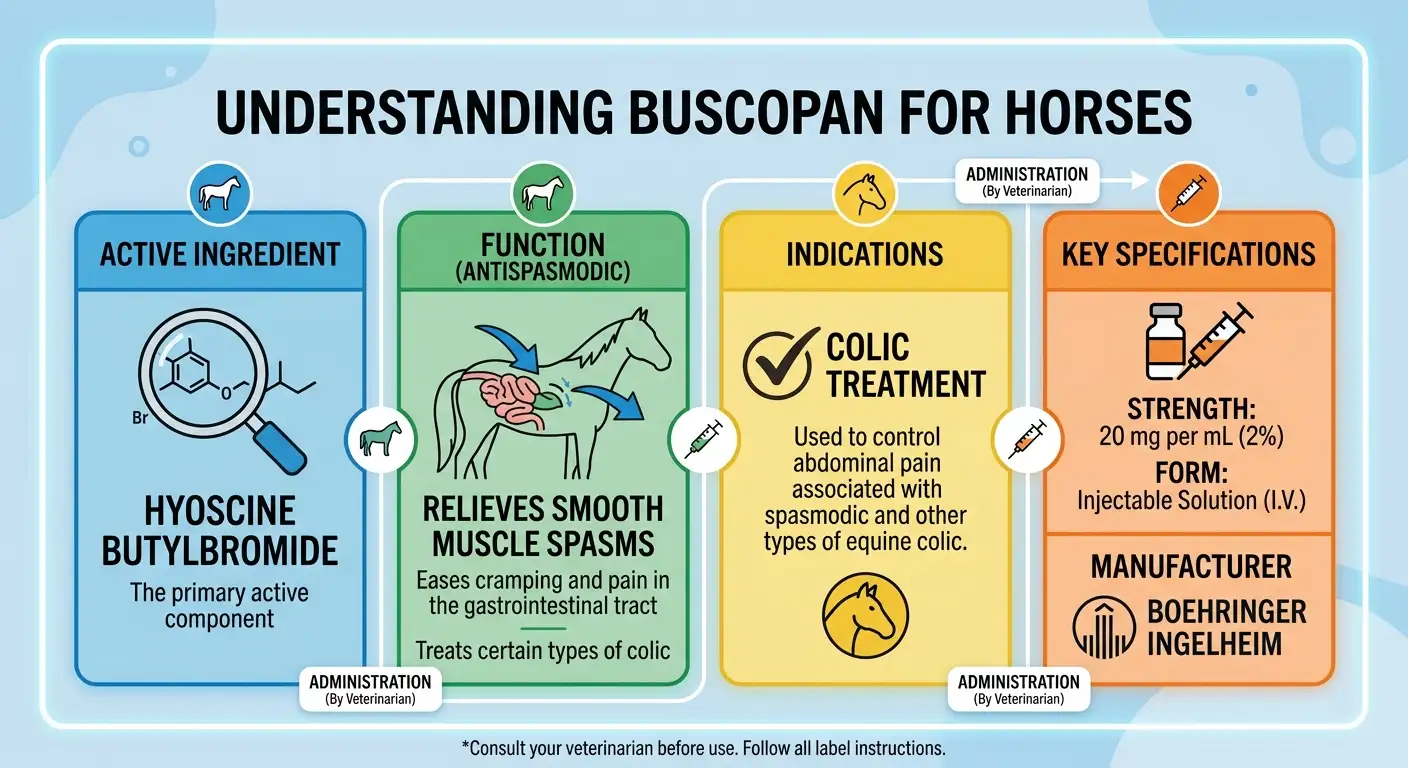
Buscopan is the brand name for hyoscine butylbromide, also written N-butylscopolammonium bromide. It is an antispasmodic (spasmolytic) and anticholinergic drug that relaxes smooth muscle in the digestive tract. That is why vets use it for colic pain caused by gut spasm.
Here is what the labels tell us about the product:
- Strength: 20 mg per mL injectable solution
- Pack size: usually 50 mL multi-dose vials
- Manufacturer: Boehringer Ingelheim Animal Health
- US status: FDA-approved (NADA 141-228), for IV use in horses, restricted to use by or on the order of a licensed veterinarian
- UK status: POM-V (prescription only, veterinarian), authorised for horses and calves
It belongs to the same family as atropine, but it behaves differently. The UK data sheet notes that it does not cross the blood-brain barrier, has less effect on the heart and on saliva and tear production than atropine, and wears off sooner without needing an antidote.
Buscopan Dosage for Horses: The Labeled Dose
The labeled Buscopan dose for horses is 0.3 mg/kg (0.14 mg/lb) as a single slow IV injection, equal to 1.5 mL of the 20 mg/mL solution per 100 kg of body weight.
How to Calculate the Dose in 3 Steps
- Get a real weight. Use a scale or weight tape. Guessing is where dose errors begin.
- Multiply kg by 0.3 to get milligrams.
- Divide milligrams by 20 to get millilitres of 20 mg/mL solution.
Shortcuts: kilograms x 0.015 = mL, or pounds x 0.0068 = mL.
Worked example: a 450 kg horse needs 450 x 0.3 = 135 mg, and 135 / 20 = 6.75 mL.
Buscopan Dosage Chart for Horses by Weight
Use these charts to check what your vet is drawing up. The kilogram chart is calculated from 0.3 mg/kg and 20 mg/mL. The pound chart comes straight from the table on the US label, which rounds to the nearest 100 lb.
Dosage Chart in Kilograms
| Body weight (kg) | Dose (mg) | Volume of 20 mg/mL (mL) |
|---|---|---|
| 200 | 60 | 3.0 |
| 250 | 75 | 3.75 |
| 300 | 90 | 4.5 |
| 350 | 105 | 5.25 |
| 400 | 120 | 6.0 |
| 450 | 135 | 6.75 |
| 500 | 150 | 7.5 |
| 550 | 165 | 8.25 |
| 600 | 180 | 9.0 |
| 650 | 195 | 9.75 |
| 700 | 210 | 10.5 |
| 750 | 225 | 11.25 |
| 800 | 240 | 12.0 |
Dosage Chart in Pounds (US Label)
| Body weight (lb) | Approx. kg | Dose (mL) |
|---|---|---|
| 400 | 181 | 2.7 |
| 600 | 272 | 4.1 |
| 800 | 363 | 5.4 |
| 900 | 408 | 6.1 |
| 1,000 | 454 | 6.8 |
| 1,100 | 499 | 7.5 |
| 1,200 | 544 | 8.2 |
| 1,300 | 590 | 8.8 |
| 1,400 | 635 | 9.5 |
| 1,500 | 680 | 10.2 |
| 1,600 | 726 | 10.9 |
| 1,800 | 816 | 12.2 |
| 2,000 | 907 | 13.6 |
Quick Answers for Common Weights
- 1,000 lb horse: 6.8 mL
- 1,100 lb (500 kg) horse: 7.5 mL
- 450 kg horse: 6.75 mL
- 1,200 lb horse: 8.2 mL
- 600 kg horse: 9.0 mL
Buscopan Dosage in the US, Canada and the UK
The dose is identical everywhere. Almost everything around it differs a little, and those details matter.
| Detail | US label | Canadian label | UK data sheet |
|---|---|---|---|
| Dose | 0.3 mg/kg | 0.3 mg/kg | 0.3 mg/kg |
| Volume | 1.5 mL per 100 kg | 1.5 mL per 100 kg | 1.5 mL per 100 kg |
| Route | Slow IV | Slow IV; not IM or SC | Single IV injection |
| Repeat dosing | Label describes a single injection | Not for repeated administration | Single injection |
| Indication | Spasmodic colic, flatulent colic, simple impactions | Nonsurgical, uncomplicated colic | Antispasmodic treatment in equine colic |
| Young horses | Not recommended in nursing foals | Safety not shown under 2 years | Not for foals under 6 weeks |
| Mares | Not recommended in pregnant or lactating mares | Not recommended in breeding, pregnant or lactating mares | Not recommended in pregnancy |
| Food horses | Not for horses intended for human consumption | Not for horses slaughtered for food | Horse meat and offal withdrawal: 1 day |
How Is Buscopan Given to Horses?
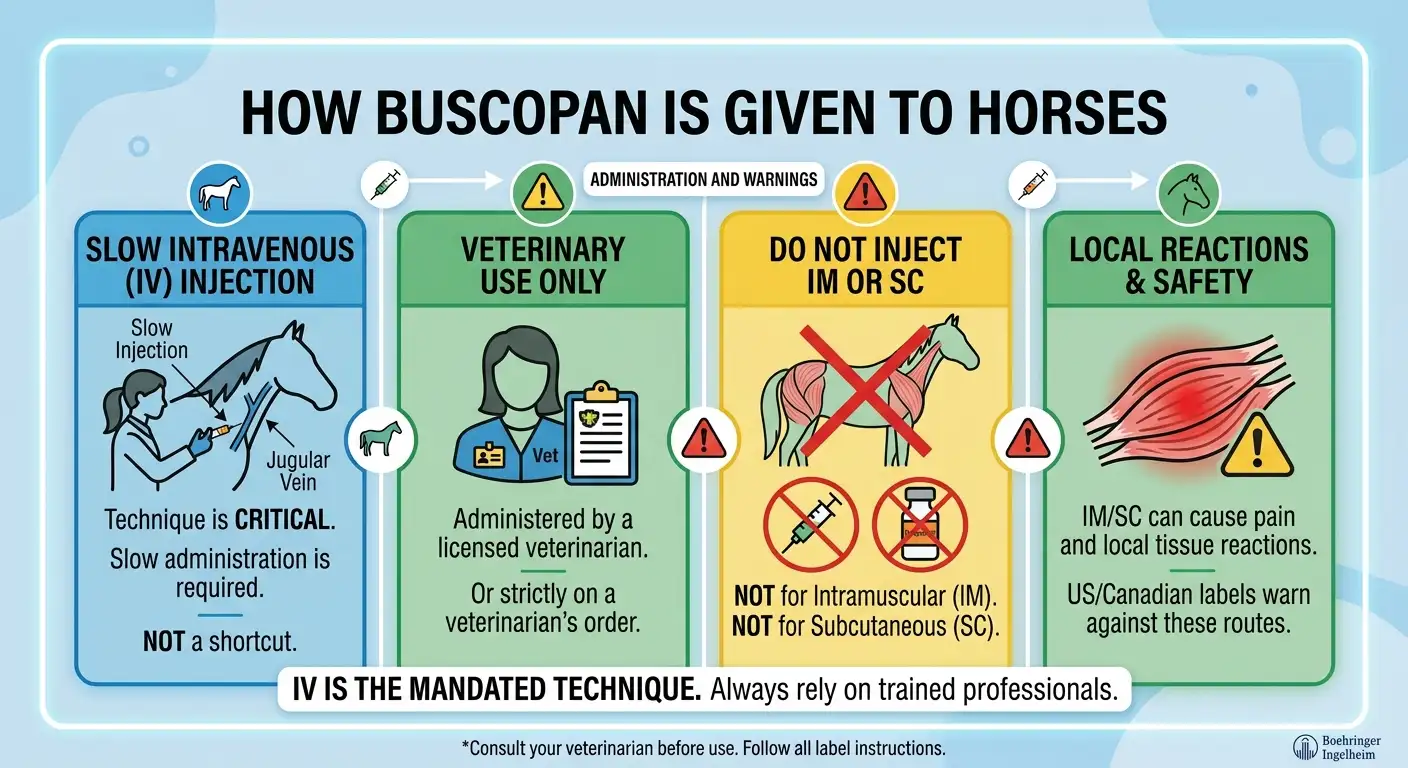
Buscopan is given by slow intravenous (IV) injection, usually into the jugular vein, by a veterinarian or on a veterinarian’s order. It is not an intramuscular or subcutaneous drug in horses.
The US label states that safety by the IM route has not been established. The Canadian label says plainly not to inject it IM or SC. For the Compositum version, the UK leaflet warns of local reactions if it is given into the muscle.
Even if your vet leaves drugs with you, the label says IV and slow. That is a technique, not a shortcut. If nobody has trained you and told you to give it, leave it to your vet.
What Does Buscopan Treat in Horses?
Buscopan is used for colic pain caused by gut spasm. The exact wording depends on the country:
- US: abdominal pain (colic) from spasmodic colic, flatulent colic and simple impactions
- Canada: intestinal pain from nonsurgical and uncomplicated colic
- UK: antispasmodic treatment in equine colic
It is not an all-purpose colic cure. That distinction matters, and we come back to it below.
How Does Buscopan Work and How Long Does It Last?
Buscopan blocks muscarinic receptors on smooth muscle cells, which interrupts the nerve signals that trigger spasm. The gut relaxes, and the cramping pain eases.
Relaxation lasts roughly 20 to 45 minutes, according to the UK data sheet. The same data sheet puts the plasma half-life at 1 to 2 hours. The US label measured total radioactivity from a labeled dose and estimated a half-life near 6 hours, with more than 96% eliminated in urine and feces within 48 hours.
Neither label gives an exact onset time. The pivotal US study checked horses at 5, 15 and 30 minutes.
Does Buscopan Actually Work? The Field Study
The US approval study randomly assigned 217 horses with colic to Buscopan or placebo. Vets did not know which group each horse was in.
88% of Buscopan-treated horses were rated a treatment success (excellent, good or moderate pain reduction), compared with 42% of placebo horses. Colic scores also improved in the placebo group, which is a reminder that many mild colics settle on their own. The difference between groups was still statistically significant.
Buscopan for Colic: What It Can and Cannot Do
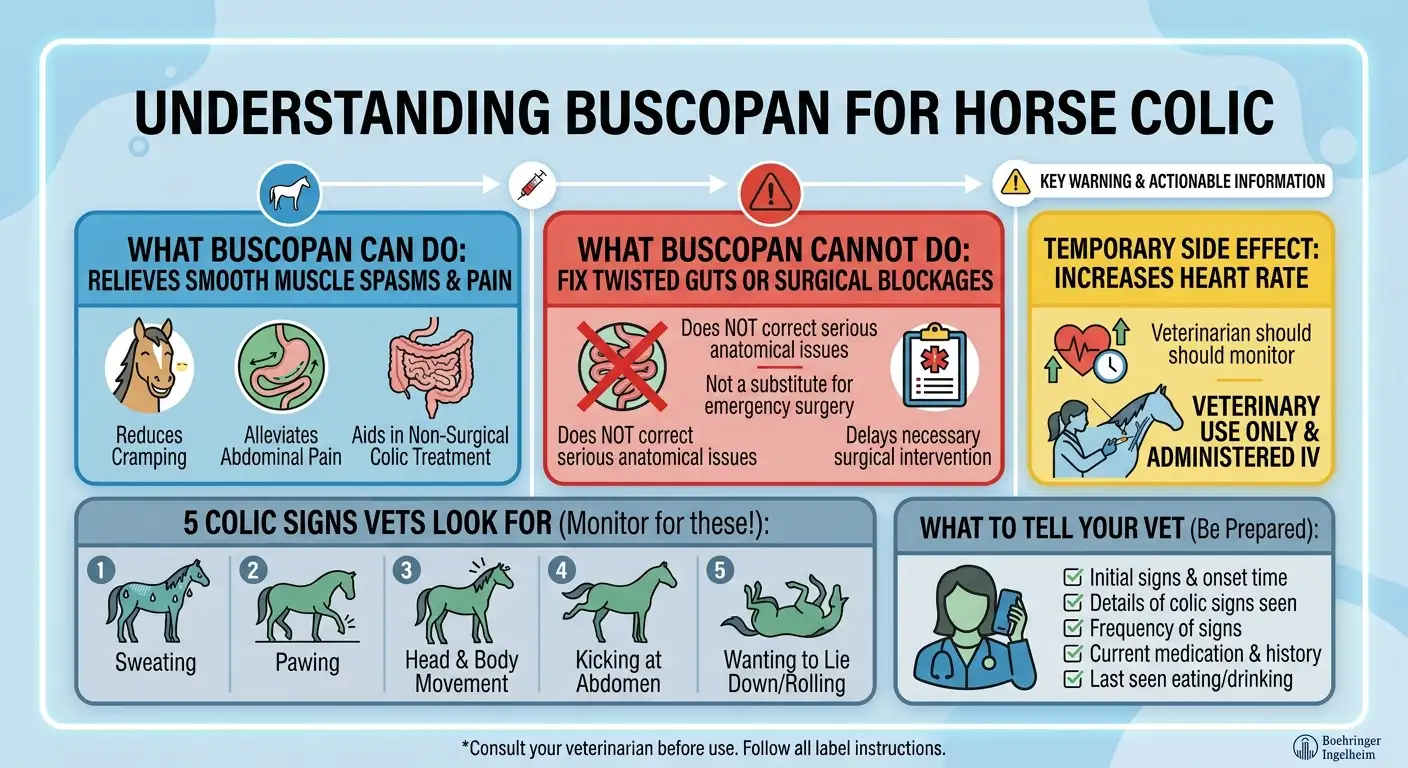
Buscopan can ease spasm-related colic pain. It cannot fix a twisted gut, a blockage that needs surgery, or an underlying problem.
The UK data sheet makes two points worth remembering. Buscopan does not mask the signs of a surgical colic, and if the response is poor, the diagnosis should be reassessed and surgery considered. In other words, a horse that does not settle is a horse that needs a closer look.
Another catch: Buscopan speeds up the heart. The US label says heart rate cannot be used as a valid indicator of pain severity for 30 minutes after the injection. Your vet knows this. If you are monitoring at home, do not read a racing pulse right after the shot as proof that things are getting worse.
Colic-like signs can also come from problems outside gut spasm, such as stomach ulcers. If your vet finds that, the treatment plan changes. You can read about omeprazole dosage for horses to see how that side of the picture works, but your vet should diagnose first.
What to Tell Your Vet
- When the signs started and how they changed
- Your horse’s weight, or the best estimate you have
- Last feed and water, and recent manure output
- Any medication already given, especially pain relievers
- Recent changes in feed, turnout, routine or exercise
If your vet also uses an NSAID, see our guides on Banamine dosage for horses and Bute dosage for horses. The UK data sheet cautions that giving NSAIDs or other analgesics alongside Buscopan can mask signs that need further diagnosis, so tell your vet exactly what was given and when.
Sedation is a separate topic too: the Dormosedan dosage for horses guide explains that product on its own terms.
Can You Repeat a Dose of Buscopan?
The labels describe Buscopan as a single injection, and the Canadian label says it is not for repeated administration.
Safety studies did give horses hourly doses for three hours, and daily doses up to five times the label amount for three days, without signs of toxicity. That is how regulators test safety. It is not permission for owners to re-dose.
If colic signs return after the shot wears off, the horse needs your vet again, not another syringe.
Buscopan Side Effects in Horses
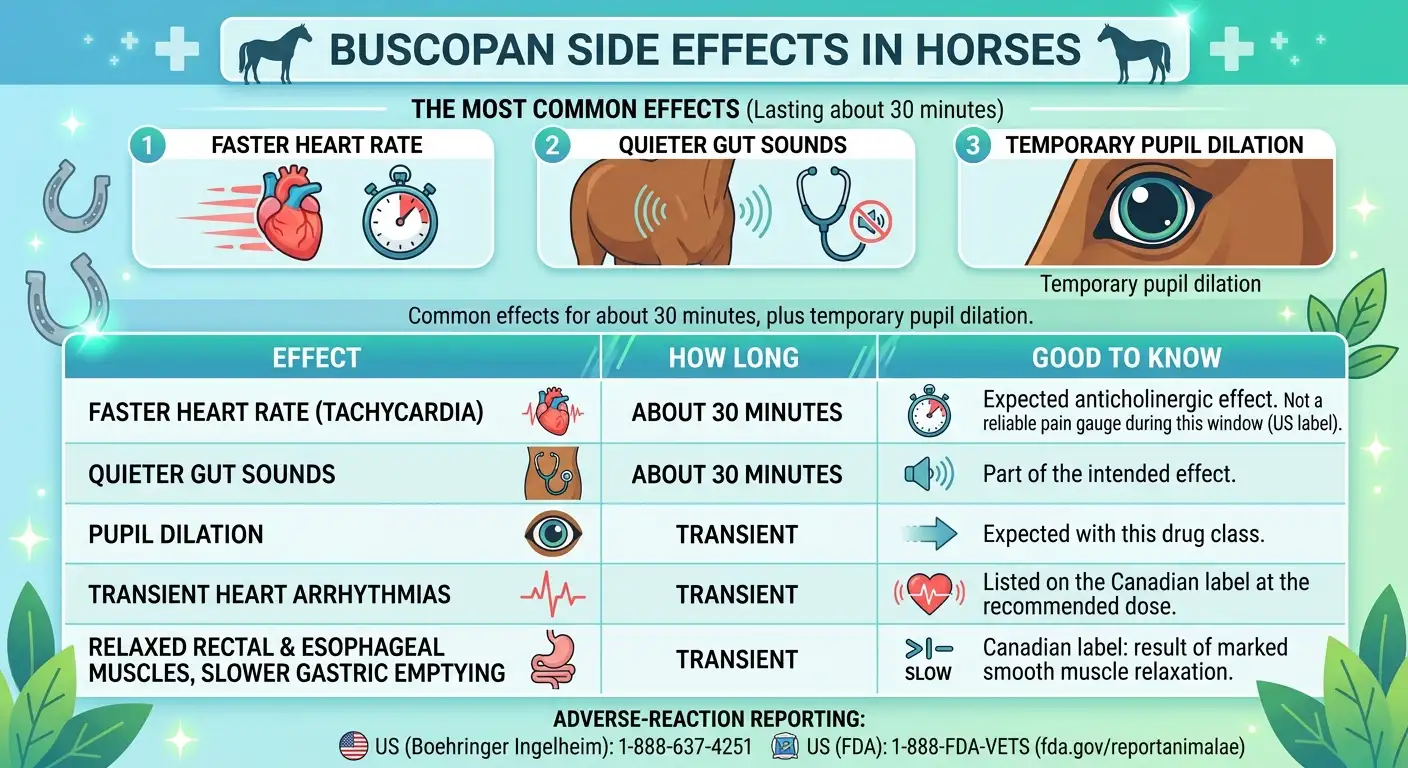
The most common effects are a faster heart rate and quieter gut sounds for about 30 minutes, plus temporary pupil dilation.
| Effect | How long | Good to know |
|---|---|---|
| Faster heart rate (tachycardia) | About 30 minutes | Expected anticholinergic effect. Not a reliable pain gauge during this window (US label). |
| Quieter gut sounds | About 30 minutes | Part of the intended effect. |
| Pupil dilation | Transient | Expected with this drug class. |
| Transient heart arrhythmias | Transient | Listed on the Canadian label at the recommended dose. |
| Relaxed rectal and esophageal muscles, slower gastric emptying | Transient | Canadian label: result of marked smooth muscle relaxation. |
When Not to Use Buscopan
Drug interactions are worth knowing too. Other anticholinergic drugs can intensify Buscopan’s effects. The UK data sheet adds that Buscopan should not be combined with other drugs acting on the (para)sympathetic system. The US label says combination safety has not been studied, so compatibility needs close monitoring.
Buscopan Overdose: What Studies Show
In controlled studies, up to five times the label dose caused no severe reactions. Ten times the dose caused temporary but striking effects. These are tests in healthy horses, not guidance to go higher.
| Dose | What researchers observed |
|---|---|
| 1x (0.3 mg/kg) | Faster heart rate, quieter gut sounds and possible pupil dilation for about 30 minutes. |
| 3x to 5x (0.9 to 1.5 mg/kg) | Given once daily for 3 days: no signs of toxicity. Quieter gut sounds, occasional slight drop in defecation (UK) and lower defecation frequency at higher doses (Canada). |
| 10x (3 mg/kg) | Dilated, fixed pupils at 10 minutes, back to normal by 4 hours in two horses and 24 hours in two. Faster heart rate and dry mucous membranes that normalized by 2 hours. No gut sounds at 10 minutes, back by 3 to 4 hours. Two mild, brief colic episodes needed no treatment. The UK data sheet notes signs of colic from gut paralysis can appear 6 to 8 hours after dosing. |
Buscopan vs Buscopan Compositum
Buscopan and Buscopan Compositum are not interchangeable. Compositum adds metamizole, a pyrazolone NSAID with pain-relieving and fever-reducing effects, and it is dosed at more than three times the volume.
| Feature | Buscopan 20 mg/mL | Buscopan Compositum (UK) |
|---|---|---|
| Active ingredients | Hyoscine butylbromide 20 mg/mL | Butylscopolamine bromide 4 mg/mL plus metamizole 500 mg/mL |
| Horse dose | 1.5 mL per 100 kg | 5 mL per 100 kg |
| Active amount delivered (calculated) | 0.3 mg/kg hyoscine butylbromide | About 0.2 mg/kg butylscopolamine bromide and 25 mg/kg metamizole |
| Horse route | Slow IV | IV only; IM not used in horses because of local reactions |
| Meat and offal withdrawal (UK) | 1 day | 12 days |
| Pack size | 50 mL | 100 mL |
| Pregnancy | Not recommended | Do not use |
| Handler warning | Parabens hypersensitivity; wear gloves | Metamizole can rarely cause serious blood and skin reactions in people |
Mix up the mL figures and you either underdose or give three times the volume of a different product. Always read the label strength before anything is drawn into a syringe.
Buscopan vs Banamine: Are They the Same?
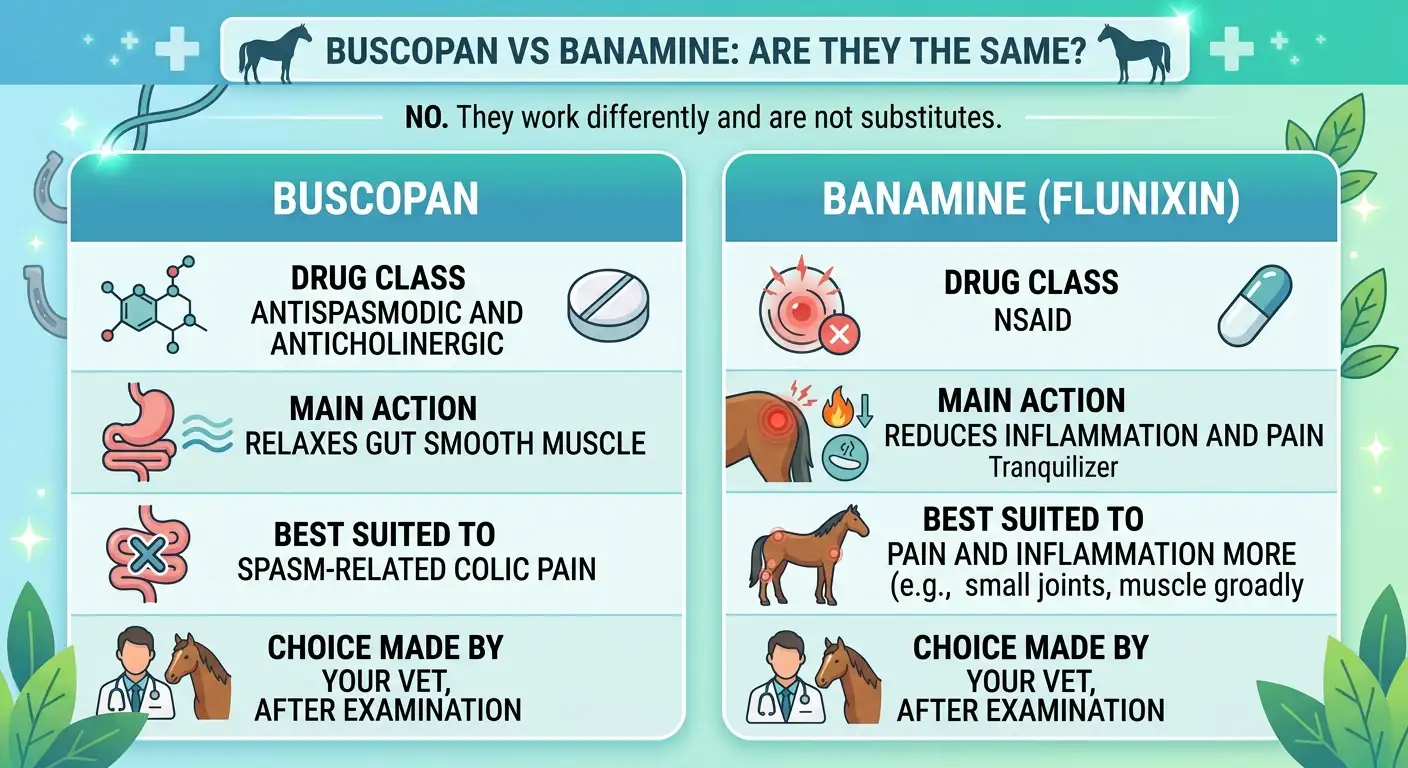
No. They work differently and are not substitutes.
| Buscopan | Banamine (flunixin) | |
|---|---|---|
| Drug class | Antispasmodic and anticholinergic | NSAID |
| Main action | Relaxes gut smooth muscle | Reduces inflammation and pain |
| Best suited to | Spasm-related colic pain | Pain and inflammation more broadly |
| Choice made by | Your vet, after examination | Your vet, after examination |
Dosing for the NSAID has its own rules. See the full Banamine dosage for horses guide, and remember that the UK data sheet warns that NSAIDs can mask signs of conditions needing further diagnosis.
Withdrawal Times, Storage and Handling Safety
Withdrawal: the US and Canadian labels do not allow use in horses intended for human consumption. The UK data sheet lists a 1-day meat and offal withdrawal for Buscopan 20 mg/mL and 12 days for Compositum. This article does not cover competition rules, so check your governing body and ask your vet.
Storage: the US label says store at or below 25°C (77°F) with excursions to 30°C. The Canadian label says 15 to 30°C. The UK data sheet lists no special storage but allows 28 days of use after first opening. Compositum should not be stored above 25°C, should be protected from light, and has a 28-day in-use life. Check the label on your own bottle.
People: keep it out of reach of children. It is not for human use, so if it is ingested, contact a physician at once. Wash hands after use, and wear impermeable gloves if you are sensitive to hyoscine butylbromide or parabens.
How Much Does Buscopan Cost?
Prices vary by country, pack size and vet. As one UK data point, an online veterinary pharmacy listed Buscopan Compositum 100 mL at £75.76 ex VAT (£90.91 inc VAT) and required a vet prescription.
At the Compositum dose of 5 mL per 100 kg, a 450 kg horse uses 22.5 mL, which is roughly £17 ex VAT of product. Plain Buscopan pricing was not available from the sources used, so ask your vet or pharmacy.
Common Mistakes With Buscopan
- Giving it IM because it “works the same”
- Confusing Buscopan and Buscopan Compositum volumes
- Re-dosing when signs return instead of calling the vet
- Reading a fast heart rate as worsening pain during the first 30 minutes
- Assuming a calm horse means the colic is solved
- Adding an NSAID without telling the vet what was already given
- Dosing from a guessed weight
Expert Tips
- Weigh, do not guess. A weight tape beats eyeballing.
- Write down the time and amount of any drug given and give it to your vet.
- Keep the box. The label and strength are what your vet will want to see.
- Plan for the 30-minute window. Expect a quick pulse and quiet gut, and let your vet interpret it.
- Ask about aftercare. Diet, water, parasite control and routine all come into prevention. Some owners use psyllium husk, and our psyllium husk dosage for horses guide covers it, but ask your vet whether it suits your horse.
- The labeled dose is 0.3 mg/kg, which is 1.5 mL of 20 mg/mL per 100 kg, as a single slow IV injection.
- Do not give it IM, and do not repeat it on your own.
- Expect a faster heart rate and quieter gut for about 30 minutes.
- Not for impaction with ileus, glaucoma, unstable heart conditions or surgical colic.
- Buscopan Compositum is a different product with a different dose.
- If the horse does not settle, the colic needs a closer look.
FAQs
What is the Buscopan dosage for horses?
The labeled dose is 0.3 mg per kg (0.14 mg per lb) given as a single slow intravenous injection. With the 20 mg/mL solution, that equals 1.5 mL per 100 kg (220 lb) of body weight. Your vet confirms the dose and gives the injection.
How many mL of Buscopan for a 1,000 lb horse?
The US label table lists 6.8 mL for a 1,000 lb horse, based on 0.68 mL per 100 lb of the 20 mg/mL solution. Your vet confirms the final dose for your horse.
How many mL of Buscopan for a 500 kg horse?
A 500 kg horse needs 150 mg, which is 7.5 mL of the 20 mg/mL solution (1.5 mL per 100 kg), given by slow IV injection.
Can Buscopan be given intramuscularly to a horse?
No. The US label says safety by the IM route has not been established, and the Canadian label says not to give it IM or SC. The labeled route is slow intravenous injection.
How long does Buscopan last in horses?
The UK data sheet describes smooth muscle relaxation lasting about 20 to 45 minutes. A faster heart rate and quieter gut sounds last about 30 minutes, and the plasma half-life is 1 to 2 hours in the UK data sheet.
Can you repeat Buscopan for horses?
The labels describe a single injection, and the Canadian label says it is not for repeated administration. If colic signs return, call your vet rather than giving another dose.
Is Buscopan safe for horses?
At the labeled dose, studies reported mainly short-lived effects such as a faster heart rate, quieter gut sounds and pupil dilation. It is not safe for every horse: impaction with ileus, glaucoma, unstable heart conditions and surgical colic are among the contraindications. Your vet decides whether it suits your horse.
What are the side effects of Buscopan in horses?
Labels list a transient faster heart rate and decreased gut sounds lasting about 30 minutes, plus temporary pupil dilation. The Canadian label also lists transient heart arrhythmias and marked smooth muscle relaxation, including rectal and esophageal muscles.
Can Buscopan be used for impaction colic?
The US label covers simple impactions but not impaction colic associated with ileus. The UK data sheet adds that in mechanical obstruction, fluids, laxatives and analgesics should be considered alongside it. Your vet decides after an examination.
Can Buscopan be given with Banamine?
Your vet decides on combinations. The US label says safety alongside other drugs has not been established, and the UK data sheet warns that NSAIDs or other analgesics can mask signs that need further diagnosis. Always tell your vet what has already been given.
What is the difference between Buscopan and Buscopan Compositum?
Compositum contains butylscopolamine bromide (4 mg/mL) plus the pain reliever metamizole (500 mg/mL). In horses it is dosed at 5 mL per 100 kg IV only, compared with 1.5 mL per 100 kg for Buscopan 20 mg/mL, and it has a 12-day meat withdrawal in the UK.
Can pregnant or lactating mares have Buscopan?
Labels do not recommend it. The US label says safety has not been established in pregnant or lactating mares and nursing foals, and the Canadian label adds breeding mares.
Can you buy Buscopan for horses without a prescription?
No. In the US it is restricted to use by or on the order of a licensed veterinarian, and in the UK it is POM-V, a prescription-only veterinary medicine.
What happens if a horse gets too much Buscopan?
In a study at ten times the dose, horses had dilated fixed pupils, a faster heart rate, dry mucous membranes and no gut sounds for hours, with mild brief colic in two horses. The UK data sheet says colic signs from gut paralysis can appear 6 to 8 hours later. Call your vet if an overdose is suspected.
Can a horse treated with Buscopan enter the food chain?
The US and Canadian labels say not to use it in horses intended for human consumption. The UK data sheet lists a 1-day meat and offal withdrawal for Buscopan 20 mg/mL. Check the label for your country and ask your vet.
Can Buscopan cure colic?
No. It relaxes gut smooth muscle to ease spasm-related pain. The UK data sheet says it does not mask signs of surgical colic, and a poor response means the diagnosis should be re-evaluated and surgery considered.
Sources and References
- Buscopan prescribing information (US, FDA-approved label), Drugs.com
- Buscopan Injection for Horses (Canada), Drugs.com Veterinary
- Buscopan 20 mg/mL SPC, VETiSearch
- Buscopan product record, UK Veterinary Medicines Directorate
- Buscopan Compositum package leaflet, UK Veterinary Medicines Directorate
- Buscopan Compositum, NOAH Compendium
- Buscopan Compositum Injection 100 ml, Farmacy
- Report an animal drug adverse event, US FDA
Label data reviewed October 2026. The US label was last revised 08/2019 and the UK SPC in November 2018, so check your product’s current label. This article is for education only and does not replace veterinary care. If your horse is showing colic signs, call your vet now.