
Misoprostol Dosage for Horses: Chart, Calculator and Safety Guide for Glandular Ulcers and NSAID Protection
Written & Reviewed By: Medshorse Team
Last Updated: October 2026
If your vet has mentioned misoprostol for a horse with stubborn glandular ulcers, one question comes up fast: how much is the right dose? The misoprostol dosage for horses used in the key published trial was 5 mcg per kg of body weight, given by mouth twice daily. For a 1,000 lb horse, that works out to about 2,268 mcg (2.27 mg) per dose.
That number looks tiny, and that is exactly why mistakes happen. Misoprostol is measured in micrograms, human tablets are not made for a 1,000 lb animal, and the drug carries real handling risks for people.
This guide gives you a dosage chart, a calculator, the research behind the numbers, side effects, and the safety rules that matter. Your veterinarian always sets the final dose.
Disclaimer: This article is for general education and is not veterinary advice. Product names mentioned, including Misoprostol, belong to their respective owners, and MedsHorse is not affiliated with them. Always follow your veterinarian’s instructions and the current product label.
What Is Misoprostol and How Does It Work in Horses?
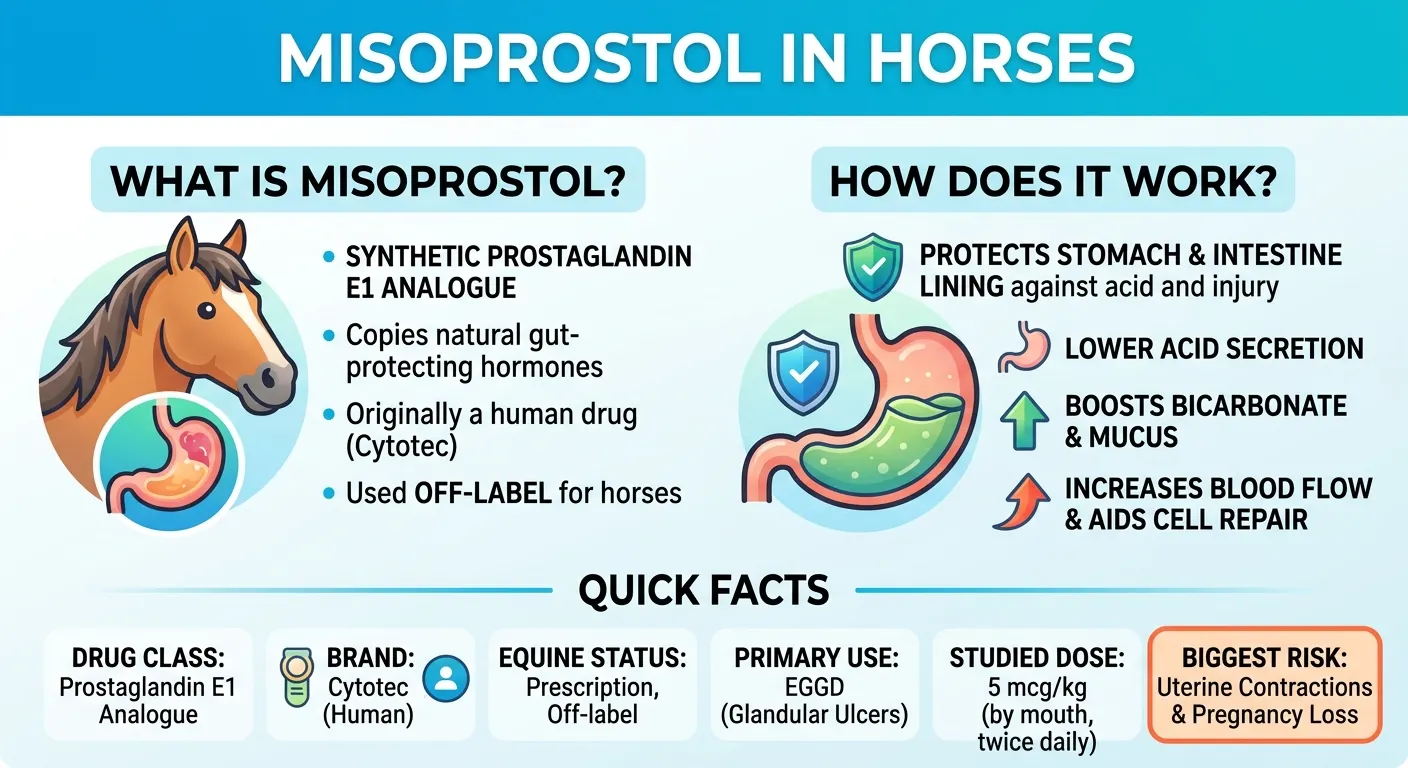
Misoprostol is a synthetic prostaglandin E1 analogue. In plain terms, it copies a natural gut-protecting hormone and helps the stomach and intestinal lining defend itself against acid and injury.
It was developed for people and is FDA approved under the brand name Cytotec to prevent NSAID-related stomach ulcers (FDA label). Horses receive it off label through what UK vets call the prescribing cascade, which means a vet chooses it because no licensed product fits the problem (BEVA client leaflet).
According to the Merck Veterinary Manual, misoprostol lowers acid secretion, boosts bicarbonate and mucus, increases blood flow to the lining and helps damaged cells repair. In one older equine study, a 5 mcg/kg oral dose raised stomach pH above 3.5 at three, four and five hours after dosing (Sangiah et al., 1989).
Why Do Vets Prescribe Misoprostol for Horses?
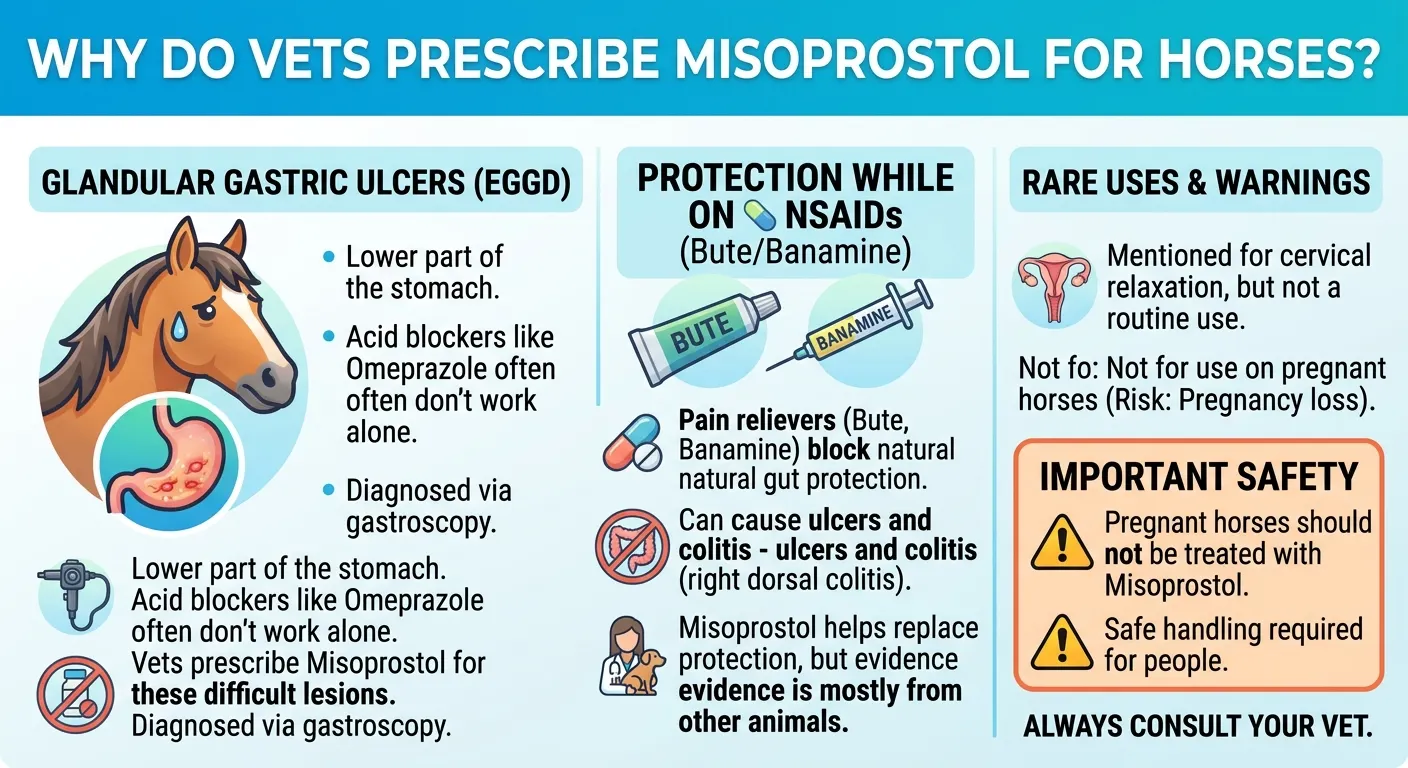
Glandular Gastric Ulcers (EGGD)
Equine glandular gastric disease affects the lower, acid-producing part of the stomach. It behaves differently from squamous ulcers. The Merck manual notes that gastric acid appears to play a smaller role in glandular disease, which helps explain why acid blockers alone often disappoint.
That is where misoprostol comes in. The BEVA leaflet says it is most commonly used for glandular lesions, where omeprazole is usually ineffective. If you want the acid-blocker side of the story, see our guide to omeprazole dosage for horses.
Typical signs that lead vets to look for glandular ulcers include poor performance, behavior changes, girthiness, weight loss, appetite changes, a dull coat, recurrent colic and teeth grinding. Diagnosis needs a gastroscopy, because these signs overlap with many other problems.
Protection for Horses on NSAIDs
Pain relievers such as bute dosage for horses plans and Banamine dosage for horses plans work by blocking prostaglandins. The problem is that the gut needs prostaglandins to keep its protective barrier intact. Long-term use can lead to ulcers and colitis, including right dorsal colitis.
Even COX-2 selective drugs such as the ones covered in our Equioxx dosage for horses guide may still irritate the intestines with long use, according to Mad Barn’s review. Vets sometimes add misoprostol for horses that must stay on NSAIDs.
One honest limit: most hard proof of this benefit comes from people and small animals, and equine data is thinner.
Reproductive Use Is Rare
You may see misoprostol mentioned for cervical relaxation in mares. That rests on a single case report using a cream applied to the cervix, so it is not a routine use and not something to try at home.
What Does the Research Say About Misoprostol for Glandular Ulcers?
The strongest evidence is a UK trial of 63 sport horses with glandular disease (Varley et al., 2019). Forty-three horses received misoprostol at 5 mcg/kg twice daily.
Twenty received omeprazole at 4 mg/kg once daily plus sucralfate at 12 mg/kg twice daily. Vets repeated the gastroscopy after 28 to 35 days (EquiManagement summary).
No lesions worsened in either group, and healing matched improvement in clinical signs. The authors concluded misoprostol was superior for both improvement and healing.
Keep the limits in mind, though. The trial was small, owners knew which drug they were giving, and horses were assigned by hospital rather than by random draw.
Misoprostol Dosage for Horses: What Is the Standard Dose?
The most widely cited misoprostol dosage for horses is 5 mcg per kg of body weight by mouth, twice daily. That is the regimen from the glandular ulcer trial. Some references describe dosing every 8 to 12 hours, and one retail guide lists 5 to 10 mcg/kg twice daily. Your vet picks the exact plan.
Here is how the sources line up:
| Source | Dose Reported | Notes |
|---|---|---|
| Varley et al. 2019 trial | 5 mcg/kg orally, twice daily | 28 to 35 day course, glandular disease |
| Mad Barn review | 5 mcg/kg every 8 to 12 hours | Advises vet guidance |
| First Choice Equine blog | 5 to 10 mcg/kg orally, usually twice daily | Retail source, not peer reviewed |
| Merck Veterinary Manual | Dogs only: 2 to 5 mcg/kg every 6 to 8 hours | No equine dose table given |
| Multi-dose pharmacokinetic study | 5 mcg/kg every 8 hours for 10 doses | 6 healthy geldings, oral and rectal routes |
Notice the gap. There is no large trial comparing different doses in horses. A 2024 European equine medicine congress abstract on misoprostol and sucralfate stated that more work is needed to evaluate the clinical effect of dosing regimens (ECEIM abstracts).
So treat any number as a starting point for a conversation with your vet, not a recipe.
Misoprostol Dosage Chart for Horses by Weight
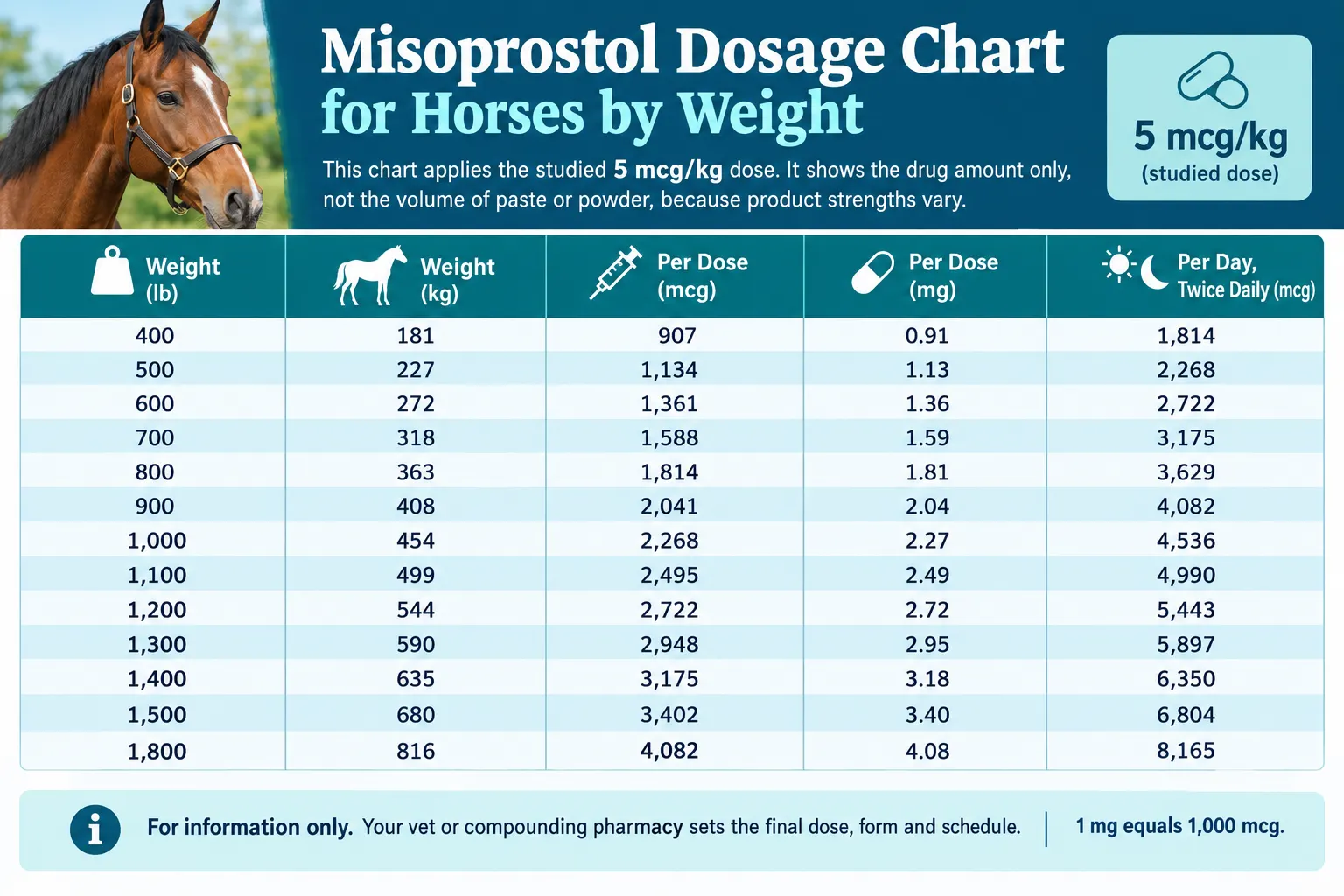
This chart applies the studied 5 mcg/kg dose. It shows the drug amount only, not the volume of paste or powder, because product strengths vary.
| Weight (lb) | Weight (kg) | Per Dose (mcg) | Per Dose (mg) | Per Day, Twice Daily (mcg) |
|---|---|---|---|---|
| 400 | 181 | 907 | 0.91 | 1,814 |
| 500 | 227 | 1,134 | 1.13 | 2,268 |
| 600 | 272 | 1,361 | 1.36 | 2,722 |
| 700 | 318 | 1,588 | 1.59 | 3,175 |
| 800 | 363 | 1,814 | 1.81 | 3,629 |
| 900 | 408 | 2,041 | 2.04 | 4,082 |
| 1,000 | 454 | 2,268 | 2.27 | 4,536 |
| 1,100 | 499 | 2,495 | 2.49 | 4,990 |
| 1,200 | 544 | 2,722 | 2.72 | 5,443 |
| 1,300 | 590 | 2,948 | 2.95 | 5,897 |
| 1,400 | 635 | 3,175 | 3.18 | 6,350 |
| 1,500 | 680 | 3,402 | 3.40 | 6,804 |
| 1,800 | 816 | 4,082 | 4.08 | 8,165 |
Misoprostol Dosage Calculator for Horses
Enter your horse’s weight to see the math. If your vet gave you a different dose, change the dose box to match it. The optional product strength field turns micrograms into a volume or weight of paste or powder, using the strength printed on your pharmacy label.
Misoprostol Dosage Calculator For Horses
Typical dose: 5 mcg/kg of bodyweight every 8-12 hours
Calculated Dose
Consult with your veterinarian for instructions and dosage guidelines for giving Misoprostol to your horse. This calculator gives an estimate only and does not replace veterinary advice. Pregnant women should avoid handling this medication.
© medshorse.com
How to Calculate the Dose by Hand
- Convert pounds to kilograms by dividing by 2.2.
- Multiply the kilograms by your prescribed dose in mcg per kg. At 5 mcg/kg, that is kg times 5.
- Divide by 1,000 if you need milligrams.
- Divide the micrograms by the product strength on the label to find the amount of paste, liquid or powder.
Here is a made-up example. A 1,100 lb horse weighs about 499 kg. Times 5 gives 2,495 mcg per dose. If a compounded product were labeled 1,000 mcg per mL, that dose would be about 2.5 mL. Your label will differ, so never copy this number.
Weight matters more than most owners expect. A weight tape gives an estimate, and every dose scales with it. If accuracy matters, use a livestock scale or ask your vet for a recent weight.
What Forms Does Misoprostol Come In for Horses?
Misoprostol for horses is usually dispensed as a compounded oral paste, powder, tablet or top-dress pellet. Mad Barn also lists chewable tablets, oil suspensions and topical gels, and notes it can be combined with omeprazole, metronidazole, piroxicam or phenytoin sodium.
Human Cytotec tablets are made in small microgram strengths, so a horse dose often needs compounding.
Two practical cautions. First, check the strength on every new fill, because compounded products are not all made the same. Second, be careful with combination pastes. One retail omeprazole and misoprostol paste lists 1.4 mg of misoprostol per tube and once-daily dosing of half to one tube.
That is roughly 3 mcg/kg for a 1,000 lb horse in a full tube, which does not match a 5 mcg/kg twice daily plan. Ask your vet to confirm the schedule that suits the product you actually have.
If your vet pairs misoprostol with an antibiotic for colitis, see our guide to metronidazole dosage for horses.
How and When to Give Misoprostol
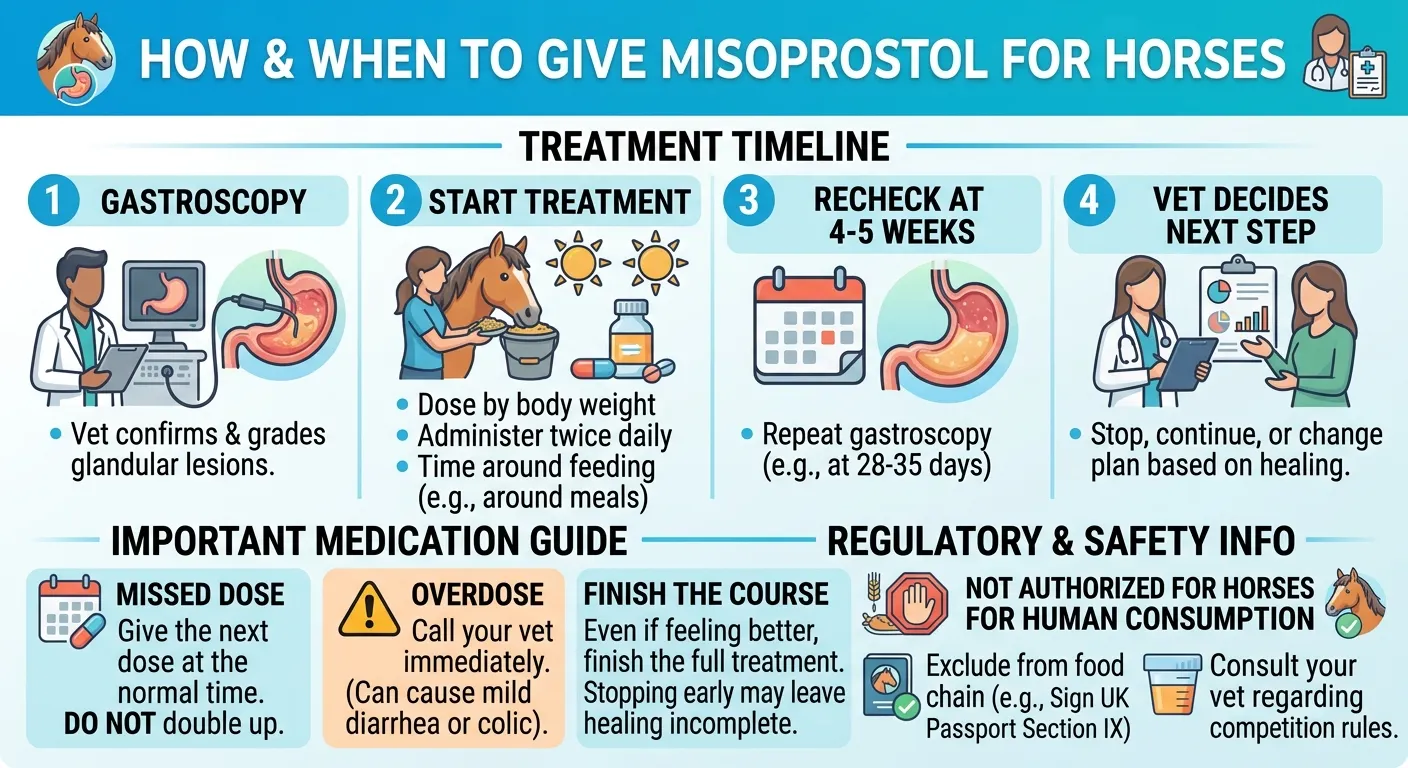
Give it exactly as your vet directs, usually twice daily and timed around feeding. The glandular ulcer trial dosed horses around meals, and the BEVA leaflet gives clear rules for missed doses and finishing the course.
Missed Dose, Overdose and Stopping Early
Missed dose: give the next dose at the normal time. Never double up. Accidental overdose: call your vet, since large doses can cause mild diarrhea or colic. Feeling better: finish the full course, because stopping early may leave healing incomplete and signs can return.
Misoprostol is also not authorized for horses intended for human consumption. In the UK, owners sign section IX of the horse passport to exclude the horse from the food chain. Ask your vet about food chain status and competition medication rules where you live.
Misoprostol vs Omeprazole vs Sucralfate
Misoprostol protects and repairs the lining, omeprazole shuts down acid, and sucralfate coats ulcerated tissue. Each has a different job, and vets sometimes combine them. Our sucralfate dosage for horses guide covers the coating drug in detail.
| Feature | Misoprostol | Omeprazole | Sucralfate |
|---|---|---|---|
| Action | Prostaglandin analogue, protects lining, lowers acid | Proton pump inhibitor, blocks acid | Forms a sticky barrier over damaged tissue |
| Best Known Target | Glandular ulcers (EGGD) | Squamous ulcers (ESGD) | Supportive coating |
| Dose in Cited Sources | 5 mcg/kg twice daily | 4 mg/kg once daily to treat, 2 mg/kg to prevent recurrence (Merck) | 12 mg/kg twice daily (Varley trial) |
| Glandular Evidence | 72% healed in one trial | Limited for glandular disease | Little evidence of efficacy in animals (Merck) |
| Key Caution | Pregnancy risk, human handling risk | Ulcers can return after stopping | May alter absorption of some antibiotics |
One more nuance for fairness. Merck notes that across species misoprostol is generally less effective than acid blockers for treating ulcers overall, though some evidence supports it for glandular disease in horses.
The right drug depends on which part of the stomach is affected, which is why the gastroscopy matters.
Misoprostol Side Effects in Horses
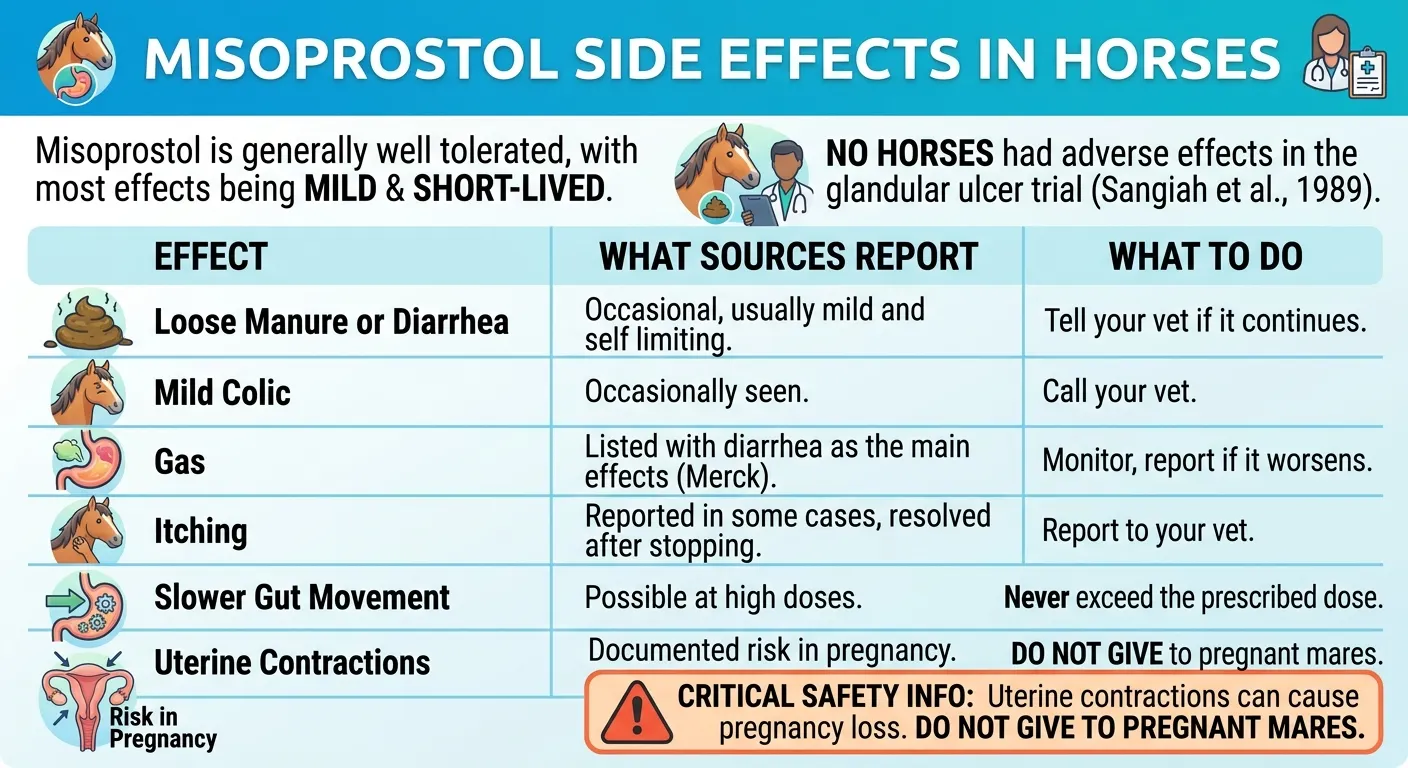
Misoprostol is generally well tolerated in horses. The most common problems are mild and short-lived: loose manure, mild colic, gas and occasional itching. No horses had adverse effects in the glandular ulcer trial, but published safety data in horses is limited.
| Effect | What Sources Report | What To Do |
|---|---|---|
| Loose manure or diarrhea | Occasional, usually mild and self limiting | Tell your vet if it continues |
| Mild colic | Occasionally seen | Call your vet |
| Gas | Listed with diarrhea as the main effects (Merck) | Monitor, report if it worsens |
| Itching | Reported in some cases, resolved after stopping | Report to your vet |
| Slower gut movement | Possible at high doses | Never exceed the prescribed dose |
| Uterine contractions | Documented risk in pregnancy | Do not give to pregnant mares |
Call your vet right away for severe or persistent colic, heavy watery diarrhea, fever, or a horse that stops eating.
Who Should Not Receive Misoprostol?
Pregnant mares. Merck calls misoprostol an abortifacient. One small study found a 5 day course did not disrupt mid-gestation pregnancy in mares (Jacobson et al., 2013), but long-term effects are unknown, so most references advise avoiding it.
Lactating mares. Plumb’s Veterinary Drug Handbook, as cited by Mad Barn, warns the drug passes into milk and could cause severe diarrhea in the foal.
Horses with seizure history or blood vessel problems. The same handbook cautions about unsafe drops in blood pressure or seizures.
Foals. The sources reviewed here give no established foal dose, so this is strictly a vet decision. Tell your vet about every other medicine and supplement your horse takes.
Handling Misoprostol Safely at the Barn
Misoprostol mimics the prostaglandins that start labor, so people can be affected by small amounts they inhale or swallow while preparing it. The BEVA leaflet sets out clear rules.
Common Mistakes to Avoid
- Guessing your horse’s weight instead of measuring it.
- Mixing up mcg and mg, which is a 1,000 times error.
- Splitting human tablets at home to hit a horse dose.
- Doubling a missed dose.
- Stopping the moment the horse looks better.
- Skipping the gastroscopy and treating blind.
- Letting a pregnant or nursing woman handle the drug.
Supporting Gut Healing Beyond Medication
Medication works best alongside better management. Offer forage free choice whenever possible, keep concentrate feeding modest, and reduce stress where you can. The glandular ulcer research also links hard exercise, more than five days a week, to a 3.5 times higher risk of glandular disease.
Some owners also add gut-support nutrients. Mad Barn points to glutamine as a key fuel for gut cells, and you can check amounts in our glutamine dosage for horses guide. Run any supplement past your vet first, especially during treatment.
FAQs
What is the standard misoprostol dosage for horses?
The most widely cited dose is 5 mcg per kg of body weight by mouth, twice daily. That regimen comes from a trial in horses with glandular gastric ulcers. Some references describe dosing every 8 to 12 hours, so your vet decides the exact plan.
How much misoprostol does a 1,000 lb horse get?
At 5 mcg/kg, a 1,000 lb horse (about 454 kg) receives about 2,268 mcg, or 2.27 mg, per dose. Given twice daily, that totals about 4,536 mcg per day. Confirm the dose and the product strength with your vet before giving it.
How often should misoprostol be given to horses?
The key glandular ulcer trial gave it twice daily. Other references mention every 8 to 12 hours, and a pharmacokinetic study used every 8 hours. Follow the schedule your vet prescribes and time doses around feeding as directed.
How long does a horse stay on misoprostol?
In the main trial, horses were treated and then rechecked by gastroscopy after 28 to 35 days. Your vet decides the final length based on healing. Finish the full course, because stopping early may leave ulcers unhealed.
What is misoprostol used for in horses?
Vets mainly use it for glandular gastric ulcers that do not respond well to omeprazole. It is also used to help protect the gut in horses on long-term NSAIDs and to support horses with NSAID-related colitis. These uses are off label.
Does misoprostol work for glandular ulcers in horses?
Evidence is encouraging. In a trial of 63 sport horses, 72 percent of lesions healed with misoprostol compared with 20 percent with omeprazole plus sucralfate. The study was small and owners were not blinded, so more research is still needed.
Can I give my horse human Cytotec tablets?
Only if your vet prescribes and directs it. Human tablets come in small microgram strengths that are hard to divide accurately for a horse, so many vets use compounded forms. Never dose from human tablets without veterinary guidance.
Can misoprostol be given with omeprazole?
Yes, vets sometimes combine them, and some compounded pastes contain both drugs. Product strengths differ, so ask your vet to confirm that the combined product matches the dose and schedule your horse needs.
Can misoprostol be given with sucralfate?
Vets do use both for glandular ulcers. Sucralfate can bind some medications and change how they are absorbed, so ask your vet whether to space the doses apart. A 2024 pharmacokinetic study has examined giving the two together.
What are the side effects of misoprostol in horses?
The most common effects are mild and short-lived, including loose manure, mild colic, gas and occasional itching. Call your vet if signs persist, and contact them immediately for severe colic, heavy diarrhea or fever.
Is misoprostol safe for pregnant mares?
It is generally avoided. Misoprostol can cause uterine contractions and is considered an abortifacient. One small study found a 5 day course did not disrupt mid-gestation pregnancy, but long-term effects are unknown, so vets advise caution.
Can women handle misoprostol for horses?
Women who are pregnant, planning a pregnancy or breastfeeding should not handle it. All other women should wear gloves, take care when crushing tablets or mixing feed, and clean buckets and surfaces afterward.
What should I do if I miss a dose of misoprostol?
Give the next dose at the normal time. Do not give a double dose to make up for the missed one. If you are unsure, call your vet.
What happens if my horse gets too much misoprostol?
Contact your vet. Large doses can cause mild diarrhea or colic. Keep the packaging handy so you can tell your vet the exact product and strength.
Is misoprostol available without a prescription for horses?
No. Misoprostol is a prescription medicine and must come from a veterinarian or a pharmacy working with one. It is used off label in horses, and your vet should set the dose, form and duration.
Key Takeaways and Next Steps
In one trial, 72% of glandular lesions healed on misoprostol versus 20% on omeprazole plus sucralfate.
No large trial has compared dose levels, so your vet’s plan comes first.
Pregnant mares and pregnant, nursing or planning-to-conceive women must stay away from it.
Finish the course, never double a missed dose, and recheck with your vet at the planned interval.
Your next step is simple. Ask your vet whether a gastroscopy is needed, confirm the dose and product strength in writing, and use the calculator above to double check the math against your horse’s actual weight. If the numbers do not match, ask before you give a single dose.
Sources and Further Reading
- Varley et al., Misoprostol is superior to combined omeprazole-sucralfate for equine gastric glandular disease (Equine Veterinary Journal, 2019)
- Merck Veterinary Manual, Drugs Used to Treat Gastrointestinal Ulcers in Monogastric Animals
- BEVA client information leaflet on misoprostol
- EquiManagement, Misoprostol for Equine Gastric Glandular Disease
- Jacobson et al., Mid-gestation pregnancy and a 5 day misoprostol regimen (Equine Veterinary Journal, 2013)
- Sangiah et al., Effects of misoprostol and omeprazole on gastric pH in horses (Research in Veterinary Science, 1989)
- ECEIM 2024 congress abstracts, misoprostol and sucralfate co-administration
- FDA label for Cytotec (misoprostol)
- Mad Barn, Misoprostol for Horses with Ulcers