
Sedivet Dosage for Horses: Dosage Chart, Calculator & Safety Guide Every Owner Should Read Before the Vet Visit
Written & Reviewed By: Medshorse Team
Last Updated: October 2026
Sedivet dosage for horses is 0.4 to 1.2 mL per 100 kg (220 lb) of body weight, given as an intravenous injection by a veterinarian. That equals 40 to 120 micrograms of romifidine hydrochloride per kilogram. The exact number depends on how deep and how long the sedation needs to be.
On paper that range looks simple. In practice, the volume in the syringe changes with your horse’s weight, the job at hand (a hoof exam is not a pre-anesthetic), and which country’s label your vet follows.
This guide puts the figures from the UK, US and Canadian product labels side by side, then adds a weight chart and a calculator so you can check the math before your vet arrives.
One thing before the numbers: Sedivet is a prescription drug licensed for intravenous use only. This article helps you understand the dose. It does not replace the veterinarian who gives it.
Disclaimer: This article is for general education and is not veterinary advice. Product names mentioned, including Sedivet, belong to their respective owners, and MedsHorse is not affiliated with them. Always follow your veterinarian’s instructions and the current product label.
Sedivet at a glance
What Is Sedivet and How Does It Work in Horses?
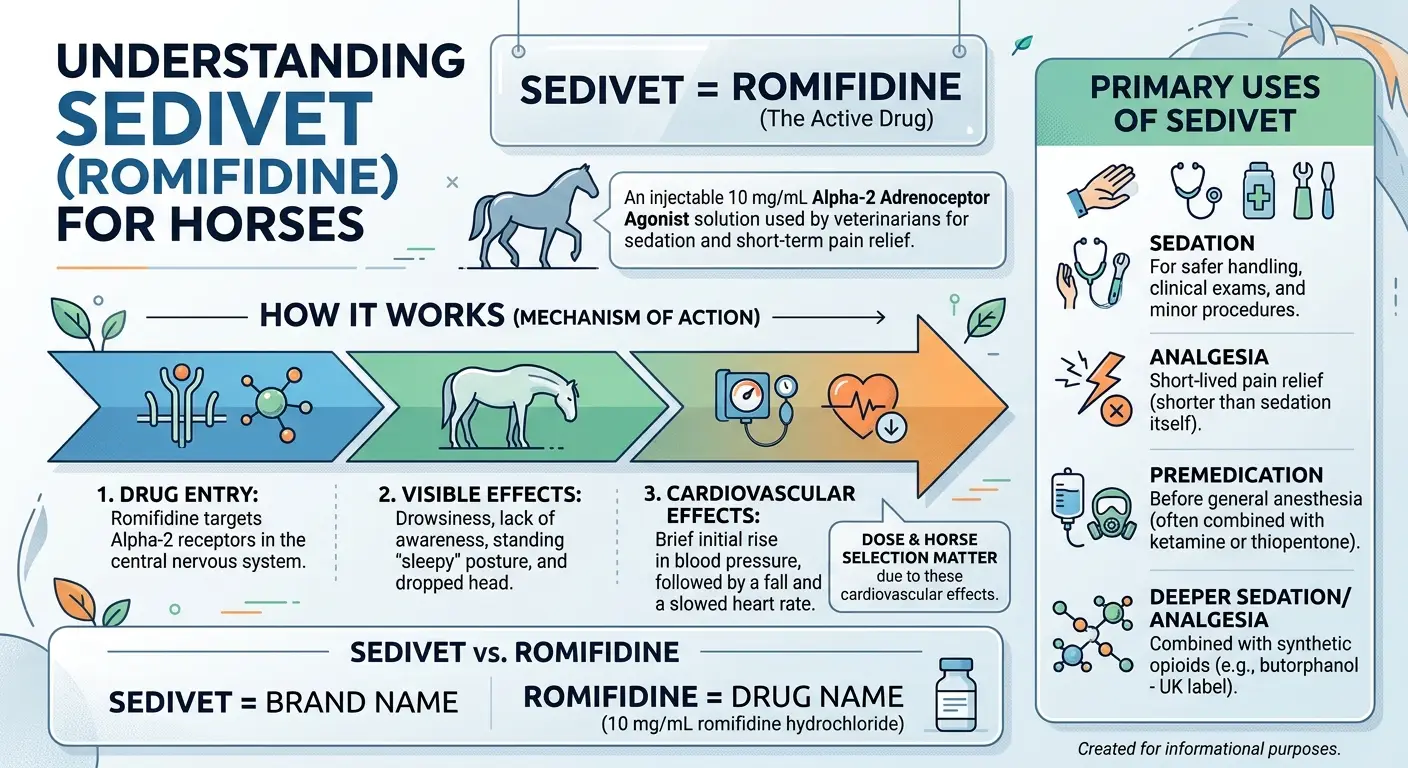
Sedivet is a brand of romifidine hydrochloride, an alpha-2 adrenoceptor agonist that sedates horses and gives short-term pain relief. Boehringer Ingelheim makes it as a 10 mg/mL injectable solution. Vets use it to calm horses for handling, exams, minor procedures and as a pre-anesthetic.
Romifidine works on alpha-2 receptors in the central nervous system. The first visible sign is the head dropping. Then comes drowsiness, less reaction to surroundings and a standing, “sleepy” posture.
The same receptor action also affects the heart and blood vessels. Blood pressure rises briefly, then falls, and heart rate slows. That is why dose and horse selection matter so much (more on that below).
What is Sedivet used for?
The product labels list these uses:
- Sedation to make handling, clinical examinations and minor surgical procedures safer.
- Analgesia (short-lived, and shorter than the sedation itself).
- Premedication before general anesthesia, often with ketamine or thiopentone.
- Deeper sedation and analgesia when combined with a synthetic opioid such as butorphanol (UK label).
Is Sedivet the same as romifidine?
Yes. Sedivet is the brand name, romifidine is the drug. Each mL holds 10 mg of romifidine hydrochloride, which the UK label says is equivalent to 8.76 mg of romifidine base. Dose figures on the label are expressed as the hydrochloride.
Sedivet Dosage for Horses: The Standard Label Dose
The standard Sedivet dose is 0.4 to 1.2 mL per 100 kg given slowly into a vein. Lower doses give lighter, shorter sedation. Higher doses give deeper, longer sedation and stronger analgesia. Onset is the same at any dose.
The formula behind every chart on this page is simple:
Dose in mL = (body weight in kg ÷ 100) × 0.4 to 1.2
Your vet picks the multiplier from the table below, based on the procedure.
| Purpose | Dose per 100 kg | Dose per kg | What the label says |
|---|---|---|---|
| Light sedation | 0.4 mL | 40 µg | Light sedation, about 0.5–1 hour (UK) |
| Deep sedation | 0.8 mL | 80 µg | Deep sedation, about 0.5–1.5 hours (UK) |
| Deep, prolonged sedation | 1.2 mL | 120 µg | Residual sedation may last up to 3 hours (UK) |
| Pre-anesthetic (US) | 1.0 mL | 100 µg | Induce anesthesia after maximum sedation is reached |
| Premedication before ketamine (UK) | 1.0 mL | 100 µg | Followed by ketamine 2.2 mg/kg after 5–10 minutes |
| Premedication with other agents (UK) | 0.4–0.8 mL | 40–80 µg | Found most suitable with other anesthetic agents |
| Sedation plus butorphanol (UK) | 0.4–1.2 mL, then 0.2 mL Torbugesic | 40–120 µg, then 20 µg butorphanol | Average 0.6 mL Sedivet with 0.2 mL Torbugesic works in most horses |
Why is the Sedivet dose range so wide?
Because the response is dose-related. In the US sedation study, 40 µg/kg gave about 75 minutes of sedation and 30 minutes of analgesia. At 120 µg/kg, sedation lasted around 3 hours and analgesia about 150 minutes.
A vet chooses the lowest dose that does the job. A quick farrier visit and a standing wound repair do not need the same depth.
Does the Sedivet dose differ by country?
Slightly. The UK and US labels share the same 40–120 µg/kg range. Canada’s label stops at 0.10 mg/kg (1.0 mL per 100 kg). Always follow the label and the vet in your own country.
| Region (label) | Dose range | mL per 100 kg |
|---|---|---|
| UK (POM-V, Boehringer Ingelheim) | 40–120 µg/kg | 0.4–1.2 mL |
| US (FDA NADA 141-229) | 40–120 µg/kg sedation; 100 µg/kg pre-anesthetic | 0.4–1.2 mL; 1.0 mL |
| Canada (DIN 02080001) | 0.04–0.10 mg/kg | 0.4–1.0 mL |
Sedivet Dosage Chart by Horse Weight
This chart shows the label volume of Sedivet 10 mg/mL for common horse and pony weights. Find your horse’s weight in the left column, then read across to the dose level your vet has chosen.
Sedivet 10 mg/mL dose chart (mL, intravenous)
| Weight (kg) | Weight (lb) | Light 0.4 mL/100 kg | Deep 0.8 mL/100 kg | Pre-anesthetic 1.0 mL/100 kg | Prolonged 1.2 mL/100 kg |
|---|---|---|---|---|---|
| 150 | 331 | 0.6 | 1.2 | 1.5 | 1.8 |
| 200 | 441 | 0.8 | 1.6 | 2.0 | 2.4 |
| 250 | 551 | 1.0 | 2.0 | 2.5 | 3.0 |
| 300 | 661 | 1.2 | 2.4 | 3.0 | 3.6 |
| 350 | 772 | 1.4 | 2.8 | 3.5 | 4.2 |
| 400 | 882 | 1.6 | 3.2 | 4.0 | 4.8 |
| 450 | 992 | 1.8 | 3.6 | 4.5 | 5.4 |
| 500 | 1,102 | 2.0 | 4.0 | 5.0 | 6.0 |
| 550 | 1,213 | 2.2 | 4.4 | 5.5 | 6.6 |
| 600 | 1,323 | 2.4 | 4.8 | 6.0 | 7.2 |
| 650 | 1,433 | 2.6 | 5.2 | 6.5 | 7.8 |
| 700 | 1,543 | 2.8 | 5.6 | 7.0 | 8.4 |
| 800 | 1,764 | 3.2 | 6.4 | 8.0 | 9.6 |
Label-based volumes for veterinary reference. Canada’s label tops out at 1.0 mL per 100 kg. Not a prescription: your vet sets the dose after examining the horse.
Weight matters more than most owners expect. A weigh tape is a reasonable estimate, but a scale is better. If your horse has lost or gained condition recently, tell your vet so the dose reflects today’s weight.
Sedivet Dosage Calculator for Horses
Enter your horse’s weight, pick the dose level and the calculator returns the label volume in mL. It uses the same 10 mg/mL concentration as the chart above.
© medshorse.com
How to Calculate a Sedivet Dose by Hand
You can verify any dose in three steps: convert to kilograms, multiply by micrograms per kilogram, then divide by the concentration. One mL holds 10 mg, which is 10,000 µg.
Example: 500 kg horse, deep sedation
- Dose rate: 80 µg/kg (the 0.8 mL per 100 kg level).
- Total drug: 500 kg × 80 µg = 40,000 µg, which is 40 mg.
- Volume: 40 mg ÷ 10 mg/mL = 4.0 mL.
Example: horse weighing 1,100 lb
Divide pounds by 2.2 to get kilograms: 1,100 ÷ 2.2 = 500 kg. From there the math is the same as above. At the 0.4 mL level that is 2.0 mL, and at 1.2 mL it is 6.0 mL.
Example: 250 kg pony, light sedation
250 kg × 40 µg = 10,000 µg = 10 mg. Divide by 10 mg/mL and you get 1.0 mL. Small animals mean small volumes, so a tiny measuring error becomes a big percentage error. That is one more reason to leave the syringe to your vet.
How Fast Does Sedivet Work and How Long Does It Last?
Sedivet starts working within 1 to 2 minutes (UK label) and peaks at 5 to 10 minutes. Sedation lasts roughly 30 minutes to 3 hours depending on dose, and effects fade gradually over 2 to 4 hours (US label).
The US label gives a slightly wider onset window, from 30 seconds to 5 minutes. Either way, the horse should stand quietly before and after the injection so the drug can take full effect.
What to expect after the injection
- 0 min: injectionSlow IV injection by the vet. The horse rests quietly beforehand.
- 1–2 min: onsetHead starts to drop. The US label allows for onset between 30 seconds and 5 minutes.
- 5–10 min: peak sedationBest time to start a procedure, or to induce anesthesia when used as a pre-anesthetic.
- 30–90 min: sedation fades at lower dosesThe UK label gives 0.5–1 hour at 0.4 mL and 0.5–1.5 hours at 0.8 mL per 100 kg.
- Up to 3 hours: top doseResidual sedation can last this long at 1.2 mL per 100 kg.
- 2–4 hours: effects subsideExpect unsteadiness and urination as it wears off.
Sedivet With Butorphanol, Ketamine and Other Drugs
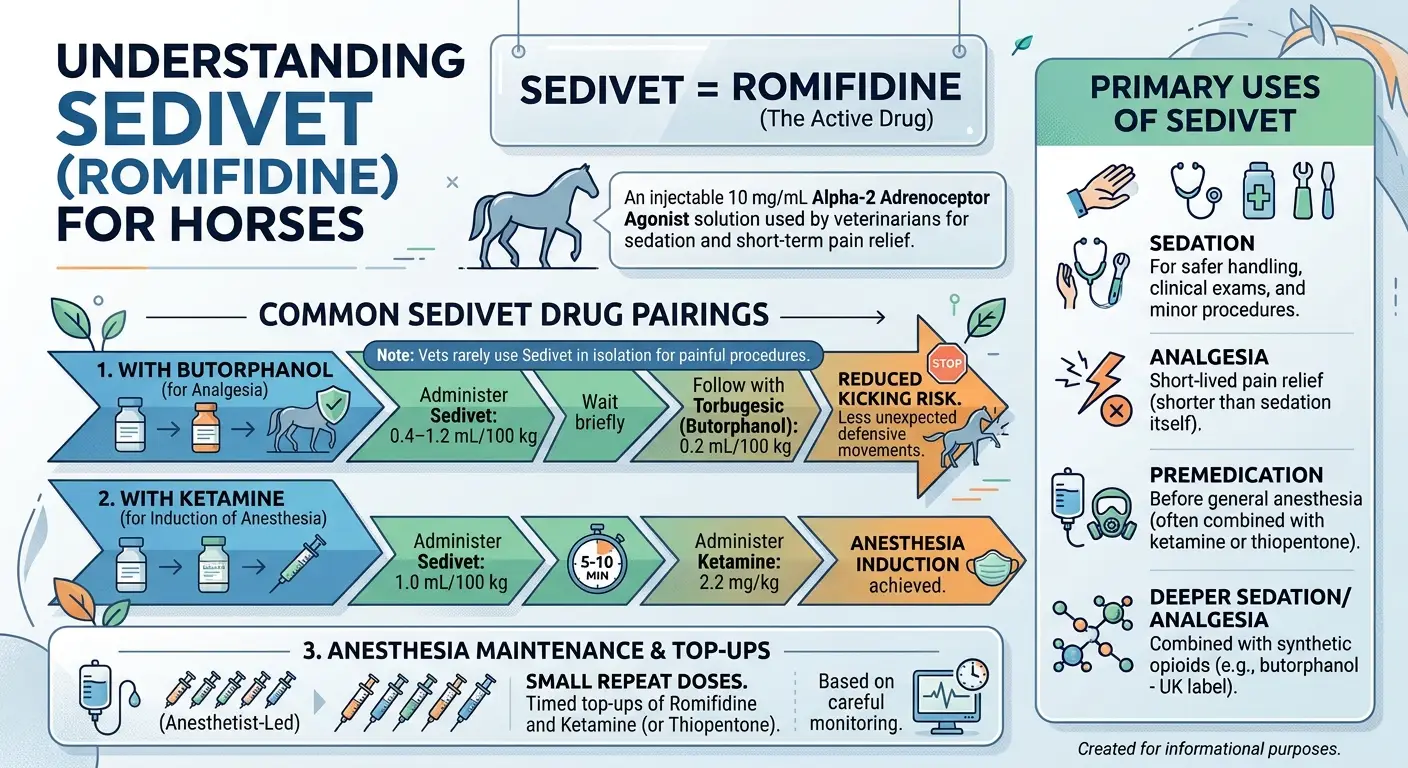
Vets rarely use Sedivet in isolation for anything painful. The UK label describes three common pairings.
- With butorphanol: 0.4–1.2 mL Sedivet per 100 kg, followed by 0.2 mL Torbugesic per 100 kg. The label says this combination reduces the chance of unexpected defensive movements such as kicking.
- With ketamine for induction: 1.0 mL per 100 kg, then ketamine 2.2 mg/kg after 5 to 10 minutes.
- Anesthesia top-ups: small repeat doses of romifidine with ketamine, or thiopentone, timed by the anesthetist.
Other sedatives and opioids add to Sedivet’s effects, so doses of every other drug in the plan need to come down. Questions about combining Sedivet with something like acepromazine dosage for horses belong with your vet, not a spreadsheet.
Sedivet Side Effects in Horses

The most important Sedivet side effects are a slow heart rate, heart block and low blood pressure. Others include unsteadiness, sweating, drooling and frequent urination. Some effects are expected with every alpha-2 agonist, and most settle as the drug wears off.
Sedivet side effects at a glance
| Body system | What may be seen | Notes from the labels |
|---|---|---|
| Heart | Bradycardia, 1st/2nd degree AV block, hypotension | Dose related. The UK label says atropine 0.01 mg/kg given 5 minutes beforehand may prevent these effects. Take care in horses with heart disease. |
| Movement | Ataxia, muscle tremors, head lowering | Lowered head can cause passive swelling of face, lips and upper airways, sometimes with stridor. |
| Gut | Reduced motility, flatulence, mild colic | Peripheral vasoconstriction can slow the gut temporarily. |
| Skin | Sweating, piloerection | Common with alpha-2 agonists. |
| Urinary and metabolic | Frequent urination, hyperglycemia, penile relaxation | Urination starts around an hour after treatment in the US label. |
| Behavior | Rare paradoxical excitation, defensive kicking | Even deeply sedated horses can respond to stimuli. |
| Immune | Hypersensitivity, very rarely anaphylaxis | Hives, trouble breathing, swelling of upper airways and head, trembling. |
The UK label lists these events as very rare (fewer than 1 in 10,000 treated animals), while the US label describes heart rate and rhythm effects as expected with this drug class.
When should you call the vet right away?
Red flags after sedation
- Hives, facial swelling or labored breathing (possible allergic reaction)
- Collapse, or a horse that cannot be roused at all
- Persistent noisy breathing or struggling to breathe
- Signs of colic: pawing, rolling, looking at the flank
- Staggering that gets worse instead of better after the first few hours
If a vet is already on site, say so immediately. If not, call the practice and describe what you see.
What Happens if a Horse Gets Too Much Sedivet?
An overdose causes the usual side effects to become more severe and last longer. The UK label reports that doses up to five times the highest recommended dose caused transient sweating, bradycardia, second-degree heart block, low blood pressure, ataxia, high blood sugar and increased urination.
The US safety studies tell a similar story. At three and five times the top dose, bradycardia and heart block lasted longer, severe ataxia appeared, and a few horses had short pauses in breathing of 20 to 40 seconds.
Blood chemistry and blood counts stayed normal. One horse offered hay before gut movement had recovered showed mild abdominal discomfort 12 hours after the highest dose.
If an overdose is suspected, treatment is symptomatic. The UK label says an alpha-2 antagonist may help reverse the effects, which is a vet decision.
Which Horses Should Not Receive Sedivet?
Sedivet should not be used in horses with known hypersensitivity to romifidine. Labels also advise against it in horses with respiratory disease, advanced liver or kidney disease, dehydration, shock or pre-existing heart block, and it has not been evaluated in colic, pregnancy or foals in the US.
Tell your vet before Sedivet if your horse has any of these
- Known allergy or past reaction to romifidine
- Heart murmur, irregular rhythm or heart disease
- Lung or airway disease
- Liver or kidney disease, or dehydration
- Colic or recent colic
- Pregnancy (UK label: do not use in the last month) or a breeding animal
- A foal or very young animal
- Recent doses of any other sedative, tranquilizer, opioid or injectable antibiotic
A US sedation study recorded ventricular tachycardia lasting 11.5 minutes in an older horse with a known heart murmur given 40 µg/kg. Heart status matters even at the lowest dose.
Pregnant mares, stallions and foals
The UK label says not to use Sedivet in the last month of pregnancy. The US label says it has not been evaluated in pregnant mares, breeding horses or foals. The Canadian label advises against use in breeding horses because the risk to mares and stallions has not been assessed.
Drug Interactions: What Not to Combine With Sedivet
The most serious label warning concerns potentiated sulfonamides. Intravenous trimethoprim-sulfonamide products should not be given to sedated or anesthetized horses, because cardiac arrhythmias that can be fatal have been reported with alpha-2 agonists.
| Combination | Why it matters |
|---|---|
| IV potentiated sulfonamides (TMP/S) | Reports of potentially fatal arrhythmias with alpha-2 agonists. Avoid IV use while the horse is sedated. |
| Other alpha-2 agonists | Effects such as heart changes, respiratory depression and ataxia can add together. |
| Other sedatives, tranquilizers, opioids | Effects are potentiated. Anesthetic doses should be reduced. |
| Epinephrine | May potentiate the effects of alpha-2 agonists. The label advises avoiding it. |
| Other products in the same syringe | The UK label says not to mix Sedivet with other veterinary medicines, as compatibility has not been studied. |
Handler Safety: Risks to People Around Sedivet
Romifidine can be absorbed through skin, eyes and mouth. Accidental self-injection or swallowing needs immediate medical attention. Show the label to the doctor and do not drive, because sedation and blood-pressure changes can occur.
- Wash skin right away with plenty of water, and remove contaminated clothing.
- If it gets in the eyes, rinse with water (the US label says for 15 minutes).
- People who take medicine for blood pressure should take special care to avoid exposure.
- Pregnant women should be extra careful not to self-inject, as the UK label warns of uterine contractions and lower fetal blood pressure after accidental systemic exposure.
- Keep out of reach of children.
Stand to the side of a sedated horse. Labels warn that horses may respond to touch or noise with sudden kicks, and that increased sensitivity of the hind limbs can occur.
Storage, Shelf Life and Withdrawal Time
Store Sedivet at 15–30 °C (59–86 °F), or not above 25 °C on the UK label. The UK label gives a shelf life of 3 years unsealed and 28 days after the vial is first opened. It must not be used in horses intended for human consumption in the US and Canada.
| Item | Label information |
|---|---|
| Storage temperature | UK: do not store above 25 °C. US and Canada: 15–30 °C |
| Shelf life | UK: 3 years as packaged; 28 days after first opening |
| Meat and offal withdrawal (UK) | 6 days. Not authorised for animals producing milk for human consumption |
| Horses for human consumption (US/Canada) | Not for use |
| Disposal | Use take-back schemes. Do not pour medicines down the drain |
The labels reviewed for this article do not publish detection times for competition drug testing. If your horse competes, check the rules of your federation and ask your vet about timing before any injection.
Sedivet Aftercare: What to Do Once the Injection Is Done
Aftercare checklist
- Let the horse stand quietly in a safe, quiet space until the sedation fades.
- Keep the area warm and calm. The UK label stresses this during recovery from anesthesia.
- Do not ride, lunge or load the horse while it is still unsteady.
- Ask your vet when feed and hay are safe. Gut movement is reduced for a time after alpha-2 sedatives.
- Watch for colic signs, labored breathing, facial swelling or hives over the next hours.
- Expect more urination and some sweating. Offer fresh water once the horse is swallowing normally.
Common Sedivet Mistakes to Avoid
- Guessing the weight. A big estimate error flows straight into the dose.
- Treating a sleepy horse as a safe horse. Even deep sedation does not stop kicking.
- Giving IV sulfa antibiotics afterward. The label specifically warns against this window.
- Stacking sedatives. Adding another alpha-2 agonist or tranquilizer multiplies side effects.
- Feeding too soon. Gut motility returns more slowly than alertness.
- Drawing up in a rush. A mix-up between concentrations is a real risk. Sedivet is 10 mg/mL, not 100 mg/mL.
Calming Options That Don’t Need an IV Sedative
Sedivet is for procedures and clinical work, not everyday nerves. For longer-term anxiety, your vet may discuss oral options such as trazodone for horses dosage chart guidance or a sublingual product like Dormosedan Gel for horses.
Each has its own dosing rules and risks, so never swap one for another without veterinary advice.
What the Evidence Says About Sedivet’s Performance
In the US field study, vets rated sedation quality as good or excellent in 18 of 23 horses. For pre-anesthesia, inductions were well controlled in 16 of 23 horses, and recoveries were satisfactory or excellent in 20 of 23 horses.
In an independent study of eight Standardbreds given 100 µg/kg, sedation was detectable in every horse for up to 105 minutes. These numbers come from the labels and published studies. They describe groups, not any one horse, and no sedative is risk-free.
Key takeaways
- Standard dose: 0.4–1.2 mL per 100 kg IV, which equals 40–120 µg/kg of romifidine HCl.
- Onset 1–2 minutes, peak at 5–10 minutes, duration from about 30 minutes to 3 hours.
- Prescription only, intravenous only. Not an owner-administered drug.
- Heart rate and blood pressure fall. Heart disease, lung, liver, kidney disease and colic call for extra caution.
- Avoid IV potentiated sulfonamides, epinephrine and extra sedatives unless your vet directs otherwise.
- Even a deeply sedated horse can kick. Stay to the side.
- Use the chart and calculator to check your understanding, not to replace your vet’s dose.
FAQs
How much Sedivet do you give a horse?
The label dose is 0.4 to 1.2 mL of Sedivet 10 mg/mL per 100 kg of body weight, given intravenously by a veterinarian. That equals 40 to 120 micrograms of romifidine hydrochloride per kilogram. Your vet picks the level based on how deep and how long the sedation needs to be.
How many mL of Sedivet per 100 kg?
Use 0.4 mL per 100 kg for light sedation, 0.8 mL for deep sedation and 1.2 mL for deep, prolonged sedation. The US label uses 1.0 mL per 100 kg as the pre-anesthetic dose. Canada’s label stops at 1.0 mL per 100 kg.
How much Sedivet for a 500 kg (1,100 lb) horse?
A 500 kg horse receives 2.0 mL at the light level, 4.0 mL at the deep level, 5.0 mL as a pre-anesthetic dose and 6.0 mL at the top level. These are label calculations only. Your vet confirms the dose after examining the horse.
What is Sedivet?
Sedivet is a brand of romifidine hydrochloride, an alpha-2 adrenoceptor agonist sold by Boehringer Ingelheim. It is a 10 mg/mL injectable that sedates horses and provides short-lived pain relief for handling, exams, minor procedures and pre-anesthesia.
How long does Sedivet take to work?
Onset is 1 to 2 minutes on the UK label, and the US label allows 30 seconds to 5 minutes. Maximum sedation arrives after 5 to 10 minutes. Onset does not depend on the dose.
Can I give Sedivet to my horse myself?
No. Sedivet is a prescription medicine, POM-V in the UK and restricted to use by or on the order of a licensed veterinarian in the US. It is for intravenous use only, and mistakes with an alpha-2 agonist can affect heart rate and breathing.
Can Sedivet be given in the muscle or by mouth?
The labels list intravenous use only. Do not use Sedivet intramuscularly, orally or by any other route unless a veterinarian directs it. Oral and sublingual sedatives are different products with their own doses.
Is Sedivet the same as Dormosedan or Rompun?
No. Sedivet contains romifidine, Dormosedan contains detomidine and Rompun contains xylazine. All three are alpha-2 agonists. In a published comparison, romifidine at 80 micrograms per kilogram appeared equipotent to detomidine at 20 micrograms per kilogram and xylazine at 1 mg per kilogram.
What are the side effects of Sedivet in horses?
Expect a slower heart rate, possible heart block, lower blood pressure, unsteadiness, sweating, drooling and frequent urination. Rare reactions include paradoxical excitation and allergic reactions such as hives and facial swelling. Report any breathing trouble or collapse to your vet immediately.
Can a sedated horse still kick?
Yes. Both the UK and US labels warn that horses can respond to stimuli with defensive movements, including kicking, even when they look deeply sedated. Combining Sedivet with butorphanol, as described on the UK label, can reduce this risk. Always stand to the side.
What happens if a horse gets too much Sedivet?
Side effects become more severe and last longer. Doses up to five times the highest recommended dose caused transient sweating, bradycardia, heart block, low blood pressure, ataxia and increased urination. Treatment is symptomatic, and an alpha-2 antagonist may help at a vet’s direction.
Can pregnant mares or foals have Sedivet?
The UK label says not to use Sedivet in the last month of pregnancy. The US label says it has not been evaluated in pregnant mares, breeding horses or foals. Canada advises against use in breeding horses. Ask your vet about any alternative.
What drugs should not be combined with Sedivet?
Do not give intravenous potentiated sulfonamides (TMP/S) to a sedated horse, because potentially fatal arrhythmias have been reported with alpha-2 agonists. Avoid epinephrine, and do not stack other alpha-2 agonists. Other sedatives and opioids add to Sedivet’s effects, so doses must be reduced.
How should Sedivet be stored, and how long is it good for?
Store it at 15 to 30 degrees Celsius (59 to 86 degrees Fahrenheit), or not above 25 degrees Celsius on the UK label. The UK label gives a shelf life of 3 years, falling to 28 days once the vial is opened. Do not mix it with other medicines in the same syringe.
Is there a withdrawal time for Sedivet?
The UK label gives 6 days for meat and offal and does not authorise use in animals producing milk for human consumption. The US and Canadian labels say not to use it in horses intended for human consumption. Check competition rules separately for detection times.
Is Sedivet dangerous to people?
It can be. Romifidine can be absorbed through skin, eyes and mouth, and accidental self-injection can cause sedation and blood-pressure changes. Wash skin with plenty of water, rinse eyes, seek medical advice immediately, show the label and do not drive. Keep it away from children.
Sources and Further Reading
- NOAH Compendium: Sedivet datasheet (UK)
- UK Veterinary Medicines Directorate: Product Information Database entry for Sedivet
- VETiSearch: Sedivet Summary of Product Characteristics
- Drugs.com Veterinary: Sedivet 1% Injection (FDA label text)
- Drugs.com Veterinary: Sedivet label for Canada
- Veterinary Medicine and Science: romifidine sedation and red blood cell kinetics in Standardbred horses (PMC)
- American Journal of Veterinary Research, 2013: accelerometric comparison of xylazine, detomidine and romifidine
Dose information on this page is drawn from the UK, US and Canadian product labels as published at the time of writing. Labels change, and your veterinarian’s instructions always take priority. This article is educational and is not veterinary advice.