Brewers Yeast Dosage for Horses: Weight Chart, Free Calculator and Safety Limits Every Owner Should Know
Written & Reviewed By: Medshorse Team
Last Updated: November 2026
Brewers yeast dosage for horses is one of the most inconsistently published numbers in the feed room. Compare six retailer and nutrition sources and the daily amounts run from 5 g to 150 g, with no explanation of why.
This guide uses the Mane Event Equestrian Supplies label as its baseline (15 to 60 g a day for a 500 kg horse, about 1 to 4 tablespoons). It shows where other sources differ, then gives you a weight-based chart, a calculator and the safety checks most dosage pages skip.
Disclaimer: This article is for general education and is not veterinary advice. Product names mentioned, including Brewers Yeast, belong to their respective owners, and MedsHorse is not affiliated with them. Always follow your veterinarian’s instructions and the current product label.
Quick answer: a 500 kg (1,100 lb) horse is typically fed 15 to 60 g of brewers yeast per day, about 1 to 4 level tablespoons. Ponies and smaller horses get proportionally less.
- Start at the low end and build up over 1 to 2 weeks.
- Weigh the powder. Tablespoon weights differ between brands.
- Brewers yeast is inactive yeast, so it is a nutrient source, not a live probiotic.
- It will not reliably calm a nervous horse. Treat that as a possible bonus.
Brewers Yeast Dosage for Horses: The Short Answer
A 500 kg horse is typically fed 15 to 60 g of brewers yeast per day, roughly 1 to 4 level tablespoons. Smaller animals get less, scaled to body weight. Start low, split the dose across two feeds if you can, and increase gradually.
Brewers Yeast Dosage Chart by Body Weight
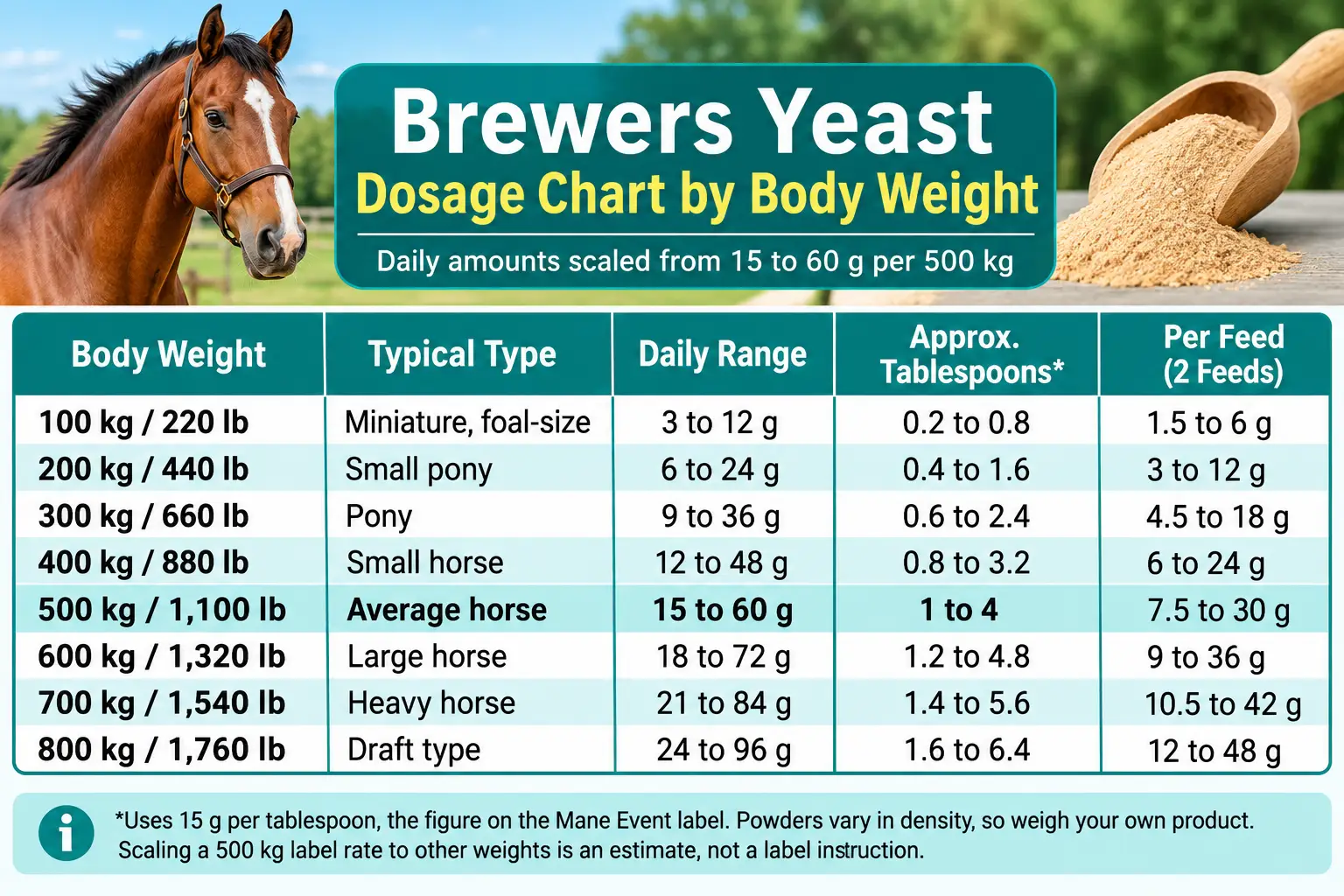
The chart scales the Mane Event rate of 15 to 60 g per 500 kg in a straight line by body weight. Reverdy publishes its own rate the same way, per 100 kg, so the approach matches common practice.
| Body weight | Typical type | Daily range | Approx. tablespoons* | Per feed (2 feeds) |
|---|---|---|---|---|
| 100 kg / 220 lb | Miniature, foal-size | 3 to 12 g | 0.2 to 0.8 | 1.5 to 6 g |
| 200 kg / 440 lb | Small pony | 6 to 24 g | 0.4 to 1.6 | 3 to 12 g |
| 300 kg / 660 lb | Pony | 9 to 36 g | 0.6 to 2.4 | 4.5 to 18 g |
| 400 kg / 880 lb | Small horse | 12 to 48 g | 0.8 to 3.2 | 6 to 24 g |
| 500 kg / 1,100 lb | Average horse | 15 to 60 g | 1 to 4 | 7.5 to 30 g |
| 600 kg / 1,320 lb | Large horse | 18 to 72 g | 1.2 to 4.8 | 9 to 36 g |
| 700 kg / 1,540 lb | Heavy horse | 21 to 84 g | 1.4 to 5.6 | 10.5 to 42 g |
| 800 kg / 1,760 lb | Draft type | 24 to 96 g | 1.6 to 6.4 | 12 to 48 g |
Brewers Yeast Calculator for Horses
Enter your horse’s weight and, if you know it, how many grams one tablespoon of your product weighs. Use a weigh tape or scale for body weight rather than guessing.
Brewers Yeast Dosage Calculator for Horses
Enter your horse’s details to get a daily brewers yeast dose in grams and level tablespoons.- A 500 kg (1,100 lb) horse is typically fed 15 to 60 g of brewers yeast per day, about 1 to 4 level tablespoons.
- Weigh the powder on a kitchen scale. Tablespoon weights differ between brands.
- Brewers yeast is inactive yeast, so it is a nutrient source, not a live probiotic.
- It will not reliably calm a nervous horse. Treat that as a possible bonus.
Why Brewers Yeast Dosage Labels Disagree
Doses differ by up to tenfold because the products, the goals and even the measuring spoons are different. Mane Event gives 15 to 60 g for a 500 kg horse. Reverdy’s 50 to 150 g is a short course, and EWALIA’s 60 to 120 g is positioned for long-term feeding.
The spoon problem is real. Mane Event states 15 g per tablespoon. Reverdy lists 50 to 150 g as about 75 to 225 ml, which works out to roughly 10 g per tablespoon.
AniMed’s label puts a tablespoon at about half an ounce, or 14 g. Feed by tablespoon without checking and you could be 50 percent off the dose you intended.
What Is Brewer’s Yeast for Horses?
Brewer’s yeast is dried, inactive Saccharomyces cerevisiae, a by-product of beer brewing. Mad Barn’s feed database notes it is heat-treated so the cells are inactive. That means it works as a source of B vitamins, protein and minerals rather than as a live probiotic.
Composition varies by brand. Reverdy’s technical sheet lists 46 percent crude protein, 2.7 percent fat, 1 percent fibre and 8 percent ash. AniMed guarantees a minimum of 35 percent protein. Reverdy also names the B vitamins B1, B2, B3, B5, B6 and B8, plus the yeast carbohydrates MOS and beta-glucans.
What the top of the label range (60 g a day) supplies
For context, a dedicated thiamine powder in the same database supplies 14.7 mg in a 15 g scoop. At the top of the label range, brewers yeast can deliver a similar amount of B1 along with everything else in the yeast.
What Brewers Yeast Can and Cannot Do for Your Horse
Brewers yeast reliably adds B vitamins and some protein. Most other benefits are traditional claims or are borrowed from research on live yeast. In the sources reviewed for this guide, we found no controlled trial of inactive brewers yeast at these doses.
| Claim | Evidence | What to know |
|---|---|---|
| Supplies B vitamins and protein | Strong | It is measurable on the label. B1, B2, B3, B5, B6 and B8 are listed by Reverdy. |
| Supports coat, skin and hooves | Plausible | Biotin and amino acids are building blocks for keratin. Direct trials are thin, and hoof change takes months. |
| Supports hindgut digestion | Mixed | Research mostly uses live yeast cultures. A 2022 review found contradictory results. |
| Supports immunity | Limited | Beta-glucans are cited by suppliers. We found no direct horse trial in the sources reviewed. |
| Helps weight gain and muscle | Limited | It adds modest protein, but it does not replace forage or calories. |
| Calms nervous horses | Unproven | Bling and Speed states the direct effect is not scientifically proven. |
Gut Health and Digestion
The gut evidence is the most misunderstood. A Mad Barn research summary reports that 11 of 14 studies of live yeast showed better fibre digestibility. A 2022 review in the journal Animals by Perricone and colleagues still called the results contradictory overall.
If hindgut stability is your goal, such as for a horse on a high-starch diet, look for a live yeast product with a stated cell count. If you want a B-vitamin and protein top-up, brewers yeast is the cheaper tool.
Coat, Skin and Hooves
Brewers yeast is often fed for shine, and the logic is sound. B vitamins and amino acids feed keratin production in hair and hoof horn.
Expect coat changes over several weeks. For stubborn hoof problems, compare it with a dedicated biotin dosage for horses, where the amount of biotin is stated and controlled.
Does Brewers Yeast Calm Horses?
Probably not on its own. Thiamine supports nerve function, and Mad Barn’s listing for one brewers yeast product pitches it for calming. Bling and Speed is more cautious, noting the direct effect is unproven and the yeast’s magnesium content is low.
If nervousness is the problem, see our guides to magnesium dosage for horses and hops dosage for horses, and have a vet rule out pain, ulcers and management causes first.
How to Feed Brewers Yeast to Horses Step by Step
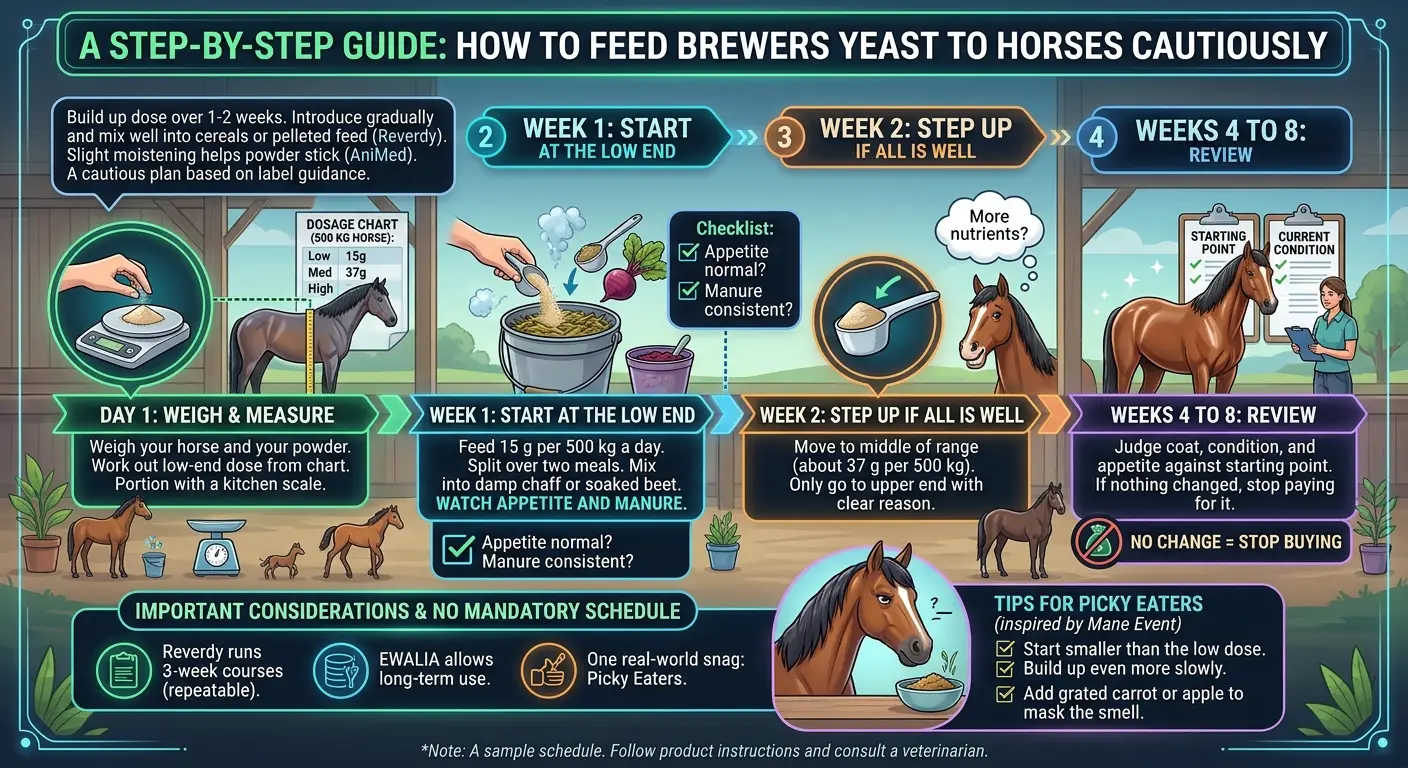
Weigh the dose, mix it into damp feed, and build up over 1 to 2 weeks. Reverdy advises introducing it gradually and mixing it well into cereals or pelleted feed. AniMed notes that slightly moistening the feed helps the powder stick.
One real-world snag: picky eaters. A customer review on the Mane Event page describes a mare who rejected two level teaspoons mixed into soaked beet and chaff. The seller’s reply suggested starting smaller, building up slowly and adding grated carrot or apple to mask the smell.
Brewers Yeast Safety, Side Effects and Limits
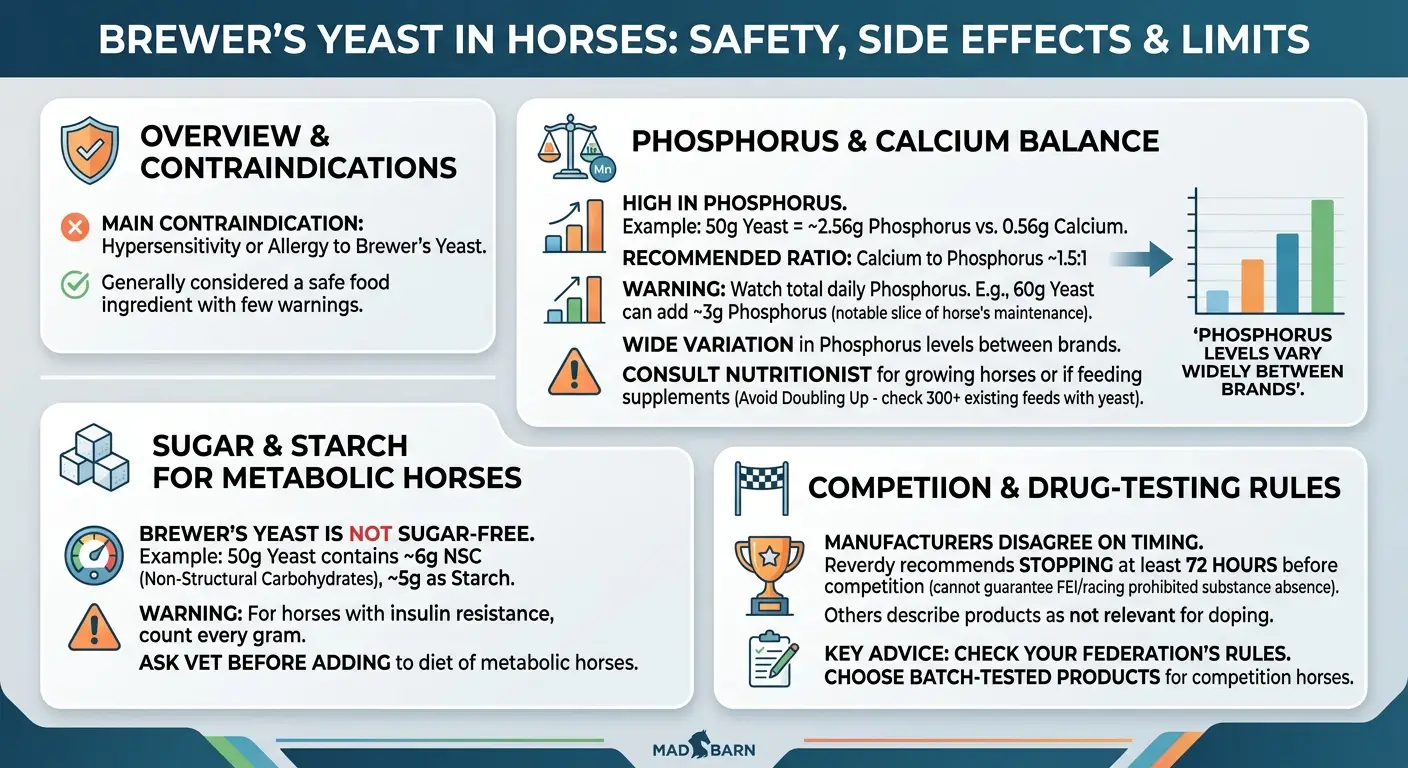
Brewers yeast is a food ingredient, and the labels we reviewed list few warnings. The main contraindication is hypersensitivity or allergy to brewers yeast. The less obvious risks are mineral balance, sugar and competition rules.
Phosphorus and Calcium Balance
Yeast is high in phosphorus. One UK brewers yeast listing on Mad Barn shows 2.56 g of phosphorus and 0.56 g of calcium per 50 g, so calcium is far below the roughly 1.5:1 calcium to phosphorus ratio Mad Barn recommends.
At 60 g a day that is about 3 g of phosphorus, a notable slice of a 500 kg horse’s maintenance needs (around 14 g in the NRC 2007 tables).
Phosphorus values differ widely between brands, from under 1 percent on one US label to over 5 percent in the UK listing. For growing horses, or when you feed a fortified balancer, ask a nutritionist to run the numbers.
Mad Barn’s database lists more than 300 feeds and supplements that already contain brewers yeast, so check you are not doubling up.
Sugar and Starch for Metabolic Horses
Brewers yeast is not sugar-free. The same listing shows about 6 g of NSC per 50 g, with 5 g of that as starch. The amount is small, but horses with insulin resistance need every gram counted, so ask your vet before adding it.
Competition and Drug-Testing Rules
Manufacturers disagree here. Reverdy recommends stopping at least 72 hours before a sporting competition because it cannot fully guarantee the absence of FEI and racing-prohibited substances.
EWALIA describes its product as not relevant for doping. Check your own federation’s rules and choose a batch-tested product.
Before you start, check
- Weight: use a weigh tape or scale.
- Label: is it pure brewers yeast with no added sugar or salt?
- Ration: does your balancer already contain yeast?
- Health: any metabolic issue, kidney or liver problem? Ask your vet.
- Competition: does your federation test, and what is the withdrawal advice?
Stop and call your vet if you see
- Hives, swelling, or itching after feeding.
- Diarrhoea or loose manure that persists.
- Colic signs: pawing, rolling, looking at the flank.
- Refusal to eat the whole ration.
- Any sudden change in behaviour or condition.
Brewers Yeast Dosage for Ponies, Minis, Seniors and Breeding Stock
Ponies and minis are dosed by weight, so the same chart applies. One US label advises 1 to 2 tablespoons a day for ponies, which sits inside the scaled range for a 300 kg pony. The labels we reviewed give no separate dose for foals, pregnant mares, stallions or seniors.
| Horse type | Daily guide | Notes |
|---|---|---|
| Miniature (about 150 kg) | 4.5 to 18 g | Weigh carefully. Start at the low end. |
| Pony (about 300 kg) | 9 to 36 g | One US label advises 1 to 2 tablespoons. |
| Average horse (500 kg) | 15 to 60 g | Mane Event label range. |
| Draft type (about 900 kg) | 27 to 108 g | Scaled estimate. Check the phosphorus load. |
| Senior horse | By weight | No separate label dose. Check teeth, weight and bloodwork with your vet. |
| Foals, pregnant mares, stallions | Ask your vet | No label dose found. Reverdy lists fertility as a traditional use only. |
Common Mistakes When Feeding Brewers Yeast
- Measuring by scoop. Scoop sizes vary by brand (one UK brand’s scoop is 20 g, Reverdy’s is 30 ml), and so do tablespoons. Weigh it.
- Jumping straight to the top dose. Build up over 1 to 2 weeks, as Reverdy advises.
- Stacking yeast products. Balancers and gut supplements often contain yeast already.
- Using it as a calmer. Persistent nervousness needs a vet, not a tub of powder.
- Judging it in a week. Coat and hoof changes need weeks to months.
When Another Supplement Fits Better
Choose the tool for the job. Brewers yeast is a general B-vitamin and protein top-up, but a goal-specific product gives you tighter control.
- Hoof growth: a measured biotin dose, covered in our biotin dosage for horses guide.
- Sand clearance: psyllium, explained in our psyllium husk dosage for horses guide.
- Extra protein and nutrients: see our spirulina dosage for horses guide.
- Trace minerals and iodine: see our kelp dosage for horses guide, and do not combine without checking totals.
FAQs
How much brewers yeast should I give my horse per day?
A 500 kg horse is typically fed 15 to 60 g of brewers yeast per day, about 1 to 4 tablespoons, based on the Mane Event Equestrian Supplies label. Scale the amount to body weight, start at the low end and build up over 1 to 2 weeks. Other manufacturers publish higher ranges, so always check your own product label.
How many tablespoons of brewers yeast is 60 grams?
About 4 tablespoons if your product weighs 15 g per tablespoon, as the Mane Event label states. Powders differ in density, though: another brand’s figures work out closer to 10 g per tablespoon, which would make 60 g about 6 tablespoons. A kitchen scale is the only reliable way to measure.
Can horses eat brewers yeast every day?
Yes, label directions allow daily feeding. Some manufacturers suggest long-term use, while others, such as Reverdy, recommend a 3-week course that can be repeated. No source we reviewed sets a strict upper time limit, so review the need with your vet every few months.
How long does brewers yeast take to work in horses?
Expect weeks, not days. Coat quality may change after several weeks, and hoof changes take longer because new horn grows slowly from the coronary band. Results vary between horses, and none of the sources we reviewed promise a fixed timeline.
Is brewers yeast safe for ponies and miniature horses?
Generally yes, at reduced weight-based amounts. A 300 kg pony works out to about 9 to 36 g per day on the Mane Event scale, and one US label advises 1 to 2 tablespoons for ponies. Introduce it slowly and ask your vet first if the pony has metabolic concerns.
Does brewers yeast calm horses?
There is no scientific proof that it does. It supplies B vitamins such as thiamine, which support nerve function, and some owners report a calmer horse, but treat that as a possible bonus. Persistent nervousness needs a vet or behaviour assessment.
Is brewers yeast the same as live yeast or a probiotic?
No. Brewers yeast is heat-treated, so the cells are inactive and it works as a nutrient source. Live yeast cultures are used as probiotics, and most research on hindgut digestion uses live products with a stated cell count.
Can brewers yeast cause side effects in horses?
The product labels we reviewed list one clear contraindication: hypersensitivity or allergy to brewers yeast. Introducing it too fast can upset digestion, and a ration that is already high in phosphorus is a longer-term concern. Stop and call your vet if you see hives, swelling, diarrhoea or colic signs.
Is brewers yeast safe for insulin-resistant or Cushing’s horses?
Ask your vet first. Brewers yeast is not sugar-free: one feed database listing shows about 6 g of non-structural carbohydrate (NSC) per 50 g, which must be counted in a metabolic horse’s daily diet. Small amounts may fit, but the decision belongs with your vet.
Will brewers yeast cause a positive drug test?
Manufacturers disagree. Reverdy advises stopping at least 72 hours before a sporting competition because it cannot guarantee the product is free of prohibited substances, while EWALIA says its product is not relevant for doping. Check your federation rules and use a batch-tested product.
How do I get a picky horse to eat brewers yeast?
Start with a small amount and build up slowly, as Mane Event suggests. You can also mix it into damp feed, chaff or soaked beet and add grated carrot or apple to mask the smell. Dampening the feed also helps the powder stick instead of settling at the bottom of the bucket.
Can pregnant mares, stallions or foals have brewers yeast?
The labels we reviewed give no separate dose for foals, pregnant mares or stallions. Reverdy lists improved fertility as a traditional use, but offers no special dosing. Ask your vet or an equine nutritionist for an amount that fits the horse’s life stage.
What is the best time of day to feed brewers yeast?
Reverdy recommends splitting the daily amount over two meals when possible and mixing it well into cereals or pelleted feed. None of the sources we reviewed name a best time of day, so consistency matters more than timing.
Key Takeaways and Next Steps
- A 500 kg horse is typically fed 15 to 60 g a day. Scale by weight and weigh the powder.
- Start at the low end and build over 1 to 2 weeks, split across two feeds.
- It is inactive yeast: a B-vitamin and protein source, not a probiotic and not a proven calmer.
- Watch phosphorus, sugar and starch, especially in metabolic, growing or competing horses.
- Review results after 4 to 8 weeks and stop if you see no benefit.
Your next step: weigh your horse, run the calculator above, and ask your vet to sign off if there is any health issue or you compete under testing rules.
Sources and Further Reading
- Mane Event Equestrian Supplies, Brewers Yeast 1 kg (dosage baseline)
- Reverdy, Brewers yeast 1 kg (composition, dose, precautions)
- AniMed Pure Brewers Yeast label (Drugs.com)
- Tully’s Stockfeed supplement dosage guide
- EWALIA Pure Brewer’s Yeast for Horses
- Bling and Speed, Brewer’s Yeast for Horses
- Mad Barn FeedBank, Traditional Brewers Yeast (Simple System) (mineral and carbohydrate analysis)
- Mad Barn, Brewers Yeast ingredient entry
- Perricone V. et al., The Role of Yeast Saccharomyces cerevisiae in Supporting Gut Health in Horses, Animals, 2022 (summary)
- National Research Council, Nutrient Requirements of Horses, 6th revised edition, 2007