Gelatin Dosage for Horses: Chart, Calculator and Safe Feeding Guide for Stronger Hooves
Written & Reviewed By: Medshorse Team
Last Updated: November 2026
Gelatin is one of the oldest tricks in the barn aisle. Walk into almost any tack room and someone will swear that a scoop in the feed bucket grows tougher hooves and a shinier coat. But how much should you actually feed, and does it really work?
Here is the short version. The recommended gelatin dosage for horses is 10 to 30 grams a day for an adult horse (450 to 550 kg) and 5 to 15 grams a day for smaller horses and ponies. Weigh the powder, start at the low end, and judge results over months, not days.
In this guide you will get a weight-based dosage chart, a free calculator, a step-by-step feeding plan, and an honest look at the research, including a pony study that found no hoof benefit. If hooves are your main worry, you will also see which nutrients have stronger evidence, such as a safe biotin dosage for horses with weak hooves.
Disclaimer: This article is for general education and is not veterinary advice. Product names mentioned, including Gelatin, belong to their respective owners, and MedsHorse is not affiliated with them. Always follow your veterinarian’s instructions and the current product label.
What Is Gelatin for Horses?
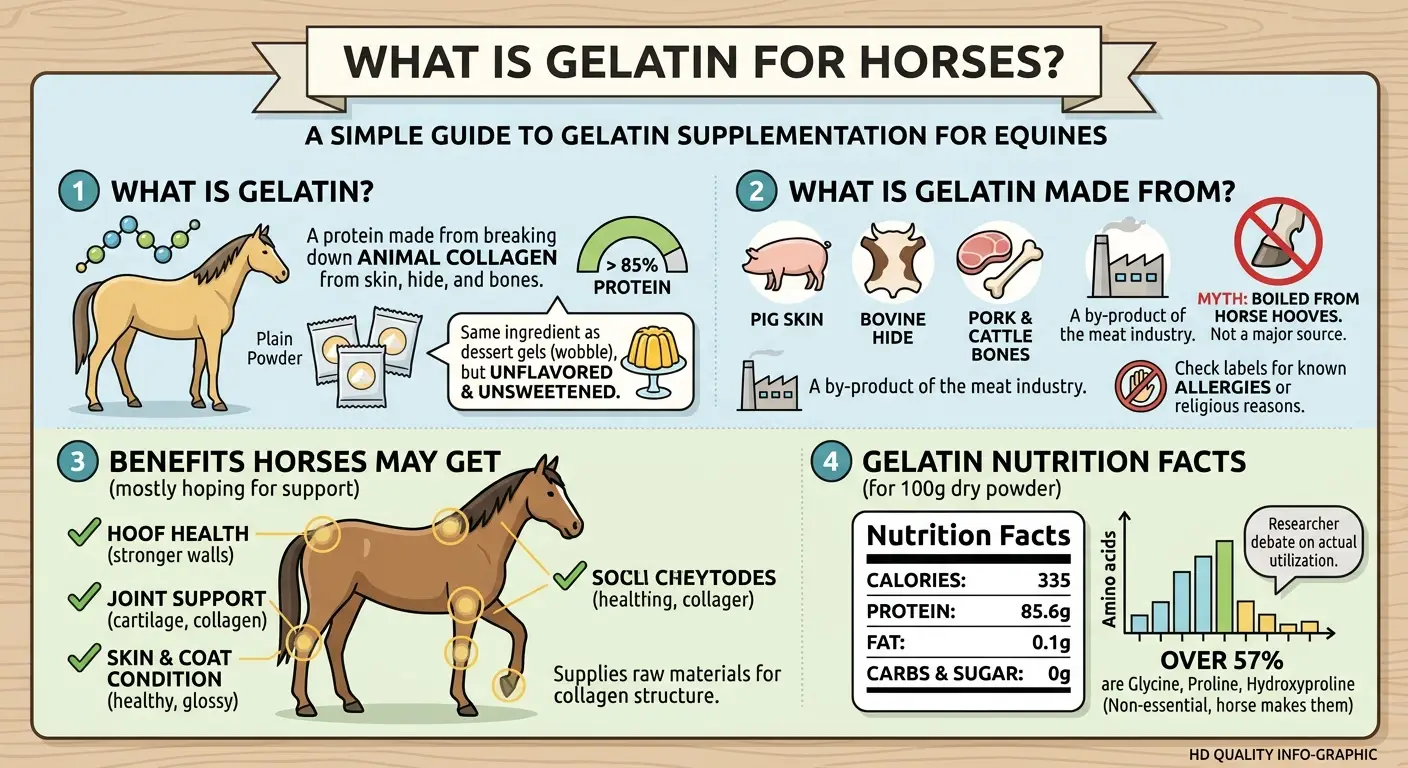
Gelatin is a protein made by breaking down animal collagen from skin, hide and bones. It is more than 85% protein and is especially rich in glycine and proline. Horse owners feed it as a plain powder, mostly hoping to support hooves, joints, skin and coat.
It is the same ingredient that gives dessert gels their wobble. The horse version is simply unflavored and unsweetened, sold in tubs from about 3 pounds up to 20 pounds.
What Is Gelatin Made From?
Industrial gelatin comes mainly from pig skin, bovine hide, and pork and cattle bones. It is a by-product of the meat industry. The old claim that gelatin is boiled down from horse hooves is a myth, because horse collagen is not a major source.
That matters if you manage a horse with a known allergy, or if you have personal or religious reasons to avoid pork or beef products. Always read the label for the animal source.
Gelatin Nutrition Facts for Horse Owners
According to USDA data for dry, unsweetened gelatin, 100 grams contains 335 calories, 85.6 grams of protein, 0.1 gram of fat and no carbohydrate or sugar. About 57% of its amino acids are glycine, proline and hydroxyproline.
These three are non-essential amino acids, which means the horse’s body can make them. Feeding extra simply adds raw material for collagen, and researchers still debate how much of it the horse actually uses for that purpose.
To put numbers on a real dose, a 30 gram serving gives roughly 100 calories, 25.7 grams of protein, 5.7 grams of glycine and 3.7 grams of proline. That is a modest addition to a 500 kg horse’s ration, but it is not zero, especially for easy keepers.
Gelatin Dosage for Horses by Weight (Chart)
For an average adult horse of 450 to 550 kg (1,000 to 1,200 lb), supplier guidance is 10 to 30 grams of gelatin per day. Smaller horses and ponies get 5 to 15 grams. The chart below scales that guidance to any body weight.
| Horse type | Body weight | Daily range | Starter dose (half) |
|---|---|---|---|
| Adult horse | 450 to 550 kg (about 990 to 1210 lb) | 10 to 30 g | 5 to 15 g |
| Smaller horse or pony | Under 450 kg | 5 to 15 g | 2.5 to 7.5 g |
Where Does This Gelatin Dosage Come From?
The amounts above follow the gelatine guidance published by African Horse Fly Spray. For an adult horse of 450 to 550 kg it lists 10 to 30 grams per day. For smaller horses and ponies it lists 5 to 15 grams per day.
Gelatin is not an essential nutrient, so there is no official requirement or regulated dose. Treat these numbers as practical feeding guidance, and check them with your vet or an equine nutritionist.
What Doses Have Researchers Used?
Two horse studies are worth knowing. In a 2006 amino acid study by Coenen and colleagues, feeding 60 grams of gelatin a day raised circulating glycine and proline in horses. That study shows the amino acids are absorbed. It is not a feeding recommendation.
The hoof study was far more aggressive. In 1977, Butler and Hintz fed eight Shetland ponies 30 grams of gelatin per 100 kg of body weight for 28 days, then 90 grams per 100 kg for another 28 days. For a 500 kg horse, that second level would equal 450 grams a day. Both studies used more than the guidance in this article, so treat them as research, not feeding advice.
How to Measure Gelatin Accurately
One ounce equals 28.35 grams. A level tablespoon of powder is roughly 9 grams, but spoons pack differently, and heaped scoops can double the amount. A cheap kitchen scale that reads in grams removes the guesswork. Weigh one day’s dose, then mark a scoop or cup to match it.
Gelatin Dosage Calculator for Horses
Enter your horse’s weight, pick a feeding level, and the calculator gives a daily amount in grams, ounces and tablespoons. It also shows a starter dose for the first week, a serving suggestion, calories added, and how long a 3 lb tub will last.
Gelatin Dosage Calculator For Horses
Calculate the daily gelatin supplement range for your horse and its suggested half-dose starter range.
Gelatin Dosage Results
Start with half of the selected daily dosage range for the first 3–5 days. The full daily range is the supplied guidance after the starter period. Use a kitchen scale to weigh the gelatin powder accurately.
Important Gelatin Supplement Notes
- Gelatin is a protein supplement, not a medicine, and it is not a complete protein.
- Research in horses shows that its amino acids are absorbed, but hoof benefits remain unproven.
- Weigh gelatin powder on a kitchen scale instead of estimating the amount with a scoop.
- Judge results after 6–12 months because hooves renew slowly and can take a year or more to grow out.
- Follow your veterinarian’s advice when choosing a supplement and daily amount.
© medshorse.com
How the Calculator Works
The three levels multiply your horse's weight in kilograms by 0.02, 0.04 or 0.06 grams. Those rates come from scaling the African Horse Fly Spray guidance of 10 to 30 grams per day for a 450 to 550 kg horse, which also matches its 5 to 15 gram range for ponies.
Gelatin Dosage for Ponies, Minis, Drafts and Special Cases
Ponies and Miniature Horses
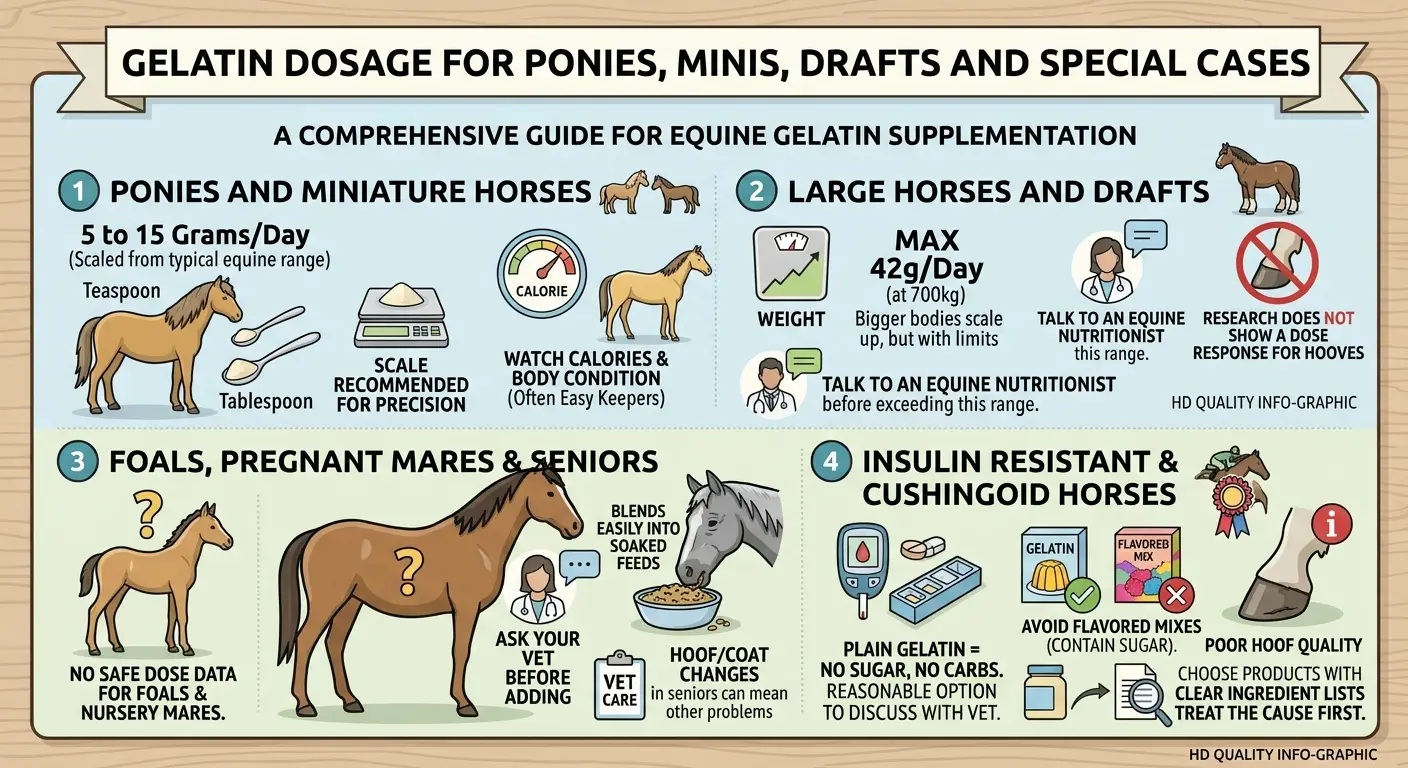
Ponies and smaller horses are listed at 5 to 15 grams a day. A miniature horse may need less than a teaspoon to a tablespoon, so a scale is even more useful. Ponies are often easy keepers, so keep an eye on total calories and body condition.
Large Horses and Drafts
Bigger bodies scale up, but not without limits. Even at 700 kg, the scaled range tops out around 42 grams. If you are tempted to go past this range, talk to an equine nutritionist first. The extra cost rarely buys extra benefit, because the research does not show a dose response for hooves.
Foals, Pregnant Mares and Seniors
None of the sources reviewed for this guide give a safe gelatin dose for foals, pregnant mares or nursing mares. Without that data, ask your vet before adding it. For seniors, gelatin powder blends easily into soaked feeds, but hoof and coat changes in older horses can point to other problems that need a vet.
Insulin Resistant and Cushingoid Horses
Plain gelatin has no sugar or carbohydrate, so it does not add starch. That makes it a reasonable option to discuss with your vet. Avoid flavored dessert mixes, which contain sugar. Poor hoof quality in these horses can also reflect the metabolic condition itself, so treat the cause first.
Competition Horses
Gelatin is a food ingredient, but supplement quality varies by brand. Check your sport's rules before you add anything, and choose a product with a clear ingredient list and a lot number you can trace.
Does Gelatin Work for Horse Hooves?
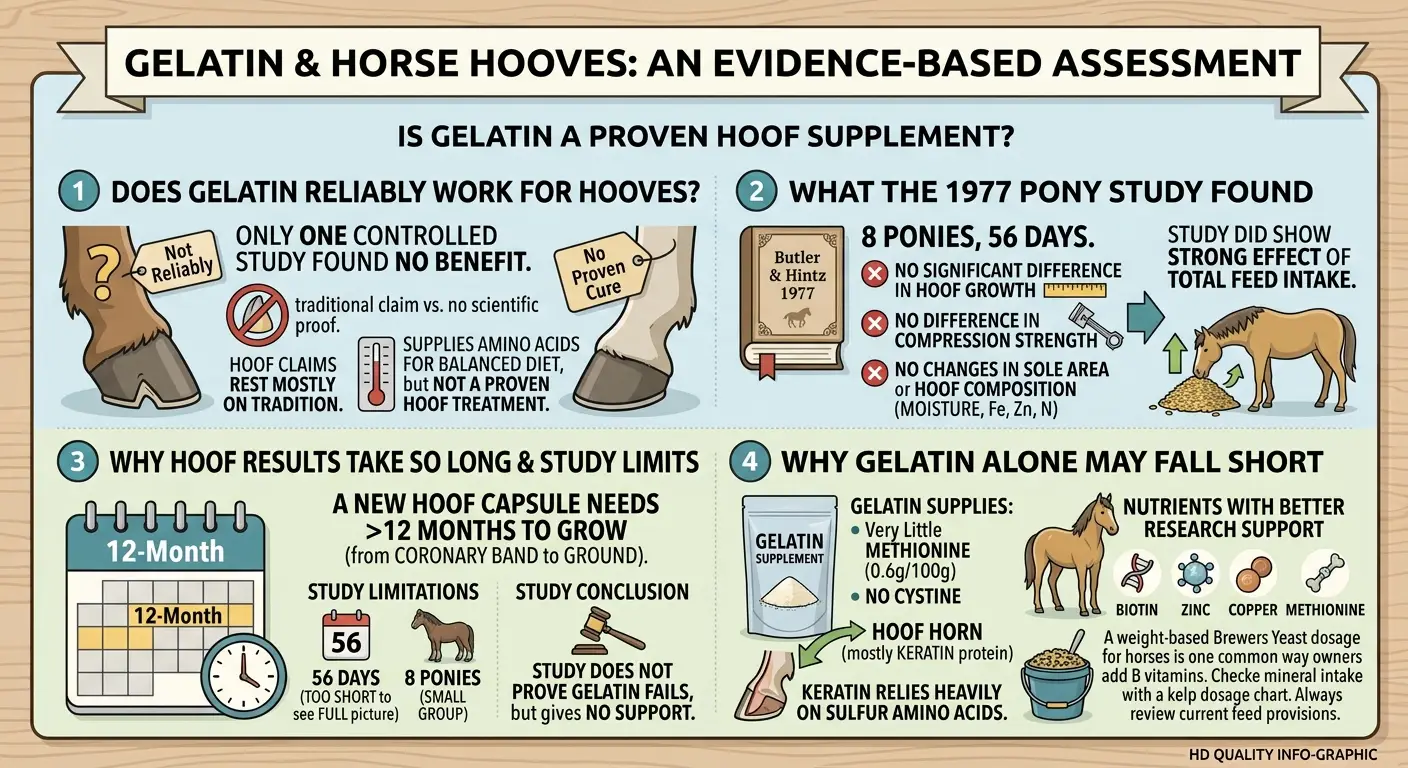
Not reliably. The only controlled hoof study in horses found no benefit, and hoof claims rest mostly on tradition. Gelatin does supply amino acids the horse absorbs, so it may help as one part of a balanced diet, but it is not a proven hoof treatment.
What the 1977 Pony Study Found
In the Butler and Hintz study, eight ponies received gelatin for 56 days. The researchers found no significant differences in hoof growth or compression strength. They also saw no changes in sole area, or in moisture, iron, zinc or nitrogen content of the hoof tissue. The study did show that how much the ponies ate had a strong effect on hoof growth.
Why Hoof Results Take So Long
A new hoof capsule needs more than 12 months to grow from the coronary band to the ground, according to Mad Barn's research review. Fifty-six days is too short to see the full picture, and eight ponies is a small group. So the study does not prove gelatin fails, but it gives no support either.
Why Gelatin Alone May Fall Short
Hoof horn is mostly keratin, a protein that relies heavily on sulfur amino acids such as methionine and cysteine. Gelatin supplies very little methionine (0.6 g per 100 g) and no cystine. Nutrients with better research support for hoof quality include biotin, zinc, copper and methionine.
If hooves are the goal, build the base first. A weight-based brewers yeast dosage for horses is one common way owners add B vitamins, and a kelp dosage for horses chart can help you check trace mineral intake. Always review what your current feed already provides.
Evidence Scorecard
Gelatin for Joints, Skin and Coat
Gelatin's joint reputation comes mostly from human research. In one lab study, serum from people who took gelatin raised collagen content in engineered tissue. In another, people who took vitamin C enriched gelatin before exercise showed a bigger rise in a marker of collagen synthesis than people who took none.
In horses, researchers have only shown that glycine and proline stay elevated in the blood. Nobody has yet shown that those amino acids end up in equine cartilage. If joints are your concern, a glucosamine dosage for horses by weight is a more familiar starting point, and your vet should guide any joint plan.
For coat and skin, human studies on hair and hydrolyzed collagen are encouraging, including a 29% rise in hair strand count in one small trial of people with hair loss. No horse trial has tested this. Coat shine is often driven by fat intake, so a camelina oil dosage for horses guide may be worth reading too.
How to Feed Gelatin to Horses Step by Step
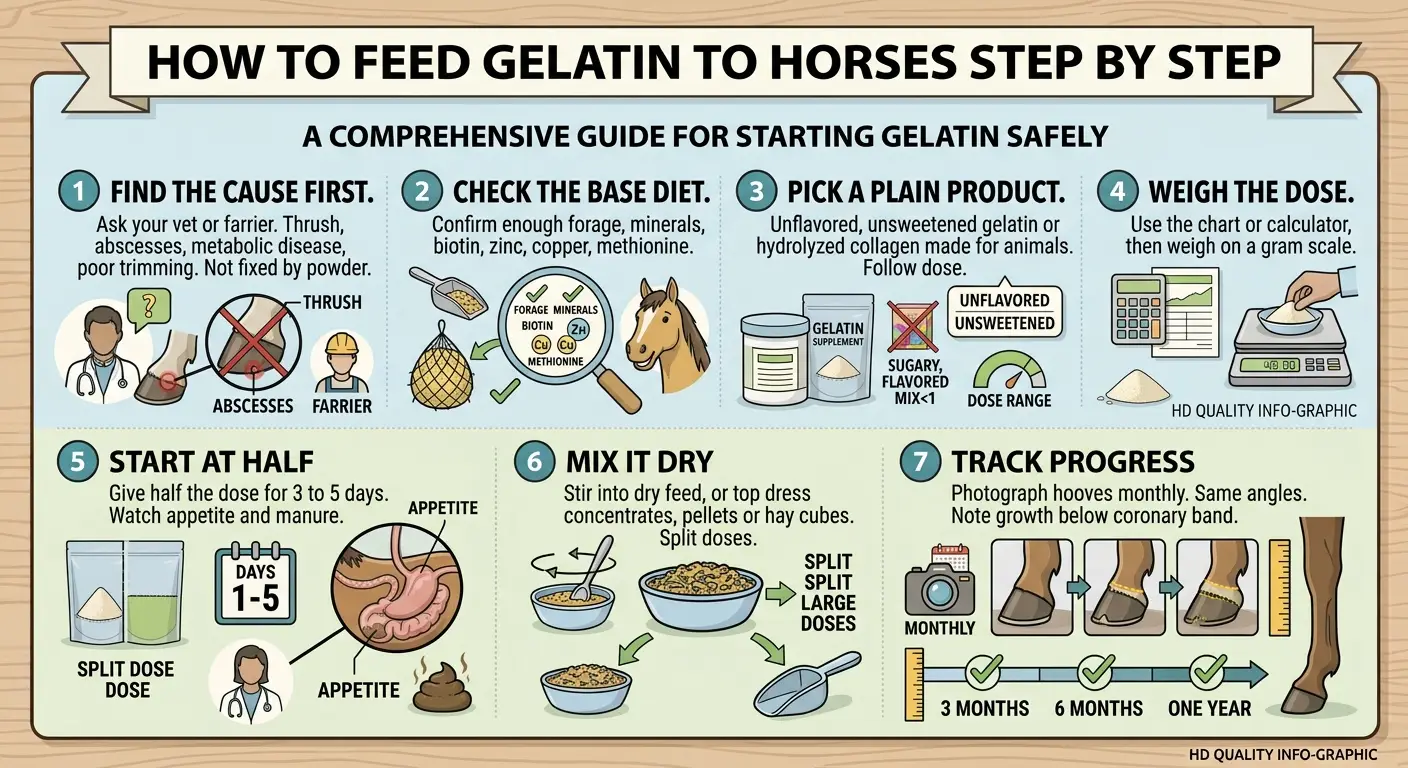
Feed gelatin by weighing the daily dose, starting at half for the first few days, and mixing it dry into the feed. Increase to the full dose after a week if the horse is eating well, and review results at three months, six months and one year.
Powder vs Granules vs Hydrolyzed Collagen
Gelatin is nearly tasteless, and most horses accept it. The one mixing problem is moisture. If you make a soupy mash, the gelatin can set into a jelly-like texture, so stir it in dry or use a damp, not wet, feed.
How Long Does Gelatin Take to Work?
Plan for six to twelve months. You can check the growth line at the top of the hoof every month, but the full hoof wall renews on a timescale of a year or more. Judge the whole program, not one tub.
Is Gelatin Safe for Horses?
Yes, for most horses. The U.S. Food and Drug Administration classes gelatin as generally recognized as safe, and it is well tolerated at the amounts used in feed. Rare allergic reactions can happen. Stay within the dose range above and introduce it slowly.
When to Talk to Your Vet First
Ask before feeding gelatin if your horse is pregnant or nursing, is a foal, has kidney or liver disease, has a history of allergies, or has metabolic disease. Also ask if the hooves are hot, the horse is lame, or the hoof wall is separating. Those are medical signs, not supplement problems.
Signs to Stop Feeding
Stop and call your vet if you see hives, itching, swelling, colic signs, sudden loose manure, or loss of appetite after starting gelatin. Any new feed ingredient can upset an individual horse, even a harmless one.
Gelatin vs Other Hoof and Coat Nutrients
Gelatin is one tool among many. Here is how it compares with other options owners often consider for hooves and general condition.
If your horse also struggles with ulcers or stress, you might look at a glutamine dosage for horses with gut and recovery needs, which is a separate amino acid with its own dosing rules.
Common Gelatin Feeding Mistakes
- Using dessert gelatin. Flavored mixes contain sugar and flavorings your horse does not need.
- Scooping instead of weighing. Heaped scoops can double a dose without you noticing.
- Expecting fast results. A hoof needs a year or more to renew, so week-three judgments are premature.
- Skipping the base diet. Without enough biotin, zinc, copper and methionine, extra protein will not carry the load.
- Mixing into a wet mash. The gelatin can set into a jelly.
- Stacking collagen products. Gelatin, hydrolyzed collagen and joint blends can overlap.
- Treating a medical problem with a supplement. Heat, lameness, abscesses and white line disease need a vet and farrier.
Pros and Cons of Feeding Gelatin to Horses
Should You Feed Gelatin? A Simple Decision Guide
Practical Tips From the Feed Room
- Keep a simple log with the start date, daily gram amount, hoof photos and farrier notes.
- Change one thing at a time. If you add gelatin, biotin and a new feed together, you will not know which one helped.
- Store the tub sealed and dry. Damp powder clumps and can spoil.
- Larger daily amounts can be split across two meals to make mixing easier.
- Ask your farrier to compare hoof growth at each trim. Their trained eye beats guesswork.
- Stop and reassess if there is no change after a full year, rather than raising the dose.
FAQs
How much gelatin should I give my horse per day?
The recommended amount is 10 to 30 grams a day for an adult horse of 450 to 550 kg and 5 to 15 grams a day for smaller horses and ponies. Start at the low end, weigh the powder, and follow your vet's advice.
How many tablespoons of gelatin for a horse?
A level tablespoon of powdered gelatin weighs roughly 9 grams, so 1 to 3 level tablespoons covers the 10 to 30 gram range for an average adult horse. Spoons pack differently, so a kitchen scale that reads in grams is more accurate than a spoon.
How much gelatin should a pony get?
The recommended amount for ponies and smaller horses is 5 to 15 grams per day. A small pony of about 200 kg works out to roughly 4 to 12 grams using the same scaling. Start with half the dose for 3 to 5 days and watch appetite and manure.
What is the maximum amount of gelatin for a horse?
The guidance used in this article tops out at 30 grams a day for an adult horse of 450 to 550 kg and 15 grams for ponies. Heavier horses scale up slightly, to about 42 grams at 700 kg. Do not go beyond your product label or your vet's advice.
Does gelatin help horse hooves grow?
There is no good evidence that it does. A 1977 study fed gelatin to eight ponies for 56 days and found no difference in hoof growth or strength. The study was small and short, so it does not prove gelatin fails, but it gives no support for hoof claims.
How long does gelatin take to work in horses?
Plan for 6 to 12 months before judging hoof results. A new hoof capsule takes more than a year to grow from the coronary band to the ground, so changes cannot be judged in a few weeks. Take monthly photos and review progress with your farrier.
Is gelatin safe for horses?
Yes for most horses. The FDA classifies gelatin as generally recognized as safe, and it is well tolerated in feed. Rare allergic reactions can occur. Stop feeding and call your vet if you see hives, itching, swelling, colic signs or a drop in appetite.
Can I give my horse Jell-O instead of plain gelatin?
It is better to avoid it. Flavored dessert gelatin contains sugar and flavorings that your horse does not need, and the gelatin content is lower than in plain powder. Choose unflavored, unsweetened gelatin or hydrolyzed collagen made for animals.
Is gelatin good for horse joints?
It is unproven. Horse studies show that glycine and proline rise in the blood after feeding, but no trial has shown that gelatin improves equine cartilage or joint comfort. Joint problems need a vet exam, and gelatin should not replace veterinary treatment.
Can I mix gelatin with water for my horse?
You can, but be careful. Gelatin may turn into a jelly-like texture in a wet mash. Some granule products are dissolved in warm water first according to their instructions. For powder, stirring it dry into feed or top dressing pellets is usually easier.
Is gelatin better than biotin for hooves?
Biotin has stronger research support for hoof quality than gelatin. Zinc, copper and methionine are also better supported when the diet is short in them. Gelatin can be an optional extra, but check the base diet first before adding it.
Can horses with insulin resistance eat gelatin?
Plain gelatin contains no sugar or carbohydrate according to USDA data, so it does not add starch. Still, ask your vet first, because weak hooves in these horses can point to a metabolic problem that needs its own management. Avoid flavored dessert mixes.
Should I feed gelatin once or twice a day?
For small amounts, once a day is fine. Larger amounts can be split between morning and evening feeds to make mixing easier, though no study shows a benefit either way. Always follow your vet's advice.
What is gelatin made from?
Gelatin is made from collagen taken from animal skin, hide and bones, mainly pig skin, bovine hide, and pork and cattle bones. It is not made mainly from horse hooves. Check the label if you need to avoid pork or beef products.
Final Thoughts: Your Next Steps
Gelatin is cheap, plain and low risk, which explains its long barn history. The honest picture is that horses absorb the amino acids, but nobody has shown that gelatin grows better hooves. If you want to try it, use the chart, weigh the dose, start low and judge results after six to twelve months.
Pair it with the nutrients that have stronger support, keep up regular trims, and call your vet when a hoof looks or feels wrong. This guide is educational and does not replace advice from your veterinarian or an equine nutritionist.
Sources and Further Reading
- Butler KD and Hintz HF. Effect of level of feed intake and gelatin supplementation on growth and quality of hoofs of ponies. Journal of Animal Science, 1977.
- Coenen M et al. Study of gelatin supplemented diet on amino acid homeostasis in the horse. Equine Veterinary Journal Supplement, 2006.
- Li P and Wu G. Roles of dietary glycine, proline, and hydroxyproline in collagen synthesis and animal growth. Amino Acids, 2018.
- U.S. Department of Agriculture. FoodData Central: Gelatins, dry powder, unsweetened.
- Mad Barn. Benefits of Feeding Gelatin to Horses, Research Review.
- First Choice Equine. Feeding Gelatin to Horses for Growing Healthy Hooves.
- African Horse Fly Spray. Gelatine dosage guidance for adult horses and ponies.