
Metronidazole Dosage for Horses: Weight-Based Chart, Calculator & Safety Guide Every Owner Should Read Before Dosing
Written & Reviewed By: Medshorse Team
Last Updated: October 2026
Metronidazole dosage for horses is usually 15–25 mg/kg by mouth every 6–8 hours in adult horses, according to the Merck Veterinary Manual and Ohio State University’s antimicrobial guidelines. For a 500 kg (1,100 lb) horse, that works out to roughly 7,500–12,500 mg per dose. That is a lot of drug, and the margin for error is narrower than most owners expect.
In a 2020 PLOS ONE study, five healthy horses were given 15 mg/kg twice daily. All of them stopped eating normally by day 3, and the researchers ended the trial early. That single result explains why this guide pairs every number with a safety limit.
Below you will find the dose by route and age, a weight-based chart, a calculator, tablet and mL conversions, side effects, and the red flags that mean “call your vet now.” This is education to help you talk with your veterinarian. It is not a prescription.
Disclaimer: This article is for general education and is not veterinary advice. Product names mentioned, including Metronidazole , belong to their respective owners, and MedsHorse is not affiliated with them. Always follow your veterinarian’s instructions and the current product label.
⚡ Quick Answer: Metronidazole Dosage for Horses
Published reference doses. All use in horses is extra-label and must be directed by a veterinarian.
Sources: Merck Veterinary Manual (Mercer, last updated Sept 2025); Ohio State University VMC Antimicrobial Use Guidelines.
What Is Metronidazole for Horses?
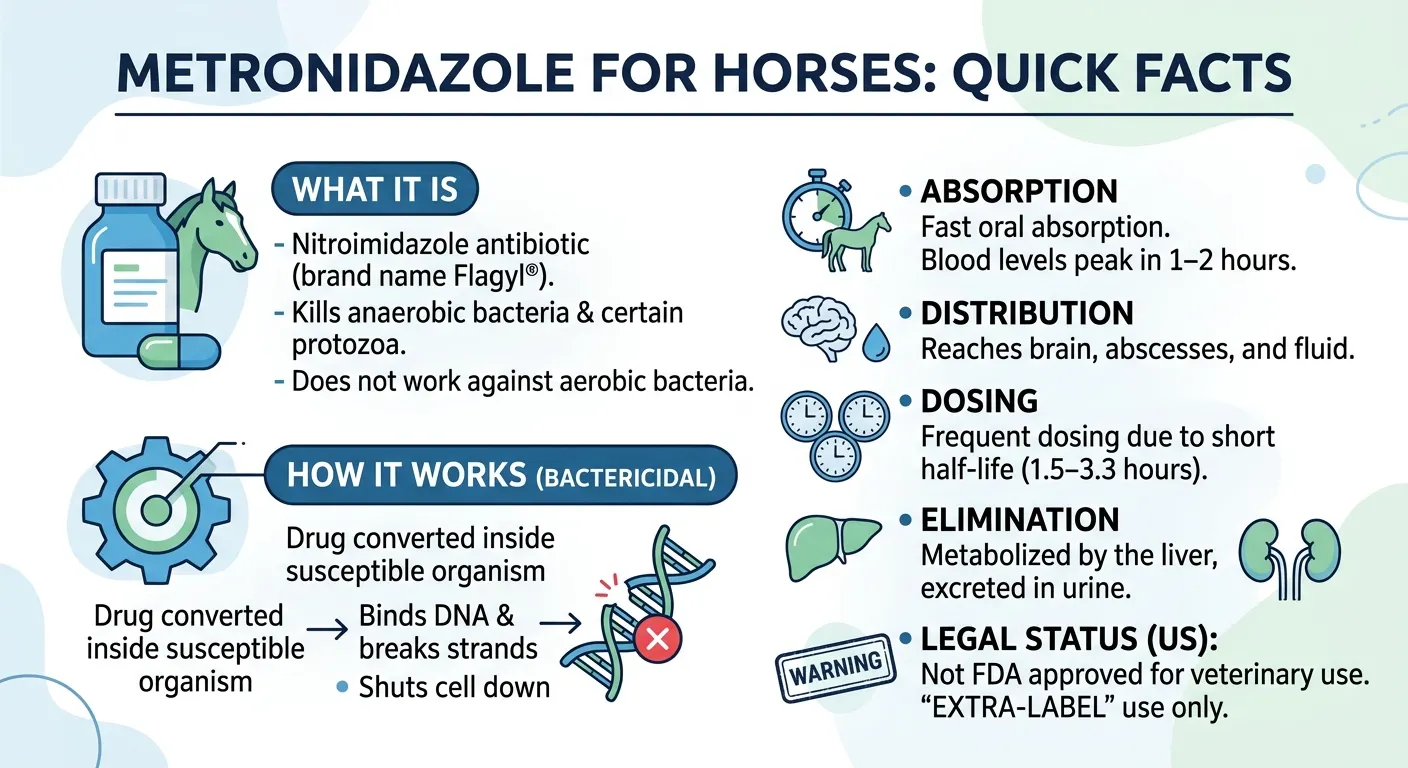
Metronidazole (brand name Flagyl®) is a nitroimidazole antibiotic that kills anaerobic bacteria, which are germs that thrive without oxygen, and certain protozoa. Ohio State’s guidelines describe it as bactericidal and concentration-dependent, with a narrow spectrum. It does not work against aerobic bacteria.
Inside a susceptible organism, the drug is converted into compounds that bind DNA, break strands and shut the cell down. According to the Merck Veterinary Manual, aerobic bacteria lack the chemical pathway that activates it, which is why it is useless against them.
Quick Facts About Metronidazole in Horses
- Absorption: oral bioavailability is reported at 60–100%, and blood levels peak within 1–2 hours.
- Distribution: it reaches the brain, abscesses and empyema fluid, and is only slightly protein-bound.
- Half-life in horses: about 1.5–3.3 hours, which helps explain the frequent dosing.
- Elimination: liver metabolism, with inactive metabolites excreted in urine.
- Legal status (US): not approved for any veterinary species, so every use is extra-label.
Metronidazole Dosage for Horses: The Numbers Vets Use
Adult horses are dosed at 15–25 mg/kg by mouth every 6–8 hours, or 10 mg/kg IV on the same schedule. Foals and neonates get different, lower or less frequent regimens. Two peer-reviewed-style references, Merck and Ohio State, agree on these ranges.
| Patient / Route | Dose | Interval | Source |
|---|---|---|---|
| Adult horse, oral | 15–25 mg/kg | Every 6–8 hours | Merck; Ohio State |
| Adult horse, IV | 10 mg/kg | Every 6–8 hours | Ohio State |
| Foal, clostridial enterocolitis, oral | 15 mg/kg | Every 8–12 hours | Ohio State |
| Neonatal foal (under 14 days), PO or IV | 10 mg/kg | Every 12 hours | Ohio State (Merck lists PO) |
| Typical adult oral figure from a compounding pharmacy | 15 mg/kg | Every 8 hours | Mixlab |
Adult Oral Dose
The oral range is 15–25 mg/kg every 6–8 hours. Many clinics sit at the lower end. A compounding pharmacy describes 15 mg/kg every 8 hours as the typical adult dose, with timing varying by case. Higher doses have occasionally been linked to anorexia, ataxia and depression, so more is not better.
Intravenous Dose
Ohio State lists 10 mg/kg IV every 6–8 hours. The injectable product in their pharmacy is a 5 mg/mL suspension, so a 500 kg horse needs about 1 liter per dose (5,000 mg ÷ 5 mg/mL). That is a hospital procedure, not a barn-aisle one. The Merck Manual notes that CNS excitement has been observed after IV dosing in some species.
Metronidazole Dose for Foals
For clostridial enterocolitis in foals, Ohio State lists 15 mg/kg by mouth every 8–12 hours. Neonates under 14 days old get a lower dose of 10 mg/kg, by mouth or IV, every 12 hours. Foals can crash quickly, so this is never a do-it-yourself drug.
Rectal Administration
Metronidazole is absorbed rapidly when given rectally, but bioavailability falls to roughly 30% according to Merck. Vets may use it when a horse cannot take oral medication, and the lower absorption must be accounted for in the plan.
Metronidazole Dosage Chart by Horse Weight
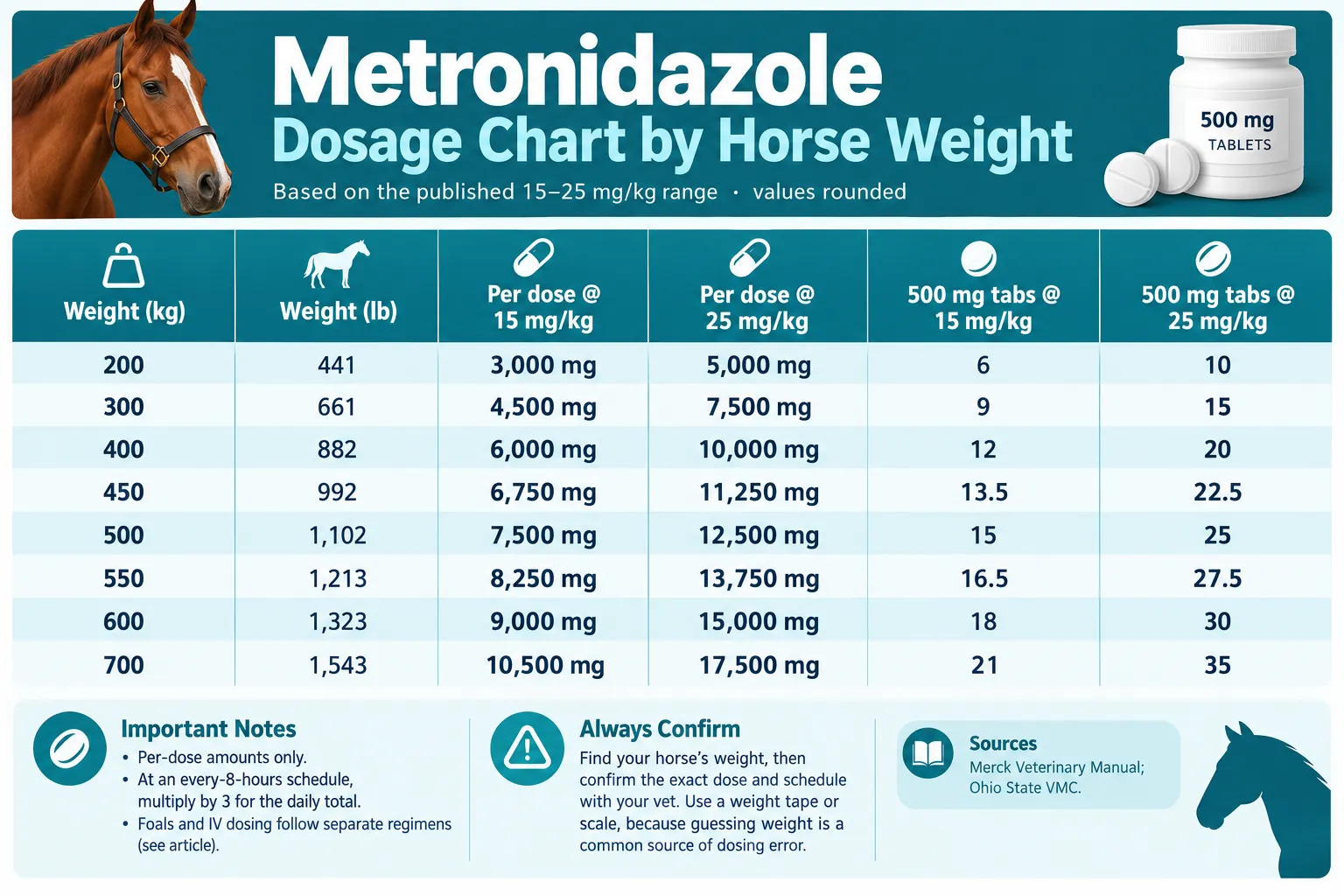
The chart below converts the published oral range into milligrams per dose and 500 mg tablet counts. Find your horse’s weight, then confirm the exact dose and schedule with your vet. Use a weight tape or scale, because guessing weight is a common source of dosing error.
📊 Oral Metronidazole Dose by Adult Horse Weight
Based on the published 15–25 mg/kg range · values rounded
| Weight (kg) | Weight (lb) | Per dose @ 15 mg/kg | Per dose @ 25 mg/kg | 500 mg tabs @ 15 | 500 mg tabs @ 25 |
|---|---|---|---|---|---|
| 200 | 441 | 3,000 mg | 5,000 mg | 6 | 10 |
| 300 | 661 | 4,500 mg | 7,500 mg | 9 | 15 |
| 400 | 882 | 6,000 mg | 10,000 mg | 12 | 20 |
| 450 | 992 | 6,750 mg | 11,250 mg | 13.5 | 22.5 |
| 500 | 1,102 | 7,500 mg | 12,500 mg | 15 | 25 |
| 550 | 1,213 | 8,250 mg | 13,750 mg | 16.5 | 27.5 |
| 600 | 1,323 | 9,000 mg | 15,000 mg | 18 | 30 |
| 700 | 1,543 | 10,500 mg | 17,500 mg | 21 | 35 |
Foal Dose Examples
| Foal weight | Neonate (under 14 days) @ 10 mg/kg | Clostridial enterocolitis @ 15 mg/kg |
|---|---|---|
| 40 kg (88 lb) | 400 mg | 600 mg |
| 50 kg (110 lb) | 500 mg | 750 mg |
| 60 kg (132 lb) | 600 mg | 900 mg |
| 100 kg (220 lb) | Not applicable | 1,500 mg |
Metronidazole Dose Calculator for Horses
Enter your horse’s weight, pick the patient type and choose the product strength your vet prescribed. The calculator shows milligrams per dose, the daily total and the amount to measure. It flags any dose outside the published range.
Metronidazole Dosage Calculator for Horses
Enter the details below and press Calculate Dose
Extra-label use. This calculator is for reference only. Always confirm the dose with your veterinarian before treating.
© medshorse.com
Worked Example: A 1,100 lb Horse
- Convert weight: 1,100 lb ÷ 2.2 = about 500 kg.
- Multiply by the dose: 500 kg × 15 mg/kg = 7,500 mg per dose.
- Convert to tablets: 7,500 mg ÷ 500 mg = 15 tablets per dose.
- Convert to liquid: 7,500 mg ÷ 50 mg/mL = 150 mL of a 50 mg/mL suspension (or 75 mL at 100 mg/mL).
- Find the daily total: every 8 hours means 3 doses, or 22,500 mg per day.
Those numbers show why compounded suspensions and pastes exist. Swallowing 45 tablets a day is unrealistic for most horses.
How Often and How Long Is Metronidazole Given?
Adults are usually dosed every 6–8 hours, foals every 8–12 hours, and neonates every 12 hours. With a half-life of only 1.5–3.3 hours in horses, evenly spaced doses matter. A missed dose is a reason to call your vet, not to double up.
No single treatment length applies to every case. Duration depends on the infection and on how the horse responds, and the references used here do not set a universal number of days.
Deep abscess cases can need long courses, while a horse that stops eating or develops diarrhea may need the plan changed or the drug stopped.
What Does Metronidazole Treat in Horses?

Metronidazole treats infections involving anaerobic bacteria or protozoa: clostridial colitis, abdominal abscesses and peritonitis, pleuropneumonia, tooth-root infections, deep or necrotic wounds, and some post-surgical infections. It is often one part of a combination plan, not a stand-alone cure.
- Clostridial enterocolitis and colitis: including infections linked to Clostridium difficile and C. perfringens.
- Polymicrobial infections: pleuropneumonia and metritis with a suspected or confirmed anaerobic component.
- Clostridial myositis/myonecrosis (Ohio State’s acceptable-use list).
- Abscesses and peritonitis: including abdominal and perianal abscesses.
- Oral and dental infections: periodontitis and tooth-root abscesses.
- Topical use for thrush caused by Fusobacterium necrophorum.
- Protozoal infections: sometimes as part of a combination regimen.
Ohio State lists aerobic infections as an unacceptable use. If the culprit bacteria need oxygen, metronidazole alone will not fix the problem.
Forms of Metronidazole for Horses
Metronidazole comes as tablets, oral suspensions, powders, pastes and an injectable. Ohio State’s pharmacy stocks 250 mg and 500 mg tablets, oral suspensions at 25, 50 and 100 mg/mL, and a 5 mg/mL injectable suspension. Other products exist, depending on your country and pharmacy.
| Form | Strength example | Good to know |
|---|---|---|
| Tablet | 250 mg, 500 mg | Large tablet counts for adult horses. |
| Oral suspension | 25, 50, 100 mg/mL | Easier to dose by weight, and can be flavored by a compounding pharmacy. |
| Oral powder (compounded) | Varies | Bitter taste, even mixed into feed, according to Mixlab. |
| Paste | 500 mg/g (an Australian product, vets only) | Product labels list indications such as anaerobic and protozoal infections. |
| Injectable suspension | 5 mg/mL | For IV use under veterinary supervision. |
Many horses refuse the drug because of the bitter taste. If yours does, ask your vet about a flavored compounded suspension instead of skipping doses or hiding tablets in a way that makes it impossible to confirm the full amount was eaten.
Metronidazole Side Effects and Safety in Horses
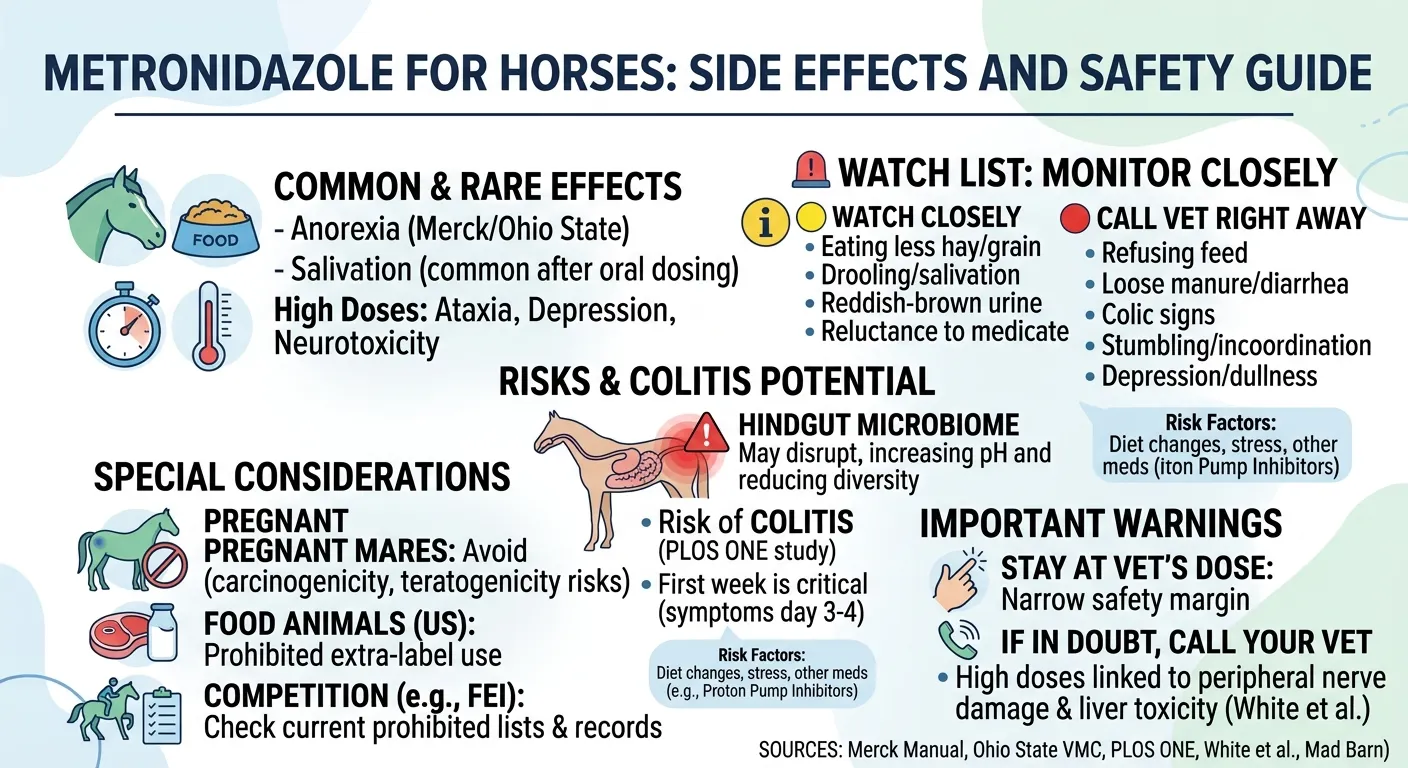
Most horses tolerate metronidazole, but side effects are real. The Merck Manual reports that anorexia and salivation are common after oral dosing. Ohio State notes that higher doses have occasionally caused anorexia, ataxia and depression. The most serious risk is colitis.
🟡 Watch closely
- Eating less hay or grain than normal
- Drooling or salivation after dosing
- Reluctance to take the medication
- Reddish-brown urine (reported with the drug)
🔴 Call your vet right away
- Refusing feed altogether
- Loose manure or diarrhea
- Signs of colic or a tucked-up belly
- Stumbling, swaying or incoordination
- Depression or unusual dullness
Can Metronidazole Cause Colitis in Horses?
Yes. Any antibiotic can disrupt the hindgut microbiome, and metronidazole is no exception. In the Texas study published in PLOS ONE, researchers gave five healthy horses with cecal cannulas 15 mg/kg twice daily. By day 3 all five had developed inappetence, an early sign of colitis, and the study was stopped.
Gut bacteria diversity dropped, and cecal samples became more acidic. The authors concluded that metronidazole “has potential to cause adverse effects in horses.” Antibiotic-associated diarrhea in horses reportedly appears three to four days after therapy starts, so the first week deserves extra attention.
Other factors can compound the risk. Gut-disturbing triggers listed by Mad Barn include sudden diet changes, stress, recent surgery and medication that suppresses stomach acid.
If your horse is also on a proton pump inhibitor, review the omeprazole dosage for horses guide and talk with your vet about the full medication list.
Neurotoxicity and Liver Risk at High Doses
One study cited in a fed-versus-fasted pharmacokinetic paper reported histological evidence of peripheral nerve damage and liver toxicity in horses given 30 mg/kg every 12 hours by mouth for 30 days (White et al., 1996).
That is a high dose over a long period, but it supports the idea that metronidazole has a narrow safety margin. Stay at your vet’s dose.
Pregnancy, Food Animals and Competition
- Pregnant mares: Merck advises avoiding metronidazole in pregnant animals, because carcinogenicity and teratogenicity were reported in laboratory mice after prolonged exposure.
- Food-producing animals (US): Merck states that extra-label use of nitroimidazoles is prohibited in all food-producing species. Ask your vet how your horse’s status is documented.
- Competition: Mad Barn reports metronidazole was not on the FEI’s 2025 Prohibited Substances List. Rules change and vary by discipline, so check the current list and keep treatment records.
Metronidazole vs Other Antibiotics for Horses
Metronidazole is chosen for anaerobes and protozoa, not as an all-purpose antibiotic. Vets often combine it with a drug that covers aerobic bacteria, because many serious infections involve both.
Ohio State describes it as part of broad-spectrum coverage for polymicrobial infections such as pleuropneumonia.
| Drug | Best known for | Main limitation |
|---|---|---|
| Metronidazole | Anaerobic bacteria and protozoa | Not for aerobic infections |
| Penicillin | Gram-positive infections such as strep, and clostridial infections like tetanus | Narrower coverage, usually injected. See penicillin dosage for horses. |
| Trimethoprim-sulfa | Oral broad-spectrum option | Different spectrum, so no anaerobic specialty. See sulfadiazine-trimethoprim dosage for horses and the Uniprim dosage for horses guide. |
| Gentamicin | Gram-negative aerobes (aminoglycoside) | Does not cover anaerobes. See gentamicin for horses dosage chart. |
🧭 How Your Vet Typically Builds a Metronidazole Plan
- Exam and history. Signs, temperature, appetite, manure, recent medications and surgery.
- Is an anaerobe or protozoan likely? Abscess, necrotic tissue, clostridial colitis or pleuropneumonia point that way.
- Choose alone or in combination. Many infections need a second drug for aerobic bacteria.
- Set the dose. By measured weight, route, age and product strength.
- Monitor. Appetite, manure, gait, hydration and temperature, with extra attention in the first week.
- Reassess. Continue, change or stop depending on response and side effects.
Common Mistakes to Avoid
- Guessing weight. A 10% weight error becomes a 10% dose error. Use a weight tape or scale.
- Mixing up mg/kg and total mg. The prescription is per kilogram, so always multiply by the horse’s weight.
- Confusing strengths. 25 mg/mL and 100 mg/mL suspensions differ by four times. Check the label every time.
- Shortening the interval because the dose is “hard to give.”
- Ignoring a drop in appetite. It was the first warning sign in the PLOS ONE study.
- Stopping early or extending on your own. Duration is a veterinary decision.
- Skipping medication reporting before competition, even if the drug is not prohibited.
- Using pain relief without asking. If your horse seems uncomfortable, check dosing and safety with your vet before giving anything. See the Banamine dosage for horses guide for background.
Key Takeaways and Next Steps
✅ Key Takeaways
- Adult dose: 15–25 mg/kg PO every 6–8 hours, or 10 mg/kg IV.
- Foals: 15 mg/kg every 8–12 hours for clostridial enterocolitis. Neonates under 14 days: 10 mg/kg every 12 hours.
- Half-life is about 1.5–3.3 hours in horses, so timing matters.
- It targets anaerobes and protozoa, not aerobic infections.
- Appetite loss, drooling, ataxia and colitis are the main risks.
- Avoid in pregnant mares. It is prohibited for extra-label use in US food-producing animals.
- Always get dose, product and duration from your veterinarian.
Next steps: weigh your horse, ask your vet to write down the dose in mg/kg and mg per dose, confirm the product strength on the label, and set phone reminders for every dose. Track appetite and manure daily, and call your vet at the first sign of trouble.
FAQs
What is the metronidazole dosage for horses?
Merck Veterinary Manual and Ohio State guidelines list 15–25 mg/kg by mouth every 6–8 hours for adult horses, and 10 mg/kg IV every 6–8 hours. All use is extra-label, so your vet sets the exact dose, interval and length of treatment for your horse.
How much metronidazole should I give a 1,000 lb horse?
A 1,000 lb horse weighs about 454 kg. At 15 mg/kg that is roughly 6,800 mg per dose, and at 25 mg/kg roughly 11,350 mg. With 500 mg tablets, 15 mg/kg is about 13–14 tablets per dose. Confirm the exact dose with your vet before giving anything.
How often can you give metronidazole to a horse?
Adult horses are typically dosed every 6–8 hours. Foals with clostridial enterocolitis may get it every 8–12 hours, and foals under 14 days old are dosed every 12 hours at a lower amount. Never shorten the interval on your own.
What is the metronidazole dose for foals?
Ohio State lists 15 mg/kg by mouth every 8–12 hours for clostridial enterocolitis in foals. Neonates under 14 days old get a lower 10 mg/kg, by mouth or IV, every 12 hours. Foals are fragile, so only a vet should set the dose.
Can metronidazole be given intravenously to horses?
Yes. Ohio State’s guidelines list 10 mg/kg IV every 6–8 hours as an extra-label option. The injectable suspension used there is 5 mg/mL, so a full-size horse needs a large volume. IV dosing should be done by a veterinarian.
What does metronidazole treat in horses?
It targets anaerobic bacteria and certain protozoa. Vets use it for clostridial colitis and enterocolitis, abdominal abscesses and peritonitis, pleuropneumonia, tooth-root and gum infections, deep or necrotic wounds, and as part of broader combination therapy. It does not treat aerobic infections.
Does metronidazole stop diarrhea in horses?
Only when diarrhea is caused by susceptible bacteria such as Clostridium. It is not a general diarrhea remedy. In a 2020 PLOS ONE study, healthy horses given 15 mg/kg twice daily developed inappetence by day 3, so a vet should diagnose the cause first.
What are the side effects of metronidazole in horses?
Reported effects include loss of appetite, drooling, mild diarrhea and, at higher doses or longer courses, incoordination (ataxia) and depression. It can also trigger colitis. A review of 200 horses found adverse effects in 4 of them.
Can metronidazole cause colitis in horses?
Yes, like any antibiotic it can upset the hindgut microbiome. In the 2020 PLOS ONE study, five healthy horses on 15 mg/kg twice daily showed gastrointestinal signs and the trial was stopped on day 3. Watch appetite and manure closely during treatment.
How fast does metronidazole work in horses?
Blood levels peak about 1–2 hours after an oral dose, and the half-life is only about 1.5–3.3 hours in horses. How quickly your horse improves depends on the infection, so your vet will recheck progress rather than judge by a single dose.
Is metronidazole safe for pregnant mares?
Merck Veterinary Manual says it should be avoided in pregnant animals because carcinogenic and teratogenic effects were seen in laboratory mice after prolonged exposure. Tell your vet if your mare is pregnant or being bred.
Can I use dog or human metronidazole for my horse?
Do not do this without a vet. Metronidazole is not approved for any veterinary species in the US, and small-animal doses differ from horse doses. A horse also needs far more total drug, so tablet strength, count and format must be planned by a veterinarian.
Is metronidazole allowed in horse competition?
Mad Barn reports it was not on the FEI 2025 Prohibited Substances List, but rules change and other bodies differ. Check the current list for your discipline and record the treatment, as medication reporting rules may still apply.
Can metronidazole be used in horses meant for human consumption?
In the US, Merck Veterinary Manual states nitroimidazoles, including metronidazole, are prohibited for extra-label use in all food-producing animal species. Ask your vet how your horse’s status is documented before treatment starts.
Why do horses refuse metronidazole?
It can taste bitter, even when powder is mixed into feed. Compounding pharmacies can make a flavored oral suspension, which may help. Ask your vet about a flavored form instead of skipping doses.
What should I do if I miss a dose of metronidazole?
Call your veterinarian for advice and do not double the next dose. With a half-life of only 1.5–3.3 hours in horses, timing matters, so keep reminders set for every dose.
How long does a horse stay on metronidazole?
There is no single standard length. Duration depends on the infection, and vets reassess based on response and side effects. Some deep infections need long courses, while a horse that stops eating or has diarrhea may need the drug changed or stopped.
Sources and Further Reading
- Merck Veterinary Manual: Nitroimidazoles Use in Animals
- Ohio State University VMC: Metronidazole (Equine) Antimicrobial Guidelines
- Arnold et al., PLOS ONE 2020: Cecal and fecal microbiomes of horses before and after metronidazole
- Sweeney et al., JAVMA 1991: Clinical use of metronidazole in horses, 200 cases
- Steinman et al., 2000: Pharmacokinetics of metronidazole in horses after IV, rectal and oral administration
- Kentucky Equine Research: Metronidazole and hindgut health in horses
- Mad Barn: Metronidazole (Flagyl) for Horses
- Mixlab: Metronidazole for Horses
- AAEP Judicious Use of Antimicrobials Guidelines
- 21 CFR Part 530: Extralabel Drug Use in Animals (FDA)