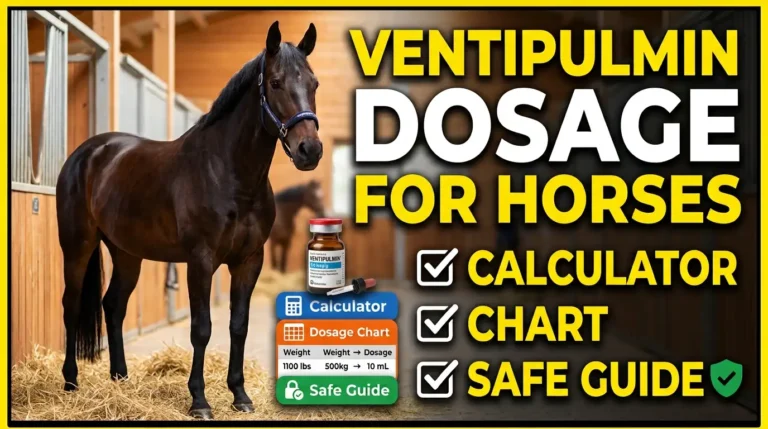
GastroGard Dosage for Horses: Weight Chart, Free Calculator and a Safe Step-by-Step Guide
Written & Reviewed By: Medshorse Team
Last Updated: November 2026
If your vet has just told you your horse has gastric ulcers, the next question is simple: how much GastroGard does my horse actually need? Getting the GastroGard dosage for horses right matters, because a syringe set even a little wrong can mean a short dose on day one and a stalled recovery by day 28.
This guide gives you the exact label dose, a weight chart, a free calculator and a plain-English walk through the syringe. It also covers what many dosing pages skip: glandular ulcers, feeding time, foals, cost and the mistakes that quietly make treatment fail.
One note before we start. GastroGard is a prescription product. Use this guide to understand and double-check the dose, then follow the plan your veterinarian gives you.
Disclaimer: This article is for general education and is not veterinary advice. Product names mentioned, including GastroGard, belong to their respective owners, and MedsHorse is not affiliated with them. Always follow your veterinarian’s instructions and the current product label.
Quick answer
GastroGard dosage for horses: 1.8 mg of omeprazole per pound (4 mg/kg) once daily for 28 days to treat gastric ulcers, then 0.9 mg per pound (2 mg/kg) once daily for at least 4 more weeks to help prevent recurrence. One full syringe delivers the treatment dose for a 1,250 lb (568 kg) horse.
Key takeaways
- The treatment dose is 1.8 mg/lb (4 mg/kg) daily for 28 days. The maintenance dose is half of that: 0.9 mg/lb (2 mg/kg).
- For maintenance, set the plunger ring at half of your horse’s weight.
- Maximum acid suppression takes three to five days, so do not judge the product on day one.
- Food cuts omeprazole absorption by about 67%, so ask your vet about dosing time.
- Glandular ulcers often need an add-on such as sucralfate. Omeprazole alone is less reliable there.
- If any paste is spat out, the label says to redose.
What Is GastroGard and How Does It Work in Horses?
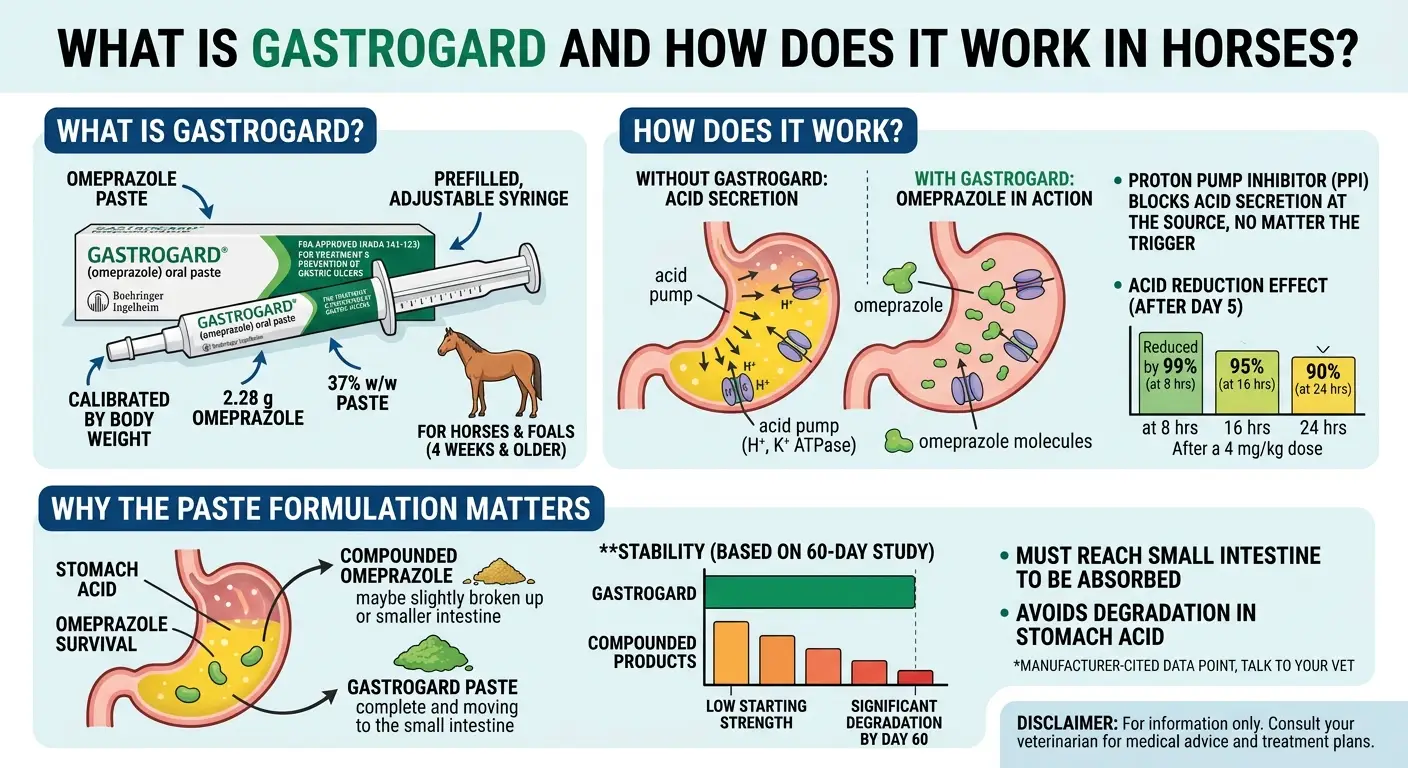
GastroGard is an omeprazole oral paste made by Boehringer Ingelheim Animal Health. It is FDA approved (NADA 141-123) for the treatment and prevention of recurrence of gastric ulcers in horses and foals 4 weeks of age and older. Each prefilled, adjustable syringe holds 2.28 g of omeprazole in a 37% w/w paste and is calibrated by body weight.
Omeprazole is a proton pump inhibitor. It binds the acid pump (H+, K+ ATPase) in the stomach lining and blocks acid secretion whatever the trigger. Per the label, once full effect is reached at day five, acid secretion was reduced by 99%, 95% and 90% at 8, 16 and 24 hours after a 4 mg/kg dose.
Omeprazole is sold in several forms. For a wider comparison, see our guide to omeprazole dosage for horses.
Why the Paste Formulation Matters
Omeprazole breaks down in acid, so it must survive the stomach and reach the small intestine to be absorbed. Boehringer Ingelheim cites a 60-day study (Stanley and Knych, AAEP 2011) in which compounded omeprazole products began as low as 63% of labeled strength and fell as low as 17% by day 60, while GastroGard stayed stable.
That is a manufacturer-cited result, so treat it as one data point. It is still a good reason to talk to your vet before switching products.
Signs Your Horse May Need Ulcer Treatment
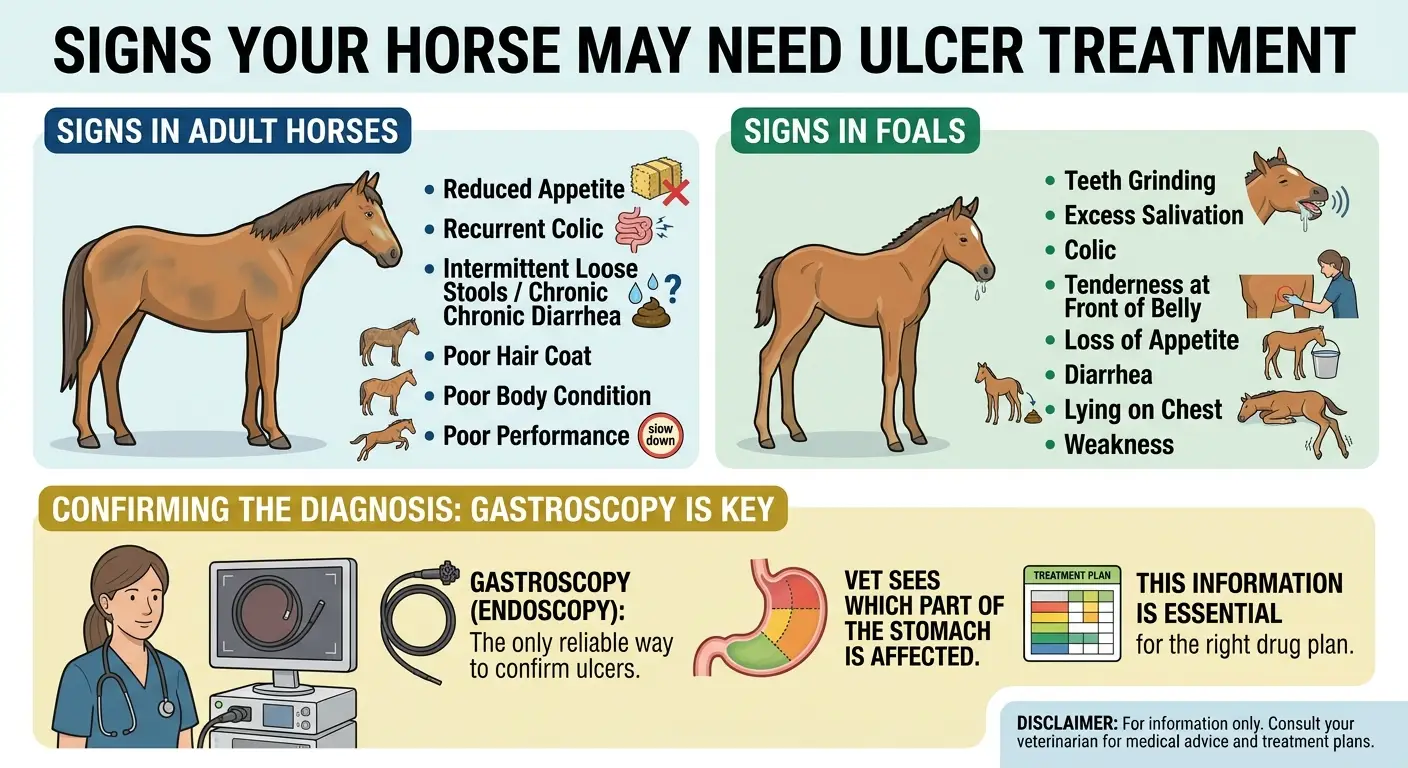
The label lists these signs as possibly linked to gastric ulcers in adult horses: reduced appetite, recurrent colic, intermittent loose stools or chronic diarrhea, a poor hair coat, poor body condition and poor performance.
In foals, look for teeth grinding, excess salivation, colic, tenderness at the front of the belly, loss of appetite, diarrhea, lying on the chest or weakness.
These signs overlap with many other problems. Gastroscopy (endoscopy) is the only reliable way to confirm ulcers and see which part of the stomach is affected. That matters, because the right drug plan depends on it.
GastroGard Dosage for Horses: The Official Label Dose
The US label sets a two-stage plan. Treatment comes first, and maintenance follows to protect the healing.
| Stage | Goal | Dose per pound | Dose per kg | Duration |
|---|---|---|---|---|
| Treatment | Heal existing gastric ulcers | 1.8 mg/lb | 4 mg/kg | Once daily for 4 weeks (28 days) |
| Maintenance | Help prevent recurrence | 0.9 mg/lb | 2 mg/kg | Once daily for at least 4 more weeks |
On the syringe, each weight marking delivers enough omeprazole to treat 250 lb (114 kg) at the treatment rate. For maintenance, set the plunger ring at the marking for half of your horse’s weight. Each marking then covers 500 lb (227 kg).
Treatment timeline at a glance
The Quick Math Behind the Dose
Treatment dose in mg equals your horse’s weight in pounds multiplied by 1.8. A 1,000 lb horse needs 1,800 mg of omeprazole a day. Because the paste is 37% omeprazole, that is about 4.9 g of paste, or roughly 79% of one syringe. At maintenance, the same horse needs 900 mg a day.
GastroGard Dosage Chart For Horses
Daily omeprazole dose by horse body weight
| Body weight (lb) | Body weight (kg) | Treatment dose (mg per day) | Maintenance dose (mg per day) |
|---|---|---|---|
| 300 | 136.1 | 540 | 270 |
| 400 | 181.4 | 720 | 360 |
| 500 | 226.8 | 900 | 450 |
| 600 | 272.2 | 1,080 | 540 |
| 700 | 317.5 | 1,260 | 630 |
| 800 | 362.9 | 1,440 | 720 |
| 900 | 408.2 | 1,620 | 810 |
| 1,000 | 453.6 | 1,800 | 900 |
| 1,100 | 499.0 | 1,980 | 990 |
| 1,200 | 544.3 | 2,160 | 1,080 |
| 1,300 | 589.7 | 2,340 | 1,170 |
| 1,400 | 635.0 | 2,520 | 1,260 |
| 1,500 | 680.4 | 2,700 | 1,350 |
| 1,600 | 725.7 | 2,880 | 1,440 |
© medshorse.com
GastroGard Dosage Calculator
Enter your horse’s weight, choose the unit and the stage, and the calculator returns the daily omeprazole dose, the paste amount, the ring setting and how many syringes a 28-day course uses. It uses the label rates and a 2.28 g syringe.
GastroGard Dosage Calculator For Horses
Omeprazole oral paste dose based on your horse body weight
© medshorse.com
How to Give GastroGard Step by Step
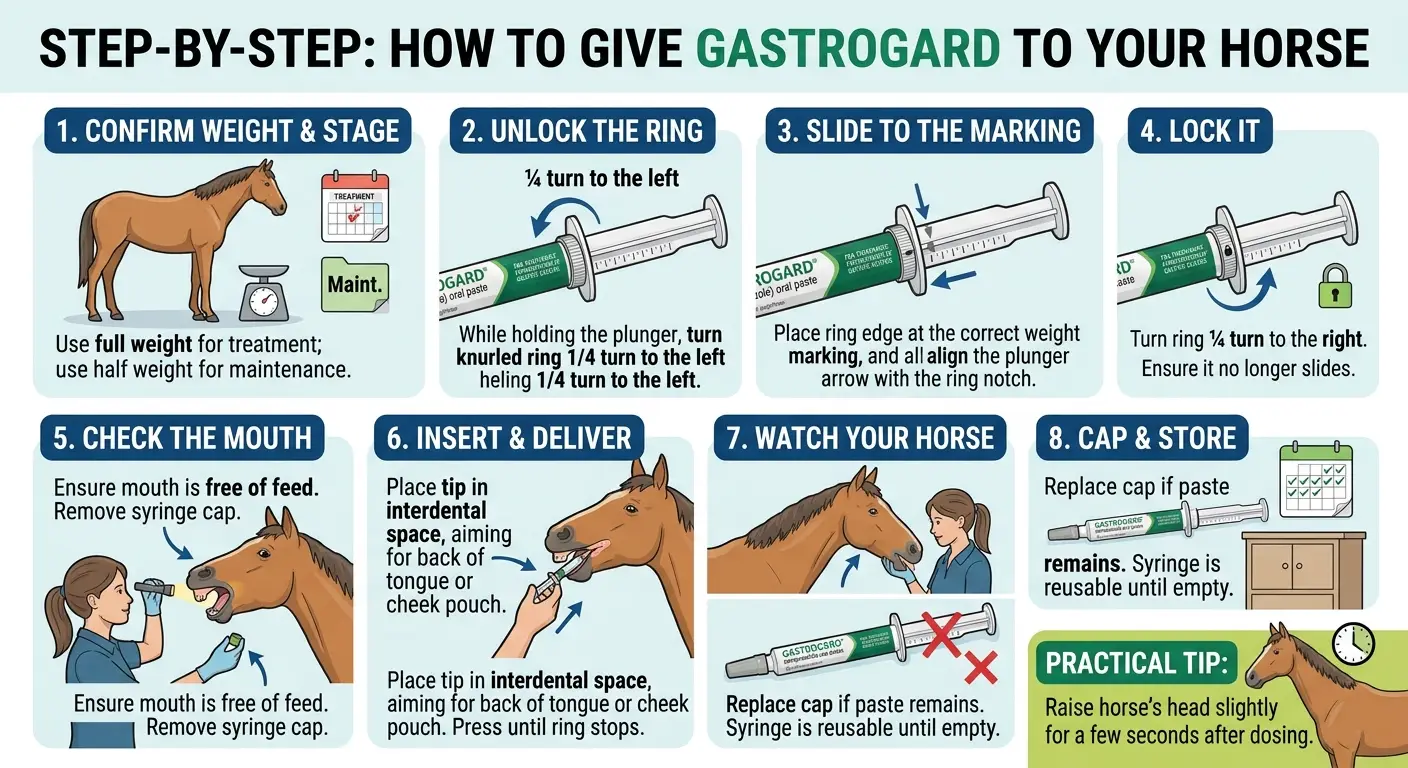
The label’s directions are short, but small slips here cause most dosing errors. Work through them in this order.
Setting and giving the syringe
- Confirm weight and stage. Treatment uses your horse’s full weight. Maintenance uses half.
- Unlock the ring. While holding the plunger, turn the knurled ring a quarter turn to the left.
- Slide to the marking. Place the side of the ring nearest the barrel at the correct weight marking and line up the arrow on the plunger with the notch on the ring.
- Lock it. Turn the ring a quarter turn to the right. It should no longer slide.
- Check the mouth. Make sure there is no feed in your horse’s mouth. Remove the cap from the tip.
- Insert and deliver. Place the tip in the gap between the front and back teeth (the interdental space) and press the plunger until the ring stops it. Aim for the back of the tongue or deep into the cheek pouch.
- Watch your horse. Make sure the whole dose is swallowed. If any paste is lost, the label recommends redosing.
- Cap and store. If paste remains, replace the cap. The syringe can be reused on following days until it is empty.
Practical tip: raise your horse’s head slightly for a few seconds after dosing. This is common practice, not a label instruction.
How Long Should a Horse Stay on GastroGard?
The standard course is 28 days of treatment, followed by at least 4 more weeks of maintenance. The US label states that ulcers may return if prevention therapy is not given after the first course. It also states that safety for longer than 91 days has not been determined, so any plan beyond that belongs with your vet.
Do not stop early because your horse looks better. A European consensus statement on gastric ulcers in adult horses (ECEIM, 2015) notes that there is no strong evidence linking clinical signs to the presence of ulcers. A repeat gastroscopy is the clearest way to know whether treatment worked.
Management Changes That Protect the Dose
Medication works best alongside better management. The same consensus statement points to steady forage (at least 1.5 kg of dry matter per 100 kg body weight daily), limited starch and gaps of at least 6 hours between concentrate meals.
Some owners also add gut-support products. If you are considering one, read our guide to glutamine dosage for horses, and treat it as a helper, not a replacement for omeprazole.
GastroGard Dosing for Foals, Ponies, Mares and Large Horses
Foals
The US label allows use in foals 4 weeks of age and older. A placebo-controlled foal study gave 4, 12 or 20 mg/kg daily for 91 days. At 20 mg/kg (five times the dose), gamma glutamyltransferase (GGT) levels rose, though the stomach looked normal under the microscope.
Canadian labeling starts at 9 weeks, and the UK product is not recommended under 4 weeks or under 70 kg. Always get a foal’s dose from your vet.
Ponies and Smaller Horses
The dose scales with weight, so a 500 lb pony takes 900 mg at the treatment rate, which is two markings on the plunger. Syringes can be reused, so one syringe may cover several days. For very small equines, ask your vet to confirm the ring setting.
Horses Over 1,250 lb
A single syringe covers a 1,250 lb horse for one treatment day. A 1,500 lb draft cross needs 2,700 mg, which is more than one syringe. Your vet or pharmacist can show you how to combine syringes without losing track of the dose.
Pregnant and Lactating Mares
The label says safety has not been determined in pregnant or lactating mares. In the UK and EU, the product is not authorised for mares producing milk for human consumption. Ask your vet to weigh the risks.
Stallions
In a male reproductive safety study, 10 stallions received 12 mg/kg daily (three times the recommended dose) for 70 days with no treatment-related effects on semen quality or breeding behavior. A safety study in breeding mares has not been conducted.
Horses on Other Medications
In the clinical trials, GastroGard was used alongside dewormers, antibiotics, NSAIDs, steroids, diuretics, tranquilizers and vaccines, with no drug-related adverse reactions reported. The Canadian label advises close monitoring in horses with liver disease, because omeprazole is metabolized by the liver.
NSAIDs can add to ulcer risk when overdosed, so keep to label doses, as covered in our guides on bute dosage for horses and Banamine dosage for horses.
Does Feeding Time Matter When Giving GastroGard?
It can. The label’s pharmacokinetic study found that absorption fell by about 67% when horses ate hay and grain, and exposure on a fasted day was roughly three times higher than on fed days. The label’s only direct instruction is that the mouth must contain no feed at the time of dosing.
Many vets suggest giving the dose at the same time each day, often before the first meal. Do not fast a horse for long to chase better absorption, because an empty stomach is itself an ulcer risk. Ask your vet which schedule suits your horse.
Does GastroGard Work for Glandular Ulcers?
Omeprazole works well on ulcers in the upper (squamous) part of the stomach, but less well on the lower (glandular) part. A 2014 study in BMC Veterinary Research notes that in three studies only about 25% of glandular ulcers healed after 28 to 35 days of omeprazole at 4 mg/kg, compared with 78% of squamous ulcers.
The ECEIM consensus reports that adding sucralfate (12 mg/kg twice daily) to omeprazole improves the success rate in glandular disease compared with omeprazole alone. You can read more about sucralfate dosage for horses and misoprostol dosage for horses, which vets also use for glandular lesions.
Squamous versus glandular ulcers
| Feature | Squamous (ESGD) | Glandular (EGGD) |
|---|---|---|
| Stomach region | Upper, non-glandular lining | Lower, acid-secreting lining |
| Response to omeprazole alone | Good. About 78% healed in the studies cited | Weaker. About 25% healed in the studies cited |
| Typical add-on | Management changes | Sucralfate, sometimes misoprostol, per your vet |
| How to confirm | Gastroscopy | Gastroscopy of the whole stomach |
GastroGard Dosage by Country: US, Canada and UK
Labels differ between markets. Always follow the label that comes with the product you hold.
Label comparison by country
| Detail | United States | Canada | United Kingdom |
|---|---|---|---|
| Treatment dose | 1.8 mg/lb (4 mg/kg) for 28 days | 4 mg/kg for 28 days | 4 mg/kg for 28 days |
| After treatment | 0.9 mg/lb (2 mg/kg) for at least 4 weeks | 2 mg/kg for 28 days to prevent recurrence | 1 mg/kg for 28 days |
| Prevention in horses without ulcers | Not on the US label | 1 mg/kg for up to 28 days | 1 mg/kg daily |
| Minimum age | 4 weeks | 9 weeks | 4 weeks and over 70 kg |
| One syringe doses | 1,250 lb (568 kg) | 575 kg | 575 kg |
| Syringe contents | 2.28 g omeprazole | 2.28 g omeprazole | 6.16 g paste at 370 mg/g |
Is GastroGard Safe? Side Effects and Safety Data
The label reports no adverse reactions in efficacy trials, and none attributed to omeprazole in field trials of 139 horses (US label) or 367 horses (Canadian label), including foals as young as one month.
The margin of safety studied is wide, but remember that the higher-dose studies were safety tests, not efficacy tests. They do not show that more paste heals faster.
Dose multiples tested with no treatment-related adverse effects
Source: US GastroGard label. In foals, GGT levels rose at 5x for 91 days. Report suspected reactions to Boehringer Ingelheim at 1-888-637-4251 or to the FDA at 1-888-FDA-VETS.
Other safety points to know:
- GastroGard is not for horses intended for human consumption (US label).
- Keep it out of the reach of children. If swallowed, contact a physician.
- If you give extra paste by mistake, call your vet for advice rather than waiting for signs.
- To report a suspected reaction, see fda.gov/reportanimalae.
Common GastroGard Dosing Mistakes
Seven mistakes that weaken treatment
- Guessing body weight instead of using a scale or weight tape.
- Forgetting to halve the ring setting when moving to maintenance.
- Stopping at day 28 with no maintenance plan.
- Dosing with feed still in the mouth.
- Not redosing after a large amount of paste is spat out.
- Swapping to human or compounded omeprazole without veterinary advice.
- Treating glandular ulcers with omeprazole alone and never rechecking.
GastroGard vs Compounded Omeprazole and Other Options
Owners often ask whether a cheaper product can replace GastroGard. Here is how the main options compare, based on the sources above.
Options compared
| Option | Role | Key point |
|---|---|---|
| GastroGard | FDA-approved treatment and recurrence prevention | Label doses of 1.8 and 0.9 mg/lb, with efficacy and safety data in the label |
| UlcerGard | Prevention in horses at risk | A lower-dose omeprazole paste meant for prevention, not for healing existing ulcers |
| Compounded omeprazole | Custom formulations | A manufacturer-cited study found strength fell to as low as 17% of label by day 60 in some products |
| Human omeprazole | Not designed for horses | Very low equine bioavailability per BEVA paper |
| Sucralfate | Add-on for glandular ulcers | Coats and protects the lining. Not a replacement for acid suppression |
If omeprazole is not an option for your horse, your vet may discuss older acid reducers, such as those covered in our guide to ranitidine dosage for horses. Never switch products without veterinary advice.
How Much Does GastroGard Cost for a Full Course?
Price depends on your horse’s size, because heavier horses use more paste. As a snapshot, Heartland Vet Supply listed a single GastroGard syringe at $44.99 (prescription required) when this guide was written. Prices change, and boxes of 7 or more may cost less per syringe, so treat the figures below as estimates.
Estimated syringes and cost per course at $44.99 per syringe
| Weight (lb) | Syringes, 28-day treatment | Estimated cost | Syringes, treatment plus 28-day maintenance | Estimated cost |
|---|---|---|---|---|
| 900 | 20 | $899.80 | 30 | $1,349.70 |
| 1,000 | 23 | $1,034.77 | 34 | $1,529.66 |
| 1,100 | 25 | $1,124.75 | 37 | $1,664.63 |
| 1,250 | 28 | $1,259.72 | 42 | $1,889.58 |
Syringes are rounded up. Because a syringe can be reused until empty, you can use partial syringes across days. Actual cost depends on the pharmacy.
How to Store GastroGard
Store at 68 to 77 degrees F (20 to 25 degrees C). Short excursions between 59 and 86 degrees F (15 to 30 degrees C) are permitted. Replace the cap after each use. Keep syringes away from children. The UK product states a shelf life of 28 days after first opening the syringe, so check the leaflet in your box.
What If a Dose Is Missed or Spat Out?
If any of the dose is lost or rejected, the label recommends redosing. For a skipped day, the label gives no specific instruction, so call your vet. Do not double the next day’s dose on your own.
When to Call Your Vet
Call your vet if
- Your horse shows signs of colic, especially pawing, rolling or repeated looking at the flank. Treat colic as urgent.
- Appetite, weight or manure quality gets worse during treatment.
- Signs return after the course ends.
- You are unsure about the ring setting or your horse’s weight.
- Your horse is a foal, is pregnant or lactating, or has liver disease.
FAQs
What is the GastroGard dosage for horses?
The US label dose is 1.8 mg of omeprazole per pound (4 mg/kg) once daily for 28 days to treat gastric ulcers. After that, the maintenance dose is 0.9 mg per pound (2 mg/kg) once daily for at least 4 more weeks to help prevent recurrence.
How much GastroGard does a 1,000 lb horse need?
A 1,000 lb horse needs 1,800 mg of omeprazole per day during treatment. That is about 4.9 g of paste, or roughly 79 percent of one syringe. For maintenance, the dose is 900 mg per day, set at the 500 lb marking.
How much GastroGard does a 1,200 lb horse need?
A 1,200 lb horse needs 2,160 mg of omeprazole per day during treatment, which is about 5.8 g of paste. For maintenance, the dose is 1,080 mg per day, set at the 600 lb marking.
How many syringes of GastroGard does one horse need?
One syringe contains 2.28 g of omeprazole and covers a 1,250 lb horse for one treatment day. Because partly used syringes can be reused, a 1,100 lb horse uses about 25 syringes over the 28-day treatment stage.
How long should a horse be on GastroGard?
The standard course is 28 days of treatment followed by at least 4 weeks of maintenance. The label says safety beyond 91 days has not been determined, so your vet should decide on anything longer.
Can you give GastroGard with food?
The label says the horse’s mouth must contain no feed when you dose. Studies also show absorption falls by about 67 percent in the presence of food, so ask your vet which time of day works best.
What should I do if my horse spits out GastroGard?
The label recommends redosing if any of the dose is lost or rejected. Watch your horse for a short time after dosing to make sure the full dose is swallowed.
How fast does GastroGard work?
Maximum acid suppression occurs after three to five days of treatment. Healing takes longer, which is why the course runs 28 days and why vets often recheck with gastroscopy.
Does GastroGard treat glandular ulcers?
Omeprazole alone heals glandular ulcers less reliably than squamous ulcers. A European consensus statement reports that adding sucralfate improves results, so ask your vet about a combined plan.
Is GastroGard safe for foals?
The US label allows use in foals 4 weeks of age and older. Canadian labeling starts at 9 weeks, and the UK product is not recommended under 4 weeks or under 70 kg. Your vet should set a foal’s dose.
Can pregnant or lactating mares take GastroGard?
The label states that safety has not been determined in pregnant or lactating mares. Talk with your vet before using it in a broodmare.
Do I need a prescription for GastroGard?
Yes. US federal law restricts GastroGard to use by or on the order of a licensed veterinarian.
Can I use human omeprazole instead of GastroGard?
This is not recommended. A BEVA conference paper reports that human omeprazole has extremely low bioavailability in horses, leading to minimal acid suppression and no ulcer healing.
What are the side effects of GastroGard?
The label reports no adverse reactions in its efficacy trials and no treatment-related effects at up to 10 times the dose in adult horses. Foals given 5 times the dose showed raised GGT levels. Report any suspected reaction to your vet.
How should GastroGard be stored?
Store it at 68 to 77 degrees F (20 to 25 degrees C), with short excursions between 59 and 86 degrees F allowed. Replace the cap after each use and keep it out of the reach of children.
Final Thoughts and Next Steps
The GastroGard dosage for horses is simple on paper: 1.8 mg/lb daily for 28 days, then 0.9 mg/lb for at least 4 more weeks. Success comes from the details, which are an accurate weight, the right ring setting, an empty mouth, a redose when paste is lost and a plan for what follows.
Your next steps:
- Weigh your horse or measure with a weight tape and write the number down.
- Use the calculator above to double-check the daily dose against your vet’s instructions.
- Ask your vet about dosing time, glandular ulcers and a recheck gastroscopy.
- Plan forage and feeding changes so the ulcers have less reason to return.
This guide is for education and does not replace veterinary advice. Your horse’s vet knows the case and is the right person to set the final dose.
Sources and Further Reading
- FDA-approved GastroGard label on DailyMed
- Boehringer Ingelheim GastroGard product page
- GastroGard Prescribing Information
- Canadian GastroGard label on Drugs.com
- UK Summary of Product Characteristics for GastroGard 370 mg/g
- BMC Veterinary Research glandular ulcer study
- European College of Equine Internal Medicine consensus statement on equine gastric ulcer syndrome in adult horses (Sykes et al., 2015)
- Boehringer Ingelheim cited study: Stanley SD, Knych HK. Comparison of pharmaceutical equivalence for commercially available preparations of omeprazole. AAEP Proceedings. 2011;57:63