Devils Claw Dosage for Horses: Weight Chart, Calculator & Safe Feeding Guide
Written & Reviewed By: Medshorse Team
Last Updated: October 2026
Devils claw dosage for horses is where most owners get stuck, because the numbers on the tub rarely agree. One label says 5 to 20 g a day for a 500 kg horse. Another says 15 to 30 g. A third says 3 to 6 g. Each can be correct for its own product, because strength differs about tenfold between plain root powder and a standardized extract.
Quick answer: A common label range for dried devil’s claw root powder is 1 to 4 g per 100 kg of body weight per day. A 500 kg (1,100 lb) horse would get about 5 to 20 g daily, ideally split into two feeds. Standardized extracts are much stronger, so always follow the product label.
Below you’ll find a weight-based chart, a working calculator, and the safety checks that matter most: ulcers, mares in foal, interactions and drug-testing rules. You’ll also see where the evidence is solid and where it is thin, because with this herb, it’s often thin.
Disclaimer: This article is for general education and is not veterinary advice. Product names mentioned, including Devils Claw, belong to their respective owners, and MedsHorse is not affiliated with them. Always follow your veterinarian’s instructions and the current product label.
Key takeaways
- Plain root powder: about 1 to 4 g per 100 kg per day (Reverdy label), split into two feeds.
- Standardized 10% extract: one maker lists 3 to 6 g a day, so never swap it gram for gram with plain powder.
- Safety data is small but reassuring: six healthy horses showed no clinically detectable side effects after a single dose, and 12 horses with existing ulcers showed no worsening over 28 days.
- Not for: pregnant or lactating mares, horses allergic to the plant, or horses with suspected gastric ulcers unless your vet agrees.
- Competition horses: harpagoside has been an FEI controlled medication since 1 January 2016.
What Is Devil’s Claw and How Does It Work in Horses?
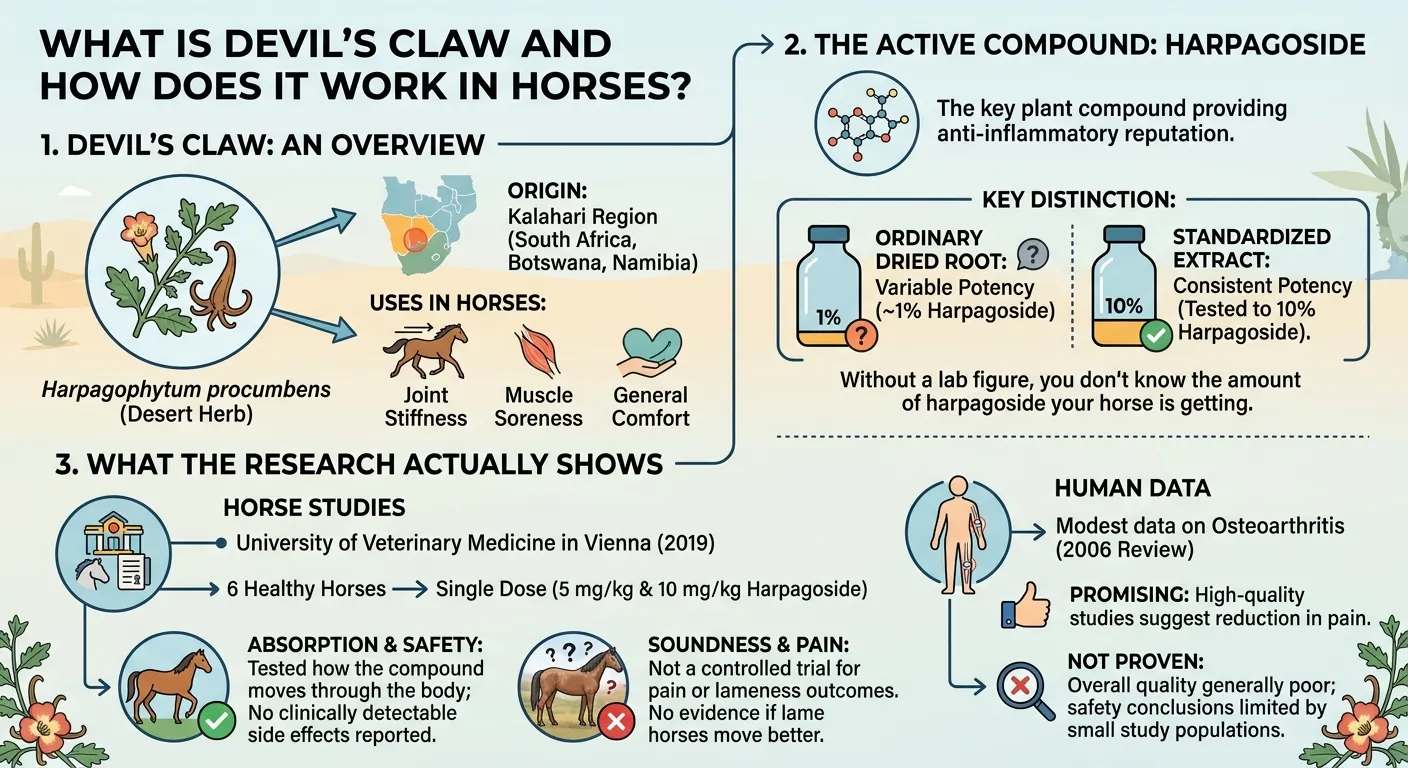
Devil’s claw (Harpagophytum procumbens) is a desert herb whose dried root is fed to horses for joint stiffness, muscle soreness and general comfort. It grows mainly in the Kalahari regions of South Africa, Botswana and Namibia, and it gets its name from its hook-covered fruit. Its main active compound is called harpagoside.
The Active Compound: Harpagoside
Harpagoside is the iridoid glycoside that gives devil’s claw its anti-inflammatory reputation. Retailers also point to other plant compounds with pain-relieving effects and to antioxidants in the root.
Here’s the catch. Ordinary dried root contains only around 1% harpagoside, according to NPC Health, while its standardized extract is tested to 10%. Without a lab figure on the label, you can’t know how much active compound your horse is really getting.
What the Research Actually Shows
The best horse-specific data is a 2019 pharmacokinetic study from the University of Veterinary Medicine in Vienna. Six healthy adult horses (495 to 560 kg) received a single dose of extract delivering 5 mg/kg and, a week later, 10 mg/kg of harpagoside by stomach tube. The researchers reported no clinically detectable side effects.
That study measured absorption, not soundness. It tells us how the compound moves through the body, not whether lame horses move better. The horse research I reviewed doesn’t include a controlled trial of pain or lameness outcomes.
Human data is broader but still modest. A 2006 review of 14 clinical trials in osteoarthritis found that the higher-quality studies suggested a reduction in pain. The authors also called the overall methodological quality generally poor and said safety conclusions were limited by small study populations. In short: promising, not proven.
Devils Claw Dosage for Horses: The Quick Answer
There is no regulator-approved dose of devil’s claw for horses. What exists are manufacturer label ranges, which depend on the product’s strength. These are the published figures worth knowing:
- Plain root powder (about 1% harpagoside): 1 to 4 g per 100 kg body weight daily. Reverdy lists 5 to 20 g for a 500 kg horse and 3 to 12 g for a 300 kg pony.
- Typical medium-sized horse: 4 g twice daily, with some horses responding to 2 g twice daily (EquusVitalis).
- Standardized 10% extract: 3 to 6 g daily as the standard amount, with 15 to 25 g suggested by that maker for strong inflammation (NPC Health).
- Another root powder label: Equifox lists 15 to 30 g, though its page doesn’t say how often or for what body weight.
Devils Claw Dosage Chart by Horse Weight
This chart applies the 1 to 4 g per 100 kg ratio from Reverdy’s plain root powder label (equal to 10 to 40 mg per kg of body weight per day). The midpoint column is a simple average I added so you can see a middle value. It is not a separate manufacturer recommendation.
Plain devil’s claw root powder: daily amount by body weight
| Horse weight | Low (10 mg/100kg) | Midpoint (25 mg/100kg) | Top of label range (40 mg/100kg) | Per feeding if split in two (low to top) |
|---|---|---|---|---|
| 200 kg (441 lb) small pony | 2 g | 5 g | 8 g | 1 to 4 g |
| 300 kg (661 lb) pony | 3 g | 7.5 g | 12 g | 1.5 to 6 g |
| 400 kg (882 lb) | 4 g | 10 g | 16 g | 2 to 8 g |
| 450 kg (992 lb) | 4.5 g | 11.3 g | 18 g | 2.3 to 9 g |
| 500 kg (1,102 lb) | 5 g | 12.5 g | 20 g | 2.5 to 10 g |
| 550 kg (1,213 lb) | 5.5 g | 13.8 g | 22 g | 2.8 to 11 g |
| 600 kg (1,323 lb) | 6 g | 15 g | 24 g | 3 to 12 g |
| 700 kg (1,543 lb) draft cross | 7 g | 17.5 g | 28 g | 3.5 to 14 g |
Source basis: Reverdy Devils Claw 1 kg label (1 to 4 g per 100 kg daily, 3-week course). For plain dried root powder only. Do not use this chart for standardized extracts or blended joint supplements.
How to Use the Chart
- Find your horse’s actual weight with a weigh tape or scale. Guessing is the fastest way to over- or under-dose.
- Introduce the powder gradually into the ration, as the Reverdy label advises.
- A sensible approach is to begin at the low end of the range and ask your vet before moving toward the top.
- If your product’s label gives a different amount, the label for that exact product wins.
Devils Claw Dosage Calculator for Horses
Enter your horse’s weight to see the daily amount of plain root powder. The second tool converts a target amount of harpagoside into grams of any product, based on the harpagoside percentage printed on its label.
Devil’s Claw Dosage Calculator for Horses
Dried devil’s claw root powder – estimated daily dose© medshorse.com
Root Powder vs. Standardized Extract: Why Doses Differ So Much
Dried root powder and standardized extract are different products. NPC Health notes that its 10% harpagoside powder is roughly ten times stronger than regular root at about 1%. Feeding 6 g of the extract is not the same as feeding 6 g of plain powder.
What labels say: grams of product per day for an adult horse
Green bars are plain root powder, ochre bars are a standardized extract. Figures are taken from each brand’s product page and are not directly comparable.
Put the arithmetic on paper and the gap is obvious. At 1% harpagoside, Reverdy’s 5 to 20 g for a 500 kg horse supplies roughly 50 to 200 mg of harpagoside. NPC Health’s suggested 385 to 770 mg target, and its 1,500 to 2,500 mg figure for painful conditions, sit well above that.
For context, the Vienna study dosed 5 and 10 mg/kg of harpagoside, which is about 2,500 and 5,000 mg for a 500 kg horse. Those were one-off research doses given by stomach tube, so don’t treat them as feeding targets.
The takeaway: nobody has agreed on the “right” amount of active compound, which is why following one product’s label closely matters.
Harpagoside content: how many grams deliver each target
| Target harpagoside per day | Plain root powder (about 1%) | Standardized extract (10%) |
|---|---|---|
| 385 mg | 38.5 g | 3.85 g |
| 770 mg | 77 g | 7.7 g |
| 1,500 mg | 150 g | 15 g |
| 2,500 mg | 250 g | 25 g |
Calculated from the harpagoside percentages NPC Health gives for regular root powder (about 1%) and its standardized extract (10%). Your product’s actual percentage may differ.
How to Read a Devil’s Claw Label
- Form: dried root, tincture, granules, pellets or standardized extract.
- Harpagoside percentage: if it isn’t stated, assume you don’t know the strength.
- Dose by weight: look for grams per 100 kg or per body-weight band, not just “one scoop.”
- Other herbs: blends such as SmartPak’s Devil’s Claw Plus add yucca, boswellia, grape seed and turmeric, which changes both dose and risk.
- Competition warning: look for a statement that the product contains a prohibited substance.
How to Give Devil’s Claw to a Horse, Step by Step
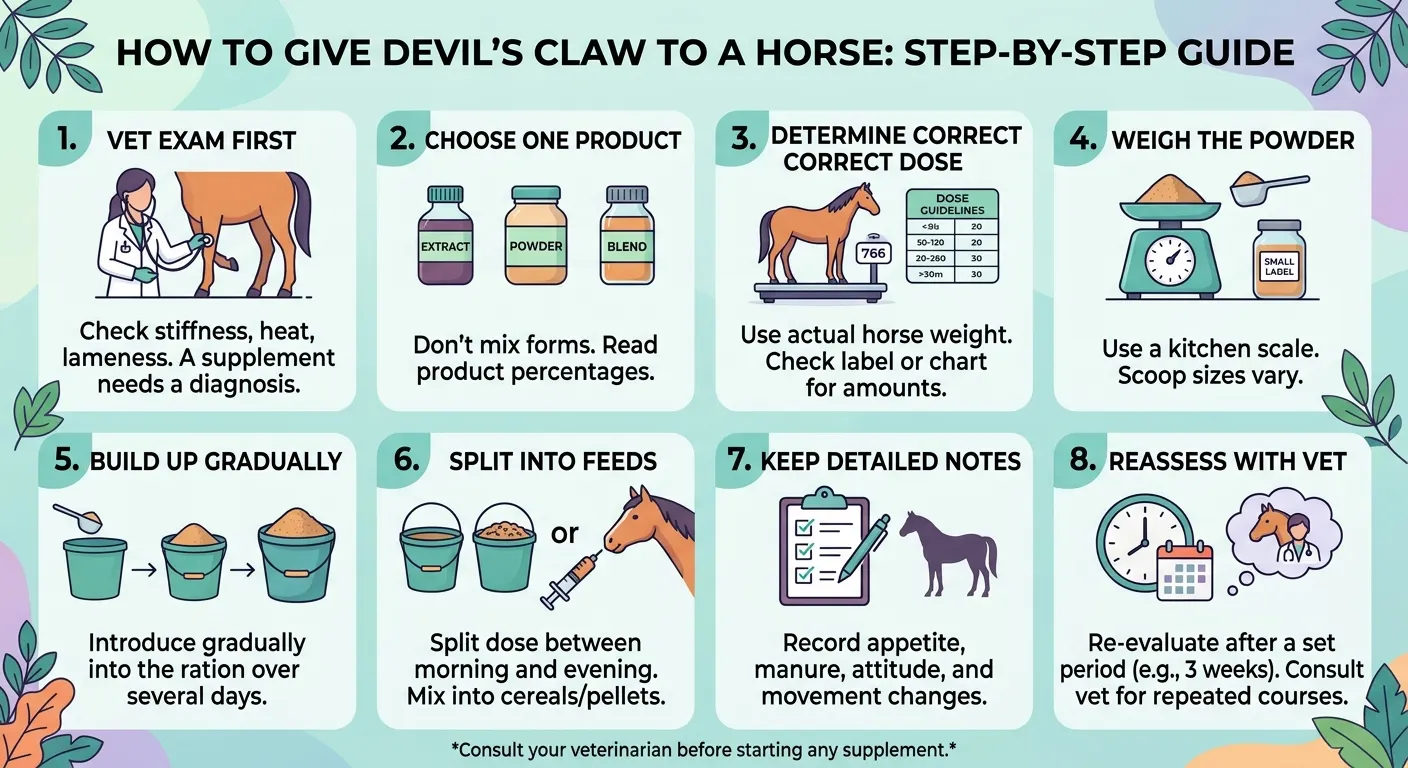
- Get the cause checked. Stiffness, heat in a joint or lameness deserves a vet exam first. A supplement can’t fix what hasn’t been diagnosed.
- Pick one product and read its percentage. Don’t mix plain powder, extract and a multi-herb joint blend.
- Use your horse’s real weight and find the matching amount on your label or in the chart above.
- Weigh the powder on a kitchen scale. Scoop sizes vary between brands and powders.
- Build up gradually. Reverdy advises introducing it gradually into the ration.
- Split into two feeds when possible and mix well into cereals or pelleted feed. EquusVitalis adds that a dosing syringe can place it directly in the mouth.
- Keep notes. Record appetite, manure, attitude and movement for the first few weeks.
- Reassess. Reverdy’s label describes a 3-week course that can be repeated if necessary, with veterinary advice.
How Long Does Devil’s Claw Take to Work in Horses?
The compound reaches the bloodstream quickly. In the Vienna study, plasma harpagoside peaked about one hour after dosing and was still detectable up to nine hours later. EquusVitalis notes it appears in the blood within about 30 minutes.
Devil’s claw timeline in the horse
- About 30 minutesHarpagoside can be detected in the blood (EquusVitalis).
- 1 hourPeak plasma level at both research doses (Axmann et al., 2019).
- 2.3 to 2.5 hoursHalf-life measured at the two doses, so the level halves in that time.
- Up to 9 hoursLast time harpagoside was detected after a single dose.
- 3 weeksCourse length on the Reverdy label; repeat if necessary with vet advice.
- 72 hours or moreStop time before competing suggested by Reverdy. Check your governing body’s rules.
Fast absorption doesn’t mean fast comfort, though. I couldn’t find a controlled horse trial showing how many days it takes for stiffness to ease. The practical way to judge is a vet lameness exam before you start and another after the course, rather than relying on how the horse “feels” to you.
How Long Can a Horse Stay on Devil’s Claw?
Reverdy suggests three weeks, repeated if needed. A 28-day study used it in horses with existing ulcers without worsening scores. Beyond that, long-term safety data in horses is limited, so ask your vet to review any use that runs for months.
Is Devil’s Claw Safe for Horses?
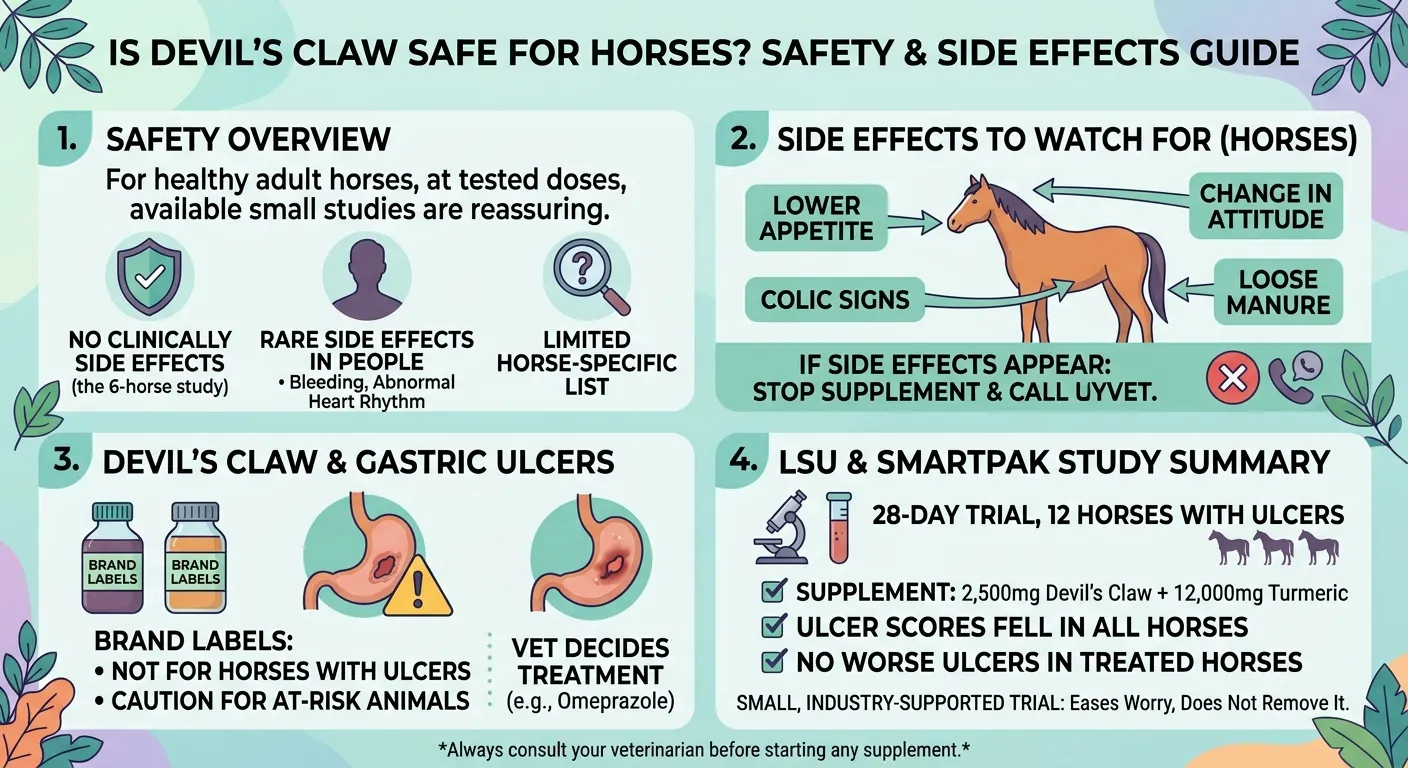
For healthy adult horses at the doses tested, the small studies available are reassuring. No clinically detectable side effects appeared in the six-horse pharmacokinetic study, and ulcer scores didn’t worsen in a 12-horse, 28-day trial. Both samples are small, and product labels still carry precautions.
Side Effects to Watch For
I found no published horse-specific list of side effects. In people, devil’s claw is generally well tolerated, though Versus Arthritis notes rare reports of bleeding and abnormal heart rhythm. In horses, watch for lower appetite, loose manure, colic signs or a change in attitude. If any appear, stop the supplement and call your vet.
Devil’s Claw and Gastric Ulcers
Labels from Reverdy and Equifox say not to feed devil’s claw to horses with stomach ulcers, and SmartPak cites a caution for animals at risk of GI ulceration.
To test whether that caution is warranted, Louisiana State University researchers, working with SmartPak, gave 12 horses with existing ulcers either a supplement or a placebo for 28 days.
The supplement contained 2,500 mg of devil’s claw extract plus 12,000 mg of turmeric. Ulcer scores fell in all horses, with no significant difference between groups, and no worsening in the treated horses.
It’s a small, industry-supported trial, so it eases the worry without removing it. If ulcers are suspected, your vet decides, including omeprazole dosage for horses if treatment is needed.
Who Should Not Get Devil’s Claw
Do not feed without your vet’s approval
- Pregnant or lactating mares. Reverdy, Equifox and SmartPak all advise against it.
- Horses allergic to devil’s claw. Reverdy lists hypersensitivity to the plant as a reason to avoid it.
- Horses with diagnosed or suspected gastric or duodenal ulcers.
- Foals. I found no foal dosing data, so there is nothing safe to publish.
- Horses entering competitions governed by FEI or national anti-doping rules.
Interactions With Other Medications
Formal interaction studies in horses are scarce. That’s reason enough to check before pairing devil’s claw with prescription pain relief. If your horse is already on an NSAID, ask your vet first. You can compare the typical vet-directed products in our guides to bute dosage for horses, Banamine dosage for horses and Equioxx dosage for horses.
Is Devil’s Claw Banned in Competition?
Harpagoside, the active compound in devil’s claw, was added to the FEI Equine Prohibited Substances List as a controlled medication on 1 January 2016. Controlled medications are substances with veterinary uses that are not permitted at FEI events.
National bodies such as the British Equestrian Federation adopted the FEI list in full, and testing can occur at competitions of any level.
The consequences can be serious. A prohibited substance in a sample can bring a minimum six-month period of ineligibility, disqualification, a fine and costs. Current labels from Reverdy and SmartPak still carry prohibited-substance warnings.
Withdrawal times on labels (Reverdy suggests at least 72 hours) are guides only, so confirm the exact rule with your governing body.
Devil’s Claw vs. Bute, Equioxx and Other Joint Options
Devil’s claw is often called a natural alternative to bute, but it isn’t a like-for-like swap. No horse study compares them, and the evidence behind bute and other NSAIDs is far deeper. Think of devil’s claw as a supportive supplement, not a replacement for a vet’s plan.
Devil’s claw compared with common alternatives
| Option | What it is | Vet involvement | Dose guide |
|---|---|---|---|
| Devil’s claw | Herbal supplement (harpagoside) | Recommended, not always required | This page |
| Bute (phenylbutazone) | NSAID | Vet-directed | Bute dosage for horses |
| Equioxx (firocoxib) | NSAID | Vet-directed | Equioxx dosage for horses |
| Banamine (flunixin) | NSAID, often used for colic pain | Vet-directed | Banamine dosage for horses |
| Adequan | Injectable joint therapy | Vet-directed | Adequan dosage for horses |
| CBD | Hemp-derived supplement | Recommended | CBD dosage for horses |
Owners exploring herbs often ask about others too. Our guide to comfrey dosage for horses explains why “natural” never means “risk-free.”
Pros and Cons of Devil’s Claw for Horses
Devil’s claw at a glance
Advantages
- Absorbed within an hour in horses
- No clinically detectable side effects in a six-horse study
- No worsening of ulcer scores in a small 28-day trial
- Easy to feed in cereals or pellets
- Widely available in several forms
Drawbacks
- No agreed horse dose and wide label differences
- No controlled horse trial on pain or lameness
- Product strength often unknown
- Not for mares in foal or lactation
- FEI controlled medication, risky for competition
Common Mistakes When Dosing Devil’s Claw
- Swapping powder for extract gram for gram. Strength can differ tenfold.
- Stacking products. Many herbal and joint blends already contain devil’s claw, so check every tub in the feed room.
- Dosing by scoop. A scoop of one brand weighs something different from another.
- Guessing weight. Use a tape or scale.
- Skipping the diagnosis. Masking pain from an undiagnosed injury can let it get worse.
- Forgetting competition rules. Stop dates are the owner’s responsibility.
- Storing it badly. Reverdy says to store it dry, at room temperature and away from light, and NPC Health notes the root readily absorbs moisture, so reseal the pack after every use.
Is Devil’s Claw Right for Your Horse? A Quick Decision Path
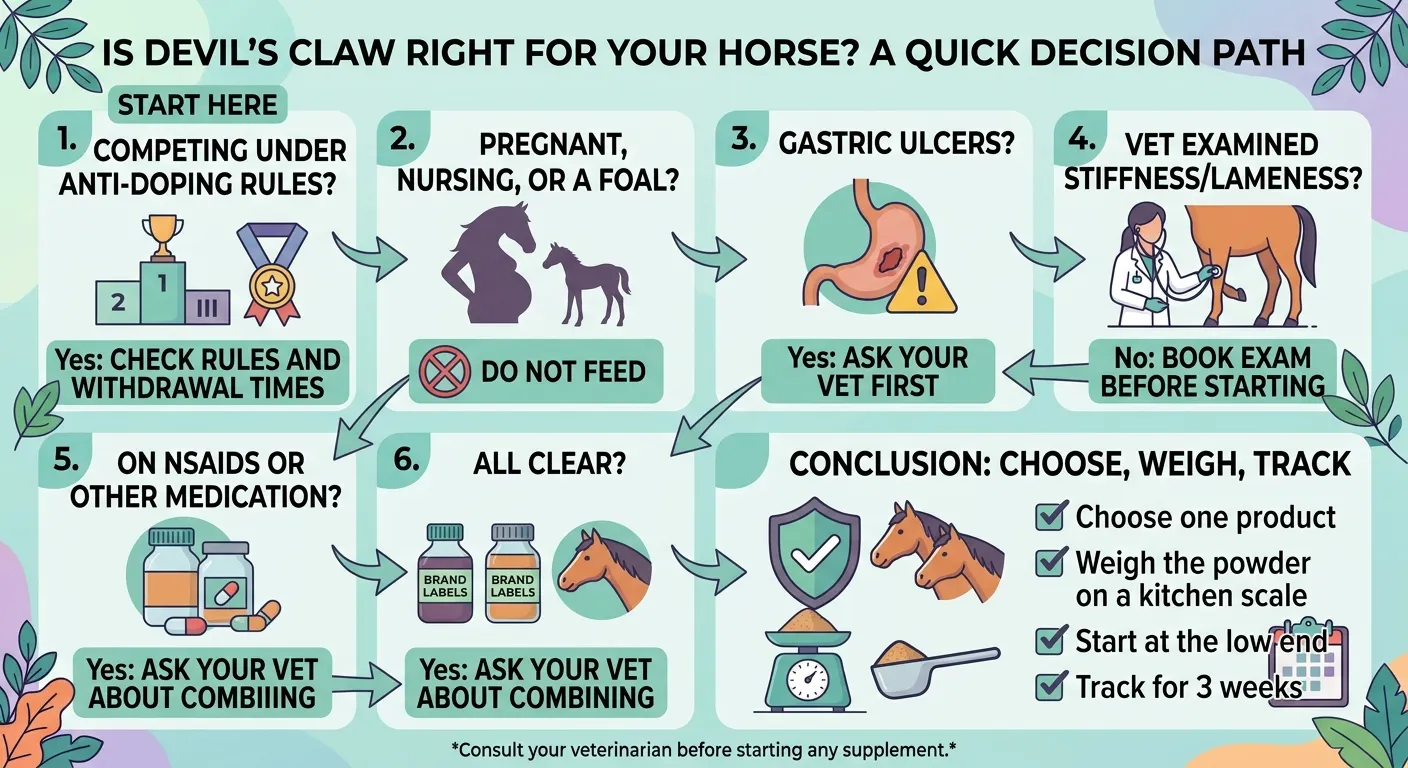
Work through these questions in order
- Is your horse competing under FEI or national anti-doping rules?Yes: check your governing body’s rules and withdrawal times before using any product. No: continue.
- Is she pregnant or nursing, or is the horse a foal?Yes: do not feed. No: continue.
- Does your horse have, or might she have, gastric ulcers?Yes: ask your vet first. No: continue.
- Has a vet examined the stiffness or lameness?No: book the exam before starting. Yes: continue.
- Is your horse on NSAIDs or other medication?Yes: ask your vet about combining. No: continue.
- All clear?Choose one product, weigh the powder, start at the low end and track your horse for 3 weeks.
When to Call Your Vet
Call right away if you see colic signs, a horse that stops eating, repeated loose manure, hives or swelling, or lameness that gets worse. Also call if there’s no change after the course you planned. Those signs mean the supplement isn’t the answer, and a proper exam is.
The Bottom Line on Devil’s Claw Dosage for Horses
The most widely quoted range for plain root powder is 1 to 4 g per 100 kg per day, split into two feeds, and standardized extracts need far less. Treat every figure as a label guide, not a medical dose. The evidence for safety in healthy horses is encouraging but small, and evidence for pain relief in horses is missing.
Your next steps: weigh your horse, check the harpagoside percentage on your label, run the calculator, start at the low end, and book a vet check before and after your first course.
FAQs
How much devil’s claw should I give my horse per day?
A common label range for plain dried root powder is 1 to 4 g per 100 kg of body weight per day, which works out to 5 to 20 g for a 500 kg (1,100 lb) horse. Standardized extracts are much stronger, so their daily amounts are far smaller. Always follow the manufacturer’s label and check with your vet.
What is the devil’s claw dosage for a 500 kg horse?
For a 500 kg (about 1,100 lb) horse, Reverdy lists 5 to 20 g of root powder daily. EquusVitalis describes a medium-sized horse getting 4 g twice daily, or 2 g twice daily for horses that respond to less. A 10% harpagoside extract is listed by NPC Health at 3 to 6 g a day.
How much devil’s claw should I give a pony?
Reverdy lists 3 to 12 g of root powder per day for a 300 kg pony, using the same 1 to 4 g per 100 kg ratio as for horses. Smaller ponies and miniatures have little published guidance, so ask your vet before feeding.
Can I split the daily dose of devil’s claw?
Yes. Reverdy suggests giving it twice daily if possible, mixed well into cereals or pelleted feed. In a horse study, the active compound harpagoside had a half-life of roughly 2.3 to 2.5 hours, so splitting the dose is a reasonable approach.
How long does devil’s claw take to work in horses?
Absorption is fast, with harpagoside peaking in horses’ blood about one hour after dosing in a 2019 study. However, no controlled horse trial I could find measures how long it takes for stiffness to improve. Judge your horse’s comfort over the 3-week course some labels suggest, and keep your vet involved.
How long can a horse stay on devil’s claw?
Reverdy recommends a 3-week course that can be repeated if necessary with veterinary advice. A 28-day study in horses with existing ulcers found no worsening of ulcer scores, but long-term safety data in horses is limited, so have your vet review any use beyond a few weeks.
Is devil’s claw safe for horses with ulcers?
Several labels say not to feed it to horses with gastric or duodenal ulcers. A small 28-day study of 12 horses with existing ulcers found no worsening when they received devil’s claw plus turmeric, but the trial was small and industry-supported. Ask your vet before using it if ulcers are diagnosed or suspected.
Can I give devil’s claw with bute or Equioxx?
Formal interaction studies in horses are scarce, so do not combine devil’s claw with prescription anti-inflammatories without your vet’s approval. Combining pain relievers can mask lameness and complicate safety monitoring, and your vet can set safe limits for your horse.
Is devil’s claw banned in horse competitions?
Harpagoside, the active compound in devil’s claw, has been on the FEI list of controlled medications since 1 January 2016, and national bodies such as the British Equestrian Federation adopted the FEI list. Reverdy suggests stopping at least 72 hours before competing, but check exact withdrawal times with your governing body.
Can pregnant or lactating mares have devil’s claw?
No. Reverdy, Equifox and SmartPak advise against feeding devil’s claw to pregnant mares, and Reverdy extends this to lactating mares because of insufficient data.
What are the side effects of devil’s claw in horses?
The six-horse pharmacokinetic study reported no clinically detectable side effects, and I found no published horse-specific side effect list. Watch for reduced appetite, loose manure or colic signs, stop the supplement and call your vet if any appear. In people, rare reports include bleeding and abnormal heart rhythm.
Is devil’s claw as good as bute?
There is no horse trial comparing the two. Devil’s claw is a herbal supplement with limited and mixed evidence, while bute is an NSAID with established veterinary use. If your horse is lame or in significant pain, get a diagnosis before choosing either.
Should I choose root powder or a standardized extract?
Plain root powder typically contains about 1% harpagoside and is fed in larger amounts. A standardized extract such as a 10% harpagoside product delivers the same compound in a tenth of the weight. Pick one product, read its label carefully, and never stack products without adding up the total.
How do I convert devil’s claw grams to scoops or teaspoons?
Use a kitchen scale whenever possible, because scoop volumes vary by product and powder density. Reverdy equates 5 to 20 g with roughly 10 to 40 ml, which is about 2 ml per gram, but that ratio applies to its own product only.
Sources and Further Reading
- Axmann S, et al. Pharmacokinetics of harpagoside in horses after intragastric administration of a Devil’s claw extract. Journal of Veterinary Pharmacology and Therapeutics, 2019.
- Devil’s Claw (Harpagophytum procumbens) as a Treatment for Osteoarthritis: A Review of Efficacy and Safety. Journal of Alternative and Complementary Medicine, 2006.
- The Horse: report on the LSU turmeric and devil’s claw gastric ulcer study.
- British Showjumping: Revised Equine Prohibited Substances List, key changes (devil’s claw added as a controlled medication).
- Horse & Hound: Devil’s claw moved to FEI controlled substances list.
- Versus Arthritis: Devil’s claw information.
- Brand product information: Reverdy, NPC Health, EquusVitalis, SmartPak and Equifox.
This article is for general information and isn’t a substitute for veterinary advice. Devil’s claw isn’t an approved veterinary drug, label directions vary by product, and your vet knows your horse’s history. Always check with your vet before starting a new supplement.