Hops Dosage for Horses: Complete Dosage Chart, Calculator & Safety Guide for Calming and Gut Support
Written & Reviewed By: Medshorse Team
Last Updated: October 2026
Hops dosage for horses usually falls between 5 and 15 grams of dried hop flowers per day for an average 500 kg (1,100 lb) horse, based on published supplier guidance. Some pellet products use 20 g a day for three weeks, and one herbal reference lists 25 to 50 g. Equine research is thin, so start low, weigh every feed, and involve your vet.
If you have ever stood at a trailer ramp with a horse that will not stand still, you have probably looked at the herbal shelf. Hops sit there next to valerian and chamomile, and the labels rarely agree on how much to give.
This guide puts the published doses from six equine sources side by side, explains why they differ, and gives you a weight-based chart and calculator as a cautious starting point. It also covers what the research really shows, who should skip hops, and why dogs must never get near them.
Disclaimer: This article is for general education and is not veterinary advice. Product names mentioned, including Equiblon, belong to their respective owners, and MedsHorse is not affiliated with them. Always follow your veterinarian’s instructions and the current product label.
- Typical range: 5–15 g of dried hops per day for a 500 kg (1,100 lb) horse.
- Higher published doses exist (20 g to 50 g), but they come from specific pellet products or herbal references. Follow the label or your vet.
- Best-supported use: traditional calming support. Equine-specific trials are limited.
- Laminitis research is laboratory-only. Hops are not a proven treatment.
- Never let dogs near hops. They can cause fatal malignant hyperthermia in dogs.
- Competing? Check the current FEI or federation rules for the exact product you feed.
How Much Hops Should You Give a Horse?
Published guidance runs from 5 to 15 g of dried hop flowers a day, up to 20 g a day for three weeks for an adult horse fed pellets, and 25 to 50 g in one herbal reference. For most owners the lower range is the sensible place to start. Anything higher should come from a product label or your vet.
| Source | Form | Published amount | Notes |
|---|---|---|---|
| Annimally | Dried hop flowers | 5–15 g/day | “Rough guide”; ask a vet if unsure or if health problems exist |
| Honeyvale Herbs | Dried herb | 15 g/day | Positioned for easily distracted horses |
| Hopstore (Equiblon) | Organic pellets | Horse 20 g/day, pony 10 g/day for 3 weeks | Maker says up to 50 g/day in a “severe crisis” |
| Ewalia | Decoction, infusion, extract | 25–50 g/day for horses | Best combined with other calming herbs |
| Whole Horse Herbs | Hops powder | 1 tablespoon (1,000 lb horse) | Described as a maintenance dose |
| Mad Barn | Feed database entry | No dose given | Notes that equine-specific research is limited |
Why the gap? The sources use different forms (flowers, pellets, extracts), different goals (everyday calming versus a three-week “treatment”), and there is no standardized, research-backed equine dose. That is why the chart below stays at the conservative end.
What Are Hops, and Why Feed Them to Horses?
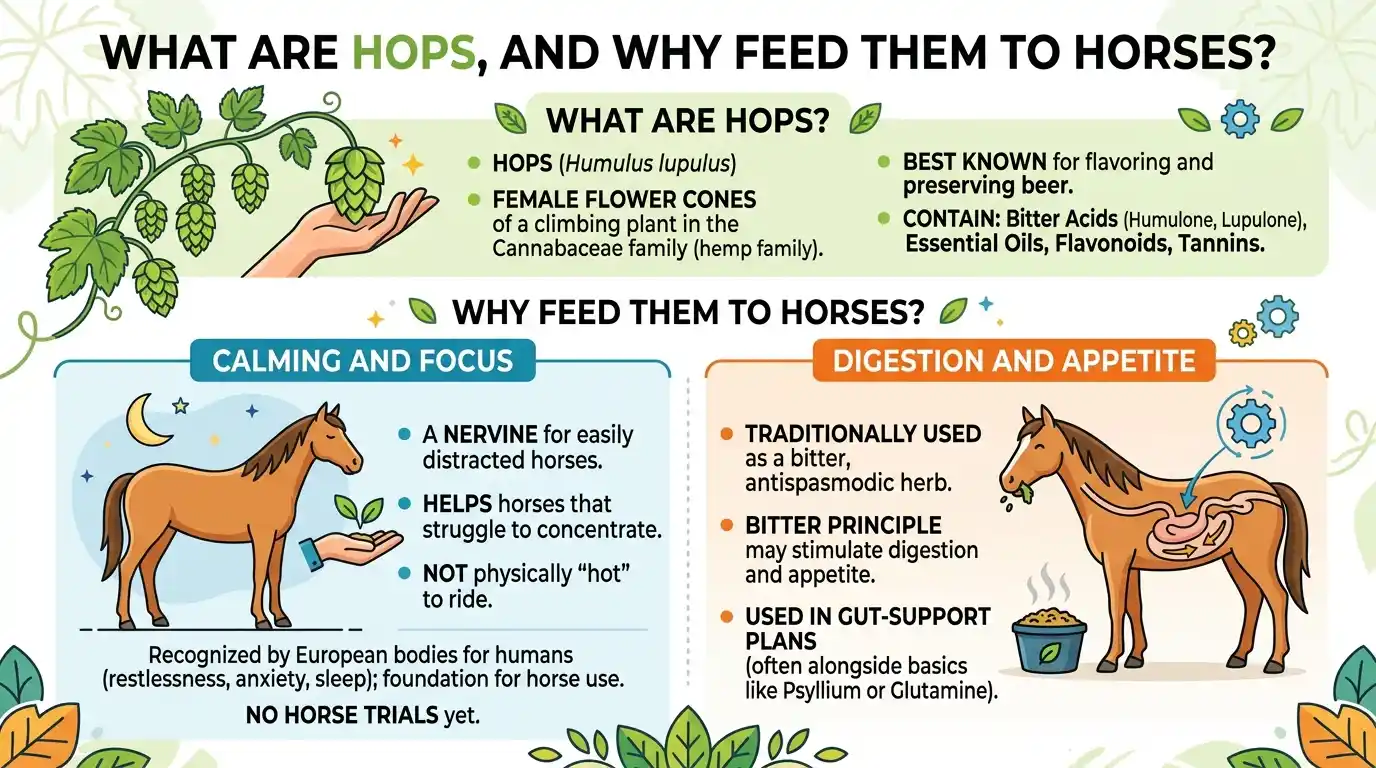
Hops (Humulus lupulus) are the female flower cones of a climbing plant in the hemp family, Cannabaceae. They are best known for flavoring and preserving beer. The cones contain bitter acids (humulone and lupulone), essential oils, flavonoids and tannins.
Calming and Focus
This is the main reason horse owners reach for hops. Honeyvale Herbs describes hops as a nervine for horses that are easily distracted and struggle to concentrate, even if they are not physically “hot” to ride.
European herbal bodies, including the HMPC, ESCOP and Germany’s Commission E, recognize hops for restlessness, anxiety and sleep problems in people. That recognition is the foundation for horse use. It is not the result of a horse trial.
Digestion and Appetite
Hops are traditionally used as a bitter, antispasmodic herb. Hopstore notes the bitter principle may help stimulate digestion and appetite, which is why some owners add hops to a gut-support plan alongside basics like psyllium husk dosage for horses or glutamine dosage for horses.
Hops Dosage Chart for Horses by Body Weight
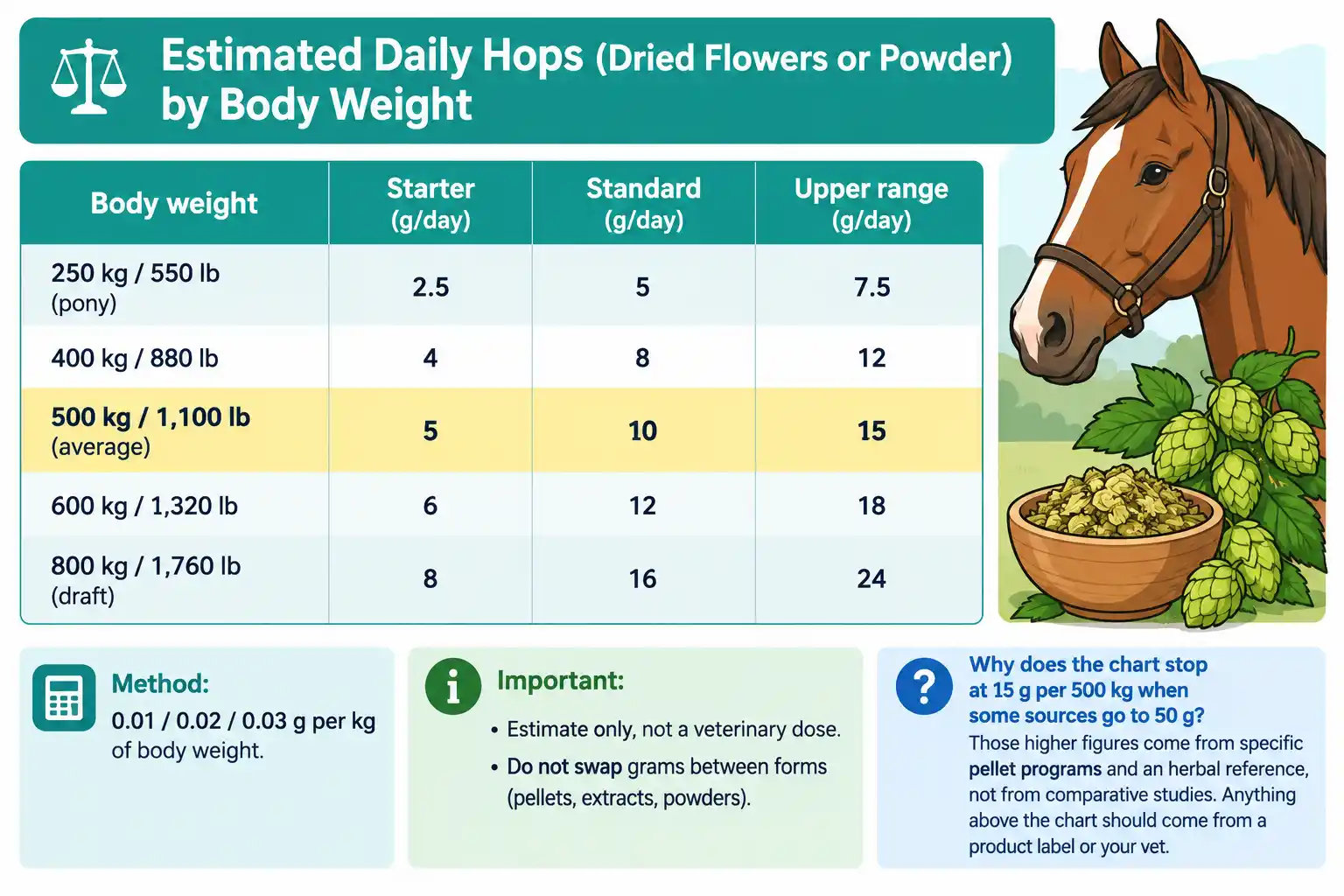
No source publishes a weight-based hops table, so this chart is an estimate. It scales the commonly cited 5–15 g range, which suits a typical 500 kg horse, proportionally to body weight. Treat it as a cautious starting guide, not a prescription.
| Body weight | Starter (g/day) | Standard (g/day) | Upper range (g/day) |
|---|---|---|---|
| 250 kg / 550 lb (pony) | 2.5 | 5 | 7.5 |
| 400 kg / 880 lb | 4 | 8 | 12 |
| 500 kg / 1,100 lb (average) | 5 | 10 | 15 |
| 600 kg / 1,320 lb | 6 | 12 | 18 |
| 800 kg / 1,760 lb (draft) | 8 | 16 | 24 |
Why does the chart stop at 15 g per 500 kg when some sources go to 50 g? Those higher figures come from specific pellet programs and an herbal reference, not from comparative studies. Anything above the chart should come from a product label or your vet.
Ponies and Miniatures
Hopstore halves its horse dose for ponies (10 g versus 20 g a day). For miniature horses, none of the sources give a figure, so ask your vet instead of scaling down by guesswork.
Pregnant Mares, Nursing Mares and Foals
None of the sources we reviewed offer safety data for these groups. Reference texts also describe oestrogenic activity in hops bitter substances. Get veterinary approval before feeding breeding stock or young horses.
Hops Dosage Calculator for Horses
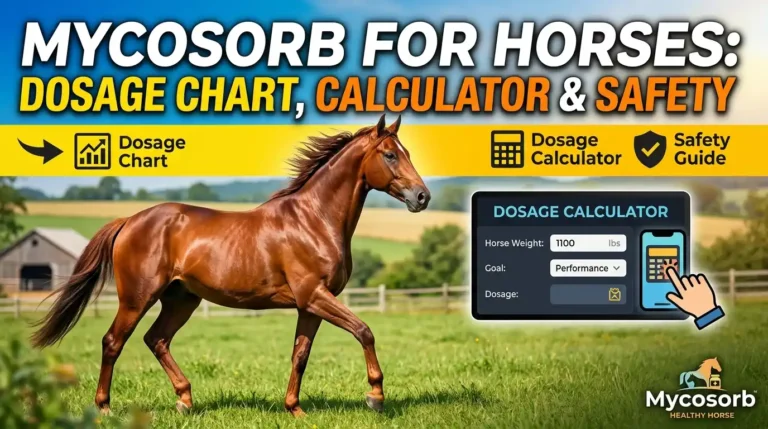
Enter your horse’s weight to see the same estimated ranges as the chart, plus a 21-day supply at the standard dose so you know how much to buy.
© medshorse.com
Hops Dosage by Goal
For Calming and Focus
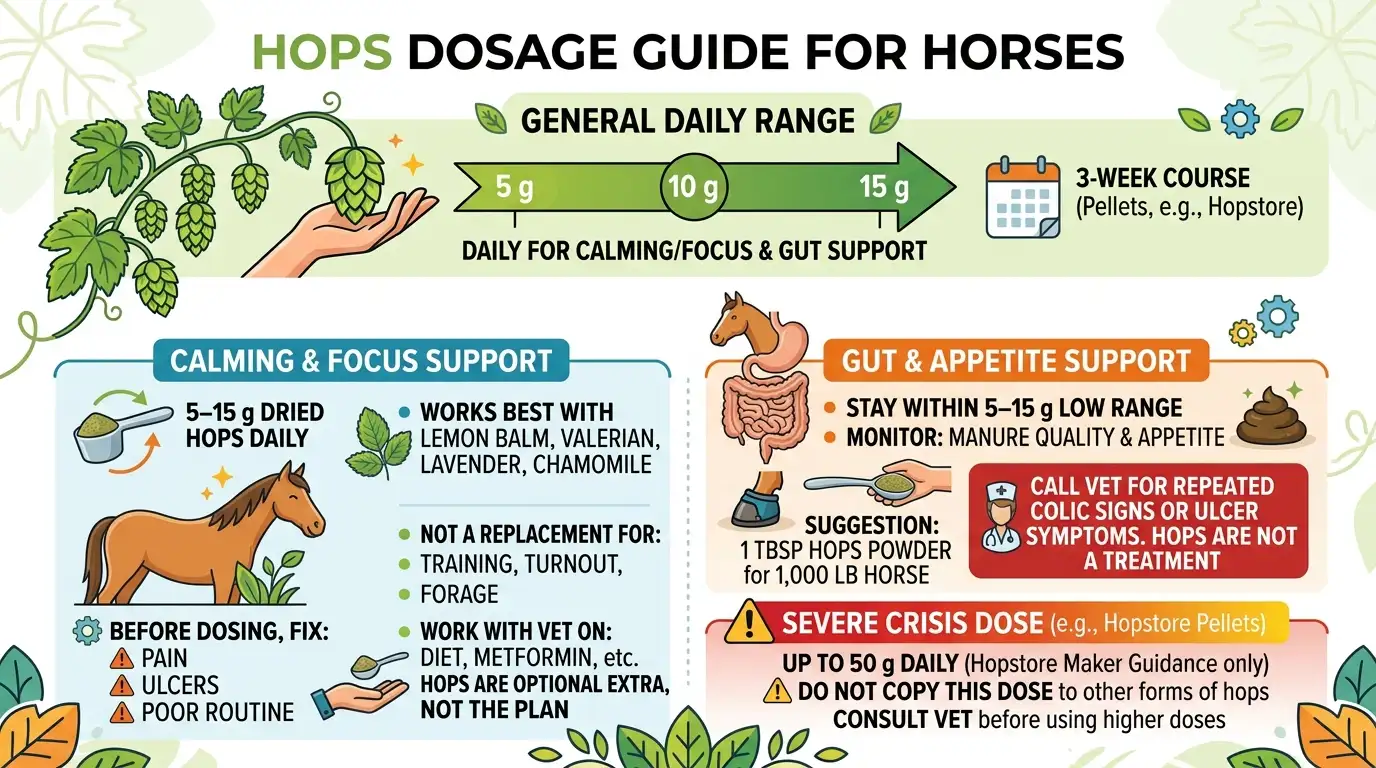
Supplier guidance sits at 5–15 g of dried hops daily. Hopstore frames its pellet plan as a three-week course. Ewalia notes hops work best alongside other calming plants such as lemon balm, valerian, lavender or chamomile.
Hops do not replace training, turnout and forage. If your horse is anxious because of pain, ulcers or a poor routine, fix that first.
For Gut and Appetite Support
No separate gut dose is published. Owners generally stay within the same low range and watch manure quality and appetite. If your horse shows repeated colic signs or ulcer symptoms, call your vet. Hops are not a treatment for either.
For Laminitis-Prone and Insulin-Resistant Horses
Whole Horse Herbs suggests one tablespoon of hops powder as a maintenance amount for a 1,000 lb horse. That suggestion rests on early lab research, covered below. If your horse has insulin dysregulation, work with your vet on diet and any medication such as metformin dosage for horses. Hops are an optional extra, not the plan.
Is a Higher “Crisis” Dose Ever Appropriate?
Hopstore says its pellets can go up to 50 g a day in a severe crisis. That is the maker’s guidance for its own product and more than three times the chart’s upper figure for an average horse. Do not copy it onto a different form of hops without veterinary advice.
Forms of Hops: Dried Flowers vs Pellets vs Powder vs Extract
Potency varies by form, harvest and storage, so grams are not interchangeable between products.
| Form | How it is used | Watch out for |
|---|---|---|
| Dried flowers / cones | Mixed into feed for calming and digestive support | Weigh by gram, not by scoop |
| Powder | Added to feed (one tablespoon referenced by Whole Horse Herbs) | Tablespoon weight varies with grind |
| Pellets | Ground into the ration or infused | Pungent and oily; many horses refuse them raw |
| Extract / liquid | Concentrated form for stressful periods | Follow the label; potency differs by brand |
| Herbal blends | Hops with valerian, chamomile, fennel or magnesium | You may be stacking several calming ingredients |
Getting a Picky Horse to Eat Hops
Hopstore warns that hop pellets smell strongly and horses often turn them down raw. Its suggestions:
- Grind and mix: keep ground pellets under 5% of the total ration weight.
- Cold infusion: soak 50 g in 1 L of cold water for 24 hours, filter it, then dilute with 4 L of water to make 5 L of drink.
- Stall method: scattering pellets in bedding relies on inhaled aroma and needs several kilos, so it is not a gram-dose method.
How to Feed Hops to Your Horse: A Step-by-Step Plan
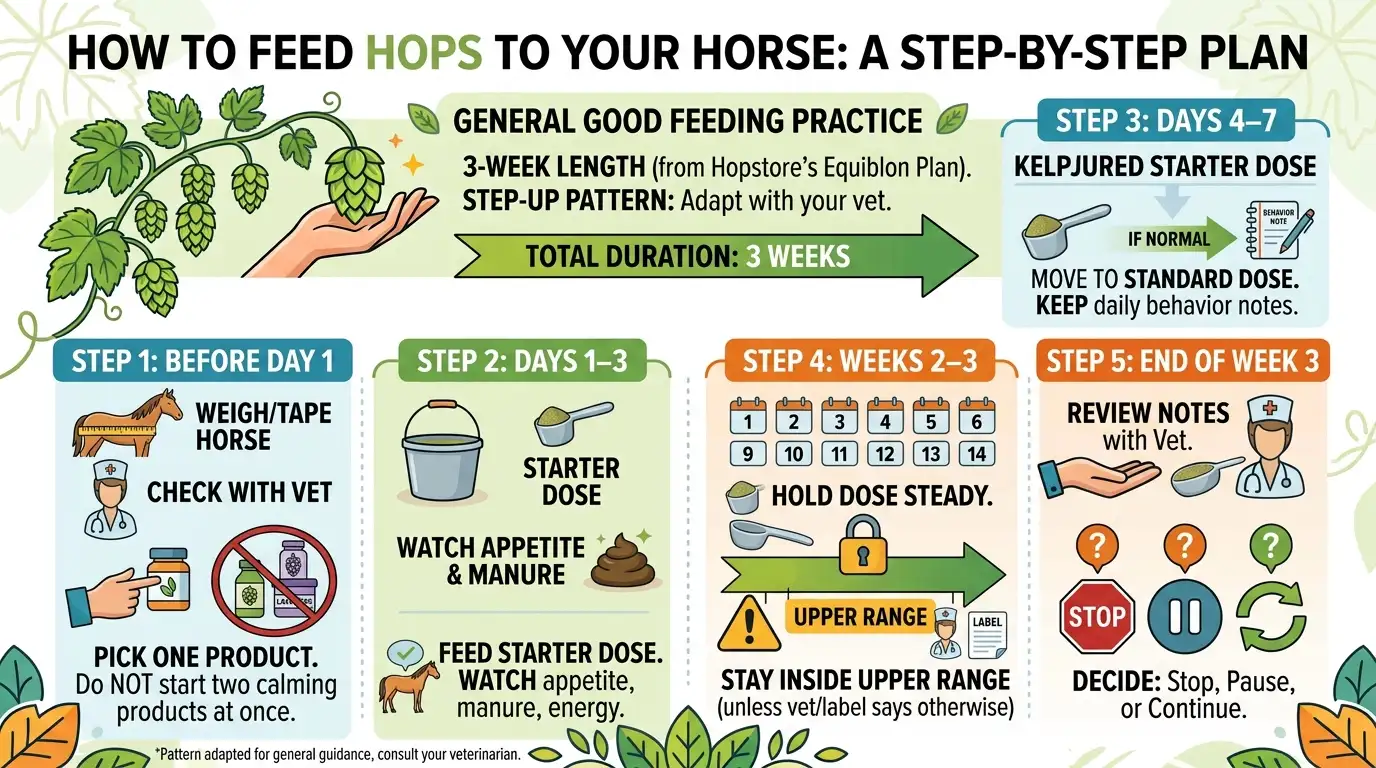
The three-week length comes from Hopstore’s Equiblon plan. The step-up pattern is general good feeding practice rather than a label instruction, so adapt it with your vet.
Weigh or tape your horse, check with your vet, and pick one product. Do not start two calming products at once.
Feed the Starter dose from the chart. Watch appetite, manure and energy.
If all looks normal, move to the Standard dose. Keep a short daily behavior note.
Hold the dose steady. Stay inside the Upper range unless your vet or the label says otherwise.
Review your notes with your vet. Decide whether to stop, pause or continue.
What Does the Research Actually Say About Hops for Horses?
The honest answer is that equine research is limited. Mad Barn’s ingredient database says hops are occasionally used as a botanical additive for digestive or calming support, but equine-specific research is scarce.
The best-known study is from the University of Kentucky and the USDA, published in the Journal of Applied Microbiology in 2014. Researchers found that hops beta acids slowed fructan-fermenting bacteria collected from horse feces, including Streptococcus bovis, a species linked to hindgut acidosis and pasture-associated laminitis.
The catch: it was a laboratory study. The researchers cautioned that the safety and effectiveness of giving hops to horses had not been tested, and they did not recommend feeding hops for this purpose until more work was done.
| Claim | What exists | Evidence level |
|---|---|---|
| Calms nervous horses | Traditional herbal use; recognized for restlessness and anxiety in people. No controlled equine trial found. | Traditional / limited |
| Supports digestion and appetite | Traditional use of the bitter principle; no equine trial found. | Traditional / limited |
| Helps prevent pasture laminitis | 2014 laboratory study on fecal bacteria; authors say horse safety and efficacy untested. | Early lab stage |
| Strengthens the immune system | Antibacterial properties of bitter acids are cited by suppliers. No equine immune data found. | Unproven |
Hops Safety for Horses: Side Effects and Who Should Skip Them
Some suppliers describe hops as well tolerated. However, none of the sources we reviewed cite long-term equine safety studies. “Natural” is not the same as “safe at any dose,” and published amounts differ by roughly ten times.
- Breeding stock and young horses: no safety data, plus described oestrogenic activity. Ask your vet first.
- Horses on sedatives or other calming products: hops are mildly calming, and no interaction studies were found. Tell your vet if your horse also gets drugs such as acepromazine dosage for horses or trazodone for horses dosage chart protocols.
- People handling fresh hops: Ewalia notes contact with fresh flowers can cause “hop pickers’ disease” (tiredness, headache, skin irritation).
- Competition horses: check the current rules (see below).
Hops can trigger malignant hyperthermia in dogs, with dangerously high body temperature. In a retrospective study of 177 dogs reported to Pet Poison Helpline, 74% showed clinical signs and 95.2% survived, but severe hyperthermia can be fatal. The Merck Veterinary Manual notes hops poisoning has been reported only in dogs.
Store horse hops sealed and out of reach. If a dog eats any, call a vet or animal poison hotline immediately.
- Unusual sleepiness or lethargy
- Loss of appetite or refusing feed
- Signs of colic (pawing, rolling, looking at the flank)
- Hives, itching or other skin reactions
Are Hops Allowed in Competition?
Hopstore reports that hops are listed as an authorized substance with no specific procedure on the French anti-doping agency (AFLD) database, and that they were not on the FEI’s prohibited list when it wrote its page. Rules change, and blends often add other herbs.
Check the FEI Prohibited Substances Database and your own federation’s rules for the exact product you feed.
Hops vs Other Calming Options
| Option | Type | Vet involvement | Good to know |
|---|---|---|---|
| Hops | Herbal nervine | Advised for breeding stock, medicated horses and doses above label | Equine research limited; competition rules apply |
| Magnesium | Mineral | Check the whole ration | Often paired with herbs in calming blends |
| CBD | Hemp-derived | Advised | Check competition rules and product testing |
| Trazodone | Prescription drug | Required | Dosed by your vet |
| Acepromazine | Prescription sedative | Required | True sedation, unlike herbal support |
For comparison, see our guides on magnesium dosage for horses and CBD dosage for horses. Hops are a mild herbal option. If your horse needs dependable sedation for a vet or farrier visit, ask about prescription options instead.
Common Mistakes When Feeding Hops
- Measuring by scoop: weigh hops on a kitchen scale, because tablespoons and scoops vary.
- Copying a pellet dose onto flowers (or the reverse): forms differ in potency.
- Starting several calming products at once: you will not know what helped or what caused a problem.
- Ignoring the cause of anxiety: pain, ulcers and poor routine need fixing first. See omeprazole dosage for horses if ulcers are suspected.
- Leaving hops where dogs can reach them.
FAQs
How much hops should I give my horse per day?
Published guidance for an average 500 kg horse starts at 5 to 15 grams of dried hops per day. One pellet maker uses 20 grams per day for three weeks for adult horses, and one herbal reference lists 25 to 50 grams. Start at the low end and confirm any higher dose with your vet.
Are hops safe for horses?
Hops are traditionally used in horse feeding and suppliers describe them as well tolerated, but long-term equine safety studies are lacking. Stay within published ranges, introduce them slowly, and check with your vet if your horse is pregnant, nursing, ill, or on medication.
Can hops calm a nervous horse?
Hops are a traditional nervine herb used for restless or easily distracted horses, and European herbal bodies recognize them for restlessness and anxiety in people. Controlled equine trials are limited, so expect mild support rather than sedation.
How long does it take for hops to work in horses?
No equine study defines an onset time. Hopstore runs its program for three weeks, so judge results over that window and keep short daily notes on your horse behavior.
What is the best form of hops for horses?
Dried flowers, powder, pellets, extracts and herbal blends are all used. Pellets are pungent and many horses refuse them raw, so grinding them into the ration or making a cold infusion can help. Do not swap grams between forms because potency differs.
Can hops help prevent laminitis in horses?
Early laboratory research from the University of Kentucky found that hops beta acids slowed fructan-fermenting bacteria, but the authors said safety and efficacy in horses had not been tested. Hops are not a proven laminitis treatment or a substitute for diet management.
Are hops toxic to horses?
No poisoning reports in horses appeared in the sources reviewed, and the Merck Veterinary Manual notes that hops poisoning has been reported only in dogs. That is not proof of safety at any dose, so stay within published ranges.
Are hops toxic to dogs?
Yes. Hops can cause malignant hyperthermia in dogs, a dangerous rise in body temperature. In a study of 177 dogs, 74 percent showed signs and 95.2 percent survived, but severe cases can be fatal. Keep hops sealed and call a vet or poison hotline immediately if a dog eats any.
Are hops allowed in horse competition?
Hopstore reports that hops are authorized by the French anti-doping agency and were not on the FEI prohibited list when it wrote its page. Rules change and blends may include other herbs, so check the current FEI database or your own federation before competing.
Can I mix hops with valerian or magnesium?
Suppliers often pair hops with valerian, lemon balm, lavender or chamomile, and some products also add magnesium. Combining calming ingredients stacks their effects and no interaction studies were found, so ask your vet before layering products.
Can pregnant or nursing mares have hops?
None of the sources reviewed provide safety data for pregnant or nursing mares or foals. Reference texts also describe oestrogenic activity in hops, so get veterinary approval before feeding breeding stock.
How do I get a picky horse to eat hops?
Grind pellets and mix them into feed at under 5 percent of the ration, or soak 50 grams in one litre of cold water for 24 hours, filter it, and dilute it. Scattering pellets in bedding only works with several kilos and is not a gram-dose method.
How many grams of hops is one tablespoon?
It varies with the grind and moisture, so weigh hops on a kitchen scale instead of guessing. Whole Horse Herbs lists one tablespoon of powder as a maintenance amount for a 1,000 pound horse.
Can hops replace a sedative before a vet or farrier visit?
No. Hops are a mild herbal support, not a sedative. If your horse needs reliable sedation, talk to your vet about prescription options.
What are the signs my horse is reacting badly to hops?
Stop feeding and call your vet if you see unusual sleepiness, loss of appetite, colic signs, or skin reactions. These are general warning signs, since no equine side-effect data has been published for hops.
Conclusion: A Realistic Way to Use Hops
Hops are a traditional, mild herbal option for nervous or easily distracted horses. The most defensible hops dosage for horses is the lower published range: about 5–15 g of dried hops a day for a 500 kg horse. Stay within a product’s label, weigh every feed, and give any new product a few weeks of careful observation.
Next steps: weigh your horse, run the calculator, talk to your vet if your horse is breeding, young, ill or medicated, and check competition rules before you feed. This article is educational and is not a substitute for veterinary advice.
Sources and Further Reading
- Harlow et al. (2014), Inhibition of fructan-fermenting equine faecal bacteria and Streptococcus bovis by hops beta acid, Journal of Applied Microbiology
- University of Kentucky Ag Equine Programs, Study: Hops Can Help Reduce Fructan Fermentation
- Merck Veterinary Manual, Toxicoses in Animals From Human Dietary and Herbal Supplements
- University of Minnesota, A retrospective evaluation of hops ingestion in 177 dogs (2005–2018)
- FEI Prohibited Substances Database
- Mad Barn Equine Feed Database: Hops
- Supplier and herbal references: Annimally, Hopstore, Honeyvale Herbs, Whole Horse Herbs, Ewalia