Written & Reviewed By: Medshorse Team
Last Updated: Sep 2026
Methocarbamol for Horses: Dosage Chart, Calculator, Guidelines & More
Your horse is stiff through the back, reluctant to move off, and the vet says the word “methocarbamol.” Or you found a vial in the barn fridge and want to know what it actually does. Either way, the number that matters most is on the label, and many online guides get it wrong.
Methocarbamol (brand name Robaxin-V) is an FDA-approved, vet-prescribed muscle relaxant for horses. The injectable label dose is 2 to 10 mg per pound IV for moderate conditions and 10 to 25 mg per pound IV for severe conditions such as tetanus, given to effect.
This guide gives you the chart, a calculator, the pharmacology, the side effects, and the competition rules, all traced to the label and published equine studies.
Key Takeaways
Methocarbamol Dosage Calculator for Horses
Injectable label dose (Robaxin-V) with 500 mg & 750 mg tablet equivalents
What Is Methocarbamol for Horses?
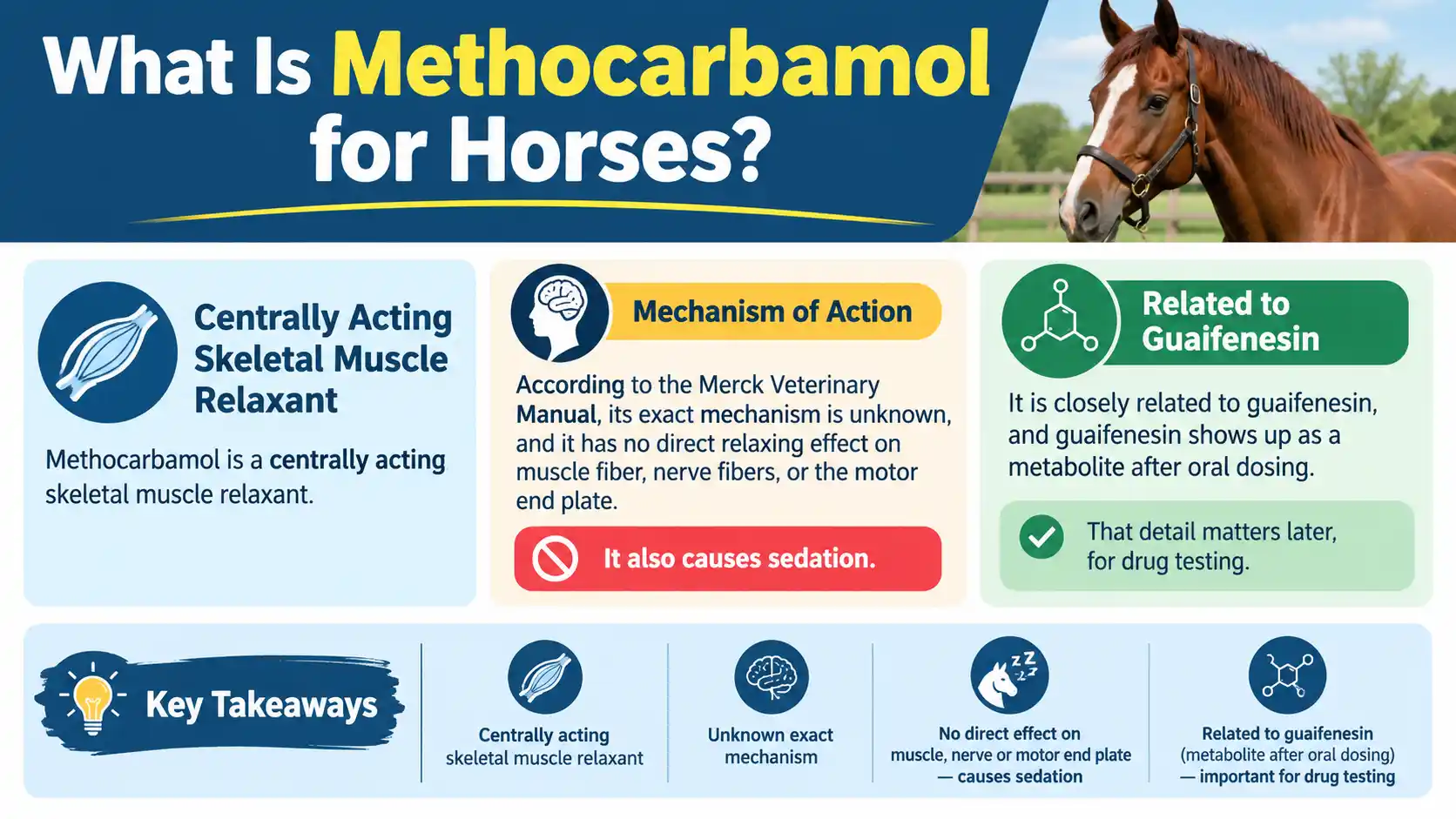
Methocarbamol is a centrally acting skeletal muscle relaxant used in horses to help manage muscle spasms and related conditions. Its exact mechanism of action is not fully understood, but it works through the central nervous system rather than directly relaxing muscle fibers.
According to the Merck Veterinary Manual, its exact mechanism is unknown, and it has no direct relaxing effect on muscle fiber, nerve fibers, or the motor end plate. It also causes sedation.
It is closely related to guaifenesin, and guaifenesin shows up as a metabolite after oral dosing. That detail matters later, for drug testing.
What Is Methocarbamol Used For in Horses?
The Robaxin-V label lists these horse indications for the injectable: trauma with muscular and ligamentous sprains and strains, myositis, fibrositis, bursitis and synovitis, tying-up syndrome, muscle spasm before or after surgery, and maintenance of muscle relaxation in tetanus.
Practical translation: a sore, spasming back after a fall, an acute tie-up episode, a strained muscle group. PetMD notes that injectable methocarbamol is commonly used for spasms, strains, and exertional rhabdomyolysis, and that oral use for tying-up is extra-label.
Methocarbamol vs. Robaxin vs. Robaxin-V
| Name | What it is | Horse relevance |
|---|---|---|
| Methocarbamol | The generic drug name | Active ingredient in all forms |
| Robaxin | Human brand | Not labeled for horses |
| Robaxin-V | Veterinary brand (injectable 100 mg/mL; 500 mg tablets) | Injectable is FDA-approved for horses |
| Compounded forms | Powders, pastes, suspensions, capsules | Not FDA-approved; require a prescription |
Methocarbamol 100mg/mL Injectable Dosage for Horses
Methocarbamol dosage should always be determined under the supervision of a veterinarian. The medication is not appropriate at the same dose for all horses or equines. The appropriate dosage may vary depending on the animal’s health condition, weight, medical history, and other individual factors.
The label dose of Methocarbomol injection for adult horses is 2 to 10 mg/lb IV for moderate conditions and 10 to 25 mg/lb IV for severe conditions (tetanus), given “to effect.” The injectable is 100 mg/mL, so 1 mL delivers 100 mg.
Injectable Methocarbamol (100 mg/mL) Dose Chart for Horses
Straight arithmetic from the Robaxin-V label ranges. For discussion with your vet, not a prescription.
| Horse weight | Moderate: 2 to 10 mg/lb | Severe: 10 to 25 mg/lb |
|---|---|---|
| 800 lb (363 kg) | 1,600 to 8,000 mg (16 to 80 mL) | 8,000 to 20,000 mg (80 to 200 mL) |
| 900 lb (408 kg) | 1,800 to 9,000 mg (18 to 90 mL) | 9,000 to 22,500 mg (90 to 225 mL) |
| 1,000 lb (454 kg) | 2,000 to 10,000 mg (20 to 100 mL) | 10,000 to 25,000 mg (100 to 250 mL) |
| 1,100 lb (499 kg) | 2,200 to 11,000 mg (22 to 110 mL) | 11,000 to 27,500 mg (110 to 275 mL) |
| 1,200 lb (544 kg) | 2,400 to 12,000 mg (24 to 120 mL) | 12,000 to 30,000 mg (120 to 300 mL) |
Methocarbamol 500mg & 750 mg Dosage Chart for Horses
| Horse Weight | Moderate 2–10 mg/lb | 500 mg Tablets | 750 mg Tablets | Severe/Tetanus 10–25 mg/lb | 500 mg Tablets | 750 mg Tablets |
|---|---|---|---|---|---|---|
| 200 lb (91 kg) | 400–2,000 mg | 4⁄5–4 | 8⁄15–2⅔ | 2,000–5,000 mg | 4–10 | 2⅔–6⅔ |
| 400 lb (181 kg) | 800–4,000 mg | 1⅗–8 | 1 1⁄15–5⅓ | 4,000–10,000 mg | 8–20 | 5⅓–13⅓ |
| 600 lb (272 kg) | 1,200–6,000 mg | 2⅖–12 | 1⅗–8 | 6,000–15,000 mg | 12–30 | 8–20 |
| 800 lb (363 kg) | 1,600–8,000 mg | 3⅕–16 | 2 2⁄15–10⅔ | 8,000–20,000 mg | 16–40 | 10⅔–26⅔ |
| 1,000 lb (454 kg) | 2,000–10,000 mg | 4–20 | 2⅔–13⅓ | 10,000–25,000 mg | 20–50 | 13⅓–33⅓ |
| 1,200 lb (544 kg) | 2,400–12,000 mg | 4⅘–24 | 3⅕–16 | 12,000–30,000 mg | 24–60 | 16–40 |
| 1,400 lb (635 kg) | 2,800–14,000 mg | 5⅗–28 | 3 11⁄15–18⅔ | 14,000–35,000 mg | 28–70 | 18⅔–46⅔ |
Oral Methocarbamol Dosage for Horses
There is no labeled oral dose for horses. Oral use is extra-label, meaning a vet prescribes it outside the approved label. Published data give useful context, though.
In a University of Florida study, six Thoroughbreds received 5 g by stomach tube (ten crushed 500 mg tablets) at 0, 12, 24, 36, and 48 hours. The authors note that the U.S. Equestrian Federation guidance, as cited in that 2014 paper, advised a maximum oral dose of 5 g every 12 hours. Treat that as a regulatory reference point, not a treatment recommendation. Your vet sets the oral dose and duration.
Oral doses need to be larger than IV doses because absorption is incomplete, as the same paper explains.
How to Convert Between mg, mL, and Tablets
How Methocarbamol Works in the Horse’s Body
Studies in horses describe a fast-in, fast-out drug. Here is what the published numbers show.
| Measure | Finding | Source |
|---|---|---|
| Terminal half-life after 15 mg/kg IV | Median 2.96 h (range 2.46 to 4.71 h) | Rumpler 2014 |
| Terminal half-life after 30 mg/kg IV | 59 to 90 minutes | Muir 1992 |
| Time to peak after oral dose | 15 to 45 minutes | Muir 1992 |
| Oral bioavailability | Median 54.4% (range 43.2 to 72.8%) | Rumpler 2014 |
| Guaifenesin metabolite | Detected after oral dosing, not after IV dosing | Rumpler 2014 |
The two half-life figures differ because the studies used different doses and methods. Both show the drug clears quickly, which is why vets often repeat doses rather than expect one dose to last a day.
Share of an oral 5 g dose that reaches the bloodstream (mean or median reported)
Side Effects, Overdose, and Warnings
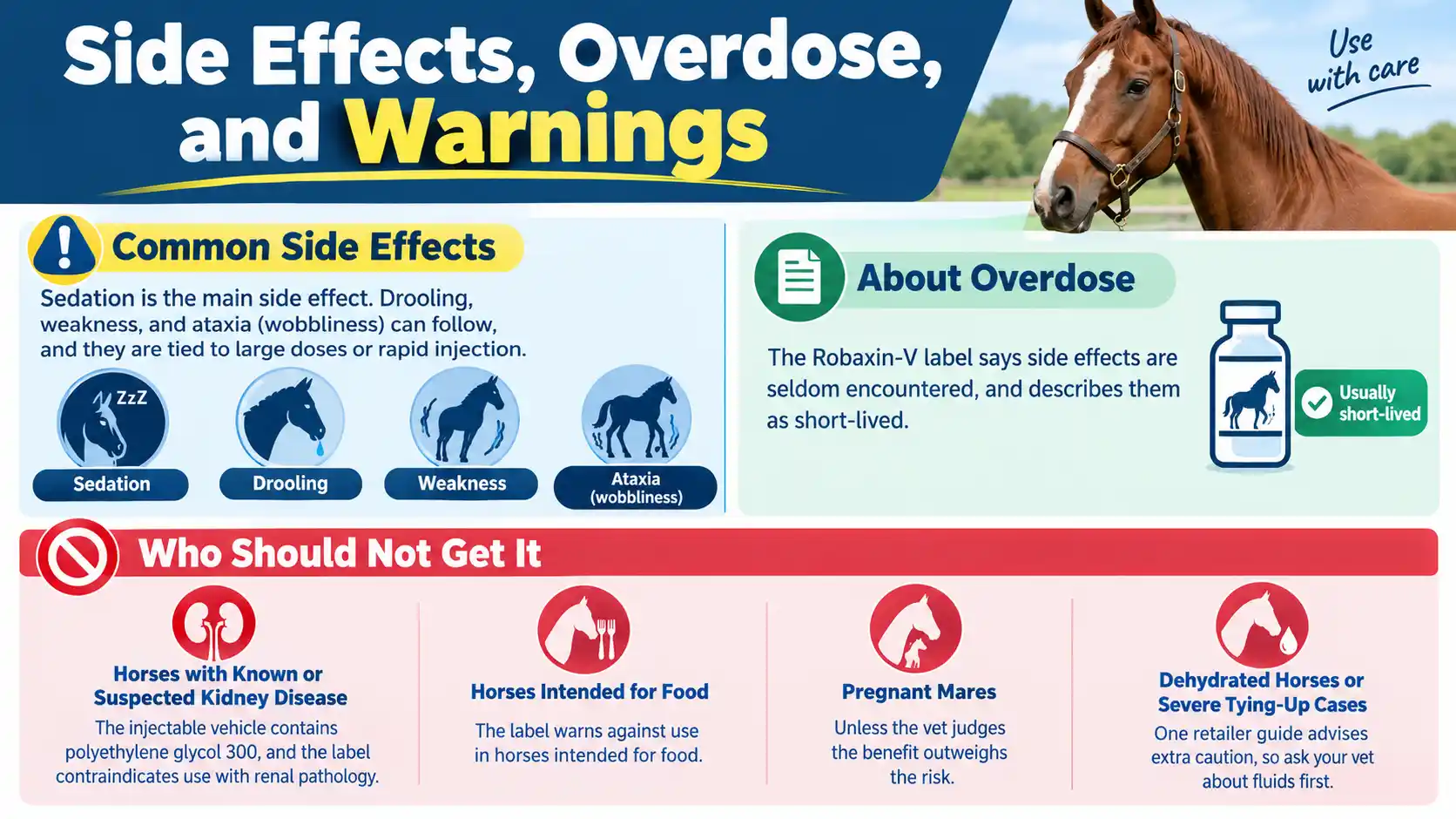
Sedation is the main side effect. Drooling, weakness, and ataxia (wobbliness) can follow, and they are tied to large doses or rapid injection. The Robaxin-V label says side effects are seldom encountered, and describes them as short-lived.
Who Should Not Get It
Injection Precautions
The solution is hypertonic, so it must stay in the vein. The label warns that extravasation must be avoided. In horses it advises injecting rapidly through a 15- or 17-gauge needle, and notes that blood aspirated into the syringe does not mix with the hypertonic solution. This is a job for your vet.
Drug Interactions
Methocarbamol depresses the central nervous system, so the Merck Veterinary Manual advises against combining it with other CNS depressants. Sedatives such as acepromazine and Dormosedan are examples worth raising with your vet before stacking.
The label says the injectable can be used alongside adrenal corticosteroids and other medications usually employed for these conditions, without untoward effects. If your vet is also treating inflammation, see our guides on dexamethasone dosage for horses and bute for horses.
Phenylbutazone deserves a special mention. A 2016 study in the Journal of Veterinary Pharmacology and Therapeutics examined methocarbamol and phenylbutazone together in exercised Thoroughbreds, and it cites earlier work reporting that co-administration lowers methocarbamol clearance.
Ask your vet whether that affects your plan.
Signs of Overdose
Merck describes overdose as generally marked by CNS depression, with salivation, weakness, and ataxia possible. The label’s manufacturer text lists loss of righting reflex, prostration, and ataxia among the signs of large-dose CNS depression. Treatment is supportive. Call your vet at once if your horse is unusually wobbly or dull.
Methocarbamol in Competition: Drug Testing and Withdrawal
Methocarbamol is a controlled substance in racing and in most sanctioned competitions. Merck notes that sports organizations regulate it and that withdrawal periods must be respected.
Rumpler and colleagues reported that the Association of Racing Commissioners International classes it as a Class 4 drug. They also counted more than 140 methocarbamol findings at U.S. tracks between 2005 and 2012, a number exceeded only by phenylbutazone, flunixin, and clenbuterol. That points to how often trainers misjudge clearance time.
Methocarbamol still detectable at 24 h in all horses. Not detected at 48 h or 72 h.
Methocarbamol below the lab’s quantification limit 48 h after the last dose in all six horses.
Quantified up to 8 h and detected up to 16 h after the last dose.
The same paper noted a possible practical use: because guaifenesin appeared after oral dosing but not after IV dosing, labs may be able to tell the route of administration.
Methocarbamol vs. Other Equine Muscle and Pain Options
Methocarbamol relaxes muscle. It is not an anti-inflammatory and it does not treat the underlying injury. Vets often pair it with other drugs.
| Drug | Main job | Learn more |
|---|---|---|
| Methocarbamol | Reduces muscle spasm; sedating | This guide |
| Phenylbutazone (bute) | NSAID for pain and inflammation | Bute dosage for horses |
| Flunixin (Banamine) | NSAID for pain and inflammation | Banamine dosage for horses |
| Firocoxib (Equioxx) | NSAID, oral, often for joint pain | Equioxx dosage for horses |
| Dantrolene | Acts directly on muscle; used for tying-up and postanesthetic myositis | Merck Veterinary Manual |
Common Dosing Mistakes
FAQs
What is methocarbamol used for in horses?
It is used as an adjunct for acute muscle spasm from strains, myositis, bursitis, synovitis, and tying-up, and to maintain relaxation in tetanus, per the Robaxin-V label.
What is the methocarbamol dosage for horses?
The injectable label dose is 2 to 10 mg/lb IV for moderate conditions and 10 to 25 mg/lb IV for severe conditions, given to effect. There is no labeled oral dose.
How much methocarbamol does a 1,000 lb horse get?
Using the label ranges, a 1,000 lb horse works out to 2,000 to 10,000 mg (20 to 100 mL) for moderate conditions, and 10,000 to 25,000 mg (100 to 250 mL) for severe conditions. Your vet decides the actual dose.
Is methocarbamol the same as Robaxin?
Robaxin is the human brand and Robaxin-V is the veterinary brand. Both contain methocarbamol.
Can I give my horse human Robaxin tablets?
Only if your vet prescribes it. Tablets are extra-label in horses, and your vet sets the dose, since horse and human doses differ.
Is methocarbamol FDA-approved for horses?
The injectable is. The label carries NADA approvals and lists horse indications. Oral and compounded forms are not FDA-approved for horses.
How fast does methocarbamol work?
After oral dosing in one study, peak plasma levels came within 15 to 45 minutes. IV effect depends on giving the drug “to effect,” as the label directs.
How long does methocarbamol last in a horse?
The blood half-life is short, roughly one to three hours across studies, so vets often repeat dosing. Clearance from the body takes longer than the visible effect.
Does methocarbamol show up on drug tests?
Yes. It is a regulated drug in racing and most sanctioned competitions, and its metabolite guaifenesin is also prohibited in many rulebooks.
How long before a show should I stop methocarbamol?
There is no universal answer. In one study, methocarbamol was below the lab’s quantification limit 48 hours after the last oral dose, and not detected 48 hours after an IV dose. Rules and test sensitivity vary, so confirm with your governing body and vet.
Can methocarbamol be used for tying-up?
Yes. Tying-up syndrome is a horse indication on the injectable label. Oral use for exertional rhabdomyolysis is extra-label, per PetMD.
Bottom Line and Next Steps
Methocarbamol is a fast-acting, short-lived muscle relaxant with a clear label dose for the injectable and a lot of gray area for oral use. Use the chart and calculator to follow along with your vet’s plan, and confirm any dose in writing.
- Get a diagnosis before medicating a sore or stiff horse.
- Ask your vet which form and route they recommend, and why.
- Confirm kidney, hydration, and pregnancy status.
- If you compete, check the current rulebook and record treatment dates.
Sources
- Robaxin-V injectable and tablets package insert (Zoetis / Fort Dodge)
- Central Muscle Relaxants for Animals, Merck Veterinary Manual
- Rumpler, Colahan, Sams (2014), J Vet Pharmacol Ther 37:25-34
- Muir, Sams, Ashcraft (1992), Equine Vet J Suppl 11:41-44
- Knych et al. (2016), Pharmacokinetics of methocarbamol and phenylbutazone in exercised Thoroughbreds
- PetMD: Methocarbamol (Robaxin) for dogs, cats, and horses