Excede Dosage For Horses: Calculator, Chart & Safe Guide
Your vet just handed you a prescription of Excede for your horse and you find yourself in the barn aisle wondering how many milliliters you’re supposed to pull out. Many experienced horse owners struggle to understand the math behind figuring out Excede for horse dosing, and it is not just you — this is because the label does not give you a direct answer, it provides you with a formula.
This guide breaks that formula down, provide you with a quick reference dosage chart, and tell you everything else you need to know before you take that needle out of the bottle: what Excede treats, how it’s administered, what side effects to keep an eye out for, and when to call your vet rather than taking a guess.
Before we begin: Excede is a prescription antibiotic. This article is designed to clarify how the dosing math works and what the label states, but doesn’t take the place of your veterinarian’s diagnosis or prescription, or your vet’s direct instructions for your horse.
EXCEDE® Dosage Calculator for Horses
Ceftiofur Crystalline Free Acid Antibiotic Suspension (200 mg/mL)
Recommended Dosage Schedule
Important Clinical Guidance & Warnings
- Shake Well: Shake thoroughly before using to ensure an even suspension.
- Injection Volume Guidelines: Administer a maximum of 10 mL per injection site to minimize local site reactions. (No more than 20 mL total per site).
- Duration of Action: Therapeutic drug concentrations are maintained for 6 days after the second injection (total of 10 days coverage from start of treatment) against S. zooepidemicus.
- Vial Expiration: Contents should be used within 12 weeks after the first dose is removed.
- Safety: Prescription only. Not for human use. Requires proper intramuscular injection techniques.
© medshorse.com
What Is Excede for Horses?

Excede (ceftiofur crystalline free acid or CCFA) is a prescription, long-lasting antibiotic suspension from Zoetis. It is designed so that one shot will release the antibiotic slowly over a number of days – not hours as with a conventional injectable drug.
What’s Actually in It
Each milliliter of Excede Sterile Suspension contains 200 mg of ceftiofur (as the crystalline free acid), suspended in a caprylic/capric triglyceride and cottonseed-oil base. Ceftiofur is in a group of antibiotics known as cephalosporins that are used in humans as well and disrupt the way bacteria construct cell walls to kill susceptible bacteria, not just inhibit their growth.
What Excede Treats in Horses
Excede is an FDA-approved product for horses, it has limited indications: lower respiratory tract infections caused by susceptible strains of Streptococcus equi subspecies zooepidemicus (S. zooepidemicus) is a common bacterium that causes respiratory disease in horses, sometimes mistakenly (and imprecisely) called “strangles” by horse owners, but is not the same organism as the true strangles pathogen, Streptococcus equi subsp. equi. Your veterinarian will diagnose the infection with a physical examination, and often a culture, before prescribing Excede.
The use of Excede for skin infections, gut infections, or for “just in case” use is not approved and is a decision made by your veterinarian only — for use in food-producing species there are restrictions in federal law.
How the Excede Dosage Is Calculated
This is the part that confuses people, so let’s slow down.
The Official Dosing Formula
Label dose is 3.0 mg of the ceftiofur equivalents per pound of body weight (6.6 mg/kg). The suspension is a fixed concentration of 200 mg/mL, so to convert the dose from mg to a volume you do the following:
Volume (mL) = (Body weight in lb × 3.0 mg/lb) ÷ 200 mg/mLThis formula reduces to a more convenient “rule of thumb” directly from the label: 1.5 mL of suspension per 100 lb (45.4 kg) body weight.
Worked example: A 1,000 lb horse needs 1,000 × 3.0 = 3,000 mg of ceftiofur, and 3,000 ÷ 200 = 15 mL per injection.
The 15 mL is administered as a single dose followed by repeat of the same calculation and administration 4 days later as a second dose.
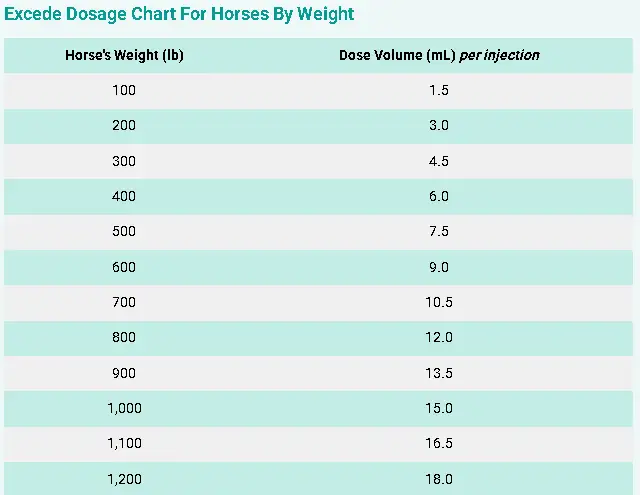
This chart mirrors the official dosing table published in Zoetis’s FDA-approved prescribing information, so you can sanity-check a calculator result or work it out at a glance.
Excede Dosage Chart For Horses By Weight
| Horse’s Weight (lb) | Dose Volume (mL) per injection |
| 100 | 1.5 |
| 200 | 3.0 |
| 300 | 4.5 |
| 400 | 6.0 |
| 500 | 7.5 |
| 600 | 9.0 |
| 700 | 10.5 |
| 800 | 12.0 |
| 900 | 13.5 |
| 1,000 | 15.0 |
| 1,100 | 16.5 |
| 1,200 | 18.0 |
| 1,300 | 19.5 |
| 1,400 | 21.0 |
| 1,500 | 22.5 |
| 1,600 | 24.0 |
| 1,700 | 25.5 |
| 1,800 | 27.0 |
| 1,900 | 28.5 |
| 2,000 | 30.0 |
Note: This is the volume per injection. The full course consists of two doses, 4 days apart; thus the 1,000 lb horse would be given 15 mL, then 15 mL 4 days later, for a total of 30 mL of drug over the entire course.
How Excede Is Given: Administration Guide
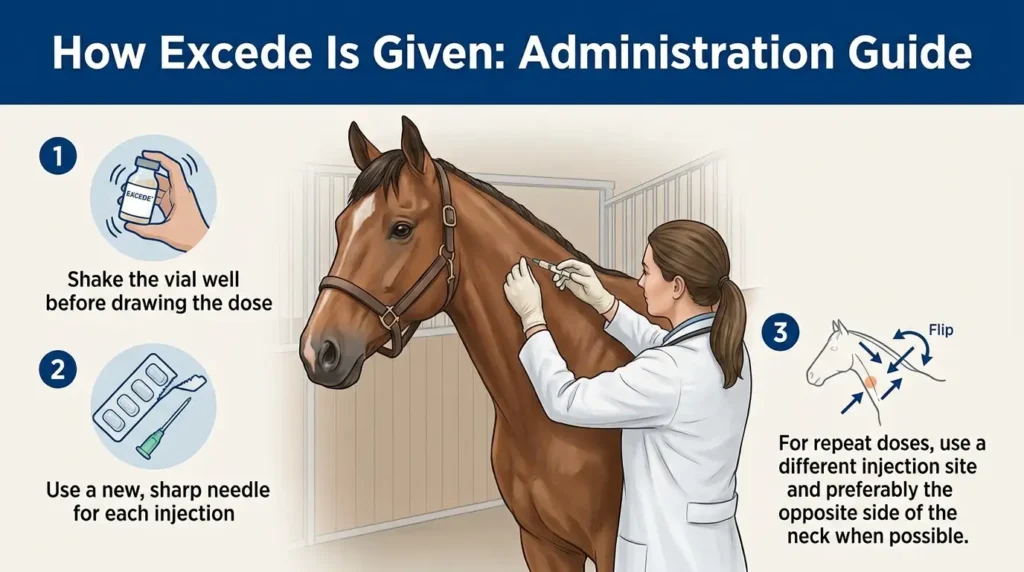
Excede medication is administered by an intramuscular (IM) injection usually in the neck of the horse. Some important tips to help ease the horse’s discomfort when wearing it:
- Shake the vial well before drawing up each dose. Excede is a SUSPENSION, which means that the active drug precipitates between doses.
- Each injection should be given with a new, sharp needle and standard IM injection technique for the neck.
- Avoid using the same injection site for the first and second dose and do not use the same side of the neck, whenever possible, to minimize the risk of a bigger local reaction.
Injection Site and Volume Limits
The approved label allows a max of 20mL per injection site. If your horse’s calculated dose is greater than that (which begins to happen around the 1300 – 1400 lb mark on the chart above), then your vet will make two (or more) separate injection sites, and not overload one injection site.
This is not an option – overdosing (injection of more than the recommended maximum) at a single site can increase the risk of a larger, painful local reaction.
Dosing Schedule (Day 0 and Day 4)
Excede is a two dose course, NOT a daily antibiotic:
- Day 0: First IM injection of the calculated dose.
- Day 4 (96 hours after the first dose): Second injection at the same dose, new injection site.
Based on the manufacturer’s pharmacokinetic data, this schedule will maintain a therapeutic target concentration for the entire 4-day period between doses and for an additional 6 days after the second dose, giving about 10 days of therapeutic drug coverage after just two doses.
Benefits of Excede Over Other Antibiotics
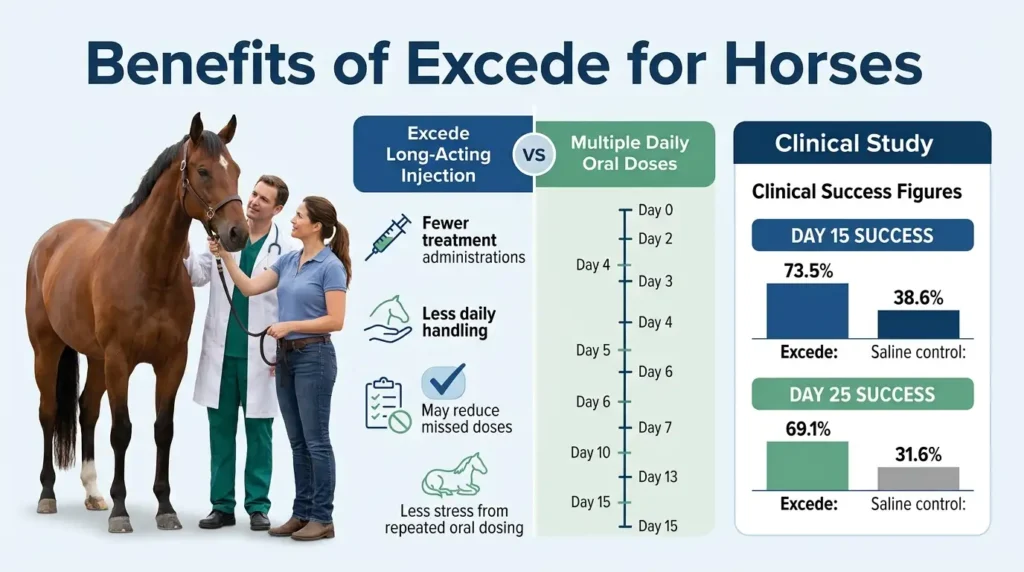
The primary advantage of Excede is dosing convenience, Zoetis’ own clinical materials state, since a conventional two-to-10 once- or twice-daily oral antibiotic treatment, such as trimethoprim-sulfa, could have been used instead. That translates to horse owners as:
- Much less handling, only 2 injections as opposed to up to 20 separate oral doses.
- The likelihood of missed doses is decreased as compliance is one of the largest challenges in real life use of multi-week oral antibiotic regimens in horses.
- Rest for the horse for less stress daily versus multiple oral doses to a horse that is sick.
- In Zoetis’s field study, a greater percentage of horses in the Excede treatment group reached clinical success (73.5% by day 15 and 69.1% by day 25) than in the saline control group (38.6% by day 15 and 31.6% by day 25), which was statistically significant at day 25 (P = 0.0215).
Excede vs. Naxcel: What’s the Difference?
Since both Excede and Naxcel (ceftiofur sodium) are Zoetis ceftiofur products, horse owners sometimes see both products listed. The bottom line:
| Excede (CCFA) | Naxcel (ceftiofur sodium) | |
| Formulation | Long-acting crystalline suspension | Standard rapid-release powder/solution |
| Horse dosing schedule | 2 injections, 4 days apart | Once daily |
| Course length | ~10 days of coverage from 2 doses | Typically daily dosing for the length of treatment |
| Approved horse dose | 3.0 mg/lb (6.6 mg/kg) | 1.0 mg/lb (2.2 mg/kg) once daily |
| Best fit | Owners/vets wanting fewer handling events | Situations needing daily reassessment or dose adjustment |
They are both prescription-only medications and should be chosen by your vet depending on the nature of the infection, the condition of the horse, and other factors such as convenience — not just what you prefer.
Side Effects of Excede in Horses

Zoetis’ pre-approval field study involved 373 horses (278 treated with Excede, 95 treated with a placebo), and provides a reasonably accurate picture of what to expect.
Injection Site Reactions
The most common side effect is this one. Approximately 3.6% (10/278) of the horses treated with Excede developed swelling at the injection site, and 1% of the horses in the placebo treatment group. These were mostly mild (8/10 were 4cm or less) with a few being larger. Study site reactions were resolved in 1-20 days.
Post-approval reports (reports gathered after the drug was marketed) report firmness, pain, inflammation, infection, muscle stiffness and sometimes lameness or a hard lump (granuloma) at the injection site.
Digestive Side Effects
Approximately 9% of Excede treated horses (25 of 278) reported loose stool or diarrhea compared to 7% of the placebo treated horses. Almost all were mild and did not require treatment, and just one dose of anti-diarrheal was used in some cases with self-recovery.
However, any antibiotic may upset a horse’s gut flora, and horses in stressful situations tend to have an acute diarrhea anyway, so it is a good idea to let your veterinarian know you’re treating a horse just in case he or she wants to keep an eye on the manure and feed intake during the first few days.
Systemic & Neurologic Reactions
These are less common but more serious and are from post-approval adverse event reports: fever, lethargy, swelling away from the injection site, loss of appetite, colic, muscle tremors, ataxia (wobbliness), seizures, and loss of consciousness. There have also been reports of allergic reactions, including hives, swelling of the face or limbs and, in rare instances anaphylaxis.
There have been rare reports of sudden death or immediate onset seizures or collapse, which have been fatal or euthanizing. They are rare but that is why it is important for a horse to be monitored for a time following every injection and why any unusual reaction should be followed up immediately with your veterinarian.
Serious Risks, Warnings & Who Should Not Get Excede
- Excede is contraindicated in horses that are known to be allergic to ceftiofur or other beta-lactam antibiotics (penicillins, cephalosporins).
- Label states that Excede has not been evaluated for safety in foals under 4 months of age or breeding, pregnant or lactating horses. Treatment in these horses is a veterinary decision on a case-by-case basis.
- Slow elimination: It’s long acting, so Excede takes about 17 days to get 97% of the dose out of a horse’s system. In case a horse does react adversely, this response may require management for longer period of time than if administered a fast clearing drug.
- Stress related diarrhea: According to the label, stress may be a primary factor in cases of acute diarrhea in horses, and may be fatal, especially if the horse is treated with antibiotics. If a treated horse experiences diarrhea, the label advises that no more Excede is administered (but that treatment should begin immediately).
- Foot pain observations: The housing (concrete-floor pens) and diet in the target animal safety study may have influenced the number of observations of foot pain (stiffness, increased heat and pulse in the front feet), and Zoetis was not able to establish a definite relationship between ceftiofur and the number of observations of foot pain.
- Not for humans to eat or drink by horse.
If your horse exhibits any of the reactions above, or if he/she appears “off” in any way following an injection, call your veterinarian instead of waiting to see if it clears up on its own.
Drug Interactions and Precautions
The FDA approved label for Excede dose does not mention a specific list of drug-drug interactions for horses — Zoetis has not released any specific combos for this indication. This does not mean there can’t be interactions, just that they have not been formally recorded in the approval data. It is good practice in general to:
- Before starting Excede treatment, inform your veterinarian if your horse is on another antibiotic or dewormer, or receiving any other medications or supplements such as NSAIDs.
- Do not use Excede in conjunction with other antibiotics unless instructed by your veterinarian as combining antibiotics may create added difficulties in effectiveness and side-effect monitoring.
- If your horse has had an allergic reaction to any antibiotic before, your vet needs to be aware of this allergy before beginning treatment, even if your horse had a reaction to an antibiotic other than ceftiofur.
When in doubt, ask your veterinarian or clinic where your horse is receiving treatment if the substance that your horse is receiving may interact with Excede — don’t guess.
Human Safety: Handling Excede
Excede is designed to be used by animals, but the handlers must take it seriously:
- Cephalosporins, such as ceftiofur, and penicillins may cause allergic reactions in individuals who are susceptible, including mild skin irritation to more severe allergic reactions upon repeated exposure.
- Do not get it on skin, in eyes or in the mouth – it is an easy precaution to wear gloves when administering the product.
- If you get the product in your eyes, flush with water for 15 minutes. If it comes in contact with your skin, wash with soap and water and change any contaminated clothing.
- If, after exposure to ceftiofur, a rash, hives, or trouble breathing occurs, go to a doctor and tell them about the exposure.
- If a person is known to be allergic to penicillin or cephalosporin, he should avoid handling this product if possible.
Storage and Shelf Life
- Keep Excede at room temperature (20-25°C/68-77°F).
- Shake well before each application, it is a suspension and the active ingredient will settle.
- After the first dose is drawn from a vial, the rest of the contents must be used within 12 weeks.
Myth vs. Fact
| Myth | Fact |
| “Excede is basically the same as any penicillin shot.” | Excede is a cephalosporin (a related but distinct antibiotic class) with a long-acting formulation and a very different dosing schedule from typical penicillin products. |
| “You can adjust the dose slightly if your horse is ‘in between’ weights on the chart.” | The dose scales directly with actual body weight — use the exact calculation (or the calculator) rather than rounding to the nearest chart line, especially for horses far from a round number. |
| “If one injection works, you can stop after the first dose.” | Excede’s approval is built around a two-dose course, 4 days apart. Stopping early undercuts the treatment and may contribute to antibiotic resistance. |
| “Excede is approved for any respiratory infection in horses.” | It’s approved specifically for lower respiratory infections caused by susceptible S. zooepidemicus — not a general-purpose respiratory antibiotic. |
Common Mistakes Horse Owners Make
- Estimating weight without measuring or weighing it. If a scale is not available, use a weight tape or “guessed” weight which is off about 100-200 lb – this would result in a meaningful dose change.
- Injecting more than 20 mL in one site. With large horses you must divide the dose up in more than one place — don’t attempt to do this in one area to save time.
- Failure to give or delay the second dose. This 4-day interval is not arbitrary, but is derived from the pharmacokinetics that maintain therapeutic drug levels.
- Failure to thoroughly shake the vial. If a suspension is not shaken it will provide an irregular dose.
- Not reporting mild diarrhoea. While most of the cases are minor, the label specifically states that further doses must be withheld and treatment must be initiated if diarrhea occurs — this is a decision for your veterinarian, NOT a wait and see approach.
You May Also Like to Read:
- Dexamethasone Dosage For Horses: Calculator, Chart & Safe Guide
- Bute Dosage For Horses: Calculator, Chart & Safe Guide
FAQs
What is Excede used for in horses?
Excede dosage is used for the treatment of lower respiratory tract infections due to susceptible strains of Streptococcus equi subsp. zooepidemicus in horses, this bacteria commonly causes respiratory infections in horses.
How much Excede do you give a horse?
The label dose is 3.0 mg/lb (6.6 mg/kg) of body weight, equal to 1.5 mL of the 200 mg/mL suspension per 100 lb, given as two injections 4 days apart.
How often do horses get Excede?
Twice — day 0 and day 4 (96 hours later). It is not used every day.
What is the highest volume of Excede that may be given at any one site?
According to the label approved by the FDA, it is possible to inject up to 20 mL per site. The complete dose should be split into more than one spot for larger horses.
Does Excede make horses runny?
Yes. In the field study, approximately 9% of the Excede treated horses and 7% of the placebo treated horses exhibited loose stool or diarrhea. Most cases were mild and self-limiting, but if it does occur new or worsening cases of diarrhoea should be reported to the veterinary surgeon as extra doses should not be given.
Is Excede safe for pregnant or lactating mares?
This use of ceftiofur has not been studied in breeding, pregnant or lactating horses, and should only be used in these situations on an individual basis with your vet.
When is it safe to give Excede to foals?
Labeling does not state that use in horses under 4 months has been evaluated – should be a veterinary decision on an individual basis.
How long will Excede remain in a horse’s system?
With long acting formulation, this requires approximately 17 days to reduce 97% of the dose.
What are the side effects of Excede?
Injection site swelling (about 4% of treated horses) and diarrhea/loose stool (about 9% of treated horses) were the most frequently reported reactions in the pivotal field study.
What’s the difference between Excede and Naxcel?
No, both are ceftiofur; the difference is that Excede (CCFA) is long-acting and administered twice (4 days apart) while Naxcel (ceftiofur sodium) is short-acting and is generally administered once a day.
If my horse reacts adversely to Excede?
This may include hives, swelling of the face or limbs and, very rarely, anaphylaxis. If you notice any of these symptoms, call your veterinarian right away.
Are there any interactions between Excede and other medicines?
There are no published formal drug interaction studies in the FDA label for horses. Before you begin treatment, notify your veterinarian of any drugs or supplements that your horse may be receiving.
Can I give Excede without a veterinarian’s prescription?
Excede is a federally restricted prescription drug — it can only be used under the direction and prescription of a licensed veterinarian.
Why does Excede require only TWO doses, as opposed to a full course of antibiotics per day?
Its crystalline, slow-release formulation keeps therapeutic drug levels in the bloodstream for about 10 days from just two injections, which is why it replaces what would otherwise be up to 10 daily oral doses.
If I miss the 4 days window of the second injection, what should I do?
Don’t guess; your veterinarian can help you to decide whether you should continue, tweak timing, or start over again, depending on your horse’s individual situation.
Key Takeaways
- The labeled dose for horses is 3.0 mg per lb of body weight (6.6 mg per kg) and the dose on the Excede (200 mg/mL) suspension is 1.5 mL per 100 lb of body weight.
- Horses receive two injections into a muscle, 96 hours (4 days) apart — not every day.
- Label approved by the FDA for up to 20 mL/injection site; larger horses may require the dose to be divided between two or more sites.
- Excede is only approved for lower respiratory tract infections due to susceptible Streptococcus equi subsp. zooepidemicus.
- The most commonly reported side effects are injection site swelling (about 4% of treated horses) and loose stool or diarrhea (about 9% of treated horses) in the pivotal field study.
- Your horse’s dose must be calculated, prescribed and confirmed by a licensed veterinarian.
Final Thoughts
Excede’s dosing math isn’t complicated once you see it laid out: 3.0 mg/lb converted through a constant 200 mg/mL concentration twice with a 4 day interval. The chart and calculator on this page are there for a reason—you don’t have to do this arithmetic all by yourself, in a barn aisle, using a syringe.
However, the number on the syringe isn’t the only consideration. The choice of antibiotic to use on your horse, whether or not Excede dosage for horses is the right one, how your horse’s medical history may make a difference and how to deal with any side effects that may occur — those are all for your veterinarian to decide. This is to help you understand what the diagnosis is and to verify math calculations only, not to substitute for the professional who examined your horse.