Ponazuril Dosage for Horses: Chart, Calculator & Safe Guide to the 28-Day EPM Treatment
Written & Reviewed By: Medshorse Team
Last Updated: October 2026
The labeled ponazuril dosage for horses is 15 mg/kg by mouth on day 1 (the loading dose), then 5 mg/kg once daily for 27 more days. That is the FDA-approved regimen for equine protozoal myeloencephalitis (EPM), and getting the math wrong in either direction matters.
A horse that is stumbling, dragging a hind toe, or losing muscle over the hip is a frightening thing to watch. When your vet confirms EPM and hands you a syringe of paste, the next question is always the same: how much, how often, and for how long?
This guide answers those questions using the FDA drug label, veterinary references and the manufacturer’s own instructions, so you can follow your vet’s plan with confidence.
Disclaimer: This article is for general education and is not veterinary advice. Product names mentioned, including Ponazuril, belong to their respective owners, and MedsHorse is not affiliated with them. Always follow your veterinarian’s instructions and the current product label.
What Is Ponazuril and What Does It Treat in Horses?
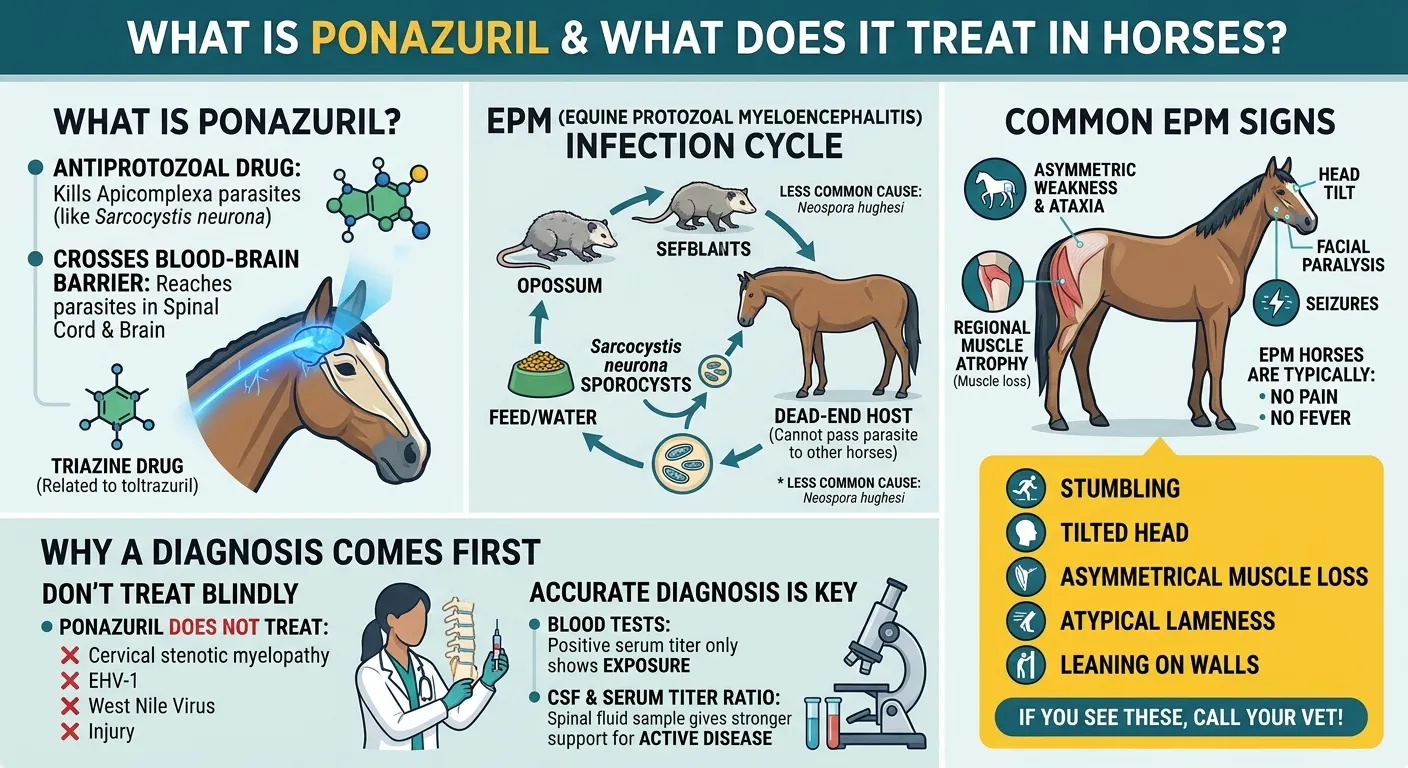
Ponazuril is an antiprotozoal drug that kills parasites in the phylum Apicomplexa. In horses, it is approved to treat EPM caused by Sarcocystis neurona. It is a triazine drug related to toltrazuril, and it crosses the blood-brain barrier, which is why it can reach parasites inside the spinal cord and brain.
EPM happens when a horse swallows S. neurona sporocysts in feed or water contaminated with opossum feces. The horse is a dead-end host, so it cannot pass the parasite on to other horses. A less common cause is a related parasite, Neospora hughesi.
Signs depend on where the parasite lands. The Merck Veterinary Manual lists asymmetric weakness and ataxia, regional muscle atrophy, head tilt, facial paralysis and seizures among the most common. EPM horses are typically not painful or feverish, which helps vets narrow down other causes.
The “STALL” memory aid from the manufacturer is simple: Stumbling, Tilted head, Asymmetrical muscle loss, Atypical lameness, Leaning on walls. If you see these, call your vet before you buy anything.
Why a diagnosis comes first
Ponazuril only treats protozoa. It does nothing for cervical stenotic myelopathy, EHV-1, West Nile virus or an injury. The label itself says EPM should be separated from other causes of ataxia before treatment starts.
Blood tests alone can mislead. A positive serum titer shows exposure, not active disease. The Merck Veterinary Manual says a serum:CSF antibody titer ratio, from a spinal fluid sample, gives much better support for an EPM diagnosis.
Ponazuril Dosage for Horses: The Label Dose
The FDA label for Marquis (NADA 141-188) directs a 15 mg/kg loading dose on day 1, followed by 5 mg/kg once daily for 27 additional days. Total treatment is 28 days. The paste is deposited on the back of the tongue, and the horse’s mouth should contain no feed.
Loading dose (day 1)
The loading dose is three times the maintenance dose. The syringe’s dosage ring is calibrated for 5 mg/kg only, so the label has you set the ring to your horse’s weight and give that dose three times in a row on day 1.
The loading dose exists for a reason. Boehringer Ingelheim’s label explains that single-dose pharmacokinetic modeling pointed to an accumulation ratio of 2.3 to 3.3, so a three-fold first dose gets blood levels to steady state within one or two days instead of waiting weeks.
Maintenance dose (days 2 to 28)
From day 2, give one 5 mg/kg dose (one ring setting) every 24 hours. Try to dose at about the same time each day. Do not double up to “catch up” if you are late; call your vet for guidance instead.
The 5 mg/kg vs 10 mg/kg question
In the field study behind the label, horses were randomized to 5 or 10 mg/kg per day for 28 days. At 5 mg/kg, 28 of 47 horses (60%) improved by at least one neurologic grade by day 118. At 10 mg/kg, 32 of 55 (58%) improved.
The label reports no statistical difference between the groups, so the lower dose is the labeled one.
Ponazuril Dosage Chart by Horse Weight
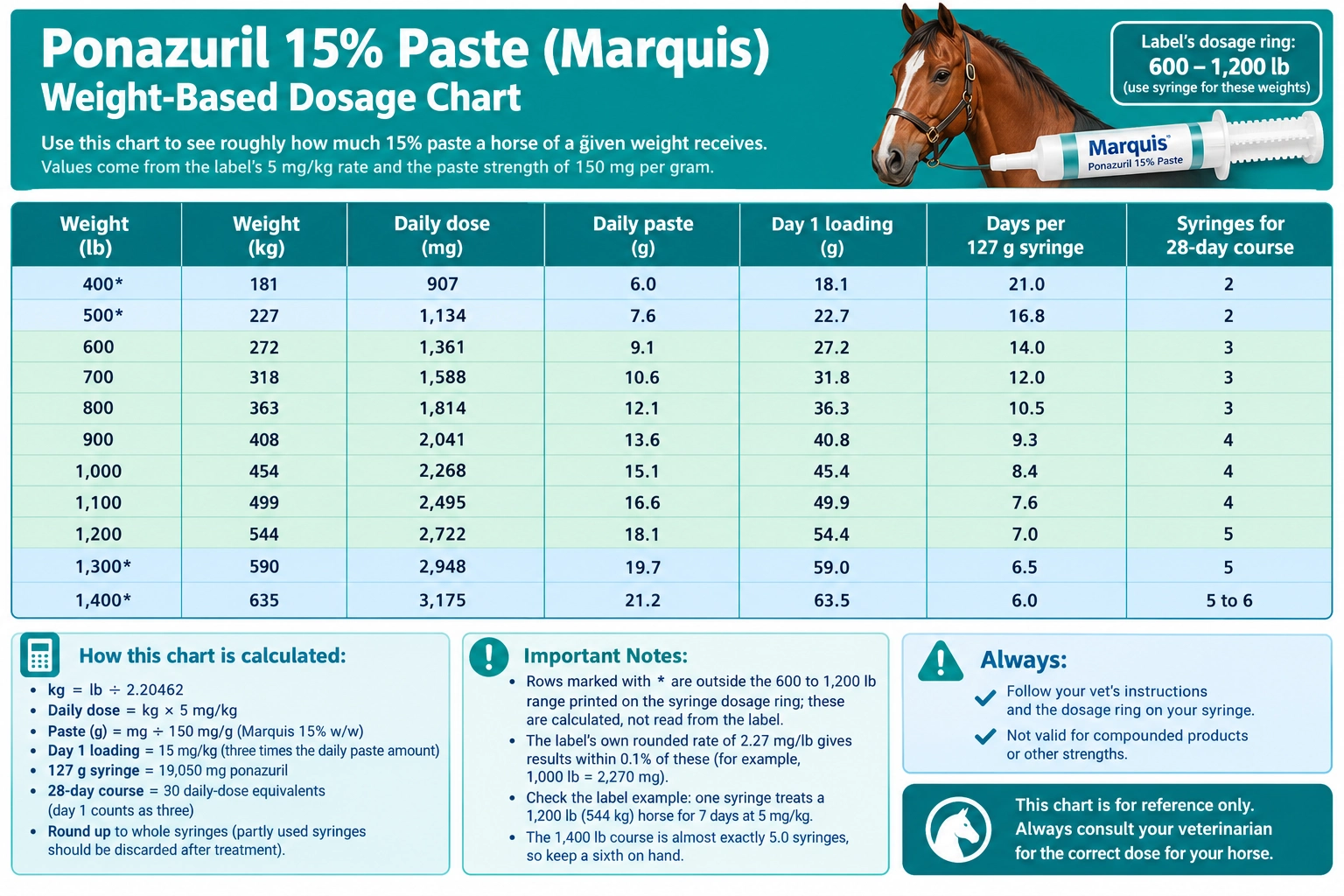
Use this chart to see roughly how much 15% paste a horse of a given weight receives. Values come from the label’s 5 mg/kg rate and the paste strength of 150 mg per gram. The label’s dosage ring is marked from 600 to 1,200 lb, so those rows correspond to your syringe.
Rows marked with an asterisk fall outside that range and should be confirmed with your vet.
| Weight (lb) | Weight (kg) | Daily dose (mg) | Daily paste (g) | Day 1 loading (g) | Days per 127 g syringe | Syringes for 28-day course |
|---|---|---|---|---|---|---|
| 400* | 181 | 907 | 6.0 | 18.1 | 21.0 | 2 |
| 500* | 227 | 1,134 | 7.6 | 22.7 | 16.8 | 2 |
| 600 | 272 | 1,361 | 9.1 | 27.2 | 14.0 | 3 |
| 700 | 318 | 1,588 | 10.6 | 31.8 | 12.0 | 3 |
| 800 | 363 | 1,814 | 12.1 | 36.3 | 10.5 | 3 |
| 900 | 408 | 2,041 | 13.6 | 40.8 | 9.3 | 4 |
| 1,000 | 454 | 2,268 | 15.1 | 45.4 | 8.4 | 4 |
| 1,100 | 499 | 2,495 | 16.6 | 49.9 | 7.6 | 4 |
| 1,200 | 544 | 2,722 | 18.1 | 54.4 | 7.0 | 5 |
| 1,300* | 590 | 2,948 | 19.7 | 59.0 | 6.5 | 5 |
| 1,400* | 635 | 3,175 | 21.2 | 63.5 | 6.0 | 5 to 6 |
*Outside the 600 to 1,200 lb range printed on the syringe dosage ring; these rows are calculated, not read from the label. Check against the label example: one syringe treats a 1,200 lb (544 kg) horse for 7 days at 5 mg/kg. The 1,400 lb course is almost exactly 5.0 syringes, so keep a sixth on hand. Always follow your vet’s instructions and the dosage ring on your syringe. Not valid for compounded products or other strengths.
Ponazuril Dosage Calculator for Horses
Enter your horse’s weight to see the daily and loading amounts. The default paste strength is 150 mg per gram, which is Marquis 15%. If your vet dispensed a different product, change the strength to match the label on your tube or syringe.
Day 1: Set the dosing ring to lb (the 5 mg/kg setting) and give that dose by mouth 3 times in a row. Together this equals the 15 mg/kg loading dose.
Day 2 to Day 28: Keep the dosing ring at lb and give 1 dose by mouth once daily (27 additional days).
© medshorse.com
How to Calculate the Ponazuril Dose by Hand
You can check any calculator, including ours, with four steps. Here is a worked example for a 1,100 lb horse.
- Convert weight to kilograms. 1,100 lb ÷ 2.2046 = about 499 kg.
- Multiply by 5 mg/kg. 499 × 5 = about 2,495 mg of ponazuril per day.
- Divide by paste strength. Marquis has 150 mg per gram, so 2,495 ÷ 150 = about 16.6 g of paste per day.
- Triple it on day 1. 16.6 × 3 = about 49.9 g of paste for the loading day.
The label gives a handy reality check. One full 127 g syringe holds enough paste to treat a 1,200 lb (544 kg) horse for seven days at 5 mg/kg. If your numbers say a 1,200 lb horse uses about 18.1 g a day, you are on track (127 ÷ 18.1 = 7).
Why an accurate weight matters
Guessing weight is the most common source of dosing error. Eyeballing weight is unreliable, and a weight tape can be off too, especially in heavily muscled horses, ponies and those with a big hay belly. A livestock or equine scale is best. Otherwise, ask your vet to confirm the weight at the exam.
A small underdose is not a harmless mistake either. Ponazuril takes time to build in the body, so a dose that is too low can leave drug levels short of the target for longer than you would expect.
How to Give Ponazuril Paste Step by Step
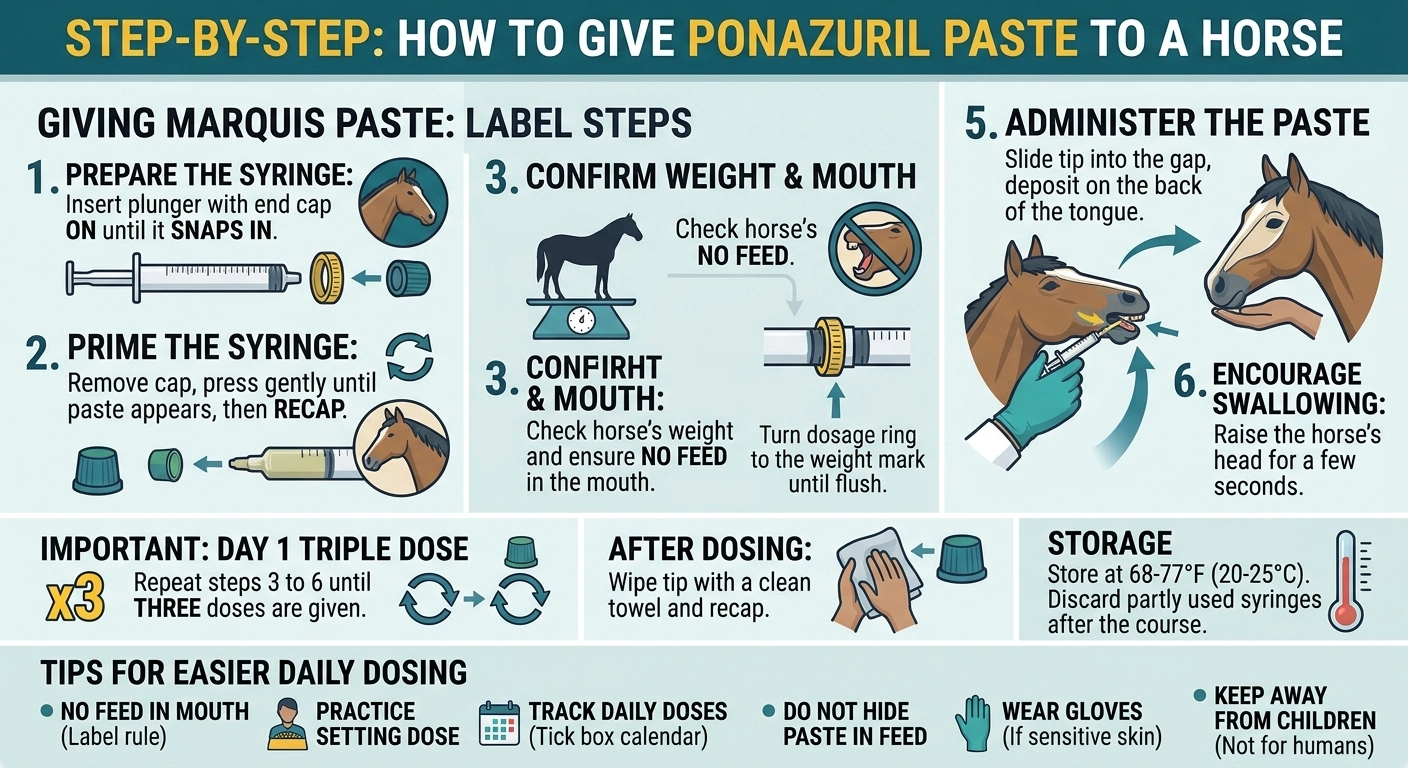
The Marquis syringe ships as a barrel and a separate plunger with a dosage ring. Assemble it before the first dose, and keep the end cap on while you insert the plunger.
- Assemble the syringe: insert the plunger with the end cap on until it snaps in.
- Remove the cap and press gently until paste shows at the tip. Recap.
- Confirm your horse’s weight and make sure the mouth has no feed in it.
- Turn the dosage ring to the weight mark until the ring collar and barrel collar are flush at the start.
- Slide the tip into the gap between the front and back teeth and deposit paste on the back of the tongue.
- Raise the head for a few seconds so the horse swallows.
- Wipe the tip with a clean disposable towel and recap.
- On day 1, repeat steps 3 to 6 until you have given three ring doses.
Tips that make daily dosing easier
- Dose before you feed, or at least make sure the mouth is empty. The label specifically says no feed in the mouth.
- Practice with the ring before the first real dose so the day 1 triple dose goes smoothly.
- Keep a simple calendar and tick each day off. A skipped or doubled dose is easy to lose track of over four weeks.
- Do not hide the paste in feed unless your vet says it is fine. You will not know how much the horse actually ate.
- Wear gloves if you have any skin sensitivity, and keep syringes away from children. The product is not for human use.
How Long Does Ponazuril Take to Work?
Ponazuril builds slowly in the body, so do not expect a dramatic change in the first week. In a pharmacokinetic study of normal horses given 5 mg/kg daily for 28 days, peak serum concentration occurred at about 18 days, and peak CSF concentration about 15 days.
The elimination half-life was about 4.5 days.
This is why the loading dose matters. It shortens the time to useful drug levels, which label data suggests happens within one or two days instead of weeks.
What improvement looks like
Improvement is usually graded by a vet on a 0 to 5 neurologic scale. A horse that stumbles less, tracks straighter when walked in circles, or stops dragging a toe is moving in the right direction. Muscle that has wasted away rebuilds more slowly than coordination returns.
Early worsening can happen. The label notes neurologic deficits, mainly ataxia, have been reported to worsen during the first part of treatment, and in some horses that worsening was temporary. If your horse gets worse, call your vet the same day rather than waiting.
Does Ponazuril Work? What the Evidence Says
It helps most horses, but it is not a guaranteed cure. The Merck Veterinary Manual reports that roughly 60% of horses improve on each of the approved EPM treatments, while fewer than 25% recover completely. Relapses can occur up to two years after antiprotozoal treatment stops.
The label’s own wording is equally careful: killing the parasite may not fully resolve signs caused by damage already done, and the outlook depends on how severe the disease was and how long it went untreated. Earlier treatment generally means better odds, which is why a prompt vet visit matters more than any product choice.
Ponazuril Side Effects and Safety
Ponazuril is generally well tolerated at the labeled dose. In the field study, eight horses had unusual observations, but the label says a link to treatment was not established. Safety-study horses given higher doses had treatment-related loose feces.
Reported effects
- Worsening ataxia early in treatment: reported in post-approval experience and sometimes temporary.
- Blisters on the nose and mouth: seen in two field-study horses.
- Skin rash or hives: three horses, lasting up to 18 days.
- Loose stool or mild colic: one horse each in the field study; loose feces were treatment-related in the safety study.
- Seizure: one horse in the field study, with no proven link to the drug.
- Reduced appetite or weight loss: occasional inappetence seen in the safety study, and one horse at 10 mg/kg lost weight.
- Your horse suddenly gets worse, falls, or cannot stand
- A seizure or collapse
- Hives, swelling, or blisters around the muzzle
- Colic signs, such as pawing, rolling or looking at the flank
- Ongoing diarrhea or refusal to eat
Breeding, pregnant and nursing mares
The label states that the safe use of Marquis in breeding horses, pregnant mares and lactating mares has not been evaluated. In a high-dose safety study (30 mg/kg, six times the daily dose), three of the four females showed moderate edema in the uterine lining. Ask your vet to weigh the risks if your mare is bred or in foal.
Other drugs given at the same time
Safety with other therapies has not been evaluated, according to the label. Vets often add anti-inflammatories for the first days of treatment, and the Merck Veterinary Manual lists flunixin, phenylbutazone, dexamethasone and vitamin E as common adjuncts.
If your vet adds one, our guides on Banamine dosage for horses, Bute dosage for horses and dexamethasone dosage for horses explain what those drugs do. Follow your vet’s dosing, not a chart.
Horses intended for human consumption
The label states not to use Marquis in horses intended for human consumption. For this reason, ponazuril dosing information on this site is for pleasure, sport and companion horses.
Handling and storage
Keep syringes out of reach of children and pets. The label says the product is for horses only and not for humans.
Compounded Ponazuril vs Marquis: Why Concentration Matters
You may see ponazuril sold as a compounded paste or powder with different strengths, such as 10%. A 10% paste holds 100 mg per gram, not 150 mg. The same 5 mg/kg dose then takes 50% more paste by weight, and the Marquis syringe ring would be wrong for it.
Never use Marquis dosing-ring numbers or grams-per-day from this page with another strength. Follow the label your pharmacy or vet prints, or enter the correct mg-per-gram in the calculator above and confirm with your vet.
A 2022 review by Dr. Nicola Pusterla in Insight Equine also states that prescribing a compounded EPM product is not allowed when an FDA-approved option is available. Your vet can explain how that applies to your case.
Ponazuril Dosage Mistakes Owners Make
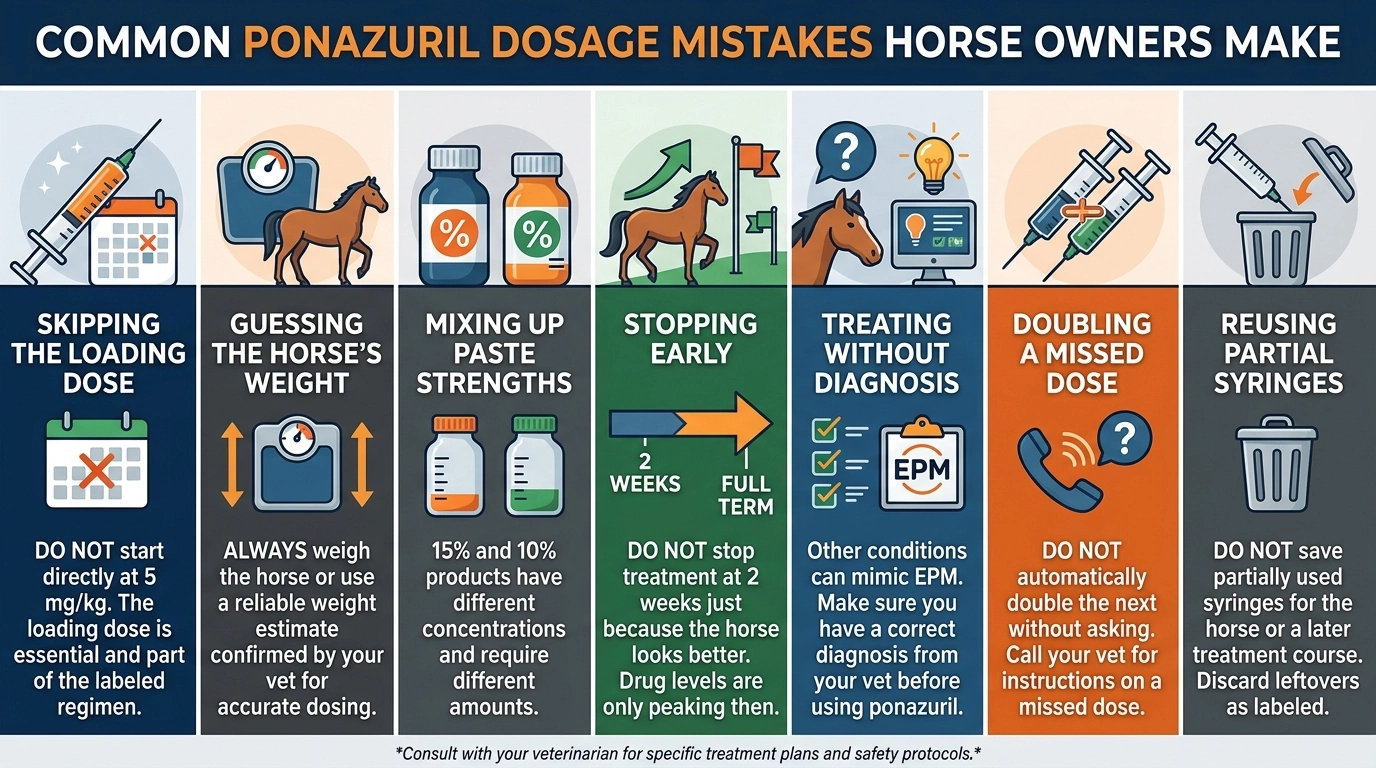
- Skipping the loading dose and starting at 5 mg/kg. The loading dose is part of the labeled regimen.
- Guessing the horse’s weight. Always weigh or use a reliable estimate confirmed by your vet.
- Mixing up paste strengths. 15% and 10% products need different amounts.
- Stopping early because the horse looks better at two weeks. Drug levels are only peaking then.
- Treating without a diagnosis. Other conditions mimic EPM and do not respond to ponazuril.
- Doubling a missed dose without asking. Call your vet instead.
- Reusing a partly used syringe for the next horse or a later course. The label says to discard leftovers.
Can You Prevent EPM?
No proven preventive exists. The most practical step is cutting down contact with opossum droppings. The Merck Veterinary Manual suggests keeping feed in closed metal containers, not leaving horse or pet feed out overnight, removing bird feeders, clearing fallen fruit, and blocking opossum access to feeding areas.
Research on using an antiprotozoal for prevention is ongoing, but the manual states that evidence-based protocols are not yet available. Do not give ponazuril “just in case.”
Where Ponazuril Fits Among Other Horse Parasite Treatments
Ponazuril targets protozoa, not worms. A horse on EPM treatment still needs a sensible deworming plan, such as ivermectin dosage for horses or Panacur dosage for horses, set by your vet from fecal egg counts.
Ponazuril’s close relative has its own guide: see toltrazuril dosage for horses for how that triazine compares.
Key Takeaways
- The label regimen is 15 mg/kg on day 1, then 5 mg/kg once daily for 27 days, 28 days in total.
- Marquis paste is 150 mg per gram, so a 1,000 lb horse gets about 15.1 g per day.
- About 60% of horses improve, fewer than 25% recover completely, and relapse is possible.
- Confirm EPM with your vet before treating. Many other diseases look similar.
- Worsening signs early in treatment should prompt a call to your vet, not a dose change.
- Safety in breeding, pregnant or nursing mares has not been evaluated.
- Never use a paste strength other than the one you calculated for.
FAQs
What is the ponazuril dosage for horses?
The FDA-approved Marquis regimen is a 15 mg/kg loading dose on day 1, then 5 mg/kg once daily for 27 more days, for 28 days in total. That equals 6.81 mg/lb for the loading dose and 2.27 mg/lb for the daily dose.
How much ponazuril do I give a 1,000 lb horse?
A 1,000 lb (454 kg) horse needs about 2,268 mg of ponazuril per day, which is about 15.1 g of Marquis 15% paste. On day 1, the loading dose is about 45.4 g given as three ring doses.
How long should a horse be on ponazuril?
The label course is 28 days. Some vets extend treatment or add another drug based on how the horse responds, and the Merck Veterinary Manual says repeat blood testing should not be used to decide how long to treat. Follow your vet for any change.
Does ponazuril need a loading dose?
Yes, the label directs a 15 mg/kg loading dose on day 1. It is three times the daily dose and helps reach steady drug levels within one or two days instead of weeks.
How do I calculate ponazuril by weight?
Convert pounds to kilograms by dividing by 2.2046, multiply by 5 mg/kg, then divide by the paste strength (150 mg per gram for Marquis). The result is grams of paste per day. Triple it on day 1 for the loading dose.
How long does ponazuril take to work in horses?
Drug levels build slowly. In a study of normal horses on 5 mg/kg, peak CSF levels came at about 15 days and peak serum levels at about 18 days. Many horses are rechecked by a vet after the 28-day course.
What are the side effects of ponazuril in horses?
Reported effects include worsening ataxia early in treatment, blisters on the nose and mouth, rash or hives, loose stool and mild colic. A link to the drug was not established for most field-study events. Call your vet if any appear.
Is ponazuril safe for pregnant or nursing mares?
The label states that safe use in breeding horses, pregnant mares and lactating mares has not been evaluated. In a high-dose safety study, some mares showed edema in the uterine lining. Talk to your vet about the risks and benefits.
Should ponazuril be given with food?
The label says to make sure the horse’s mouth contains no feed when you deposit the paste. The Merck Veterinary Manual notes that corn oil or DMSO may improve absorption, but that is a decision for your vet.
Do I need a prescription for ponazuril?
In the United States, federal law restricts Marquis to use by or on the order of a licensed veterinarian. The manufacturer notes that an owner can give it once it has been prescribed.
What if I miss a dose of ponazuril?
The label does not give a make-up rule. Do not double the next dose. Call your vet or the manufacturer at 1-888-637-4251 for guidance.
How does ponazuril compare with diclazuril?
Both are 28-day oral treatments with apparently similar efficacy, according to the Merck Veterinary Manual. Ponazuril is a paste dosed at 5 mg/kg with a loading dose, while diclazuril is a pelleted top-dressing dosed at 1 mg/kg.
Can horses relapse after ponazuril?
Yes. About 60% of horses improve, fewer than 25% recover completely, and relapses can occur up to two years after antiprotozoal treatment stops, according to the Merck Veterinary Manual.
Can ponazuril prevent EPM in horses?
No proven preventive exists. Evidence-based protocols for preventive antiprotozoal use are not available, so ponazuril should be used only for treatment under veterinary direction.
Your Next Steps
If your horse has neurologic signs and no diagnosis yet, book a vet exam first. If EPM is confirmed and ponazuril is prescribed, weigh your horse, check the paste strength on the label, set a daily reminder, and write down the day 1 triple dose so nothing gets missed.
Take notes on gait each week, and film your horse walking in circles so your vet can compare before and after.
Use this guide to understand the label, ask better questions and avoid common mistakes. Your vet makes the final dosing and treatment decisions.
Sources and Further Reading
- Marquis (15% w/w ponazuril) Antiprotozoal Oral Paste: FDA label on DailyMed (revised 5/2025)
- Boehringer Ingelheim Animal Health: MARQUIS product page
- Merck Veterinary Manual: Equine Protozoal Myeloencephalitis
- Reed SM et al. ACVIM consensus statement on EPM (J Vet Intern Med, 2016)
- Mitchell MA. Ponazuril therapeutic review (Journal of Exotic Pet Medicine, 2008)
- Pusterla N. Treating EPM: Best Practices and Watch-Outs (Insight Equine, 2022)
- FDA: How to report an animal drug adverse event
Medical disclaimer: this article is for education only. Ponazuril is a prescription veterinary drug. Always follow the instructions of your veterinarian and the product label.