Previcox Dosage for Horses: Dosage Chart, Calculator & What Every Owner Must Know Before Giving Firocoxib
Written & Reviewed By: Medshorse Team
Last Updated: October 2026
If you searched for Previcox dosage for horses, you want a number. You will get one below. But first, a fact many pages bury: Previcox is a dog medication, and the firocoxib product made for horses is Equioxx. That difference changes the dose, the legal picture and the safety margin.
Quick answer: The firocoxib dose for horses is 0.1 mg/kg (0.045 mg/lb) by mouth once daily for up to 14 days. Previcox is a dog product with no horse label. The FDA approved horse tablet, Equioxx, is one 57 mg tablet daily for horses weighing 800 to 1,300 lb. Your vet sets the final plan.
Disclaimer: This article is for general education and is not veterinary advice. Product names mentioned, including Previcox, belong to their respective owners, and MedsHorse is not affiliated with them. Always follow your veterinarian’s instructions and the current product label.
Previcox Dosage for Horses at a Glance
- Active ingredient: firocoxib, a COX-2 preferential NSAID
- Horse dose: 0.1 mg/kg (0.045 mg/lb) once daily
- Equioxx tablet: one 57 mg tablet for horses of 800 to 1,300 lb
- Maximum label duration: 14 days for any firocoxib form
- Previcox dog dose: 5 mg/kg, which is 50 times the horse dose per kilogram
- Not for: horses intended for human consumption, or horses allergic to firocoxib
What Is Previcox, and Is It Meant for Horses?
Previcox is a barbecue flavored chewable firocoxib tablet from Boehringer Ingelheim. Its label covers dogs, for osteoarthritis pain and for pain after surgery. It comes in 57 mg and 227 mg strengths, and the dog dose is 2.27 mg/lb (5 mg/kg) once daily.
What Is Firocoxib?
Firocoxib is a nonsteroidal anti-inflammatory drug (NSAID). It blocks the COX-2 enzyme that drives joint inflammation and pain, while sparing more of the COX-1 enzyme that helps protect the stomach and kidneys. A review of firocoxib in equine osteoarthritis notes other authors have reported it is about 265 times more selective for COX-2 than COX-1.
Why the Dog Dose Is Dangerous for a Horse
A dog gets 5 mg of firocoxib per kilogram. A horse gets 0.1 mg per kilogram. Giving a horse the dog rate would be a 50 times overdose. Even a single 227 mg dog tablet is more than five times the roughly 45 mg a 1,000 lb horse needs.
The FDA client information sheet for Equioxx tablets also warns owners against substituting the dog tablets for horses because overdoses can occur.
Previcox vs Equioxx for Horses: What Is the Difference?
Both products contain firocoxib, but only Equioxx is approved for horses. The doses per kilogram, the labeled uses and the legal status are all different.
| Feature | Previcox | Equioxx |
|---|---|---|
| Labeled species | Dogs | Horses |
| Active ingredient | Firocoxib | Firocoxib |
| Forms | 57 mg and 227 mg chewable tablets | 57 mg tablets, oral paste, 20 mg/mL injection |
| Labeled dose | 5 mg/kg (2.27 mg/lb) daily | 0.1 mg/kg (0.045 mg/lb) daily; tablet is one 57 mg for 800 to 1,300 lb |
| Labeled duration | As needed for dog osteoarthritis | Up to 14 days |
| Use in horses | Extra label, which equine clinics report is no longer allowed now that an equine tablet exists | FDA approved |
For years, vets prescribed Previcox to horses because it cost less than Equioxx paste. Irongate Equine Clinic explained that extra label drug use is only allowed under strict conditions, including that no approved product with the right ingredient, form and concentration exists.
It also warned that insurers may refuse claims for a horse that has had Previcox, and that owners lose recourse against the manufacturer if a horse reacts.
Once an equine labeled 57 mg tablet arrived, clinics changed course. Oakencroft Equine states that it can no longer legally prescribe Previcox 57 or 227 mg tablets for horses and now uses Equioxx 57 mg tablets. For the full product breakdown, see our guide to Equioxx dosage for horses.
Firocoxib Dosage Chart for Horses by Weight
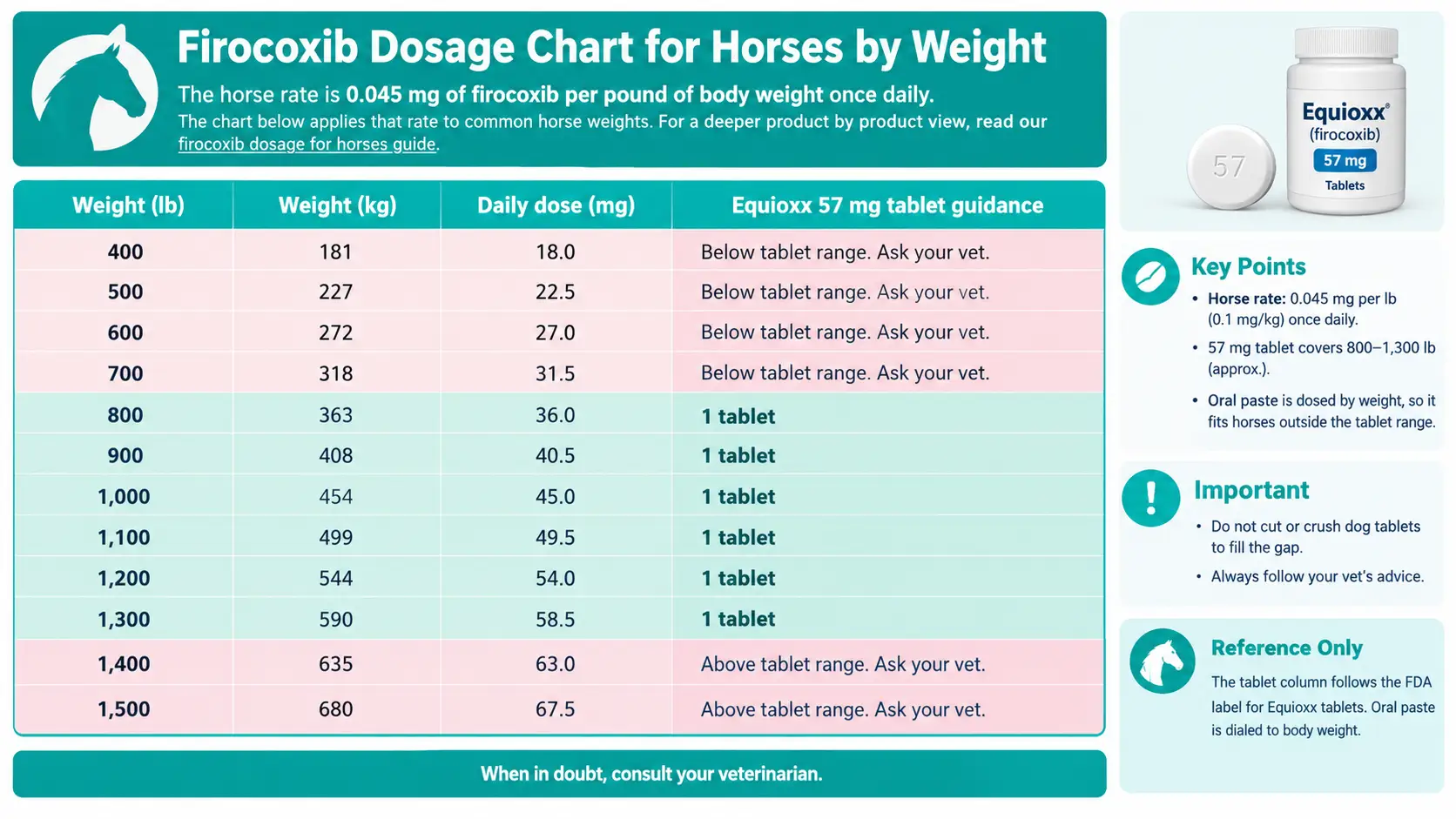
The horse rate is 0.045 mg of firocoxib per pound of body weight once daily. The chart below applies that rate to common horse weights. For a deeper product by product view, read our firocoxib dosage for horses guide.
| Weight (lb) | Weight (kg) | Daily dose (mg) | Equioxx 57 mg tablet guidance |
|---|---|---|---|
| 400 | 181 | 18.0 | Below tablet range. Ask your vet. |
| 500 | 227 | 22.5 | Below tablet range. Ask your vet. |
| 600 | 272 | 27.0 | Below tablet range. Ask your vet. |
| 700 | 318 | 31.5 | Below tablet range. Ask your vet. |
| 800 | 363 | 36.0 | 1 tablet |
| 900 | 408 | 40.5 | 1 tablet |
| 1,000 | 454 | 45.0 | 1 tablet |
| 1,100 | 499 | 49.5 | 1 tablet |
| 1,200 | 544 | 54.0 | 1 tablet |
| 1,300 | 590 | 58.5 | 1 tablet |
| 1,400 | 635 | 63.0 | Above tablet range. Ask your vet. |
| 1,500 | 680 | 67.5 | Above tablet range. Ask your vet. |
Reference only. The tablet column follows the FDA label for Equioxx tablets. Oral paste is dialed to body weight, so it fits horses outside the tablet range.
The 57 mg tablet is a fixed dose, so it covers a weight band rather than every pound. If your horse falls outside 800 to 1,300 lb, your vet may choose the oral paste, which is dosed by weight. Do not cut or crush dog tablets to fill the gap.
Previcox Horse Dosage Calculator
© medshorse.com
The math is simple. Multiply body weight in pounds by 0.045, or body weight in kilograms by 0.1. For a 1,000 lb horse, that is 1,000 x 0.045 = 45 mg of firocoxib per day. A scale gives the most reliable weight, and a weight tape is a reasonable second choice.
How to Give Firocoxib to a Horse Safely
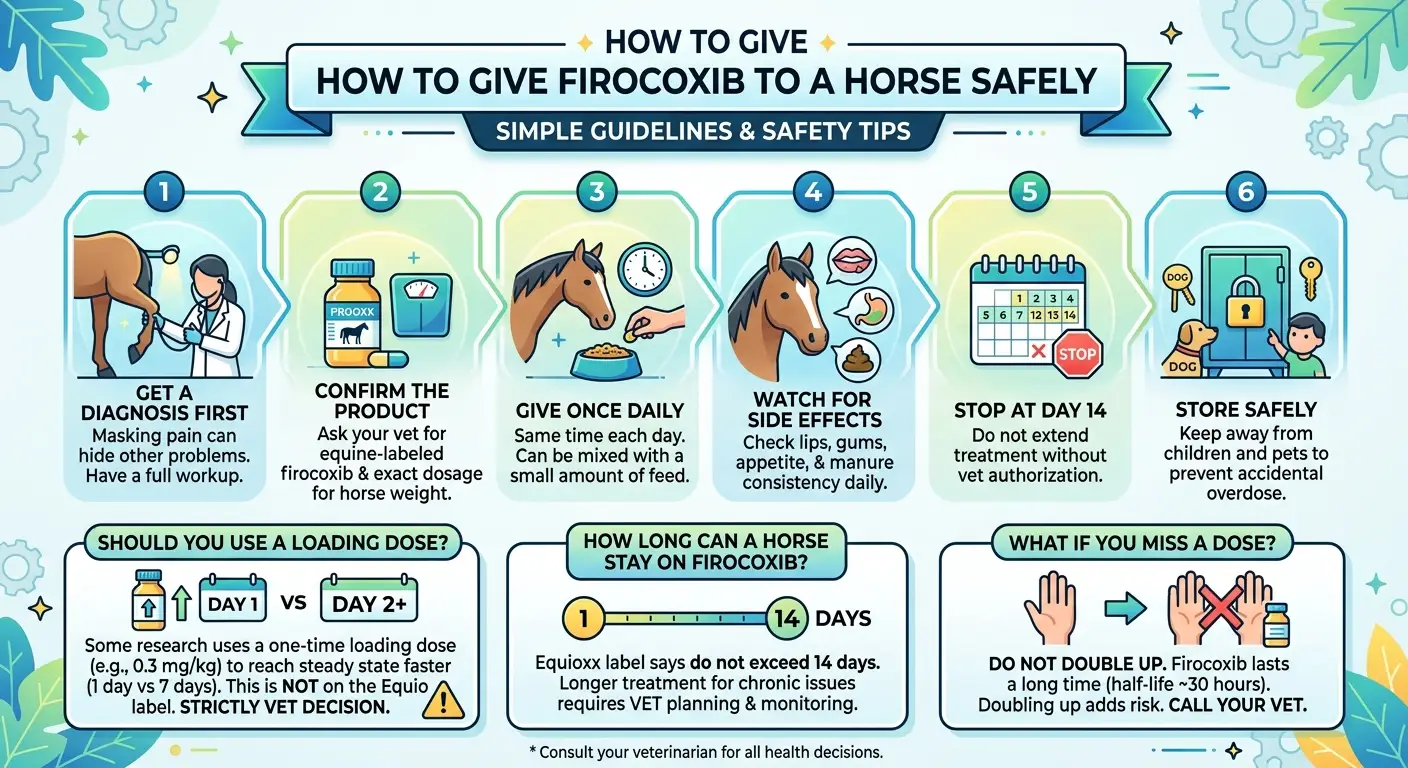
- Get a diagnosis first. Lameness has many causes, and masking pain can hide a problem that needs different care.
- Confirm the product. Ask your vet for the equine labeled product and the exact amount for your horse’s weight.
- Give it once daily at a steady time. The Equioxx tablet label allows dosing with food, and the FDA study placed tablets on a small amount of feed.
- Watch appetite, manure and the mouth. Check the lips and gums for swelling or sores.
- Stop at day 14, or sooner if your vet says so. Do not extend treatment on your own.
- Store tablets away from dogs and children. Accidental ingestion is a real overdose risk.
Should You Use a Loading Dose?
Some research used a one time loading dose of 0.3 mg/kg on day one, followed by 0.1 mg/kg daily. The study authors noted it brought blood levels near steady state after the first day instead of after about seven days. That approach is not on the Equioxx label, so it is strictly a decision for your veterinarian.
How Long Can a Horse Stay on Firocoxib?
The label says treatment with any firocoxib form, whether tablets, paste or injection, should not exceed 14 days. Some safety studies ran longer under controlled conditions, but extended use for a chronic arthritic horse is something only your vet should plan and monitor.
What If You Miss a Dose?
Do not double up the next day. Firocoxib stays in the body a long time, with an oral half life of about 30 hours in one study, so a doubled dose adds to what is already there. Call your vet for guidance.
How Fast Does Firocoxib Work in Horses?
At the labeled dose, most improvement shows up within about a week. Blood levels take roughly seven days to reach a steady state, which is slower than bute. That is why some owners expect quick results and feel disappointed on day two.
How Well Does Firocoxib Work? What the Studies Show
Firocoxib has been tested in several horse studies. The figures below come from the published review of equine osteoarthritis trials. They are separate studies, so compare them with care.
In the 253 horse trial, firocoxib paste and bute paste improved lameness at similar rates, with no significant overall difference. Firocoxib did score better on pain on manipulation, joint circumference and range of motion.
The field study had no control group, so the authors warned that owner and vet bias may have inflated results. Firocoxib is a symptom modifier. The review found no evidence that it slows joint disease.
Previcox for Horses: Side Effects and Risks
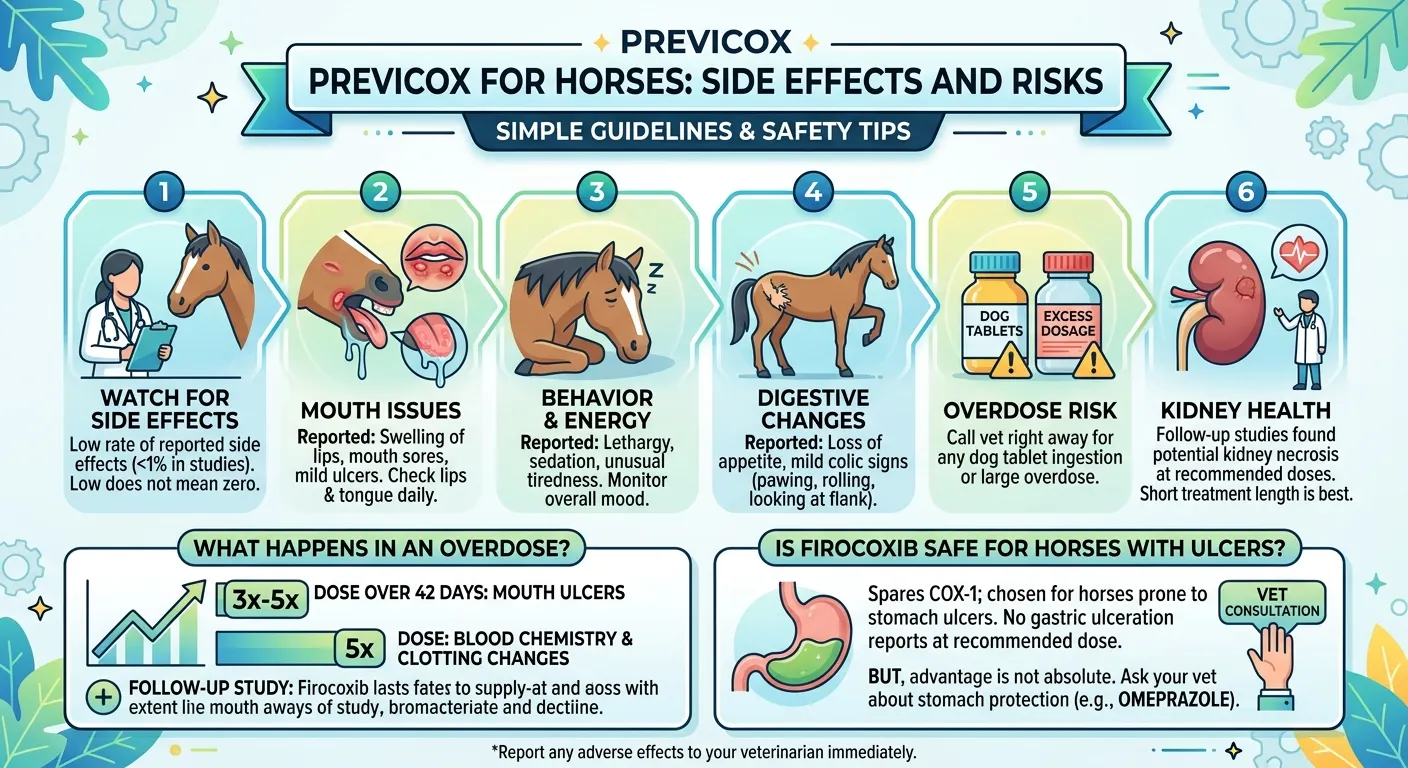
At the labeled dose, firocoxib has a low rate of reported side effects. Reported problems include swelling of the lips, mild colic, mild mouth ulcers, lethargy and sedation. In one safety report, fewer than 1 percent of horses had an adverse effect. Low does not mean zero.
- Loss of appetite or unusual tiredness
- Signs of colic such as pawing, rolling or looking at the flank
- Swollen lips or tongue, heavy drooling or mouth sores
- Any sign that a horse swallowed dog tablets or too much medication
What Happens in an Overdose?
Target animal safety studies found mouth ulcers at three and five times the recommended dose over 42 days, and blood chemistry and clotting changes at five times the dose.
A follow up study reported delayed healing of existing mouth ulcers in all horses, and kidney papillary necrosis in one of eight horses given the recommended dose. That last finding is a good reason to keep treatment short and monitored.
Is Firocoxib Safe for Horses With Ulcers?
Because firocoxib spares more COX-1, it is often chosen for horses prone to stomach ulcers. The review found no reports of gastric ulceration at the recommended dose, but it also cautioned that the advantage over bute is not absolute.
Ask your vet whether stomach protection such as omeprazole dosage for horses should be part of the plan.
Who Should Not Get Firocoxib?
- Horses with a known hypersensitivity to firocoxib
- Horses intended for human consumption
- Horses under one year old, breeding horses, and pregnant or lactating mares, because safe use has not been evaluated
- Horses already receiving another NSAID, unless a vet has approved the combination
Can You Combine Firocoxib With Bute, Banamine or Other Drugs?
Not without veterinary approval. The label cautions against combining firocoxib with other anti-inflammatory drugs, and protein bound drugs have not been studied with it.
In one study, six horses given firocoxib and phenylbutazone together for 10 days showed rises in creatinine and total protein, which supports kidney stress.
If your horse is already on another NSAID, read our guides on bute dosage for horses and Banamine dosage for horses, then ask your vet which single drug fits best. For joint support alongside an NSAID plan, see Adequan dosage for horses.
Firocoxib and Competition Drug Testing
Research on all three firocoxib forms found blood levels stayed below the 2014 USEF threshold of 240 ng/mL during sampling, and below the Racing Medication and Testing Consortium level of 20 ng/mL seven days after the last dose.
Rules change often, so check your current rulebook and ask your vet about withdrawal timing before you compete.
Common Mistakes Owners Make With Previcox
- Cutting dog tablets into “horse sized” pieces and guessing the amount
- Using the dog dose of 5 mg/kg, which is 50 times too high for a horse
- Stacking firocoxib with bute or Banamine
- Running treatment past 14 days without a vet plan
- Judging the drug on day two, before blood levels reach a steady state
- Leaving tablets where dogs or children can reach them
FAQs
What is the Previcox dosage for horses?
Previcox is labeled for dogs, so it has no labeled horse dose. The firocoxib dose approved for horses is 0.1 mg/kg (0.045 mg/lb) once daily for up to 14 days, and Equioxx 57 mg tablets are labeled as one tablet daily for horses weighing 800 to 1,300 lb. Your vet sets the exact plan.
Can horses take Previcox?
Previcox contains firocoxib, the same drug as Equioxx, but it is approved for dogs. Veterinary clinics report that once an equine labeled tablet became available, prescribing Previcox for horses was no longer legal for them. Ask your vet for Equioxx instead.
How many Previcox tablets should I give a 1,000 lb horse?
Do not give dog tablets on your own. For a 1,000 lb horse the label rate works out to about 45 mg of firocoxib, and the labeled Equioxx product for that weight is one 57 mg tablet daily. Your vet should confirm the product and amount.
Is Previcox the same as Equioxx?
Both contain firocoxib and are made by the same company, but Previcox is a dog product and Equioxx is FDA approved for horses. The doses per kilogram are very different, 5 mg/kg for dogs and 0.1 mg/kg for horses.
How long can a horse stay on firocoxib?
The label says treatment with any firocoxib form, whether tablets, paste or injection, should not exceed 14 days. Longer use is a decision for your veterinarian.
How fast does firocoxib work in horses?
In clinical studies, improvement was usually seen within about 7 days at the labeled dose, which is also when blood levels reach a steady state. Higher research doses worked earlier, but those are not label doses.
What happens if a horse gets too much firocoxib?
Overdose can cause mouth ulcers, lip swelling and colic signs, and in safety studies at five times the dose, blood chemistry and clotting changes. Call your vet right away if a horse eats dog tablets or receives too much.
Can I give firocoxib with bute or Banamine?
Not unless your vet says so. The label cautions against combining firocoxib with other anti-inflammatory drugs. In a study of firocoxib plus bute for 10 days, creatinine and total protein rose, which points to kidney stress.
Is firocoxib safe for horses with stomach ulcers?
Firocoxib spares more COX-1 than bute and is often chosen for ulcer prone horses, but it is not risk free. It can cause mouth ulcers and may delay healing of existing ones, so ask your vet whether added stomach protection is needed.
Can foals, breeding horses or pregnant mares get firocoxib?
Safety has not been evaluated in horses under one year, breeding horses, or pregnant and lactating mares. Your vet should weigh the risks and benefits before using it.
Is firocoxib allowed in horse competition?
Rules differ by organization and change over time. Research found firocoxib levels at the label dose stayed below the 2014 USEF threshold of 240 ng/mL, and below the 20 ng/mL RMTC level 7 days after the last dose. Always check the current rulebook and ask your vet.
Can I give firocoxib to a horse intended for food?
No. The label states that firocoxib is not for use in horses intended for human consumption.
What are the side effects of firocoxib in horses?
Reported effects include swelling of the lips or tongue, heavy drooling, mild colic, mild mouth ulcers, lethargy, sedation and loss of appetite. Stop the medication and call your vet if any of these appear.
Is firocoxib better than bute for horses?
In a 253 horse trial, 85 percent of horses improved on firocoxib and 87 percent on bute, with no significant overall difference. Firocoxib did better on a few joint measures and is given once daily. Your vet chooses based on your horse.
Can I split an Equioxx tablet for a smaller horse?
The tablet is scored, but the label dose is one whole 57 mg tablet for horses weighing 800 to 1,300 lb. For smaller horses, ask your vet, since oral paste can be dosed by body weight.
Key Takeaways and Next Steps
- The horse firocoxib dose is 0.1 mg/kg (0.045 mg/lb) once daily for up to 14 days.
- Equioxx 57 mg is the FDA approved tablet, one daily for horses of 800 to 1,300 lb.
- Previcox is a dog product, and its dog dose is 50 times higher per kilogram.
- Do not combine firocoxib with other NSAIDs unless your vet says so.
- Watch appetite, manure and the mouth, and call your vet at the first warning sign.
Next step: book a lameness exam, ask your vet whether Equioxx tablets or paste suit your horse’s weight, and write down the start and stop dates before the first dose.
This article is for education and is not a substitute for veterinary advice. Always follow the instructions and the product label from your veterinarian.