Biotin Dosage for Horses: Dosage Chart, Calculator & Safety Guide for Stronger Hooves
Written & Reviewed By: Medshorse Team
Last Updated: October 2026
Cracked walls, chipped edges, shoes that won’t stay on. Biotin is the first thing many horse owners reach for, and then they hit the feed-store shelf. One tub says 7.5 mg, another says 20 mg, and a third doesn’t say clearly at all.
Biotin dosage for horses typically falls at 15 to 20 mg per day for an average 500 kg (1,100 lb) adult. Some references go up to 30 mg for problem hooves or heavy horses, and ponies need less. The dose matters less than feeding it every day for 6 to 15 months, because hooves grow slowly.
This guide gives you a weight-based chart, a free calculator, the research behind the numbers, safety limits and the mistakes that waste money. Last updated: October 2026.
Disclaimer: This article is for general education, not veterinary advice. Brands mentioned belong to their owners, and MedsHorse is not affiliated with them. Always follow your vet’s instructions and the product label.
Quick Answer
for a typical 500 kg (1,100 lb) adult horse with weak hoof horn. Ponies need less. Some references go up to 30 mg for problem hooves. Feed daily for at least 6–9 months.
What Is Biotin and What Does It Do in Horses?
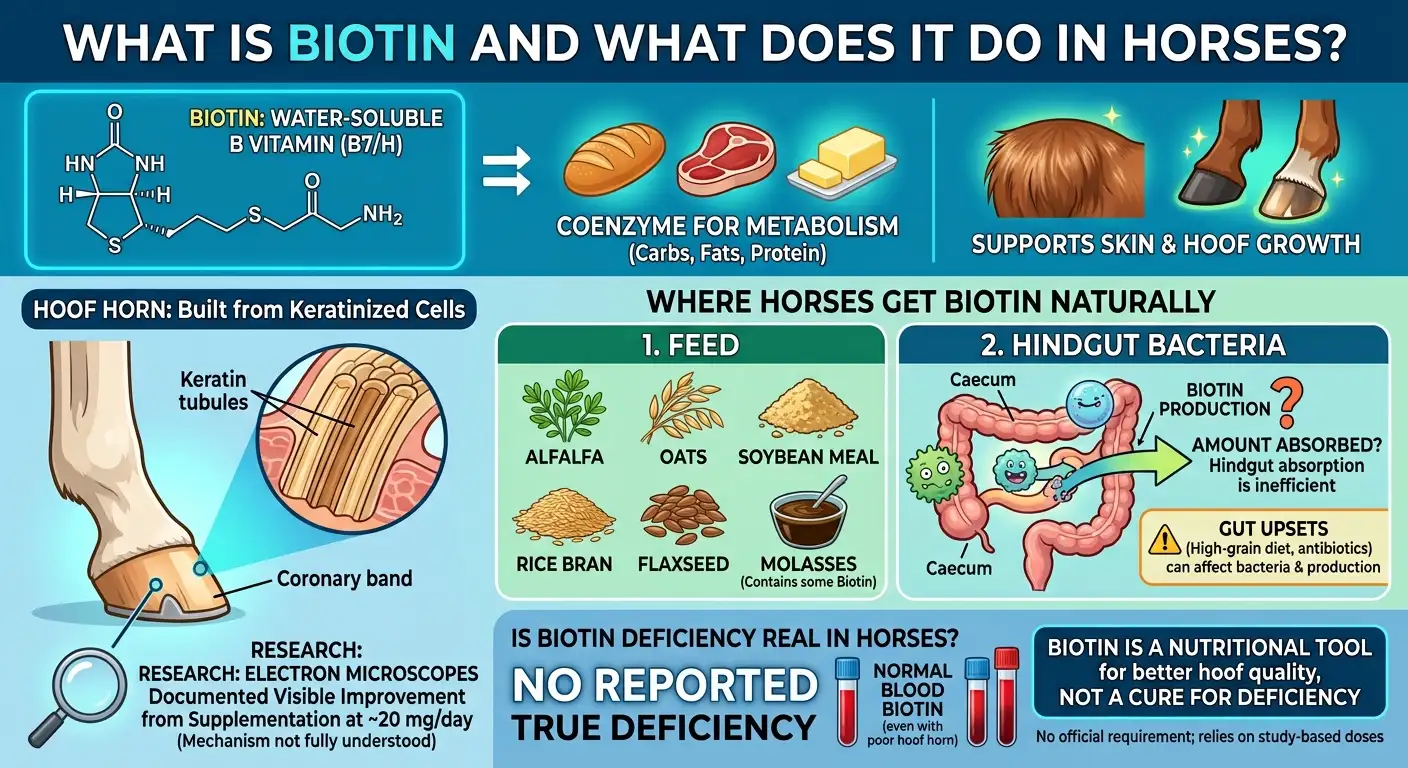
Biotin is a water-soluble B vitamin, also called vitamin B7 or vitamin H. It works as a coenzyme in carbohydrate, fat and protein metabolism, and it supports skin and hoof growth and repair.
Hoof horn is built from keratinized cells arranged in tiny tubules that run from the coronary band down to the ground. Researchers don’t fully understand how biotin helps. Electron microscope work, though, has documented visible improvement in hoof horn from supplementation at about 20 mg per day.
Where Horses Get Biotin Naturally
Horses get biotin from two places:
- Feed: alfalfa, oats, soybean meal, rice bran and molasses all contain some.
- Hindgut bacteria: microbes ferment forage in the caecum and large intestine and produce biotin.
Nobody knows how much of the hindgut biotin the horse actually absorbs, because the hindgut isn’t an efficient place for absorbing nutrients. Anything that upsets the gut microbiome, such as a high-grain diet or antibiotics, may also change biotin production. Biotin in the ration may be absorbed better than biotin made in the hindgut.
Is Biotin Deficiency Real in Horses?
True deficiency has not been reported in horses. Researchers have even found normal blood biotin in horses with poor-quality hoof horn.
Yet those horses still responded to much higher doses by mouth. So biotin works more like a nutritional tool than a cure for a deficiency. This is why there is no official daily requirement, only dose ranges that worked in studies.
Biotin Dosage for Horses: How Much Is Enough?
For an average adult horse, 15 to 20 mg of biotin per day is the most widely used range. Hartog’s guideline and many hoof supplements land on 20 mg. A Med-Vet Pharmaceuticals guide puts it at 20 mg per 500 kg, and some horses with visible hoof problems may be given up to 30 mg.
Two other points from the research:
- Higher beat lower in one trial. In a 10-month study of 24 riding horses, 15 mg per day produced greater hoof growth and hardness than 7.5 mg.
- Hoof supplements typically supply 5 to 25 mg per daily serving. Fortified feeds usually contribute less than 1 mg per day at normal feeding rates, according to Kentucky Equine Research (KER).
KER’s practical advice is that a horse should receive at least 15 mg per day to get the maximum hoof benefit.
Biotin Dosage Chart for Horses by Weight
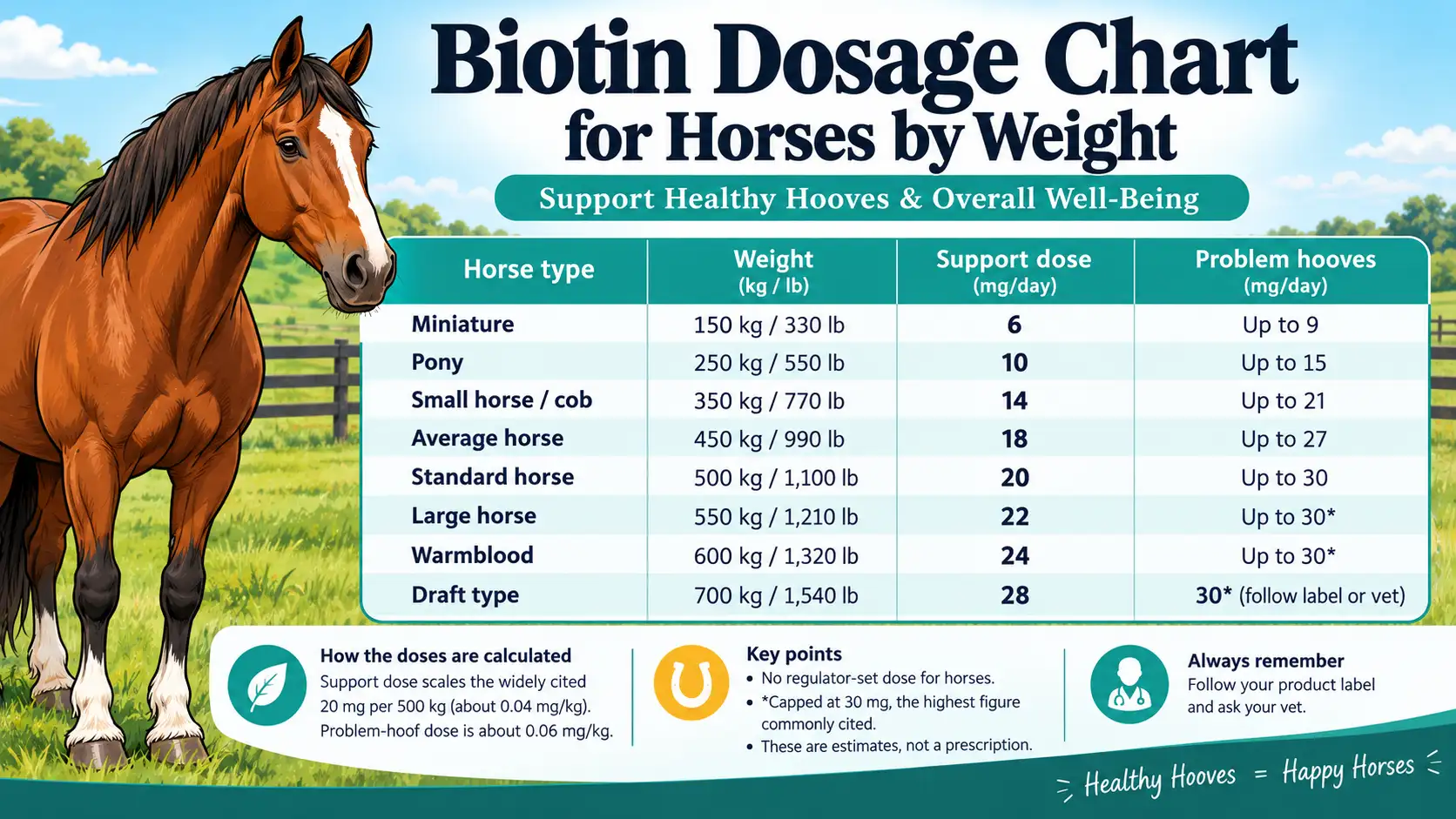
There is no regulator-set dose for horses. The chart below scales the commonly cited 20 mg per 500 kg support dose (about 0.04 mg per kg) and the 30 mg ceiling used for problem hooves. Use it as a starting guide, not a prescription.
Biotin Dosage Chart for Horses by Body Weight
| Horse type | Weight | Support dose (mg/day) | Problem hooves (mg/day) |
|---|---|---|---|
| Miniature | 150 kg / 330 lb | 6 | Up to 9 |
| Pony | 250 kg / 550 lb | 10 | Up to 15 |
| Small horse / cob | 350 kg / 770 lb | 14 | Up to 21 |
| Average horse | 450 kg / 990 lb | 18 | Up to 27 |
| Standard horse | 500 kg / 1,100 lb | 20 | Up to 30 |
| Large horse | 550 kg / 1,210 lb | 22 | Up to 30* |
| Warmblood | 600 kg / 1,320 lb | 24 | Up to 30* |
| Draft type | 700 kg / 1,540 lb | 28 | 30* (follow label or vet) |
Support dose scales the widely cited 20 mg per 500 kg (about 0.04 mg/kg). Problem-hoof dose is about 0.06 mg/kg. *Capped at 30 mg, the highest figure commonly cited. These are estimates, not regulator-set doses. Always follow your product label and ask your vet.
Biotin Dosage Calculator
Enter your horse’s weight and, if you like, the biotin per serving printed on your product label. The calculator gives a daily dose and the number of servings.
© medshorse.com
Biotin Dosage for Ponies and Miniature Horses
Ponies need a smaller dose, roughly 6 to 12 mg per day depending on size. One pony trial used 0.12 mg per kg per day. Product labels are more conservative: Lloyd Biotin-100 suggests one 7.5 mg measure a day for ponies, and Equine America lists 30 g (about 12 mg) for smaller ponies.
For foals, pregnant or lactating mares, and horses with metabolic disease, the sources reviewed for this guide don't set separate doses. Ask your vet before starting.
Support Dose vs. Problem-Hoof Dose
| Situation | Typical daily dose (500 kg horse) |
|---|---|
| Healthy hooves, routine support | About 15–20 mg |
| Weak, crumbling or chipped hoof horn | 20 mg, sometimes up to 30 mg |
| Heavy horses | Up to 30 mg, or follow the label |
Staying consistent matters more than going higher. Large doses for a short time won't speed up results.
What Does the Research Say About Biotin for Horses?
The evidence is real but modest. Most studies are small, and many date from the 1980s and 1990s. Here are the numbers that matter:
- Lipizzaner study: 90% of Austrian Lipizzaners examined had soft white lines and crumbling, fissured horn at the bearing border.
- Pony trial: treated ponies grew 35.34 mm of hoof in five months versus 30.69 mm for controls, about 15% faster growth.
- Long-term study: 97 horses on biotin improved after 8 to 15 months, while the hoof condition of most controls stayed the same.
Key Biotin Studies in Horses and Ponies
| Study | Animals | Dose | Duration | Main finding |
|---|---|---|---|---|
| Comben et al., 1984 | 40+ clinical cases | 10–30 mg/day | Not stated | Varying improvement in hardness, integrity and shape of hoof horn in all cases |
| Wintzer, 1986 | 15 horses (5 warmbloods, 10 trotters) | 0.031–0.037 mg/kg/day (about 15–18 mg for 500 kg) | Up to 10 months | Well tolerated; improved horn quality in the growing hoof |
| Buffa et al., 1992 | 24 riding horses | 7.5 vs 15 mg/day | 10 months | Significant gains in growth rate and hardness; 15 mg beat 7.5 mg |
| Geyer & Schulze, 1994 | 97 treated, 11 controls | 5 mg per 100–150 kg/day | 1–6 years | Improvement after 8–15 months; growth rate unchanged; 7 of 10 worsened after dose cut or stopped |
| Josseck / Zenker et al., 1995 | 42 Lipizzaner stallions (double blind) | 20 mg/day | 19 months | Controlled trial of hoof quality in a breed with a high rate of soft white lines and crumbling horn |
| Reilly et al., 1998 | 8 match-paired ponies | 0.12 mg/kg/day | 5 months | 35.34 mm vs 30.69 mm growth; about 15% faster growth (P < 0.05) |
| Kempson, 1987 | Horses with brittle feet | Not stated | Not stated | One defect type resolved with biotin; another responded only after limestone was added |
Most studies are small and older. Doses and designs differ, so results can't be compared directly. Sources: Mad Barn research database, Kentucky Equine Research, PubMed.
Biotin improves hoof quality more reliably than it speeds growth. Some studies found faster growth. Others found harder, more intact horn with no change in growth rate. Researchers also note that evaluating supplements in horses is slow, difficult and expensive, which is partly why the evidence base is thin.
How Long Does Biotin Take to Work in Horses?
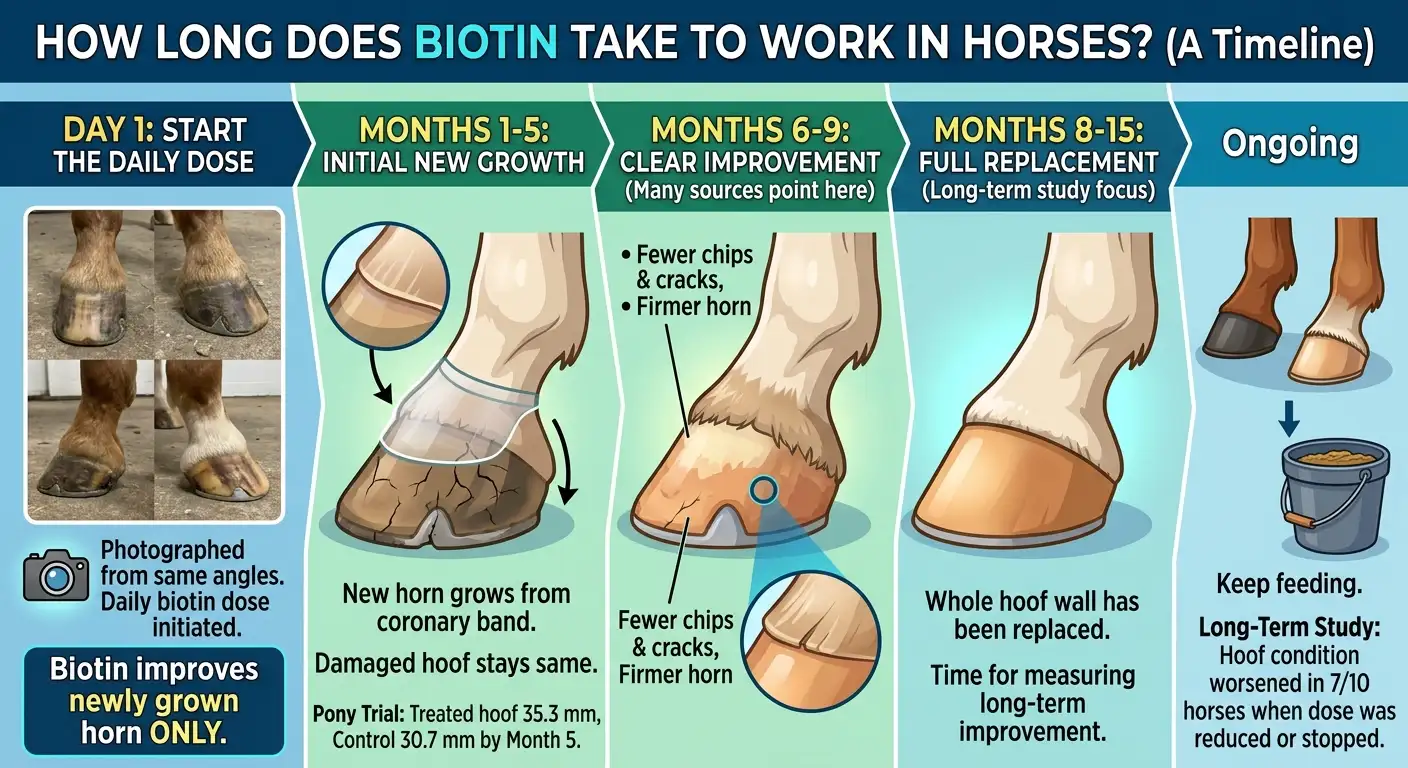
Expect 6 to 9 months to see a clear difference, and 8 to 15 months for the hoof wall to fully replace itself. Biotin only improves newly grown horn. It can't repair the damaged hoof you already have.
Biotin Results Timeline for Horse Hooves
Expert tip: take a photo of each hoof from the same angle every month. Growth is slow enough that you'll forget what "before" looked like. Researchers in one trial marked the hoof wall and measured the distance to the coronary band over time. Photos are a simple version of the same idea.
Is Biotin Safe for Horses? Side Effects and Limits
Biotin appears to be very safe for horses. Toxicity has not been reported, and no upper limit has been set. Because it is water-soluble, the body doesn't store the excess; it is excreted in urine. Mad Barn notes that horses could likely tolerate many times the usual dose, an estimate drawn from studies in other animals rather than from horse trials.
Safe doesn't mean "more is better," though. Three practical cautions:
- Don't double up. Complete feeds, balancers and multi-vitamins can already contain 20 mg. Add up every label first.
- Don't expect faster results from mega-doses. No study shows that doses above the 20 to 30 mg range work faster.
- Watch the extras. Combination hoof products may include other ingredients. For example, one UK maker notes that the MSM in its biotin powder is a threshold substance under the Rules of Racing. Competition horses need products checked against their governing body's rules.
How to Read a Biotin Label (and Convert Scoops to mg)
Labels list biotin in different ways: mg per serving, mg per kg of powder, or mg per pound. Here is how a few real labels compare.
Biotin Label Reality Check: What Products Actually Provide
| Product label | Biotin per serving | Daily feeding rate |
|---|---|---|
| Lloyd Biotin-100 | 7.5 mg per heaping measure (about 1.2 oz) | 2 measures for a 1,100 lb horse (15 mg); 1 measure for ponies |
| NAF Biotin Plus | 15 mg per 50 g | 50 g for horses and ponies |
| Equine America Biotin Xtra | 20 mg per 50 g | 50 g for horses and large ponies; 30 g (about 12 mg) for smaller ponies |
| Mad Barn Biotin powder | 20 mg per 4 g scoop | 1 scoop |
| Hartog Essential / Comfort (complete feeds) | 20 mg at the recommended daily amount | As directed on the bag; no extra biotin needed |
Figures taken from manufacturer pages. Formulas can change, so always check the current label. Equine America's 12 mg figure for smaller ponies is a calculation (20 mg x 30/50).
Worked example: a 500 kg horse needs about 20 mg a day. On Lloyd Biotin-100, each heaping measure supplies 7.5 mg, so 20 mg would be roughly 2.7 measures. The label itself suggests 2 measures (15 mg) for a 1,100 lb horse. Both are in the range used in studies, but they aren't the same dose, so decide which target you're aiming for.
Two buying notes from KER:
- Check freshness. Once biotin is mixed with oils or fats, shelf life is around six months from manufacture. Buy only what you can use in that time.
- Choose a reputable brand. Equine supplements are not government-controlled, so the amount on the label depends on the manufacturer.
Biotin Alone Won't Fix Weak Hooves
Nutrition and management shape the hoof as much as one vitamin does.
- Other nutrients matter. Zinc, methionine, copper and iodine all influence hoof quality. This is why many supplements pair biotin with them. If you're reviewing the mineral side of the diet, our guides to magnesium dosage for horses and kelp dosage for horses cover two common additions.
- Gut health affects biotin supply. Because hindgut bacteria make part of the horse's biotin, a disrupted gut can matter. See our glutamine dosage for horses guide for gut-support background.
- Some hoof defects don't respond to biotin. In an electron microscope study, one type of defect cleared up after biotin, while a second type, poor attachment of horn cells, did not. That second type improved when powdered limestone was added to the diet.
- Insulin-resistant and laminitic horses need a vet-led plan. If your horse is managing metabolic disease, read our metformin dosage for horses guide, then talk to your vet before adding supplements.
- A dull coat isn't always a biotin issue. Parasite load, protein intake and general health matter too. For deworming dose information, see our Panacur dosage for horses guide.
- Basics still win. Regular trimming, daily hoof cleaning, dry footing, exercise and balanced protein, copper and zinc all support the hoof.
Common Mistakes to Avoid
- Quitting after two months. The hoof hasn't had time to grow out. Judge results after 6 to 9 months at least.
- Stopping once hooves look good. In one long-term study, hoof condition worsened in 7 of 10 horses whose biotin was reduced or stopped.
- Doubling up on products. A balancer plus a hoof powder plus a multi-vitamin can mean far more biotin than you planned.
- Under-dosing a full-size horse. A 5 mg scoop is a pony-sized dose. Compare mg per day, not scoops.
- Ignoring the farrier. Trimming balance and shoeing affect cracks as much as nutrition.
- Buying in bulk. Fat-mixed supplements lose freshness over about six months.
When to Call Your Vet
Biotin is for hoof quality, not for lameness. If you see any of the signs below, call your vet before changing supplements.
Call Your Vet Before Adjusting Supplements If You See:
- Sudden lameness or reluctance to bear weight
- Heat in the hoof or a bounding pulse at the fetlock (possible laminitis)
- Foul smell, black discharge or soft crumbling frog (possible thrush or infection)
- Hoof wall separating or the sole bruising easily
- No improvement after 9 to 12 months of consistent daily dosing
- A pregnant or nursing mare, foal, or a horse with metabolic disease that you plan to supplement
Biotin supports hoof horn quality. It does not treat pain, infection or lameness.
Key Takeaways and Next Steps
- Dose: about 15 to 20 mg per day for a 500 kg horse, up to 30 mg for problem hooves, and less for ponies.
- Timeline: 6 to 9 months to see change, 8 to 15 months for full hoof regrowth.
- Safety: no toxicity reported in horses, and the excess is excreted in urine.
- Consistency beats quantity. Daily feeding matters more than a bigger dose.
- Look at the whole hoof. Minerals, gut health, footing and farrier work all count.
Your next step: check the biotin on every product you already feed, set a target from the chart, photograph the hooves today, and re-check in three months.
FAQs
How much biotin should I give my horse per day?
Most adult horses of about 500 kg (1,100 lb) with weak hoof quality are given 15 to 20 mg of biotin per day. Some references go up to 30 mg for problem hooves or heavy horses. Ponies need less, roughly 6 to 12 mg. Feed it daily for at least 6 to 9 months.
What is the right biotin dosage for ponies?
A practical estimate is about 0.04 mg per kg of body weight, which works out to roughly 10 mg per day for a 250 kg pony. Product labels often use 7.5 to 12 mg for ponies. Always follow the label and ask your vet if the pony has laminitis or metabolic issues.
Can a horse overdose on biotin?
No toxicity has been reported in horses, and no upper limit has been set. Biotin is water soluble, so extra is excreted in urine. Still, higher doses have not been shown to work faster, so stay within the 15 to 30 mg range and avoid doubling up on products that already contain biotin.
How long does biotin take to work in horses?
Expect 6 to 9 months before you notice a clear change, and 8 to 15 months for the hoof wall to fully grow out. Biotin only improves newly grown horn, so damaged hoof lower down will not repair. Keep dosing daily through the whole period.
Is 10 mg of biotin enough for a horse?
For a pony, often yes. For a 500 kg horse, 10 mg is below the doses used in most studies. One 10-month trial found 15 mg per day gave better hoof growth and hardness than 7.5 mg. Most feeding guides for horses suggest 15 to 20 mg.
Is 20 mg of biotin per day safe for horses?
Yes. 20 mg per day is a widely used dose and is the amount many hoof supplements provide per serving. No toxicity has been documented in horses at this level, and any excess is lost in urine. Check your feed label so you do not double up.
Do I need to give biotin every day?
Yes, daily feeding gives the best results. In a long-term study of 97 horses, hoof condition worsened in 7 of 10 horses whose biotin was reduced or stopped. If your horse responds, plan to continue long term.
Does biotin make horse hooves grow faster?
Results are mixed. A pony trial found about 15% faster hoof growth after five months, and a 10-month riding horse trial found faster growth at 15 mg. Other studies found hoof quality improved without any change in growth rate. Biotin is better described as improving hoof quality than as a growth booster.
Can biotin improve my horse's coat, mane and tail?
Biotin supports skin and keratin production, so a dull or dry coat may improve in some horses. However, the strongest research is on hooves, not hair. If the coat is dull, also check parasites, protein intake and overall health with your vet.
How do I know if my horse needs biotin?
True biotin deficiency has not been reported in horses, and horses with poor hoof horn have shown normal blood biotin levels. Signs that may justify a trial include cracked, crumbling or chipped hoof walls, soft white lines, and shoes that will not stay on. Ask your farrier or vet first.
What is the best time of day to feed biotin?
No research shows an ideal time. Mix the daily amount into the feed so it is eaten fully and at the same time each day. Biotin from the diet may be absorbed better than biotin made in the hindgut, so feeding it in the ration makes sense.
Can I give biotin with zinc, methionine and other hoof nutrients?
Yes. Many hoof supplements combine biotin with zinc, methionine, copper or iodine because these nutrients also affect hoof quality. Add up the totals from every product on the label so you know what your horse is really getting.
Does biotin work for every horse with bad hooves?
No. Hoof problems have many causes, including wet footing, poor trimming, thrush, laminitis and mineral imbalance. In one electron microscope study, one type of hoof defect responded to biotin while another improved only when limestone was added to the diet. A farrier and vet should look at the whole picture.
Is biotin allowed in competition horses?
Biotin itself is a vitamin, but many hoof supplements include other ingredients. One UK supplement maker notes that the MSM in its biotin powder is a threshold substance under the Rules of Racing. Check your governing body rules, choose products tested for prohibited substances, and ask the manufacturer if unsure.
How long does a biotin supplement stay fresh?
Once mixed with fats or oils, biotin supplements have a shelf life of around six months from manufacture. Buy fresh stock, store it sealed and cool, and only buy what you can use within that window.
Sources and Further Reading
- Kentucky Equine Research: Biotin Basics
- Buffa et al., 1992: Effect of dietary biotin supplement on equine hoof horn growth rate and hardness (PubMed)
- Geyer & Schulze, 1994: The long-term influence of biotin supplementation on hoof horn quality in horses (PubMed)
- Mad Barn: Biotin research database for horses (Comben 1984, Wintzer 1986, Josseck/Zenker 1995, Reilly 1998, Kempson 1987)
- Hartog: The benefits of biotin for horses
- Med-Vet Pharmaceuticals: Biotin for horses: benefits, dosage & best supplements
- Drugs.com: Biotin-100 label (Lloyd)
- Product labels: Equine America Biotin Xtra and NAF Biotin Plus