Winter Diarrhea in Horses: Why It Happens, What to Do Right Now, & How to Keep Your Horse’s Gut Steady All Season
You walk into the barn on a frozen morning and something is off. The manure that should be firm balls is soft, wet, and smeared up the tail.
Winter diarrhea in horses is common, and it covers a huge range. Sometimes it’s a harmless reaction to a new hay lot. Sometimes it’s the first sign of colitis, a parasite emergence, or an infection that can move through a barn. On day one, they can look identical.
Here’s the short version. Cold weather doesn’t directly cause diarrhea. But winter changes how we feed and house horses, and those changes (plus a few seasonal parasites and viruses) explain why loose manure turns up now.
A bright, eating horse with mildly soft manure can often be watched closely for a day or two. A horse that is dull, feverish, off feed, colicky or passing watery manure needs a vet the same day.
This guide walks you through the causes, the red flags, what to do tonight, what vets actually do, and how to prevent it next winter.
This article is educational and doesn’t replace veterinary care. Diarrhea in horses can become an emergency quickly.
⚡ Key Takeaways
- Winter diarrhea is a symptom, not a disease. Cold itself isn’t the cause; winter feeding, water and housing changes are.
- Bright, eating, normal temperature? Mild loose manure can often be watched for a day or two, but a call to your vet is still smart.
- Fever, dullness, colic, dehydration or watery manure? Same-day vet call.
- Don’t deworm a horse with diarrhea without your vet. Larval cyathostominosis can occur with a zero egg count.
- Dehydration is the main danger. Keep fresh water and good forage in front of him.
- Prevention is consistency: gradual feed changes, steady water, a vet-guided parasite plan, and daily manure checks.
What Is Winter Diarrhea in Horses?
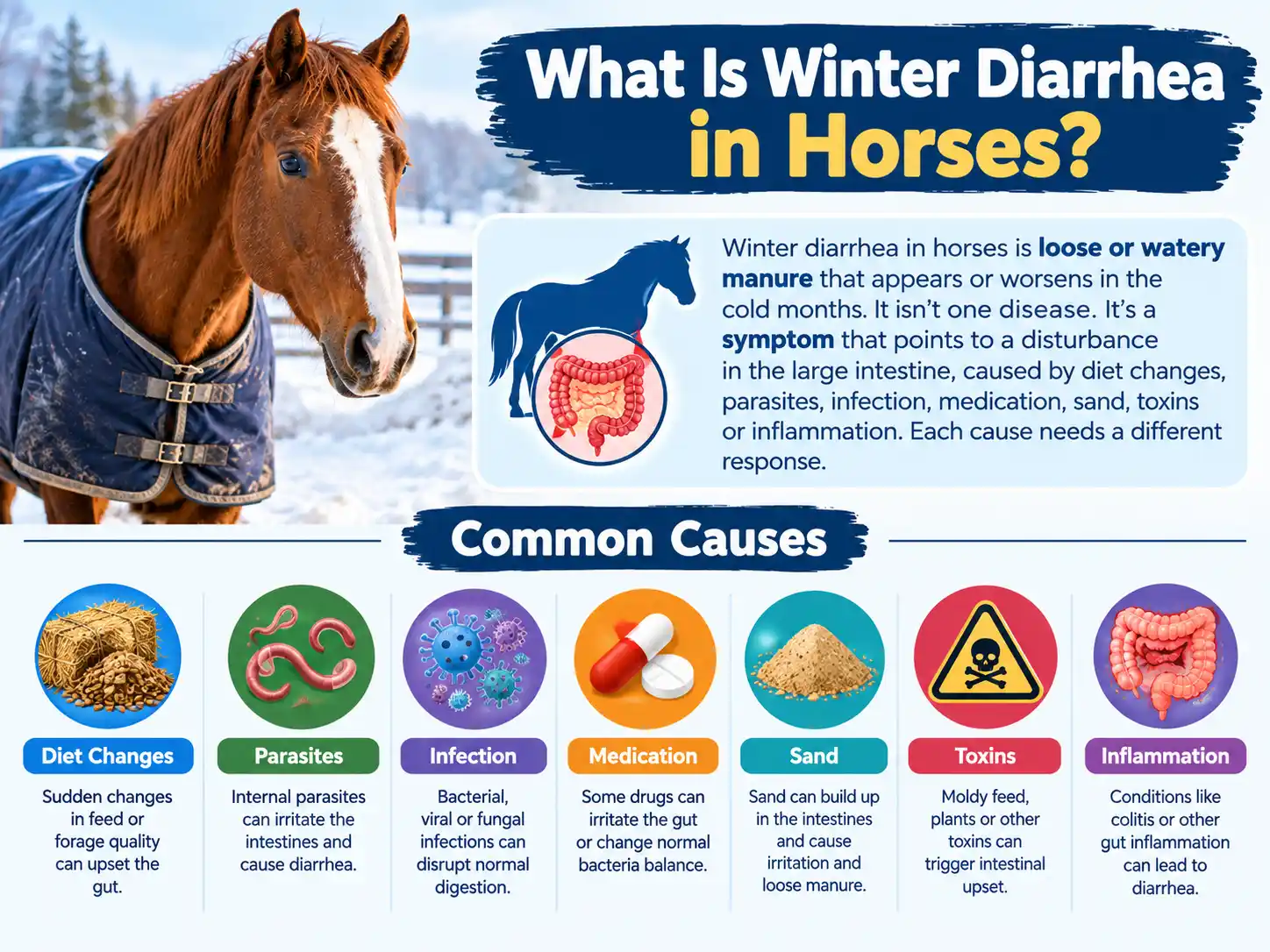
Winter diarrhea in horses is loose or watery manure that appears or worsens in the cold months. It isn’t one disease. It’s a symptom that points to a disturbance in the large intestine, caused by diet changes, parasites, infection, medication, sand, toxins or inflammation. Each cause needs a different response.
Why can it escalate so fast? A horse’s cecum and colon reabsorb up to 100 liters of fluid a day, according to Barwon Equine Hospital. When that system fails, a horse can lose fluid, electrolytes and protein in a hurry.
The Merck Veterinary Manual notes that diarrhea in adult horses can be explosive, with illness and death rates that exceed those of many other species.
Two more facts help set expectations:
Also, “normal” manure changes with the forage. Hay-fed horses often pass drier balls, while lush grass or alfalfa can produce softer manure.
If it’s the only change and your horse is bright, that isn’t automatically a problem. Compare with other horses on the same forage.
Is It Diarrhea or Free Fecal Water?
Many winter “diarrhea” calls turn out to be free fecal water syndrome (FFWS): formed manure balls plus a separate stream of liquid that soils the tail and hind legs. Vet Times’ equine author notes this pattern is often harmless to the horse but bothers owners a great deal.
Because winter diets lean on hay, it can seem more noticeable this time of year.
💧 Diarrhea vs. Free Fecal Water Syndrome
| Feature | True diarrhea | Free fecal water |
|---|---|---|
| Manure | Soft, loose or watery throughout | Formed balls plus separate liquid |
| Where liquid appears | Mixed into the manure | Before, during or after defecation; soils tail and hind legs |
| Overall health | May include fever, lethargy, colic, dehydration | Horse is often otherwise well |
| Typical winter link | Diet change, parasites, infection, meds | Hay-heavy winter diets |
| Action | Call your vet promptly | Ask your vet if it persists or worsens |
Don’t relax completely, though. Pavo’s horse-health team points out that fecal water can progress to true diarrhea if it drags on. If it persists or the horse looks unwell, call your vet.
Is Winter Diarrhea an Emergency? A Quick Triage
Use this before anything else. If you’re unsure which column your horse fits, treat it as the more serious one.
🚦 Winter Diarrhea Triage: How Urgent Is It?
🔴 Call the vet NOW
- Watery or projectile diarrhea
- Fever, dullness, off feed
- Colic signs
- Dry gums, sunken eyes, skin tent
- Blood, or swelling of belly/legs
- Several horses affected
- Started during/after antibiotics
- Any foal with diarrhea
🟠 Call the vet’s office today
- Soft-to-loose manure, horse bright and eating
- Normal temperature, but it’s lasted 24+ hours
- Started after a feed, hay or med change
- Take his temperature twice daily
- Isolate if any fever appears
🟢 Monitor and mention it
- Formed manure balls plus some liquid
- Bright, eating, drinking normally
- Normal temperature
- Review forage and feeding with your vet at the next visit
When in doubt, treat it as the more serious column. This tool supports, but doesn’t replace, veterinary advice.
Call the vet immediately if you see any of these:
PetMD’s veterinarian author advises calling the vet as soon as diarrhea starts and isolating the horse in case it’s infectious. In practice, a short phone call to your clinic is always reasonable. It lets the vet decide whether a visit is needed.
What Causes Winter Diarrhea in Horses? 9 Common Triggers
1. Sudden Forage and Feed Changes
Winter often means leaving fresh pasture for stored hay, opening a new hay lot, or adding grain to help a horse stay warm. Each shift can upset the microbes that ferment fiber in the hindgut. PetMD recommends phasing in any new feed or forage over 7 to 14 days.
Vet Times’ author adds that starch and fructan that escape digestion in the small intestine get fermented rapidly in the large intestine, which can upset it. Extra grain “for warmth” is a common winter trigger.
Practical tip: Keep some of the old hay and blend it with the new lot over a week or two.
2. Less Water Than Usual
Horses may drink less when water is icy, which can firm up gut contents and slow things down. Mad Barn and Biozyme both flag reduced intake as a winter risk factor. Warming water slightly and checking heaters daily are cheap fixes.
3. Stress, Confinement and Routine Changes
The Merck Veterinary Manual notes that stressful events can produce semiformed manure in some horses. Winter often brings more stall time, less turnout and fewer herd interactions, all of which can add up.
4. Larval Cyathostominosis (Small Strongyle Emergence)
This is the winter cause owners hear about least, and it’s one of the most dangerous.
Small strongyle larvae can sit encysted in the wall of the large intestine for months. When large numbers emerge together, they trigger severe inflammation, fluid loss and protein loss. The MSD Veterinary Manual describes a mortality rate of roughly 50% in acute cases. It mostly affects young horses (about 1 to 4 years old), though older horses can be hit.
What makes it tricky:
- Timing: Most reported in late winter to early spring in temperate climates, although timing varies by region.
- It can follow deworming. Vet Times’ author notes cases often appear within a few weeks of an anthelmintic.
- A zero fecal egg count doesn’t rule it out. Barwon Equine Hospital explains that affected horses are often well wormed with a zero egg count, and may be the only horse in the herd affected.
- Signs: Sudden diarrhea, weight loss, poor appetite, fever, and swelling under the belly or in the lower legs.
Vets typically combine a larvicidal dewormer (moxidectin is often preferred, and a five-day fenbendazole course is also licensed but limited by resistance) with corticosteroids and supportive care. Please don’t try this at home: dewormer choice and timing matter.
If you want to understand what your vet may be prescribing, our guides to fenbendazole for horses, Panacur, ivermectin and dexamethasone guide for horses explain how these drugs are normally used. They’re reference material, not a substitute for a diagnosis.
Expert tip: Don’t deworm a horse that already has diarrhea unless your vet tells you to. Killing luminal worms can trigger further larval emergence.
5. Infectious Diarrhea (Salmonella, Clostridia, Equine Coronavirus)
Infections are less common than diet-related upsets but far more serious and contagious.
A fever plus a poor appetite, with or without loose manure, deserves isolation and a vet call.
6. Medications: Antibiotics and NSAIDs
Antibiotics can wipe out helpful gut bacteria and let harmful ones flourish. Barwon Equine Hospital notes severe, sometimes fatal diarrhea has followed multiple antibiotics given to treat an unresponsive infection, and stopping them (with vet guidance) is part of management. Never stop a prescribed antibiotic on your own. Call the prescribing vet.
NSAIDs can also injure the gut. PetMD advises calling your vet before the next dose if a horse on Banamine or bute develops diarrhea, since some horses develop right dorsal colitis.
Vet Times’ author adds that NSAIDs can impair recovery of the gut lining, so they’re used only when needed. Always confirm your Banamine dosage for horses and bute dosage for horses with your vet, and stop and call at the first sign of loose manure.
7. Sand
Horses in sandy paddocks or on sparse pasture can swallow enough sand to cause intermittent loose manure and mild colic. Try Barwon’s simple check: mix fresh manure with water in a bucket and see whether sand settles at the bottom.
Feeding hay off rubber mats rather than the ground helps, per Pavo. Vets sometimes prescribe psyllium courses.
See our psyllium husk guide page for how it’s commonly used, and confirm the plan with your vet.
8. Spoiled Feed, Mold and Toxins
Musty or moldy hay, spoiled concentrates and contaminated feed can irritate the gut. Suspect this if diarrhea starts after opening a new batch or affects several horses eating the same feed. Pull the suspect feed and call your vet.
9. Teeth, Ulcers and Chronic Gut Disease
Poor teeth mean poorly chewed forage, which Pavo links to digestive upset. Ulcers, inflammatory bowel disease and other chronic conditions can also produce loose manure. Vet Times’ author notes gastric ulceration is common in horses with diarrhea and is likely a result rather than a cause.
If ulcers are confirmed, your vet may discuss drugs like omeprazole or sucralfate; our guides to omeprazole and sucralfate give background. Older horses with weak teeth or aging guts may also have poorly formed manure.
🔍 Cause-to-Clue Cheat Sheet
| Cause | Common clues | Winter link | First move |
|---|---|---|---|
| Feed or hay change | Soft-to-loose manure; horse bright and eating | Pasture to hay, new lot, extra grain | Hold steady; call if it lasts 1–2 days |
| Larval cyathostominosis | Sudden diarrhea, weight loss, belly or leg swelling; egg count may be zero | Late winter to early spring; can follow deworming; young horses | Same-day vet call; don’t self-deworm |
| Salmonella | Fever and poor appetite (may precede diarrhea); foul watery manure | Stress, diet change, weather | Isolate; call vet; wash hands |
| Clostridia | Colitis, often after antibiotics or colic | Any season | Call vet |
| Equine coronavirus | Fever, lethargy, off feed; diarrhea inconsistent | Most commonly diagnosed in winter | Isolate; vet; fecal PCR |
| Antibiotic or NSAID | Diarrhea during or after medication | Any season | Call prescriber before next dose |
| Sand | Intermittent loose manure, mild colic; sand settles in bucket test | Sandy paddocks, hay on ground | Vet plan; feed off mats |
| Spoiled or moldy feed | Starts after a new batch; may affect several horses | Stored winter hay | Pull feed; call vet |
How Serious Can Winter Diarrhea Get? What the Data Say
Most winter diarrhea is mild. But when it’s severe enough for a referral hospital, the numbers show why vets take it seriously:
| Study | Horses | Survived to discharge |
|---|---|---|
| Multicenter study, 26 hospitals (Gomez et al., 2024) | 1,438 | 76% |
| Colitis study, U.S. hospital (Luethy et al., 2021) | 85 | 74% |
| Canadian multicenter study (2015–2019) | 300 | 70% |
Some perspective:
- These are hospitalized horses, the sickest cases. They don’t represent everyday loose manure.
- In the Canadian study, colic signs, severe dehydration, endotoxemia and low blood protein were tied to non-survival.
- In the 85-horse study, survival by cause ranged from 100% for coronavirus (16 of 16) to 65% for Potomac horse fever and 70% for both Salmonella and unknown causes. Those are small groups, so treat them as illustrations, not forecasts.
- Larval cyathostominosis carries a reported mortality of around 50%.
- Laminitis is a recognized complication of colitis, so watch the feet in any horse recovering from severe diarrhea.
📊 Survival to Hospital Discharge in Acute Diarrhea
Hospitalized horses only. These are the sickest cases, not typical loose manure.
Sources: Gomez et al., Equine Vet J 2024; Luethy et al., J Vet Intern Med 2021; Canadian multicenter study 2015–2019; MSD Veterinary Manual.
I couldn’t find reliable incidence figures for “winter diarrhea” as its own category, since it isn’t a distinct diagnosis. Anyone quoting a winter-specific percentage is probably guessing.
Symptoms, and a 60-Second Hydration Check
Signs vary by cause. Alongside loose or watery manure, watch for:
Dehydration is the main short-term danger. Here’s a quick way to check:
⏱️ 60-Second Hydration Check
What to Do Right Now: An 8-Step Plan
What not to do: Don’t give leftover antibiotics, NSAIDs like Banamine or bute, human anti-diarrheal medicine or dewormer unless your vet says so.
How Vets Find the Cause
Vets combine history, a physical exam and targeted tests, according to PetMD. They’ll check hydration, heart rate, gut sounds and temperature, then may add:
- Bloodwork (blood counts, protein, electrolytes)
- Fecal exams, cultures and PCR panels (Salmonella, ECoV, clostridia)
- Sand checks, ultrasound or X-rays
- Endoscopy if ulcers are suspected
A few quirks to know about. Salmonella can be hard to catch on a single sample. Barwon Equine Hospital says five negative fecal samples are needed to rule it out. ECoV can test negative in the very earliest stage, as Cornell’s lab notes, because shedding starts a few days after exposure.
And a companion analysis of the multicenter dataset found limited diagnostic testing in many acute cases, which helps explain why a cause often stays unknown.
Treatment Options by Cause
Treatment depends on what’s driving it. Nothing here is a do-it-yourself protocol.
| Likely cause | What vets commonly do |
|---|---|
| Mild diet-related | Monitor, correct the diet, transition slowly. PetMD says most adult horses with diarrhea and no other symptoms are back to normal in a day or two |
| Larval cyathostominosis | Larvicidal dewormer plus corticosteroids and supportive care. Plasma may be needed for low protein |
| Salmonella | Fluids and supportive care. Antibiotics often don’t change the course in adults |
| C. difficile / C. perfringens | Fluids and supportive care; metronidazole in some cases |
| Equine coronavirus | Supportive care and isolation. Most adults recover in days |
| Antibiotic-associated | Stop or change the antibiotic under vet direction, plus supportive care |
| NSAID-related colitis | Stop the NSAID and call the vet. Care depends on severity |
| Sand | Management changes and psyllium courses under vet guidance |
| Ulcers | Ulcer treatment plus management changes (more forage, less grain, more turnout) |
| Inflammatory bowel disease | Diet plus longer-term anti-inflammatory therapy. Prognosis is guarded |
Supportive care is the backbone. In the 26-hospital treatment study, about 65% of horses (926 of 1,419) received a fluid bolus on admission, and electrolytes and anti-inflammatories are common. The authors also point out that many treatments are based on anecdotal opinion or small studies rather than large trials.
What to Feed a Horse with Diarrhea
Diet changes should be made with your vet, especially if diarrhea is severe. Once serious causes are ruled out, these are the common principles:
| Do | Don’t |
|---|---|
| Offer plenty of good-quality grass or alfalfa hay | Suddenly swap hays or feeds |
| Keep water available and encourage drinking | Pile on extra grain or sweet feed |
| Consider a soaked, low-starch fiber source like non-molassed beet pulp, if your vet agrees | Add oil while diarrhea is active (Vet Times’ author advises waiting until it resolves) |
| Offer plain salt, adjusted for size and diet (Mad Barn notes diarrhea increases sodium and chloride losses) | Feed moldy, dusty or spoiled hay |
| Keep meals small and consistent | Turn out onto lush spring grass without a gradual build-up |
Vet Times’ author suggests limiting concentrates to a low starch load per meal during recovery. Your vet can turn that into numbers for your horse’s size.
Do Probiotics Help Horses With Diarrhea?
Maybe, but the evidence is more mixed than the marketing.
Bottom line: A probiotic may help gut recovery after a mild upset or antibiotic course, but it isn’t a cure. Ask your vet which product, if any, fits your horse.
How Long Does Recovery Take?
| Situation | Typical timeline (source) |
|---|---|
| Mild, diet-related | About a day or two (PetMD) |
| Equine coronavirus | Most adults recover within a few days (UC Davis); viral shedding can last 2–5 weeks, so biosecurity continues |
| Larval cyathostominosis | Treatment may run for weeks and involves monitoring (Vet Times) |
| Chronic “idiopathic” diarrhea in a bright horse | Can drag on for months and usually resolves eventually, sometimes up to 12 months (Barwon Equine Hospital) |
| Severe colitis | Hospital stay; laminitis risk. Outcomes vary widely |
How to Prevent Winter Diarrhea in Horses
You can’t prevent every case, but consistency prevents many.
Your prevention checklist
🗓️ Winter Gut-Health Calendar
🍂 Autumn (before winter)
- Fecal egg counts and parasite plan with your vet
- Dental check
- Sand test (bucket method)
- Source hay; consider testing it
- Start any feed changes slowly (7–14 days)
❄️ Early winter
- Set up heated or warmed water
- Keep salt available
- Quarantine new arrivals
- Introduce new hay lots gradually
🥶 Mid-winter
- Check manure daily
- Keep routine and turnout steady
- Feed hay off the ground on sandy sites
- Take temperature at the first hint of illness
🌱 Late winter / early spring
- Watch young horses for weight loss, diarrhea and belly swelling
- Introduce spring grass gradually
- Ask your vet about larval risk before any deworming
6 Common Mistakes
- Waiting too long on a horse with fever or dullness
- Deworming a horse that already has diarrhea
- Reaching for leftover Banamine or antibiotics
- Changing three things at once (hay, grain and supplement)
- Trusting a “zero” fecal egg count to rule out worms
- Skipping isolation and hygiene during a barn outbreak
FAQs
Why does my horse have diarrhea in winter?
Usually because of changes tied to the season: less pasture, new hay, more grain, colder water and more confinement. Parasites (especially small strongyle larvae) and infections like equine coronavirus also show up in winter. A vet can sort out which one.
Is winter diarrhea in horses serious?
It can be. Mild cases resolve in a day or two, but severe diarrhea can cause dehydration, protein loss and laminitis. In one 1,438-horse hospital study, 76% survived to discharge.
How long does diarrhea last in horses?
Diet-related cases often clear in a day or two, per PetMD. Chronic diarrhea (a month or more, per Merck) can last months in some bright horses.
What can I give my horse for diarrhea at home?
Start with fresh water, good-quality forage and steady feeding, and call your vet. Skip leftover medications and dewormers. A probiotic may help gut recovery but isn’t a treatment on its own.
Should I call the vet for loose manure?
A phone call is reasonable. Go straight to a visit if there’s fever, dullness, colic, dehydration or watery manure, or if more than one horse is affected.
Can hay cause diarrhea in horses?
Yes. A new hay lot, poor-quality or moldy hay, or a fast switch from pasture can loosen manure. Alfalfa is naturally softer for many horses.
Can cold weather cause diarrhea in horses?
Not directly. Cold changes how horses are fed, watered and housed, and some pathogens (like equine coronavirus) are diagnosed more often in winter.
What’s the difference between diarrhea and free fecal water?
With diarrhea the manure itself is loose. With free fecal water, formed balls pass along with separate liquid, and many horses are otherwise well.
Can parasites cause diarrhea even with a negative fecal egg count?
Yes. Immature encysted larvae don’t shed eggs, so a horse can have larval cyathostominosis with a zero count.
Is diarrhea in horses contagious?
It can be. Salmonella, clostridia and equine coronavirus spread through manure-contaminated feed, water, tools and hands. Isolate the horse and practice strict hygiene until infection is ruled out.
The Bottom Line
Winter diarrhea in horses is a symptom, not a diagnosis. Most mild cases in bright, eating horses settle quickly with steady feeding and clean water. The dangerous ones (fever, dullness, watery manure, colic, dehydration, weight loss with belly swelling) need a vet the same day.
Your next steps:
- Take your horse’s temperature now and note how he’s acting.
- Write down recent feed, medication and deworming changes.
- Call your equine vet with those details.
- Bookmark the prevention calendar above and set reminders for your fall and late-winter checks.
References and Sources
- Gomez DE, et al. Survival rates and factors associated with survival and laminitis of horses with acute diarrhoea admitted to referral institutions. Equine Vet J. 2024. https://beva.onlinelibrary.wiley.com/doi/10.1111/evj.14032
- Treatment approaches to horses with acute diarrhea admitted to referral institutions: a multicenter retrospective study. PLOS ONE. 2024. https://journals.plos.org/plosone/article?id=10.1371%2Fjournal.pone.0313783
- Luethy D, et al. Risk factors for laminitis and nonsurvival in acute colitis. J Vet Intern Med. 2021. https://academic.oup.com/jvim/article/35/4/2019/8446912
- Acute diarrhea in horses: a multicenter Canadian retrospective study (2015–2019). Can Vet J. https://pubmed.ncbi.nlm.nih.gov/36185796/
- Shaw SD, Stämpfli H. Diagnosis and treatment of undifferentiated and infectious acute diarrhea in the adult horse. Vet Clin North Am Equine Pract. 2018. https://pmc.ncbi.nlm.nih.gov/articles/PMC7134835/
- Durham A. Treating diarrhoea in mature horses. Vet Times. 2017. https://www.vettimes.com/news/vets/equine/treating-diarrhoea-in-mature-horses
- Walshe N, et al. Outbreak of acute larval cyathostominosis. Equine Vet J. 2021. https://beva.onlinelibrary.wiley.com/doi/10.1111/evj.13350
- MSD Veterinary Manual. Larval cyathostominosis in horses. https://www.msdvetmanual.com/digestive-system/gastrointestinal-parasites-of-horses/larval-cyathostominosis-in-horses