CBD for Horses: Dosage Chart, Calculator & What the Research Actually Shows
Cannabidiol (CBD) is a non-psychoactive compound derived from cannabis plants and is known for its anti-inflammatory and analgesic properties. Equine owners often search for information about CBD for horses and are concerned about whether CBD oil and other CBD formulations is safe or not.
To use CBD to help your horse with pain, it is essential to learn about the safe CBD dosage for horses, its benefits, side effects, and safe serving ideas.
This guide has been compiled for every equine owner regarding CBD use in horses. So, keep reading.
Disclaimer: All information in this guide is provided for educational purposes only and should never replace professional veterinary advice.
CBD For Horse Overview
- The most research and studied CBD doses for equine range between 0.5 and 2mg/kg of body weight.
- There's no FDA-approved or universally agreed-on dose every product's concentration is different, so the dose has to be calculated for your horse and your bottle, not copied from a label.
- Cannabidiol is generally well-tolerated in horses, though a few studies found temporary, mild liver enzyme changes that resolved after stopping.
- USEF prohibits CBD outright in competition; FEI classifies CBD as a Controlled Medication (not banned) but still bans THC and other cannabinoids these are two different rulebooks and mixing them up is the single most common competition mistake.
- Always loop in your veterinarian before starting CBD, especially if your horse takes other medications, since CBD is processed by the same liver enzyme pathway as many common equine drugs.
What Is CBD, and How Is It Different From THC?
Cannabidiol (CBD) is one of more than 100 naturally occurring compounds called cannabinoids found in the hemp and cannabis plant. Unlike THC (tetrahydrocannabinol), CBD is not psychoactive, meaning it doesn't get a horse "high" or intoxicated.
Legally, hemp-derived CBD products must contain no more than 0.3% THC by dry weight under the 2018 Farm Bill definition of hemp. That's why you'll see three main types of CBD product on the market:
| Type | What It Contains | Best For |
|---|---|---|
| Full-spectrum | CBD plus other cannabinoids, including trace THC (up to 0.3%) | Non-competing horses only |
| Broad-spectrum | CBD plus other cannabinoids, THC removed to non-detectable levels | Most owners, including some competitors |
| Isolate | Pure CBD only, no other cannabinoids or THC | Competitors who need a verified zero-THC product |
Is CBD Legal for Horses?
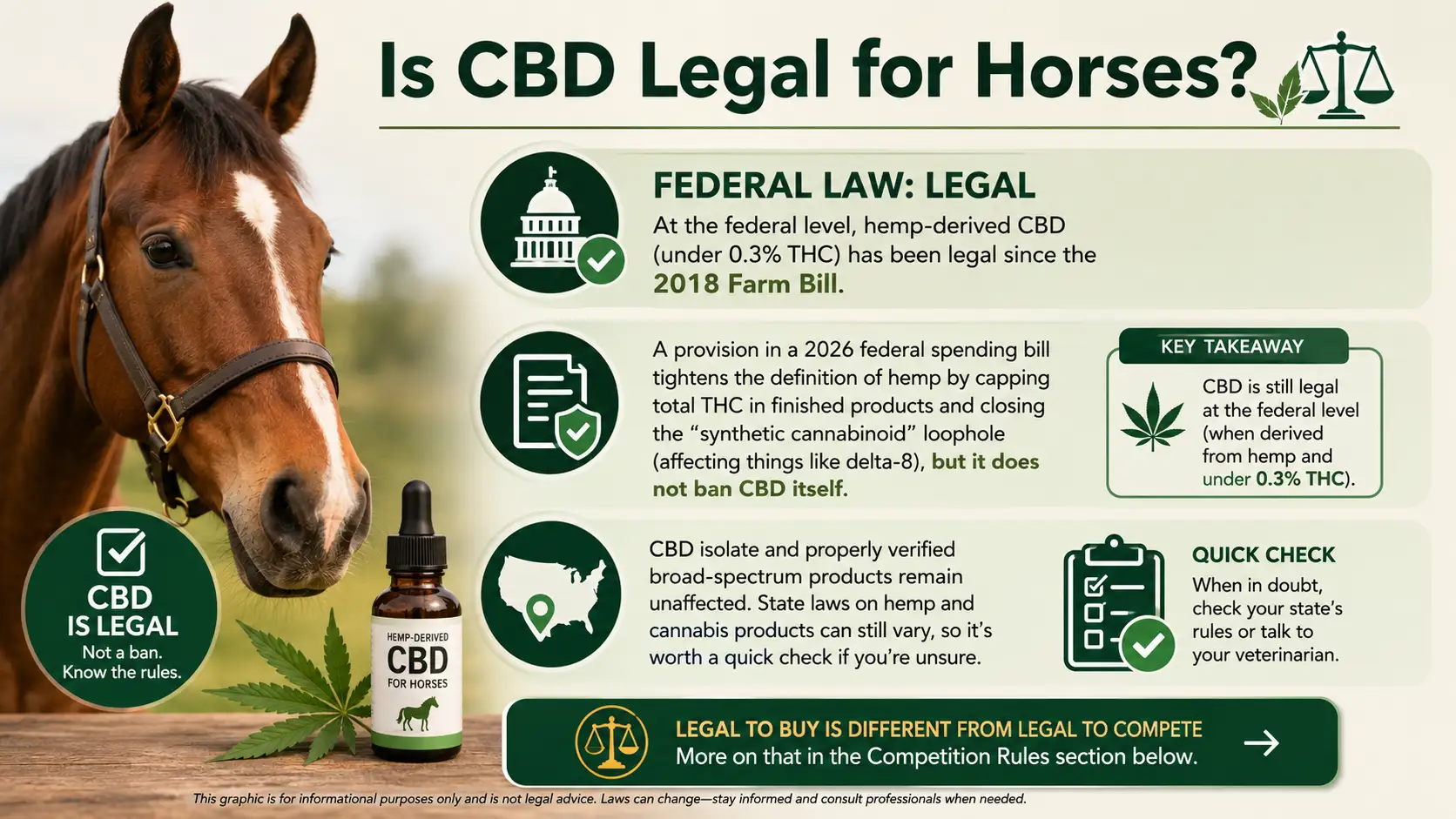
At the federal level, hemp-derived CBD (under 0.3% THC) has been legal since the 2018 Farm Bill. A provision in a 2026 federal spending bill tightens the definition of hemp by capping total THC in finished products and closing the "synthetic cannabinoid" loophole (affecting things like delta-8), but it does not ban CBD itself.
CBD isolate and properly verified broad-spectrum products remain unaffected. State laws on hemp and cannabis products can still vary, so it's worth a quick check if you're unsure.
Legal to buy is a different question from legal to compete on more on that in the competition rules section below.
How Much is CBD Dosage for Horses
The well-tolerated and effective CBD dosage for horses is 0.5 to 2 mg/kg. However, the lower and upper dose ranges depend on the condition being treated. Veterinarians generally follow the protocols below regarding the safe Cannabidiol dosage for equines.
- Low/starting range: 0.25–0.5 mg/kg, once or twice a day for mild pain sensitivity and behavior, and a common conservative starting point.
- Moderate range: 1–2 mg/kg, once or twice a day the most frequently used range across pharmacokinetic and short-term safety studies.
- Higher/study-ceiling range: 3–3.5 mg/kg used in a handful of tolerability studies; well-tolerated short-term but not typically recommended as a default starting dose. Note that a higher dose should only be given under veterinary supervision.
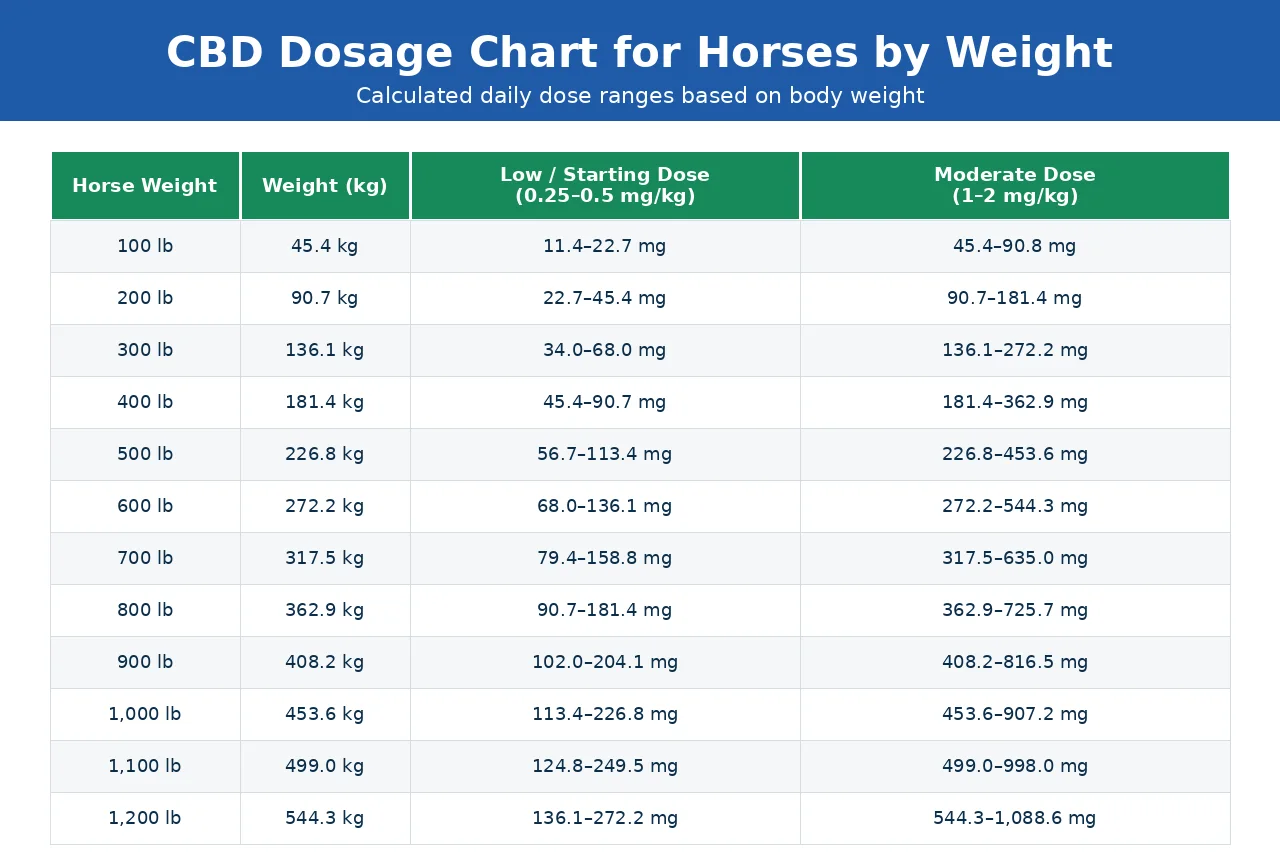
CBD Dosage Chart for Horses by Weight
| Horse Weight | Weight (kg) | Low/Starting Dose (0.25–0.5 mg/kg) | Moderate Dose (1–2 mg/kg) |
|---|---|---|---|
| 100 lb | 45.4 kg | 11.4–22.7 mg | 45.4–90.8 mg |
| 200 lb | 90.7 kg | 22.7–45.4 mg | 90.7–181.4 mg |
| 300 lb | 136.1 kg | 34.0–68.0 mg | 136.1–272.2 mg |
| 400 lb | 181.4 kg | 45.4–90.7 mg | 181.4–362.9 mg |
| 500 lb | 226.8 kg | 56.7–113.4 mg | 226.8–453.6 mg |
| 600 lb | 272.2 kg | 68.0–136.1 mg | 272.2–544.3 mg |
| 700 lb | 317.5 kg | 79.4–158.8 mg | 317.5–635.0 mg |
| 800 lb | 362.9 kg | 90.7–181.4 mg | 362.9–725.7 mg |
| 900 lb | 408.2 kg | 102.0–204.1 mg | 408.2–816.5 mg |
| 1,000 lb | 453.6 kg | 113.4–226.8 mg | 453.6–907.2 mg |
| 1,100 lb | 499.0 kg | 124.8–249.5 mg | 499.0–998.0 mg |
| 1,200 lb | 544.3 kg | 136.1–272.2 mg | 544.3–1,088.6 mg |
Quick fact: For an average 500 kg (1,100 lb) horse, most owners land somewhere between 250–500 mg of CBD per day, split into two doses — that's the range you'll see most often in both research and real-world use.
How to Calculate Your Horse's Exact CBD Dose
Because every CBD product has a different concentration, the chart above only gets you to a milligram target — you still need to convert that into "how many mL do I actually draw up." Here's the full formula, step by step.
Step 1: Get your horse's weight in kilograms. Weight (kg) = Weight (lb) ÷ 2.2
Step 2: Pick a dose rate (mg/kg) and multiply. Total daily dose (mg) = Weight (kg) × dose rate (mg/kg)
Step 3: Split it if dosing twice daily. Per-dose amount (mg) = Total daily dose (mg) ÷ 2
Step 4: Find your product's concentration. Concentration (mg/mL) = Total mg of CBD in the bottle ÷ Bottle size (mL) (This is printed on the label. For example, a 1,000 mg bottle that holds 30 mL is 33.3 mg/mL.)
Step 5: Convert your target dose into mL. Volume to give (mL) = Per-dose amount (mg) ÷ Concentration (mg/mL)
Worked Example
A 550 kg (1,210 lb) horse, dosed at 0.5 mg/kg twice daily, using a 30 mL bottle containing 1,000 mg of CBD (33.3 mg/mL):
- Total daily dose: 550 × 0.5 = 275 mg/day
- Per dose (BID): 275 ÷ 2 = 137.5 mg per dose
- Volume per dose: 137.5 ÷ 33.3 = ≈4.1 mL, twice a day
Run the same math with your horse's actual weight, your chosen dose rate, and your product's actual label concentration — the formula doesn't change, only the numbers do.
How to Start CBD to Horse: A Simple Titration Plan
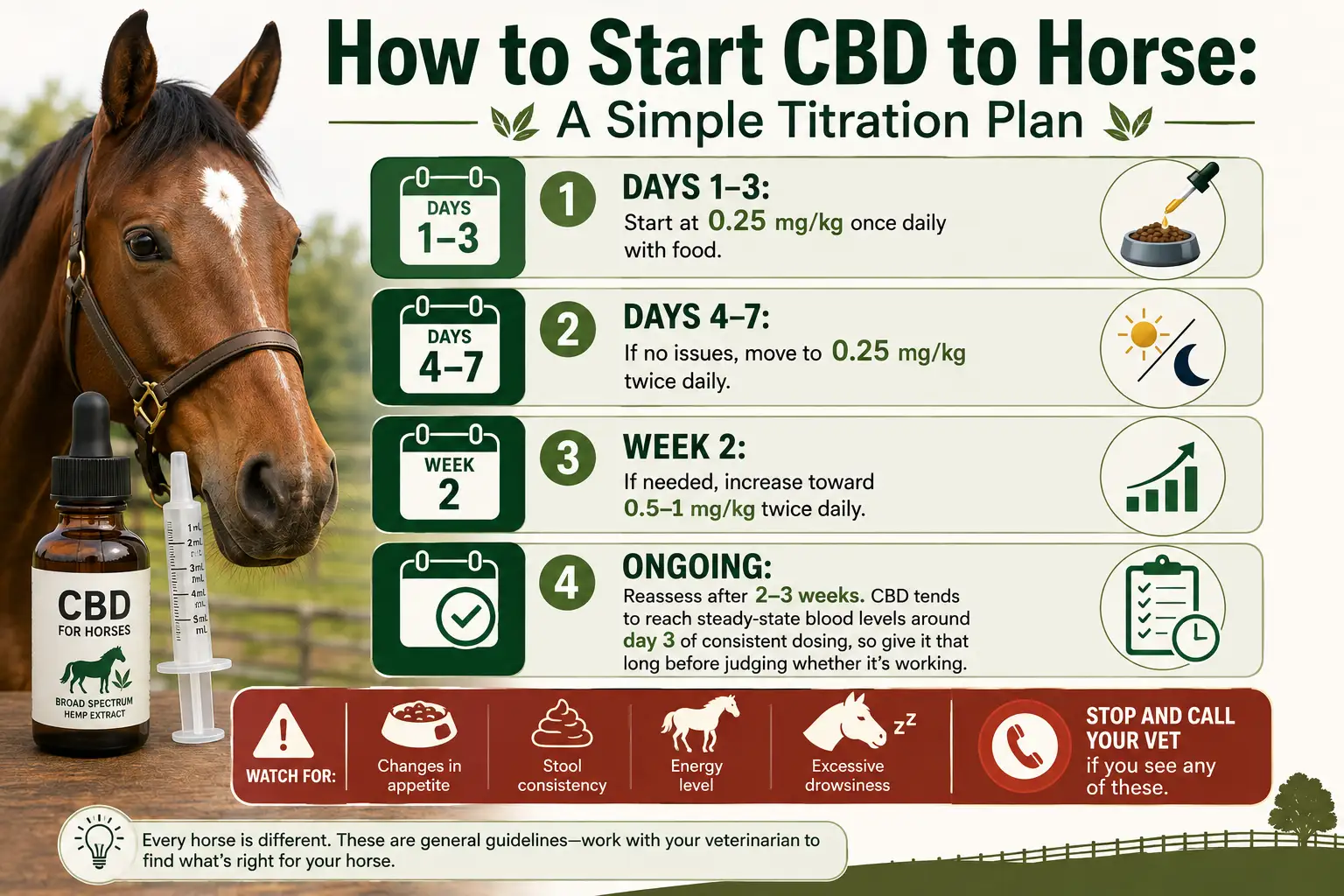
Jumping straight to a "moderate" dose isn't necessary and isn't how most of the research protocols work. A gradual introduction lets you watch for any reaction before committing to a full dose.
- Days 1–3: Start at 0.25 mg/kg once daily with food.
- Days 4–7: If no issues, move to 0.25 mg/kg twice daily.
- Week 2: If needed, increase toward 0.5–1 mg/kg twice daily.
- Ongoing: Reassess after 2–3 weeks. CBD tends to reach steady-state blood levels around day 3 of consistent dosing, so give it that long before judging whether it's working.
Watch for: changes in appetite, stool consistency, energy level, or excessive drowsiness. Stop and call your vet if you see any of these.
CBD Forms for Horses: Oil vs. Paste vs. Pellets vs. Treats
| Form | Dosing Precision | Pros | Cons |
|---|---|---|---|
| Oil/tincture | High (measure by mL) | Easiest to fine-tune with the formula above; fast absorption | Some horses dislike the taste undiluted |
| Paste (syringe) | High | Pre-measured markings; good for precise per-kg dosing | Often pricier per mg |
| Pellets/powder | Moderate | Mixes into feed easily | Harder to micro-adjust dose |
| Treats/chews | Low (fixed dose per treat) | Easiest to administer, good palatability | Can't fine-tune mg/kg; may need multiple treats to hit target |
For horses being dosed precisely by body weight especially smaller ponies or minis oil or paste with a marked syringe gives you the most control.
What Does the Research Actually Show CBD Can Help With?
It's important to separate what's been studied from what's assumed. Here's an honest breakdown:
| Use Case | What the Evidence Shows |
|---|---|
| Pain/inflammation (osteoarthritis) | Some positive findings a CBDA/CBG oil combination improved pain scores in horses with chronic osteoarthritis in a small study, and oral CBD improved mechanical pain thresholds at 0.5 mg/kg twice daily in another. Sample sizes are small. |
| Anxiety/situational stress | Limited but promising most equine anxiety studies are pharmacokinetic (measuring blood levels), not large-scale behavior trials. Anecdotal use for trailering and vet visits is common, but rigorous equine-specific efficacy data is still thin. |
| Cribbing/stereotypies | One small study reported improvement at low oral doses; not yet confirmed at scale. |
| General "wellness" claims | Not supported by controlled equine studies. Be skeptical of broad claims like "cures" or "eliminates" anything. |
Bottom line: CBD research in horses right now is mostly focused on how the body absorbs and processes it (pharmacokinetics) and whether it's safe not yet on proving it works for specific conditions. That doesn't mean it doesn't help; it means the science hasn't caught up to the marketing yet.
Safety, Side Effects & What Studies Found in Bloodwork
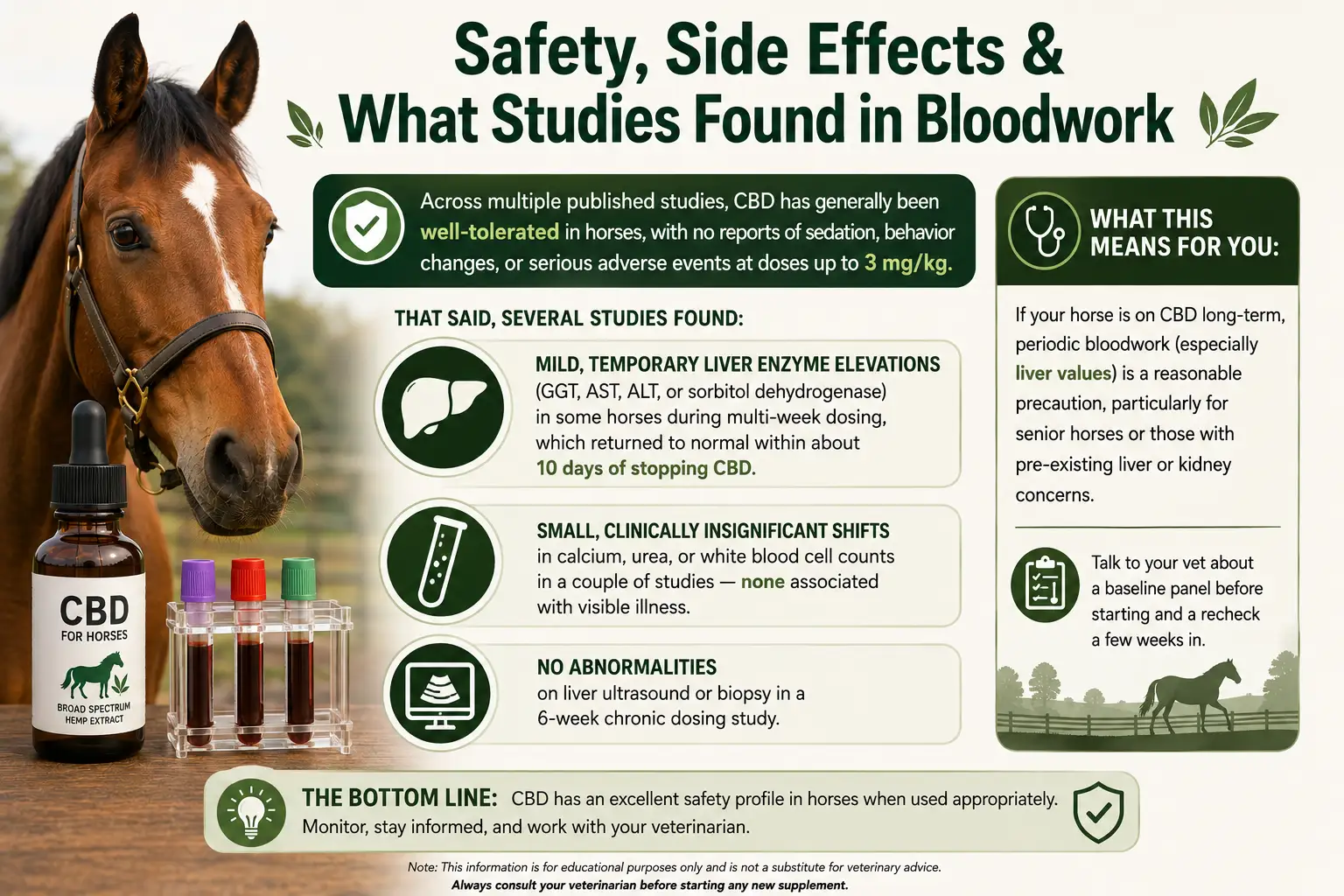
Across multiple published studies, CBD has generally been well-tolerated in horses, with no reports of sedation, behavior changes, or serious adverse events at doses up to 3 mg/kg. That said, several studies found:
- Mild, temporary liver enzyme elevations (GGT, AST, ALT, or sorbitol dehydrogenase) in some horses during multi-week dosing, which returned to normal within about 10 days of stopping CBD.
- Small, clinically insignificant shifts in calcium, urea, or white blood cell counts in a couple of studies none associated with visible illness.
- No abnormalities on liver ultrasound or biopsy in a 6-week chronic dosing study.
What this means for you: if your horse is on CBD long-term, periodic bloodwork (especially liver values) is a reasonable precaution, particularly for senior horses or those with pre-existing liver or kidney concerns. Talk to your vet about a baseline panel before starting and a recheck a few weeks in.
Drug Interactions: Why Your Vet Needs to Know
CBD is metabolized through the cytochrome P450 (CYP450) liver enzyme pathway the same pathway used by many common equine medications. In theory, this means CBD could slow down or speed up how quickly other drugs clear your horse's system, changing their effective dose.
This is especially worth discussing with your vet if your horse is currently on:
- NSAIDs like bute (phenylbutazone) or Banamine (flunixin meglumine)
- Steroids like dexamethasone
- Ulcer medication such as omeprazole
- Sedatives like acepromazine, especially before trailering if you're also giving CBD for the same purpose
None of this means CBD and these medications can't be used together many horses take them concurrently without issue — but your vet may want to monitor bloodwork more closely or adjust timing when combining CBD with other liver-metabolized drugs.
CBD and Competition Horses: USEF vs. FEI Rules (2026)
This is where most of the confusion online comes from, because USEF and FEI treat CBD differently, and a lot of blog content conflates the two. Double check with the updated rules of USEF vs. FEI b before entering the competition.
| Rule-Making Body | CBD Status | THC Status | What This Means |
|---|---|---|---|
| USEF | Prohibited substance | Prohibited | CBD (natural or synthetic) is banned outright for USEF-recognized competition. If given for a legitimate therapeutic reason under a vet's direction, USEF requires a minimum 24-hour withdrawal and a filed Medication Report Form. |
| FEI | Controlled Medication (a "Specified Substance," not banned) | Banned | CBD itself isn't prohibited under FEI rules, but it's controlled — meaning it's still tested for and subject to FEI's medication rules. All other natural cannabinoids besides CBD, plus THC and synthetic cannabinoids, are fully banned. |
| WADA (human riders) | Not prohibited | Prohibited above a threshold (in-competition) | Relevant if you're the one using CBD, not just the horse. |
How to Choose a Quality CBD Product
- Look for a Certificate of Analysis (COA) from an independent, third-party lab it should confirm both CBD content and THC content (ideally "non-detectable" for competition horses).
- Match the label's mg-per-mL (or mg-per-serving) to the dosing math above — vague labels like "full strength" without a milligram count make accurate dosing impossible.
- Avoid products with added xylitol or other ingredients not meant for horses.
- Choose isolate or verified broad-spectrum if there's any chance the horse will compete, even at a lower level, since rules can change and residues can linger.
Common Mistakes Owners Make With CBD Dosing
- Copying a dose off a bottle meant for a different horse's weight or a different product's concentration.
- Judging effectiveness too quickly. CBD needs a few days of consistent dosing to reach steady blood levels.
- Assuming "hemp" automatically means "competition-safe" it doesn't, especially under USEF.
- Skipping the vet conversation when the horse is already on NSAIDs, steroids, or sedatives.
- Using a full-spectrum product on a competing horse without lab-verified THC content.
FAQs
How much CBD should I give my horse?
Most research uses 0.5–2 mg per kg of body weight, once or twice daily, with many owners starting closer to 0.25–0.5 mg/kg and increasing gradually. Always calculate based on your horse's actual weight and your product's actual concentration.
Is CBD safe for horses?
Published studies report CBD is generally well-tolerated at doses up to 3 mg/kg, with no serious adverse effects. Some studies noted temporary, mild liver enzyme elevations that resolved after stopping a reason to loop in your vet for long-term use.
Can a horse overdose on CBD?
No fatal or severe toxicity has been reported in equine studies at the doses tested (up to 3mg/kg), but a formal upper safety limit hasn't been established, so more is not automatically safer.
How long does it take for CBD to work in a horse?
Peak blood levels are typically reached within 2–5 hours of an oral dose, but consistent (steady-state) blood levels generally take about 3 days of regular dosing to build up, so give it several days to a couple of weeks before judging effect.
Is CBD banned in horse competitions?
It depends on the organization. USEF prohibits CBD outright. FEI classifies CBD as a Controlled Medication (not banned) but still bans THC and other cannabinoids. Check your specific competition's rulebook.
Does CBD show up on a horse drug test?
Yes, CBD and its metabolites are detectable in blood and urine and are specifically screened for under USEF and FEI testing programs.
What's the difference between CBD oil and CBD paste for horses?
Both allow precise, weight-based dosing. Oil is usually more affordable per milligram; paste comes in a pre-measured syringe, which some owners find easier to dose consistently.
Can I use CBD treats instead of oil?
Yes, but treats are dosed per-piece rather than per-kg, so it's harder to hit a precise mg/kg target better suited for maintenance use than for horses needing a carefully calculated dose.
Sources & Further Reading
- USEF Guidelines & Rules for Drugs and Medications (2026)
- FEI 2026 Equine Prohibited Substances List
- World Anti-Doping Agency, The Prohibited List
- "Pharmacokinetics, Safety, and Synovial Fluid Concentrations of Single- and Multiple-Dose Oral Administration of 1 and 3 mg/kg Cannabidiol in Horses," ScienceDirect
- Frontiers in Veterinary Science multiple 2024–2026 equine CBD pharmacokinetic studies
- PMC/NCBI equine cannabidiol research articles