UlcerGard Dosage for Horses: Chart, Calculator and Safe Dosing Guide for Every Weight
Written & Reviewed By: Medshorse Team
Last Updated: November 2026
You have a trailer to load on Friday, a horse who goes off his feed whenever the routine changes, and a fresh syringe of UlcerGard in your hand. The only question that matters right now: how much do you actually give?
The label answer is short. The details around it (weight bands, syringe math, how long, and when UlcerGard is the wrong tool) are where owners go wrong. This guide covers all of it, using the current product labels and veterinary research.
Disclaimer: This article is for general education and is not veterinary advice. Product names mentioned, including UlcerGard, belong to their respective owners, and MedsHorse is not affiliated with them. Always follow your veterinarian’s instructions and the current product label.
Quick answer: how much UlcerGard to give a horse
Give UlcerGard once a day. How much depends only on your horse’s weight.
That is the label dose of 1 mg of omeprazole per kg of body weight. It is for preventing ulcers in healthy horses, not for treating ulcers. Source: UlcerGard label and Boehringer Ingelheim. Always follow the package in your hand.
What Is UlcerGard and What Does It Do?
UlcerGard is an oral paste containing omeprazole, a proton pump inhibitor. It blocks the pumps in the stomach lining that make acid, so the stomach has less acid to damage its own lining.
The FDA approved it under NADA 141-227, and the manufacturer, Boehringer Ingelheim, describes it as the only FDA-approved medication to prevent equine gastric ulcer syndrome (EGUS).
Horses make stomach acid around the clock, whether they are eating or not. That is why long gaps without forage, hard work, trailering and stall confinement all raise ulcer risk. UlcerGard is built for those predictable stress windows.
If you have used the prescription product, note this: UlcerGard and GastroGard contain the same active ingredient at the same paste concentration (370 mg per gram). The difference is the label. UlcerGard is labeled for prevention in healthy horses.
GastroGard is labeled for treatment of ulcers and for preventing recurrence. We compare them side by side below, and our guide to GastroGard dosage for horses covers the treatment doses.
Watch out: the other “Ulcerguard”
If you shop or read labels from Australia, you may run into Ranvet’s “Ulcerguard” oral paste. It is a different product entirely. Its active ingredient is ranitidine (220 mg/mL), it is sold as a veterinary-only product, and its directions use millilitres, not syringe fractions.
Nothing in this article applies to it. If your tube says ranitidine, read its own label, and see our notes on ranitidine dosage for horses.
How Common Are Stomach Ulcers in Horses?
More common than most owners expect. The UlcerGard label cites studies showing ulcers in over 90% of racehorses and about 60% of performance horses. The European College of Equine Internal Medicine (ECEIM) consensus statement reports wide ranges depending on the job a horse does.
Reported ulcer prevalence by type of horse
Bars show the reported range from published studies. Wider bars mean studies disagree more.
Sources: UlcerGard label (Drugs.com); Sykes et al., ECEIM Consensus Statement, J Vet Intern Med 2015. ECEIM figures come from its section on squamous disease (ESGD).
Two take-aways. A horse in light work is not immune. And a quiet-looking horse can still have ulcers, because some horses show very few signs.
UlcerGard Dosage Chart by Horse Weight
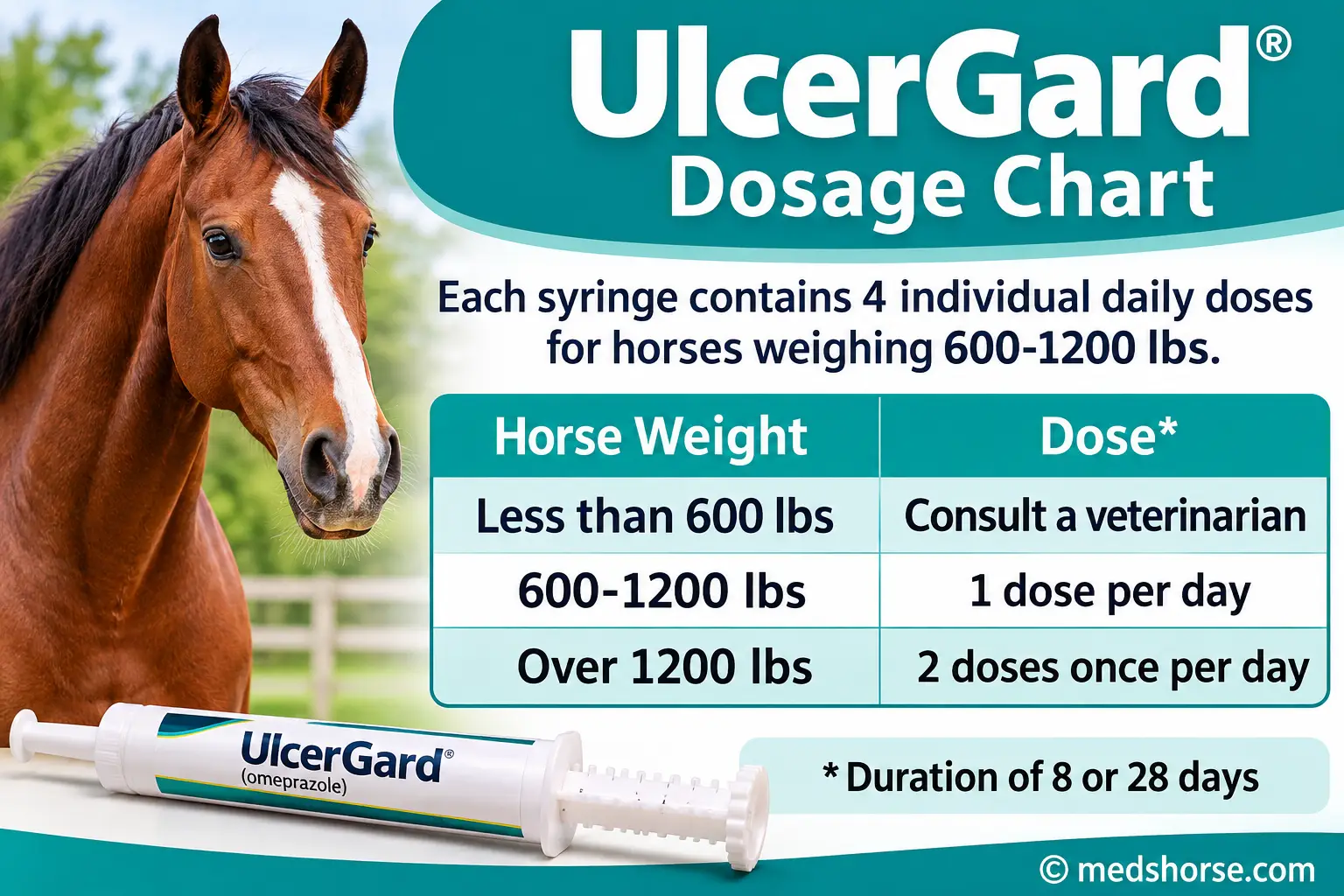
Find your horse’s weight, then read across. Every horse from 600 to 1,200 lb gets the same dose. Every horse over 1,200 lb gets double.
| Horse Weight | Dose* |
|---|---|
| Less than 600 lbs | Consult a veterinarian |
| 600-1200 lbs | 1 dose per day |
| Over 1200 lbs | 2 doses once per day |
Why does a smaller horse get the same dose?
The syringe is made for weight bands, not exact weights. One dose covers every horse from 600 to 1,200 lb, so lighter horses in the band simply get a little more than the 1 mg/kg minimum. That is normal and is how the label is written.
Get an accurate weight first
The chart only works if the weight is right. A scale is best. A weight tape can be off by 50 lb or more. If your horse is close to 600 or 1,200 lb, confirm the weight with your vet.
UlcerGard Dosage Calculator
Type in your horse’s weight to see the daily dose and how many syringes you need.
- To set the syringe plunger, unlock the dose ring by rotating ¼ turn and slide the dose ring along the plunger shaft so that the side nearest the barrel is set at the appropriate daily dose marking.
- Rotate ¼ turn to lock ring before dosing.
- Make sure horse’s mouth contains no feed before administration.
- Remove syringe tip cover.
- Insert syringe into the corner of the horse’s mouth.
- Depress the plunger until it stops at the dose ring.
The entire dose should be deposited on the back of the tongue or deep in the cheek pouch.
Horses should be observed briefly to assure no part of the dose is lost or rejected. If any of the dose is lost, re-dosing is recommended.
Replace cap if any unused doses remain in the syringe.
How to Give UlcerGard Step by Step
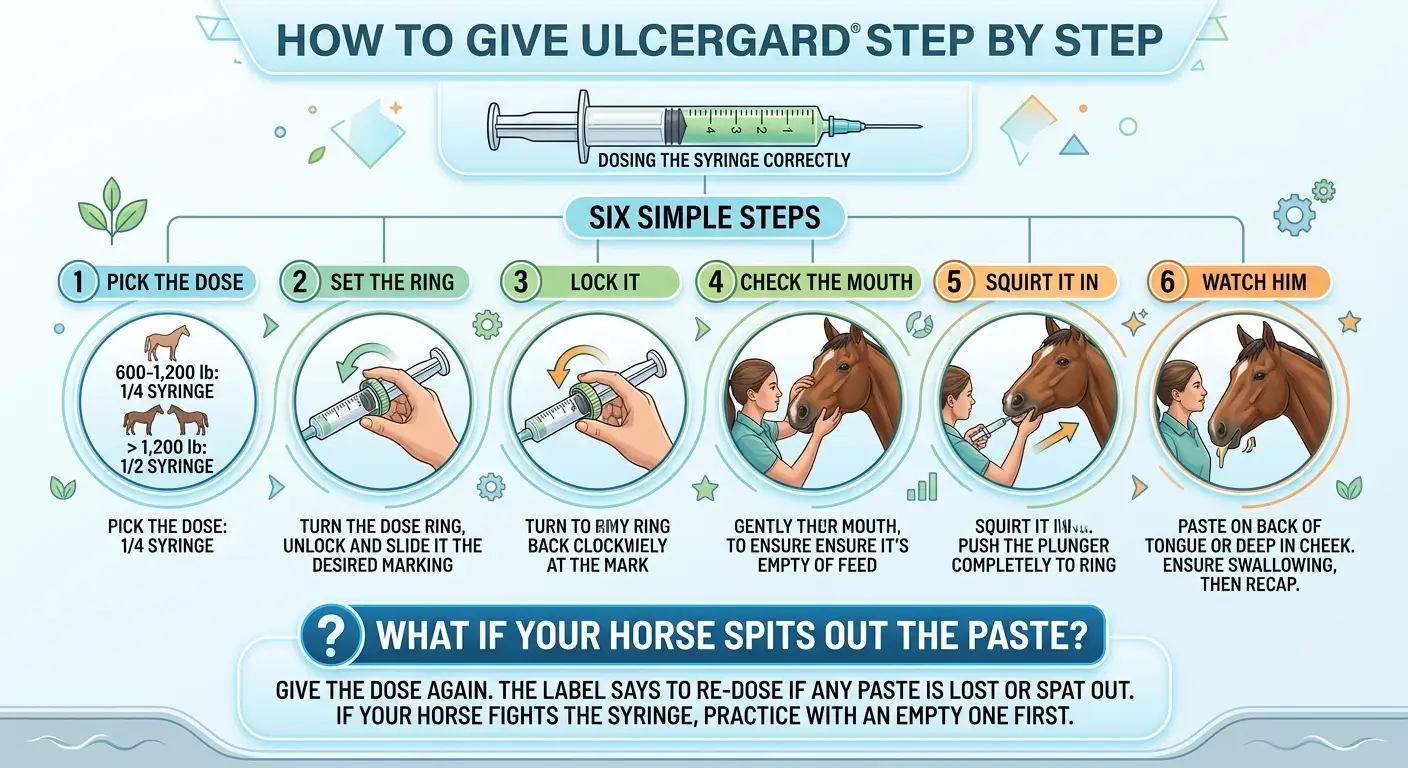
Dosing the syringe correctly
Six simple steps. They match the directions on the label.
- Pick the dose. 1/4 syringe for 600 to 1,200 lb. 1/2 syringe over 1,200 lb.
- Set the ring. Turn the dose ring a quarter turn to unlock it. Slide it to the right mark.
- Lock it. Turn the ring a quarter turn back to lock it.
- Check the mouth. Make sure your horse has no feed in his mouth.
- Squirt it in. Put the tip in the corner of the mouth. Push the plunger until it stops at the ring.
- Watch him. The paste goes on the back of the tongue or deep in the cheek. Make sure he swallows it, then put the cap back on.
What if your horse spits out the paste?
Give the dose again. The label says to re-dose if any paste is lost or spat out. If your horse fights the syringe, practice with an empty one first.
When to Start UlcerGard and How Long to Give It
The label recommends once-daily UlcerGard during stressful events or activities that may cause ulcers, such as training, racing, showing, traveling, stall confinement and competition. The effect was tested in horses exposed to stress for 8 or 28 days.
Here is the part most guides skip. Omeprazole does not switch acid off instantly. The GastroGard label, for the same active ingredient, notes that maximal acid suppression takes three to five days of treatment.
For a planned event such as a trailer ride, ask your vet whether to begin a few days before departure rather than the morning you leave. That timing is not stated on the UlcerGard label, so it is a vet decision.
The label also does not set a maximum number of days for UlcerGard. If your horse seems to need it for months, that is a signal to scope the stomach and review management with your vet, not simply to keep refilling.
Does UlcerGard Actually Work? What the Research Shows
Yes, with realistic expectations. In the study Boehringer Ingelheim cites (White et al., AAEP Proceedings, 2003), UlcerGard prevented ulcers in 82% of horses during stress, while 86% of untreated horses developed ulcers. Sister-product label data for 1 mg/kg tell a similar story.
Ulcers under stress: treated vs untreated horses
Share of horses that developed gastric ulcers. Treated values are calculated from the percent protected.
Sources: Boehringer Ingelheim UlcerGard horse owner page; GastroGard (Canada) label on Drugs.com, which also reports 88% of treated horses stayed ulcer-free after 7 days at 1 mg/kg under ulcer-causing conditions. Different studies, so compare patterns, not exact numbers.
The honest reading: UlcerGard greatly lowers the odds of ulcers, but it does not guarantee zero. About one treated horse in five in these studies still developed an ulcer. Management still matters.
Independent research agrees on the dose question. A 2019 meta-analysis in Equine Veterinary Journal (Mason et al.) looked at omeprazole for preventing ulcers in horses in training. Doses ran from 0.5 to 4 mg/kg, and summaries of it report no difference in ulcer prevention between 1 and 2 mg/kg.
So more is not better. Similarly, a blinded trial in racehorses (Sykes et al., 2015) found 1 and 2 mg/kg were not inferior to 4 mg/kg for squamous ulcers, though that trial used an enteric-coated product.
UlcerGard vs GastroGard: What Is the Difference?
UlcerGard vs GastroGard
Same active ingredient, different jobs.
| Feature | UlcerGard | GastroGard |
|---|---|---|
| Label purpose | Prevention of gastric ulcers in healthy horses | Treatment of gastric ulcers and prevention of recurrence |
| Prescription | No (over the counter) | Yes, through your vet |
| Dose rate | 1 mg/kg once daily | 4 mg/kg daily for 28 days, then 2 mg/kg for at least another 28 days |
| Syringe use | 1/4 syringe per dose (2 doses if over 1,200 lb) | A full syringe treats about 1,250 lb at 4 mg/kg |
| Horse size or age | At least 600 lb; foals and weanlings not evaluated | Horses and foals 4 weeks and older |
| Pregnant mares | Safety not determined | Safety not determined in pregnant or lactating mares |
| FDA approval | NADA 141-227 | NADA 141-123 |
Sources: UlcerGard and GastroGard package inserts (Drugs.com); Boehringer Ingelheim. Some retailers state that the two syringes hold the same paste. Even so, using UlcerGard at treatment doses is a vet decision, never a DIY swap.
A new option appeared in 2026. On April 6, the FDA approved Gastrobim, the first generic omeprazole oral paste for horses. It is bioequivalent to GastroGard (not UlcerGard), is prescription-only, and is labeled for treatment and prevention of recurrence.
If your vet prescribes a treatment course, ask whether the brand or the generic fits your budget. Our omeprazole dosage for horses guide explains how the doses compare across products.
Can UlcerGard Treat Existing Ulcers?
No. The label is clear that UlcerGard is for preventing ulcers in healthy horses. If your horse already shows signs, the next step is a vet visit, not a bigger dose.
Signs listed on the label include decreased appetite, recurrent colic, intermittent loose stools or diarrhea, a poor hair coat, poor body condition and poor performance. Valley Vet Supply also lists cribbing, wind sucking and a poor attitude.
These signs overlap with other diseases, and the ECEIM statement notes there are no reliable blood tests for gastric ulcers. Gastroscopy is the only dependable way to confirm them.
Squamous vs glandular ulcers
The stomach has two regions. The upper squamous region (ESGD) responds well to acid suppression with omeprazole. The lower glandular region (EGGD) is different.
The ECEIM statement reports that adding sucralfate to omeprazole improves success rates for glandular disease compared with omeprazole alone, and glandular lesions sometimes appear or persist during omeprazole treatment.
Your vet may add other drugs. For background, see our guides on sucralfate dosage for horses and misoprostol dosage for horses.
The takeaway: UlcerGard prevention data come from studies of general ulcer occurrence under stress. If your horse has a confirmed glandular problem, UlcerGard alone is not a plan.
Who Should Not Use UlcerGard (or Should Ask a Vet First)?
Ask your vet before using UlcerGard if…
- Your horse weighs under 600 lb (outside the label).
- The horse is a foal or weanling (effectiveness not evaluated).
- The horse is a pregnant mare (safety not determined). Breeding stallions are covered: the label says UlcerGard may be used safely in breeding stallions.
- Your horse shows colic, weight loss, diarrhea or poor appetite (signs need diagnosis, not self-treatment).
- The horse is intended for human consumption (the label says do not use).
- You compete under rules that restrict omeprazole (see the section on competition below).
Not for use in humans. Keep all syringes out of reach of children. If a person swallows it, contact a physician. Store at 68 to 77°F (20 to 25°C); brief excursions between 59 and 86°F are permitted.
Is UlcerGard Safe? Side Effects and Safety Margin
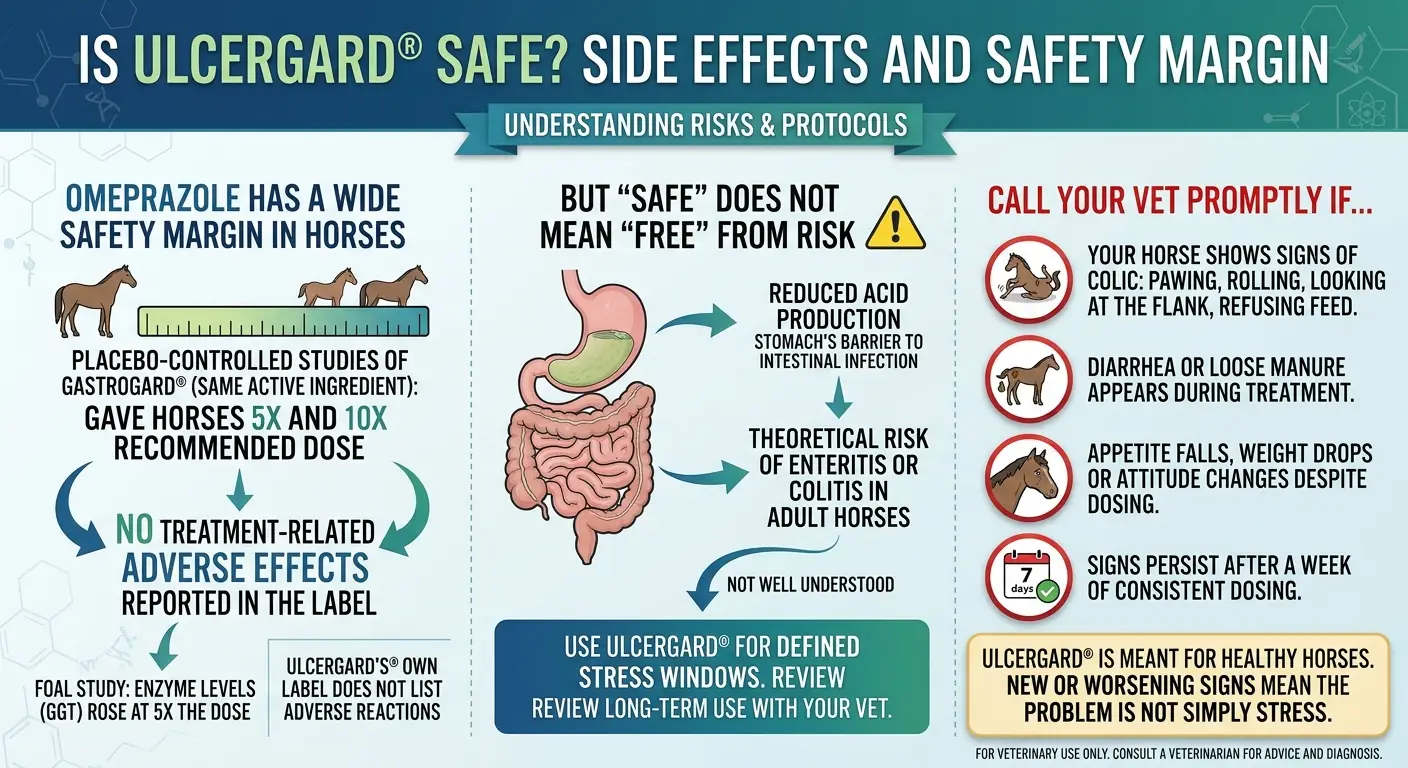
Omeprazole has a wide safety margin in horses. Placebo-controlled studies of GastroGard (same active ingredient) gave horses 5 times and 10 times the recommended dose with no treatment-related adverse effects reported in the label.
In a foal study, enzyme levels (GGT) rose at 5 times the dose. UlcerGard’s own label does not list specific adverse reactions.
That said, “safe” does not mean “free”. Veterinary references note that reduced acid production lowers the stomach’s barrier to intestinal infection, so there is a theoretical risk of enteritis or colitis in adult horses, though this is not well understood.
It is one more reason to use UlcerGard for defined stress windows and to review long-term use with your vet.
Call your vet promptly if...
- Your horse shows signs of colic: pawing, rolling, looking at the flank or refusing feed.
- Diarrhea or loose manure appears during treatment.
- Appetite falls, weight drops or attitude changes despite dosing.
- Signs persist after a week of consistent dosing.
UlcerGard is meant for healthy horses. New or worsening signs mean the problem is not simply stress.
Can You Use UlcerGard in Competition?
It depends on the rule book, so check before you dose. The US Hunter Jumper Association’s guidance says prophylactic UlcerGard use during stress should be discussed with your vet, and notes that FEI competitions follow a different medication regime from USEF.
Omeprazole is prohibited under the rules of most racing authorities. A 2024 paper in Equine Veterinary Journal argued that if a horse is treated outside competition, treatment on the day should be permitted on welfare grounds. That is a debate, not a rule.
Practical step: read your governing body’s current prohibited list, then ask your vet for a written plan that matches it. Do this before the season, not at the stable gate.
How Much Does UlcerGard Cost?
Prices vary by store and change often, so treat this as a ballpark. One online retailer listed a 28-syringe pack (112 doses) at $1,334 in November 2026, which works out to about $12 per daily dose.
At that rate an 8-day course for a horse in the 600 to 1,200 lb band costs roughly $95, and a 28-day course roughly $335. Horses over 1,200 lb need twice as much. A carton of six syringes (24 doses) from the manufacturer is the usual starting pack.
Be careful with bargain omeprazole pastes. In an earlier round of FDA warning letters, testing of unapproved omeprazole products found amounts ranging from about 36% to 135% of what the label claimed.
An under-strength paste gives you no protection, and an over-strength one adds risk. Stick with FDA-approved products from a reputable supplier or your vet.
Cut Ulcer Risk With Daily Management
Medication is one layer. Both the manufacturer’s guidance and the ECEIM consensus point to the same management basics. Their recommendations, in plain language:
- Give forage all day. Pasture is ideal. If not, offer hay free-choice or in frequent meals, since long gaps between meals raise ulcer risk.
- Feed hay before concentrates, and consider adding alfalfa to the hay mix.
- Limit starch. The ECEIM summary suggests no more than 2 g of starch per kg of body weight per day and no more than 1 g per kg per meal, with at least six hours between concentrate meals.
- Keep water available at all times. Intermittent water access is listed as a risk factor.
- Cut stress where you can: steady routines, turnout, social contact and gradual changes in training load.
- Review pain medication use. Overdosing NSAIDs raises ulcer risk, so keep to the labeled dose (see bute dosage for horses, Banamine dosage for horses and firocoxib dosage for horses).
Some owners also add gut-support supplements such as glutamine for horses as part of a broader plan. Evidence for supplements is weaker than for acid suppression, so treat them as extras, not replacements.
Common UlcerGard Mistakes to Avoid
- Guessing the weight. A weight tape that is 100 lb off can push a horse into the wrong band.
- Skipping days. The label is built on once-daily dosing during the stress period.
- Using it to treat. Prevention product, prevention job.
- Doubling up “for safety”. The research shows no extra prevention at higher doses, and the label already sets the bands.
- Dosing over a mouthful of feed. The label wants the mouth empty of feed.
- Not re-dosing a spat-out dose. The label says to re-dose.
- Ignoring the rule book. Check competition medication rules first.
Before-You-Dose Checklist
Pre-dose checklist
- Confirmed weight (scale, or tape plus formula) and the correct band.
- Horse is healthy, at least 600 lb and not a pregnant mare.
- Product is UlcerGard omeprazole paste (not another “Ulcerguard”).
- Dose ring set to the right marking and locked.
- Mouth is empty of feed.
- Competition rules checked.
- Start date, end date and a spare dose planned.
- Syringe capped and stored at 68 to 77°F, away from children.
Key takeaways
- UlcerGard dose: 1 mg/kg once daily. One dose (1/4 syringe) for 600 to 1,200 lb. Two doses (1/2 syringe) over 1,200 lb.
- It prevents ulcers in healthy horses during stress. It does not treat existing ulcers.
- In the cited study, 82% of treated horses stayed ulcer-free; 86% of untreated horses developed ulcers.
- Each syringe holds 4 doses. Re-dose if the paste is lost.
- Never use it under 600 lb, in pregnant mares or in foals without vet advice.
- Pair it with all-day forage, low starch and steady routines.
FAQs
What is the UlcerGard dosage for horses?
Give it once a day. Horses from 600 to 1,200 lb get 1/4 of the syringe. Horses over 1,200 lb get 1/2 of the syringe. This is the label dose of 1 mg of omeprazole per kg of body weight.
How much UlcerGard do I give a 1,000 lb horse?
Give 1/4 of the syringe once a day. One syringe lasts 4 days for a horse this size.
How much UlcerGard should I give a horse over 1,200 lb?
Give 1/2 of the syringe (two doses) once a day. One syringe lasts 2 days. For very large draft horses, ask your vet to confirm the plan.
How many days should you give UlcerGard?
Give it once daily during the stressful period. The label says its effect was tested over stress periods of 8 or 28 days and sets no maximum. If your horse needs it for months, ask your vet to review the stomach and management.
Can I give UlcerGard to a horse under 600 lb?
The label covers horses of at least 600 lb. For smaller horses the label says to consult a veterinarian, so do not guess the dose.
Can UlcerGard treat existing stomach ulcers?
No. UlcerGard is labeled to prevent ulcers in healthy horses. Horses with signs of ulcers need a veterinary exam, often a gastroscopy, and a treatment plan such as GastroGard.
What is the difference between UlcerGard and GastroGard?
Both contain omeprazole paste. UlcerGard is over the counter and labeled for prevention at 1 mg per kg. GastroGard is prescription and labeled for treatment at 4 mg per kg for 28 days, then 2 mg per kg to prevent recurrence.
When should I start UlcerGard before a show or trip?
The label says to give it during stressful events such as traveling, competition and stall confinement. Omeprazole takes about three to five days to reach maximal acid suppression, so ask your vet whether to start a few days before a planned event.
Do I need a prescription for UlcerGard?
No. In the United States UlcerGard does not require a prescription and owners can give it themselves. Your vet is still the best person to confirm it fits your horse.
What if my horse spits out the UlcerGard paste?
The label recommends re-dosing if any of the dose is lost or rejected. Make sure the mouth has no feed, place the paste on the back of the tongue or deep in the cheek pouch, and watch briefly afterward.
How many doses are in one UlcerGard syringe?
Each syringe holds four daily doses for a horse in the 600 to 1,200 lb band. A carton of six syringes holds 24 doses. A horse over 1,200 lb uses two doses a day, so a syringe lasts two days.
Can pregnant mares or foals have UlcerGard?
Safety in pregnant mares has not been determined, and effectiveness in foals and weanlings has not been evaluated. Ask your vet before using it in either. The label says it may be used safely in breeding stallions.
Should I give UlcerGard before or after feeding?
The label only says the horse's mouth should contain no feed when you dose. It does not give a feeding schedule, so pick a consistent time each day and ask your vet if you want specific timing.
Is UlcerGard allowed in competition?
It depends on the governing body. Omeprazole is prohibited by most racing authorities, and USEF and FEI follow different medication rules. Check the current rules for your sport and ask your vet before competing.
Is human omeprazole the same as UlcerGard?
No. Human omeprazole products are not labeled for horses. UlcerGard is a paste formulated for horses, with the active ingredient protected so it can survive stomach acid and be absorbed.
What is the Ranvet Ulcerguard sold in Australia?
It is a different product. Ranvet Ulcerguard is a ranitidine oral paste with directions in millilitres. It is not the omeprazole UlcerGard described in this article.
Next Steps
Weigh your horse, pick the dose with the chart or calculator above, and write down your start date. If your horse already shows signs of ulcers, book a vet visit for a scope before relying on prevention. And if your plan includes a treatment course, our GastroGard dosage for horses guide is the logical next read.
Sources and Further Reading
- Boehringer Ingelheim Animal Health: ULCERGARD (veterinary site)
- Boehringer Ingelheim Horse Owner: ULCERGARD dosage and study data
- UlcerGard package insert on Drugs.com
- GastroGard package insert on Drugs.com
- Sykes et al. ECEIM Consensus Statement on Equine Gastric Ulcer Syndrome in Adult Horses (J Vet Intern Med, 2015)
- Mason et al. Omeprazole compared with sham for prevention of gastric ulceration in horses: systematic review and meta-analysis (Equine Vet J, 2019)
- Sykes et al. A comparison of three doses of omeprazole in the treatment of EGUS (Equine Vet J, 2015)
- Campbell and Sykes. Should the use of omeprazole be allowed during equestrian competition? (Equine Vet J, 2024)
- FDA CVM Update: first generic omeprazole oral paste for horses (April 2026)
- Valley Vet Supply: FAQ on preventing equine ulcers with UlcerGard
- Medi-Vet: UlcerGard product page and label text
- Ranvet (Australia): Ulcerguard ranitidine oral paste datasheet
- Covetrus summary of FDA warning on unapproved omeprazole products
Medical disclaimer
This article is general information for horse owners and is not a substitute for veterinary advice. Doses come from product labels and published research current as of November 2026. Always read the label on your product and ask your veterinarian before starting, changing or stopping any medication.