Kentucky Red Dosage for Horses: Chart, Calculator and the Safety Facts Every Owner Should Check First
Written & Reviewed By: Medshorse Team
Last Updated: November 2026
Kentucky Red dosage for horses is not as simple as the product pages make it look. Three sellers agree on one routine: 10 ml into the vein 24 hours before training, then another 10 ml 4 to 6 hours before training. A fourth seller lists something quite different.
That gap matters. This guide lays out every dose figure we found in four seller listings, shows where they agree and where they do not, and gives you a chart and a calculator to plan vial use. It also covers the safety rules, because this is a product that belongs in a veterinarian’s hands.
We checked the four listings on November 15, 2026. Where a listing gave no information, we say so instead of guessing.
Disclaimer: This article is for general education and is not veterinary advice. Product names mentioned, including Kentucky Red, belong to their respective owners, and MedsHorse is not affiliated with them. Always follow your veterinarian’s instructions and the current product label.
Kentucky Red Dosage for Horses at a Glance
The most common Kentucky Red dosage for horses in the listings is 10 ml by intravenous injection 24 hours before training, plus a second 10 ml 4 to 6 hours before training. That is 20 ml per session, so one 60 ml vial covers three sessions. A vet should confirm the dose, route and timing for your horse.
Key Takeaways
- Most listings give Kentucky Red as 10 ml into the vein 24 hours before training and 10 ml again 4 to 6 hours before training.
- That is 20 ml per session, so one 60 ml vial covers three sessions.
- One seller lists a different plan: 10 to 15 mL into the muscle once or twice a week.
- No listing gives a dose by body weight, so no weight chart is shown here.
- Listings warn that it is prohibited in many racing jurisdictions and say a veterinarian should give it.
Kentucky Red Quick Facts
What Is Kentucky Red for Horses?
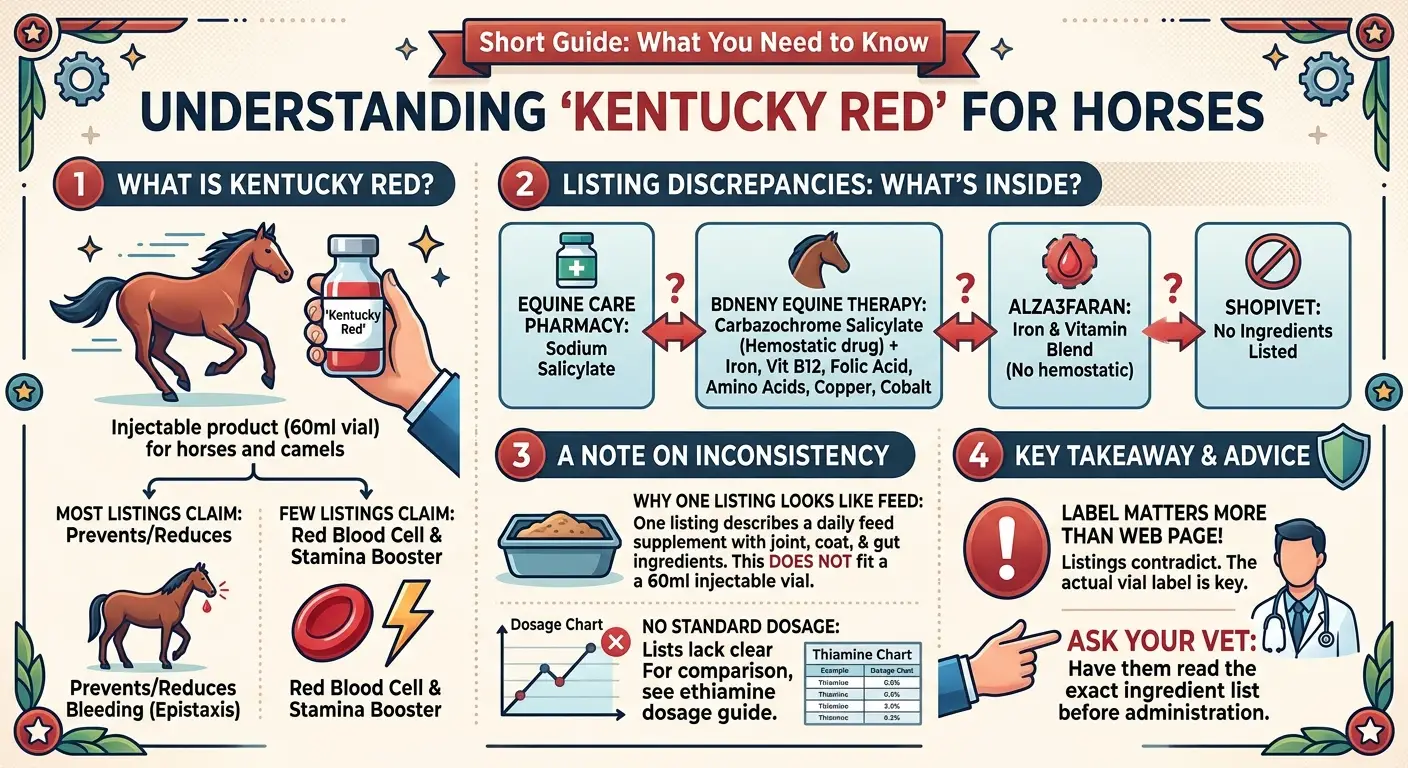
Kentucky Red is an injectable product sold in 60 ml vials for horses and, in some listings, camels. Most listings link it to preventing or reducing bleeding during training, including nosebleeds, which are called epistaxis. A few listings describe it as a red blood cell and stamina booster instead.
What the Listings Say It Contains
The four listings do not agree on the formula. Equine Care Pharmacy mentions sodium salicylate. Bdneny Equine Therapy names carbazochrome salicylate, described as a hemostatic drug that stabilizes capillaries, and also lists iron compounds, vitamin B12, folic acid, glycine, methionine, copper and cobalt.
Alza3faran lists the iron and vitamin blend but no hemostatic ingredient. Shopivet names no ingredients at all.
Because the listings use different names, the label on your vial matters more than any web page. Ask your vet to read the exact ingredient list before anything is given.
If you want to see how a clear, weight-based vitamin dose is laid out, our thiamine dosage for horses guide shows what a full chart looks like. The Kentucky Red listings give nothing like it.
Why One Listing Reads Like a Feed Supplement
The first half of the Equine Care Pharmacy page describes a daily feed supplement with joint, coat and gut ingredients.
That text does not fit an injectable 60 ml vial, and the vial section of the same page describes bleeding prevention. No other listing says anything like it, so we did not use that text for dosing.
Kentucky Red Dosage Chart for Horses
The chart below puts every dose figure from the four listings in one place. The pre-training plan appears in three listings. The muscle plan appears in two. Bdneny Equine Therapy lists both.
Pre-Training Timeline From the Listings
Volumes come from seller listings. Your vet sets the real plan.
Kentucky Red Dosage Chart for Horses (From Seller Listings)
| Detail | Pre-training bleeding plan | Red blood cell support plan |
|---|---|---|
| Listed purpose | Prevent or reduce bleeding linked to training, including nosebleeds | Support red blood cells, oxygen transport and stamina |
| Route | Into the vein (IV) | Into the muscle (IM) |
| Volume per dose | 10 ml | 10 to 15 mL for an adult horse or camel |
| Timing | First dose 24 hours before training, second dose 4 to 6 hours before training | Once or twice a week, set by a veterinarian |
| Total volume | 20 ml per training session | 10 to 30 mL per week (our arithmetic) |
| One 60 ml vial lasts | 3 sessions | 4 to 6 doses (our arithmetic) |
| Dose by body weight | Not given | Not given |
| Vet role stated | One listing says a veterinarian must give it | Both listings say veterinary supervision |
| Listed by | Equine Care Pharmacy, Shopivet, Bdneny Equine Therapy | Bdneny Equine Therapy, Alza3faran |
Our arithmetic means we multiplied the listed volumes. It is not a recommendation.
The Pre-Training Plan: 10 ml Into the Vein Twice
Equine Care Pharmacy, Shopivet and Bdneny Equine Therapy agree on this routine: 10 ml IV 24 hours before training, then 10 ml 4 to 6 hours before training.
The stated goal is to prevent nosebleeds or lower how bad they are. Shopivet adds a practical point. You also need a suitable syringe and needle, so this is not a feed additive.
The Muscle Plan: 10 to 15 mL Once or Twice Weekly
Bdneny Equine Therapy and Alza3faran list 10 to 15 mL for an adult horse or camel, given into the muscle once or twice a week under veterinary supervision.
This plan is tied to anemia, low blood counts, fatigue, hard training, and recovery from illness, parasites or surgery. Both listings say the vet sets the schedule.
IV or IM: Which Route Is Right?
The listings split on route, and one page even lists both. Route is a clinical decision, so it has to come from your vet and from the label of the exact vial you hold. Do not pick one because it looks easier.
Is There a Kentucky Red Dose by Body Weight?
No. None of the four listings gives a dose per kilogram or per pound. The intravenous listings give fixed volumes with no weight or age adjustments, and the one muscle range is for adult horses or camels.
That is why we have not built a weight chart. If your horse is small, young, old or unwell, your vet decides whether the standard volume fits.
Kentucky Red Dosage Calculator
This calculator plans how much Kentucky Red a schedule uses and how many 60 ml vials that takes. It does not set a dose. It only does the math on the volumes the listings publish, so your vet’s instructions always come first.
Kentucky Red Dosage Calculator For Horses
Kentucky Red is used before training to help prevent or reduce bleeding. Each dose is given by injection into the vein, so you also need a suitable syringe and needle. Please confirm the dose with your veterinarian.
© medshorse.com
How to Read Your Result
Total volume is every dose added up. Vials needed is rounded up, because you cannot buy part of a vial. Left in the last vial is what remains after the plan ends. Alza3faran calls it a multi-dose vial, so ask your vet how long an opened vial stays usable.
How Many Doses Are in a 60 ml Vial?
A 60 ml vial holds three 20 ml pre-training sessions, or six 10 ml doses. On the 10 to 15 mL muscle plan it holds four to six doses, which is two to six weeks of supply at once or twice weekly. Those totals are our arithmetic from the listed volumes.
How Far One 60 ml Vial Goes
All bars are our arithmetic from the volumes in the listings.
When Is Kentucky Red Used in Horses?
The listings describe three situations. The first is the most common.
- Bleeding during training, where the aim is to prevent nosebleeds or reduce how severe they are.
- Performance horses in training or competition, where one listing says it supports red blood cell function, oxygen transport and stamina.
- Recovery from illness, anemia, low blood counts, parasitic infestations or surgery, according to two listings.
Parasites are a separate problem with their own treatments. Our fenbendazole dosage for horses and ivermectin dosage for horses guides cover deworming doses. A product that supports blood counts does not replace parasite control.
How Kentucky Red Is Thought to Work
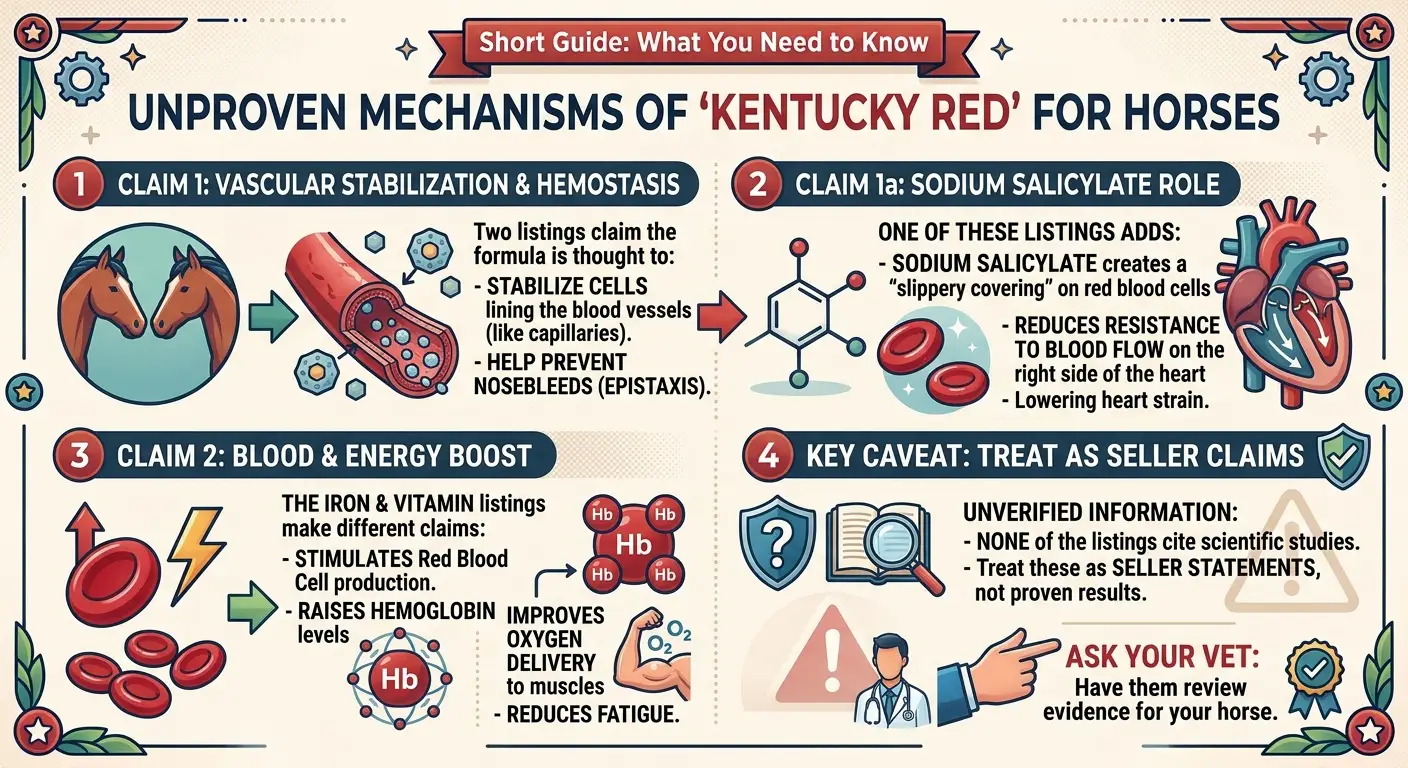
Two listings say Kentucky Red is thought to stabilize the cells that line the blood vessels, which is how it would help prevent nosebleeds. One of them adds that sodium salicylate creates a slippery covering on blood cells and lowers resistance to blood flow in the right side of the heart.
The iron and vitamin listings make a different claim. They say the formula stimulates red blood cell production, raises hemoglobin, improves oxygen delivery to muscles and reduces fatigue.
None of the four listings cites a study. Treat these as seller statements, not proven results, and ask your vet what evidence supports use in your horse.
Kentucky Red vs Kentucky Karron Oil vs Red Cell
Names that sound alike cause mix-ups. Kentucky Red is described as an injection. The other two products named in the Bdneny Equine Therapy listing are oral supplements.
If you are weighing an oral option for low blood counts, our Red Cell dosage for horses guide covers a label-based chart and the iron safety rules.
Kentucky Red Is Not the Same as Similar Sounding Products
| Product | What the listing says | Form |
|---|---|---|
| Kentucky Red | Linked to training bleeding, and in some listings to red blood cell support | Injection, 60 ml vial |
| Kentucky Karron Oil (Foran Equine) | Oral supplement for digestive and immune support | Oral |
| Red Cell Supplement and Kossolian | Oral supplements used for anemia, lethargy and general vitality | Oral |
Source: the Bdneny Equine Therapy listing.
What the Four Listings Agree On and Where They Split
What Four Seller Listings Say About Kentucky Red
| Detail | Equine Care Pharmacy | Shopivet | Bdneny Equine Therapy | Alza3faran |
|---|---|---|---|---|
| Main purpose | Bleeding prevention in the vial section, generic supplement text above it | Prevent or reduce bleeding linked to training | Prevent nosebleeds, plus red blood cell and stamina support | Red blood cell production, oxygen transport, stamina |
| Route | IV | IV | IV in one section, IM in another | IM |
| Dose | 10 ml 24 hours before and 10 ml 4 to 6 hours before training | 10 ml 24 hours before and 10 ml 4 to 6 hours before training | 10 ml twice before training, and 10 to 15 mL once or twice weekly | 10 to 15 mL once or twice weekly |
| Ingredients named | Sodium salicylate | None named | Carbazochrome salicylate, sodium salicylate, iron, B12, folic acid, amino acids, copper, cobalt | Iron, B12, folic acid, amino acids, copper, cobalt |
| Racing warning | None | None | Prohibited in many jurisdictions, vet must give it | None on the product page |
| Pack size | 60 ml vial | 60 ml bottle | 60 ml | 60 ml multi-dose vial |
Listings checked on November 15, 2026. Seller pages can change.
Kentucky Red Safety Rules Every Horse Owner Should Know
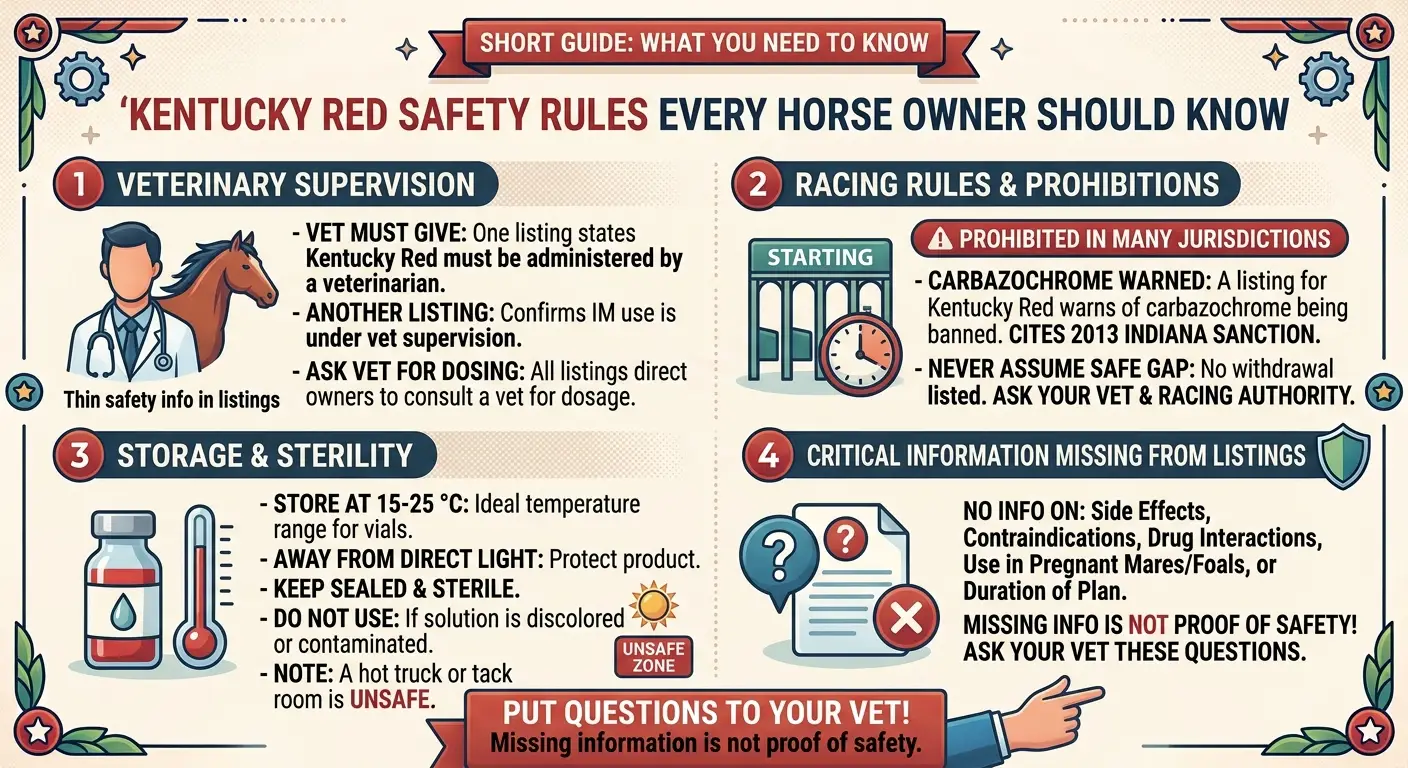
Kentucky Red is a veterinary product, and the safety information in the listings is thin. Here is what the pages do say, and what they leave out.
Veterinary Supervision
Bdneny Equine Therapy states that a veterinarian must give Kentucky Red. Alza3faran says intramuscular use is under veterinary supervision. Both tell owners to consult a vet for dosing.
Racing Rules
Bdneny Equine Therapy warns that carbazochrome, which it names as Kentucky Red, is prohibited in many racing jurisdictions. It cites an Indiana sanction in 2013 involving Kentucky Red. None of the listings gives a withdrawal time, so never assume a safe gap before a race. Ask your vet and your racing authority.
Storage
Alza3faran says to store the vial at 15 to 25 °C, away from direct light, and to keep it sealed and sterile. It also says not to use the solution if it becomes discolored or contaminated. A hot truck or tack room does not fit that range.
What the Listings Do Not Tell You
No listing covers side effects, contraindications, drug interactions, use in pregnant mares or foals, or how long a horse can safely stay on the plan. Missing information is not proof of safety. Put those questions to your vet.
Safety Checklist Before Any Kentucky Red Dose
- Written vet instructions for route, volume and timing
- The label or insert from the exact vial you hold
- Racing authority rules checked for your jurisdiction
- Vial stored at 15 to 25 °C and away from direct light
- Solution clear and not discolored, seal and sterility intact
- Sterile syringe and needle ready, with the vet doing the injection
- Date, time, volume and horse written in a log
Common Mistakes to Avoid
- Trusting the feed supplement text on one listing instead of the vial section.
- Mixing up the IV and IM plans because the listings disagree.
- Guessing a dose by body weight when no listing gives one.
- Assuming an online listing means the product is allowed in your sport.
- Leaving the vial somewhere hot or bright.
Kentucky Red Cost Breakdown
Listed prices for a 60 ml vial ranged from USD 65 to USD 85, with another listing at EUR 110.95 and one at AED 480. On the pre-training plan, one vial covers three sessions, so the cost per session is one third of the vial price.
Kentucky Red Cost Breakdown From Four Listings
| Listed price for 60 ml | Per 20 ml session (1 of 3) | Per 10 ml dose (1 of 6) |
|---|---|---|
| USD 65.00 | USD 21.67 | USD 10.83 |
| USD 85.00 | USD 28.33 | USD 14.17 |
| EUR 110.95 | EUR 36.98 | EUR 18.49 |
| AED 480.00 | AED 160.00 | AED 80.00 |
Prices were seen on November 15, 2026 and are shown in the currency listed, with no conversion. One AED listing showed a sale price. Per session and per dose figures are our arithmetic and ignore syringes, needles and vet fees.
Questions to Ask Your Vet Before Using Kentucky Red
- Which route, IV or IM, does the label of this exact vial call for?
- What volume and timing fit my horse, given its size, age and health?
- What ingredients are in this vial, and do they match the listing I read?
- Is Kentucky Red allowed under the rules where my horse competes, and is there a required gap before racing?
- What side effects should I watch for, and when should I call you?
- How long can an opened vial be kept and used?
FAQs
What is the Kentucky Red dosage for horses?
Most seller listings give 10 ml into the vein 24 hours before training and another 10 ml 4 to 6 hours before training. One listing instead gives 10 to 15 mL into the muscle once or twice weekly. A veterinarian should confirm the dose, route and timing.
How much Kentucky Red do you give a horse before training?
Three listings give 10 ml IV 24 hours before training and 10 ml IV 4 to 6 hours before training, which is 20 ml per session. The stated aim is to prevent or reduce nosebleeds.
How many sessions does a 60 ml vial of Kentucky Red cover?
At 20 ml per session, a 60 ml vial covers three pre-training sessions. That is six separate 10 ml doses. On the 10 to 15 mL muscle plan, a vial holds four to six doses.
Is Kentucky Red given IV or IM?
The listings disagree. Three describe intravenous use before training. Alza3faran describes intramuscular use, and the Bdneny Equine Therapy page mentions both. Ask your vet which route fits the vial you have.
Is there a Kentucky Red dose by horse weight?
No. None of the four listings gives a dose per kilogram or per pound. The volumes are fixed amounts, so any weight chart for this product would be invented.
What is Kentucky Red used for in horses?
Most listings link it to preventing or reducing bleeding during training, such as nosebleeds. Some listings also describe red blood cell support, stamina, and recovery from illness, anemia or surgery.
What is Kentucky Red made of?
The listings do not agree. They name sodium salicylate, carbazochrome salicylate, or an iron and B vitamin blend with amino acids, copper and cobalt. Shopivet names no ingredients. Read the label on your vial.
Is Kentucky Red legal for racing horses?
One listing warns that it is prohibited in many racing jurisdictions and cites a 2013 Indiana sanction involving Kentucky Red. Check the rules of your own racing authority before use. The listings give no withdrawal time.
Can I give Kentucky Red to my horse myself?
The listings do not support that. One says a veterinarian must give it, and another says intramuscular use should be under veterinary supervision. Ask your vet to give the injection and set the plan.
How should Kentucky Red be stored?
One listing says to store it at 15 to 25 °C, away from direct light, with the vial kept sealed and sterile. It also says not to use the solution if it looks discolored or contaminated.
What are the side effects of Kentucky Red in horses?
None of the four listings lists side effects, contraindications or drug interactions. That gap is not proof of safety, so ask your vet what to watch for.
How much does Kentucky Red cost?
The listings we checked on November 15, 2026 showed USD 65, USD 85, EUR 110.95 and AED 480 for a 60 ml vial. At three sessions per vial, that works out to about USD 21.67 to USD 28.33 per session in the two dollar listings.
Is Kentucky Red the same as Kentucky Karron Oil?
No. One listing describes Foran Equine Kentucky Karron Oil as an oral supplement for digestive and immune support. Kentucky Red is described as an injectable product.
Does Kentucky Red really work?
The listings say it is thought to stabilize the cells lining blood vessels and so help prevent nosebleeds. None of them cites a study, so treat the claims as seller statements and ask your vet for evidence.
Can Kentucky Red be used in camels?
Some listings name horses and camels. This guide covers horses only. Ask a veterinarian about any other species.
Final Word on Kentucky Red Dosage for Horses
The listings give a clear starting picture for Kentucky Red dosage for horses: 10 ml IV 24 hours before training and 10 ml IV 4 to 6 hours before training, with a 60 ml vial covering three sessions.
They also disagree on route, purpose and ingredients, and they give no weight based dose, no side effect list and no withdrawal time.
Your next step is simple. Take this guide and the vial label to your vet, settle the route and volume in writing, and check your racing rules before the first dose. Use the calculator only to plan supply, never to choose a dose.
Sources used (the four listings you supplied)
- Equine Care Pharmacy: https://equinecarepharmacy.com/product/kentucky-red/
Supplied the 10 ml IV plan, sodium salicylate and the $85 price. - Shopivet: https://shopivet.com/en-eu/products/kentucky-red
Supplied the 20 ml per session and 3 sessions per vial figures, the syringe and needle note and the EUR 110.95 price. - Bdneny Equine Therapy: https://realbrownbeauties.com/product/kentucky-red-60ml/
Supplied the IV and IM plans, carbazochrome salicylate, the racing warning, the Indiana 2013 sanction, the Kentucky Karron Oil and Red Cell comparison and the $65 price. - Alza3faran: https://www.alza3faran.com/en/products/kentucky-red-60-ml
Supplied the 10 to 15 mL IM plan, the ingredient list, the storage range and the AED 480 price.