Rompun® for Horses: Dosage, Dosage Chart, Precautions & Everything Owners Should Know (100 mg/mL)
Written & Reviewed By: Medshorse Team
Last Updated: October 2026
Rompun for horses is a prescription sedative and pain reliever (xylazine). The FDA label dose of Rompun 100 mg/mL is IV–0.5 mL/100 lbs (0.5 mg/lb) & IM–1.0 mL/100 lbs(1.0 mg/lb).
A 1,000 lb horse therefore gets 5 mL IV or 10 mL IM. That is the label dose, not a prescription for your horse. Your veterinarian decides the actual dose.
Why does this matter so much? Rompun 100 mg/mL is a concentrated product. A decimal slip or a mix-up with a weaker xylazine product can turn a calm horse into a dangerous situation.
This guide walks through what Rompun does, the label dosage chart, what to watch for, and the mistakes worth avoiding. It is for education and does not replace your vet’s instructions.
Quick safety note: Rompun is a prescription drug. Federal law restricts it to use by or on the order of a licensed veterinarian.
Rompun® Dosage Calculator For Dogs
Rompun (xylazine) sedative & analgesic — enter details and tap Calculate Dose.
Calculated Dose
Disclaimer: For educational use only. Rompun is a prescription drug and must be dosed by or under the direction of a licensed veterinarian. Always confirm the dose against the current product label for the species and concentration being used.
What Is Rompun for Horses?
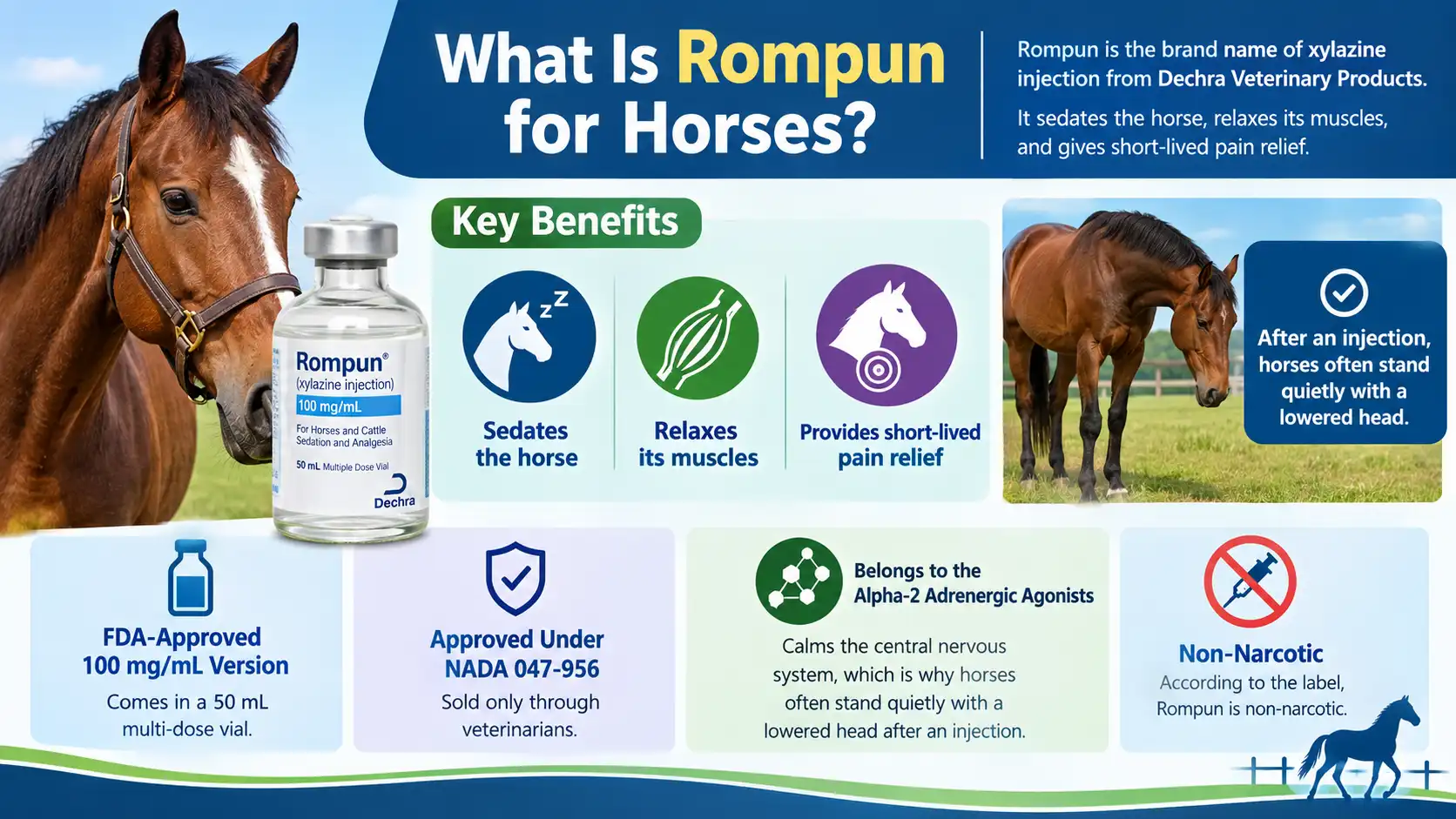
Rompun is the brand name of xylazine injection from Dechra Veterinary Products. It sedates the horse, relaxes its muscles, and gives short-lived pain relief.
The FDA-approved 100 mg/mL version comes in a 50 mL multi-dose vial. It is approved under NADA 047-956 and sold only through veterinarians.
Xylazine belongs to a drug family called alpha-2 adrenergic agonists. It calms the central nervous system, which is why horses often stand quietly with a lowered head after an injection. According to the label, Rompun is non-narcotic.
Two things worth knowing up front:
What Is Rompun Used For in Horses?
Vets use Rompun to calm a horse enough for an exam or procedure, and to relieve pain for a short time.
The label lists these uses in horses:
- Diagnostic work: oral and eye exams, rectal and abdominal palpation, bladder catheterization, radiographs
- Orthopedic procedures such as applying casts and splints
- Dental procedures
- Minor surgery of short duration, such as wound debridement, removing skin growths, and suturing lacerations
- Calming fractious or difficult horses
- Sedation and pain relief after injury or surgery
- A preanesthetic before general anesthesia, or with local anesthetics such as lidocaine or procaine
In practice, many owners meet Rompun during emergencies and routine visits. A common example is a painful colic episode.
If you are managing one, our guide to Banamine covers the anti-inflammatory side, but never give anything without your vet's go-ahead.
Rompun Dosage for Horses (100 mg/mL)
The FDA label gives two routes. Intravenous (IV) is 0.5 mL per 100 lb of body weight. Intramuscular (IM) is 1.0 mL per 100 lb.
In milligrams, that is 0.5 mg/lb IV and 1.0 mg/lb IM. In metric terms, it is roughly 1.1 mg/kg IV and 2.2 mg/kg IM.
The IM dose is double the IV dose. This is normal, because intramuscular absorption is slower and less complete. Never swap one for the other.
Rompun Dosage Chart for Horses by Weight
How to Calculate Rompun Dose (Worked Example)
Divide the horse's weight by 100, then multiply by 0.5 for IV or by 1.0 for IM.
Take a 1,200 lb horse:
IM: 12 × 1.0 = 12 mL
Can You Give Rompun by Mouth or Under the Skin?
No. The label lists only intravenous and intramuscular routes.
Any other route is outside the label. Subcutaneous or oral administration is not described in the label for horses, so your vet's instructions should always come first.
Do Vets Always Use the Full Label Dose?
Not always. The label gives the reference dose for sedation of 1 to 2 hours. In real practice, vets tailor doses to the horse's temperament, health, and the procedure.
A lighter sedation for a short exam may use less. This is a clinical judgment, and it is why you should never repeat or adjust a dose on your own.
How Fast Does Rompun Work and How Long Does It Last?
Rompun works in 3 to 5 minutes after IV injection and in 10 to 15 minutes after IM injection. Sedation usually lasts 1 to 2 hours, but pain relief lasts only 15 to 30 minutes.
Rompun Side Effects in Horses
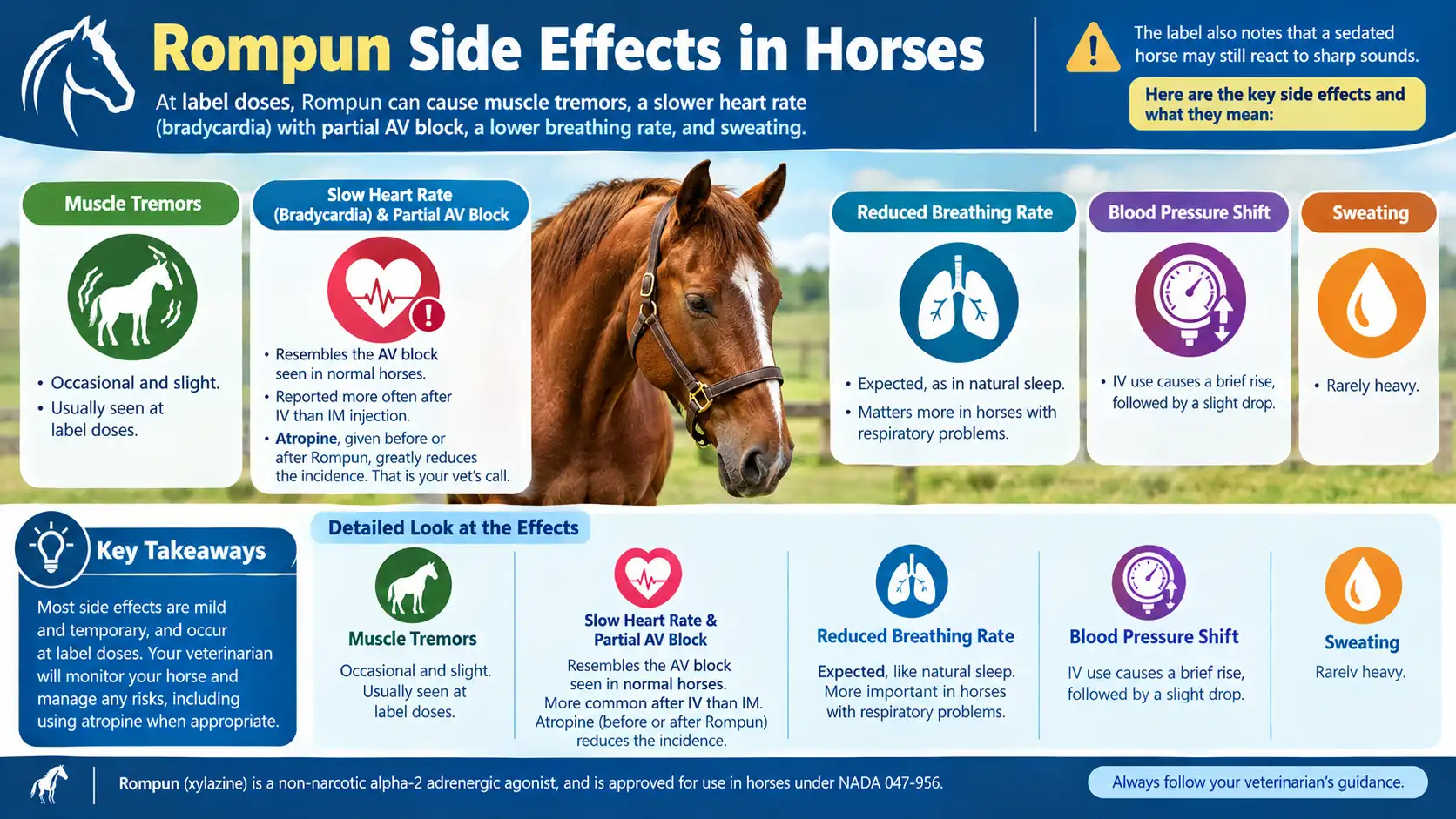
At label doses, Rompun can cause muscle tremors, a slower heart rate (bradycardia) with partial AV block, a lower breathing rate, and sweating.
The label also notes that a sedated horse may still react to sharp sounds. Here is what each effect means:
When to call your vet immediately: collapse, seizure-like activity, labored breathing, a very slow or irregular pulse, or a horse that cannot stand and does not recover as expected.
Key Precautions
1. Avoid the carotid artery
The label warns that accidental injection into the carotid artery can cause immediate violent seizures followed by collapse. Recovery can be rapid and complete, but your vet needs to confirm the needle is in the jugular vein.
2. A sedated horse is not a safe horse
The label states that a heavily sedated-looking animal can still respond defensively to handling or sudden noise. Stand to the side, stay calm, and keep other people out of the kicking zone.
Pain relief can be patchy. The label notes analgesia varies and is most variable at the distal limbs. Your vet will test the depth of sedation before starting.
3. Do not use it with tranquilizers
The label says not to use Rompun in conjunction with tranquilizers. That includes acepromazine, a phenothiazine tranquilizer. If your vet plans a combination, that decision belongs to them.
4. Be cautious with barbiturates
The label explains that Rompun adds to the effect of barbiturates such as pentobarbital and thiopental, so those drugs need lower doses.
Typically, only 1/3 to 1/2 of the calculated barbiturate dose is needed. This is anesthesia territory and is strictly for veterinarians.
5. Transporting a sedated horse
The label says transport works best once the full effect is reached and the horse is stable on its feet. Noise or stimuli can still arouse the horse and raise the risk of injury.
5. Pregnancy and lactation
The horse label does not give specific guidance for pregnant mares. Ask your vet. For people, the label warns that pregnant women should take special care to avoid self-injection because uterine contractions and decreased fetal blood pressure may occur after accidental systemic exposure.
Is Rompun Safe for People Who Handle It?
No. Rompun is not for human use, and accidental self-injection is a medical emergency.
The label's human safety warnings say:
Xylazine can cause breathing depression, slow heart rate, low blood pressure, dry mouth, and high blood sugar in people. Dechra's number for adverse reactions and the SDS is 1-866-933-2472.
Competition Horses and Food Animals
Rompun must not be used in horses intended for human consumption. The label says so directly.
For competition horses, medication rules vary by organization (for example USEF or FEI). I could not find a publicly stated detection time on the label, so I won't guess one.
Ask your vet and check your governing body's current medication rules before an event.
Rompun vs Dormosedan vs Acepromazine
All three calm horses, but they are different drugs with different jobs. Rompun (xylazine) and Dormosedan (detomidine) are both alpha-2 agonists with sedative and pain-relieving effects. Acepromazine is a tranquilizer that sedates but does not provide pain relief.
Rompun Dosage Mistakes to Avoid
Storage and Handling
Store Rompun at 68°F to 77°F (20°C to 25°C). Do not freeze it. The label allows brief excursions up to 104°F (40°C). Keep it locked away from children, and never reuse a vial past 30 days after first puncture or 20 punctures.
Key Takeaways
FAQs
What is Rompun used for in horses?
It sedates, relaxes muscles, and gives short-term pain relief for exams, dental work, minor surgery, handling difficult horses, and as a preanesthetic.
How much Rompun for a 1,000 lb horse?
At label doses, 5 mL IV or 10 mL IM of the 100 mg/mL product. Your vet decides the actual dose.
How long does Rompun take to work?
About 3 to 5 minutes IV and 10 to 15 minutes IM.
How long does Rompun last in a horse?
Sedation usually lasts 1 to 2 hours. Pain relief lasts 15 to 30 minutes.
Is Rompun the same as xylazine?
Yes. Rompun is the Dechra brand name for xylazine injection.
Can I give Rompun to my horse without a vet?
No. It is a prescription drug restricted to use by or on the order of a licensed veterinarian.
Can Rompun be given orally?
The label lists only IV and IM routes.
My Final Thoughts
Rompun is an effective, widely used tool when it is dosed correctly and handled with respect. Know your horse's weight, confirm the concentration, stay out of the kicking zone, and let your vet lead.
Next steps: save the dosage chart, ask your vet to confirm the plan before any procedure, and read about related medications such as bute dosage for horses and Banamine dosage for horses.
Medical disclaimer: This article is for education only and does not replace professional veterinary advice. Doses here are drawn from the FDA label and may differ from what your veterinarian prescribes.
Sources:
DailyMed, Rompun (xylazine injection) 100 mg/mL, Dechra Vet Products, revised 12/2025, NADA 047-956 (dailymed.nlm.nih.gov); Dechra US Rompun product page; FDA reporting of animal drug adverse events (fda.gov/reportanimalae).