Garlic Dosage for Horses: Weight Chart, Free Calculator & the Safe Limits Most Owners Never Hear About
Written & Reviewed By: Medshorse Team
Last Updated: November 2026
Garlic is one of the most popular add-ons in the feed room. Owners use it for flies, lungs and general “immunity.” But there is a catch that many product pages skip: garlic belongs to the onion family, and in horses it can damage red blood cells.
So what is a sensible garlic dosage for horses? The most cited conservative figure is 15 mg per kg of body weight per day, which works out to about 7.5 g of dried garlic for a 500 kg (1,100 lb) horse. Below you will find a weight chart, a calculator, the toxic thresholds from real studies, and an honest look at whether garlic delivers on its promises.
Disclaimer: This article is for general education and is not veterinary advice. Product names mentioned, including Garlic, belong to their respective owners, and MedsHorse is not affiliated with them. Always follow your veterinarian’s instructions and the current product label.
Quick answer: how much garlic can a horse have?
- Conservative ceiling: 15 mg of dried garlic per kg of body weight per day. That is about 7.5 g for a 500 kg (1,100 lb) horse.
- Where harm shows up: Heinz body anemia indicators appeared above roughly 0.2 g/kg per day (100 g for a 500 kg horse) in a University of Guelph study.
- Lower doses still need care: in a 2019 Finnish trial, 32 mg/kg (about 16 g for a 500 kg horse) for 83 days nudged hemoglobin, hematocrit and red cell counts down.
- Fly control: no horse trial has shown that feeding garlic repels flies.
- Bottom line: no long-term safe dose has been formally established, so check with your vet first and use the smallest amount for the shortest time.
Garlic Dosage for Horses: The Short Answer
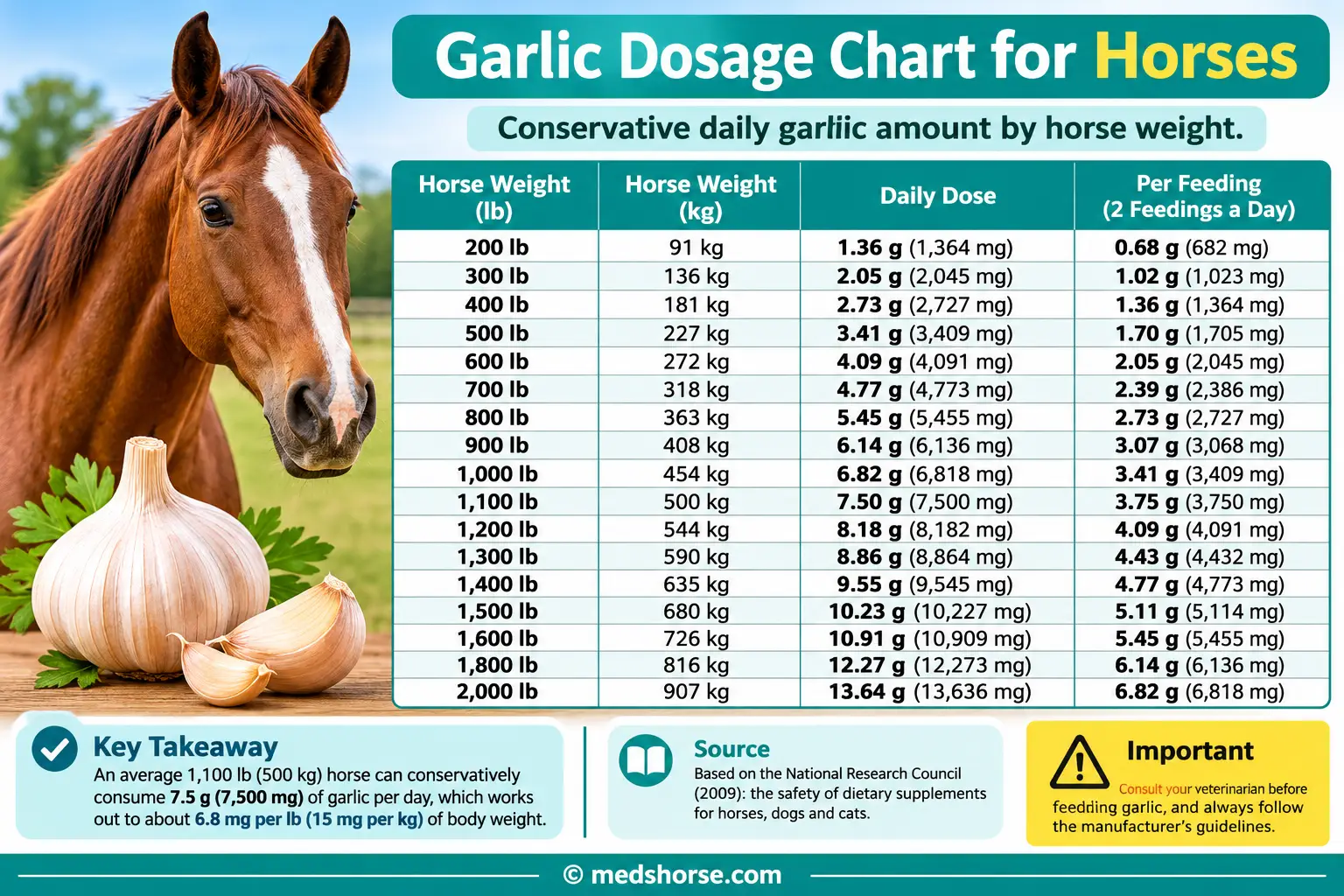
What is a safe garlic medication for horses? The National Research Council’s conservative figure is 15 mg of dried garlic per kg of body weight daily, or about 7.5 g (roughly 2 level teaspoons of granules) for a 500 kg horse. Treat it as a ceiling rather than a target, and check with your vet before you start.
Garlic (Allium sativum) is a bulb in the onion family. It contains sulfur compounds, mainly n-propyl disulfide, that can damage equine red blood cells when fed in excess. Nobody has established a truly safe long-term dose, which is why the number matters.
The 7.5 g figure comes from the National Research Council’s report on the safety of dietary supplements for horses, dogs and cats, and it is the amount Redmond and Reverdy both align their garlic products with.
Garlic Dosage Chart for Horses by Weight
| Horse weight (lb) | Horse weight (kg) | Daily dose | Per feeding (2 feedings a day) |
|---|---|---|---|
| 200 lb | 91 kg | 1.36 g (1,364 mg) | 0.68 g (682 mg) |
| 300 lb | 136 kg | 2.05 g (2,045 mg) | 1.02 g (1,023 mg) |
| 400 lb | 181 kg | 2.73 g (2,727 mg) | 1.36 g (1,364 mg) |
| 500 lb | 227 kg | 3.41 g (3,409 mg) | 1.70 g (1,705 mg) |
| 600 lb | 272 kg | 4.09 g (4,091 mg) | 2.05 g (2,045 mg) |
| 700 lb | 318 kg | 4.77 g (4,773 mg) | 2.39 g (2,386 mg) |
| 800 lb | 363 kg | 5.45 g (5,455 mg) | 2.73 g (2,727 mg) |
| 900 lb | 408 kg | 6.14 g (6,136 mg) | 3.07 g (3,068 mg) |
| 1,000 lb | 454 kg | 6.82 g (6,818 mg) | 3.41 g (3,409 mg) |
| 1,100 lb | 500 kg | 7.50 g (7,500 mg) | 3.75 g (3,750 mg) |
| 1,200 lb | 544 kg | 8.18 g (8,182 mg) | 4.09 g (4,091 mg) |
| 1,300 lb | 590 kg | 8.86 g (8,864 mg) | 4.43 g (4,432 mg) |
| 1,400 lb | 635 kg | 9.55 g (9,545 mg) | 4.77 g (4,773 mg) |
| 1,500 lb | 680 kg | 10.23 g (10,227 mg) | 5.11 g (5,114 mg) |
| 1,600 lb | 726 kg | 10.91 g (10,909 mg) | 5.45 g (5,455 mg) |
| 1,800 lb | 816 kg | 12.27 g (12,273 mg) | 6.14 g (6,136 mg) |
| 2,000 lb | 907 kg | 13.64 g (13,636 mg) | 6.82 g (6,818 mg) |
Based on the National Research Council (2009): an average 1,100 lb (500 kg) horse can conservatively consume 7.5 g (7,500 mg) of garlic per day, which works out to about 6.8 mg per lb (15 mg per kg) of body weight. Consult your veterinarian before feeding garlic, and always follow the manufacturer’s guidelines.
The 7.5 g figure comes from the National Research Council’s report on the safety of dietary supplements for horses, dogs and cats, and it is the amount Redmond and Reverdy both align their garlic products with.
© medshorse.com
Garlic Dosage Calculator for Horses
Use the calculator below for an instant answer in pounds or kilograms. It shows the daily ceiling, the amount per feed, a teaspoon estimate and a starter amount for the first week.
Based on the National Research Council (2009): an average 1,100 lb (500 kg) horse can conservatively consume 7.5 g (7,500 mg) of garlic per day. Studies show little danger of anemia, even with long-term use. Consult your veterinarian before feeding garlic, and always follow the manufacturer’s guidelines.
The 7.5 g figure comes from the National Research Council’s report on the safety of dietary supplements for horses, dogs and cats, and it is the amount Redmond and Reverdy both align their garlic products with.
© medshorse.com
If your horse’s result looks tiny, that is normal. Garlic is potent in the wrong amounts, and the conservative guideline is a small number by design.
How Much Garlic Is Too Much for a Horse?
Researchers recorded signs of Heinz body anemia in horses fed more than about 0.2 g of freeze-dried garlic per kg of body weight each day. That is roughly 100 g for a 500 kg horse. Smaller amounts have not been proven harmless either, because long-term low-dose research is thin.
The 2005 University of Guelph study
This American Journal of Veterinary Research study was small. Four horses took part. Two ate freeze-dried garlic starting at 0.05 g/kg twice daily, rising to a maximum voluntary intake of 0.25 g/kg twice daily over 41 days, and continued for 71 days in total. Two control horses received no garlic.
Summaries of the paper report anemia indicators above 0.2 g/kg per day. The researchers concluded that horses will voluntarily eat enough garlic to develop Heinz body anemia, and that more study is needed to find a safe dose. Recovery was largely complete within five weeks of stopping garlic.
The 2019 Finnish study
A team from the Natural Resources Institute Finland tested a much lower dose. Twelve Finnhorse mares were matched in pairs, and one horse in each pair received 20 g of dried garlic flakes daily (32 mg/kg) for 83 days.
The garlic group had fewer tracheal symptoms and less accumulation of tracheal exudate. But hemoglobin, hematocrit and red blood cell values drifted down slightly. The authors suggested that even low garlic levels may harm blood health over a long period, and estimated that the point where risk rises sits somewhere between 15 and 200 mg/kg of dried garlic, depending on the horse.
Why do sources quote different toxic thresholds?
You will see 0.2 g/kg on some pages and 0.4 g/kg on others. Both cite the Guelph work. Different summaries of the same paper report anemia indicators above 0.2 g/kg per day, while the horses ate as much as 0.5 g/kg per day at their maximum. This guide uses the lower figure, 100 g for a 500 kg horse, because it is the more cautious reading.
The garlic dose ladder for a 500 kg (1,100 lb) horse
Grams of garlic per day, drawn to scale. The safe guideline is a sliver of the amounts linked to harm.
Studies used different forms (freeze-dried versus dried flakes or granules), so compare the figures as rough guides rather than exact equivalents.
What Do Garlic Feed Labels Say About Dosage?
Label advice varies more than most owners expect. The table compares the main sources for a 500 kg horse.
How garlic dosage advice differs by source (500 kg horse)
| Source | Daily amount | Duration and cautions |
|---|---|---|
| National Research Council (via Redmond) | 7.5 g | Described as safe under normal circumstances; vet check advised |
| Reverdy garlic granules | 7.5 g (10 ml) | 30 days maximum; avoid in pregnant and lactating mares; stop 72 hours before competition |
| Redmond Daily Red garlic minerals | Per product label, aligned with NRC | Seasonal use for up to six months, then a garlic break |
| PharmaHorse garlic granules | About 20 g (40 mg/kg, extrapolated) | Label gives 12 g for a 300 kg pony and 24 g for a 600 kg horse; recommends a 30 g daily maximum |
| Finnish trial (Saastamoinen 2019) | 16 g (32 mg/kg) | Hemoglobin, hematocrit and red cells drifted down over 83 days |
| FeedXL | Not recommended without a clear benefit | If you continue, check MCV, hemoglobin, PCV and Heinz bodies with bloodwork |
Notice the spread. For a 500 kg horse, guidance runs from 7.5 g to about 20 g, which is roughly 2.7 times higher. The lower figure matches the NRC’s conservative guideline. The higher one sits above the 32 mg/kg level at which blood values dipped in the Finnish trial.
Also check how much real garlic is in each serving. A mineral salt flavored with garlic oil contains far less garlic than pure granules, so compare grams of garlic, not scoops of product.
Does Garlic Actually Work for Horses? What the Evidence Shows
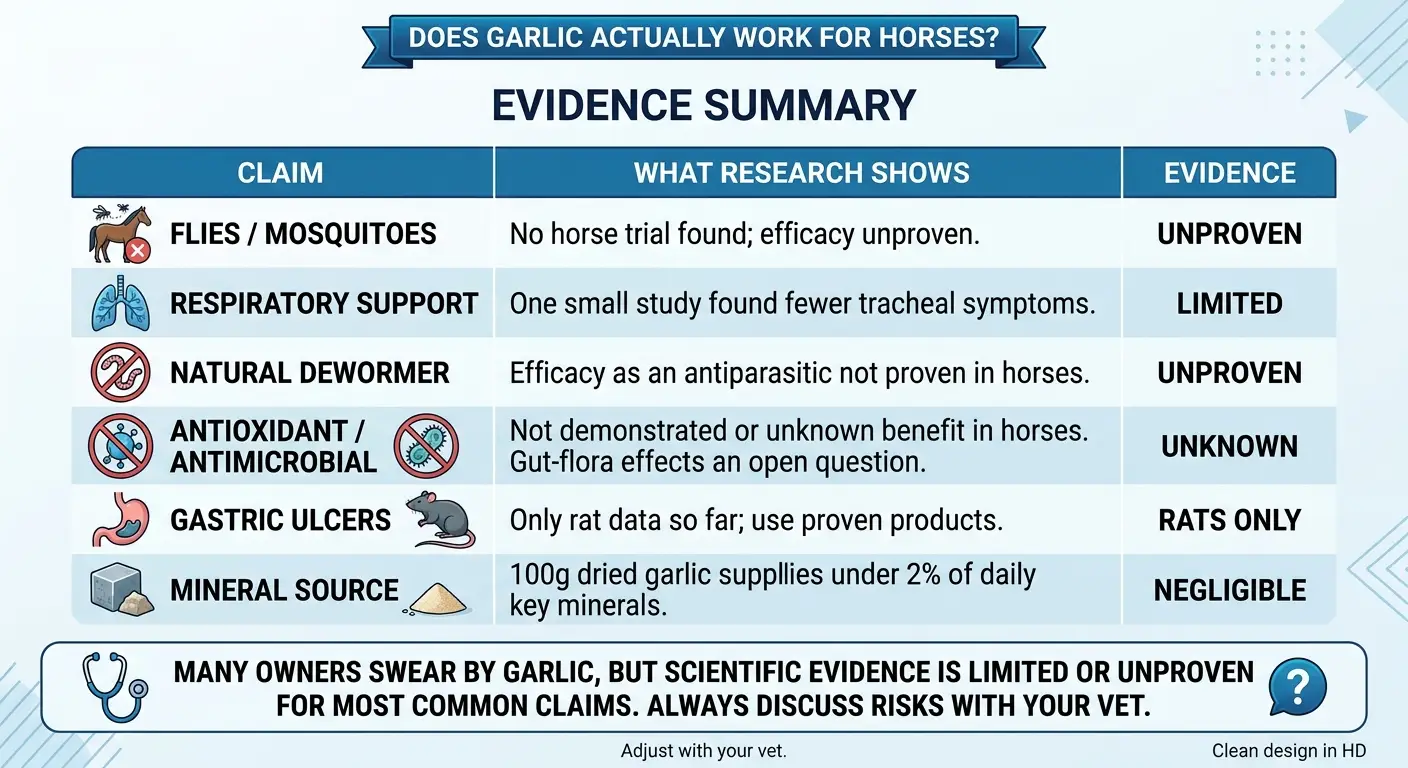
Garlic is promoted for flies, lungs, gut health and immunity. Here is how each claim holds up.
Garlic claims versus the evidence
| Claim | What research shows | Evidence |
|---|---|---|
| Repels flies and mosquitoes | No horse trial found. KPP says none has been done; Kentucky Equine Research says efficacy is unproven. | Unproven |
| Clears airway mucus | One small controlled study (12 mares, 32 mg/kg) found fewer tracheal symptoms and less exudate, alongside slightly lower blood values. | Limited |
| Natural dewormer | Efficacy as a natural antiparasitic has not been proven in horses. | Unproven |
| Antioxidant support | Not demonstrated in horses. | Unproven |
| Antimicrobial action | Allicin shows antimicrobial effects, but benefit in horses is unknown and gut-flora effects are an open question. | Unknown |
| Gastric ulcer protection | Only rat data so far; use proven ulcer products instead. | Rats only |
| Mineral source | 100 g supplies under 2% of daily needs for key minerals. | Negligible |
Garlic as a fly and mosquito repellent
No scientific trial has verified garlic as a fly repellent in horses, according to Kentucky Performance Products, and Kentucky Equine Research says its efficacy as an insect repellent is unproven. Many owners swear by it, and those experiences are real, but they are not controlled evidence.
One human study found garlic oil diluted to 1% repelled insects 97% of the time on skin. It was not done on horses, but KPP suggests diluted garlic oil applied to the coat may be safer than feeding garlic. Patch test a small area first.
For mosquito-borne disease, vaccination is the real protection. Our guide to the core horse vaccines and their timeline explains what your horse needs and when.
Garlic for respiratory support
The Finnish study is the best controlled data available, and it did find fewer tracheal symptoms. It was also very small, and the same horses showed slightly lower red blood cell values. If your horse has a cough or airway disease, ask your vet about proven management before reaching for garlic.
Is garlic a natural dewormer?
Efficacy as a natural antiparasitic has not been proven in horses. If your horse needs worming, base the plan on fecal egg counts and review the ivermectin dosage for horses guide with your vet.
Garlic for gut health and ulcers
The ulcer claim rests on a rat study of indomethacin-induced stomach ulcers, which is a long way from a stabled horse. Kentucky Equine Research’s nutritionist advises choosing scientifically proven products for gut support. For ulcer treatment, see our GastroGard dosage for horses guide.
FeedXL also raises a fair question: could garlic’s antimicrobial action upset the beneficial bacteria a horse relies on to digest fiber? Nobody knows yet.
Garlic as a mineral supplement
Garlic is a poor source of minerals. FeedXL calculated what 100 g of dried garlic per day, far more than anyone should feed, supplies for a 500 kg horse in moderate work:
| Nutrient | Share of daily requirement from 100 g dried garlic |
|---|---|
| Calcium | 1.1% |
| Phosphorus | 1.3% |
| Copper | 0.4% |
| Zinc | 0.6% |
| Selenium | 1.1% |
| Manganese | 0.8% |
| Iodine | 0.0% |
| Iron | 0.6% |
If minerals are the goal, garlic is the wrong tool. FeedXL notes that seaweed is the one herb that supplies meaningful iodine, and our kelp dosage for horses guide covers its limits.
What Is Heinz Body Anemia in Horses?
Heinz body anemia is a condition in which damaged hemoglobin forms clumps, called Heinz bodies, on red blood cells. The spleen and liver remove those cells, and the horse becomes anemic. Garlic and onions can trigger it because of n-propyl disulfide.
How too much garlic leads to Heinz body anemia
In the Guelph study, recovery from anemia was largely complete within five weeks of stopping garlic, although Heinz body scores and MCV were still high at that point.
Signs of too much garlic in horses
General signs of anemia in horses include lethargy, weakness, poor appetite, a faster heart rate, pale gums and jaundice.
Stop garlic and call your vet if you see these signs
- Sudden loss of energy or unusual weakness
- Reduced appetite
- Faster than normal heart rate
- Pale gums
- Yellow tinge to the gums or eyes (jaundice)
- Slow loss of stamina or performance that has no other explanation
Mild anemia can be quiet. A blood count is the only way to confirm what is going on.
Low-grade anemia is the sneaky version. KPP and FeedXL both point out that mild anemia may not be obvious but can reduce stamina, lower energy and weaken resistance to disease. If you suspect a problem, stop the garlic and ask your vet for a complete blood count.
Garlic Granules, Powder, Fresh Cloves or Oil: Which Form Is Best?
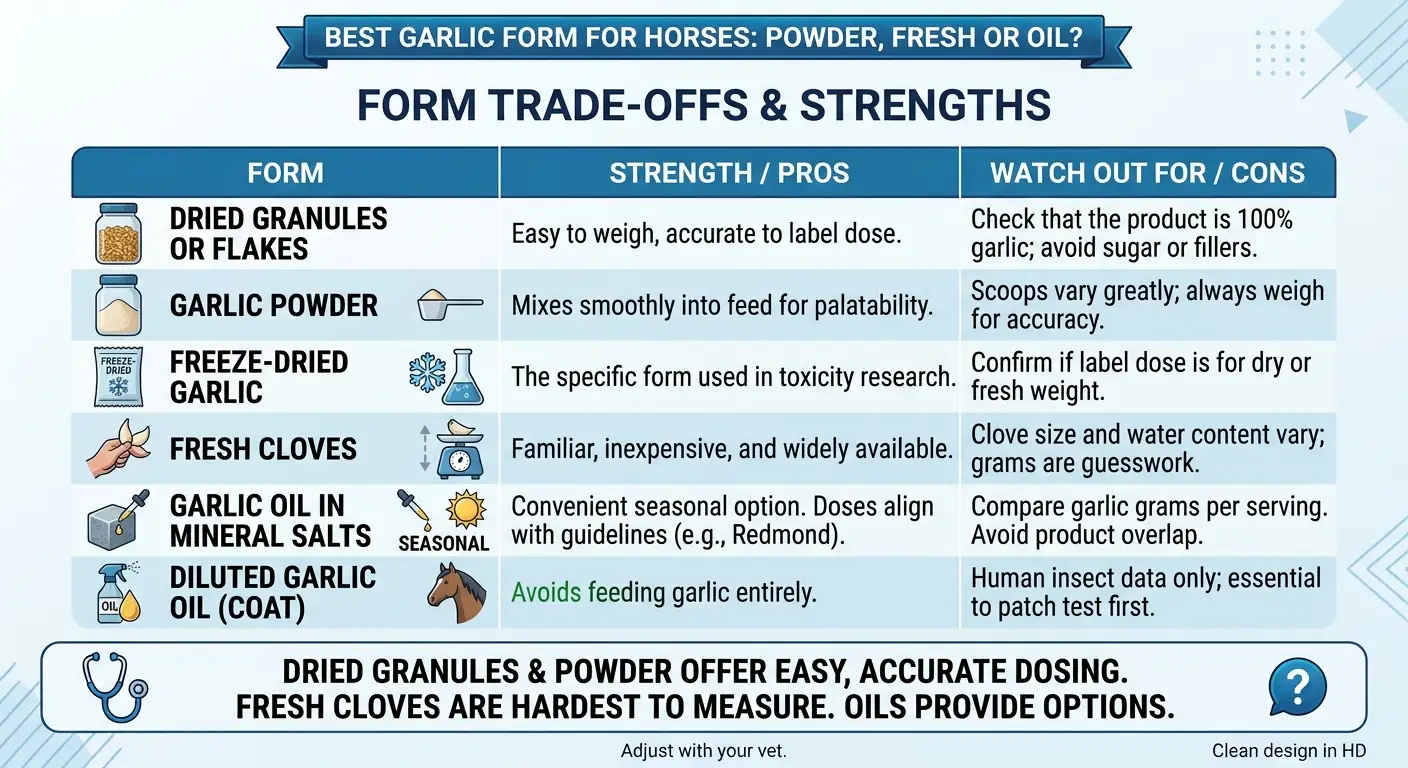
Dried granules or powder are the easiest forms to dose accurately. Fresh cloves are the hardest. The table shows the trade-offs.
| Form | Strength | Watch out for |
|---|---|---|
| Dried granules or flakes | Easy to weigh and match to a label dose | Check that the product is 100% garlic with no sugar or filler |
| Garlic powder | Mixes smoothly into feed | Scoops vary a lot, so weigh it |
| Freeze-dried garlic | The form used in the Guelph toxicity research | Confirm whether the label dose refers to dried or freeze-dried weight |
| Fresh cloves | Familiar and cheap | Clove size and water content vary, so grams of garlic are guesswork |
| Garlic oil in mineral salts | Convenient seasonal option; Redmond says its doses align with NRC guidance | Compare grams of garlic per serving and avoid doubling up with other garlic products |
| Diluted garlic oil on the coat | Avoids feeding garlic at all | Only human insect-repellent data exist; patch test first |
How to Feed Garlic to Horses Safely: Step-by-Step

- Talk to your vet. Ask about anemia, clotting, medications and a baseline blood count.
- Weigh your horse. Use a weight tape and convert to kilograms.
- Pick a plain product. Choose 100% dried garlic with a stated garlic content and no added sugar.
- Calculate the dose. Use the chart or calculator above and stay at or below 15 mg/kg.
- Weigh it. Use a gram scale, not a heaped scoop.
- Start low. Feed about half the target for the first week and mix it well into the ration.
- Split the dose. Reverdy suggests two feeds a day where possible.
- Set an end date. Plan breaks and watch for the warning signs listed above.
A conservative garlic feeding calendar
Built from label guidance and the research above. Adjust with your vet.
Who Should Not Be Given Garlic?
Garlic is contraindicated for horses with anemia or blood clotting problems. Several other groups should skip it or get a vet’s approval first.
Skip garlic if your horse is in any of these groups
- Anemic, or has a history of anemia
- Has a blood clotting disorder or bleeding problem
- Allergic or hypersensitive to garlic
- A pregnant or lactating mare (Reverdy’s label cites insufficient data)
- Competing within 72 hours, or under rules that restrict supplements
- On prescription medication, unless your vet has approved garlic
- Already grazing pasture with wild garlic or wild onions
None of the sources reviewed gives a dose for foals, so do not feed garlic to young foals.
Wild Garlic, Wild Onions and Other Hidden Sources
Supplements are not the only route. US veterinarian Dr. Karen Hayes, quoted by FeedXL, sees a handful of Heinz body anemia cases every year from horses eating wild onions in pasture or raiding compost and garden waste. That suggests the dose does not always need to be high for harm to occur.
Walk your paddocks in spring, remove wild onion and garlic plants, and keep kitchen scraps and garden waste well away from fence lines. Research from 1972 found that large amounts of onion tops caused life-threatening anemia within 11 days.
Garlic and Competition Rules
Reverdy recommends stopping its garlic at least 72 hours before any sporting competition because it cannot guarantee the product is free of substances banned by the FEI and racing codes. Rules differ by organization, so check your governing body’s current policy before you feed garlic in competition season.
Safer Ways to Handle Flies, Worms and Gut Health
Garlic is not the only option, and for most goals it is not the best one.
- Flies: use fly sheets, masks, fly traps and strict manure management, and consider diluted topical garlic oil only after a patch test.
- Mosquito-borne disease: keep vaccinations current. Kentucky Equine Research’s nutritionist lists vaccination among appropriate mosquito-control steps.
- Worms: follow a vet-guided plan built on fecal egg counts.
- Gut support: use proven products for ulcers, and review other popular add-ons such as brewers yeast dosage for horses and spirulina dosage for horses before stacking supplements.
Common Garlic Feeding Mistakes
- Using human-style doses, such as several fresh cloves a day.
- Doubling up: garlic granules, a garlic mineral salt and a herbal blend such as FenuGarlic can add up quickly.
- Stacking herbs without checking each one. Review the milk thistle dosage for horses limits before you add another herb.
- Feeding year-round without breaks or bloodwork.
- Measuring with a heaped scoop instead of a gram scale.
- Assuming natural means harmless.
- Ignoring wild garlic and onions in pasture.
Expert Tips and Key Takeaways
- The conservative guideline is 15 mg/kg per day, about 7.5 g for a 500 kg horse.
- Anemia indicators appeared above roughly 0.2 g/kg per day in the Guelph study, and slight blood changes appeared at 32 mg/kg over 83 days in Finland.
- Label doses range from 7.5 g to about 20 g for the same horse, so read labels critically.
- No horse trial proves garlic repels flies.
- Weigh the dose, split it, set an end date and ask your vet about blood tests.
- When in doubt, leave garlic out. FeedXL’s position is to skip it unless there is a definite, demonstrable benefit for your specific horse.
FAQs
How much garlic can I give my horse per day?
A commonly cited conservative amount is 15 mg of dried garlic per kg of body weight per day. That is about 7.5 g for a 500 kg (1,100 lb) horse. Treat it as a ceiling, ask your vet first and weigh the dose on a gram scale.
How much garlic is toxic to a horse?
In a University of Guelph study, horses fed more than about 0.2 g of freeze-dried garlic per kg of body weight daily showed signs of Heinz body anemia. That is roughly 100 g for a 500 kg horse. No truly safe long-term dose has been established, and a Finnish trial saw slightly lower blood values at 32 mg/kg over 83 days.
Is garlic safe for horses long term?
Long-term safety has not been proven. Some feed makers cap use at 30 days or six months followed by a break, and one equine nutrition company advises against feeding it without a clear benefit. If you feed garlic for longer, ask your vet about periodic blood tests.
How many teaspoons of garlic granules should I feed a horse?
For a 500 kg horse, 7.5 g is about 2 level teaspoons of garlic granules, assuming roughly 3.75 g per teaspoon. Powders and flakes weigh differently, so a gram scale is more accurate than a spoon.
Does garlic repel flies on horses?
No horse trial has shown that feeding garlic repels flies, according to Kentucky Performance Products and Kentucky Equine Research. Many owners report good results, but that is not controlled evidence. Fly sheets, masks, manure management and fly traps remain the proven basics.
Can I feed fresh garlic cloves to my horse?
It is not recommended. Clove size and water content vary, so it is hard to know how many grams of actual garlic you are giving. A dried product with a stated dose is easier to measure accurately.
What is Heinz body anemia in horses?
It is a form of anemia where damaged hemoglobin forms clumps called Heinz bodies on red blood cells. The spleen and liver remove those cells, so red cell numbers fall. Garlic and onions can trigger it because of sulfur compounds such as n-propyl disulfide.
What are the signs of garlic poisoning in horses?
Watch for loss of energy, weakness, reduced appetite, a faster heart rate, pale gums and yellow-tinged gums or eyes. Mild cases may only show as lower stamina. Stop garlic and call your vet if you notice any of these.
Can ponies and miniature horses have garlic?
Dose must scale with body weight, which is about 15 mg/kg per day on the conservative guideline. A 200 kg pony works out to about 3 g. Miniature horses need very small amounts that are hard to measure by spoon, so ask your vet before feeding garlic.
Can pregnant or lactating mares eat garlic?
Reverdy’s label advises against it for pregnant and lactating mares because of insufficient data. Ask your vet before giving a breeding mare any garlic supplement.
Is garlic a natural dewormer for horses?
Efficacy of garlic as a natural antiparasitic has not been proven in horses. Do not use it in place of a vet-guided deworming plan based on fecal egg counts.
Should I stop garlic before a competition?
Reverdy recommends stopping at least 72 hours before a sporting competition because it cannot guarantee the absence of banned substances. Check the rules of your governing body, since supplement policies differ.
Is garlic oil safer than feeding garlic?
Kentucky Performance Products suggests diluted garlic oil applied to the skin may be safer than feeding garlic. A human study found a 1% dilution repelled insects 97% of the time, but it was not done on horses. Patch test on a small area first.
Can horses eat wild garlic or onions in pasture?
No. Wild onions and garlic contain the same compounds that cause Heinz body anemia, and a vet has reported seeing a handful of cases each year from horses eating them. Remove them from pasture and keep horses away from compost and garden waste.
Does garlic help horses with respiratory problems?
A small Finnish study of 12 mares found fewer tracheal symptoms with 32 mg/kg of dried garlic. The same horses showed slightly lower hemoglobin, hematocrit and red blood cell values, so the benefit comes with a trade-off. Talk to your vet about proven respiratory management.
Should I test my horse’s blood if I feed garlic?
It is a sensible precaution. FeedXL suggests checking mean corpuscular volume, hemoglobin and packed cell volume and looking for Heinz bodies if you continue feeding garlic. Your vet can advise on timing.
Final Thoughts: Is Garlic Worth the Risk?
For most healthy horses, a small, carefully weighed amount of garlic for a limited time is unlikely to cause trouble, and several feed makers align their labels with the NRC’s 7.5 g guideline. But the evidence for benefits is thin, the safe long-term dose is unknown, and the downside is a blood disorder that can be hard to spot.
Your next step: weigh your horse, run the numbers in the calculator, and ask your vet whether garlic makes sense for your horse at all. If the answer is yes, weigh each dose, set a stop date and watch for the warning signs.
Sources and Further Reading
- Pearson W, et al. Association of maximum voluntary dietary intake of freeze-dried garlic with Heinz body anemia in horses. Am J Vet Res, 2005
- Saastamoinen M, et al. Garlic supplementation improves respiratory health but has increased risk of lower hematologic values in horses. Animals, 2019
- National Research Council. Safety of Dietary Supplements for Horses, Dogs, and Cats
- Merck Veterinary Manual: Anemia in horses
- FeedXL: Garlic for horses, should you feed it?
- Kentucky Performance Products: Is it safe to feed garlic to horses to repel insects?
- Redmond Equine: How much garlic to feed horses
- PharmaHorse garlic for horses (product label)
- Reverdy garlic granules (product label)